But have you heard of the miniature version of Landmannalaugar, Sogin, on the Reykjanes peninsula? It is sometimes referred to as Litlu Landmannalaugar = the Little Landmannalaugar, and is a hidden pearl on the Reykjanes peninsula, a UNESCO Geosite.
I visited Sogin a couple of years ago and fell in love with this beautiful place.
Top photo: hiking in Sogin
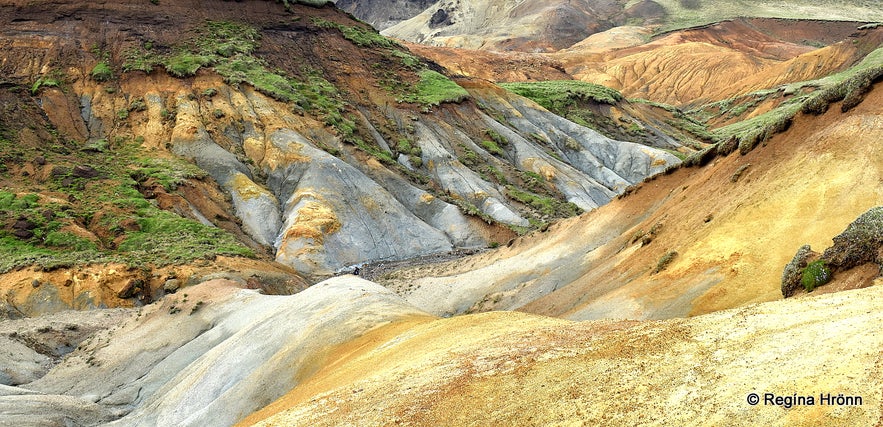
Colourful Sogin
I waited a couple of years to write about Sogin because I realized its natural beauty is delicate and sensitive, and it could easily be ruined by mass tourism.
But now that the official website of the Reykjanes peninsula has listed Sogin as a place to visit, it's time I show you this colourful, hidden natural gem.
We visited Sogin on Iceland's National Holiday, the 17th of June. It was during the pandemic, so we decided to celebrate on our own.
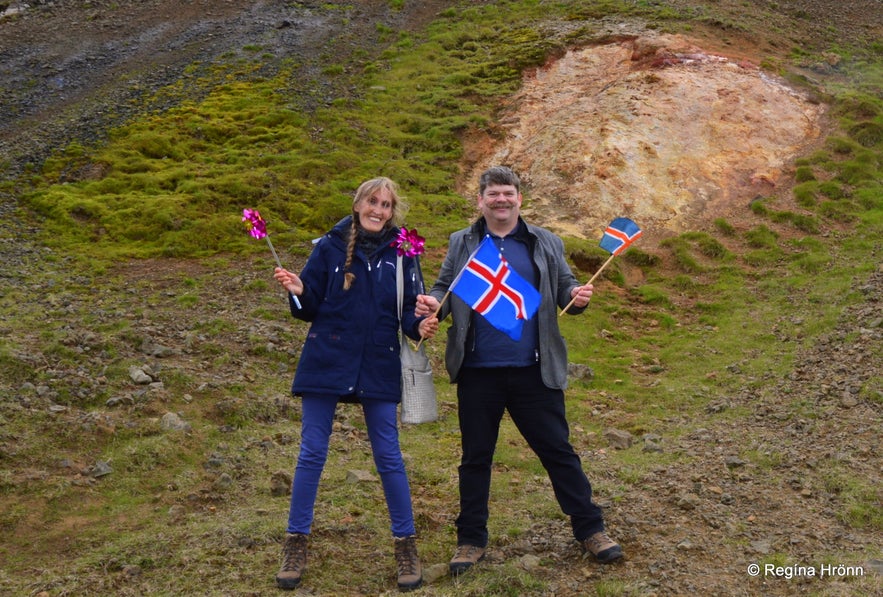 Celebrating Iceland's National Holiday at Sogin
My husband is a professional magician and always performs on this day, so this was a different celebration than usual: an amazing first visit to an area of Iceland that neither of us had ever laid eyes on before.
We visited Sogin from the west side. It took some doing to get there: the road is rough gravel, and the last stretch, closest to the geothermal area, is for jeeps only.
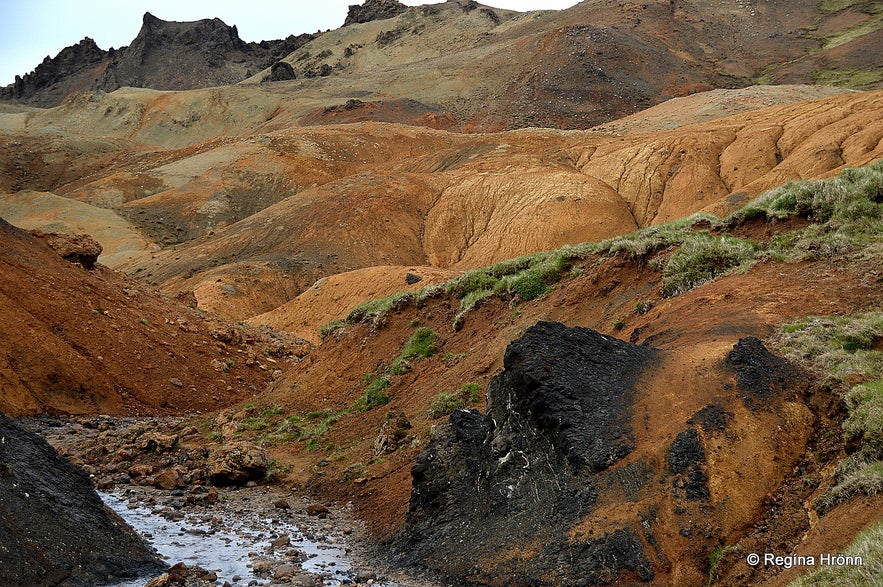
We followed the creek to Sogin
Now, what are Sogin and why are they so colourful?
Sogin is a very colourful rift within a set of fluvial gullies in a high-temperature geothermal area.
This is a purely volcanic area with geothermal heat that creates these magnificent colours.
The volcanoes in this area are: Trölladyngja and Grænadyngja volcanoes, and many more, of course. These two volcanoes are often referred to as Dyngjur (plural for Dyngja - Shield volcano), although these volcanoes formed in subglacial eruptions during the Ice Age.
They are hyalocastite mountains (it is much easier for us laymen to refer to them as tuff mountains).
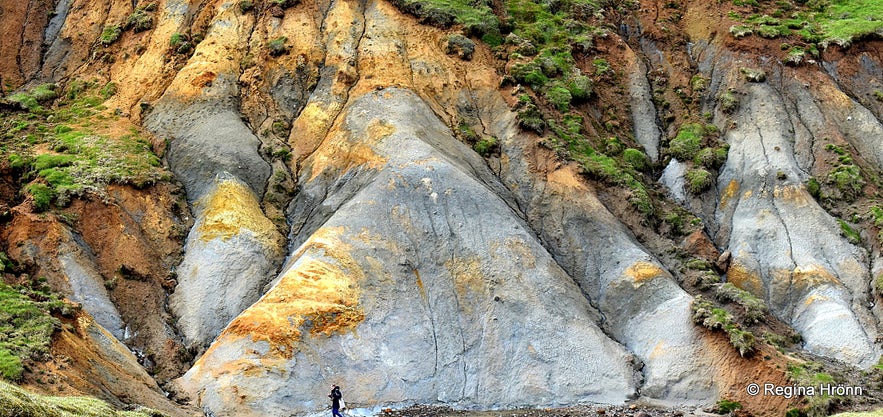
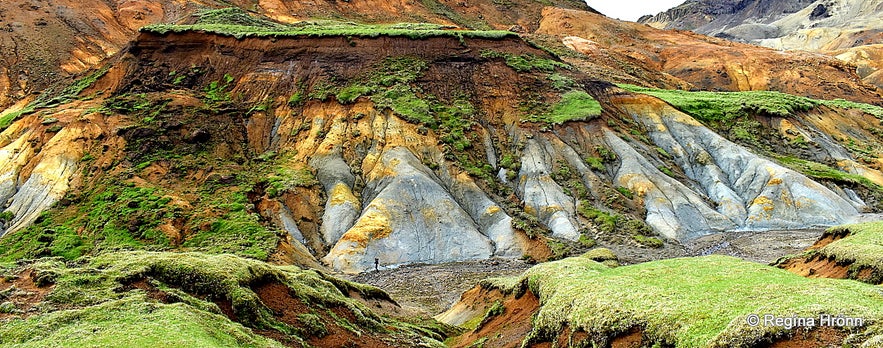 You can see me as a tiny black spot in the photo
We left the car close to an experimental borehole, and off we went on an adventure, really excited to see this area.
The road was built to reach this experimental borehole, and even though it was very rough, we were grateful, as it meant we could drive very close to Sogin.
We followed Sogalækur creek and tried not to step in the colourful mud that sticks to your shoes, making your steps heavier and heavier. And our footprints left scars in the mud.
This is why this area cannot be visited by many; it would ruin this delicate landscape.
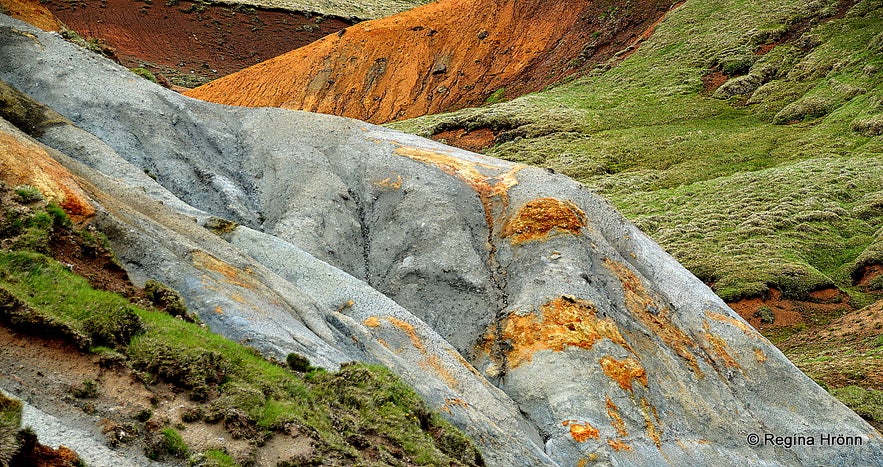
Colourful Sogin
We entered the around 150-200 meters deep gully, and I was in awe, unable to believe how beautiful it was - I felt like I had stepped into a painting!
Here in the gully, there was once a high-temperature geothermal area, and it still is, although I didn't see any bubbling hot springs.
If we had continued on this hike, we would have seen more.
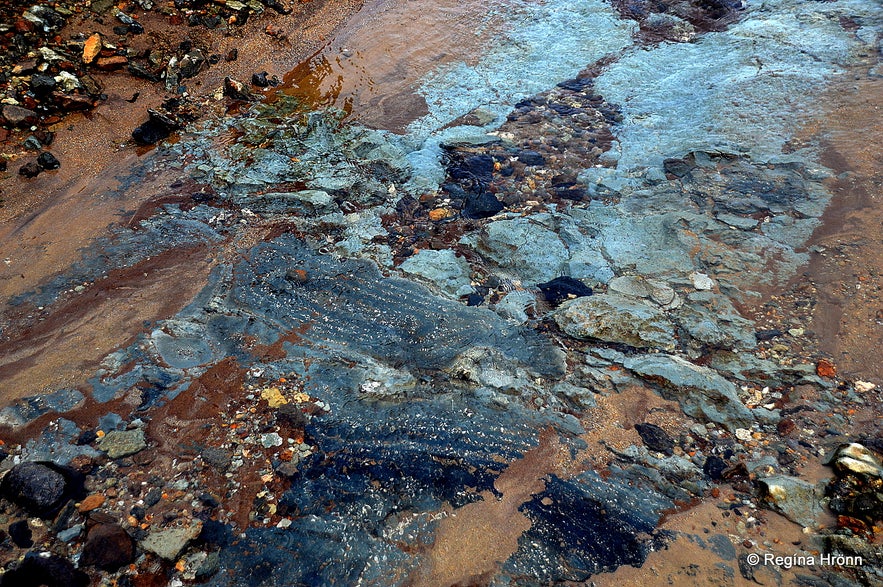
Geothermal colours at Sogin
Here you will find many place names with Sog or Sog-in, which is the plural form with a definite article (the -in ending in Icelandic).
Here we have Sogasel, Sogaselsgígur, Sogamelar, and Sogaselsdalur. I found the first three names on the map I rely on from the Nature Science Institute of Iceland. But I couldn't find the last name on that map.
But I trust the source of the article: Trölladyngja – Sogin, written by a group of police officers who recount their travels on the Reykjanes peninsula.
Ferlir is an excellent website with many interesting ideas of places to visit on the Reykjanes peninsula (in Icelandic only).
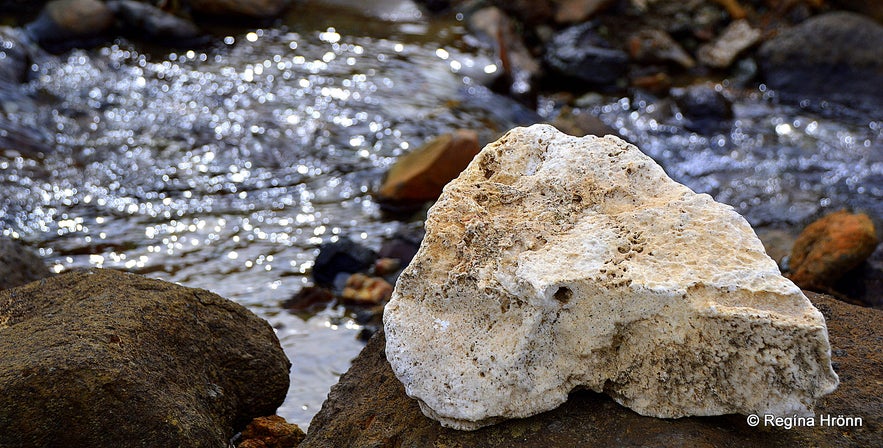
Sogalækur creek
At Sogin, you will see a multitude of colours: golden, red, orange, and grey with green moss (grass) dotted on top of these impressive, colourful mounds and hills.
These amazing colours draw me to visit Iceland's geothermal areas. I usually visit the geothermal areas only on sunny days, as sunlight makes the geothermal colours much more vivid.
This was an overcast day, but the beauty of Sogin was like something out of this world.
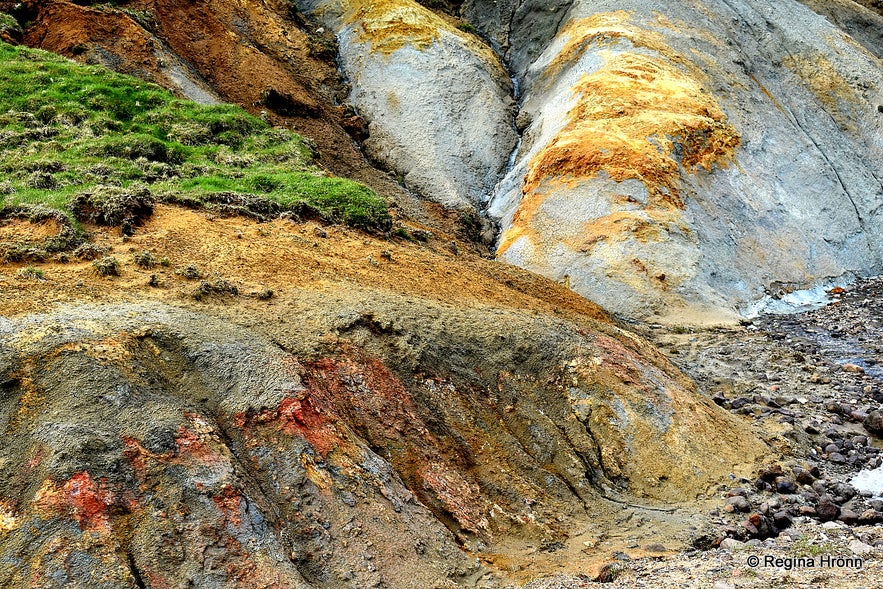
Sogin
I couldn't stop taking photos, and my husband took pictures of me with the backdrop of Sogin to give perspective.
The Afstapahraun lava field (a strange name; could have been Arnstapahraun earlier on), through which we drove, formed during the Trölladyngja eruption.
There are so many lava fields here on the Reykjanes peninsula, from different eruptions.
The lava flowed quite far, reaching the sea some 10 km from the volcano. The Reykjanesbraut road lies through the lava field. And that is where we came from.
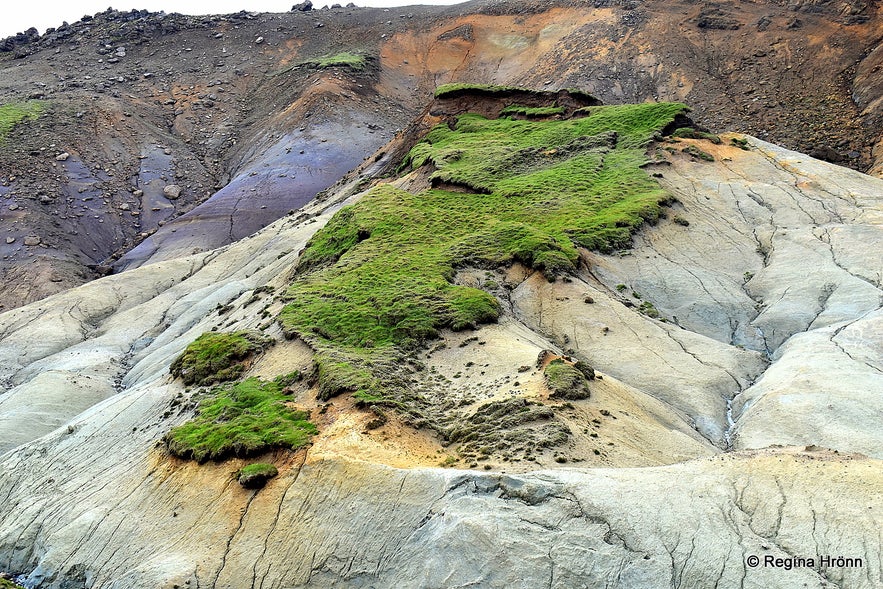
Sogin
You can also reach Sogin from the east side of Lake Djúpavatn and hike through this area.
On the Hiking map of Reykjanes, you will see 3 lakes: Spákonuvatn, Grænavatn, and Djúpavatn.
I have not done this hike, as I am not a great hiker, so we only visited Sogin from the west side.
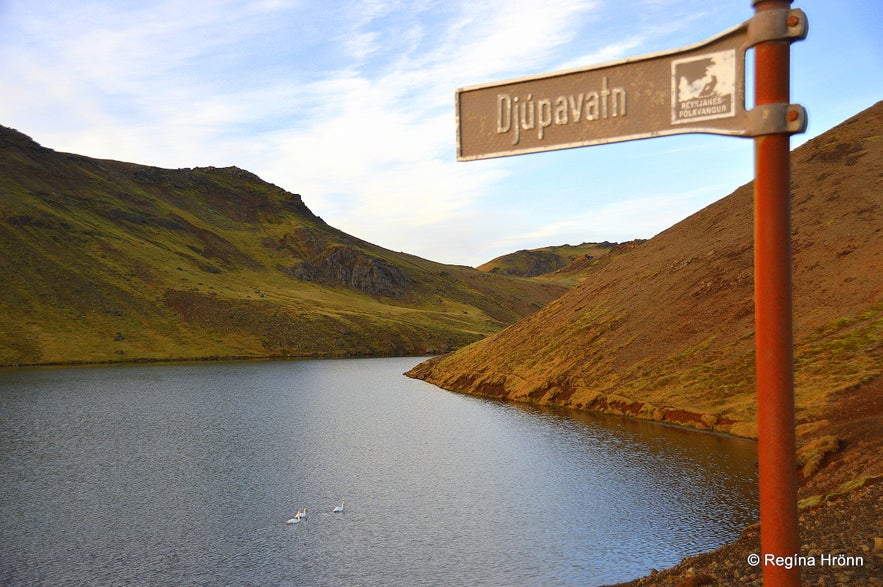 Lake Djúpavatn by Vigdísarvallavegur road
But, during another visit to this area, we drove via Vigdísarvallavegur no 428 through Vigdísarvellir to check out Lake Djúpavatn - the Deep Lake, an explosive crater formed during the Ice Age.
We also checked out the ruins of two farms on Vigdísarvellir plains, one of which had been abandoned after a big earthquake in 1905.
We spent the whole day exploring the peninsula.
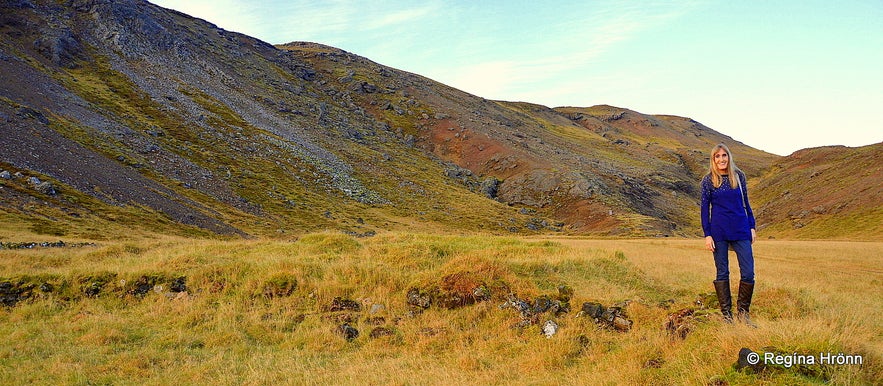 Visiting the ruins of an abandoned farm on the Vigdísarvellir plains in the dusk
The following day, the 20th of October 2020, a major earthquake (5.6 on the Richter scale) shook the area, and large boulders came tumbling down onto the Vigdísarvallavegur road, where we had just been driving!
I'll tell you a little bit further on in this travel blog what happened to the people hiking on Mt. Keilir when this earthquake shook the whole peninsula.
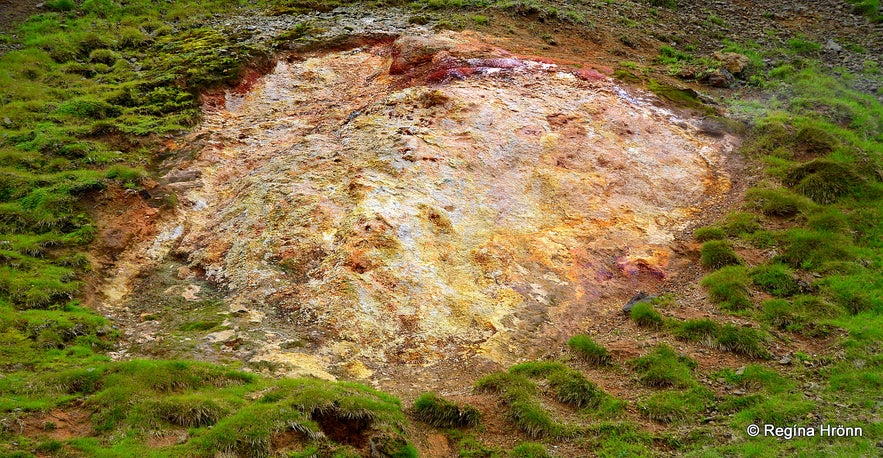 A hot spring at Sogin
There are several volcanic systems on the Reykjanes peninsula, and this volcanic system is called Krýsuvík-Trölladyngja.
The best-known geothermal area on the Reykjanes peninsula, and the easiest one to access, is the Seltún - Krýsuvík geothermal area, about which I have written another travel blog:
Seltún - the colourful Geothermal Area at Krýsuvík on the Reykjanes Peninsula in SW-Iceland.
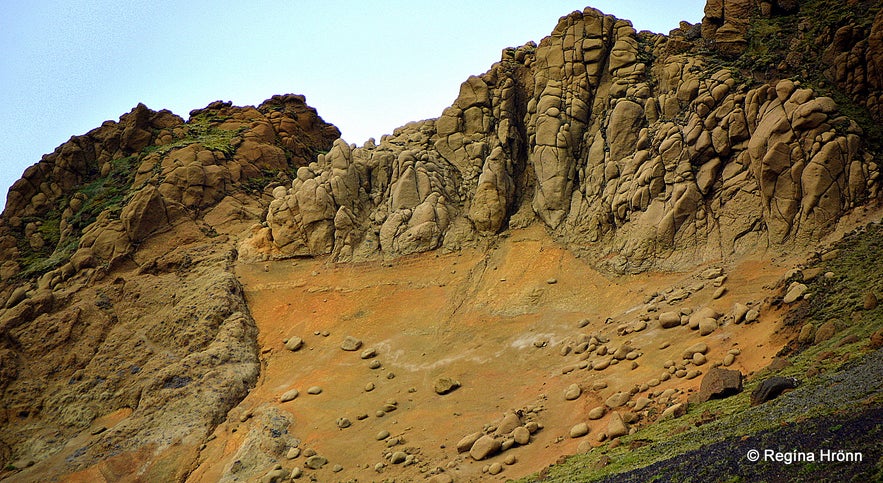 Mountains by Sogin
If you decide to visit Sogin, do so on a dry day, as visiting on a rainy or wet day will cause you to sink into the mud and possibly damage this beautiful area.
It is always best to wear wellies when visiting geothermal areas, and when I visit lesser-known ones, I put silicone bags over my hiking boots. I didn't do that on this hike, should have though.
I have shown you what happened at Þeistareykir up north, when thick, heavy red mud stuck to my hiking boots: The colourful Þeistareykir Geothermal Area in North Iceland.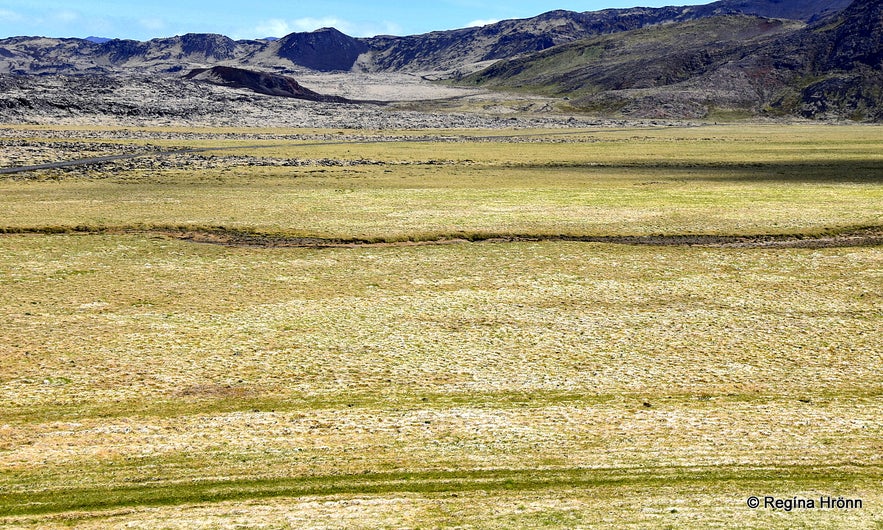
Höskuldarvellir plains - Eldborg in the distance
To reach Sogin, we drove through a vast lava field, Afstapahraun, on a very bumpy road, Höskuldarvallavegur, named after the Höskuldarvellir plains.
The Höskuldarvellir plains are a grassy area, some 1 km wide and 1 km long.
The plains that stand out in the surrounding lava fields were created by the transport of the dissolved material in Sogalækur creek.
Höskuldur is a male name, but we know nothing about who he was or why the plains are named after him.
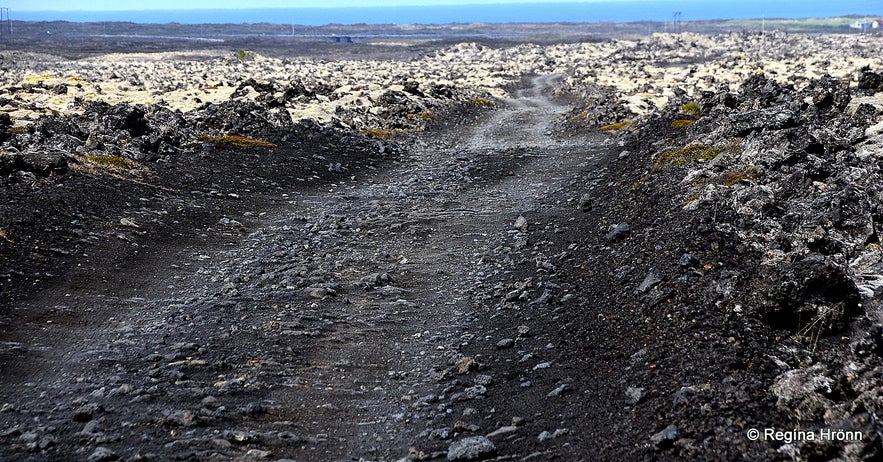
The road leading to Keilir and Sogin is rough and bumpy
The material for the 9-10 km-long Höskuldarvallavegur road was taken from the Eldhraun and Rauðhólar craters, unfortunately leaving scars on them.
The crater is still beautiful, though we can only guess what it looked like before the farmer from Stóra-Vatnsleysa, who owned this land, decided to use the material for the roadbed.
But gravel mining also reveals the crater's interior, making the colours very vivid, as I have shown you in my travel blog about Kerið crater, where you can see photos of the striking colours of Tjarnarhólar and Seyðishólar craters.
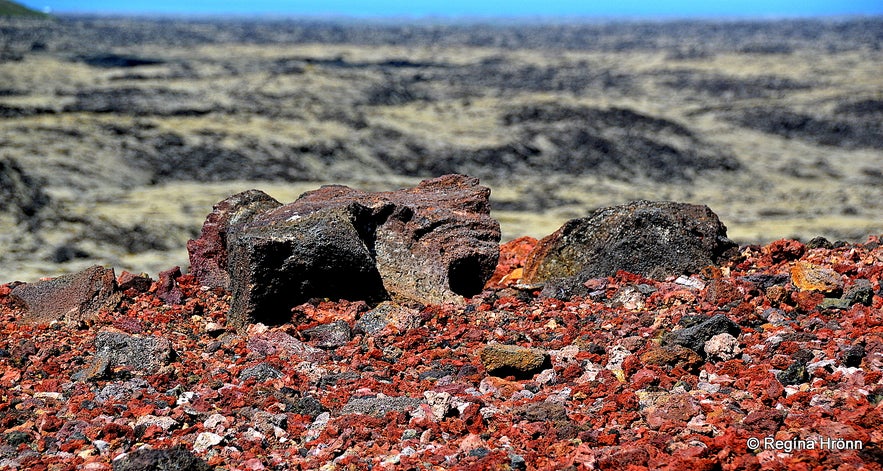
On top of the Eldborg scoria crater
Just so you know, if you are carsick, like I am, this is not the best road, and a friend of mine got so carsick on it that they had to turn back.
When driving through lava fields, of which there are many in Iceland, I often wonder what they might have looked like during the volcanic eruptions that formed them. And if it will ever erupt again.
Never in a million years did we think that it would erupt again in our lifetime (or ever) on the Reykjanes peninsula, but what do you know:
A helicopter ride to the volcanic eruption
On the 19th of March 2021, an eruption began on the Reykjanes peninsula. Since then, we have seen 11 volcanic eruptions in the vicinity of Sogin, and I feared it would be damaged or destroyed by lava.
Fortunately, that didn't happen, and hopefully it never will. But we don't think we have seen the end of these eruptions.
If you look at the map, you will see how close the volcanic eruptions were, and you can see the lava field on the map from the Litli-Hrútur and Geldingadalir eruptions.
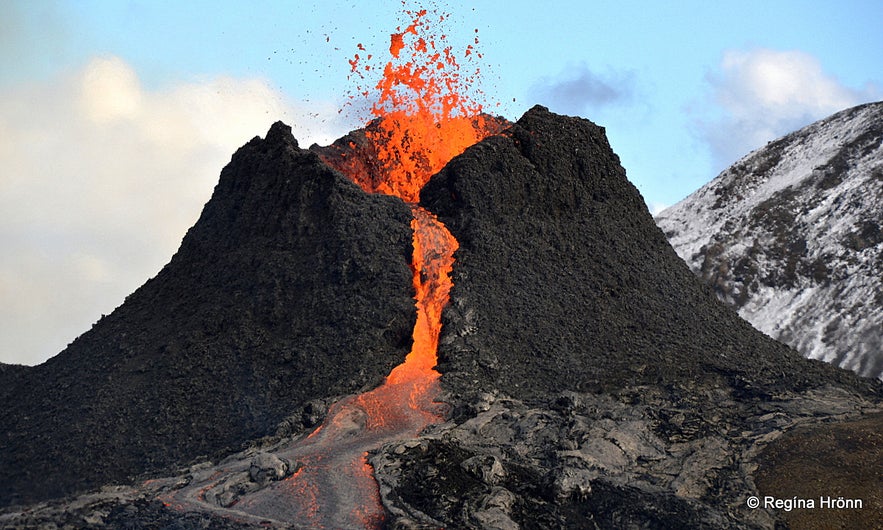
A volcanic eruption started in Mt. Fagradalsfjall and Geldingadalir in 2021
I booked a helicopter tour to see the eruptions with my own eyes, and wrote another travel blog with many photos from the nearby eruptions:
The Volcanic Eruption in Mt. Fagradalsfjall and Geldingadalir in SW-Iceland.
The last time it erupted on the Reykjanes peninsula, Snorri Sturluson was alive, and the eruption is mentioned in the Sturlunga-Íslendingabók.
And it was 6,000 years ago that it erupted in this exact area! So to us, this was just an ancient lava field, and we thought it would not erupt again. But now we know that where there is a lava field, it might erupt again.
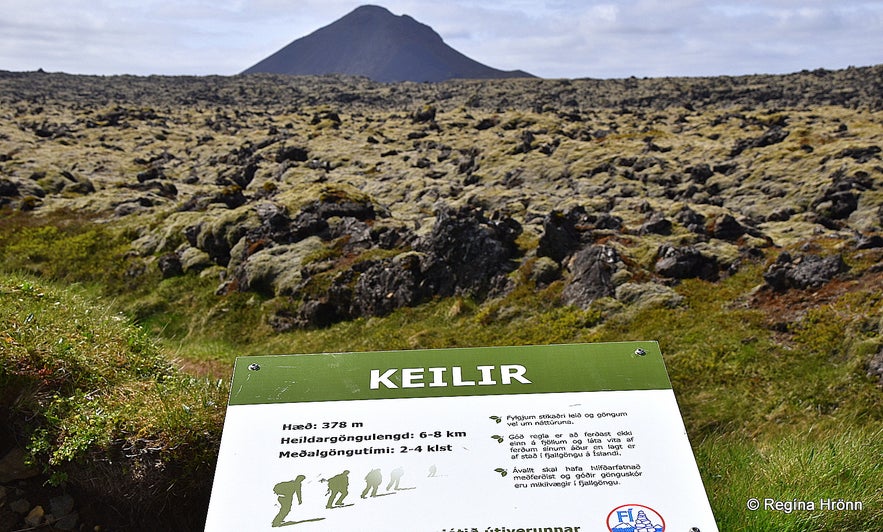
The palagonite mountain Keilir in the distance
On the way to Sogin, you will notice Mt. Keilir, the landmark of this area.
Keilir is a distinctive volcano that actually looks like a volcano. Wherever you look in this area, you will see volcanoes, but only some of them actually look like volcanoes, i.e., what we picture a volcano should look like.
Mt. Keilir erupted in a single subglacial eruption beneath the thick Ice Age glacier.
When you see Keilir from a certain angle, you will notice that attached to it is a much lower ridge, Keilisbörn - the Children of Keilir, which I think is such a cute name :)
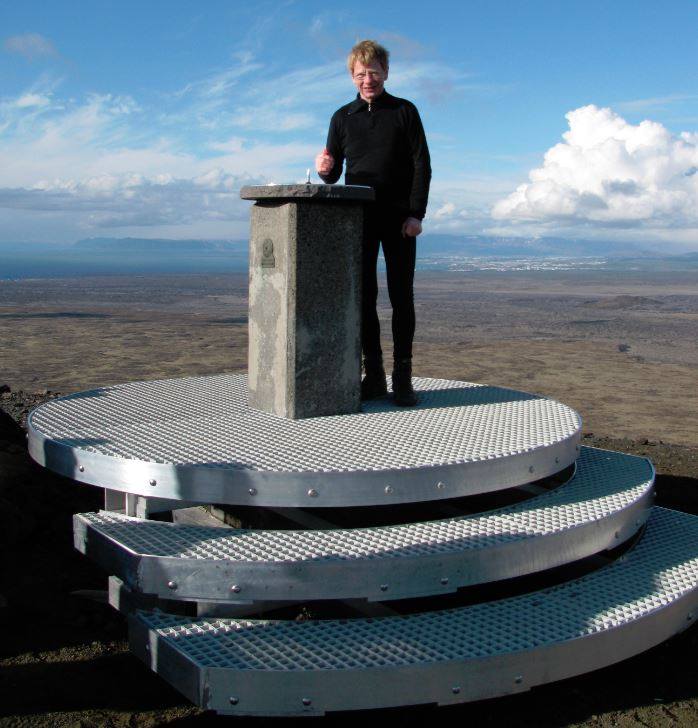 Jakob Hálfdanarson on top of Mt. Keilir when the view-dial was unveiled
On top of Mt. Keilir, you will find one of the view-dials, which my father-in-law, Jakob Hálfdanarson, designed and was unveiled in 2009.
Shortly after, while Jakob was revisiting the view-dial with a group of friends, an earthquake of 4.3 on the Richter scale shook the mountain and the view-dial.
On the 20th of October 2020, another much larger earthquake, 5.6 on the Richter scale (the epicentre of which was Núpshlíðarháls), shook Mt. Keilir. This earthquake preceded the volcanic eruptions.
Jakob hiked to the top of Mt. Keilir shortly after the earthquake to check whether his view dial was still there. It was a whole new top of Mt. Keilir that appeared, and the view-dial, with its molten plinth, pillar, and foundation, had flown in one piece into the air and lay on its side.
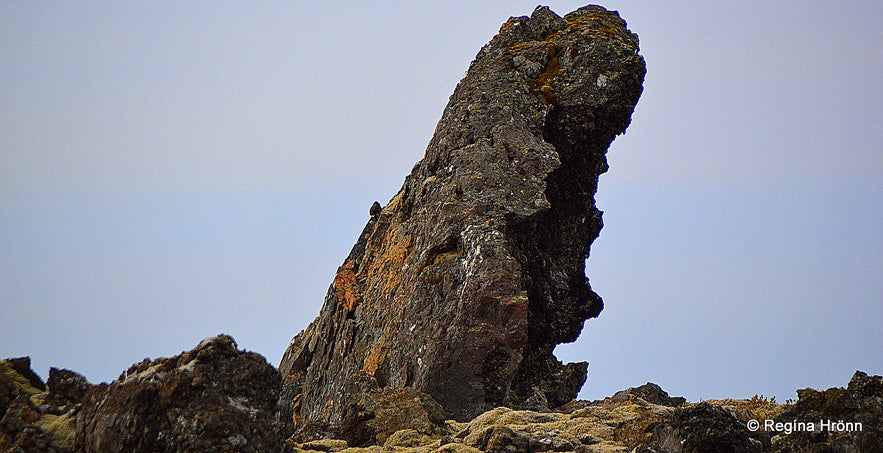
A protruding lava rock in the vast Afstapahraun lava field
One man was on top of Mt. Keilir, admiring the view, when the earthquake started. He lost his footing and was knocked out. When he came to, he ran as fast as he could down the mountain and straight to the emergency room.
Two people were hiking on Mt. Keilir when the earthquake occurred, and large boulders came tumbling down the mountain towards them. They had to run for their lives down the mountain.
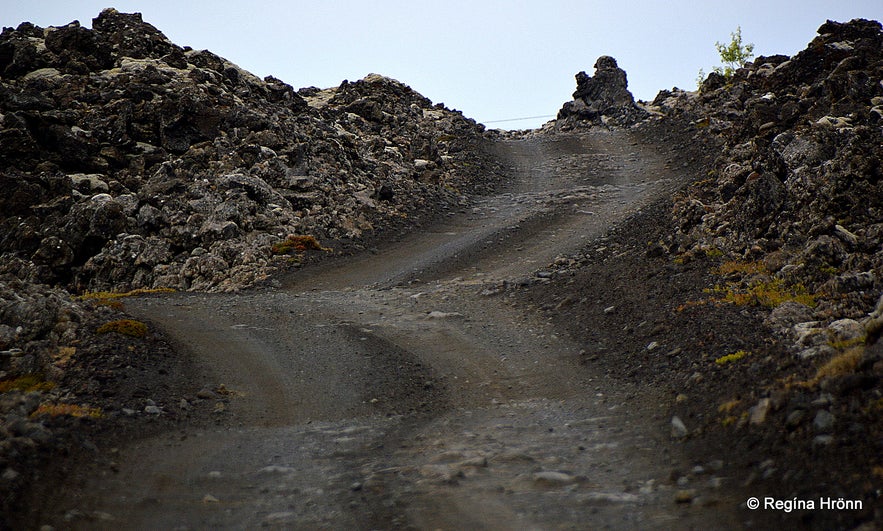 The road lies through a lava field - do elves live in the rocks?
After our visit to Sogin, we checked out the Lambafellsklofi rift, which is by the same road; you turn left for the rift and right for Sogin:
The amazing Lambafellsklofi Rift on the Reykjanes Peninsula in South-West Iceland.
This is a summer visit only. To reach Sogin, you can rent a car in Reykjavík. A 4x4 is needed for this bumpy road.
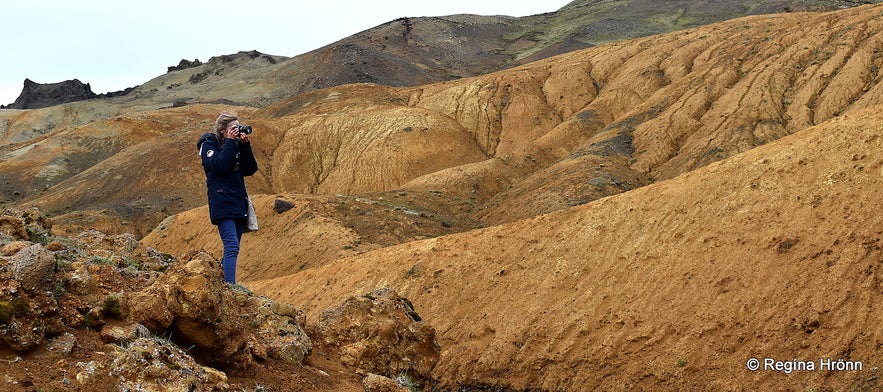 Photographing Sogin
Drive the Reykjanesbraut road number 41 and turn onto the Höskuldarvallavegur road.
Let's treat Sogin with the utmost respect that they deserve, so we can keep this hidden pearl relatively intact.
Ref.:
Ferlir: Sogin - náttúra, jarðsaga og minjar
Have a lovely time in Iceland :)

Hi, my name is Regína Hrönn, and I was born and raised here in Iceland.