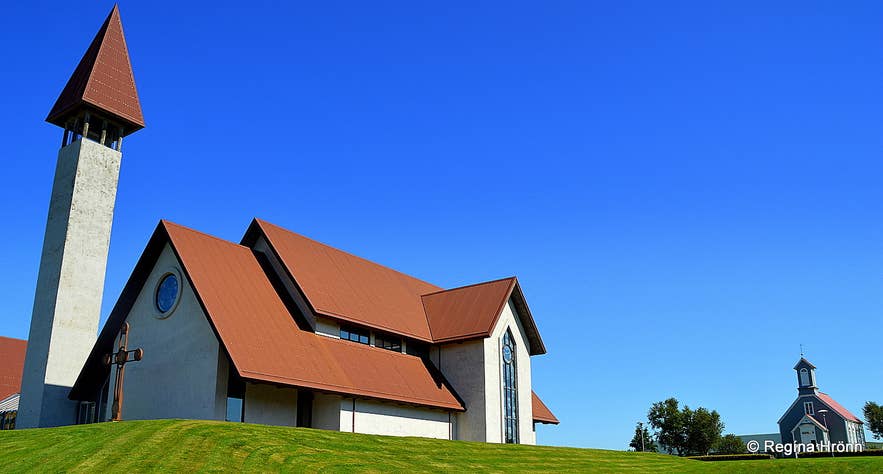
In this travel blog, I want to tell you about Reykholt in West Iceland, which is one of the most historically significant sites in Iceland.
Reykholt was the home of Snorri Sturluson (1179-1241) from 1206 to 1241. Snorri was quite possibly the most influential Icelander ever. He was a Saga writer, politician, historiographer, and poet.
Top photo: the 2 Reykholtskirkjur churches at Reykholt
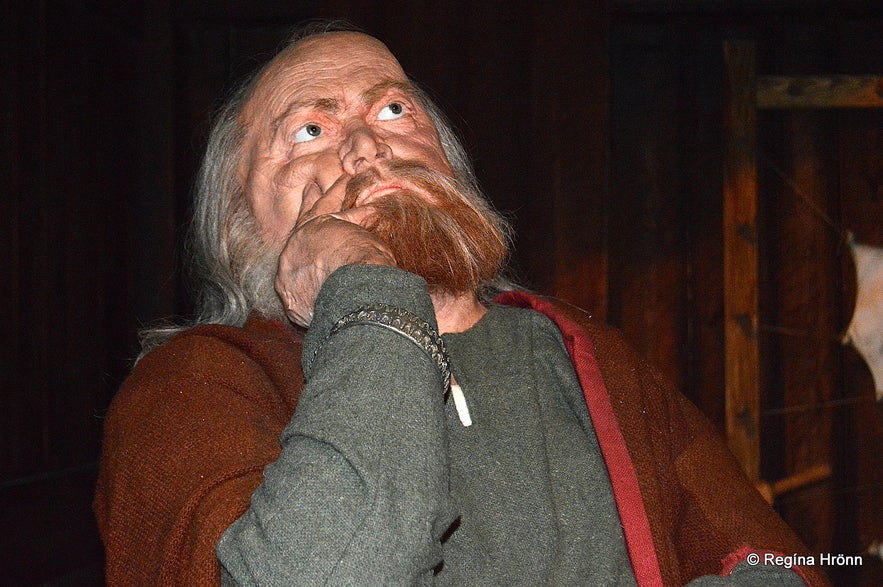
Snorri Sturluson as depicted at the Saga Museum in Reykjavík
Snorri was a chieftain and one of the wealthiest men in Iceland during the Sturlungaöld - the Sturlung Age, and the most powerful man in Iceland.
He held the power of 11 chieftainships and had a revenue of 100 farms in Iceland.
Reykholt was an ecclesiastical and cultural centre in medieval times and an educational centre.
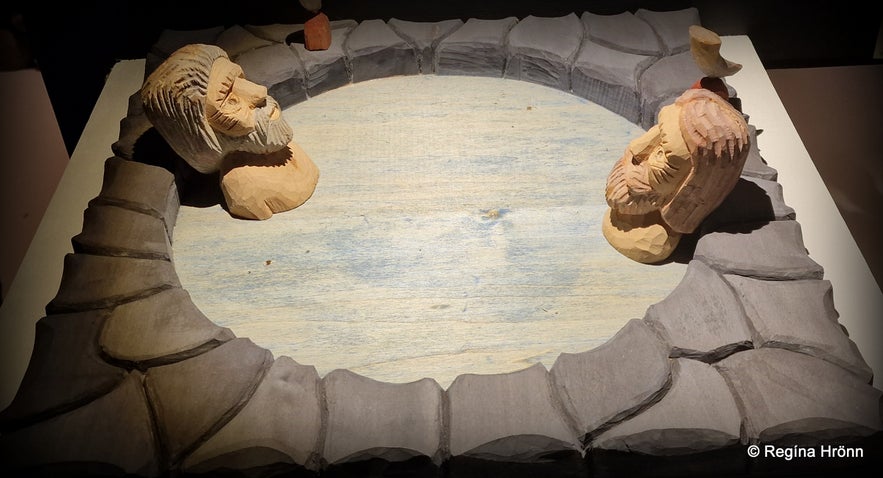 Snorri in his hot pot as depicted at Kakalaskáli in North Iceland - artwork by Sigurður Petersen
Snorri was Iceland's greatest Saga writer and the author of Heimskringla, the history of the Norwegian kings, and the Prose-Edda, which contains information about Nordic mythology and poetry. Snorri is also believed to be the writer of Egils Saga, the saga of Egill Skallagrímsson.
Snorri was influential in preserving the Norse cultural heritage through his extraordinary work.
Snorri has been called the Homer of the North. He wrote in Icelandic, not in Latin, which was the more common practice. And he wrote all his work on calfskin.
Just imagine how much calfskin was needed for all of his work. I have been told that Snorri bought 200 calfskins for Heimskringla!
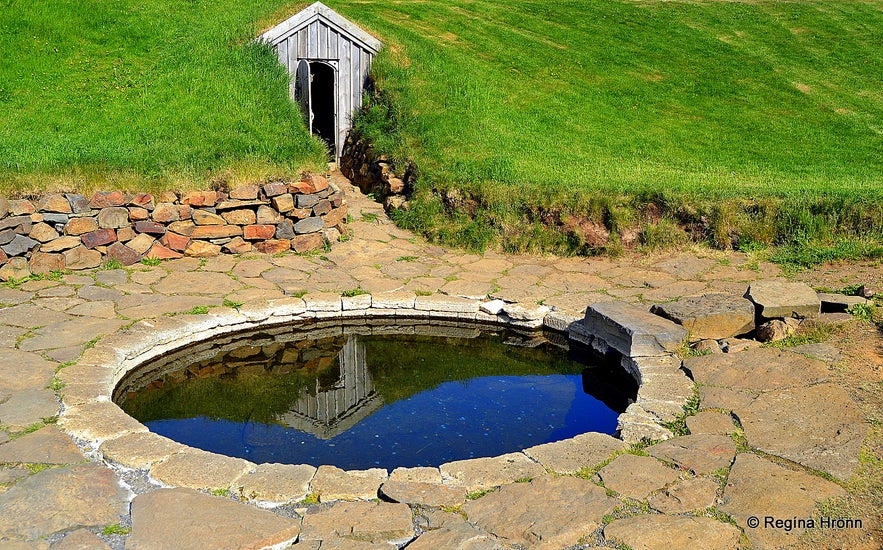
Snorralaug at Reykholt
Snorralaug, Snorri's bath in Reykholt, is the warm outdoor bathing pool of Snorri Sturluson and one of the first archaeological remains listed in Iceland in 1817.
This bath of Snorri is among the best-known heritage sites in Iceland. Þjóðminjasafnið - the National Museum of Iceland reconstructed Snorralaug in 1959.
The pool was first mentioned in Landnáma, the Book of Settlements, written around 1200, which states that the hot pool was in use as early as the 10th century, but at that time no one lived at Reykholt. Snorri moved here in the 13th century.
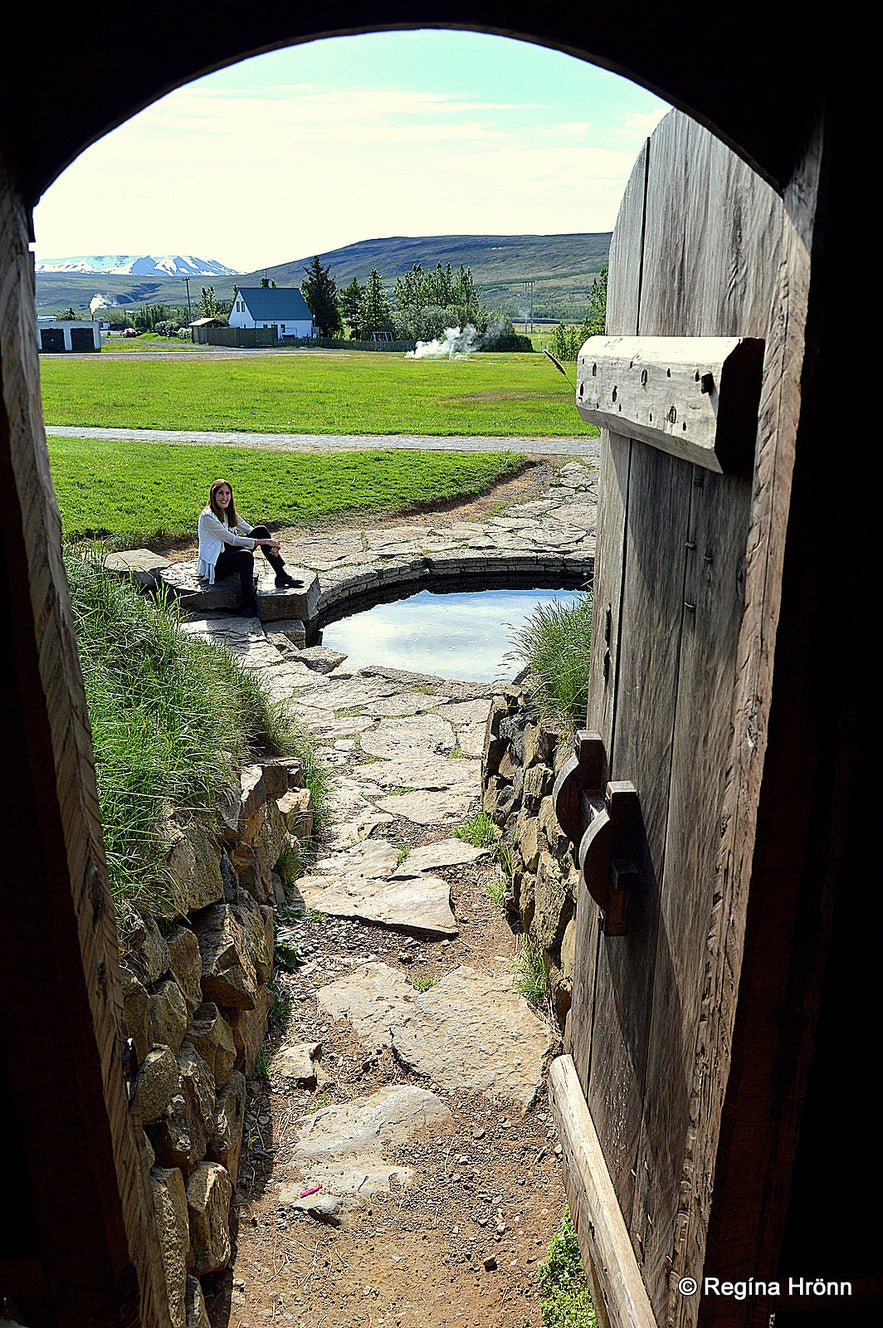
The underground passage leads to the hot pool
In Snorri Sturluson's time, an underground passage led from the farmhouse to the pool.
In the Sturlunga Saga, Snorri is depicted sitting in his hot pool, conversing with his friends in 1228.
I love this image, Snorri chatting with his friends in the pool, probably wearing a linen caftan :)
The hot pool is around 3.70-3.90 m in diameter and 0.7-1 m deep, and there is a circular rim and a bench, alongside the walls, where Snorri would sit, alone or with his friends and family.
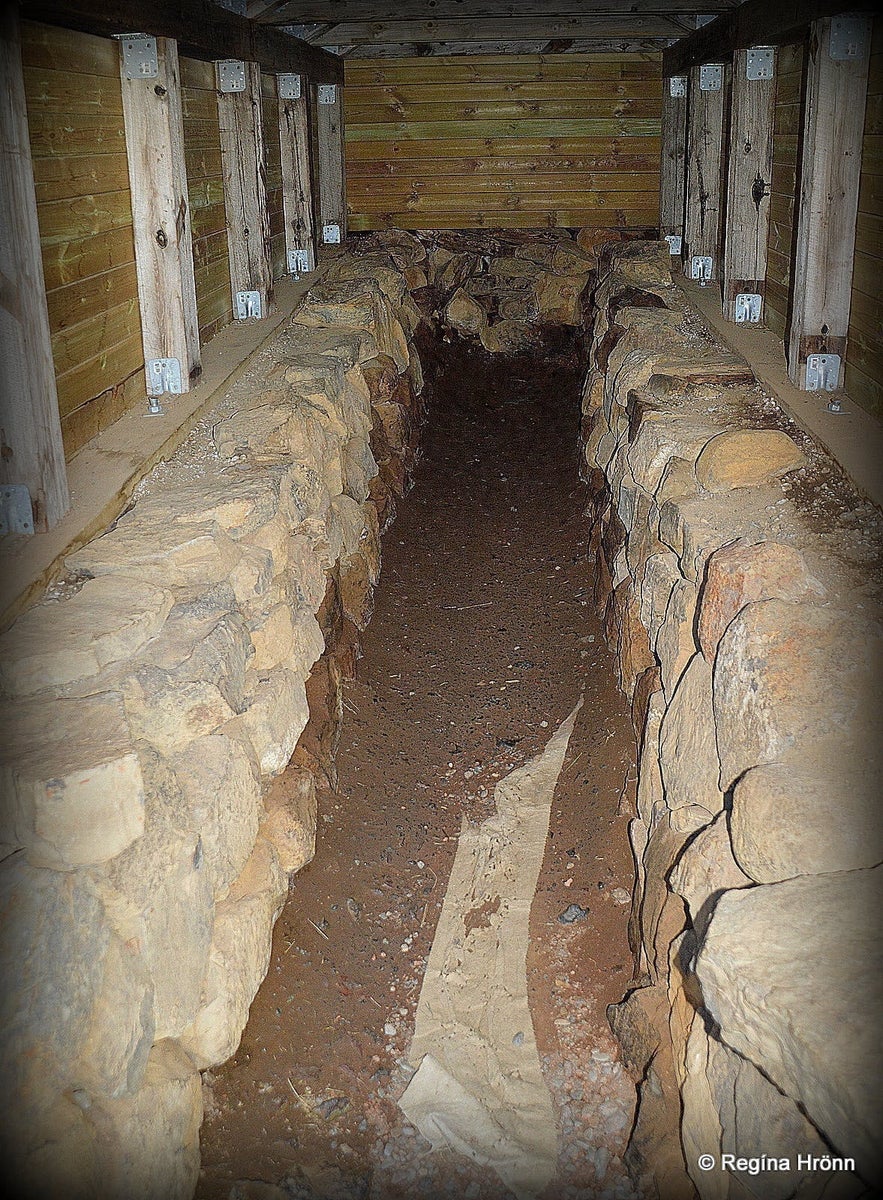
The underground passage at Reykholt
A small lodge covers a part of the passage leading to the pool. It is only there to preserve the archaeological remains of the passage, not to show us what it looked like. This passage was discovered in 1930 during the construction of the school, which is now next to the pool.
It is possible to walk into a part of the passage and have a look. The passage was some 30 meters long and led to the farmstead. In my opinion, a rope should close the passage so that people know that it is an archaeological site.
I once saw a group of tourists who were really happy to have found a small hut where they could have a picnic. They were unaware that they were inside archaeological remains from the 13th century.
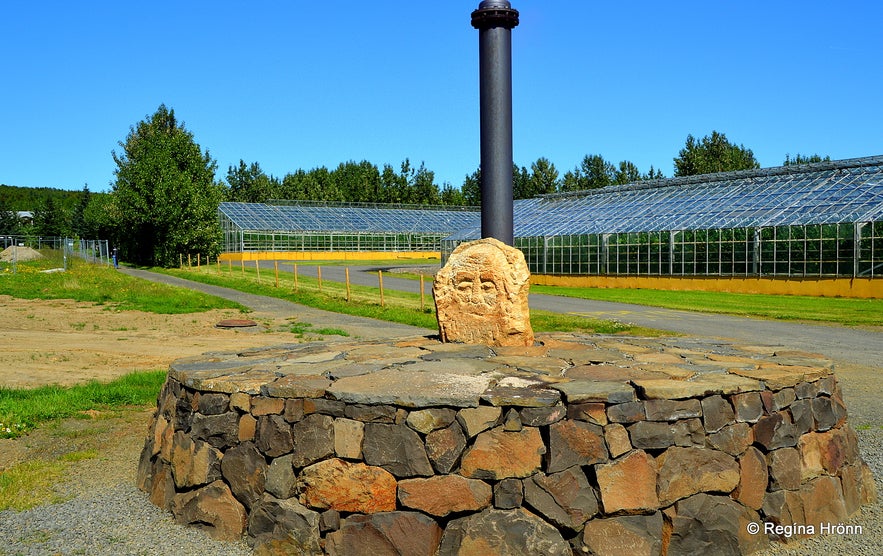
The hot-spring Skrifla
Hot water is supplied to it via a stone-built conduit from the hot spring Skrifla, which is close by. The hot spring has now been tastefully closed with a rock cover, and artwork by Páll Guðmundsson at Húsafell has been put on top - the face of Snorri Sturluson carved into a rock.
These archaeological remains should be treated with utter respect and care. To me, it is fantastic to sit by the reconstructed hot pool of Snorri Sturluson. Money has been thrown into the pool, as in so many other places in Iceland, which is not allowed.
There is also no bathing in it! It makes me sad that some people don't show respect here, or maybe don't realize what a treasure this pool is.
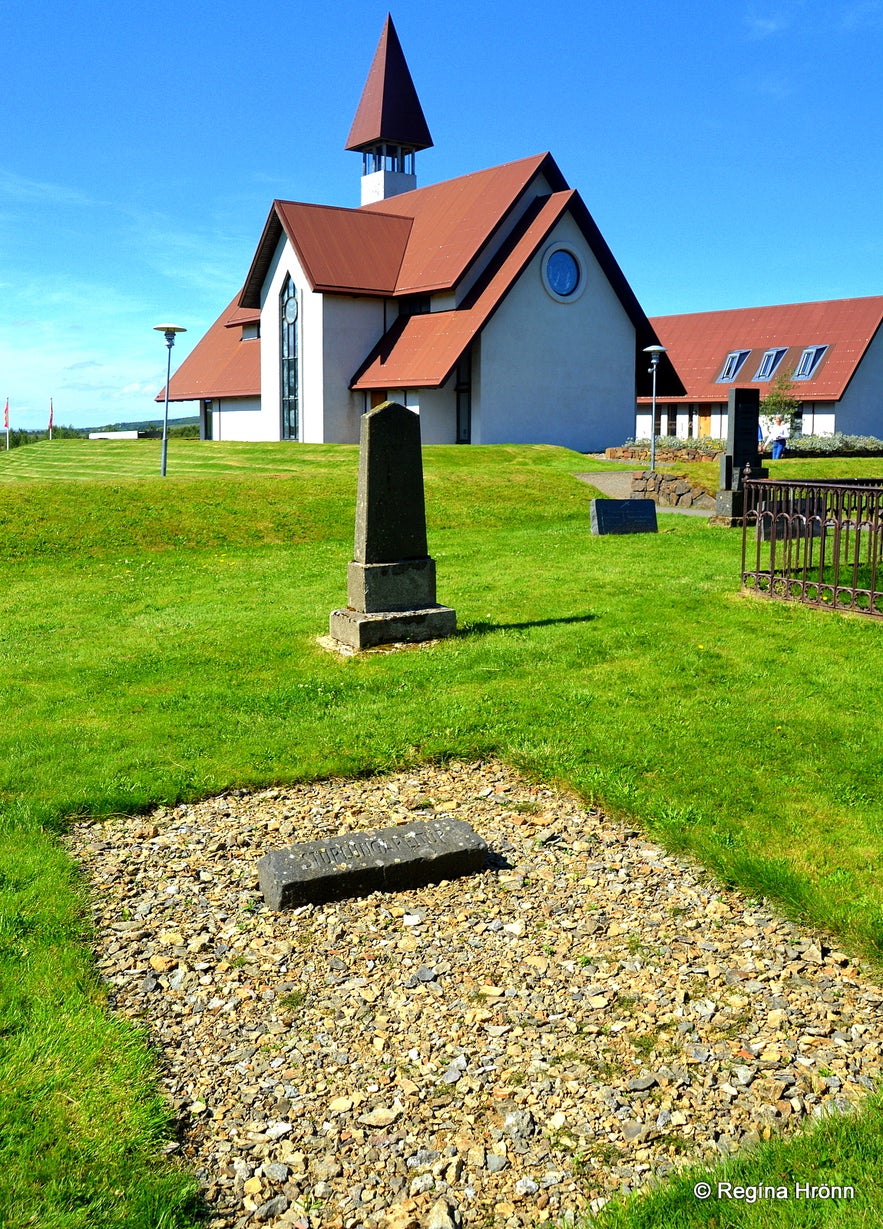
Sturlungareitur at Reykholt
In the graveyard by the old church, one can find the grave of Snorri Sturluson.
I didn't know exactly where it was, but I sensed this strong energy coming from the ground, so I walked straight up to his grave.
I couldn't tear myself away from the grave; the energy is so strong there, and I visited it often during my 2-day stay in Reykholt, sitting by it and pondering the life and fate of this remarkable man, Snorri Sturluson.
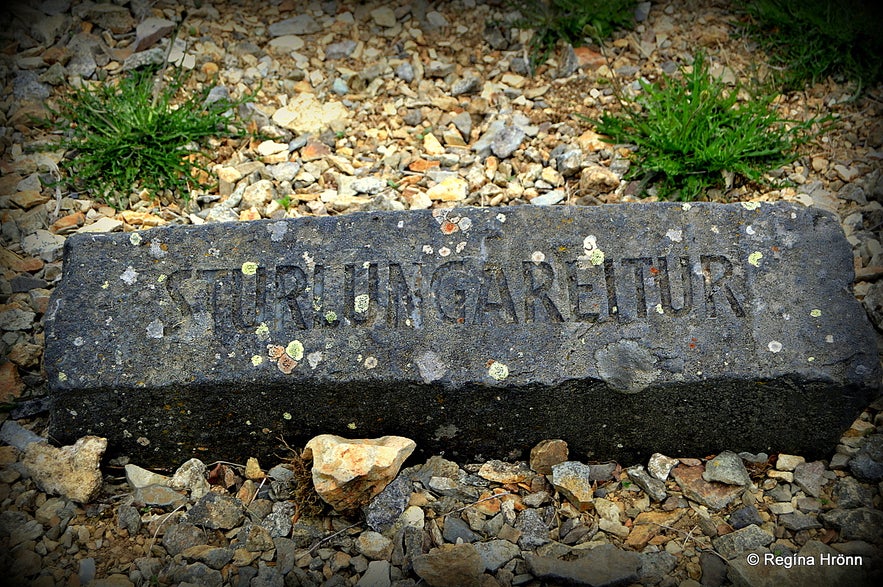
Sturlungareitur at Reykholt
More members of the Sturlunga clan are buried in this grave, and a small tombstone was placed on it in 1965.
On it is written Sturlungareitur.
Snorrastofa 
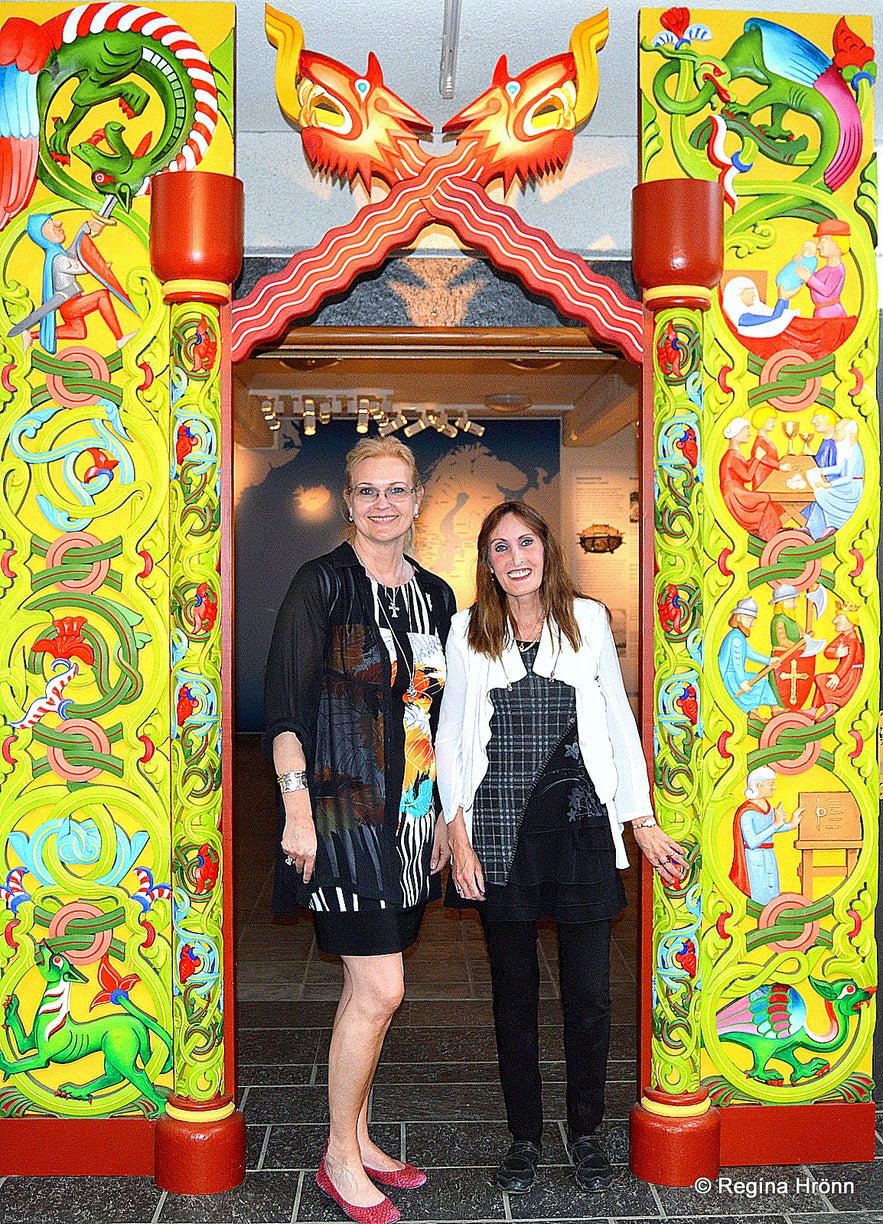
Sigrún Þormar and I by the entrance to Snorrastofa
Snorrastofa in Reykholt is an independent cultural and medieval centre, established in 1995. At Snorrastofa, you will find an excellent public and research library dedicated to Snorri Sturluson and his work, and scholars can rent facilities for workshops and conferences. Snorrastofa offers lectures on Snorri and personal guidance through the exhibition on Snorri Sturluson.
Accommodation is rented out to scholars and guests of Snorrastofa both at Snorrastofa and in the old school. I stayed there for 2 nights and can vouch for how serene and inspiring it is to stay in the old school just above the medieval hot pool of Snorri, contemplating Snorri's life and achievements. We got a room right behind the statue of Snorri Sturluson, so we had the feeling of having him with us in our room :)
In 2013, an exhibition on Snorri Sturluson's Saga opened in Snorrastofa on the ground floor of the church, with medieval studies and research into the history of Borgarfjörður. Here, one can read about Snorri's life and how influential he really was. I got an excellent guided tour of the exhibition by Sigrún Þormar, the project leader of Snorrastofa.
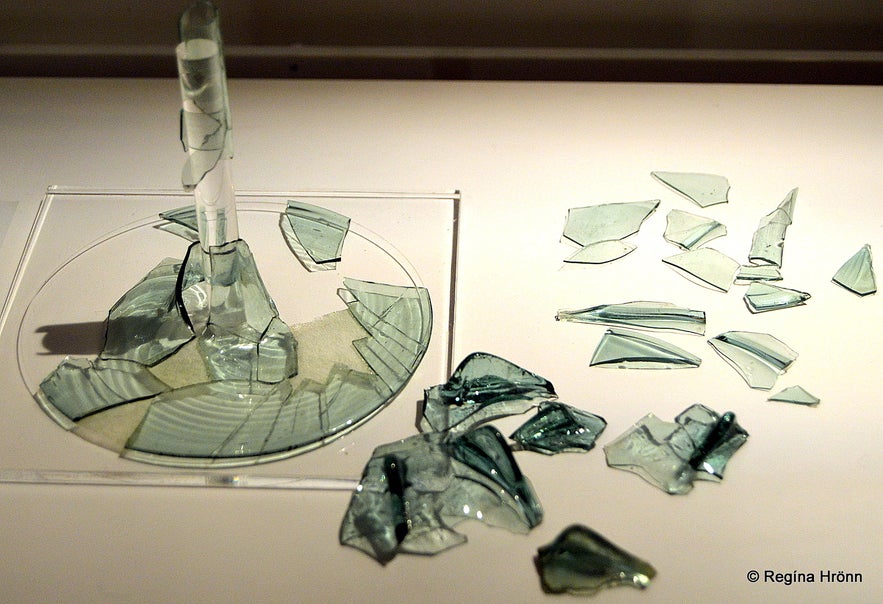
A broken beaker made of glass at Snorrastofa
On display at Snorrastofa's exhibition on Snorri Sturluson are artifacts found during archaeological excavations, such as this exquisite French-style glass beaker. It shows what an elegant man Snorri was, drinking from fine glasses. These finds show the multinational links Snorri had and the links to the European cultural environment.
Archaeological excavations have been done on Snorri's old farmstead at Reykholt. Some medieval buildings have been found. The curved stair where Snorri was killed has been found, and pictures of it hang on one wall in Snorrastofa, along with explanations and other photos from the archaeological finds.
The excavations show that Snorri's farmstead was a large fortress, and it is amazing to see the drawings at the exhibition of what this fortress might have looked like.
These finds have been covered with turf, as there are not enough funds to continue this project. I would love to see them on display under glass and hope funds will be raised soon so the public can see these historical treasures.
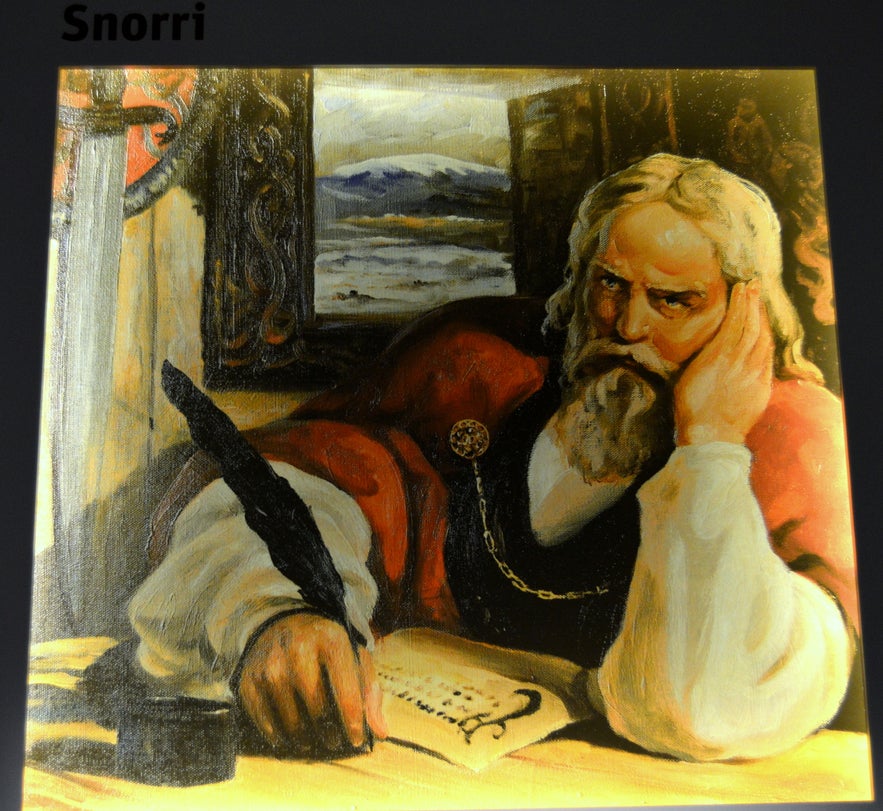
Nobody knows what Snorri looked like, but this painting of Snorri was painted by Haukur Stefánsson in 1933.
The exhibition at Snorrastofa is very well presented. The highlights of Snorri's life are projected on the floor - they appear in a circle, which is in the form of Snorri's hot bath.
There are 35 circles altogether, and I photographed every single one and wrote down all the highlights. So, the following are the highlights of Snorri's life, courtesy of Snorrastofa (my remarks are inside the brackets):
1179 - Snorri Sturluson was born at Hvammur in the Dala district in West Iceland. (There is a tall memorial stone at Hvammur in memory of Snorri Sturluson - see my photo below. The Irish settler woman, Auður djúpúðga, had settled here at Hvammur.)
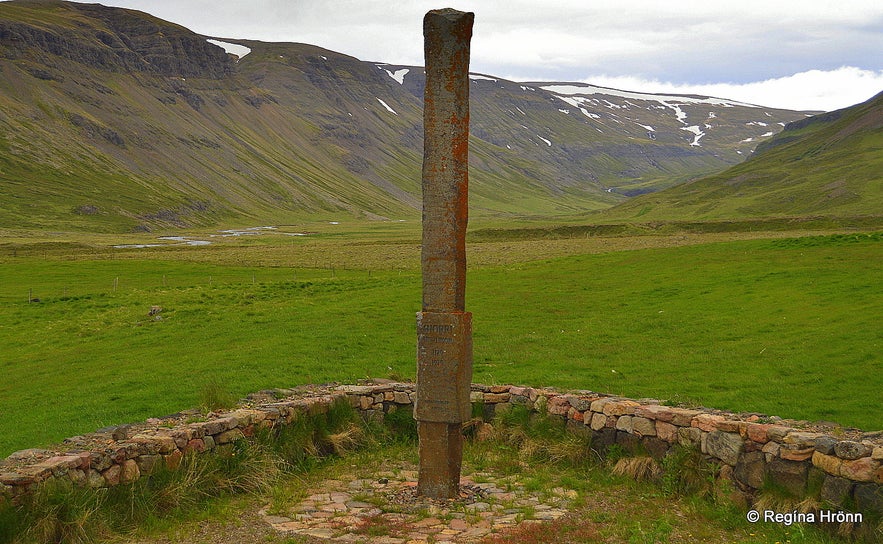
The monument of Snorri Sturluson at Hvammir in Dalir
1181: Snorri is taken to be fostered at Oddi in South Iceland.
1181-1196: As a child and teenager, Snorri was educated at Oddi.
(Snorri was only 3 years old at the time when he went into foster care. This was caused by a conflict between his father, Sturla, and the priest Páll Sölvason at Reykholt. Iceland's lawspeaker, Jón Loftsson, was called in to resolve the conflict. As part of the settlement, Jón offered to foster Snorri at his home, Oddi, one of Iceland's primary cultural centres.
At Oddi, Snorri received an excellent education and proved to be an excellent student. Jón's grandfather was the Norwegian king Magnus the Barefoot. The photo below is of Oddi.)
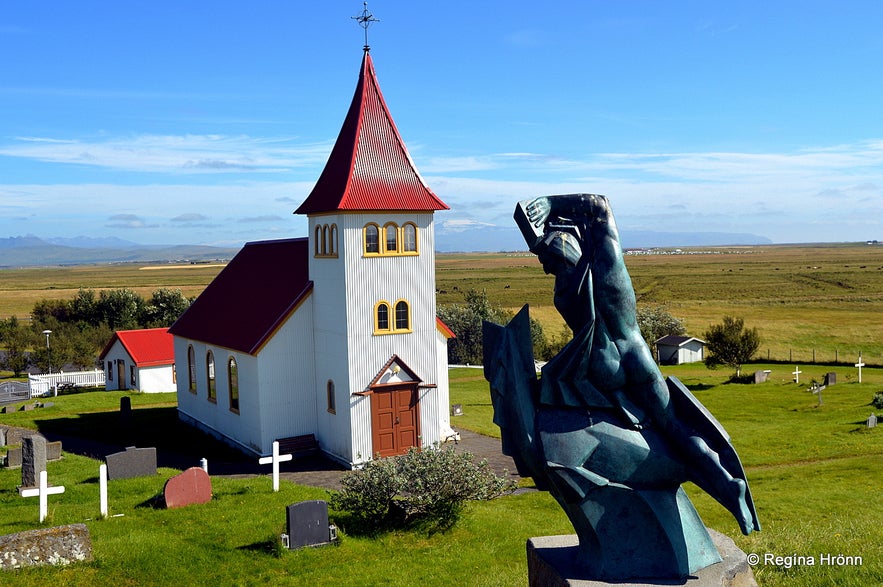
Oddi in South Iceland
1197: Jón Loftsson, Snorri's foster father at Oddi, dies.
1198: Snorri begins to engage with the politics of West Iceland.
1199: Snorri marries Herdís Bersadóttir at Borg in the Mýrar-district in West Iceland. (Borg was the former home of Egill Skallagrímsson from Egil's Saga. The photo below is of Borg.)
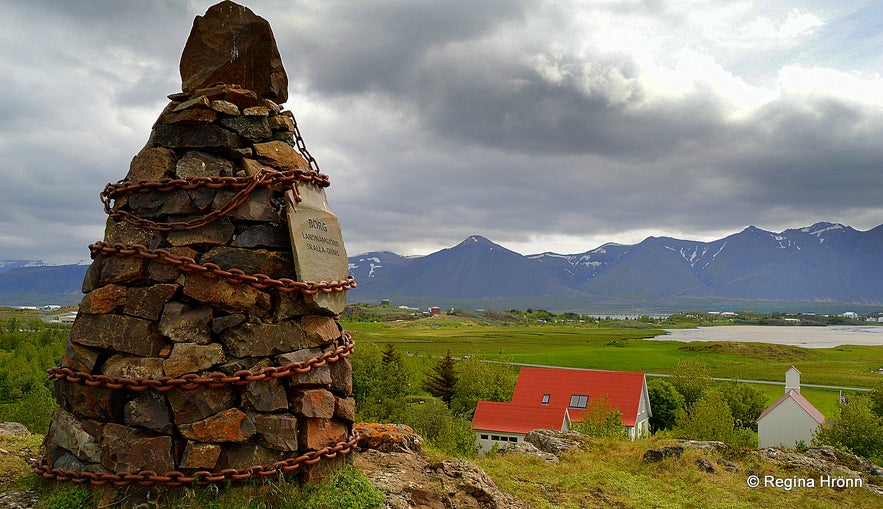
Borg á Mýrum
1199-1201: The young couple lives under the protection of the Oddi clan in South Iceland.
1202-1205: Snorri takes on all authority on the farm Borg in West Iceland.
1206-1207: Herdís divorces Snorri.
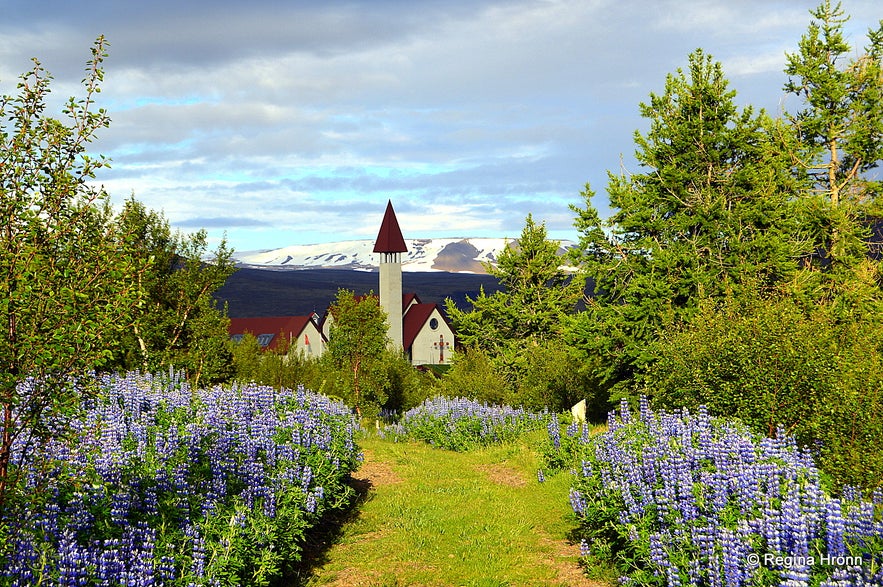
Beautiful Reykholt in the summertime
From 1206, Reykholt became Snorri's primary home.
1209: The Battle of Hólar. Snorri brings bishop Guðmundur Arason to Reykholt.
1206-1215: Snorri's chieftainly power increases. He gained dominion in Borgarfjörður as well as many other areas in West and North Iceland.
1216-1217: Conflict at the Althing - disagreement among the Oddi clan.
1217: Snorri comes to the Althing at Thingvellir with an army of 600 men, Norwegians among them.
1215-1218: Snorri is appointed the Lawspeaker of the Althing.
1218-1220: Snorri's first visit to Norway.
1220: Snorri prevents a war from breaking out between Iceland and Norway - He becomes the King's man.
After 1220: Snorri compiles the "Enumeration of Metres", a poem 102 stanzas long eulogizing both King Hakon and Earl Skúli of Norway.
1222-1224: Snorri lives at Stafholt. Construction of buildings and a fort of Reykholt. (The photo below is of Stafholt.)
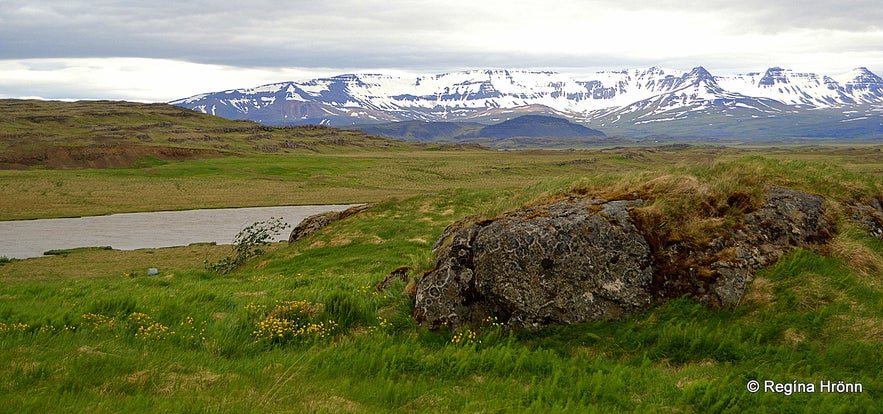
Stafholt in Borgarfjörður
1222-1231: Snorri is a Lawspeaker of the Althing for the second time.
1224: Snorri enters into a relationship with Hallveig Ormsdóttir. She becomes the mistress of Reykholt.
After 1225: Snorri's "Edda" is compiled - an instructional work on poetics, consisting of a preface and three other sections: "The Deluding of Gylfi"; "The Language of Poetry"; and the "Enumeration of Metres".
1226: Snorri establishes a convent on the island of Viðey, Reykjavík.
1231: On the 21st of January, Snorri's son, Jón murtur, dies in Bergen, Norway. On the 17th of July, Snorri's daughter, Hallbera, dies at her mother's home in Borg.
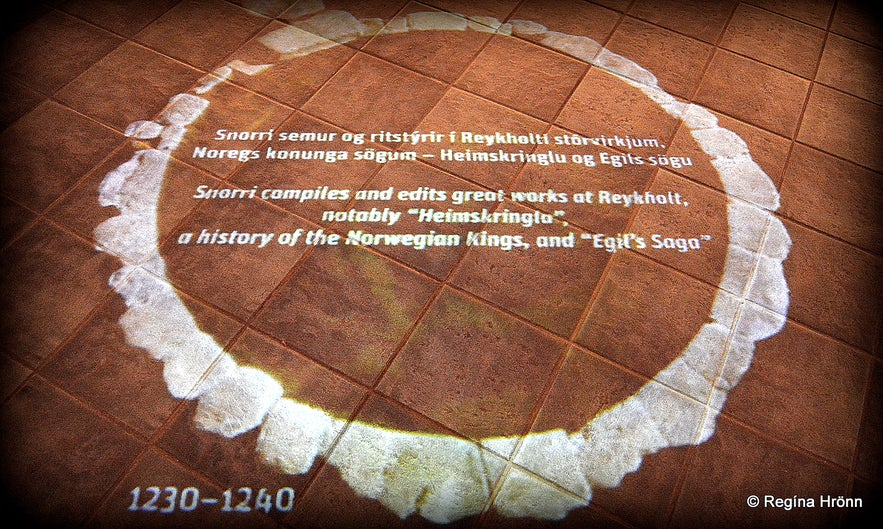
At Snorrastofa
1230-1240: Snorri compiles and edits great works at Reykholt, notably "Heimskringla", a history of the Norwegian Kings, and "Egil's Saga".
1236: Sighvatur and Sturla, Snorri's brother and nephew, come to Borgarfjörður from the North with a thousand men and drive Snorri from his home, ending his chieftaincy of Borgarfjörður.
1237: Snorri's son, Órækja, makes a pilgrimage to Rome.
1237: A battle concerning Snorri's interests takes place at Bær in Borgarfjörður. Snorri was not present.
1237-1239: Snorri's second visit to Norway. He receives Duke Skúli's protection. 1239: Duke Skúli makes Snorri an Earl.
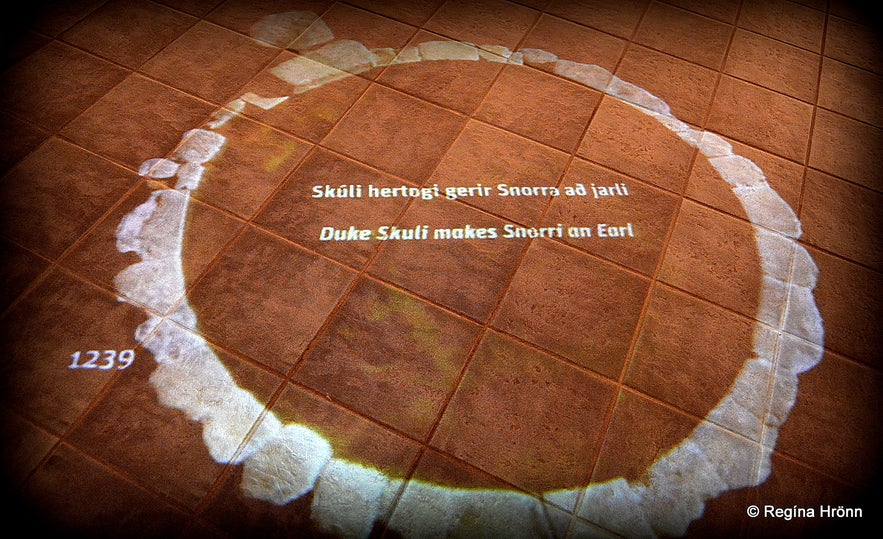
At Snorrastofa
1239: King Hakon forbids Snorri from leaving Norway and returning to Iceland.
1239-1240: Snorri returns to Iceland and proceeds to negotiate for peace in his domain.
1241: Hallveig Ormdóttir, the mistress of Reykholt, dies in July.
1241: In the autumn, Gissur Thorvaldsson (Snorri's former son-in-law) plans an attack on Snorri at Reykholt at the behest of the Norwegian King Hakon.
September 23rd, 1241: "Eigi skal höggva!" - "Thou shalt not strike"!
Snorri Sturluson was murdered here in Reykholt by his enemies, defenseless, in a spiral staircase leading down to the cellar. His final words were: "Eigi skal höggva!" or "Thou shalt not strike!"
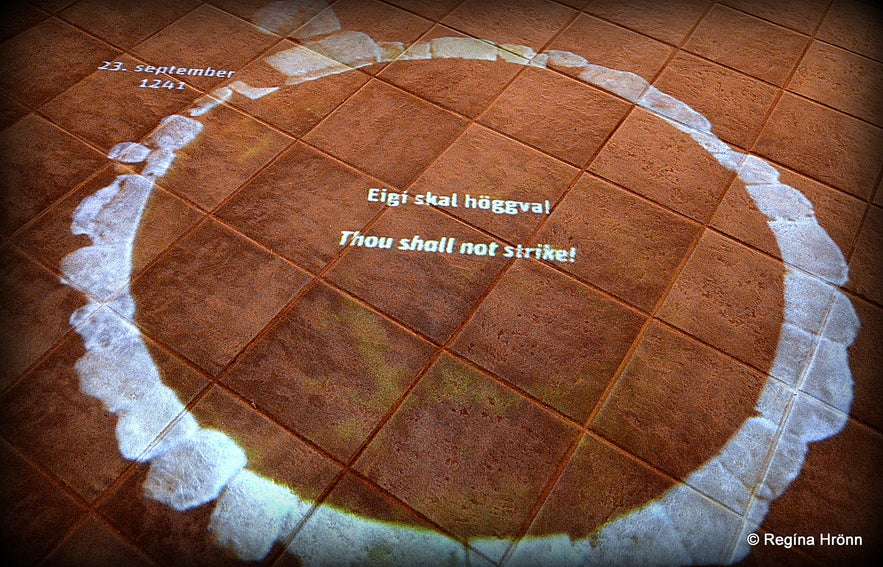
Eigi skal höggva - thou shalt not strike!
At Snorrastofa, there is a visitor centre and a museum about Snorri Sturluson and Reykholt, and a store where one can buy Snorri's literature, books on Snorri Sturluson, and, for example, this beautiful 18-carat gold ring, which was found during the archaeological excavations in 2005.
Is this Snorri's ring?
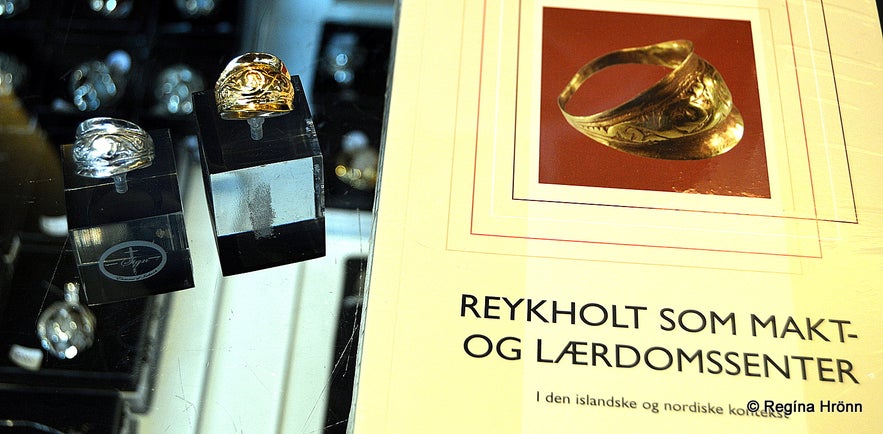
The ring found at Reykholt
The original ring is kept at the National Museum of Iceland. A copy of the ring can only be bought at Snorrastofa and at the National Museum of Iceland.
This ring is ever so popular and sells like we Icelanders say "heitar lummur" ;) I would not mind owning such a beautiful ring.
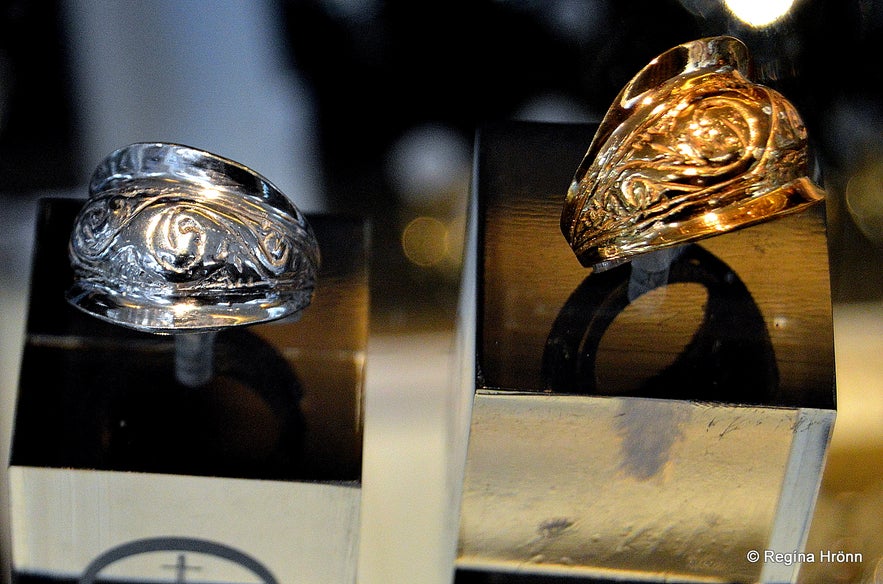
The replica of the ring found at Reykholt
Snorri was the most noteworthy man of the Nordic countries, and Reykholt has been called the Mecca of the Norwegians. I am sure that most Norwegians visit Reykholt during their stay in Iceland.
My father-in-law and I guided a group of Norwegian friends who were eager to visit Reykholt, and I could see it was a moving experience for them.
There is a statue of Snorri Sturluson in Reykholt by Gustav Vigeland, Norway's most famous sculptor. In 1947, Olav V, the crown prince of Norway at the time, brought this statue as a gift from the Norwegian nation.
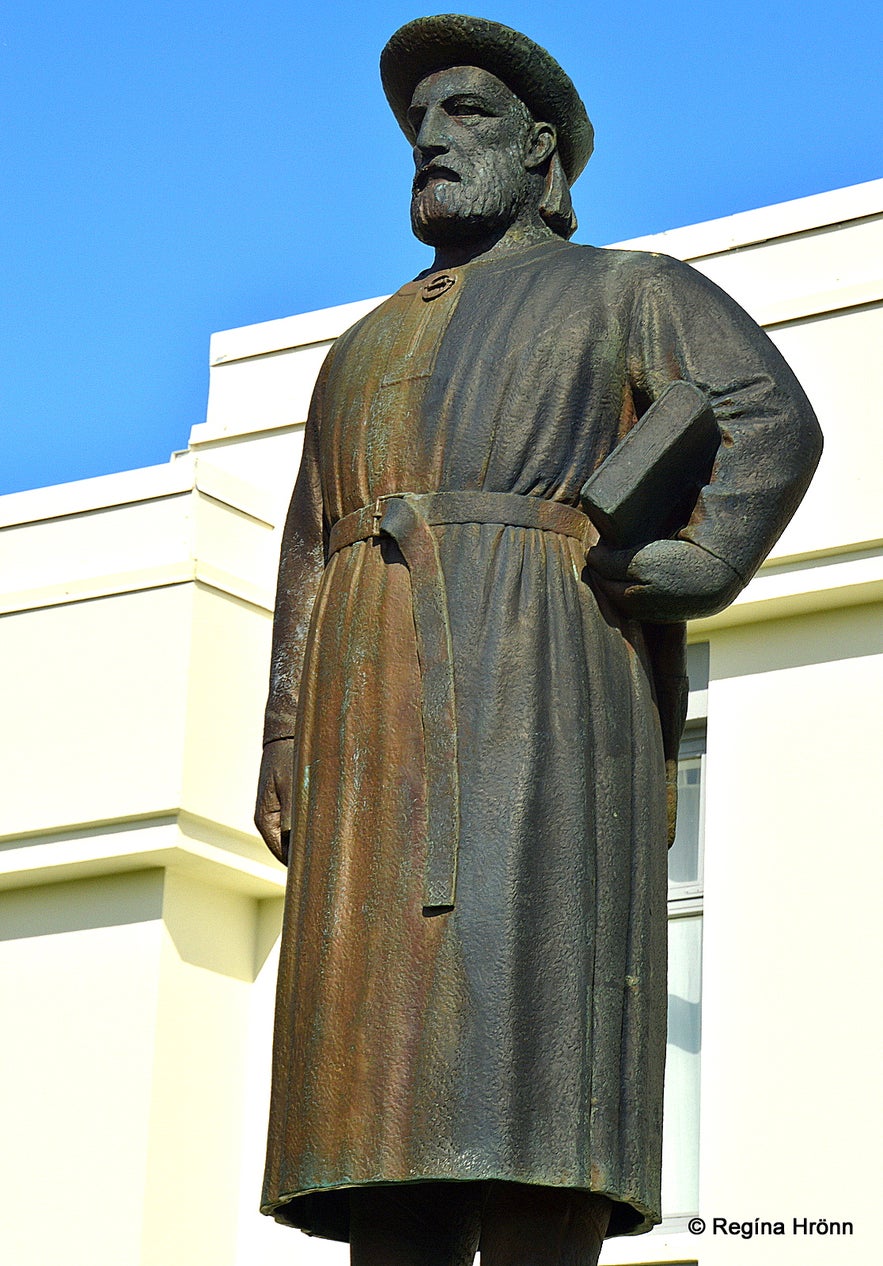
The statue of Snorri Sturluson
Snorri was married twice, to Herdís and then Hallveig, and had two children by Herdís and two stepsons by Hallveig. Snorri also had children with three other women: Guðrún, Oddný, and Þuríður.
According to Íslendingabók (the Icelandic Book of Relations), Snorri Sturluson was my ancestor:
Snorri Sturluson 1179 - 23.09.1241 and Oddný 1180
Þórdís Snorradóttir 1205
Einar Þorvaldsson 1227 - 1286
Ónefnd Einarsdóttir 1250
Eiríkur Sveinbjarnarson 1277 - 1342
Einar Eiríksson 1320 - 1382
Björn "Jórsalafari" Einarsson 1350 - 1415
Kristín Björnsdóttir 1374 - 1468
Sólveig Þorleifsdóttir 1415 - 1479
Jón Sigmundsson 1455 - 1520
Helga Jónsdóttir 1511 - 1600
Jón Kráksson 1533 - 1622
Sturli Jónsson 1590
Jón Sturluson 1625 - 1700
Einar Jónsson 1676 - 1745
Guðríður Einarsdóttir 1726 - 1772
Oddur Guðmundsson 1770 - 1841
Svanborg Oddsdóttir 1814 - 1877
Helga Ásmundsdóttir 1841 - 1910
Ásmundur Sigurðsson 1868 - 1919
My grandfather, 1903 - 1977
My father, 1942 - 2008
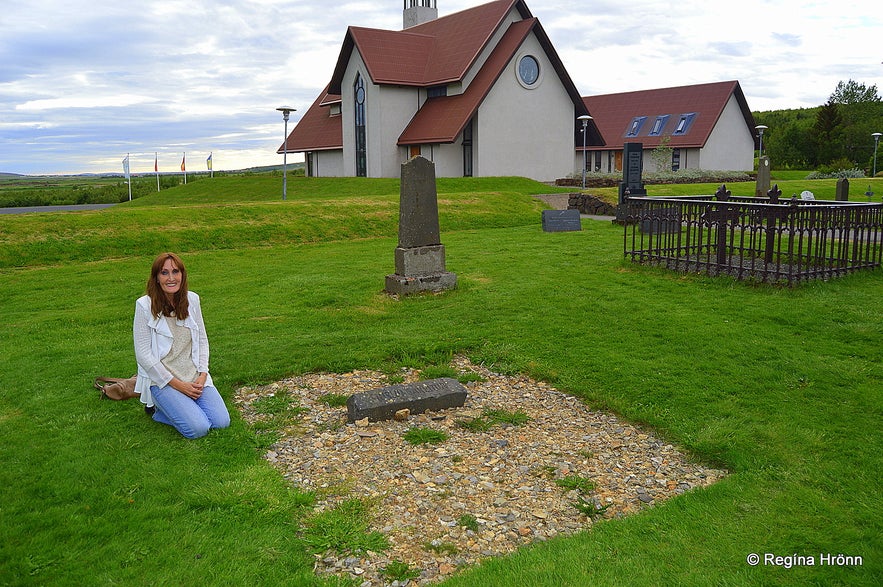
Regína Hrönn 1965
Reykholtskirkja church
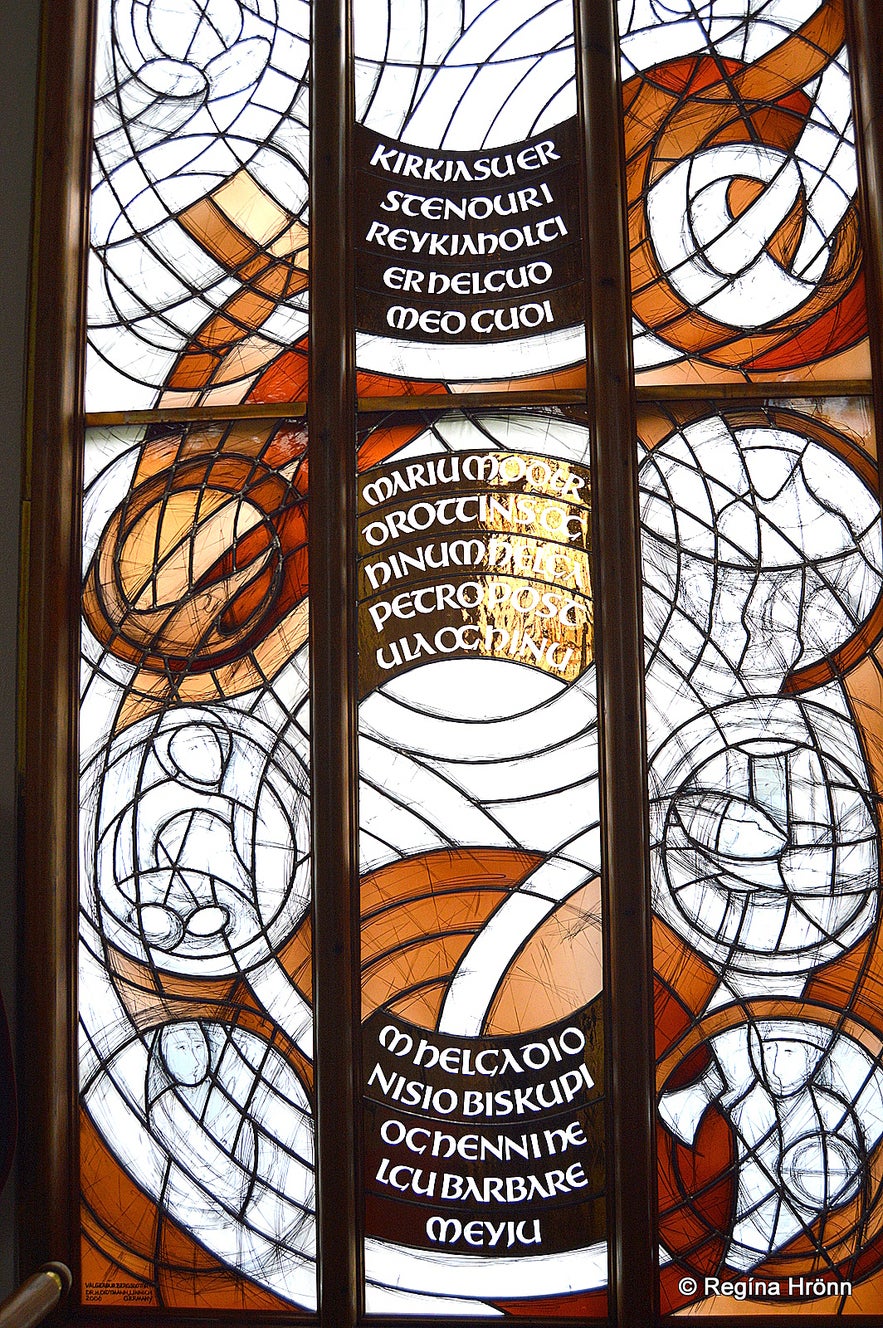
The stained glass windows in Reykholtskirkja church
At Reykholt is a rectory and two churches: the older church of Reykholt, built in 1897, which served as a parish church for 100 years, and the new church, consecrated in 1996.
The new church also serves as a concert hall, with excellent acoustics. I was lucky enough to attend a beautiful concert during my stay in Reykholt when a Danish choir visited.
I visited Reykholt at the end of June, but at the end of July, an annual music festival is held: Reykholtshátíð, or the Reykholt Chamber Music festival.
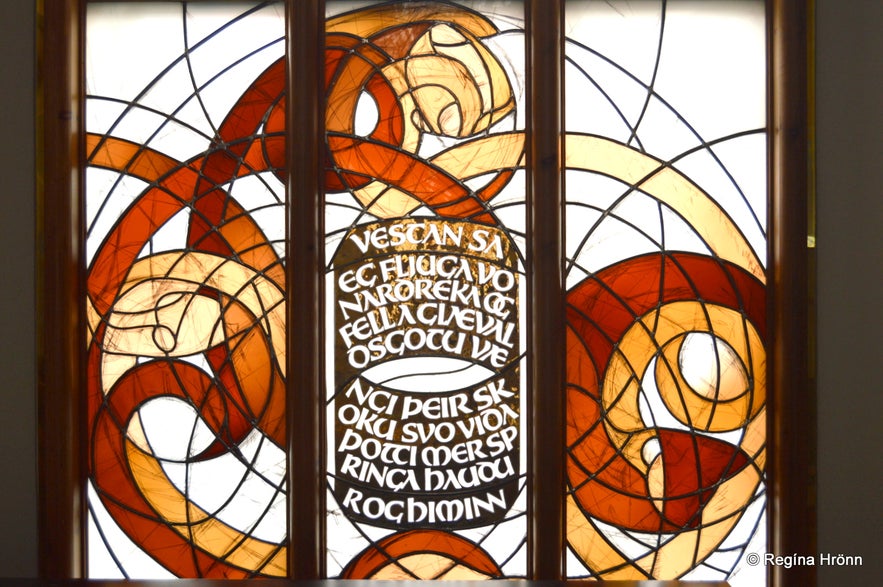
The stained glass windows in Reykholtskirkja church
The award-winning stained glass windows in the new church at Reykholt are ever so beautiful and one of a kind. They were made by the Icelandic artist Valgerður Bergsdóttir.
They are extraordinary as there are no real colours in them, the glass is transparent and mixed with metals, and they change colours in accordance with the light shining upon them.
There are four windows of this kind in the church, and two of them are distinct, as the artist focuses on the written word. The windows are inscribed with an old Icelandic poem called "Sólarljóð" (the Poem of the Sun) and the Gospel of John.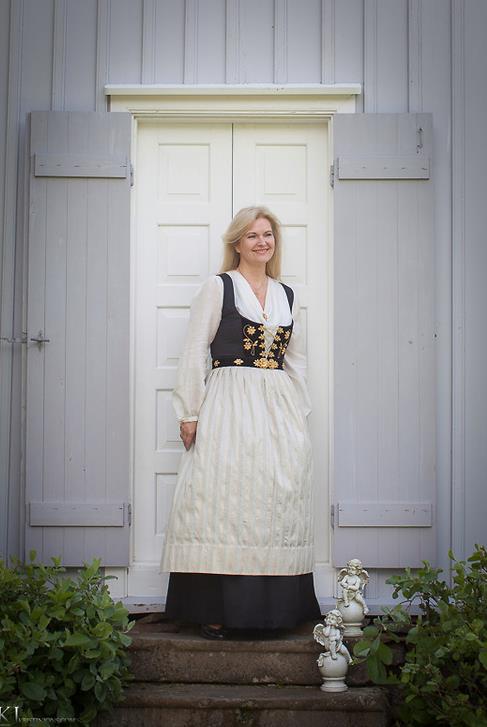
Sigrún in the traditional costume upphlutur by Fitjakirkja church in Skorradalur
The project leader of Snorrastofa is my fellow travel blogger on Guide to Iceland, Sigrún Þormar. You can check out her blog for in-depth information on Snorri and Reykholt.
She is a lovely lady, so knowledgeable and enthusiastic about Snorri Sturluson and Reykholt.
Do pay her a visit at Snorrastofa for a guided tour of the exhibition on Snorri Sturluson.
Reykholt is rich in history, and I feel privileged to have been invited to spend two days at this wonderful historical site.
Have a lovely time at Reykholt :)

Hi, my name is Regína Hrönn, and I was born and raised here in Iceland.