In this travel blog, I want to tell you about the burial mounds of Krýsa and Herdís, who are believed to have given their names to Krýsuvík and Herdísarvík on the Reykjanes peninsula. Icelandic folklore tells of these two quarreling women.
I also want to show you the two Eldborg craters, Stóra-Eldborg and Litla-Eldborg, which are close by.
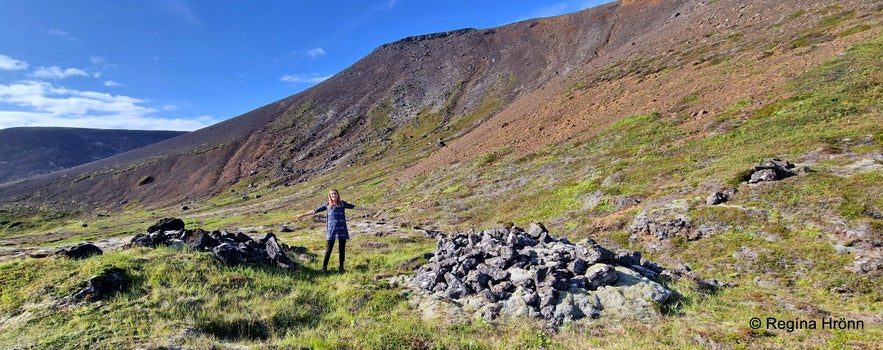
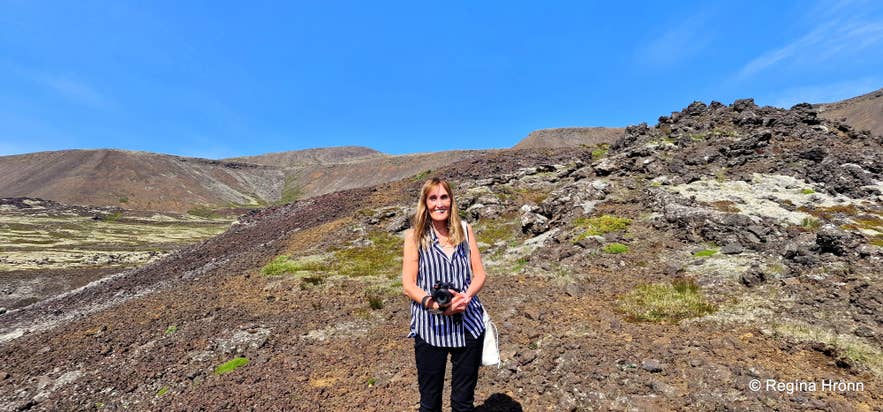
Top photo: By the burial mounds of Krýsa and Herdís
Krýsudys and Dísudys on the Reykjanes peninsula
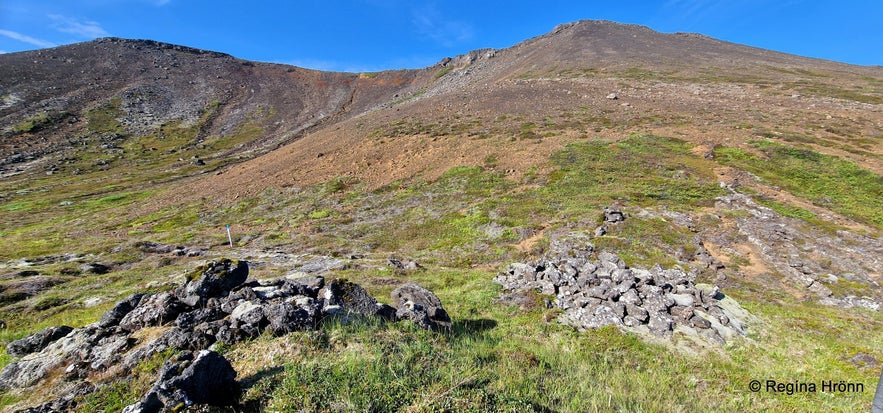
Krýsudys and Dísudys burial mounds - the shepherd's burial mound on the hill
In our folklore, we can read how the Kerlingadysjar burial mounds got their name.
Kerlingadysjar are the collective name for the protected burial mounds of Krýsa and Dísa. "Kerling" is a derogatory word in Icelandic for an elderly woman.
You can see the burial mounds in my photo above. In my photo, the burial mound of Krýs is to the north, and the burial mound of Herdís (Dís) is to the south.
It was a bit difficult to find these protected burial mounds, and I had to visit this area twice before I finally found them.
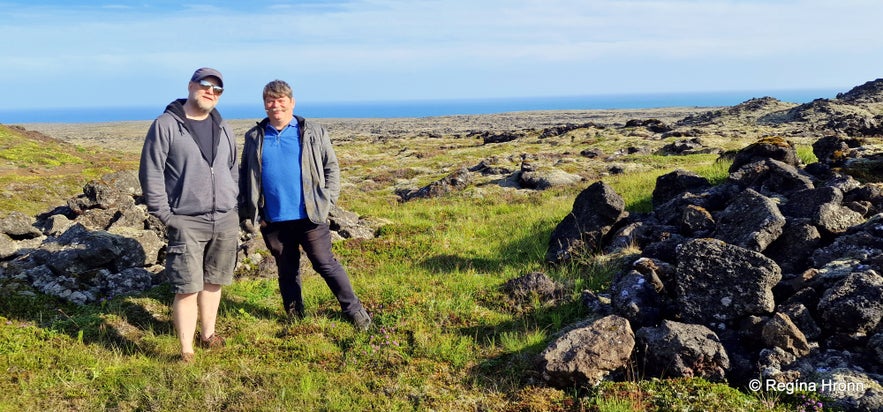
With my husband and a friend at Kerlingadysjar, looking towards the sea
There are a couple of versions of this folklore in Þjóðsögur Jóns Árnasonar - the Compilation of Folklore by Jón Árnason, some short and some long, each one contributing something to the story about Krýs and Herdís.
I love Icelandic folklore, and I translated three of them into English so you can compare them.
Krýsa and Herdís
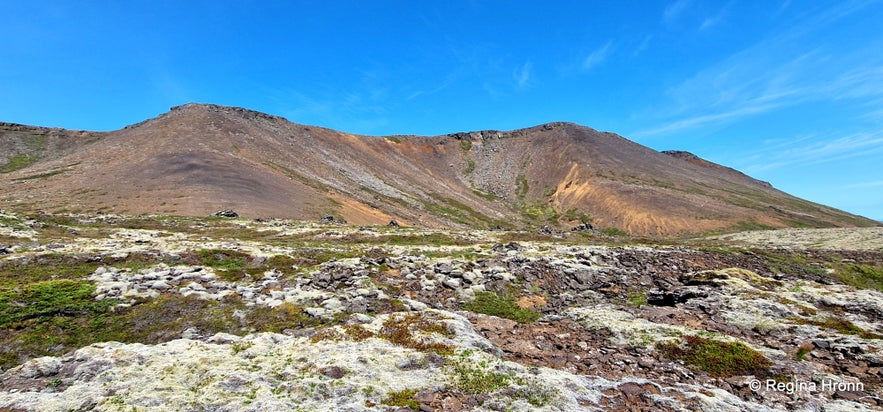
Mt. Geitahlíð
The following is what the folklore Krýsa and Herdís tells us about these two women:
"Þórir haustmyrkur (autumn darkness) settled Selvogur and Krýsuvík. It must have been late in the settlement period, as the southern part of Iceland had become densely populated, according to the account that poor people wandered to Selvogur, both from the sea and south of the mountain.
Þórir didn't like this, so to prevent poor people from wandering into Selvogur, he set up a barred gate locked in Grindaskarð, and another in the pass that leads from Grindavík up to Siglubergsháls.
Grindarskarð and Grindavík got their names from these barred gates (Grindavík is the village in this area, RHR).
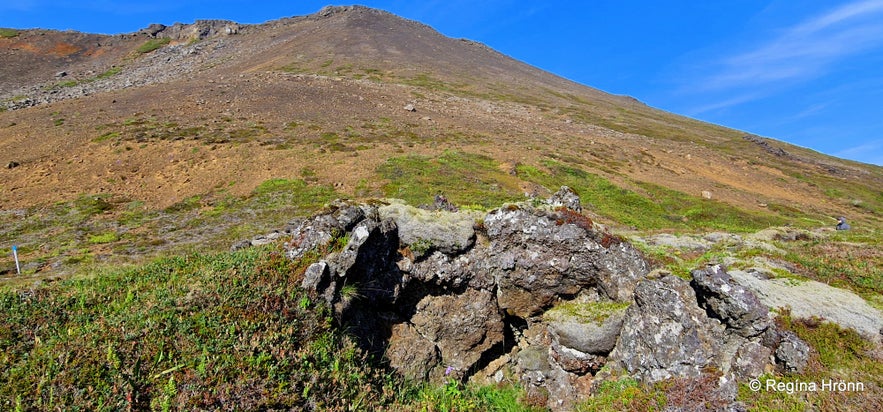
Kerlingadysjar
Krýsa lived in Krýsuvík, and Herdís in Herdísarvík; it was said that they were Þórir’s daughters, but it is hardly more than speculation.
They quarreled over their boundary lines: Krýsa wanted to own all of Mt. Geitahlíð and claimed the boundary was at a large rock, now called the Sýslusteinn, and stands in the lava to the east of the slope’s corner.
Herdís wanted the boundary set at Deildarháls. It is a little bit more west, beneath the middle of Mt. Geitahlíð.
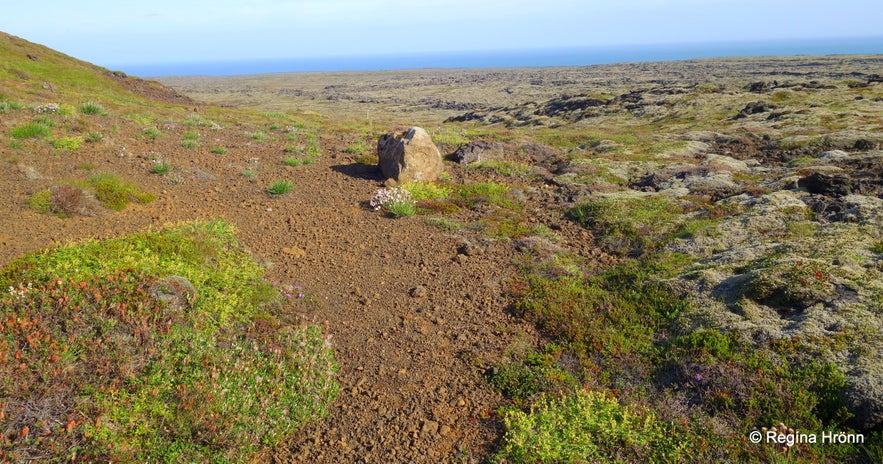
This is not Sýslusteinn, but the only rock that we saw in the mountain hill
Mt. Geitahlíð has spewed fire; a fairly large crater is in it, and from it a lava flow called Klofningur or Klofningar ran.
There, they met and argued fiercely, threatening each other until they both died, and their burial mounds are on a ridge beneath the hill.
We can speculate that Herdís was the first to arrive on foot, because she was doing worse in this argument, although neither of them was winning.
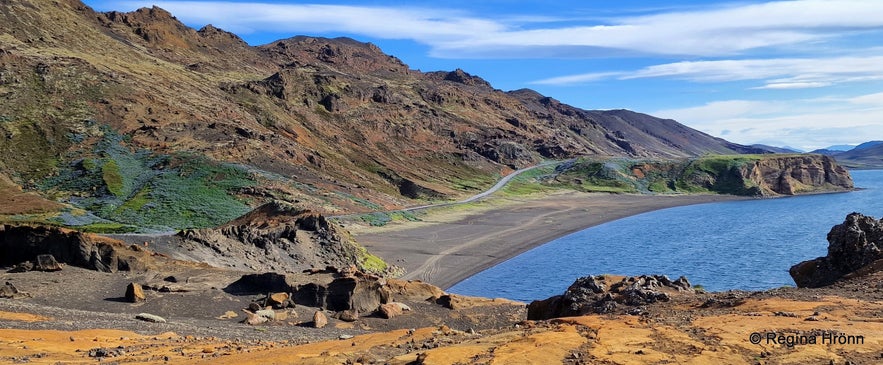
By Lake Kleifarvatn
Until this time, there had been very good fishing in Lake Kleifarvatn in the land of Krýsuvík, and the pond in Herdísarvík was filled with sedge (stör - stararflóð) with a pool of trout in the middle of the pond.
Herdís put on this curse: that all the trout in Lake Kleifarvatn should become loðsilungur, inedible fur-bearing trout.
In return, Krýsa put a curse on Herdísarvík cove that it should eat itself out, be void of sedge, and destroy the farm, and that all the trout should turn into stickleback (hornsíli).
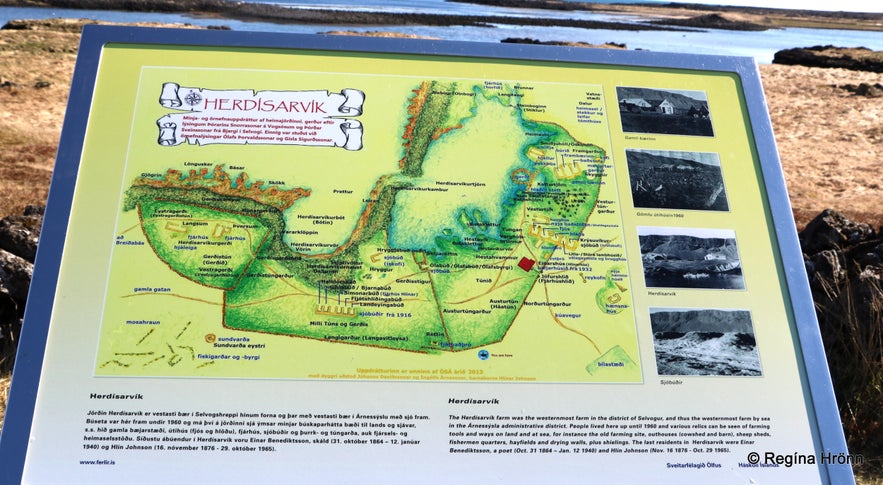
Herdísarvík
She also put the curse that 2 ship crews would drown in the pond. This all happened later.
The farm at Herdísarvík stood earlier by Búrklettur rock, but the pond ruined its foundations, so it had to be moved.
And one winter, when the pond was frozen, fishermen from 2 ships walked across it. The ice broke, and all of them drowned. It still remains risky to walk on the icy pond.
The landmark is where Krýsa wanted it to be, and the rock is called Sýslusteinn - the County Rock.
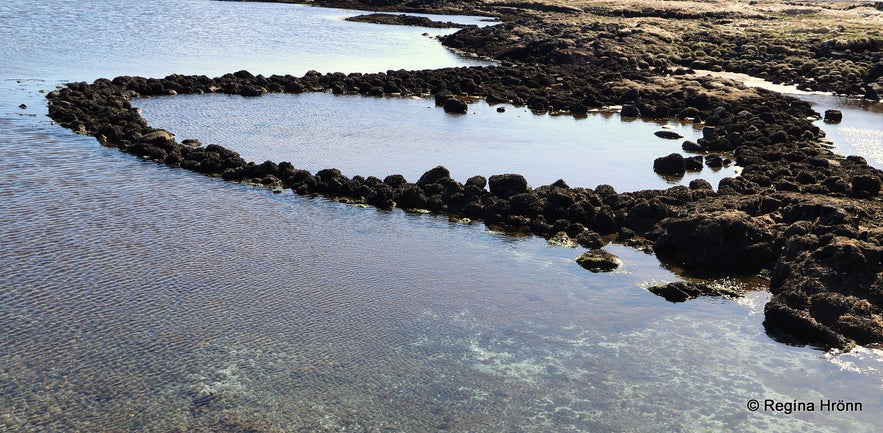
Herdísarvík cove
A little bit east of Kerlingar (the burial mounds of Krýsa and Herdís) are two stones that have also been called Sýslusteinar - County rocks, which have obviously plummeted down from the hill in latter times."
(Translated from Krýsa og Herdís in Þjóðsögur Jóns Árnasonar - the Compilation of Folklore by Jón Árnason)
Sýslusteinninn - the County Rock divides Gullbringusýsla and Árnessýsla counties.
Next is another much shorter version of the folklore:
Herdís and Krýs
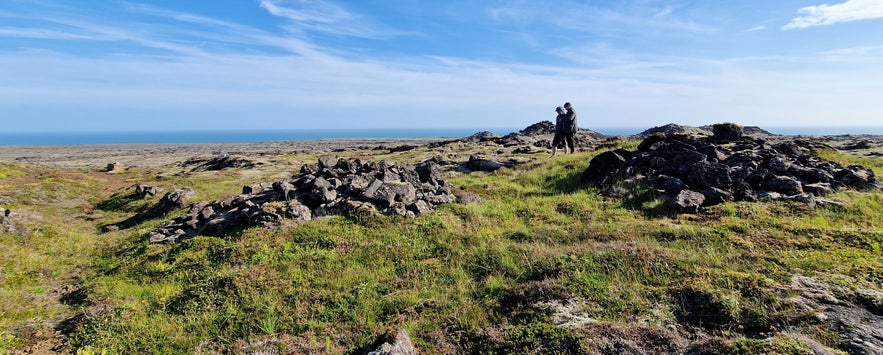
The protected burial mounds
"Herdís and Krýs are the names of two women from olden times; they lived in coves in Gullbringusýsla county, which are since their time named after them: Krýs in Krýsuvík, and Herdís in Herdísarvík.
There was fishing in a lake in the heath. Both of these women claimed ownership of the lake's fishing and fished intensively in it.
Once they met on their way to the lake, in the lava between the coves, they started quarreling over the fishing, threatened each other, and finally turned to stone.
The stones stand on each side of the path in the lava field; the southern stone is called Herdís, and the northern stone is called Krýs."
(Translated into English from Þjóðsögur Jóns Árnasonar - Krýsa og Herdís and Herdís og Krýs)
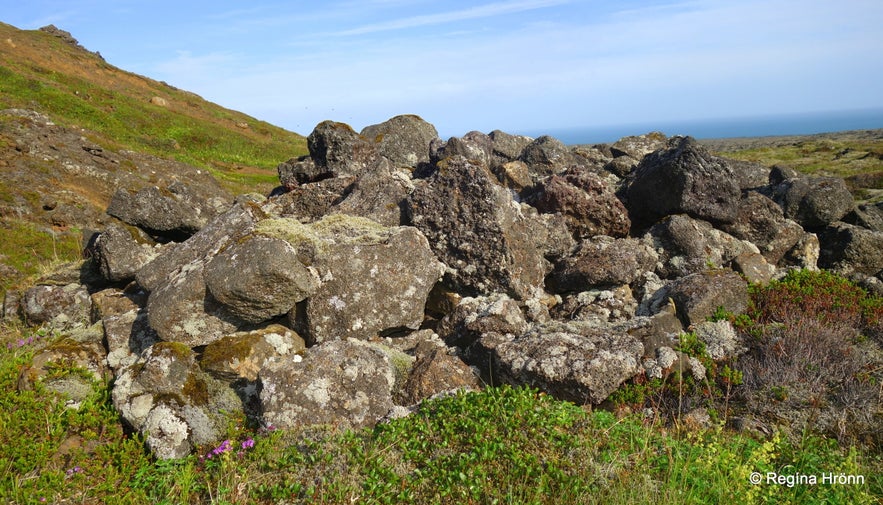
Kerlingadysjar burial mounds
Krýsa and Herdís may have been the daughters of Þórir haustmyrkur, the settler of this area, but this remains uncertain; the only source is this folklore.
Landnámabók - the Book of Settlements has very little to say about Þórir haustmyrkur: "Þórir haustmyrkur settled Selvogur and Krýsuvík, but his son Heggur lived at Vogur. His other son's name was Böðmóður."
There is no mention of him having daughters. The other mention of Þórir is that his brother, Steinn mjögsiglandi Vígbjóðsson, settled Skógarströnd in West Iceland. This Steinn is my ancestor 30 generations back.
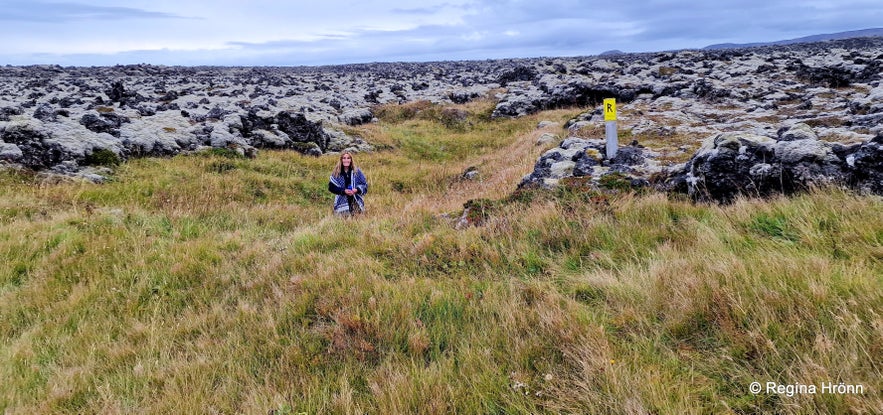
Did these women first live at Húshólmi with their father? We have no idea who lived here
We also have no Saga about the settlers of this area; it may not have been written, or it may be one of the invaluable Sagas that were lost or even eaten during famine.
I have told you about the ruins of the early settlers at Húshólmi, which is close by. According to Landnáma, Þórir haustmyrkur was the settler of Krýsuvík:
Húshólmi - a Hike to the Ancient Ruins in the middle of Ögmundarhraun Lava Field
Krýs and Herdís
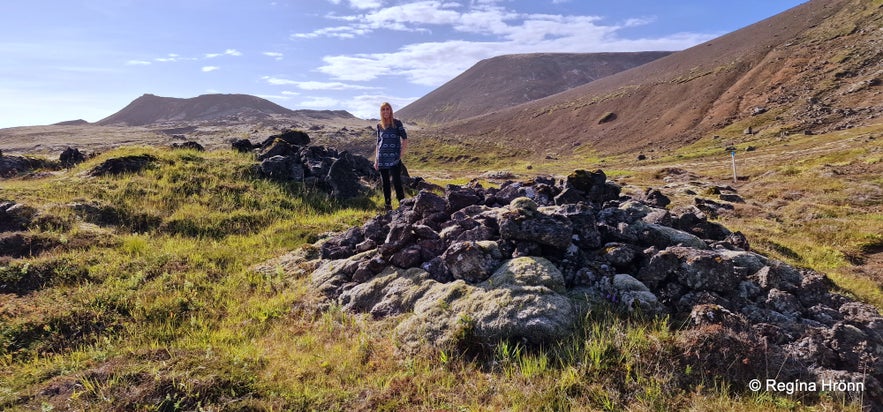
By Kerlingadysjar - Stóra-Eldborg in the distance
Now, let's have a look at the longest version of the folklore I found in Þjóðsögur Jóns Árnasonar, called simply " Krýs og Herdís". It also tells us about the shepherd in the 3rd burial mound:
"In the southern part of Iceland, there are two farms: one, called Krýsuvík, is the easternmost farm in Gullbringusýsla along the seashore, and the other, called Herdísarvík, is the westernmost farm in Árnessýsla.
These are the nearest farms on either side of the county boundary; both are settlement estates and, so it is to be understood, that each was named after the woman who settled it and lived there for a long time.
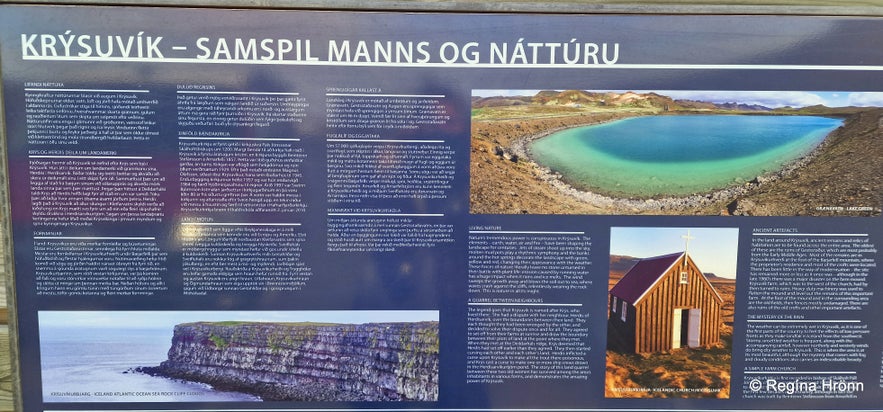
The information sign about Krýsuvík includes one version of the folklore
The one who built Krýsuvík was called Krýs, and Herdís set up a homestead in Herdísarvík.
These estates have always been counted among the best holdings in the country, and this is not surprising, for both have access to the sea, large bird cliffs, and plenty of driftwood.
On land, both farms owned fine fishing lakes: Krýsuvík, many to the south and east of the farm where it stands now, while Herdísarvík had one small pond in the home field between the sea and the farm.
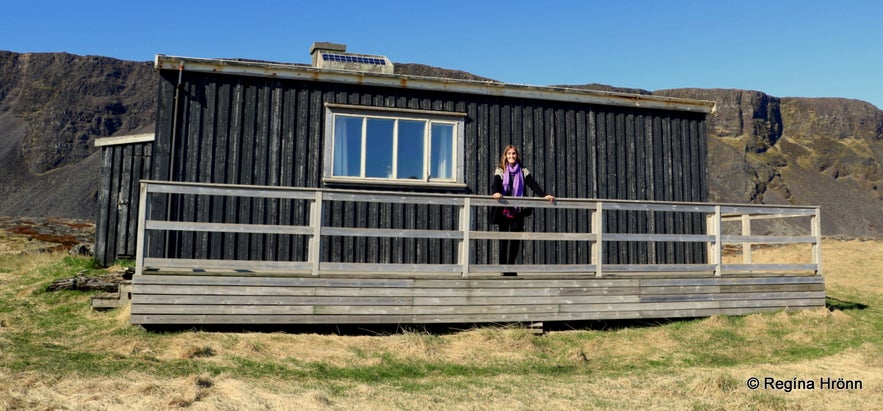
At Herdísarvík
Right by the fishing lakes, Krýsuvík owned a large and beautiful sedge meadow (starengi), which provided a truss for 300 horses to carry per year.
Herdísarvík, on the other hand, had no meadow, but pasture land so much better for sheep than Krýsuvík’s that the pasture in Herdísarvík’s lava rarely becomes void; it is both sheltered by the mountainside that runs along the entire northern edge of the lava and is called Mt. Geitahlíð, and there is a large forest.
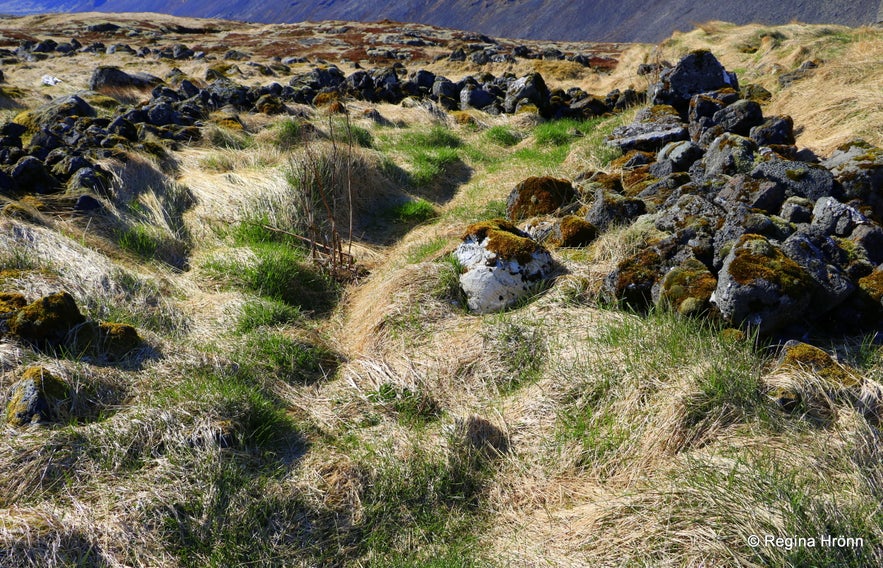
Ruins at Herdísarvík
Now, though the road between these farms is a considerable distance, an 18.75 km ride (hálf þingmannleið), because Krýs and Herdís were neighbours, there was intense neighbour rivalry between them.
Because each envied the other for the land advantages the other supposedly had: Krýs envied Herdís for the pastures, and in turn Herdís envied Krýs for the meadow.
For a long time, each gave the other harsh troubles; Krýs drove her sheep into Herdís’s land, and Herdís sought to gain access to the meadow in return.
They contended back and forth in this way, either because the boundaries seemed unclear or because there were none at the time.
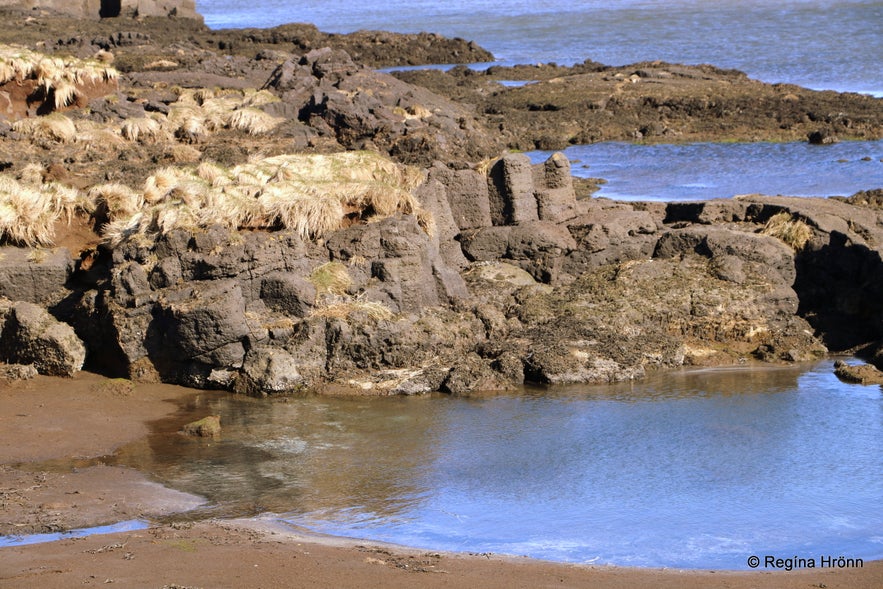
Herdísarvík in spring
When the two neighbouring women grew older, they were less inclined to act on their desire to covet what the other possessed, but their tempers did not become milder for that reason.
Once, Herdís had walked out onto the lava and then along Mt. Geitahlíð as the path led out toward Krýsuvík. But farther along the slope, some heights extend from the lava; they are called Eldborgir. The road runs over these heights.
On the same day Herdís set out on this walk, Krýs also left home.
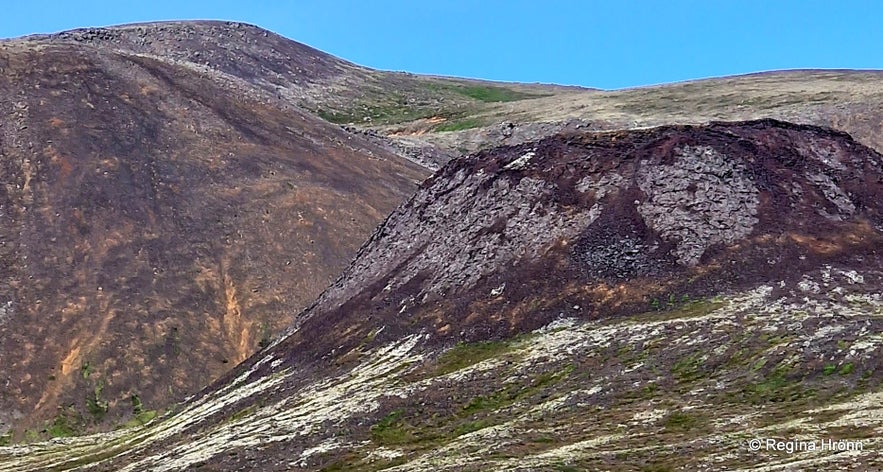
Mt. Stóra-Eldborg and Geitahlíð
South of Krýsuvík, there is a flat, gravel track; it is a somewhat long stretch running south beneath the corner of Mt. Geitahlíð, and when one comes past that corner, the Eldborgir rise to the south along the slope and are quite near there under the lip of the hillside.
In a short while, Krýs reaches the road where it crosses the northern Eldborg, and there Herdís, coming from the south, bumps into her.
When they met, there were few greetings, but many insults were exchanged, as each claimed ownership of the land they stood on.
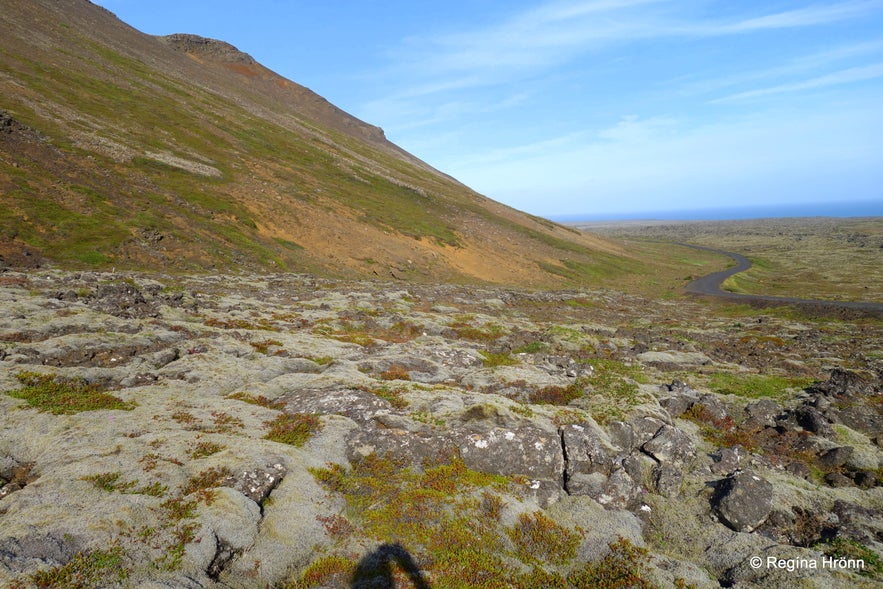
Herdís arrived from the south
It is not stated exactly which words they used, but it ended with each cursing the other over the land dispute.
Krýs put a curse that all the trout would vanish from Herdís’s fishing pond, and that it would instead be full of loðsilungur (a poisonous, furry trout caused by a spell - if you eat it, you die), some say reverse-fin trout (öfuguggi).
Herdís, in turn, laid the spell on Krýs that all the trout in her fishing lakes should turn into stickleback (hornsíli).
Krýs further cursed that two or three ship crews should be lost from Herdísarvík.
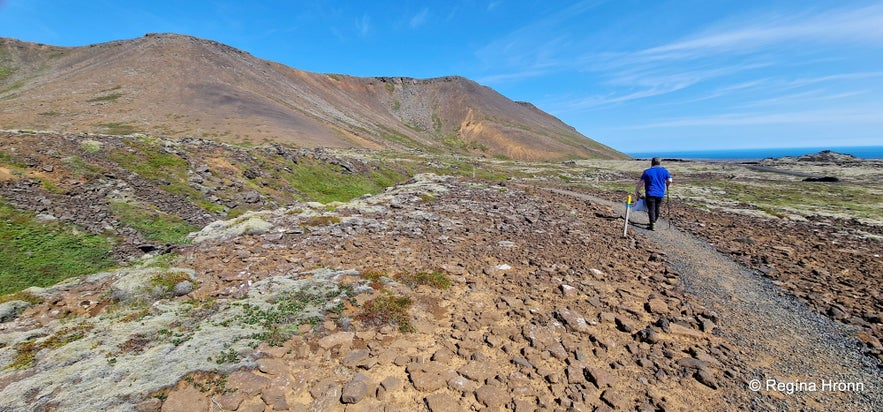
My magician husband was lucky not to have run into the two quarreling women on this path
Herdís, in turn, proclaimed that the meadow (starengi) at Krýsuvík would sink a little every twenty years, and then reappear over the same length of time.
After these pronouncements, both women burst where they stood and were both buried to the left of the track when riding out to Krýsuvík northward, on the northernmost Eldborg.
Their burial mounds are still seen there; Krýs’s cairn is the one nearer Krýsuvík, and Herdís’s is the one farther away.
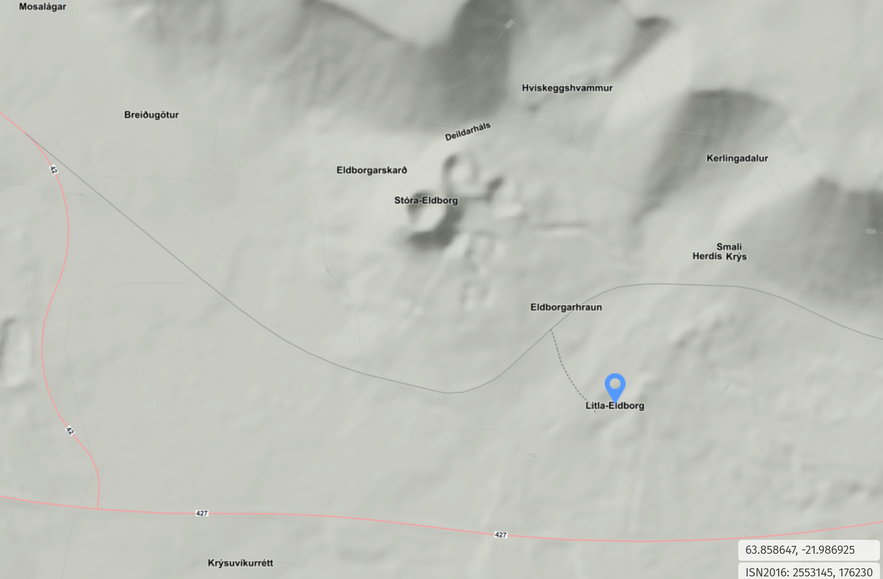
A screenshot of a map of the area - Náttúrufræðistofnun
While the two women were hurling their curses at each other, the shepherd from Krýsuvík arrived, and the curses affected him so that he fell dead on the spot; he is buried on the right side of the road up there above their cairns so that only the track separates them.
Their burial mounds (cairns) of the two neighbouring women (and maybe sisters, RHR) are still called Krýs and Herdís, and thus mark the county boundary between Gullbringusýsla and Árnessýsla, and are also considered landmarks between Krýsuvík and Herdísarvík.
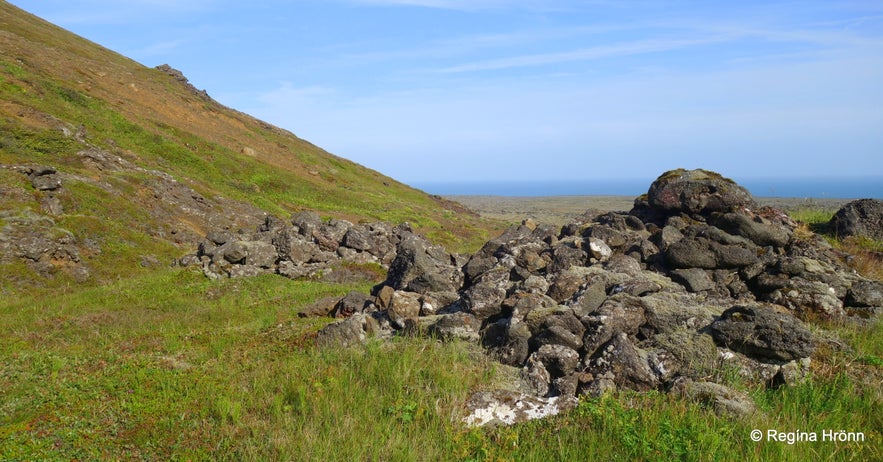
Kerlingadysjar and Smaladys on the hill
Regarding the women's curses, it should be said that no trout has since then been caught in Krýsuvík’s fishing lakes, as far as anyone knows, but they are full of stickleback, and no trout has been seen in Herdísarvík’s pond either; people suppose there may have been loðsilungar there, though no one is known to have died from them.
Again, one winter after this, fishermen launched from Herdísarvík early in the morning; it is a short route across the pond when it is frozen; they all perished when they fell through the thin ice on the frozen pond, and people say there were twenty-four of them.
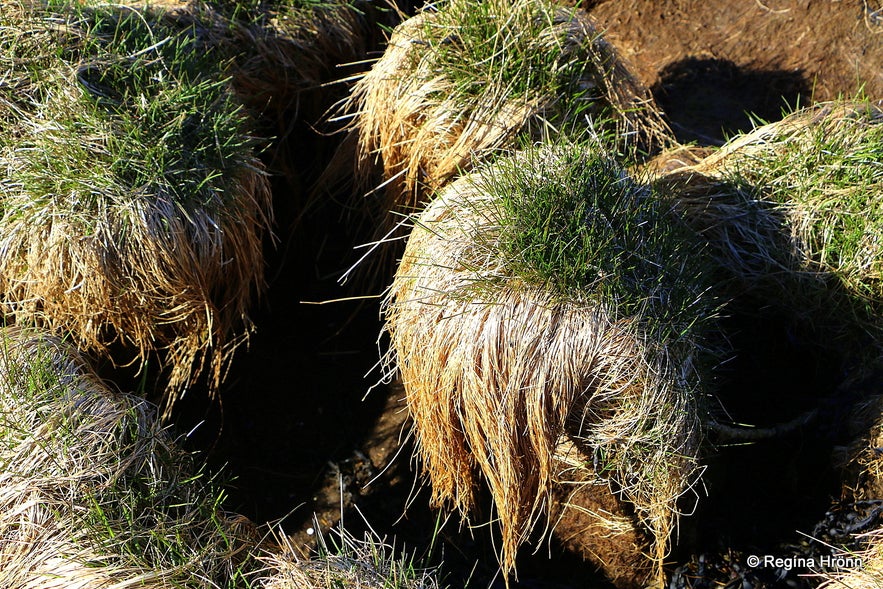
Tussocks in Herdísarvík - they looked like wigs
Concerning the meadow at Krýsuvík, it is still evident today that it sinks little by little toward the pond, so that the water spreads higher up onto the meadow, until, after twenty years, it has covered the whole meadow.
But then the pond gradually recedes, so the meadow comes up again until it is as good as before after another twenty years, and even today it provides a truss for 300 horses to carry per year (each horse carried around 100 kilos - RHR)
(Translated into English from Þjóðsögur Jóns Árnasonar - Volume I, pages 459-460)
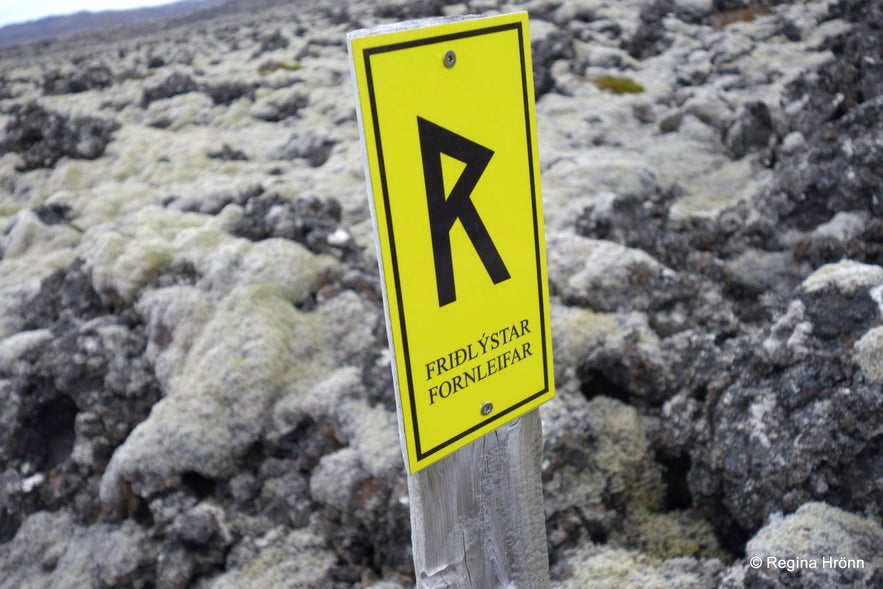
The yellow sign indicating preserved or protected antiquities - this one is at Húshólmi
The burial mounds are protected, and so is the path between them.
No yellow sign was in sight, but the yellow sign indicates that we are visiting an old, protected site of interest.
The sign might have either been blown away or damaged in the snow. There was nothing to indicate that I was here by protected burial mounds, known to many of us from Icelandic folklore.
So it was really difficult to find them, as I only had one photograph from the excellent Ferlir's website to go by.
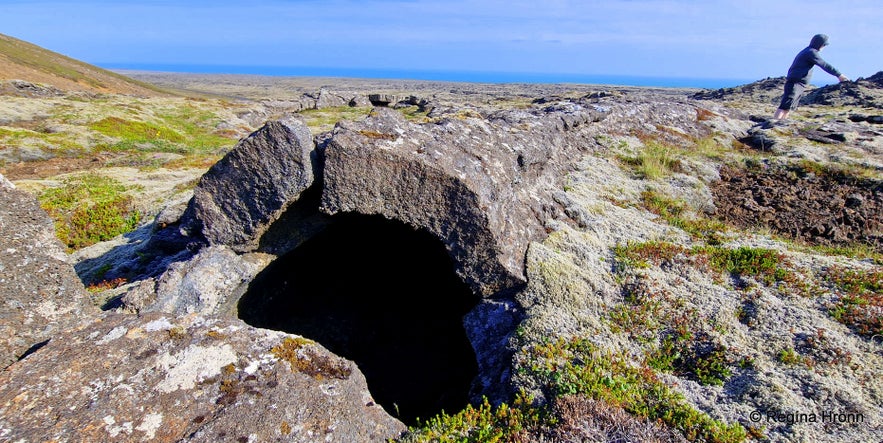
A lava tube by Kerlingadysjar
The burial mounds are located in a lava field, and lava can take many forms, as it certainly did at Kerlingadysjar.
While exploring this area, we found a cave by the burial mounds. We had been walking on its roof while searching for Kerlingadysjar, without even realizing it.
We peeped into it, and to our surprise, saw that somebody had thrown away a white plastic chair. It looked very out of place.
We saw several such lava formations, which I guess are hollow lava tubes.
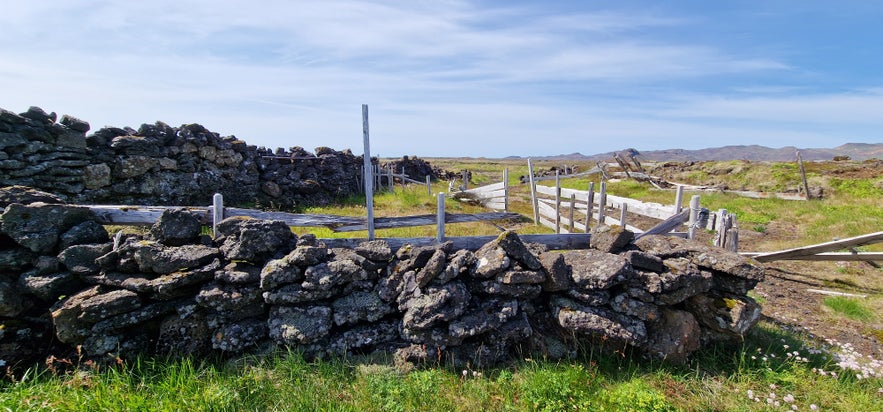
Eldborgarrétt sheep-pen close by is made of lava and by a fissure, also called Krýsuvíkurrétt
There is another place name that indicates the women fought here: Kerlingadalur valley.
As I mentioned earlier, I made two separate trips to this area because I couldn't find the burial mounds on my first visit.
Now, let's check out the two Eldborg - City of Fire craters near the burial mounds, which we visited on our first trip.
Stóra-Eldborg & Litla-Eldborg craters
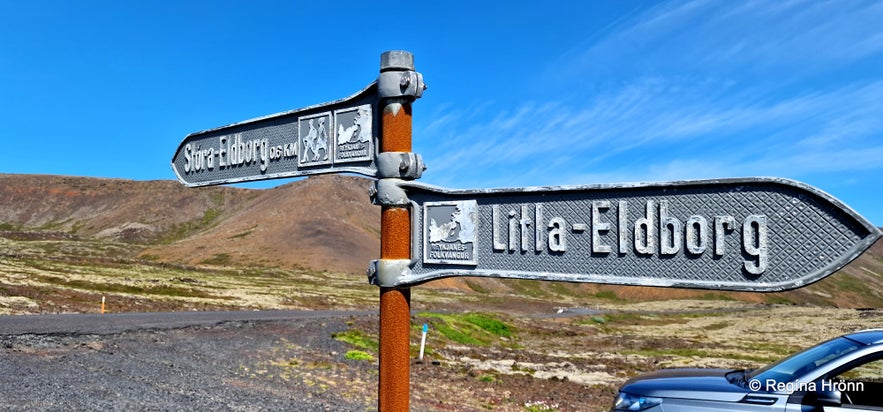
The sign by the parking lot pointed towards the two craters
We checked out two protected scoria-and-spatter cones (craters), Stóra-Eldborg and Litla-Eldborg - the Big-Eldborg and Little-Eldborg or Big- & Little Cities of Fire.
The Holocene Stóra-Eldborg crater belongs to a crater sequence: a row of craters in a volcanic fissure vent by the table mountain Geitahlíð. It is the largest of these craters.
According to the information sign at Litla-Eldborg, the volcanic eruptions in Litla-Eldborg were part of a parallel eruption that occurred some 5,000 years ago (geologists at Vísindavefurinn say it erupted approximately 3,500 years ago).
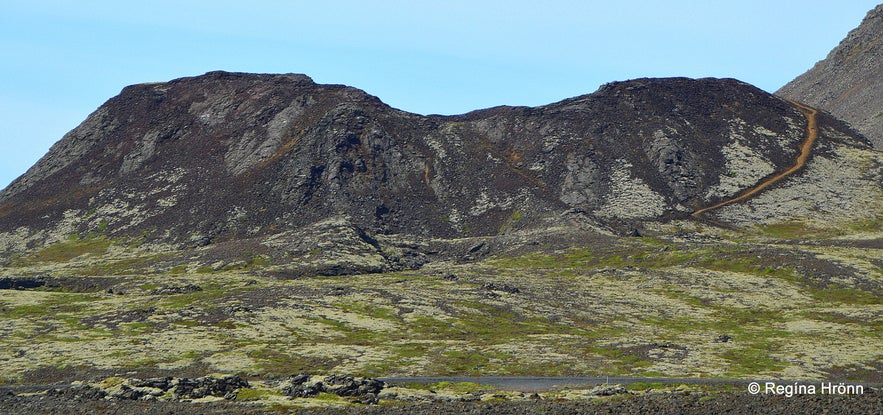
Stóra-Eldborg
Stóra-Eldborg is much older than Litla-Eldborg, and the lava flowed in one direction towards and into the sea at Krýsuvíkurbjarg. The lava from Litla-Eldborg lies in part atop the older lava from Stóra-Eldborg.
I had heard from one tour guide that Stóra-Eldborg was the most beautiful crater in the southwest corner of Iceland. So I was eager to check it out.
We had talked for years about checking out these craters, and finally, on a sunny summer day, we made the trip from our hometown, Reykjavík, to explore the area.
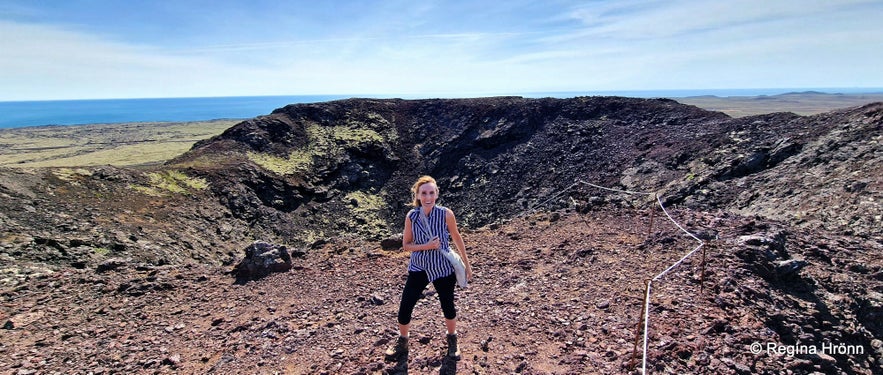
Trying not to blow into the crater
We left the car in the parking lot, where a sign pointed to both craters.
A gravel path leads up to the scoria crater Stóra-Eldborg. The crater is approximately 30 meters deep, but Stóra-Eldborg is approximately 50 meters high.
The hike is easy, but once on the top of Stóra-Eldborg, the wind was so strong I couldn't hold the camera steady, let alone my mobile phone, and feared I would be blown into the crater.
In the photo above, I am almost flattened by the strong wind, so I didn't dare get any closer to the crater, even though my husband kept telling me to take at least one step back.
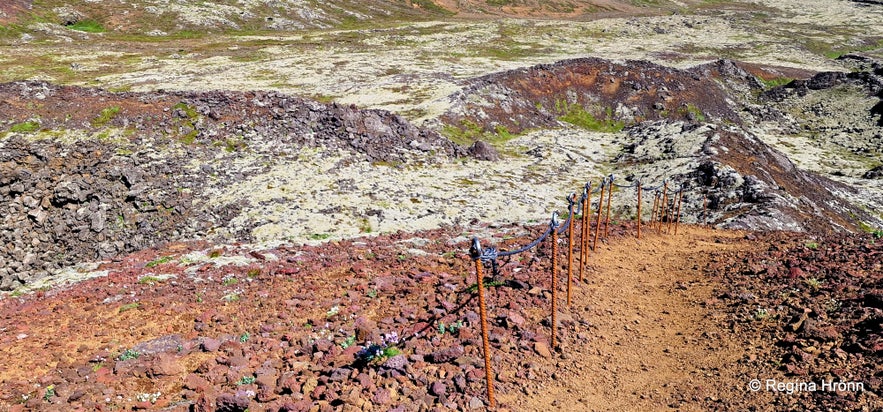
Descending from Stóra-Eldborg
Fortunately, I don't always listen to this joker ;) Maybe on a still day, but not in this strong wind.
The sun was in the "wrong" position for photos, so I didn't get to enjoy the beauty of the crater, but it was still a fun and colourful short hike in the sunshine.
When we ascended Stóra-Eldborg with the strong wind at our backs, I really appreciated having a rope to hold onto. I still have this fear of slipping on gravel paths, and the wind for sure wasn't helping.
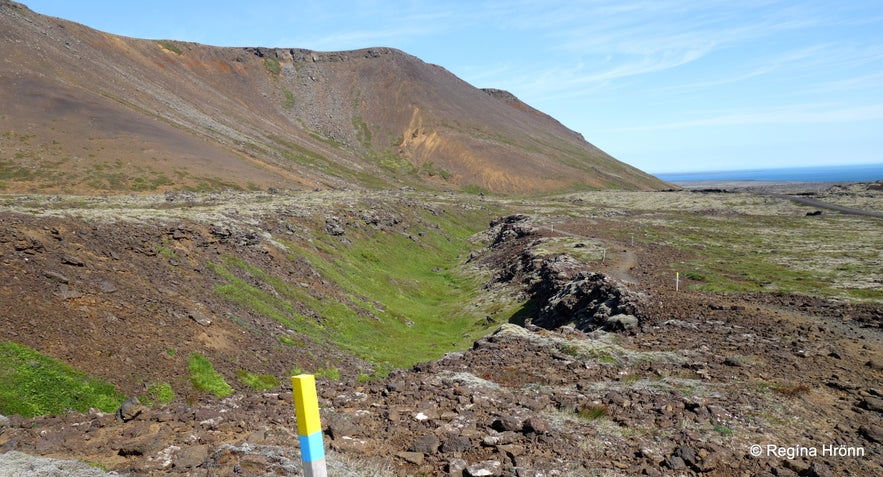
Returning by the path, which is by the lava channel
The path to Stóra-Eldborg runs along a prominent lava channel. This lava channel only became noticeable to us when we were on top of Stóra-Eldborg.
Grass and moss are now growing in the lava channel. You can see the old road from where the hike starts in my photo above.
I saw a "lava rose" right by the path on Stóra-Eldborg scoria crater. I find such lava roses so pretty.
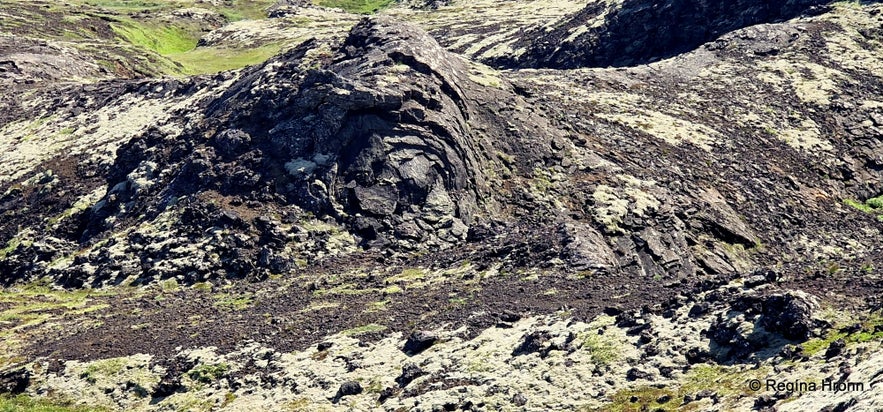
A "lava rose" by Stóra-Eldborg
I refer to such geological phenomena as lava roses, but then I am not a geologist, just a layman. There is, for sure, a geological name for this kind of lava.
When we had descended from Stóra-Eldborg, a lovely French couple stopped us and said they always plan their journeys to Iceland by reading my travel blogs, and they also recognized my husband, Jonni, from the photos I post :)
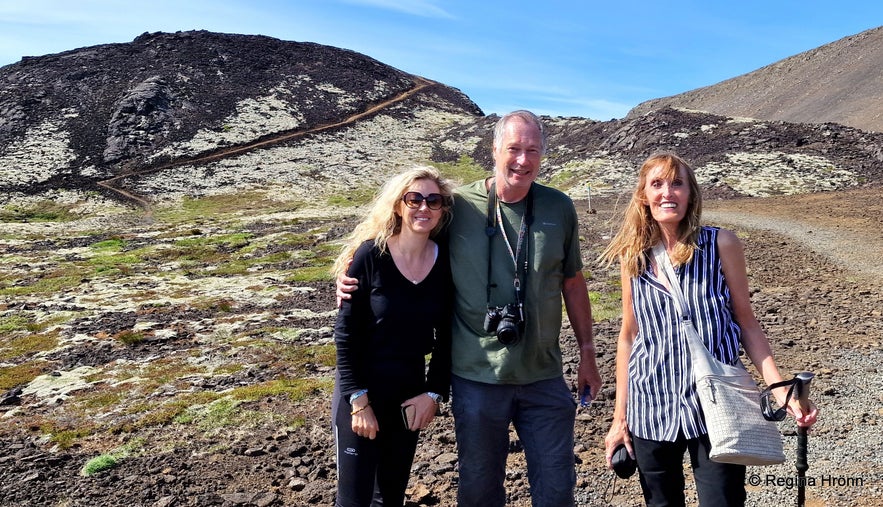
Stóra-Eldborg behind us
I really appreciate it when people who read my travel blogs stop me and chat, since I write them alone at home as a hobby and never know who, if anybody, reads them.
We are now friends on Facebook, and I follow their travels as well :)
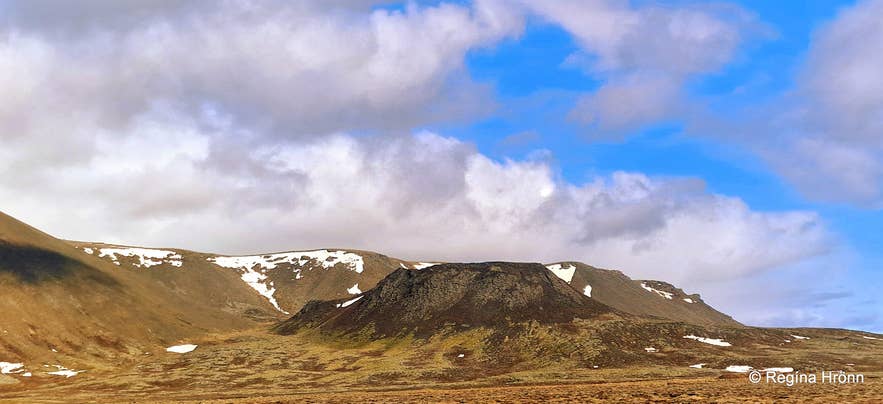 Stóra-Eldborg as seen from the road
Next, we visited Litla-Eldborg. It is so small now that I cannot even say that we hiked on it; we just walked to the top.
Litla-Eldborg
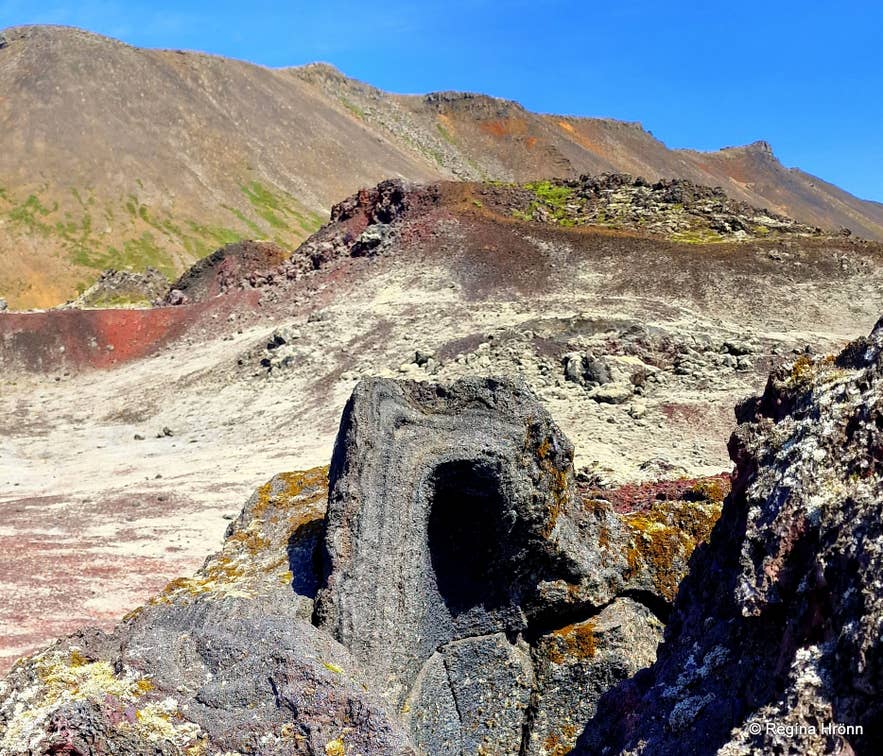
Beautiful rock formations by Litla-Eldborg crater
The hike on Litla-Eldborg is very easy; you only have to take a few steps to reach the top of that crater.
It was larger, but due to gravel mining, much of the material had been removed before it was protected as a natural monument in 1987.
This happened to many craters, such as Grábrók in West Iceland and Rauðhólar pseudocraters in southwest Iceland. And several other craters were greatly damaged.
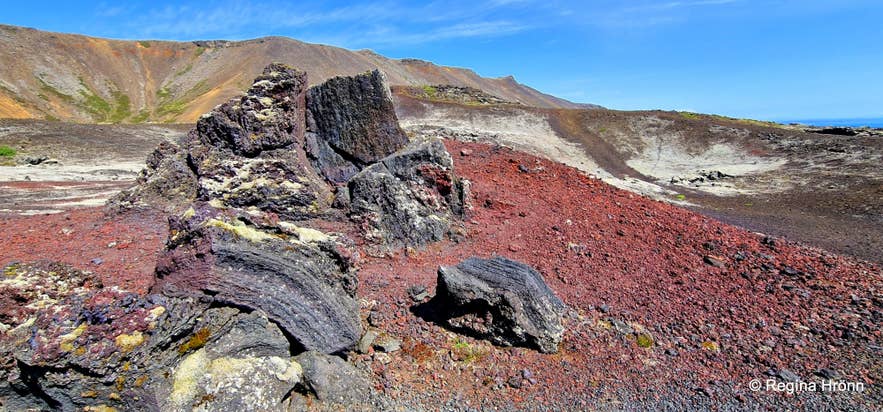
Colourful lava in Litla-Eldborg
But it has also revealed the very colourful lava inside the craters; the red lava becomes much more vivid when the craters have been tampered with, as you will also notice at the Seyðishólar craters in Grímsnes in South Iceland.
You can see these very colourful craters in my last photos of the following travel blog:
Kerið crater and Nykurinn - the Water-kelpie in South Iceland. I have seen nothing like them in Iceland; the red colour is striking, so bright and vivid.
But, of course, we want to keep these volcanic craters intact, so I am glad they are now protected. But this also means that we, who hike on them, cannot take small lava fragments as souvenirs, as I used to when I was younger.
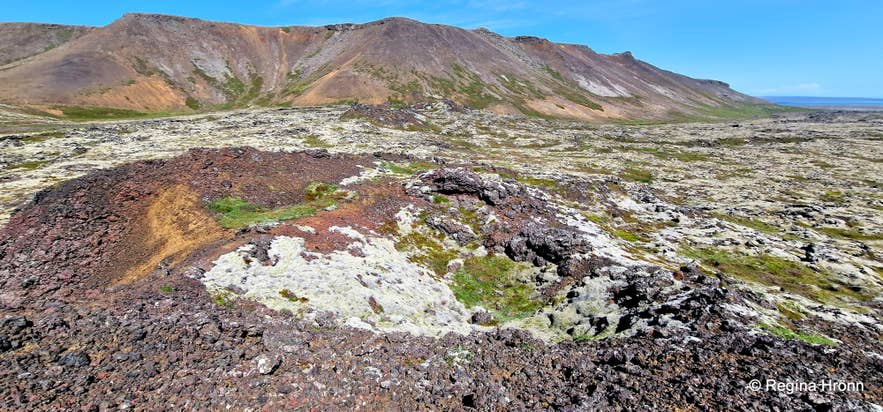
Litla-Eldborg and Mt. Geitahlíð
Between the Eldborg craters, the lava field is called Eldborgarhraun. And the collective name for the lava fields here is Krýsuvíkurhraun.
There have been so many volcanic eruptions here, with craters in many places and different lava fields from different eruptions.
And in the past few years, we have experienced 11 volcanic eruptions on the Reykjanes peninsula with short intervals, as I have shown you in a couple of my travel blogs:
A Helicopter Ride to the Volcanic Eruption in Mt. Fagradalsfjall in SW-Iceland
One of the recent volcanic eruptions
Here we are on the top of the Mid-Atlantic Ridge, the Reykjanes volcanic belt, which explains all this volcanic activity and different lava flows.
Atop Mt. Geitahlíð is, for example, a big crater called Æsubúðir.
Mt. Geitahlíð, Stóra-Eldborg, and Litla-Eldborg are part of the Brennisteinsfjöll volcanic system. At the outposts of this volcanic system are two volcanoes named Eldborg: Nyrðri-Eldborg and Stóra-Eldborg, the latter at the southern outpost (here).
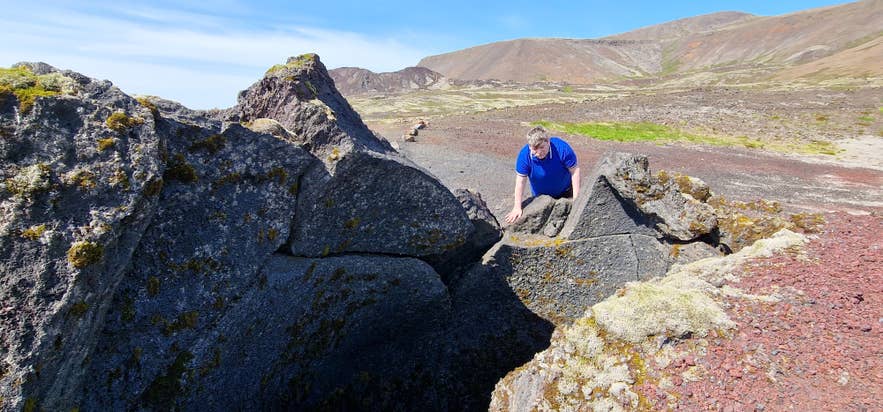
Looking into Litla-Eldborg - Stóra-Eldborg and Mt. Geitahlíð in the distance
I flew over the northern outpost in a helicopter and took a video, which is at the end of this travel blog:
A fantastic Helicopter ride with Norðurflug to a Geothermal Area in South Iceland.
From Nyrðri-Eldborg flowed the lava field Kristnitökuhraun in 999-1000. The Chieftain Snorri goði mentioned this volcanic eruption at Alþingi at the Conversion to Christianity in 1000.
There are many interesting and better-known places in the vicinity, like the popular Seltún geothermal area and Lake Grænavatn, which are only a couple of km away from here, but also be on the lookout for these Eldborg craters and the burial mounds when visiting this area, now that you know their story.
Almost at the top of Litla-Eldborg
You can reach this area either from Krýsuvíkurvegur road no 42 or Suðurstrandarvegur road no 247, and you cannot miss spotting the beautiful crater Stóra-Eldborg.
To visit this area, you can rent a car in Reykjavík or Keflavík, depending on which direction you are coming from.
Ref.:
Þjóðsögur Jóns Árnasonar, Krýs og Herdís
Þjóðsögur Jóns Árnasonar, Krýsa og Herdís
Vísindavefur - Brennisteinsfjöll
Geitahlíð við Eldborg - including a map of the protected area
Have a lovely time on the Reykjanes peninsula :)

Hi, my name is Regína Hrönn, and I was born and raised here in Iceland.