In this travel blog, I am going to show you a special phenomenon you pass on Ring Road 1 just east of Reykjavík.
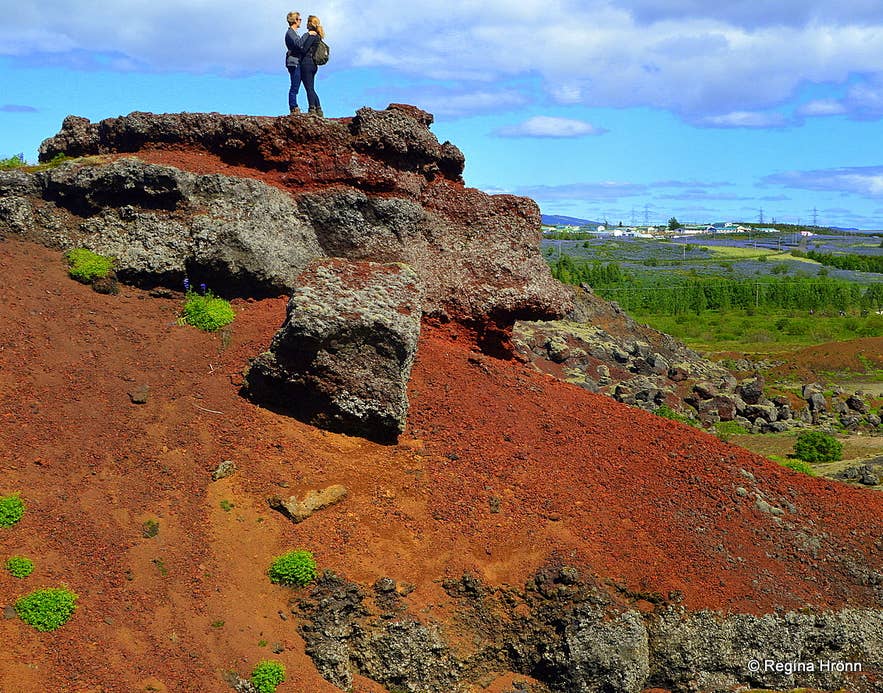
You will notice a cluster of dark maroon hills. These hills are called Rauðhólar - Red Hills, and are around 5,000 years old pseudocraters, give or take a few years.
Top photo: a lovely couple on top of one of the pseudocraters
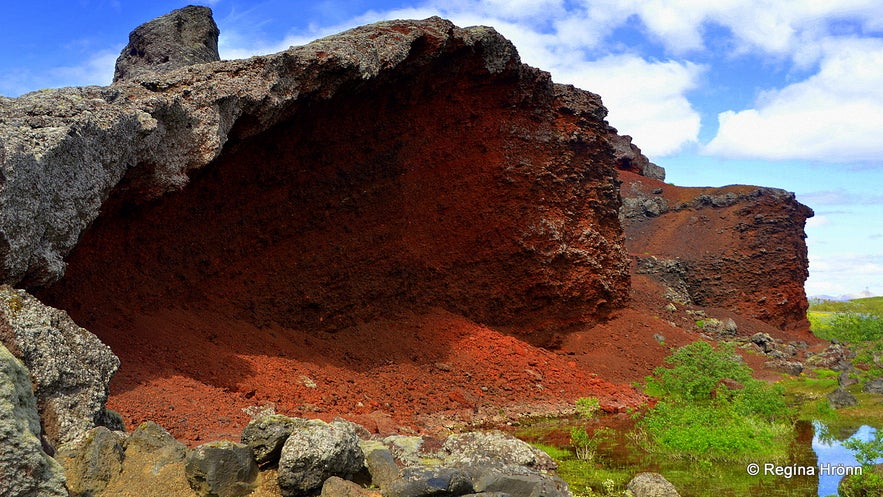
Rauðhólar pseudocraters
Pseudocraters are, as far as I know, rarely seen outside of Iceland and on the planet Mars, so they are quite an interesting phenomenon.
They are formed when 1,100°C molten lava flows over ponds and swamps, causing the water to boil.
The pressure of the steam from the boiling water then causes explosions, which in turn create the pseudocraters.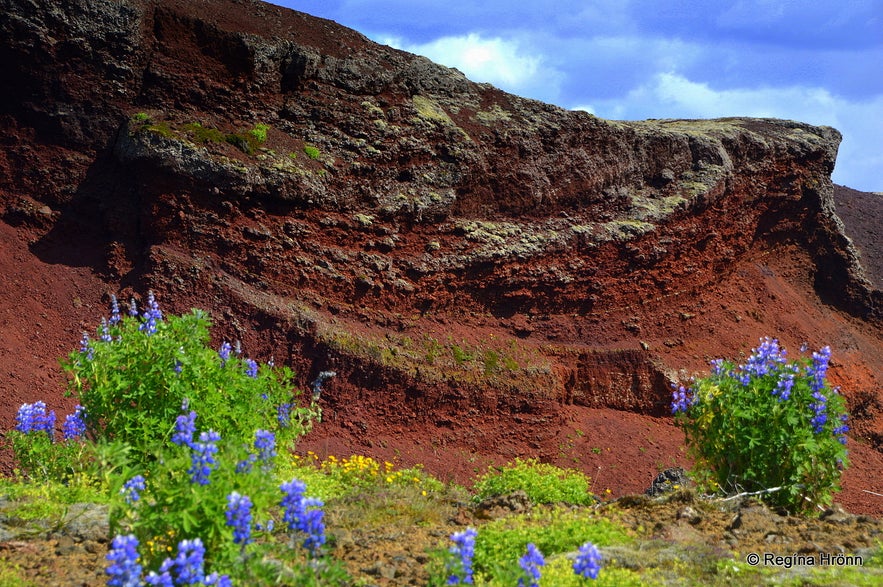
Rauðhólar pseudocraters
These prominent pseudocraters, Rauðhólar, are located in the Leitahraun lava field, which flowed in this area during an eruption from the shield volcano Leiti.
The part of the lava field by Rauðhólar is called the Elliðaárhraun lava field, located in the Nature Reserve of Heiðmörk.
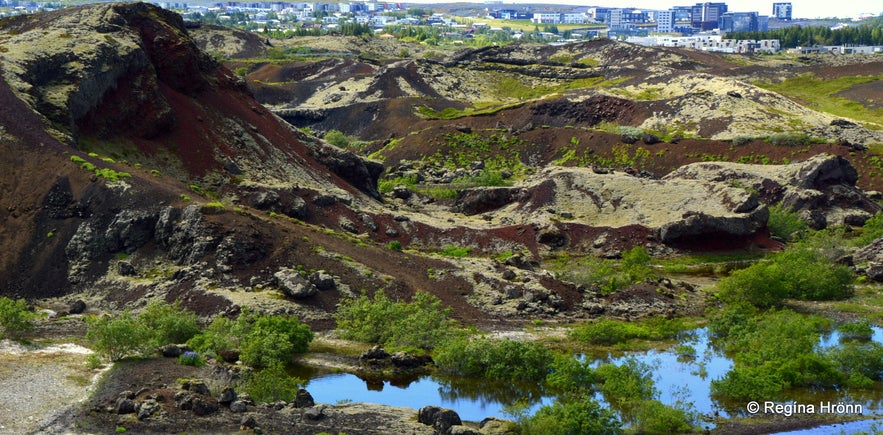
Rauðhólar - Reykjavík in the distance
What makes Rauðhólar pseudo craters so beautiful to me is that they are bright red in colour, which is caused by the scoria being coloured by the oxidation of the iron in the lava.
I have seen pseudocraters in several other places in Iceland, e.g., the shapely Skútustaðagígar pseudocraters at Mývatn in North Iceland.
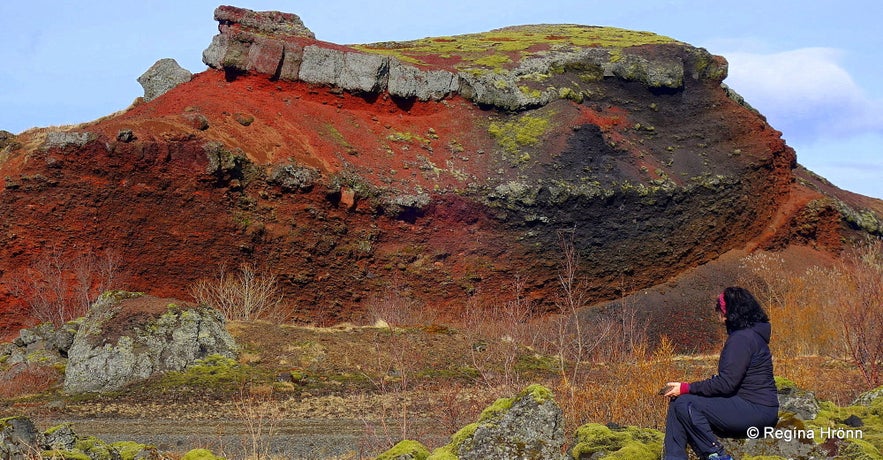 Visiting Rauðhólar with a friend
And the Álftaver and Landbrotshólar pseudocraters in South Iceland.
The Landbrotshólar area is actually the largest pseudocrater field in Iceland, covering about 50 sq. km. I have written about them in my travel blog:
The Elf-City and the amazing surroundings by Hotel Laki
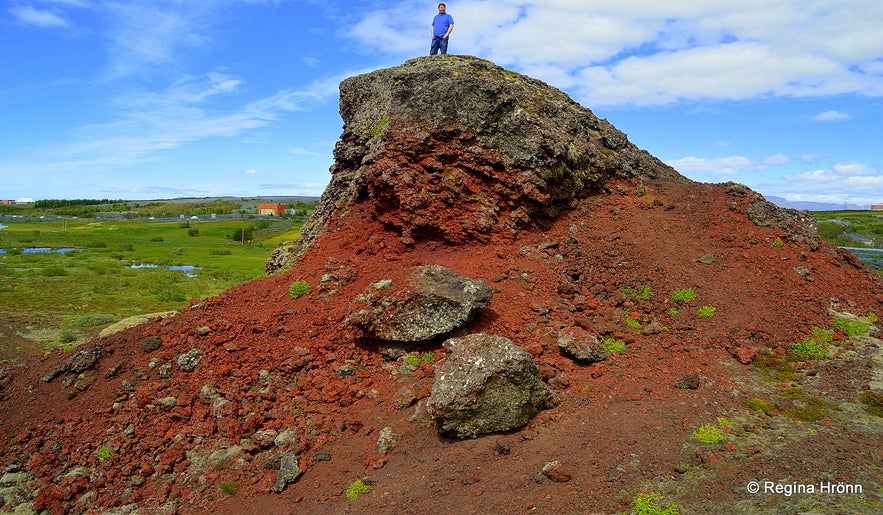
My husband on top of Rauðhólar
I know that people travel far to see these pseudocraters, and I have searched for them all around my country. But we often tend to overlook what is in our own backyard.
I am so used to seeing Rauðhólar pseudocraters that it wasn't until I made a special trip to photograph them for the travel blog that I actually saw how extraordinarily beautiful they are.
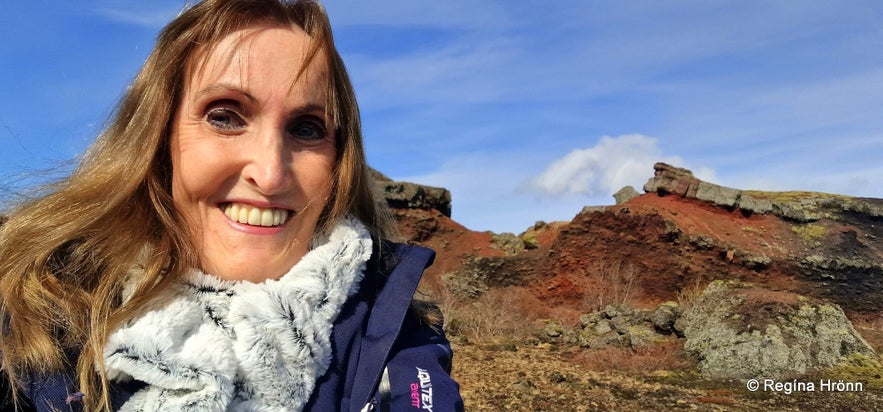 By Rauðhólar on a cold but sunny April day
They are especially beautiful when the sun shines on them, making the red vibrant colours very vivid.
There is something so magical about walking amongst these red pseudocraters, and I can only compare them to the mystical Dimmuborgir in Mývatn, which were formed under similar circumstances but with a different outcome, though.
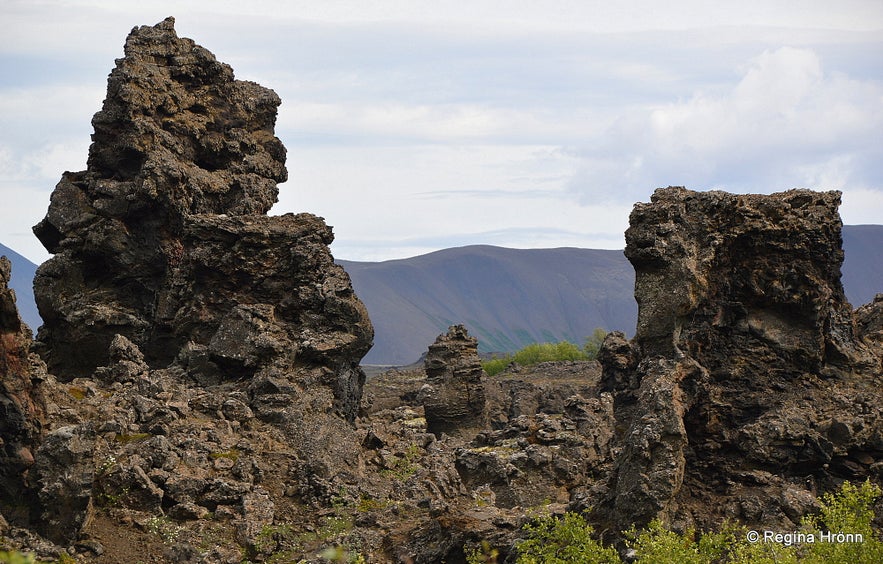
Dimmuborgir in North Iceland
Dimmuborgir is on a larger scale than Rauðhólar, but in the right light, Rauðhólar will make you feel like you've entered another planet.
The Rauðhólar protected area covers some 130.2 ha, and earlier, there were around 80 pseudo-craters here.
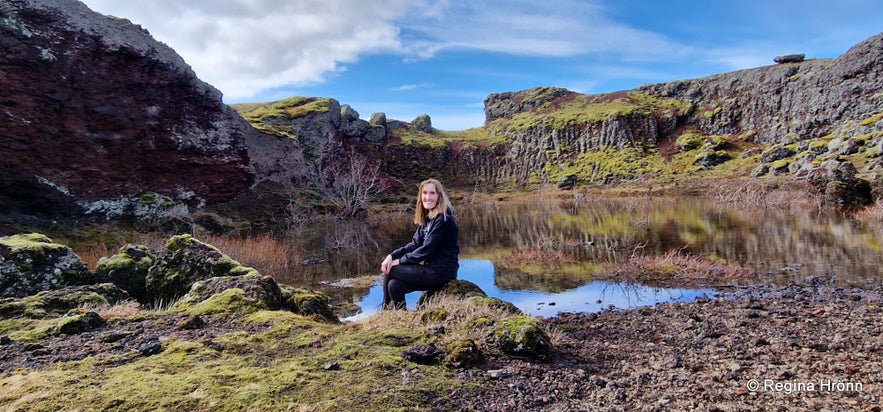 By a beautiful pond at Rauðhólar
Material for different purposes was taken from Rauðhólar, such as filling material, some of which was used for the domestic airport, Reykjavíkurflugvöllur, during WWII, which was built by the British army.
The British documented how much material they used, and it was only 95,000 cubic meters (ref. Rauðhólar, ekki Bretum um að kenna).
Some of the material from Rauðhólar was used for roads and fill material before and after the war.
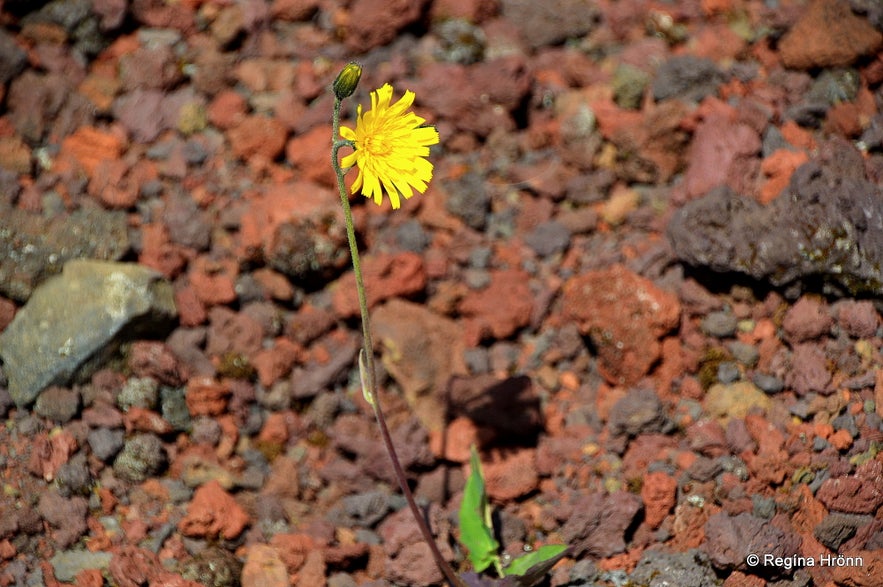
Life finds its way through the lava
It is such a pity that large parts of Rauðhólar were destroyed; they must have been quite magnificent before truckloads of red gravel were removed from them.
Rauðhólar were preserved back in 1961 and declared a nature reserve in 1974.
I have visited other craters in South Iceland, Seyðishólar, which are bright red in colour and very exotic, but are now used as a quarry. You can see parts of the craters in my photo below, but the quarry is closed to traffic.
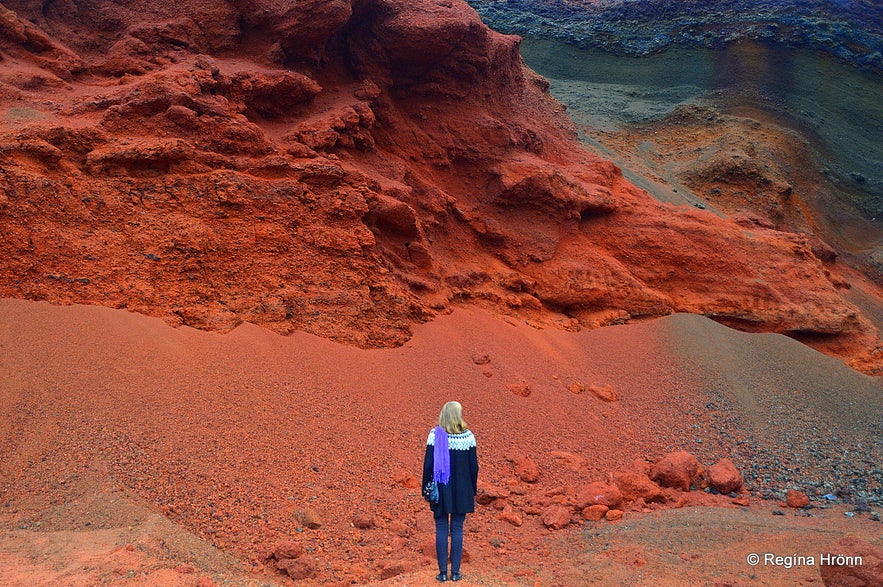
Seyðishólar quarry in South Iceland
In North Iceland, in the magnificent Jökulsárgljúfur canyon, another set of maroon craters is to be found.
In the summer of 2020, I spent several days hiking in Jökulsárgljúfur canyon, including from Hljóðaklettar Echo Rocks to Rauðhólar (a relatively short hike compared to other hikes in the canyon).
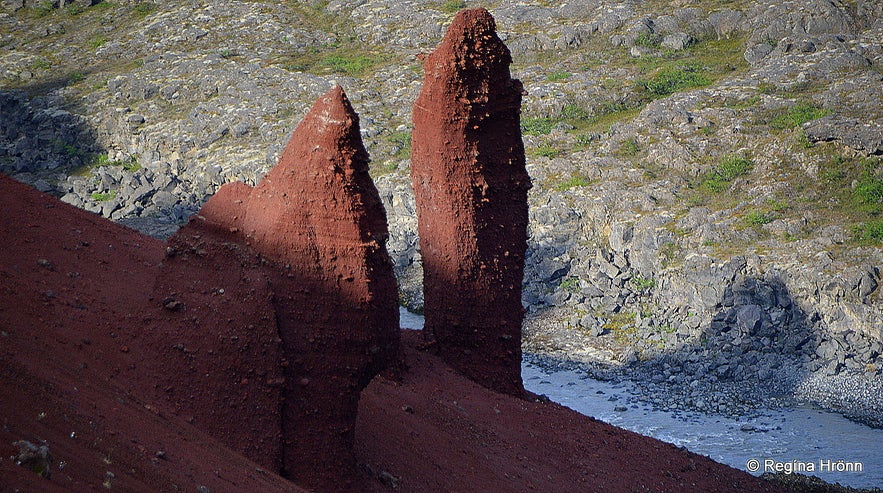
Rauðhólar craters in Jökulsárgljúfur canyon
I had seen a photo of the maroon pillars in my photo below and really wanted to see them with my own eyes. Aren't they amazing, like some fairytale creatures?
I have written another travel blog about the glacial river Jökulsá á Fjöllum, which runs through Jökulsárgljúfur canyon:
Jökulsá á Fjöllum Glacial River and the Waterfalls in Jökulsárgljúfur Canyon
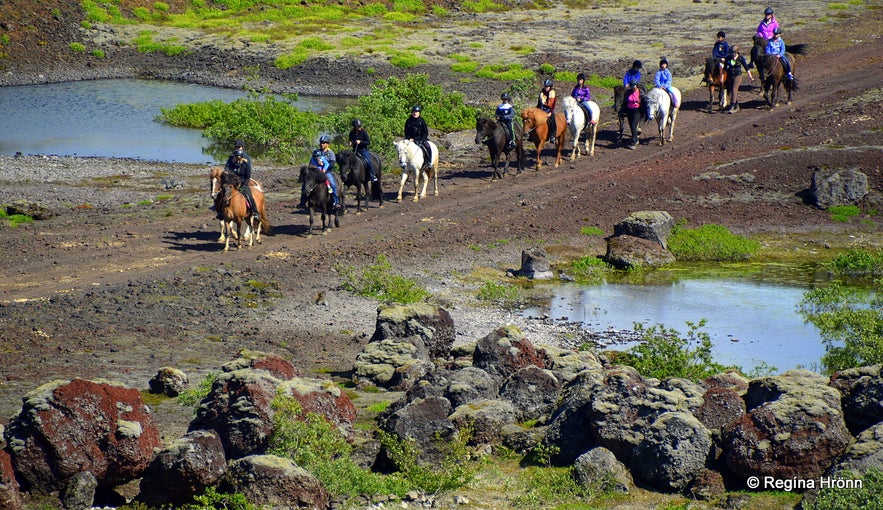
Horseback riding at Rauðhólar
During my recent visits to Rauðhólar in the south, I have encountered many people on horseback.
Horseback riding tours are popular here, and the volcanic landscape at Rauðhólar is an ideal spot for this outdoor activity.
I posted a short YouTube video of horses I met at Rauðhólar.
Here is a video I shot last winter of the Icelandic horses playing:
The last photo of Rauðhólar I took is from a helicopter during a helicopter tour I joined.
The photo is a bit blurry because I took it through the helicopter window.
I was a bit unprepared as this was my first time in a helicopter, and it took me some time to recognise the landscape of my own country from above ;)
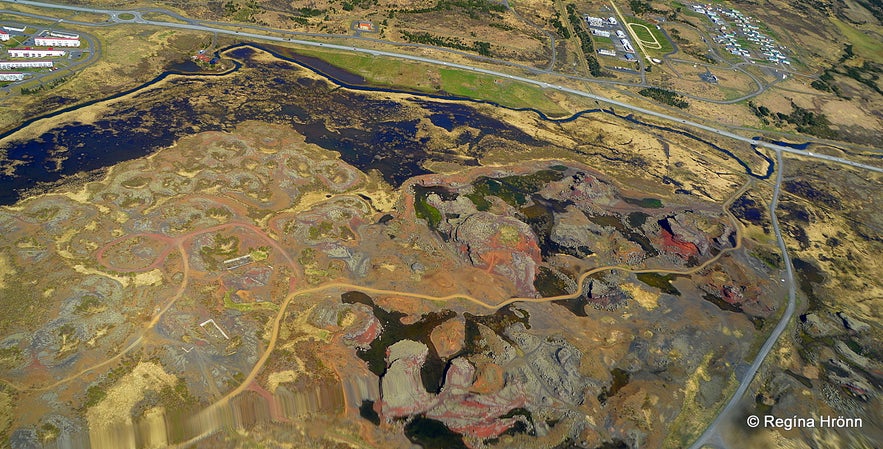
In the photo, you can see how close Rauðhólar are to Ring Road 1 and how easily accessible they are.
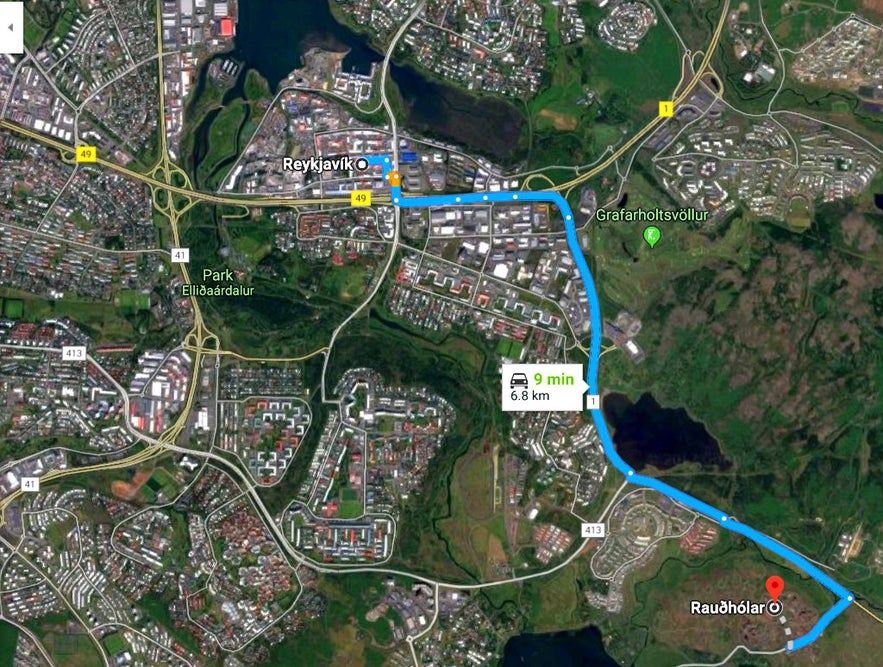
To visit these beautiful red pseudocraters, you can rent a car in Reykjavík, take Ring Road 1 southeast out of the city, and drive for 6-7 km.
Turn right on road 408 when you reach a sign for Heiðmörk and right again for the pseudocraters.
And if you will be driving further on along the south coast of Iceland, then I would recommend a visit to the extraordinarily colourful Raufarhólshellir lava tube.
Also check out: The Unique Phenomenon of Pseudocraters in Iceland
Tröllabörnin - the Troll Children
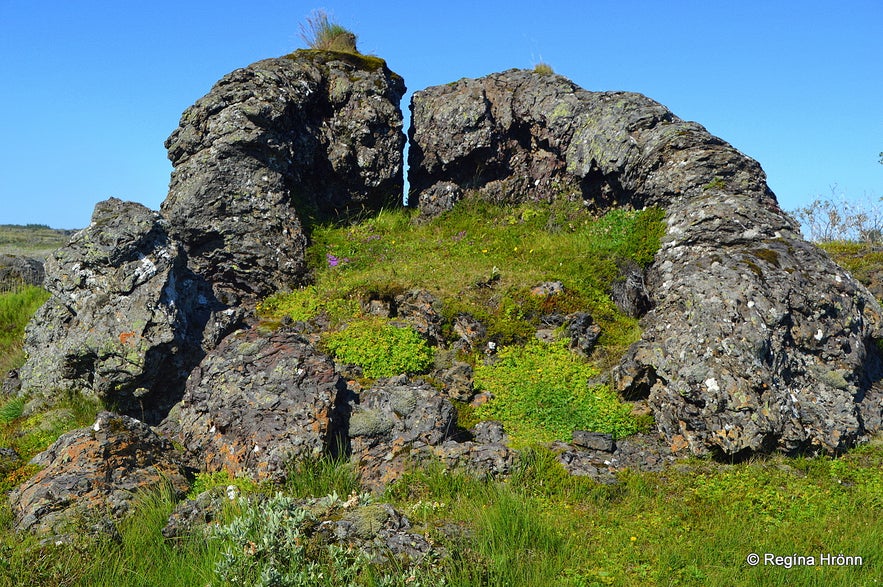
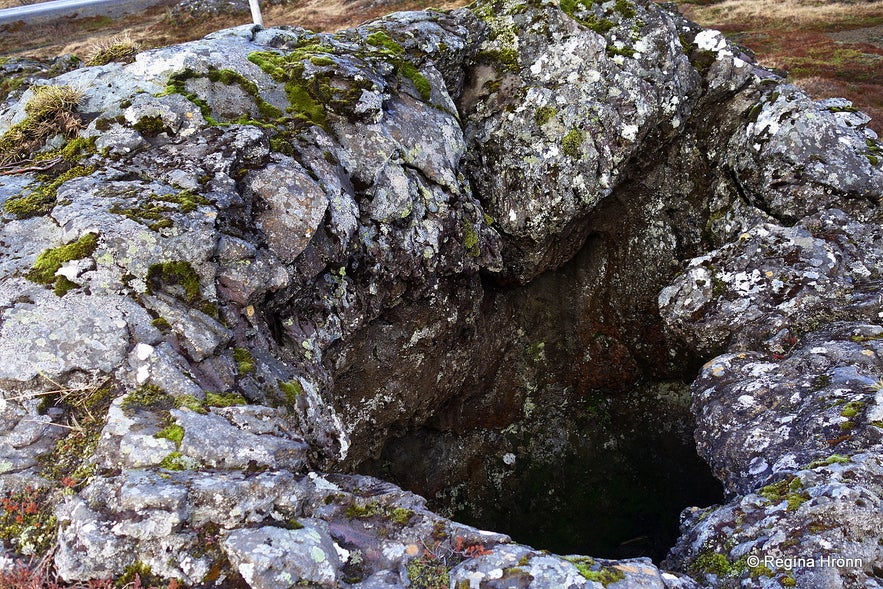
Tröllabörnin hornitos in SW-Iceland
In Lækjarbotnar, some 5 km east of Rauðhólar pseudocraters, you will find another preserved natural phenomenon, which is also right by Ring Road 1.
Most people don't know about this spot, which we call Tröllabörn or the Troll Children.
The Troll Children, which were formed at the same time as Rauðhólar pseudocraters, are a cluster of hornitos - spatter cones - covering some 4.7 hectares of land, and are well worth a visit.
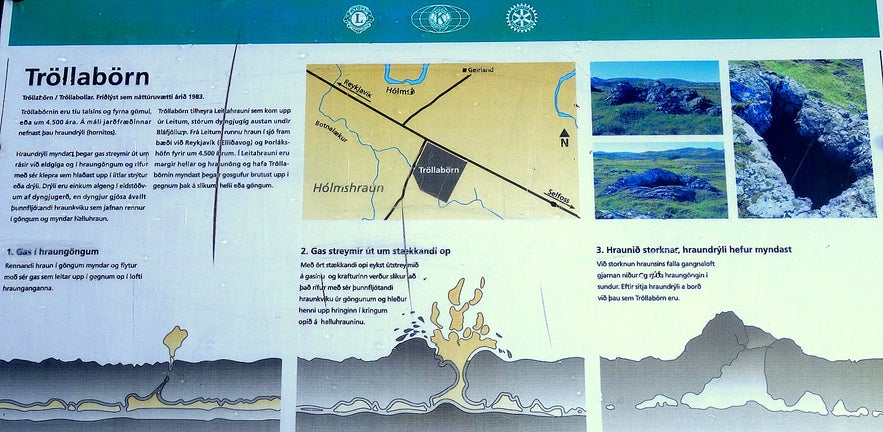
The information sign by Tröllabörnin
The Troll Children were formed during a volcanic eruption when the hot steam from the lava flow tried to find its way through the ceiling of the forming lava tunnel.
When the steam managed to force itself through the forming lava ceiling and connected with the oxygen in the air, it burned at a really high temperature, and molten lava splashed up and solidified.
Thus, the steep spatter cones were formed.
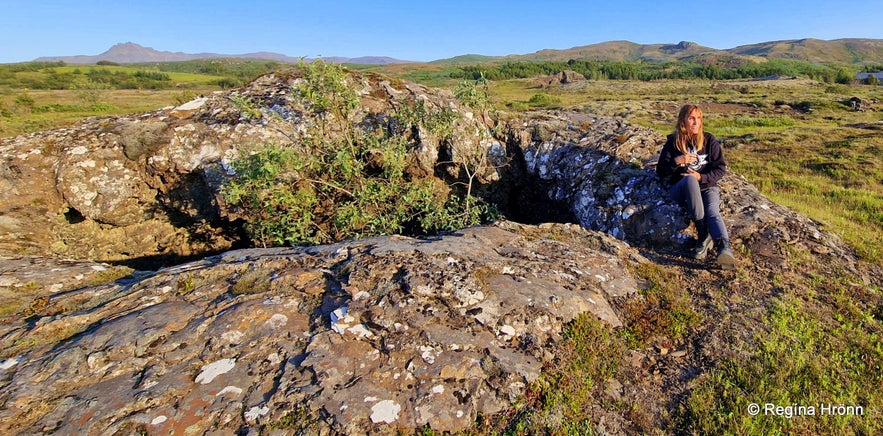 Tröllabörn and I
These cones actually show how steam or gases were released from the lava flow, making it a fascinating geological phenomenon.
You can see in the sign above how it happened; it's by the parking lot and was donated by the Kiwanis, Lions, and Rotary clubs.
Tröllabörnin hornitos in SW-Iceland
The volcanic eruption in this area occurred some 5,000 years ago at the shield volcano Leiti and formed the Leitahraun lava field.
You will find about 10 Troll Children, varying in size and shape, in the reserved area; more in the surrounding areas.
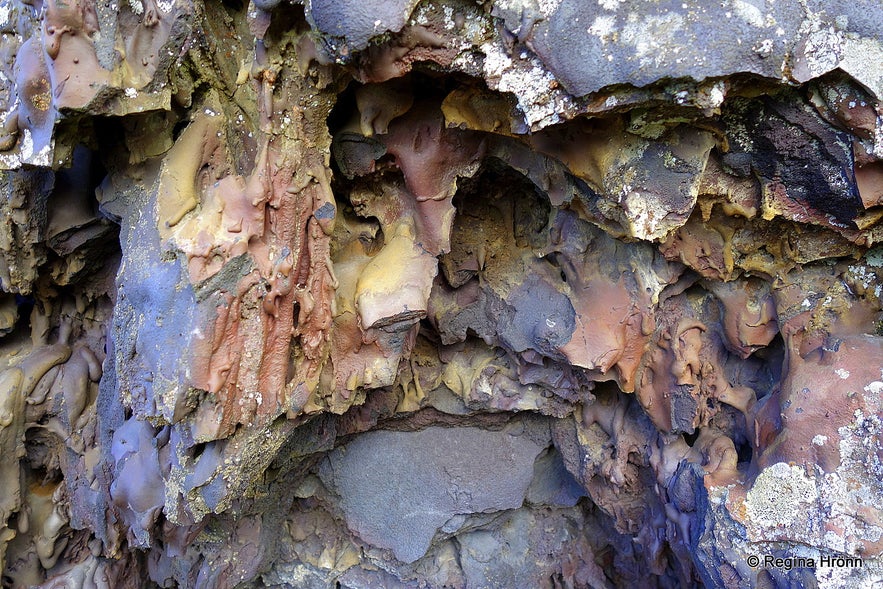
Also, notice the different colours of the lava - this is an old lava field, but you can still see the different colours in the accumulated solidified lava in the hornitos.
Colourful lava at Tröllabörnin hornitos
These lava formations were preserved back in 1983. I have seen similar lava formations up north in Aðaldalur and written a travel blog about them - the Peculiar Knútsstadaborg Lava Chamber in Aðaldalshraun in North Iceland.
Tröllabörn - the Troll Children are located right next to Ring Road 1.
Here you can see the exact location of Tröllabörn on Google Maps.
With Jón contemplating which turf house to buy
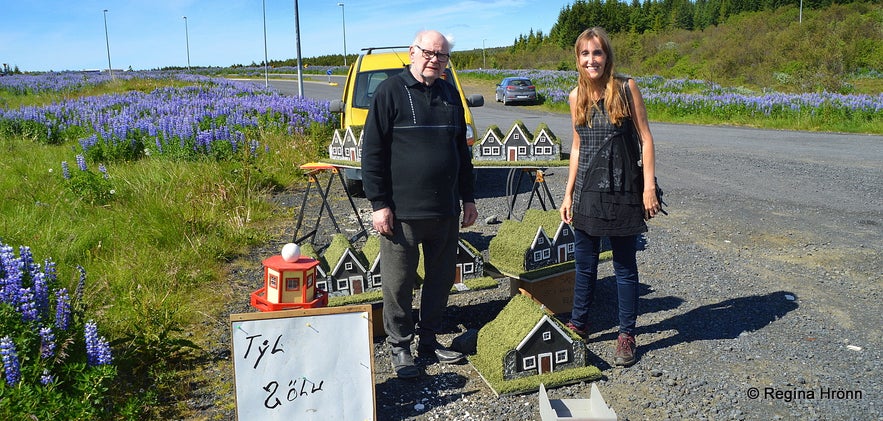
On your way from and to Reykjavík, be on the lookout for the man in my photo above - his name is Jón Karlsson, and he often sells beautiful handmade replicas of the traditional Icelandic turf-houses. He was usually stationed close to the first roundabout by Ring Road 1 when leaving the city going southeast.
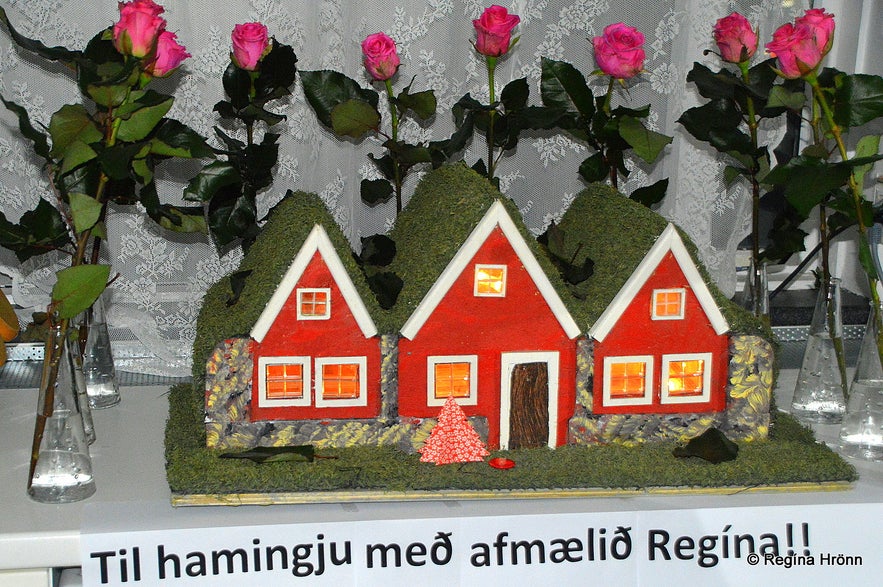
I spotted him last summer and wanted to buy a red turf house, but unfortunately, the red ones were all sold out. But, for my last birthday, my husband surprised me with a beautiful red turf house :) He went to Jón's home and made sure that he had a red turf house in stock. I am elated :)
My birthday present from my husband - a lovely red turf-house :)
Turf houses are a passion of mine, so I really need them in all colours; black like Þverá and Skógar turf houses, white like Grenjaðarstaður turf-house, and red like Bustarfell turf-house.
These replicas are very popular amongst Icelanders, and you can see them in many gardens in Iceland. They are sometimes referred to as elf houses :)
Here is the location of Rauðhólar on Google Maps.

Hi, my name is Regína Hrönn, and I was born and raised here in Iceland.