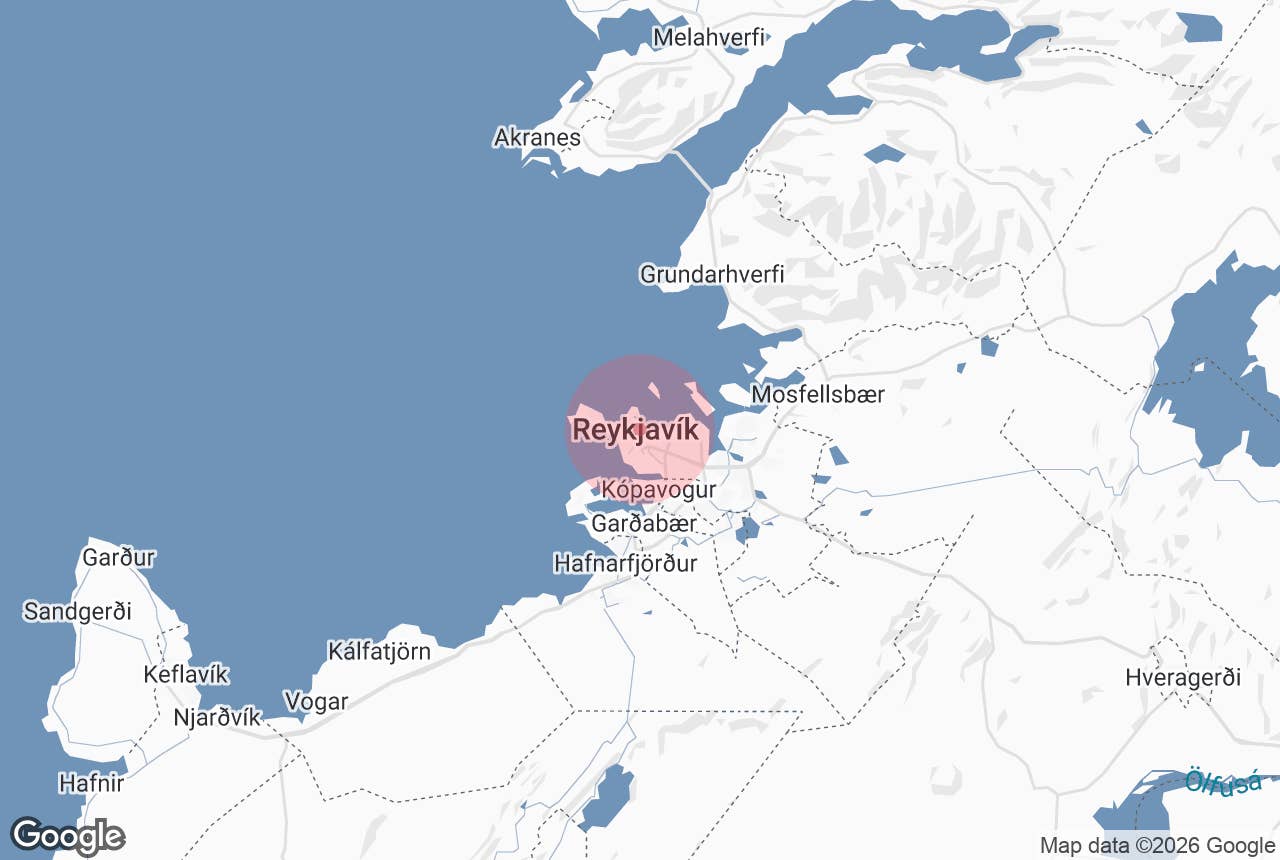
Government House on Lækjargata.
Government House (Icelandic: Stjórnarráðshúsið) is the white 18th-century stone building on Lækjargata, opposite Lækjartorg Square in central Reykjavík. Prisoners built it in 1761 to 1771 as Iceland's first prison. It later housed the governors of Iceland, and since 1904 it has been the seat of the Icelandic government.
Today it's the Prime Minister's Office.
Key Takeaways About Government House
- Built in 1761 to 1771 as Iceland's first prison, partly by the prisoners themselves
- Home of the governors of Iceland from 1820 to 1904, then the seat of Iceland's government
- Today the Prime Minister's Office; you view it from outside
- Two bronze statues by Einar Jónsson stand in front: King Christian IX and Hannes Hafstein
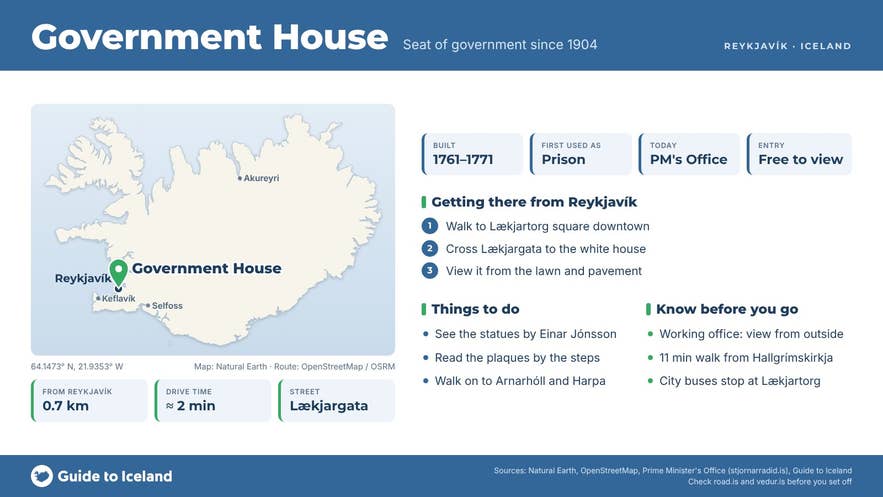
- On Lækjargata opposite Lækjartorg, an 11-minute walk from Hallgrímskirkja
Why visit Government House
Government House (Stjórnarráðshúsið) is the long, white, stone building with a slate roof on Lækjargata in downtown Reykjavík. It houses the Prime Minister's Office, and the government of Iceland has worked from it since 1904.
It's also one of the oldest buildings in the city. Prisoners built it between 1761 and 1771 as Iceland's first prison, and in the centuries since it has been a governor's residence, the seat of Iceland's first home-rule minister and, for over two decades, the office of the President of Iceland.
A visit takes only a few minutes, but it explains a lot about how Iceland went from a Danish dependency to an independent republic. The building sits right across Lækjargata from Lækjartorg Square, so it's an easy stop on any walk through the city centre.
History of Government House
The Danish king ordered a prison (tugthús) to be built in Iceland by royal decree on 20 March 1759. Until then, Icelanders sentenced to long terms were shipped to prisons in Denmark. The site chosen was land belonging to the royal farm at Arnarhóll, close to the new wool workshops in Reykjavík, so the inmates could be put to work there.
Construction began in 1761 and dragged on for a decade. Convicts did much of the labour, working under a Danish mason, and the house was finally finished in the winter of 1770 to 1771. The drawings are lost, but the Prime Minister's Office says they were almost certainly made by the Danish court architect Georg David Anthon.
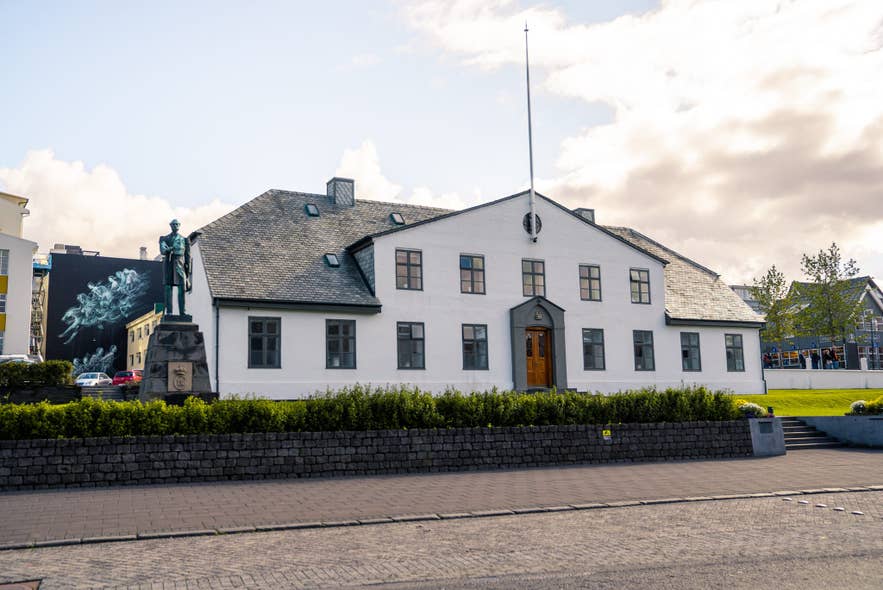
Statue of Christian IX by Einar Jónsson.
The prison was a one-storey house of dressed grey stone with double walls, barred windows and a high roof. It was designed to hold 16 serious offenders and 54 other prisoners, and people in Reykjavík called it "Múrinn" (the Wall).
Supplies ran short during the Napoleonic Wars, the prison stopped operating in 1813, and a royal letter formally closed it on 3 May 1816.
In 1819 to 1820 the empty prison was converted into a residence and office for the Danish governor (stiftamtmaður), Count Moltke. A dormer was added to the west side in 1866. From 1873 to 1904 it was the residence of the landshöfðingi, the governor of Iceland, and was known as Landshöfðingjahús.
Home rule came on 1 February 1904. Hannes Hafstein became the first Icelandic minister, the governor moved out, and the building was turned into government offices. It has been known as Stjórnarráðshúsið ever since.
When the number of ministers grew to three in 1917, a matching dormer was built on the east side, which gave the house its present shape.
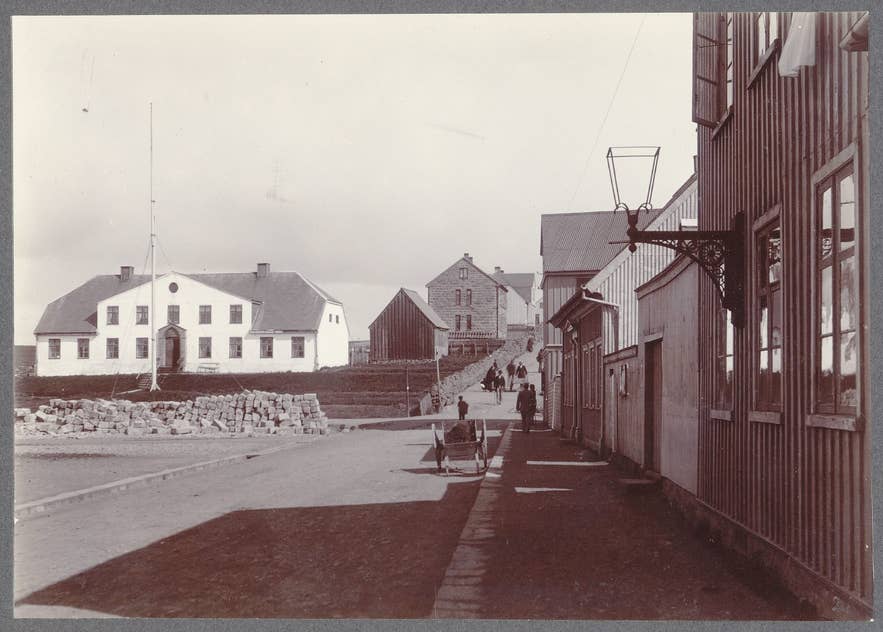
The governor's house around 1900. Photo: Frederick W. W. Howell, Fiske Icelandic Collection, Cornell University Library, No known copyright restrictions
In December 1918, when Iceland became a sovereign state, the new Icelandic flag was raised at Government House as a state flag for the first time. You can read more about that day in our article on the history of the Icelandic flag. The Office of the President of Iceland was also in the building from 1973 to 1996.
What to see
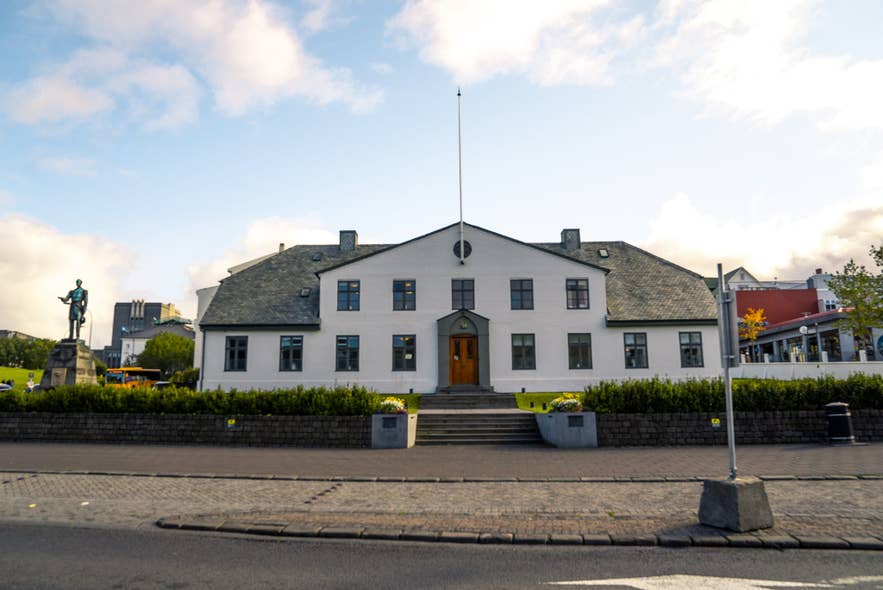
- The façade: the white walls, two dormers and slate roof are what most people photograph. Note the coat of arms above the front door.
- The statues: two bronze statues by the sculptor Einar Jónsson stand on the lawn. King Christian IX, who holds a rolled-up paper meant to be the 1874 constitution, was finished in 1907 and unveiled here in 1915. The statue of Hannes Hafstein was put up in 1931.
- The history plaques: markers in Icelandic and English on either side of the front steps tell the story of home rule in 1904.
If you like Einar Jónsson's work, the Einar Jónsson Museum and Sculpture Garden near Hallgrímskirkja has many more of his pieces.
How to get to Government House
Government House is in central Reykjavík, at the foot of Bankastræti, opposite Lækjartorg. Most people simply walk there:
- From Hallgrímskirkja: about 850 m, or an 11-minute walk downhill via Skólavörðustígur and Bankastræti.
- From Reykjavík: about 0.7 km by road from the city-centre point by City Hall, a 2-minute drive or a short walk past Austurvöllur.
- By bus: several city bus stops called Lækjartorg are right outside the building.
There's no visitor car park at the building, so it's easier to leave the car at your hotel or in one of the city-centre car parks and walk.
When to visit
You can see the outside at any time of year. The main entrance is on the west side, facing Lækjargata, so the front catches the afternoon and evening sun.
Tips for visiting
- Government House is a working office, so plan to see it from the pavement and the lawn in front.
- Combine it with a short loop: Lækjartorg, Arnarhóll hill with the statue of Ingólfur Arnarson, Harpa and back via Austurvöllur square.
Nearby attractions
- Lækjartorg Square – across the street
- Arnarhóll – about 0.1 km
- The National Theater of Iceland – about 0.2 km
- Austurvöllur – about 0.2 km
- Harpa Concert Hall – about 0.4 km
- Reykjavik City Hall – about 0.4 km
- Tjörnin pond – about 0.5 km
- Hallgrímskirkja – about 0.8 km
For more ideas, see our guide to Reykjavík.