Ragnar Kjartansson was born on the 17th of August at Staðastaður on the Snæfellsnes peninsula, where you will see one of his artworks.
Ragnar was a sculptor and one of the pioneers of ceramics in Iceland, and the founder of Glit, Iceland's ceramic factory. He was one of the founders and an honorary member of Myndhöggvarafélag Reykjavíkur - the Sculptors' Association in Reykjavík, established in 1972.
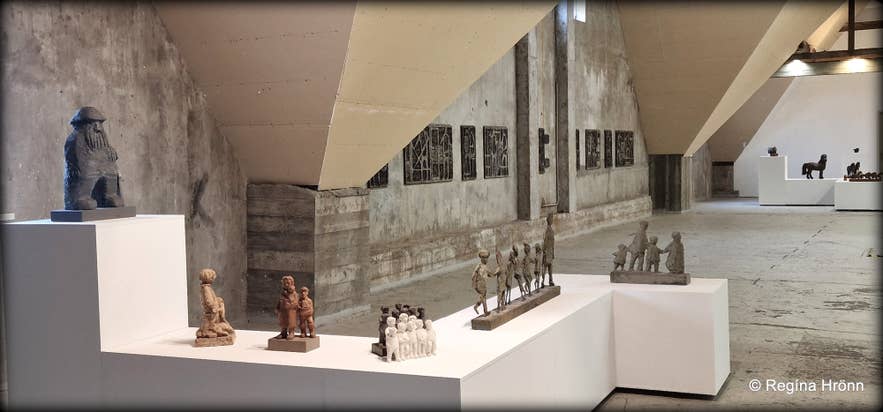
Top photo: an exhibition of Ragnar Kjartansson's work on the 100th anniversary of his birth
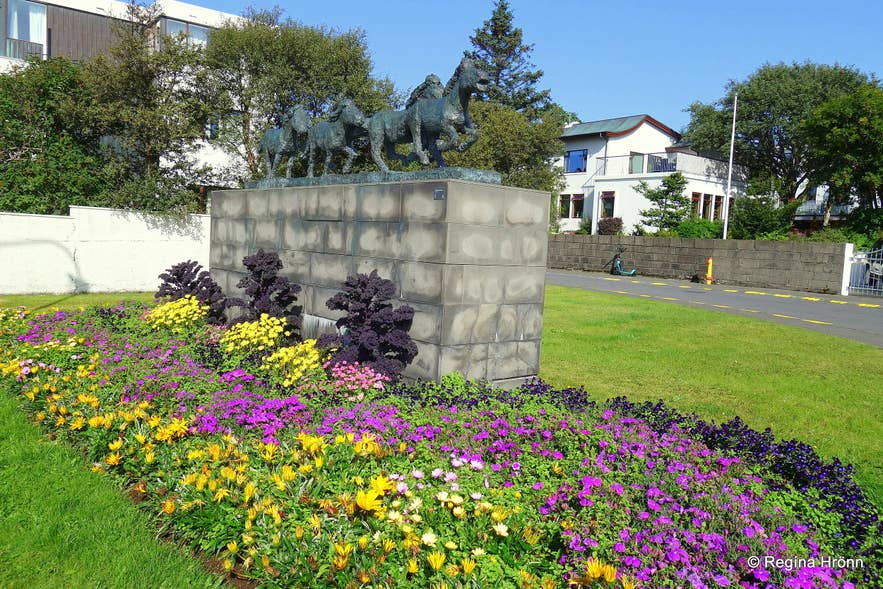 Stóð - one of Ragnar's sculptures in Reykjavík
Ragnar died on the 26th of October 1988 in Reykjavík.
Now, let us first visit one of the sculptures, which Ragnar created for his birthplace, the Snæfellsnes peninsula.
Artwork on the Snæfellsnes Peninsula
Bárður Snæfellsás at Arnarstapi
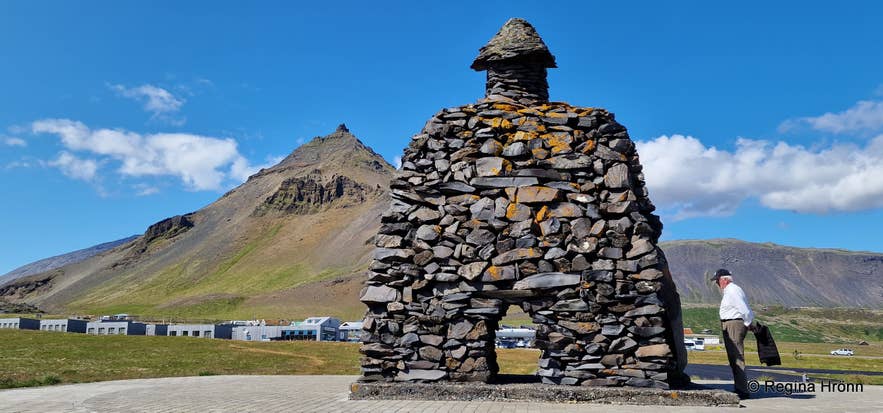
Bárður Snæfellsás at Arnarstapi
The first artwork by Ragnar Kjartansson I want to show you is probably his best-known work to visitors in Iceland.
It is the statue of Bárður Snæfellsás at Arnarstapi on the Snæfellsnes peninsula.
It must be the most-photographed work by Ragnar Kjartansson, as I am sure that everybody who visits Arnarstapi takes a photo of the statue.
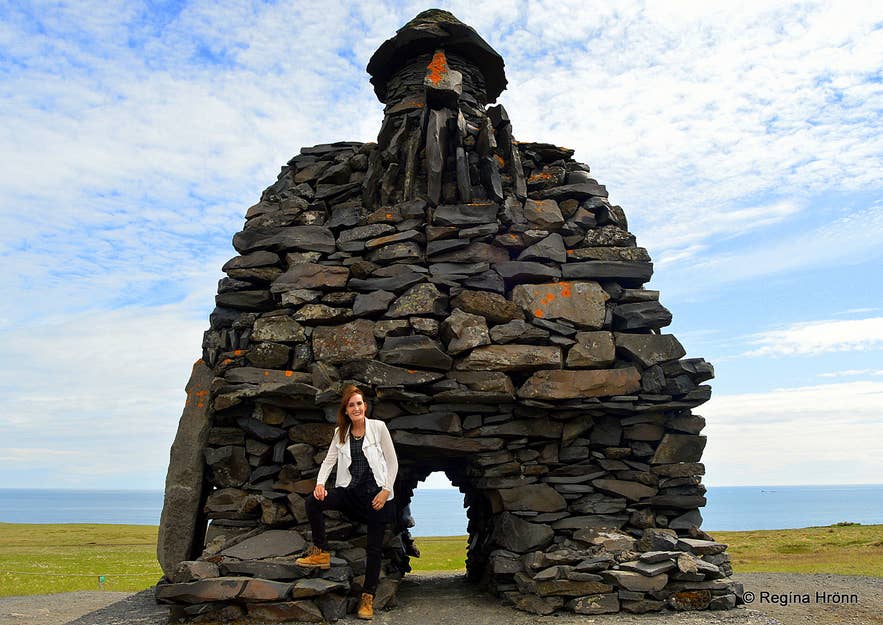
With Bárður at Arnarstapi
Ragnar erected this massive stone structure in memory of Bárður Snæfellsás as a memorial to Jón Sigurðsson and his wife, Guðrún Sigtryggsdóttir, who lived at Bjarg in Arnarstapi.
It was unveiled on the 17th of June 1985, Iceland's National Day.
See also my travel blog: Bárður Snæfellsás - the Mythical Protector of the Snæfellsnes Peninsula in West Iceland.
I visited an exhibition at Korpúlsstaðir on the work of the sculptor Ragnar Kjartansson, which was opened for a short period to celebrate the 100th anniversary of Ragnar's birth. At the exhibition, I saw many of the prototypes of Ragnar's statues.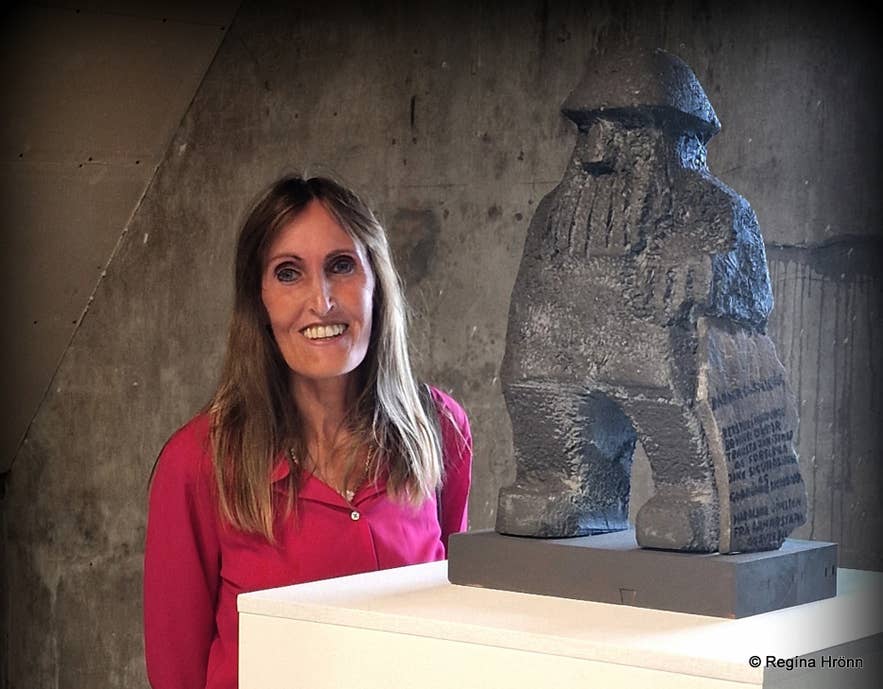
The prototype of the statue of Bárður Snæfellsás
As you can see in the photo, the prototype of the statue of Bárður Snæfellsás is much smaller than the actual statue at Arnarstapi.
It was wonderful to see the prototypes for many of his well-known works. I will show you more further on in this travel blog.
A Memorial for Ari the Wise at Staðastaður
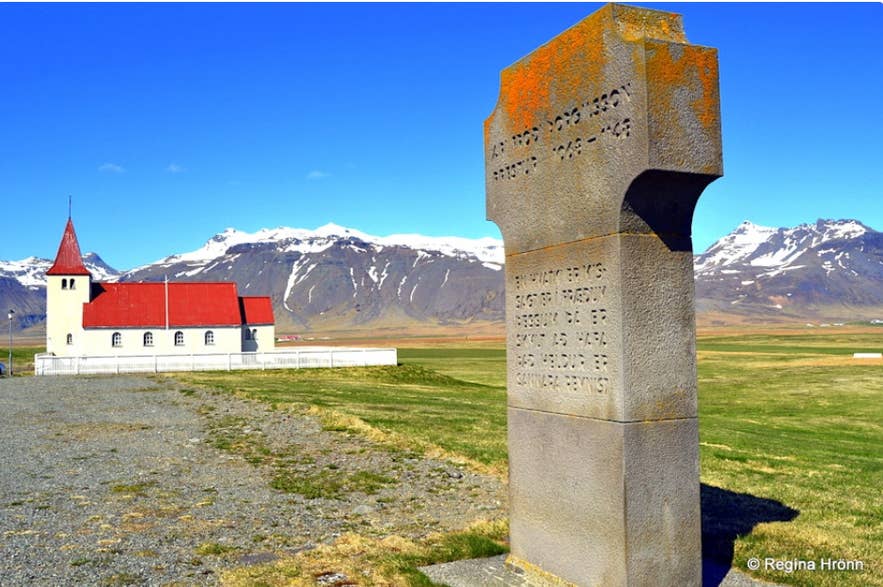
Staðastaður and the monument for Ari fróði
You will find another artwork by Ragnar Kjartansson at Staðastaður, his birthplace on the Snæfellsnes peninsula. Here, Ragnar's father, Kjartan Kjartansson, was a minister from 1920 to 1938, and his parish reached as far as Hellnar.
Staða(r)staður is a historical site, as, apart from being the birthplace of the sculptor Ragnar Kjartansson in 1923, in the 11th and 12th centuries Ari Fróði Þorgilsson (1067-1148) - Ari the Wise - lived here and served as a priest.
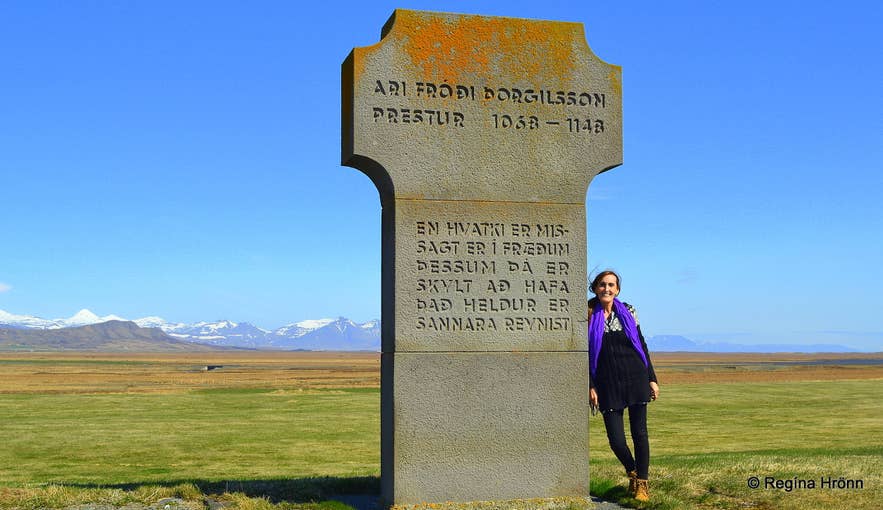 I stand by the memorial to give you a perspective of how tall it is
Ari the Wise is best known for writing Íslendingabók, or the Book of Icelanders, the first written history of Iceland, which covers the Settlement of Iceland through 1118.
The memorial for Ari fróði, fittingly created by Ragnar Kjartansson, is a big concrete cross erected in 1981.
Carved on the front cross is: "En hvatki er missagt er í fræðum þessum þá er skylt að hafa það heldur sem sannara reynist" meaning that if anything proved to be wrong in Ari's writings then it must be corrected.
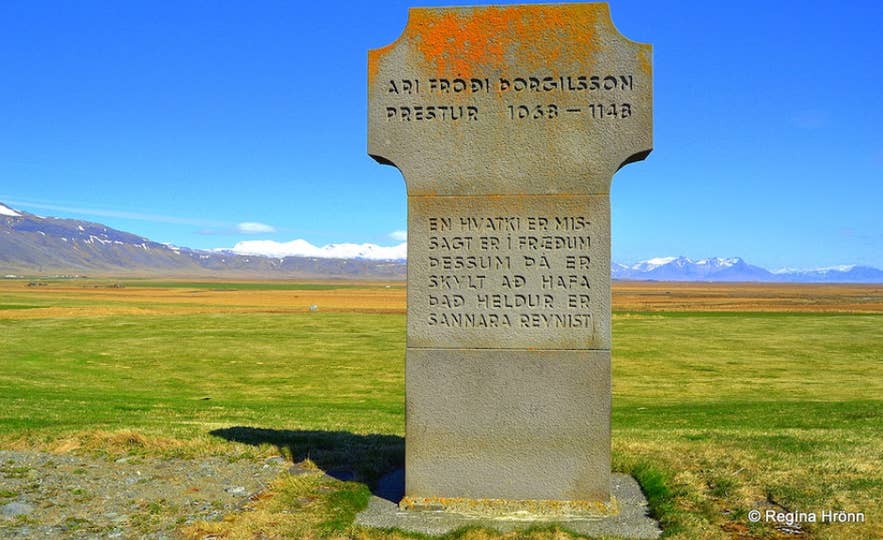 The monument for Ari fróði
On the back of the cross is written:"Ari hinn Fróði Þorgilssonar Gellissonar ritaði fyrstur manna hér á landi að norrænu máli fræði bæði forna og nýja. Snorri Sturluson" - Ari the Wise Þorgilsson, the son of Gellir, was the first man in Iceland to write in Old Norse both old and new studies (instead of Latin RHR).
Jöklarar - a Memorial for drowned fishermen in Hellissandur
Jöklarar
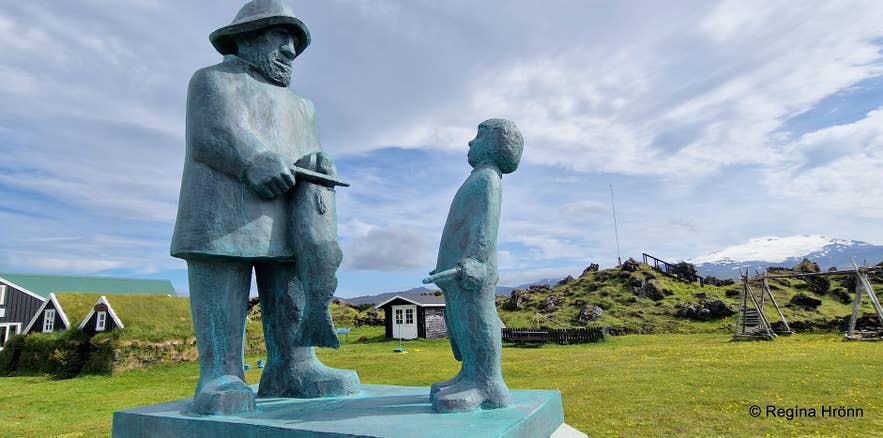
The third sculpture by Ragnar Kjartansson on the Snæfellsnes peninsula is in Sjómannagarður - the Fishermen's Garden in Hellissandur. It is one of Ragnar Kjartansson's oldest artworks, unveiled in 1974.
The year 1974 was the so-called Þjóðhátíðarárið, the year we Icelanders remembered the 1100th anniversary of the Settlement of Iceland.
Ragnar lived in the village of Hellissandur from 1937 to 1944. And his work in the Fishermen's garden is a memorial (heiðursvarði um drukknaða sjómenn) to the fishermen called Jöklarar.
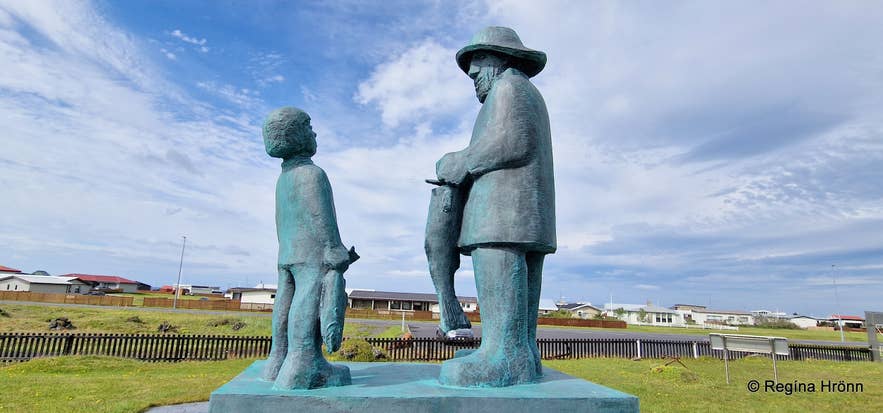
Ragnar Kjartansson named his prototype "Hvað ungur nemur gamall temur" - what the old teach the young will learn - or better still, the young learn from the old.
 Jöklarar in 2024
The name refers to a time when Hellissandur had a vibrant fishing community, and after returning from their fishing trips, older fishermen would teach the younger generation proper fishing techniques.
You can see how the old fisherman is teaching the young boy how to gill freshly caught cod. The locals preferred to call the memorial Jöklarar - the Glacier people.
This memorial is in honour of fishermen, I would say, and there is another Memorial for Fishermen down by the sea in Hellissandur village by the sea called Beðið í von - Waiting in hope. It was unveiled in 2000.
 The plaque on the statue Jöklarar
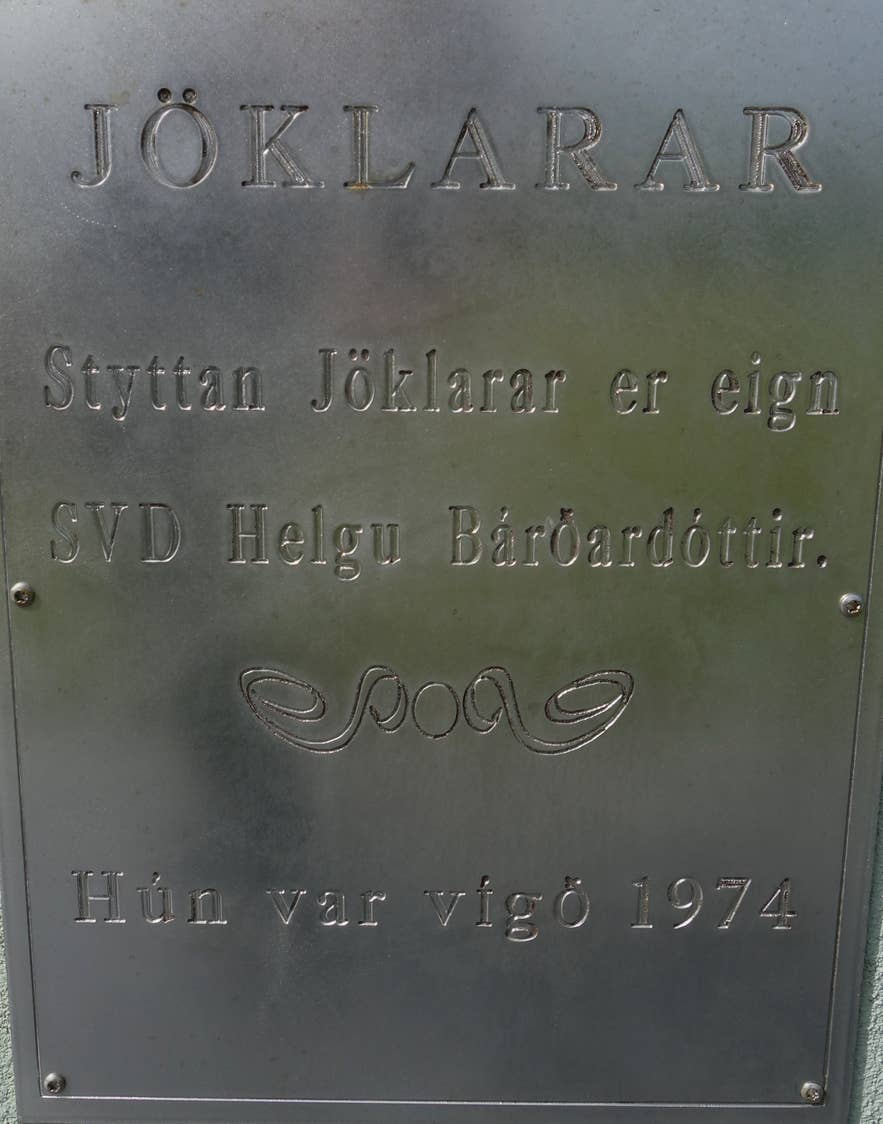
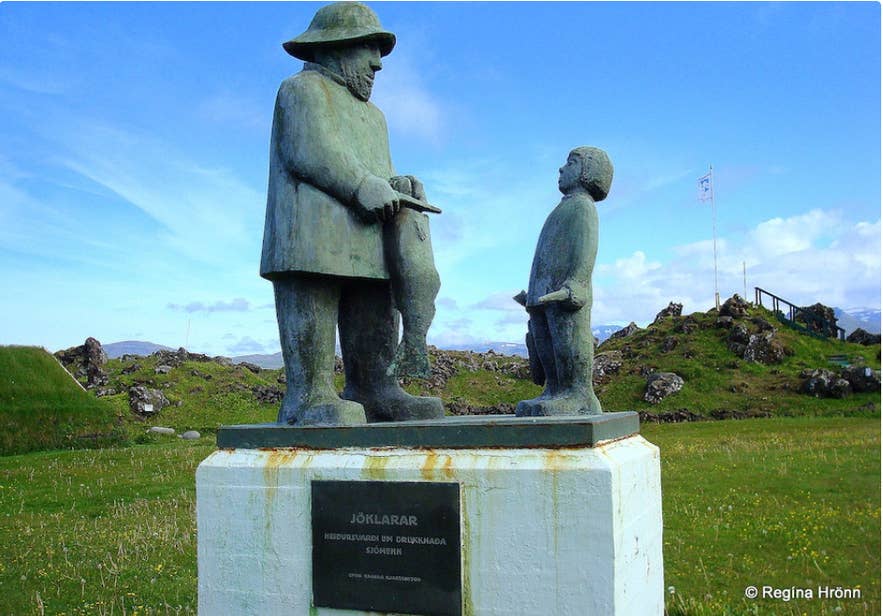
The Lifesaving Association Department, Helga Bárðardóttir, owns the statue, and they used one of my 2008 photos to show its condition when applying for a grant to have the statue cast in bronze.
The statue was sent to Germany in 2018-2019 for repair and looks like new.
I am so glad that Ragnar Kjartansson's artwork is being well looked after and repaired when needed.
 My photo from 2008 of the damaged statue of Jöklarar
You can read more about this place in my travel blog about the Fishermen's Garden: The Fishermen's Garden and Maritime Museum in Hellissandur
Artwork in SW Iceland
Ásgarður in Hotel Holt in Reykjavík
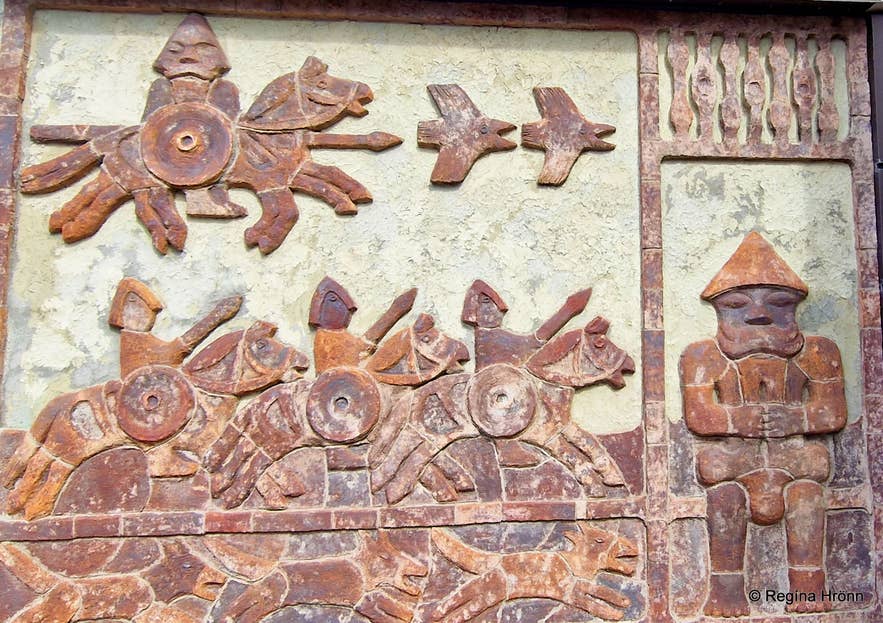
Óðinn and his eight-legged horse Sleipnir
You will find a beautiful artwork - a mural - by Ragnar Kjartansson, on one of the walls of Hotel Holt in Reykjavík.
This artwork, created by Ragnar in 1974, is titled Ásgarður - Asgard (the home of the aesir in Norse mythology).
It is one of my favourite artworks by Ragnar. It depicts major figures from Ásatrú, the old Norse religion, as described by Snorri Sturluson in the Snorra-Edda.
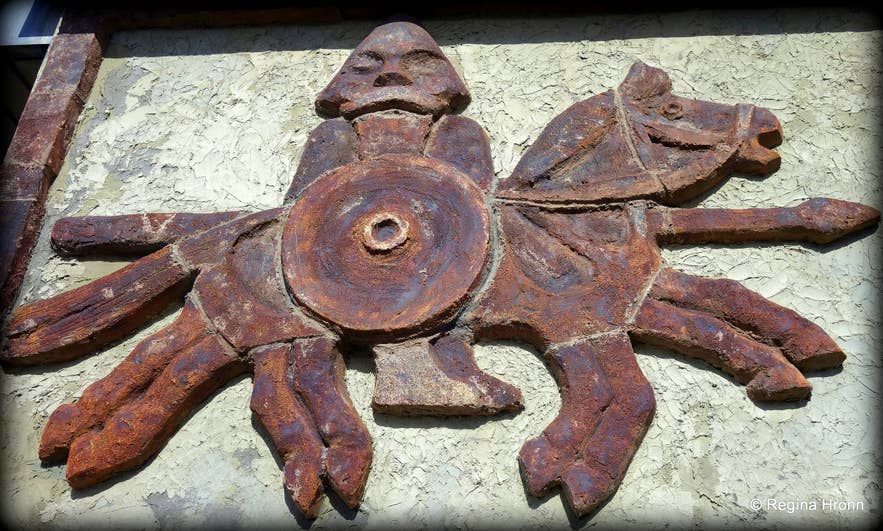 Óðinn and Sleipnir
Here you will see Óðinn, his horse Sleipnir, his ravens, Huginn and Muninn, and the wolves Geri, Freki, and Breki.
Einherjar accompany him, and you will also see Þór with his hammer waiting for them in his realm, Þrúðvangur.
Þór, as depicted by Ragnar, is a replica of one of the key objects in Þjóðminjasafnið - the National Museum of Iceland.
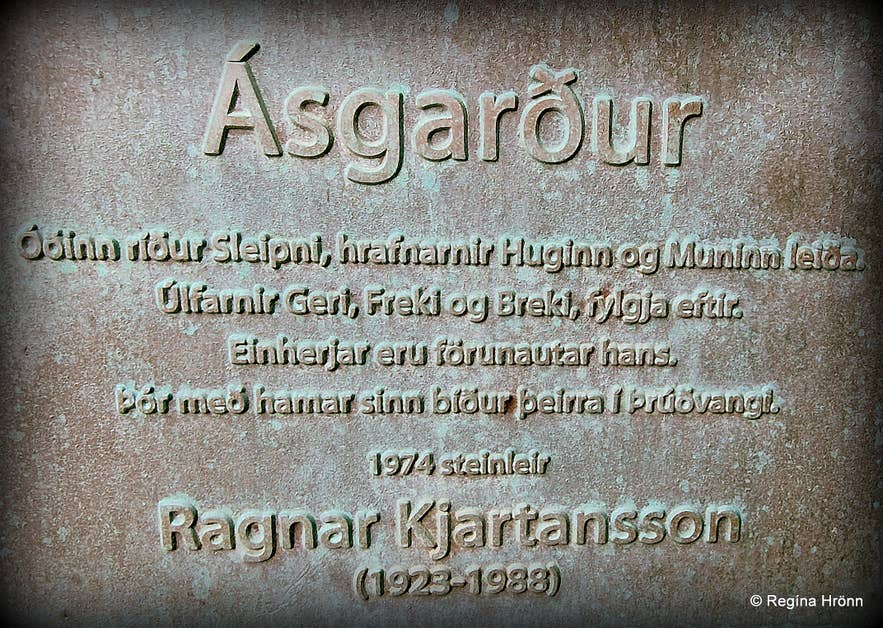 The plaque by the mural
You will find this artwork, created by Ragnar in stoneware clay, at Bergstaðastræti 37 in the centre of Reykjavík.
This is one of Ragnar's clay murals, but Ragnar made many of his works from clay.
In 1939, when Ragnar was only 15 years old, he studied the art of pottery (ceramics) with Guðmundur from Miðdalur until 1944 (whose work I adore and own a couple of pieces).
Ragnar co-founded the Funi pottery firm in 1947 and worked primarily with Icelandic clay. He also used other ground minerals and lava (hraunkeramik), plenty of which are found here in Iceland.
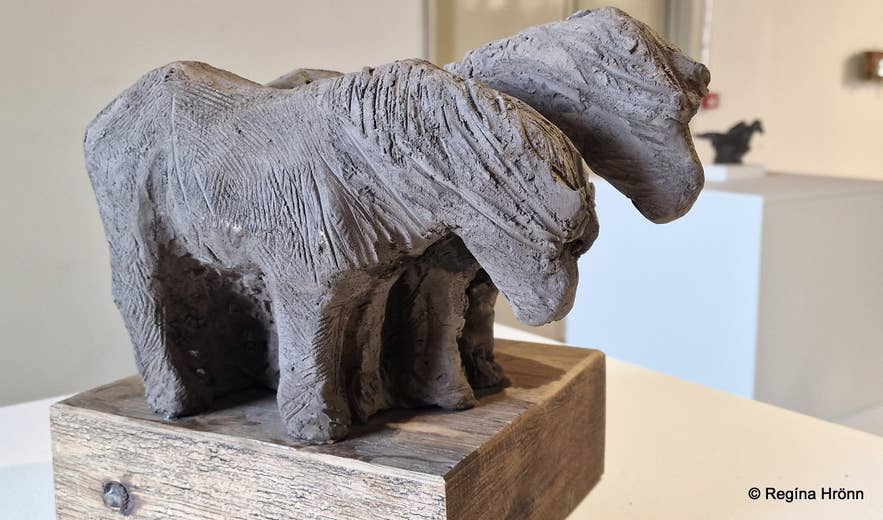 Artwork by Ragnar Kjartansson at Korpúlsstaðir
I remember how popular the lava clay vases were when I was little, and I gave one to my grandfather for Christmas when I was 10 years old :)
After returning from Sweden, where Ragnar studied what was then new in the art of ceramics, he studied with the noted sculptor Ásmundur Sveinsson.
Ragnar then co-founded the Glit pottery in Reykjavík in 1957-58, where many of Iceland's best-known artists worked at one point or another. (Ref.: Glit.is).
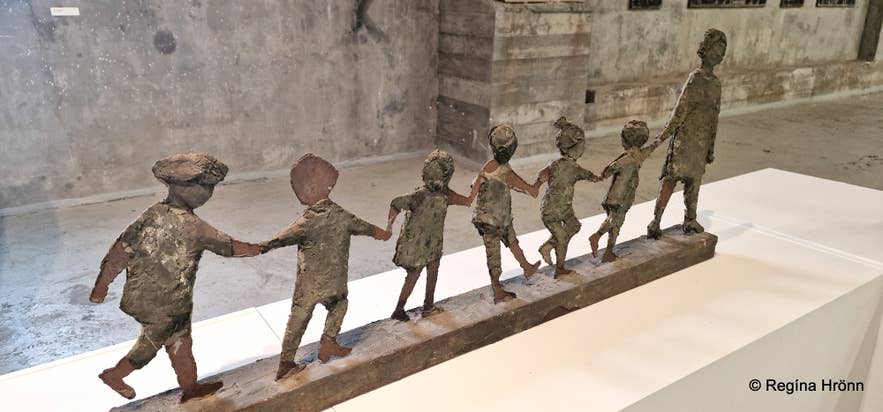 Artwork by Ragnar Kjartansson at the exhibition
Ragnar then started working independently. His biggest buyers must have been towns and villages in Iceland.
Ragnar was also the headmaster for Myndlistaskólinn - the Reykjavík School of Visual Arts for some years and taught at the school.
Stóð - Pack of Horses from 1963
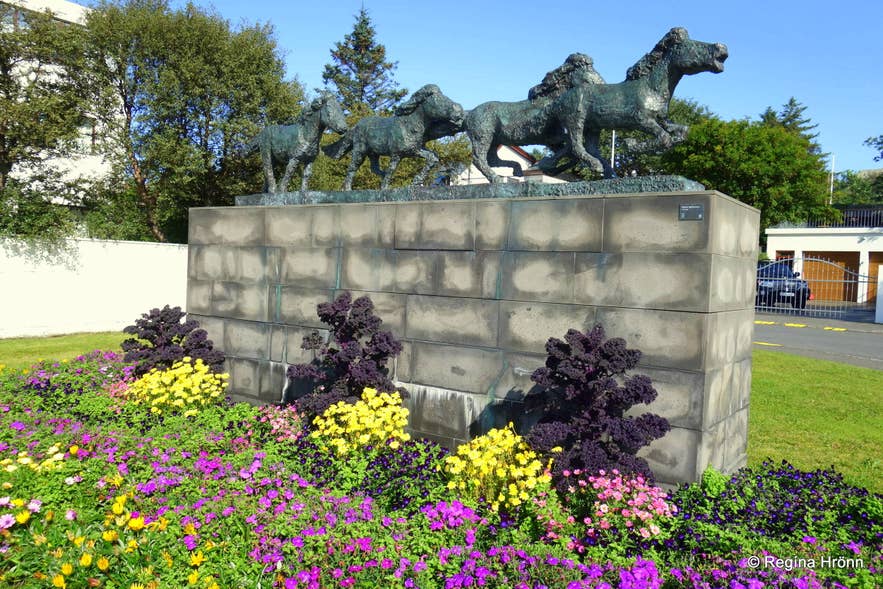 Stóð in Reykjavík
In Reykjavík, on the corner of Smáragata and Miklubraut, you will find Ragnar's beautiful artwork of running horses, called Stóð - Pack of Horses.
Stóð was made in 1963. I remember when the legs of the horses of Stóð were damaged, and it took a long time to fix the statue. The repaired horses were put on their pedestal a little over a week before Ragnar died in 1988.
It was a bit painful to see this statue of sturdy Icelandic horses damaged, especially since Ragnar's favourite subjects were horses and memorials for fishermen, i.e., subjects connected with the sea.
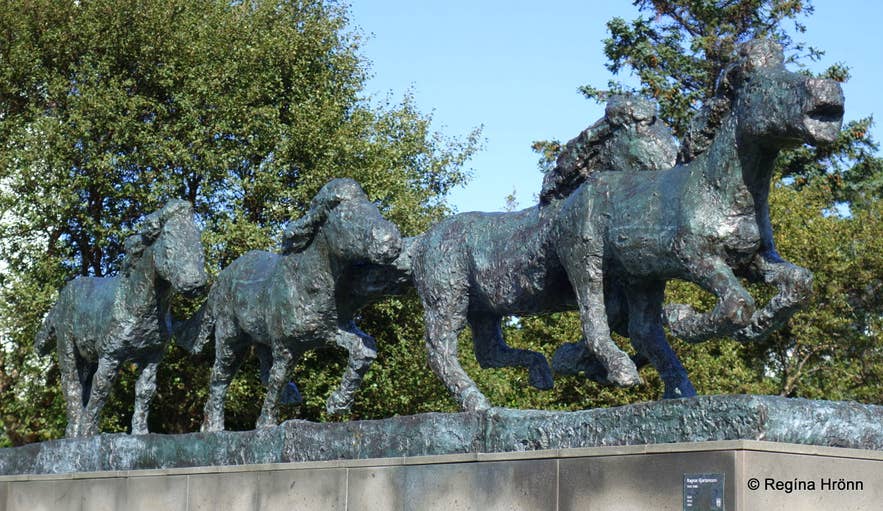 Stóð - it is somehow difficult to photograph
Ragnar grew up on the Snæfellsnes peninsula, surrounded by both working horses and riding horses. His father, the minister Kjartan Kjartansson, visited his large parish on horseback and experimented with horse breeding.
Ragnar was born in 1923, and there were not many motor vehicles at the time. As a young boy, he dreamed of driving cars instead of riding on horseback.
It was only later, when he had spent time abroad, that he understood what a majestic and resilient animal the Icelandic horse really is.
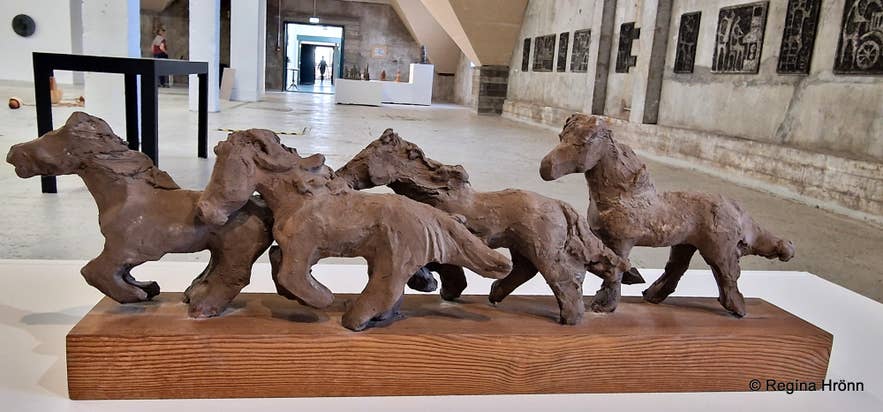 The prototype of Stóð at the exhibition
I got this information in an 1988 interview with Ragnar for Morgunblaðið, and in that interview, Ragnar mentioned my great-uncle Gunnar Bjarnason, who was a pioneer in horse breeding in Iceland.
He recalled that Gunnar had put forth the theory that horses hypnotize themselves under certain circumstances when standing outside in a herd.
Stóð is such a beautiful statue, and the City of Reykjavík takes pride in planting beautiful flowers by the statue in the summertime.
A bas-relief in Grasagarðurinn in Laugardalur in Reykjavík
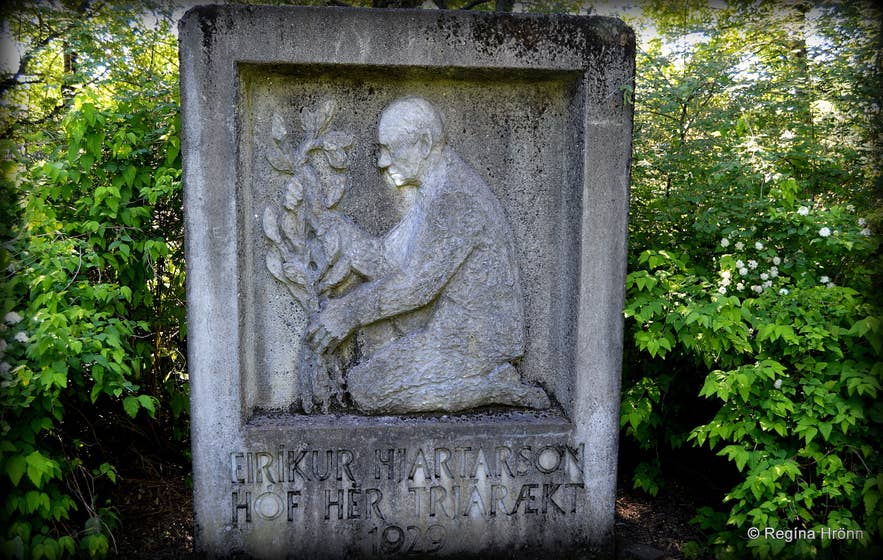 The bas-relief of Eiríkur Hjartarson depicts him planting a tree
In my neighbourhood park in Reykjavík, Grasagarðurinn (the Botanical Garden) in Laugardalur valley, you will find a bas-relief by Ragnar Kjartansson.
The work depicts Eiríkur Hjartarson (1885-1981), who lived in Laugardalur valley from 1920 to 1955. He grew herbs and vegetables in the valley and began planting trees in 1929. The City of Reykjavík took over the Laugardalur Horticultural Station when Eiríkur moved away with his family.
Kudos to him for a job well done; he also planted about 100,000 trees in the Svarfaðardalur valley up north. When I was growing up, there were very few trees in Reykjavík, and the city has changed a lot in this regard.
The children of Eiríkur donated the bas-relief.
Bas-relief on a wall in Ánanaust in Reykjavík
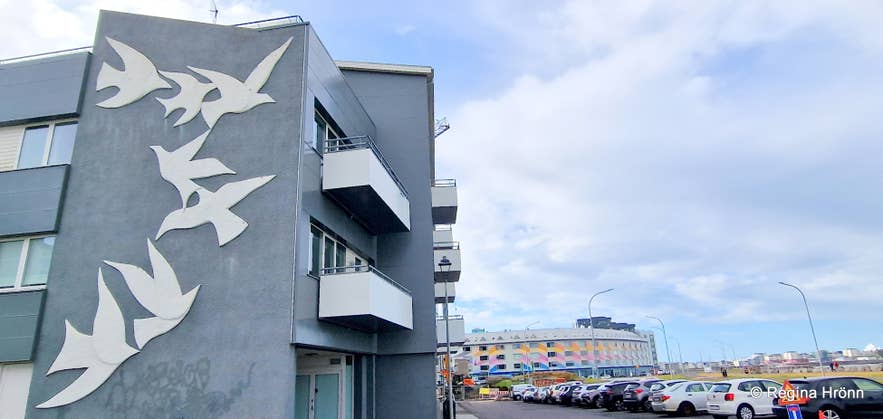
The bas-relief in Reykjavík
On a building wall in Ánanaust in Reykjavík, you will see one of Ragnar's artworks.
Seven white birds are flying on the wall, livening it up. I love such artwork.
Bas reliefs on the college wall in Laugarvatn
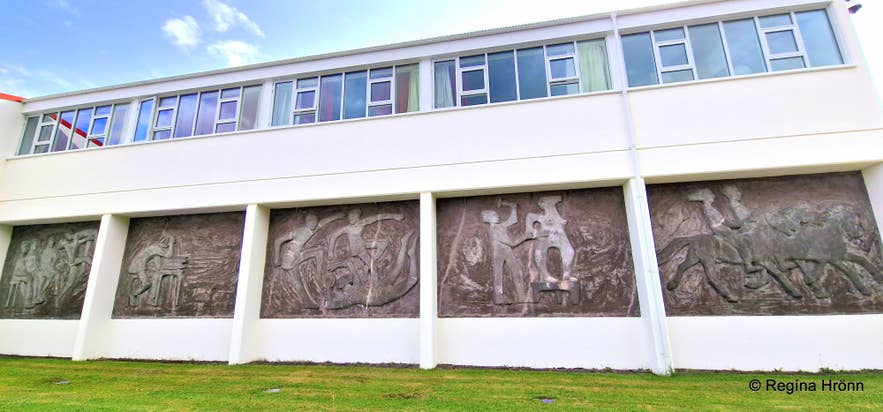 Bas reliefs at Laugarvatn
Ragnar Kjartansson has also created artwork at Félagsheimilið Festi in Grindavík and Menntaskólann at Laugarvatn.
Ragnar studied at Laugarvatnsskóli for 2 years, and we visited it in the summer of 2026.
The bas reliefs are a 5-piece artwork that beautifully decorates the college.
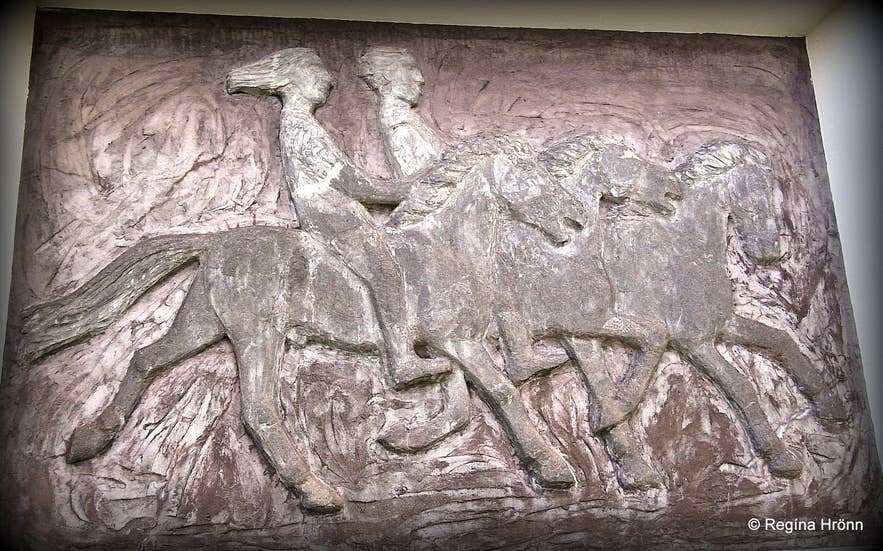 One of the 5-piece wall murals depicts people horseback riding
One of the bas reliefs depicts horses, one of Ragnar's favourite subjects.
I took photos of each and every one of them, and the other ones depict a hard-studying student, a sculptor at work, students playing a ball game, and students wrestling.
Vonin - Hope - a Memorial for drowned fishermen in Grindavík
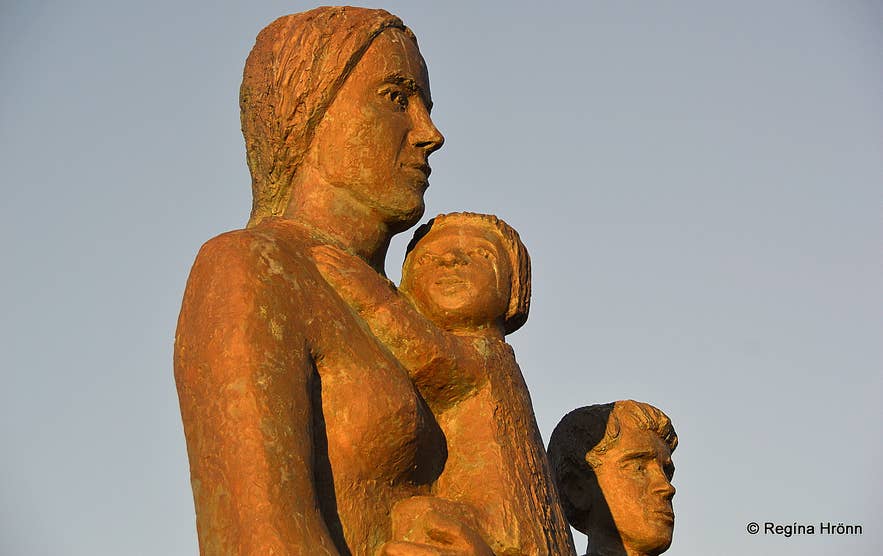
Vonin in Grindavík
Another of Ragnar's memorials for fishermen was erected on Sjómannadagurinn, the Fishermen's Day, in 1980.
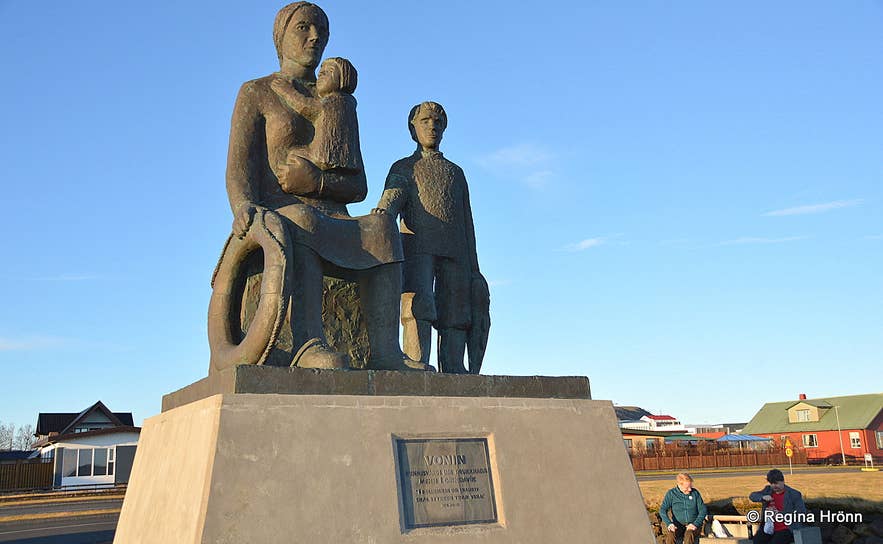
This beautiful memorial is called Vonin - the Hope, and depicts a sitting woman with her two children waiting for her husband's safe return from the sea. She is holding a lifebuoy.
It is heartbreaking to visit such memorials, as so many fishermen were lost at sea. The seaman's family has a stern and worried look on their faces.
 Vonin
Vonin
What total agony it must have been waiting in hope for the father of the house to return safely back home - or not :(
My great-grandfather Ásmundur Sigurðsson drowned in the Grundarfjörður fjord on the 31st of January 1919, but his son, Einar, managed to swim ashore. Five men drowned on this day.
Ásmundur's second wife was pregnant and had children aged 7, 5, 3, and 1. Ásmundur had 7 children by my great-grandmother, Katrín, 3 of whom had already died. Times were hard back then in Iceland.
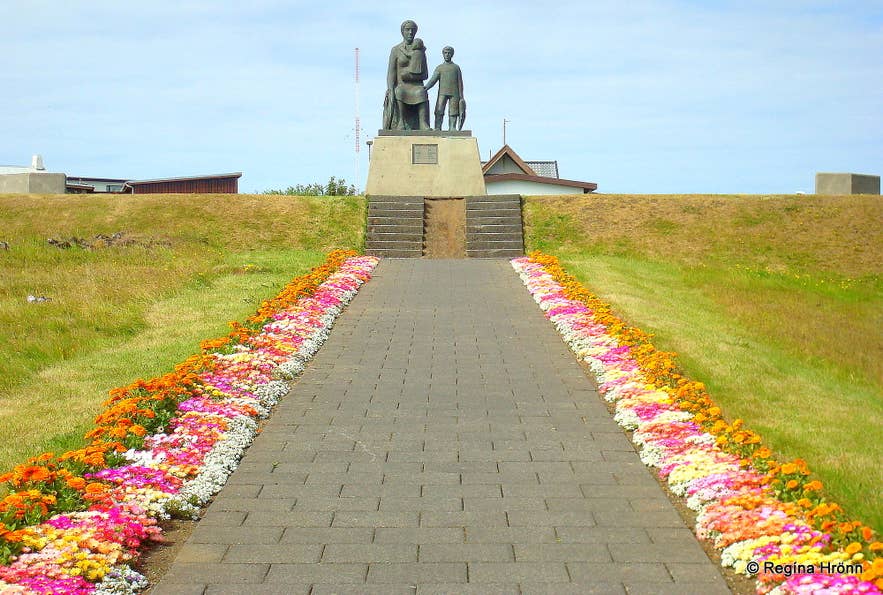 Vonin in Grindavík in 2010
I include the first photo I took of the memorial Vonin back in 2010. The flowers were so pretty and complemented the memorial.
In all towns and villages in Iceland, which are located by the sea, there is a statue in remembrance of the many fishermen who lost their lives at sea.
I have been photographing such memorials for fishermen for 2 decades now, and I always stop by them to pay my respects. To me, these memorials represent the heart of the hamlets and towns in Iceland.
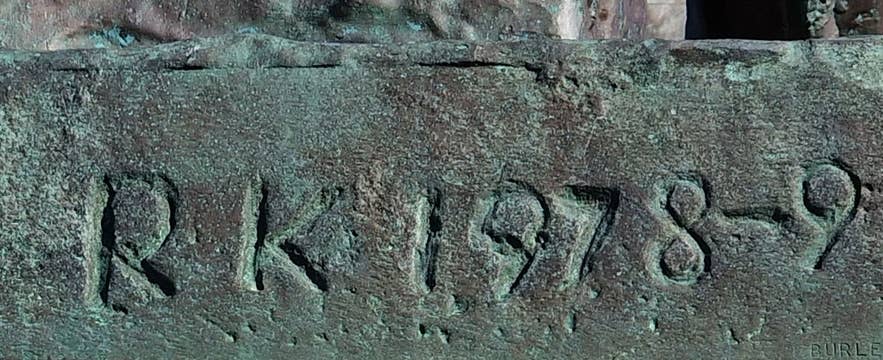 Ragnar Kjartansson's initials RK - 1978-9 on the pedestal of Vonin
Following the tragic event in a violent storm in 1952, when 5 men of the crew of Grindvíkingur GK 39 drowned at Hópsnes, the Women's Association of Grindavík (Kvenfélag Grindavíkur) decided to start saving for a memorial for drowned fishermen in Grindavík.
It took almost 30 years to save enough money for a memorial statue, and they did so with many donations.
They contacted Ragnar Kjartansson, and he made some prototypes for such a statue, and one of them was chosen.
The prototype in my photo below is a bit different from the erected statue: the boy holds a boat, whereas the statue depicts him holding a large fish. The statue itself, Ragnar sculpted in the hayloft of Korpúlsstaðir (ref. Þjóðviljinn - Ragnar Kjartansson).
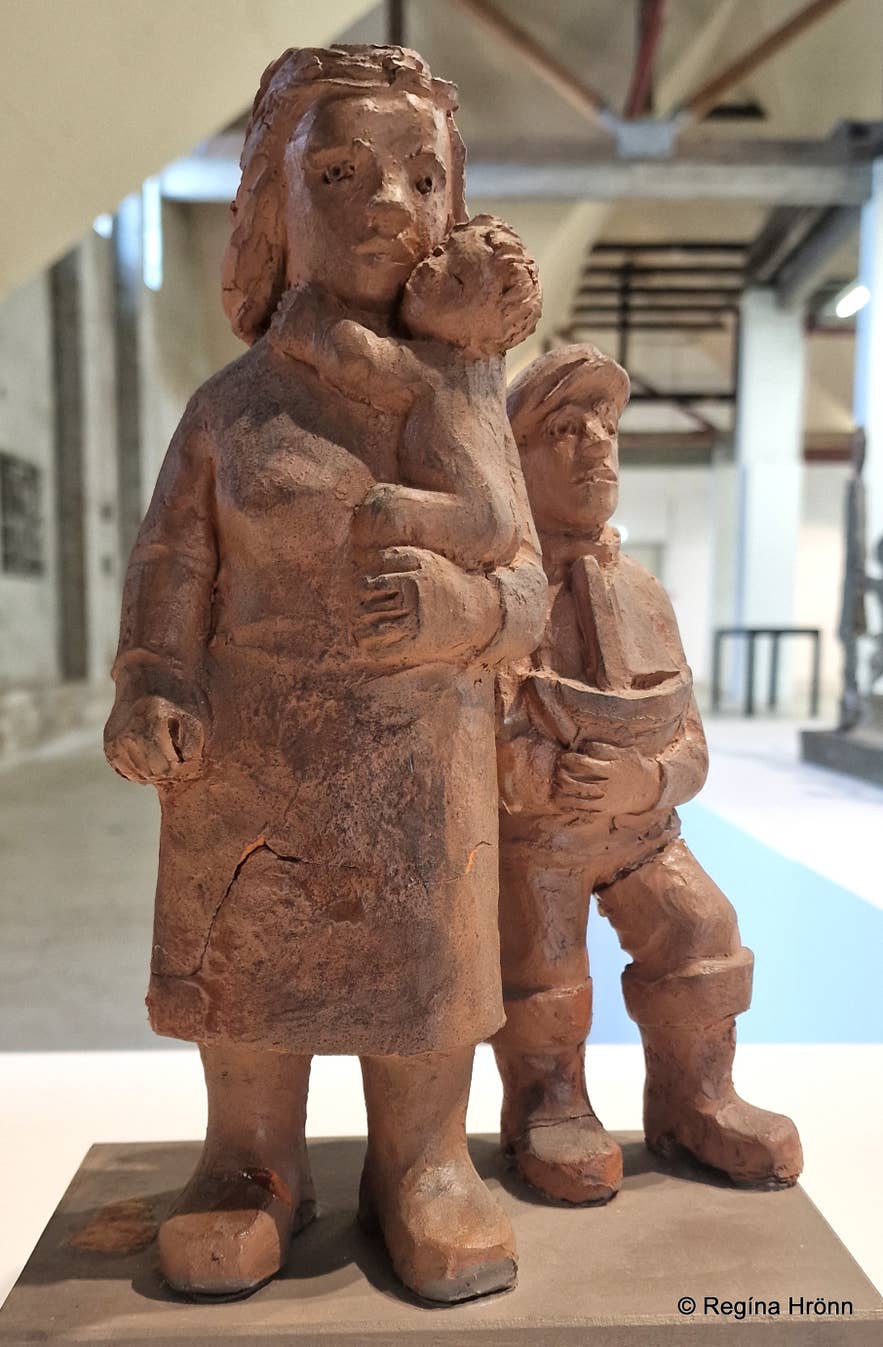
A prototype for the memorial for drowned fishermen, Vonin, in Grindavík - it is a bit different from the statue
Written on the foundation of the memorial is "Minnisvarði um drukknaða menn í Grindavík," along with a quote from Jes. 30.15: "Í þolinmæði og trausti skal styrkur yðar vera" - "In quietness and trust is your strength".
The memorial stands in Sjómannagarðurinn park by Mánagata in Járngerðarstaðahverfi in Grindavik.
Sjómenn in Innri-Njarðvík
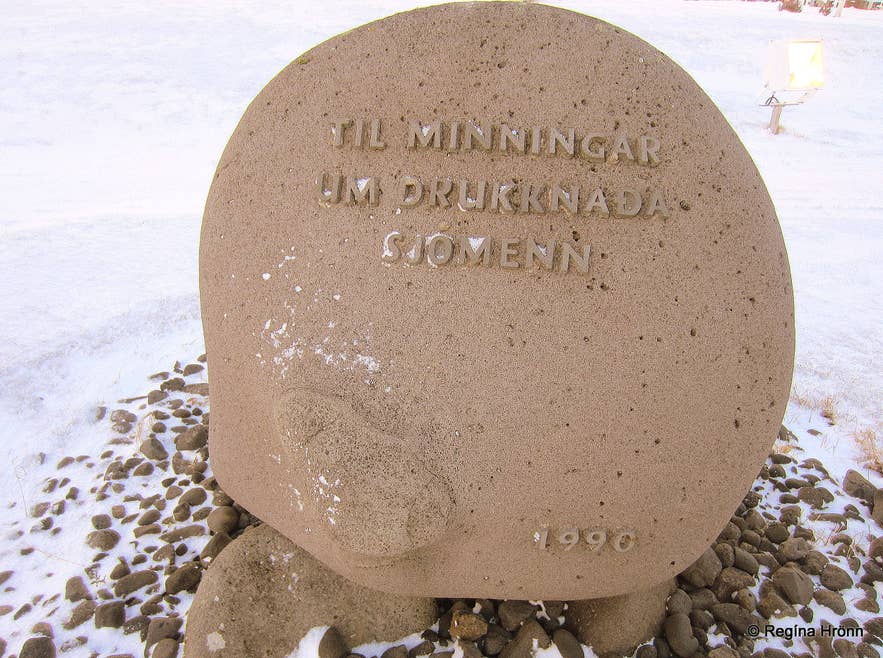 A memorial for drowned fishermen in Innri-Njarðvík
I read in an article that there is a stone in Innri-Njarðvík in remembrance of drowned fishermen, and that Ragnar Kjartansson made it.
I found this stone in Innri-Njarðvík, erected in 1990, and gathered that it is the memorial in question. Correct me if I am wrong.
The Little Fisherman on Vatnsleysuströnd
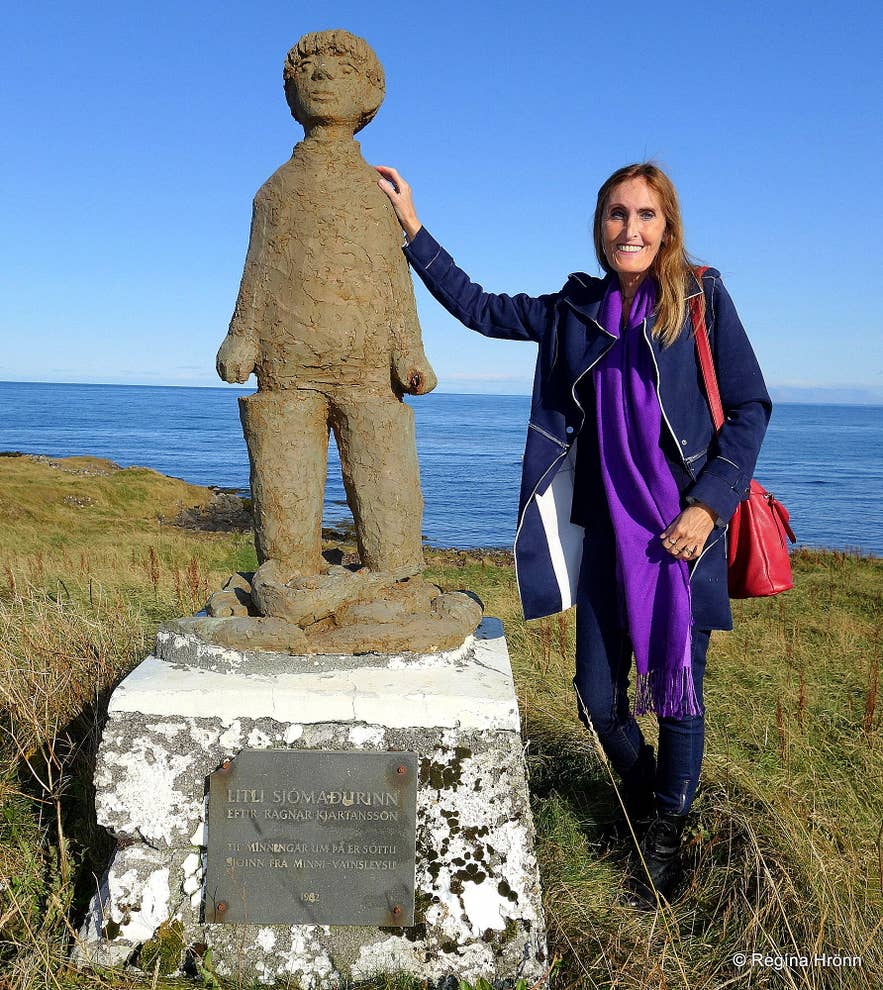 By the Little Fisherman
Litli sjómaðurinn - the Little Fisherman was erected in memory of fishermen on Minni-Vatnsleysa on Vatnsleysuströnd on the Reykjanes peninsula.
I first saw it on an old travel show on TV, and very much wanted to visit it. It took some effort, though, to find out exactly where it was located.
And we had to pass a pork farm and a pork factory on the way to visit it. It said no trespassing, so I was not at ease.
The Little Fisherman on Vatnsleysuströnd
The owner of Minni-Vatnsleysa from 1953, Þorvaldur Guðmundsson, asked Ragnar Kjartansson to make this statue in remembrance of drowned fishermen on Vatnsleysuströnd. At that time, Minni-Vatnsleysa was the biggest pork farm in Iceland.
You can see a photo of Þorvaldur and Ragnar by the Little Fisherman here in Morgunblaðið.
The statue stands by the sea, as you can see in my video.
Written on the pedestal is: "Litli sjómaðurinn eftir Ragnar Kjartansson. Til minningar um þá er sóttu sjóinn frá Minni-Vatnsleysu - 1962." - the Little Fisherman by Ragnar Kjartansson. In the memory of seamen from Minni-Vatnsleysa - 1962".
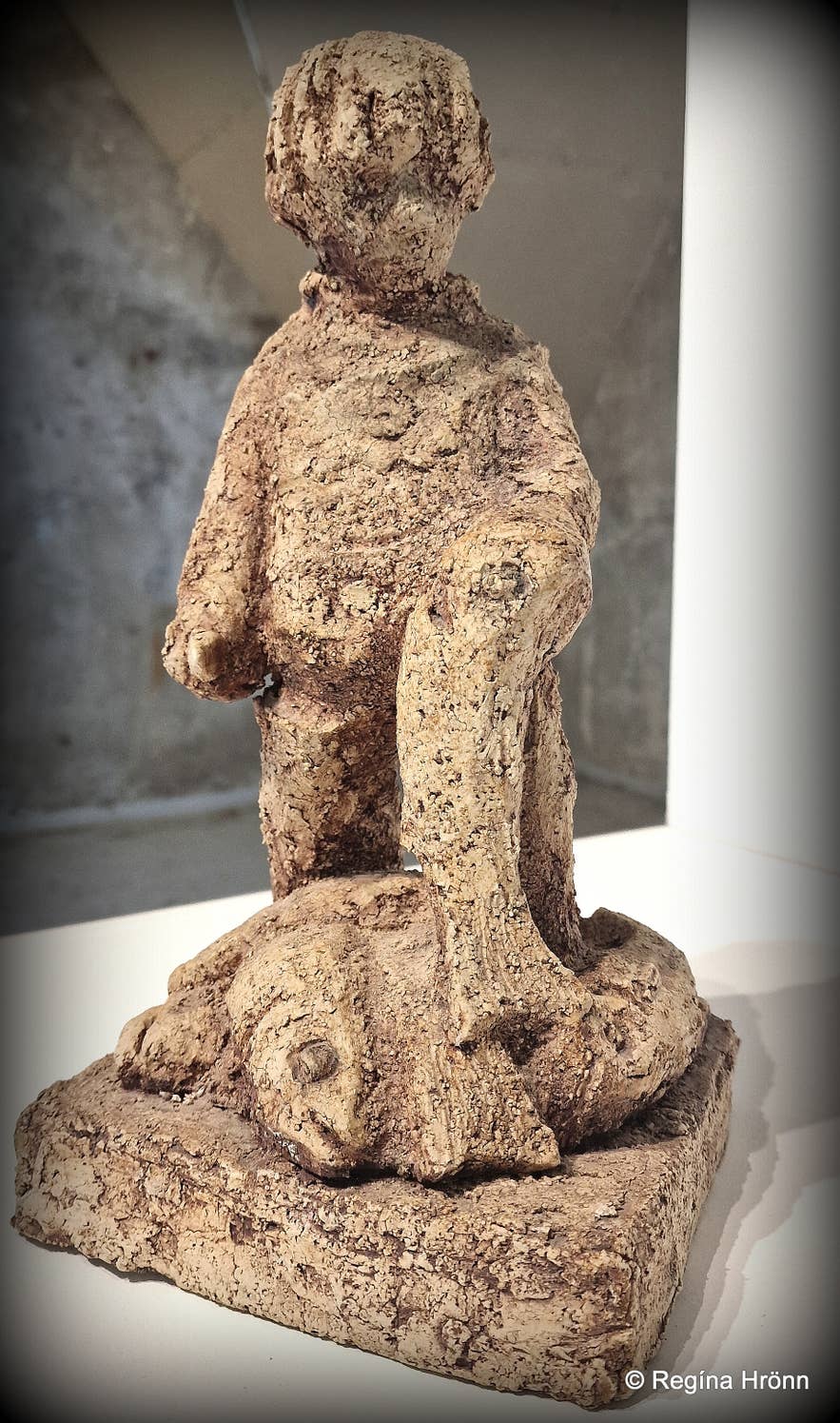
The prototype of the Little Fisherman
I visited it a couple of years ago, and when we visited the exhibition of Ragnar Kjartansson's work, his daughter told us that the sea was eroding the statue and that they wanted it moved to another location.
Usually, Ragnar formed his prototypes in clay before creating the final version of his work, as you might have noticed from the photos of the prototypes.
Artwork in North Iceland
The cow Auðhumla and the Milkmaid in Akureyri
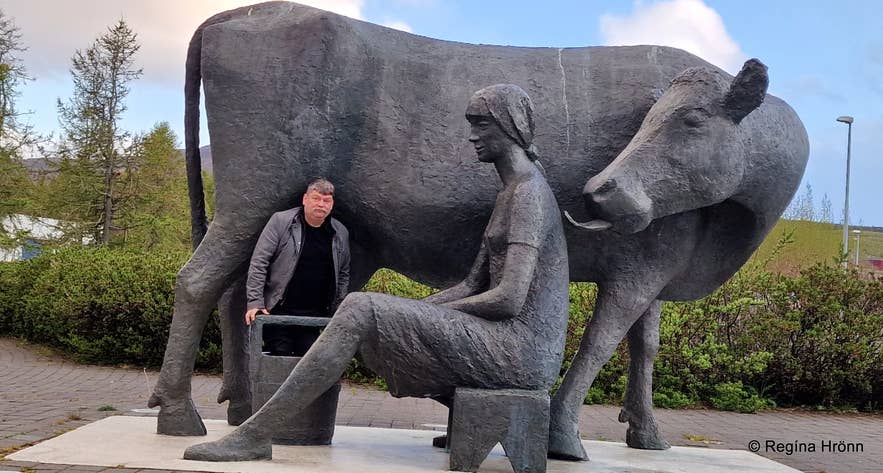
Auðhumla - my husband stands next to it so you can see how big it is
In 1983, on the 100th anniversary of KEA (Kaupfélag Eyfirðinga) in Akureyri, Ragnar Kjartansson was asked to create one of his largest sculptures, Auðhumla og mjaltastúlkan - the Cow Auðhumla and the Milkmaid. The cow is more than double the size of a normal Icelandic cow.
Auðhumla is the primeval cow in Norse mythology. And Ragnar made the cow in the image of Icelandic cows, which have kept Icelanders alive through the centuries and nourished our children.
Instead of the frost giant Ýmir sucking the cow Auðhumla, Ragnar had a milkmaid milking the cow.
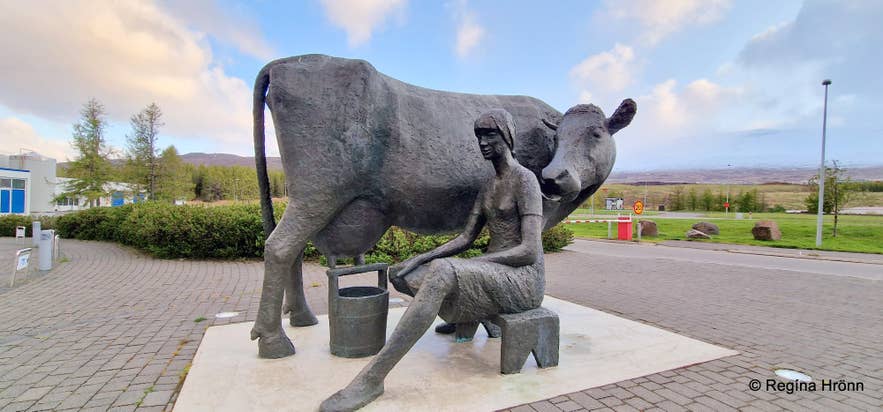 Auðhumla by Ragnar Kjartansson
As Ragnar said when asked about his work: "... á meðan kýrin mjólkar er alltaf von um að börnin lifi af veturinn" - meaning that there is always hope that the children would live through the winter as long as the cow could be milked.
You will find Auðhumla by MS (Mjólkursamsalan - MS Iceland Dairies) in Akureyri on Súluvegur 1.
Lífsbjörg - a Memorial for drowned fishermen in Siglufjörður
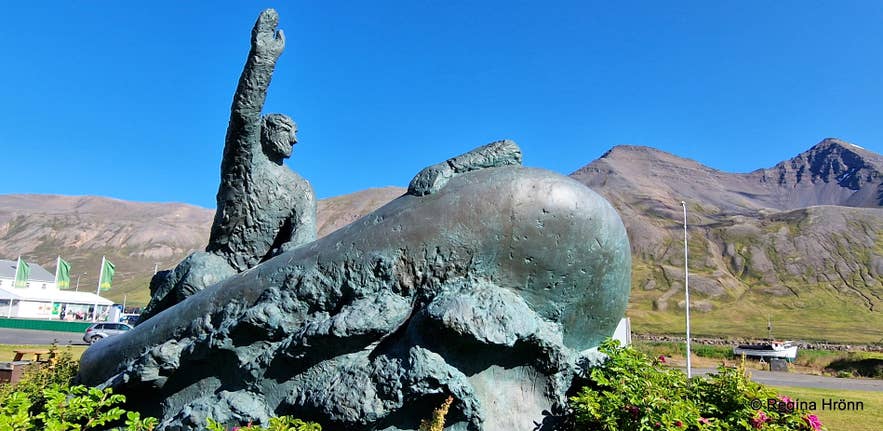
Lífsbjörg in Siglufjörður
The memorial for fishermen in Siglufjörður, North Iceland, was also made by Ragnar Kjartansson.
It is called Lífsbjörg - Lifesaving and was unveiled on Sjómannadagurinn - the Fishermen's Day in 1988, the year that Ragnar died.
On the memorial is written "Lífsbjörg: Minnisvarði um drukknaða sjómenn frá Siglufirði“ - "Livesaving: a memorial for drowned fishermen in Siglufjörður".
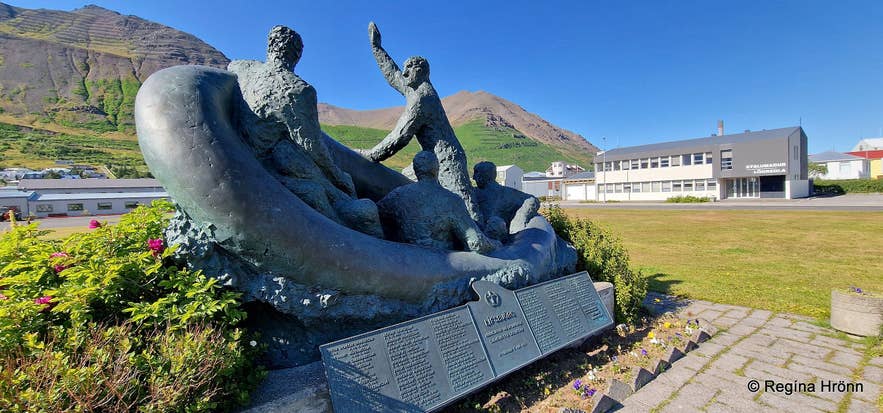 Lífsbjörg
On the memorial are written 62 names; the names of drowned fishermen from 1900 to 1988 - blessed be their memory.
The memorial depicts 5 men aboard a lifeboat, one of whom has his hand raised in a wave for help, indicating they are being rescued. Such memorials speak volumes, at least to people living by the sea.
Bishop Friðrek and Þorvaldur víðförli. 981 Mission 1981
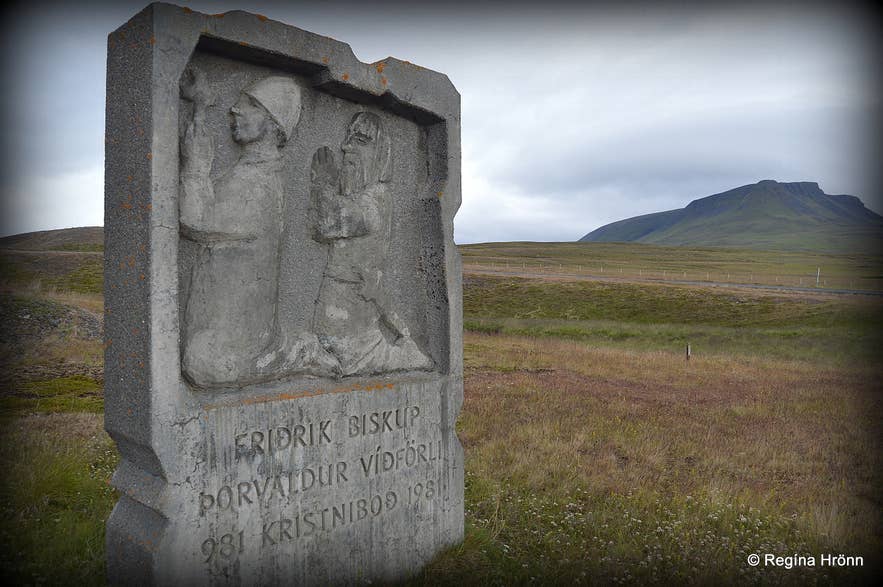
Fyrstu trúboðarnir - the First Missionaries
When driving north in Húnaþing, you will see one of Ragnar Kjartansson's artworks by the side of the road.
It is a beautiful memorial, erected in 1981, to commemorate the 1000th anniversary of the arrival of the first Christian missionaries in Iceland, the first ones to preach the Christian faith in my country.
The memorial depicts Þorvaldur víðförli Konráðsson, who was born at Stóra-Giljá close by (a beautiful green house by the road), and the bishop Friðrik.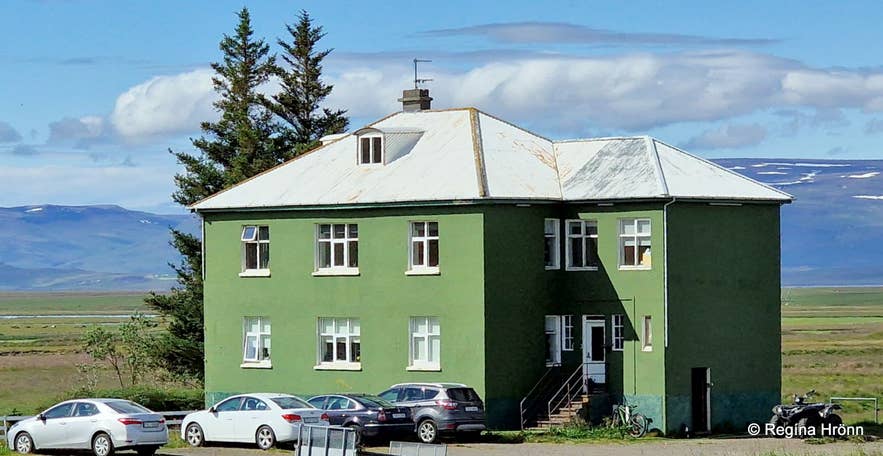
Stóra-Giljá
Þorvaldur and Friðrik (Friðrek) stayed at Stóra-Giljá for the first year of their mission in 981-986.
The memorial depicts Bishop Friðrik and Þorvaldur kneeling in prayer, and I joined them on one of my stops there. And thanked them for bringing Christ to Iceland.
The Norwegian settlers were of the Ásatrú faith - the old Norse religion, but some of them were Christians, like the Norwegians coming from the Hebrides, one of the best-known of whom is the settler woman Auður djúpúðga, whom I have told you about in other travel blogs.
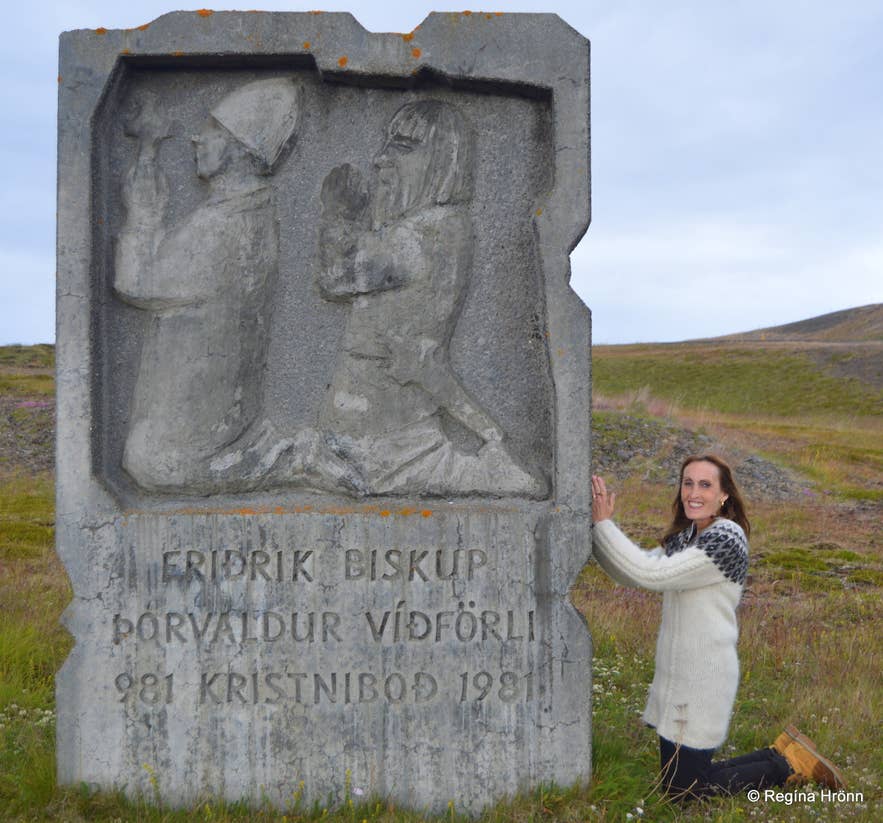
The memorial for Bishop Friðrik and Þorvaldur víðförli
Behind the memorial is a rock called Gullsteinn - the Gold Rock.
Þorvaldur's father, Koðrán, refused to change his faith and allow his son to baptize him. It is often said that people believed in "stokka og steina", and Koðrekur didn't want to offend the guardian spirit in Gullsteinn.
What did Bishop Friðrik (-ur) then do? He chanted over the rock until it cracked!
We have many stories about supernatural beings living in our rocks, and many of us still believe they reside in Iceland with us, myself included.
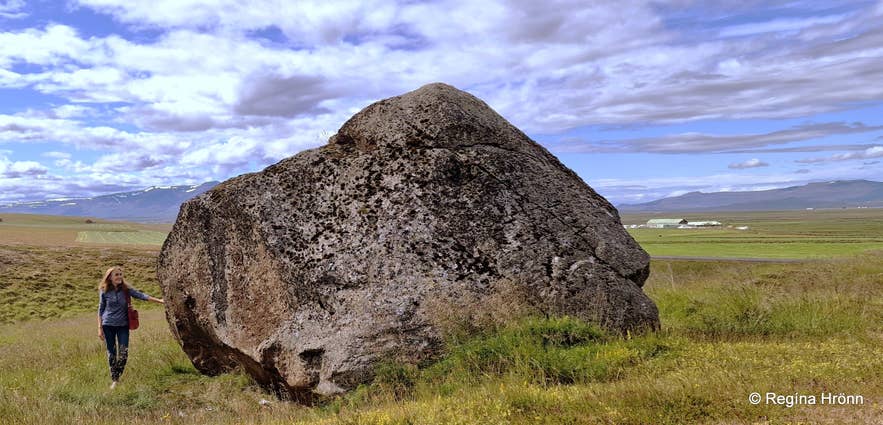
By Gullsteinn - the Gold Rock
I am a firm believer in Jesus Christ, but also know that we share Iceland with the Hidden people of Iceland, whom I have told you about in many of my travel blogs.
Let's think back to the year 1981, when the memorial was consecrated.
Our beloved late Bishop Sigurbjörn Einarsson held a speech and consecrated the memorial, and a choir of 100 people from the Húnavatns deanery sang at the ceremony.
The Bishop of Iceland christened a child at the ceremony, a grandchild of the farmers of Stóra-Giljá.
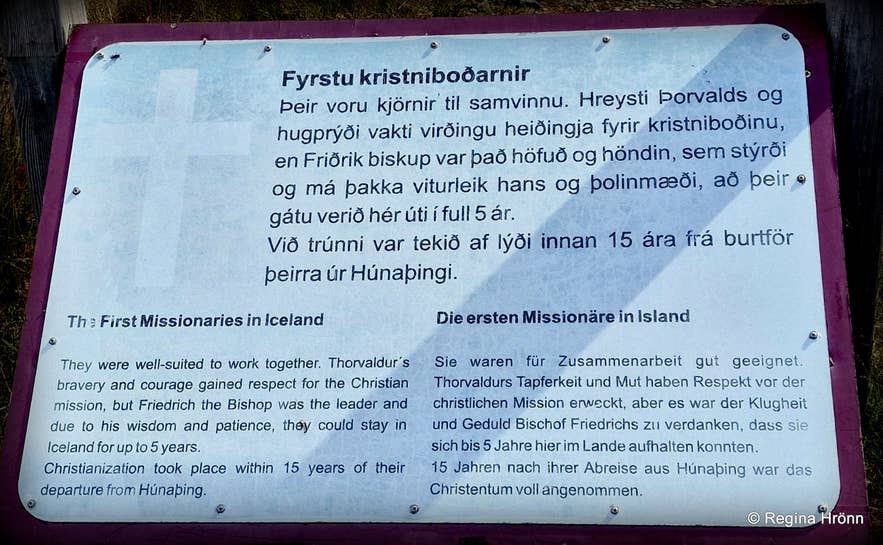 The worn information sign by the memorial
Both of the ordaining bishops of Iceland attended the ceremony, along with many ministers and laymen. And a service was held in nearby Þingeyrakirkja church, my favourite church in Iceland.
The story of Friðrik and Þorvaldur is told in Hauksbók Landnámu, Kristni saga in Biskupasögur, and also in Þorvalds þáttur víðförla.
Ref.: Tíminn 1981 - Þúsund ár liðin frá upphafi kristniboðs
Faxi at Faxatorg in Sauðárkrókur
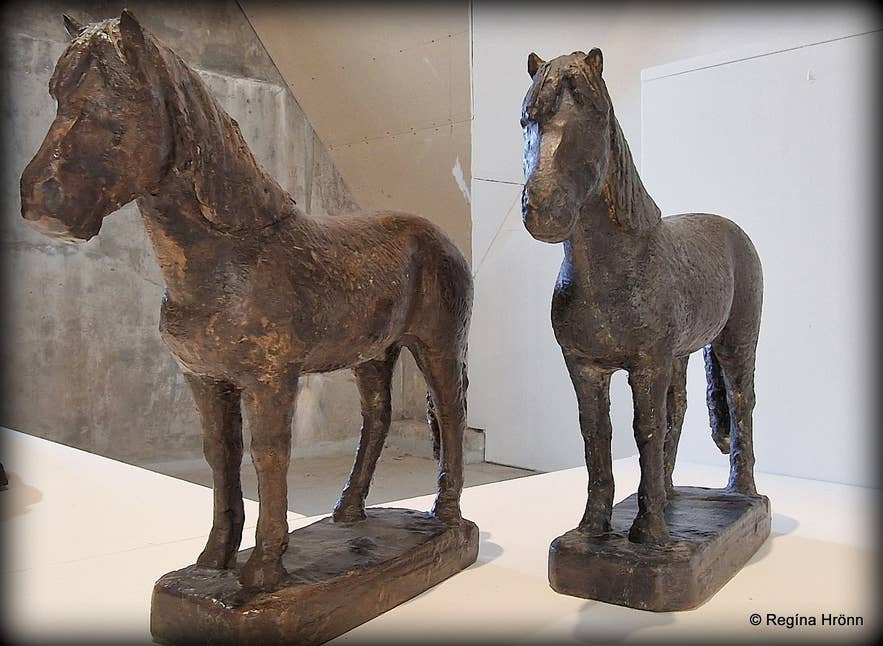
Prototypes of horses at the exhibition
One of Ragnar's major works is the horse artwork at Faxatorg in Sauðárkrókur in Skagafjörður. It is called Faxi.
I have visited Faxi and taken a photo of it, but I cannot for the life of me find it. So I added a photo of Ragnar Kjartansson's horse prototypes, which I saw at the exhibition.
In 1971, on the occasion of the 100th anniversary of the first house being built in Sauðárkrókur, the local council approached Ragnar Kjartansson and asked him to create a horse sculpture for them.
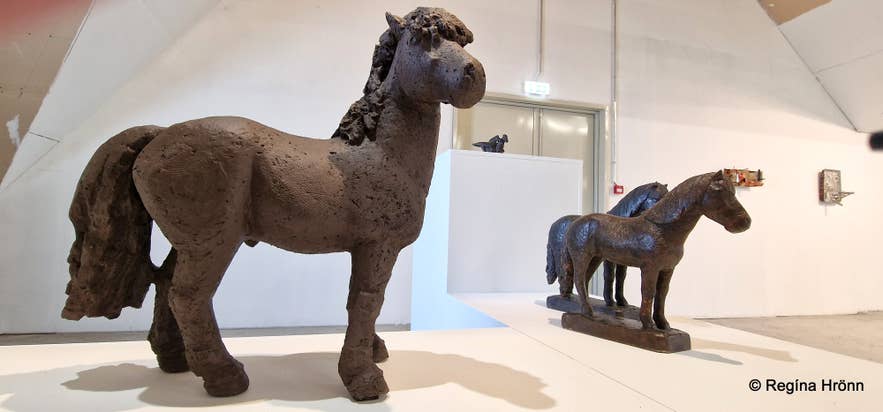 The many prototypes for horses at the exhibition of Ragnar's work
The concrete sculpture Faxi was consecrated on the 100th anniversary at Faxatorg.
And on the occasion of Ragnar Kjartansson's 100th anniversary in 2023, Faxi, which had become damaged over the years, was removed from its pedestal and shipped to Germany, where it was cast in bronze.
Ref: Faxi á Faxatorgi lagfærður - Færður úr steypu í brons
Artwork in the Westfjords
The Memorial for drowned fishermen at Ísafjörður
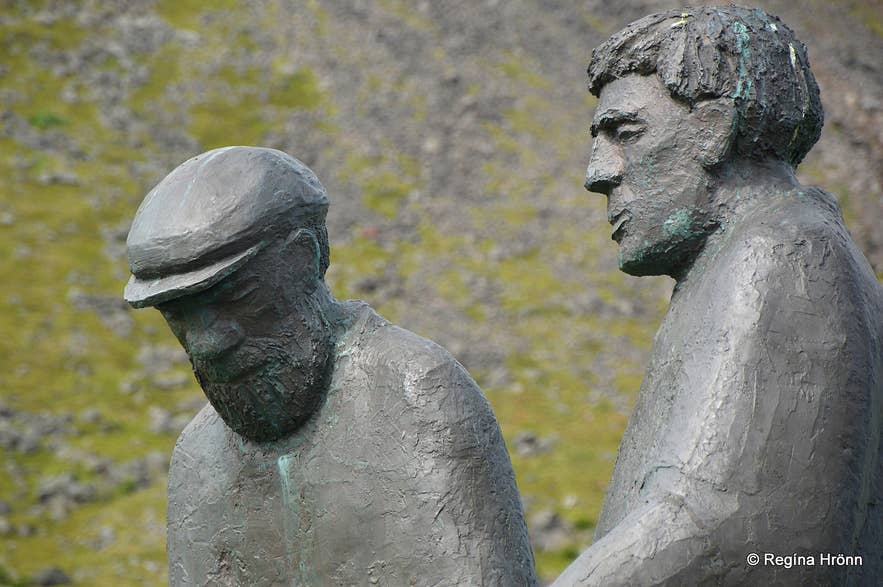
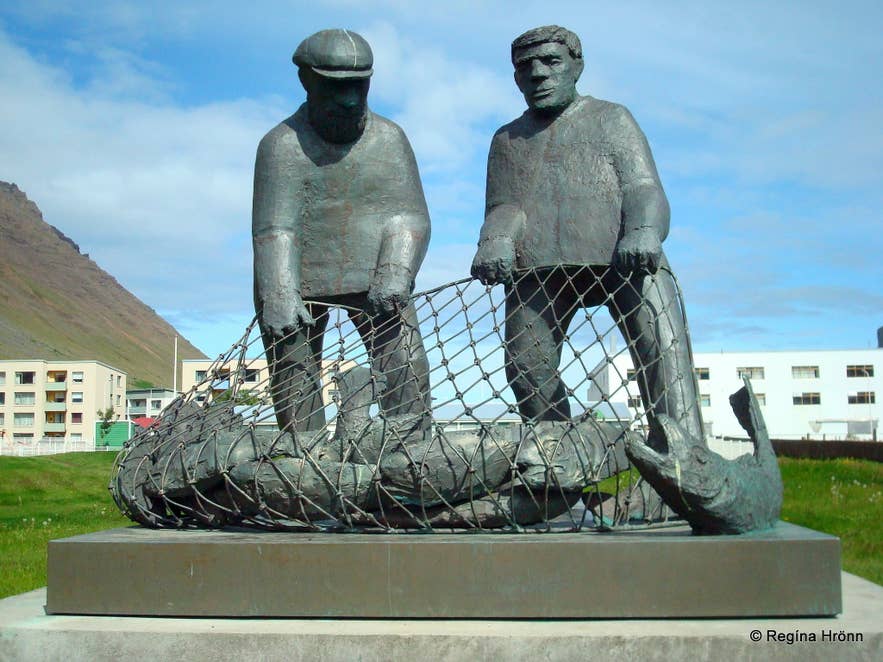
The memorial depicts 2 fishermen hauling in a net
In Ísafjörður, the capital of the Westfjords of Iceland, in a prominent, open place, stands Ragnar's largest work of this kind, the memorial for seamen from Ísafjörður.
It was unveiled at Eyrartún in front of the old hospital in September 1974.
The memorial is large, 3 meters tall, and in addition to these 3 meters is the pedestal. It depicts fishermen hauling in a net with fish.
On the pedestal is written in Icelandic: "Til heiðurs þeim sem horfnir eru, til heilla þeim sem halda á mið" - In honour of those who have died (horfinn), and for the good fortune of those sailing to the fishing grounds.
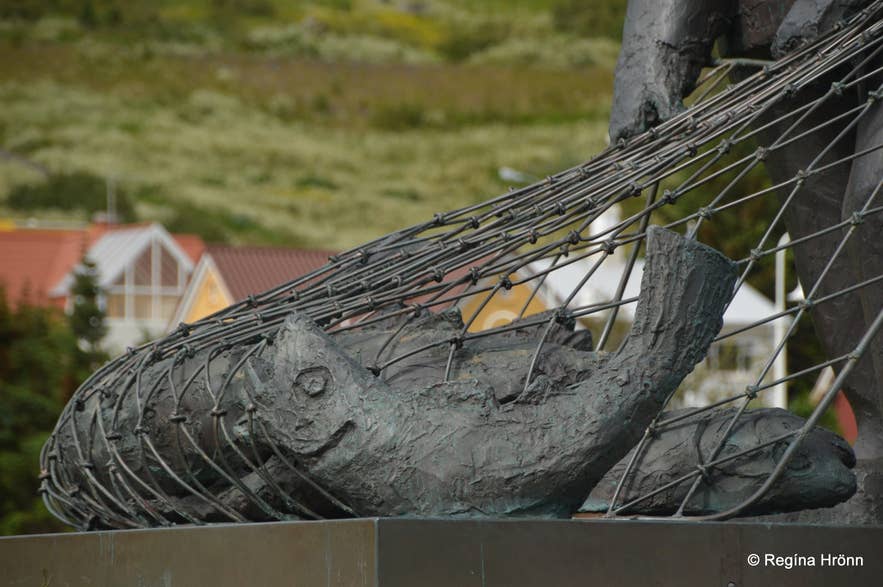
A net filled with fish
This memorial is a bit different from the memorials I have seen of the family of the fishermen waiting in anguish for the return of their loved ones, and fishermen in peril.
As this memorial shows two working fishermen, as the pedestal says, it is twofold: both to honour the drowned fishermen and to honour the working fishermen.
The municipal authorities and Sjómannafélag Ísfirðinga erected this memorial, and good-hearted people donated to it.
As this memorial in Ísafjörður is so large, Ragnar couldn't fit the prototype into his atelier on Grettisgata in Reykjavík. He made a 1-meter-tall prototype to show to them, and then finished the memorial in a hangar in Reykjavík (ref. Lesbók Morgunblaðsins).
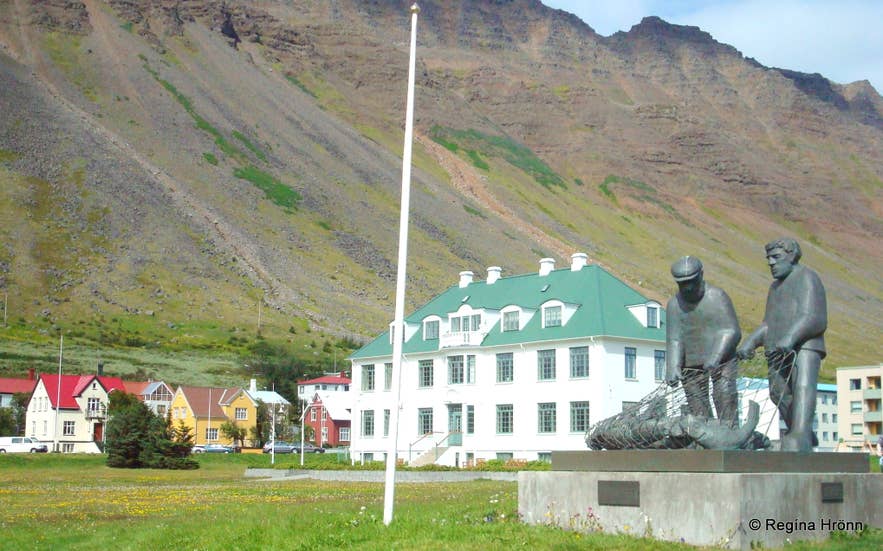 The memorial stands next to the old hospital in Ísafjörður, where my grandmother worked
The memorial was cast in bronze in 2008, following a request from Ragnar's daughter, Inga Sigríður Ragnarsdóttir, as it had become damaged. Landsbanki Íslands paid for the repair.
On Sjómannadagurinn - the Fishermen's Day, a wreath is put by the memorials of fishermen.
It was not an easy task to create such large statues, and Ragnar first sketched his ideas on paper, then molded a prototype, and then he made a full-size metal frame from welded steel.
As I mentioned earlier in this travel blog, Ragnar's favourite subjects were horses and fishermen.
When Ragnar was a teenager, he started working on open motorboats in Hellnar on the Snæfellsnes peninsula. And later worked for a while on trawlers to support his family.
What stood out in this experience was his interaction with the strong, resilient, weather-beaten fishermen, who worked out at sea in all kinds of weather.
He sketched a lot of them during his work at sea.
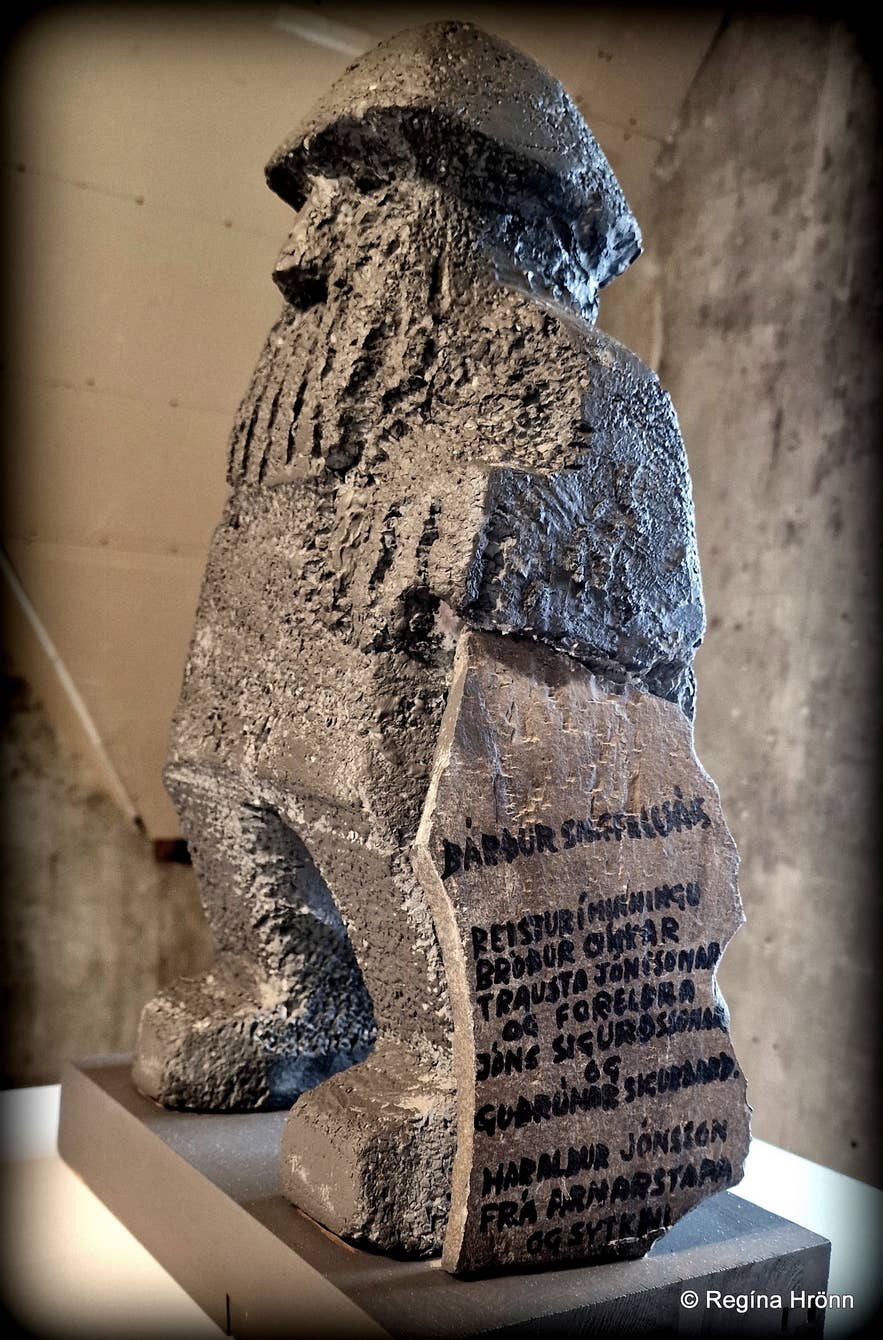 The prototype of Bárður Snæfellsás - he was also strong and resilient
I know exactly what type of men he is talking about. My great-grandfather, Guðmundur, who lived at Sæból in Ingjaldssandur in the Westfjords, was one of them.
And Ragnar Kjartansson for sure looked like one of them as well.
Nothing has influenced Ragnar's work more than these working men, who had to fight the elements to bring home their catch and support their families.
The admiration for the heroes of the sea shines through in Ragnar's work, and you cannot help but be moved when you stand in front of his sculptures.
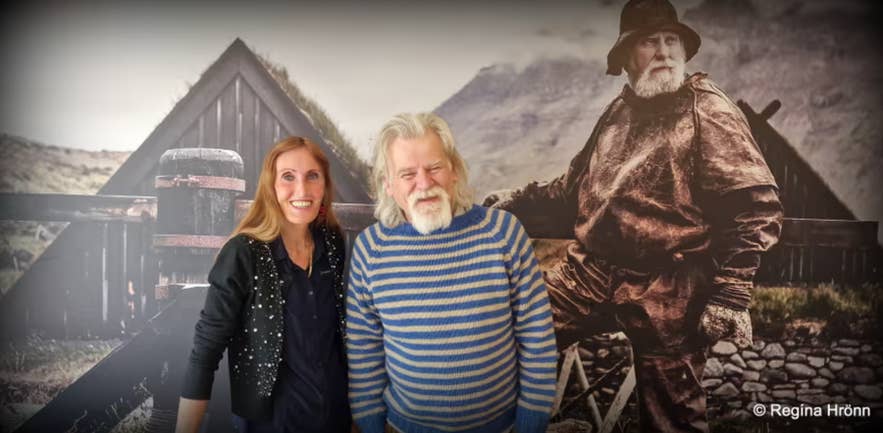 Visiting the Westfjords, the fishermen looked like the one in the picture behind us
This type of artwork is called social realism. And quoting Ragnar, he said that the realism had to be precise and resounding (ref.: Morgunblaðið).
I know that I am always moved when I stand in front of such statues, and that is why I am writing this travel blog: I wanted to find all of Ragnar's work around Iceland and honour the memory of the fishermen. We wouldn't have survived as a nation without them.
Artwork in South Iceland
Páll Ísólfsson in Stokkseyri
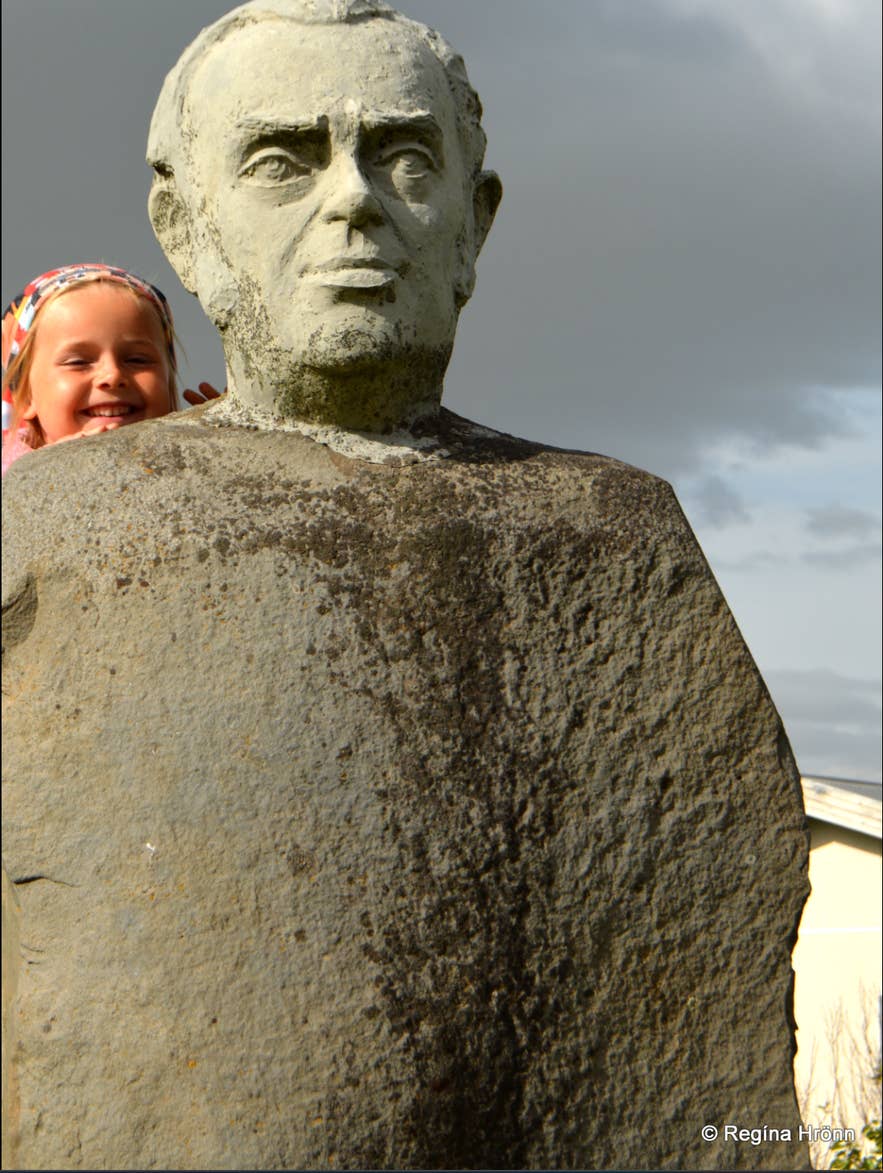
Páll Ísólfsson and my little niece peaking above his shoulder to tease me :D
In Stokkseyri village in South Iceland, you will find one of Ragnar's artworks.
It is a statue of Páll Ísólfsson (1893 – 1974), an Icelandic composer, organist, and conductor. Páll was one of the leading figures in music in Iceland in the 20th century.
On the pedestal is written: Páll Ísólfsson – tónskáld – 1893-1974.
The portrait, which is a head on a large rock, is here in Stokkseyri because Páll was born in this village. And the village honoured Páll with this statue for his 80th birthday.
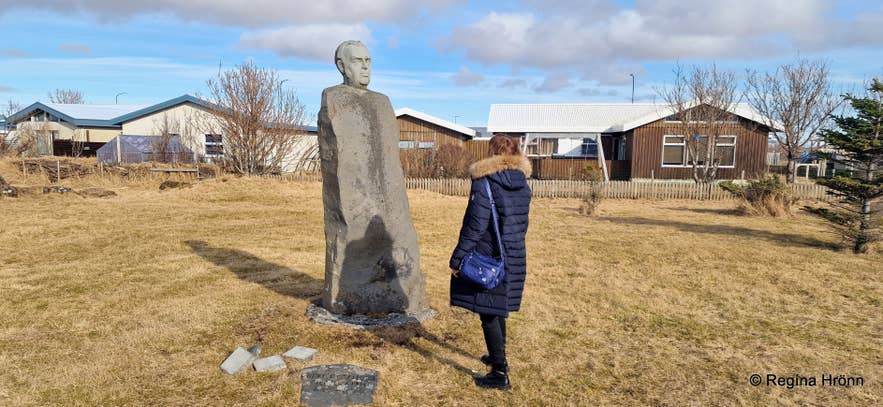 The statue in 2026
You will find the bust of Páll Ísólfsson by Hásteinsvegur in Stokkseyri.
I have written another travel blog about what to see and do here in Stokkseyri, often referred to as Iceland's museum village: The lovely Stokkseyri Village in South Iceland - the Home of the Wildlife Museum, Turf Houses, and Kayaking.
Ref.: Ferlir - Stokkseyri - minnismerki
The Exhibition on Ragnar's artwork at Korpúlsstaðir
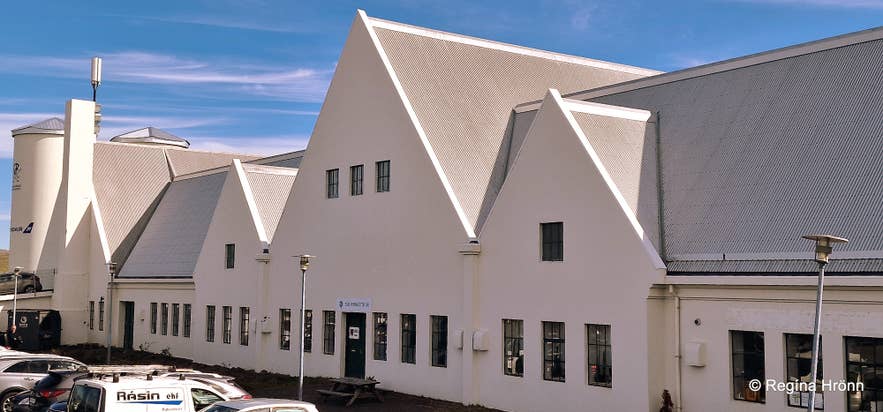 Korpúlsstaðir at the time of the exhibition
I visited an exhibition at Korpúlsstaðir on the work of the sculptor Ragnar Kjartansson, which was opened for a short period to celebrate the 100th anniversary of Ragnar's birth.
Kjarvalsstaðir, the old dairy farm established by the entrepreneur Thor Jensen, is a beautiful building on the outskirts of Reykjavík.
It was one of Ragnar's ideas to host the ateliers of Myndhöggvarafélag Íslands here. So it was fitting to celebrate his 100th anniversary and to showcase his prototypes and his family's private art collection.
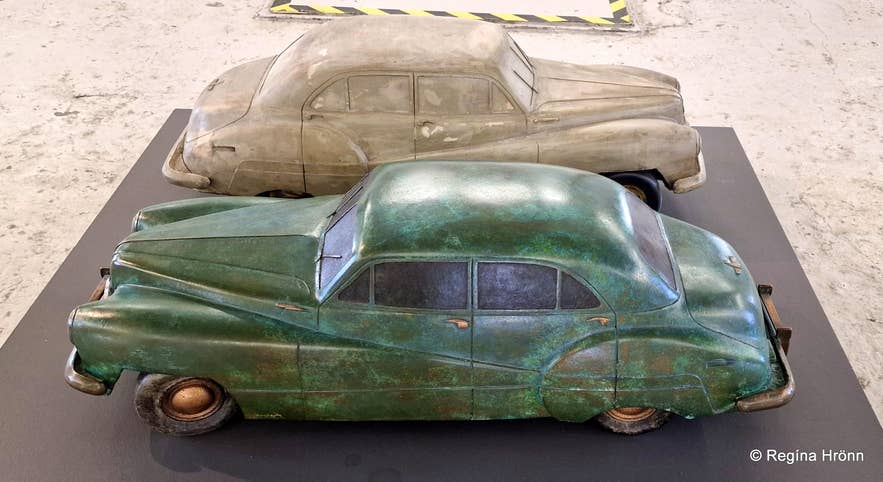
Cars by Ragnar Kjartansson from the family's private collection
The artwork in my photo below, titled Iðn 1966, is one of Ragnar's artworks for Iðnaðarbankinn in Miðbær on Háaleitisbraut (the same street where I live).
It is a large work of art covering an entire wall. It was hidden away in a storage room, and I hope it will not go back into storage.
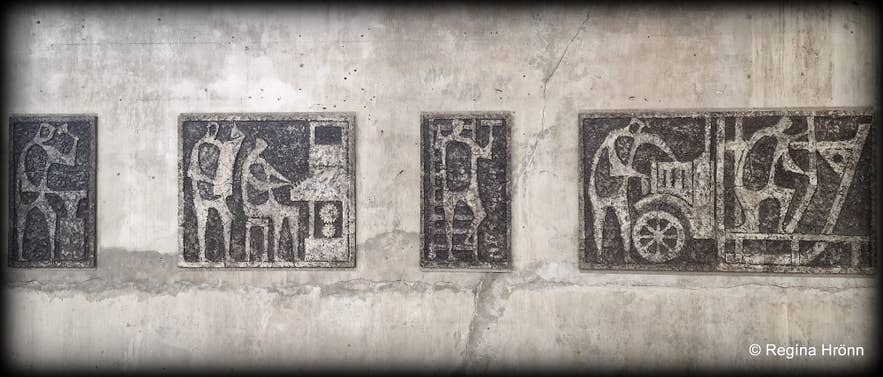 Iðn covers a whole wall
Ragnar also painted and donated a valuable collection of paintings to Nýlistasafnið.
Now, this is the artwork by Ragnar Kjartansson that I have seen on my travels in Iceland and in my hometown, Reykjavík, and this travel blog is a tribute to Ragnar's wonderful work.
My late father's name was also Ragnar Kjartansson, so writing this name so often in my travel blog has been a bittersweet experience.
Ragnar's grandson and namesake, Ragnar Kjartansson, is also a well-known name in Iceland.
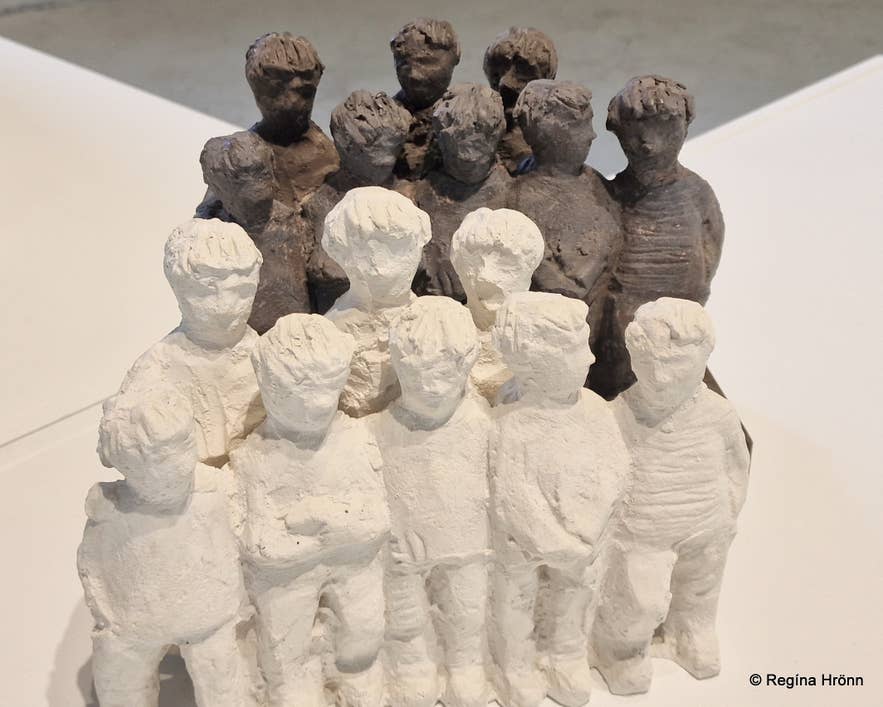
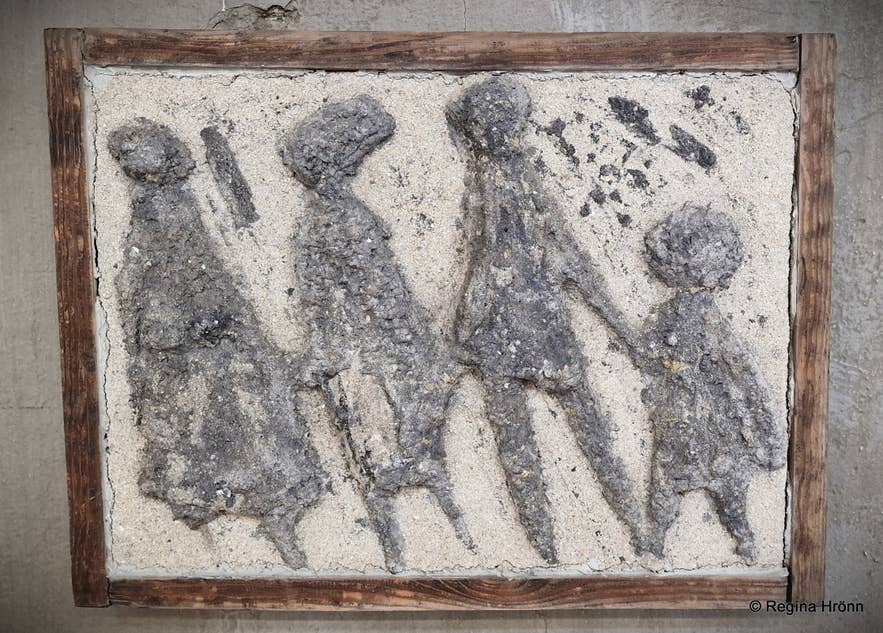 Fjölskylda - family by Ragnar Kjartansson, photo taken at the exhibition
His father, i.e., Ragnar junior's father, is Kjartan Ragnarsson, who established and runs the award-winning Settlement Centre in two of Borgarnes' oldest houses, which I highly recommend visiting.
Landnámssetrið - the Settlement Centre has two exhibitions about the settlement of Iceland and the Saga of Egill, which is amongst the best-known Icelandic Sagas.
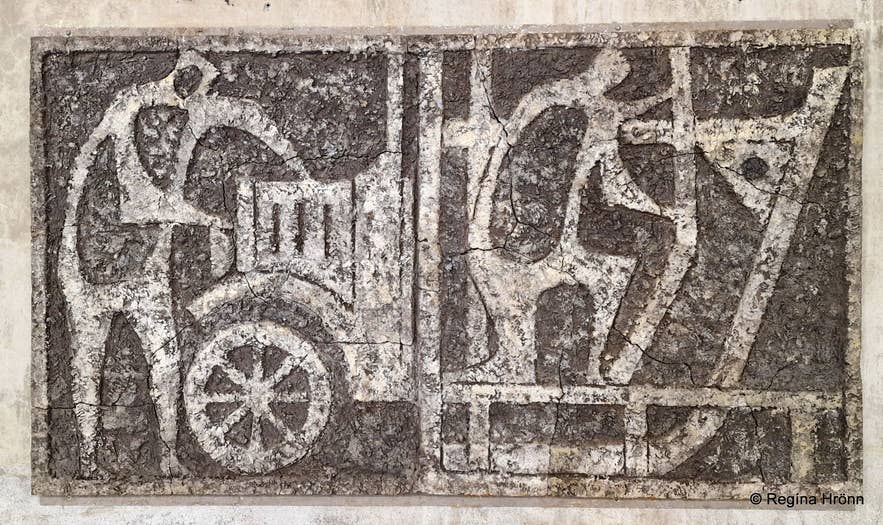 Parts of the artwork Iðn
I have written another travel blog about the exhibitions and the 9 cairns that Kjartan Ragnarsson has erected, and mark important events in the Saga of Egill: The Saga of the Viking Egill Skallagrímsson & the 9 Cairns in West Iceland.
I never met Ragnar Kjartansson in person, but I have admired his work since I was little. No book has been written about this remarkable man, so I had to read up on him online.
Fortunately, we have a website called Timarit.is, where I could read old articles and obituaries.
 Prototypes of artwork by Ragnar Kjartansson - photo taken at the exhibition
I hope this travel blog will enrich your time in Iceland as you visit Ragnar's sculptures. Have a lovely time in Iceland :)
Reference for further reading (in Icelandic):
Lesbók Morgunblaðsins - Viðfangsefnin eru byggð á sjálfri reynslunni
Mbl. 1983 - Á meðan kýrin mjólkaði var alltaf von
Morgunblaðið - Ragnar Kjartansson, minningargrein
Tíminn - Ragnar Kjartansson, minningargrein
Ferlir - Vonin - minnismerki um drukknaða menn
Ferlir - Minnismerki um drukknaða menn í Grindavík
Ferlir - Reykjavík - minnismerki
Skemman - Stríð, stolt, sorg og sprengja - Brot úr sögu íslenskra áfallaminnismerkja by Ketill Kristjánsson

Hi, my name is Regína Hrönn, and I was born and raised here in Iceland.