I want to dedicate this 200th travel blog of mine here on Guide to Iceland to a very remote valley in the beautiful Westfjords of Iceland- the birthplace of my maternal grandmother, Kristbjörg Guðmundsdóttir.
This remote valley, called Ingjaldssandur, is located in the Önundarfjörður fjord.
To reach Ingjaldssandur, we drive on the northern side of Dýrafjörður fjord, pass Núpur, drive into Gerðhamradalur valley and up on Sandsheiði heath, on a narrow, winding gravel road, and down into Brekkudalur.
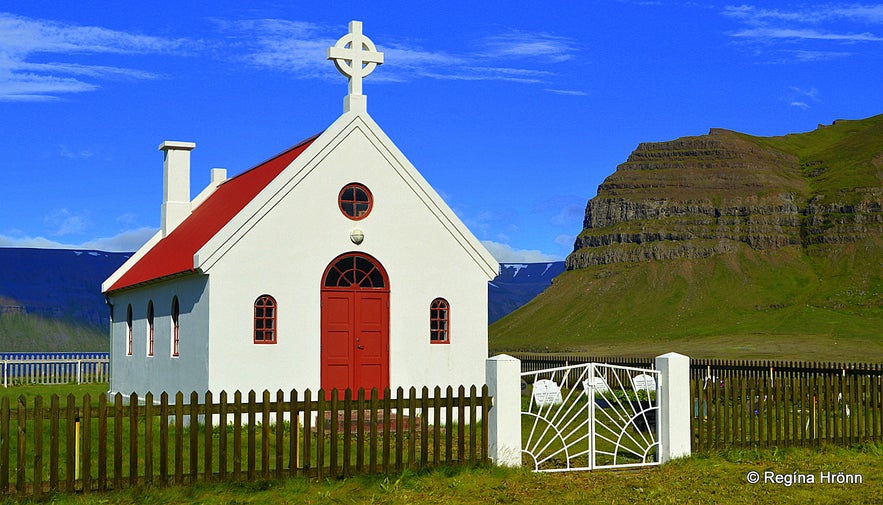
Top photo: Sæbólskirkja church
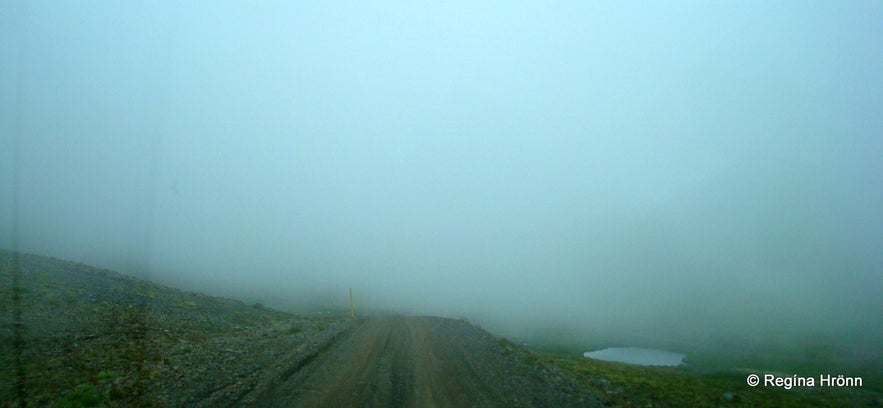
Driving into the fog on the mountain, not knowing where the next turn was!
We had a family reunion back in 2010 at Núpur in Dýrafjörður, close to Ingjaldssandur, and spent one day there, which is called Sandur for short by those who know it well. My mother and I arrived early and drove to Ingjaldssandur to check it out.
She had never been to the Westfjords before, and after my grandmother left her birthplace and met my grandfather in Reykjavík in 1943, she never returned to the Westfjords.
I was always told, as a young girl, that we could not go to the Westfjords because the roads are high up, winding, and very bumpy gravel roads.
Well, since the reunion back in 2010, I have spent quite a few days in the Westfjords of Iceland and always look forward to revisiting them in the summertime.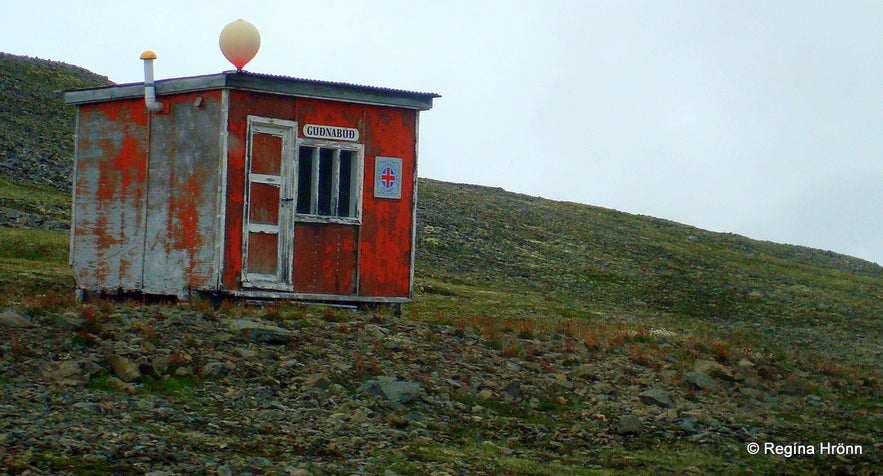
The emergency shelter
On the day my mother and I visited Ingjaldssandur for the first time, it was overcast, and we drove so high up the windy road in the mountain pass at Sandsheiði heath that we were way up in the clouds.
It was pretty scary, as we didn't know the road, which takes you up to some 530 meters above sea level!
We thought to ourselves what on earth we had gotten ourselves into, and when we saw the orange emergency shelter in the clouds, we almost lost our courage - but there was no other way than to go straight forward... into the fog... not knowing what lay behind it.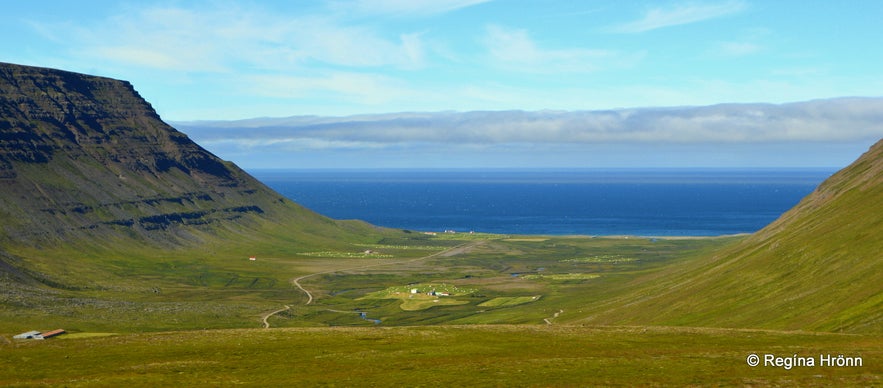
The view of the lovely Ingjaldssandur
Fortunately, by then we were close to the descent from the mountain, and soon we were out of the clouds, and the beautiful valley of Ingjaldssandur opened up. Finally, we were able to see the birthplace of my mother's mother :)
I was so happy when I spotted the lovely little white church, of which I had seen so many photos.
The day after, the whole extended family (some 170 people) drove over this mountain in beautiful weather - it was quite strange seeing a long line of cars driving up this winding mountain road - so remote in the Westfjords of Iceland!
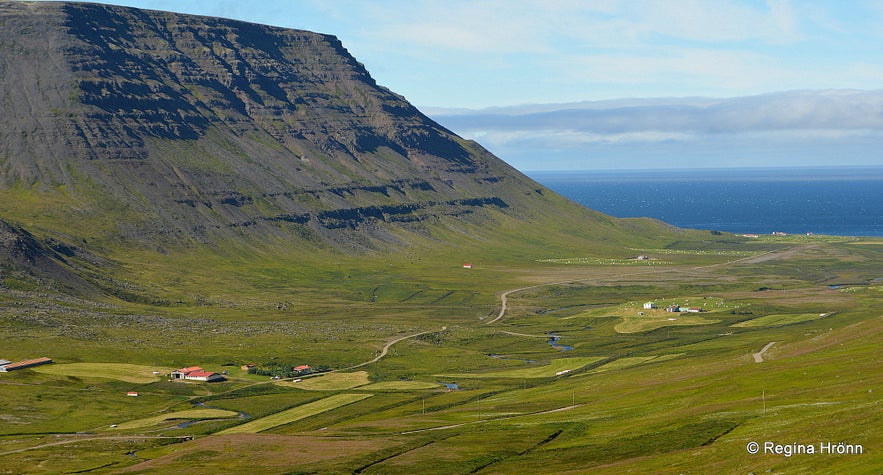
The view of Ingjaldssandur
Ingjaldssandur was once home to more than 100 people, including a family of 10, to whom my grandmother belonged.
My grandmother, who was born on the 1st of April 1923, was born in a turf house at Sæból, right by the open sea, and later on, a concrete house was built, which is still standing.
All Icelanders used to live in turf houses, rich and poor, and it wasn't until the mid-20th century that the last inhabitants moved out of the turf houses - things sure have changed in my country.
And they changed relatively quickly, as my generation, who were born in Reykjavík city, thought it was so strange that people had been living in these turf houses.
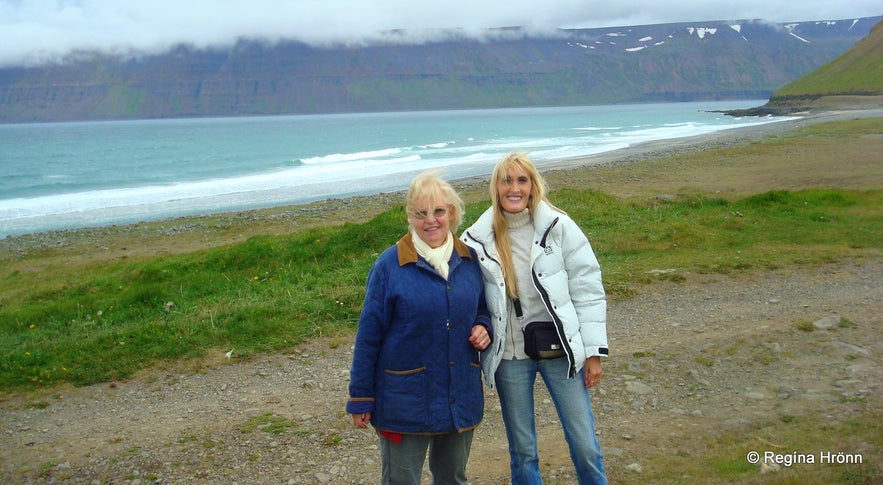
With my mother at Ingjaldssandur back in 2010
I wonder what it must have been like to live so close to the open sea, especially during the long, dark, and cold winters, with the icy wind blowing from the sea.
I want to tell you the story of just one family of many, who have lived in this remote place through the centuries.
Just imagine how many other stories there are to tell from the thousand years of habitation in Ingjaldssandur!
Ingjaldssandur
My great-grandparents, Guðmundur Guðmundsson (1889) and Ingibjörg Guðmundsdóttir (1890), had met at Hvanneyri in West Iceland, where my great-grandfather was studying to become an agriculturist.
She had already graduated as a "rjómabústýra" - manager of a creamery - from Hvítárvellir in Borgarfjörður, and worked at the creamery at Hvanneyri.
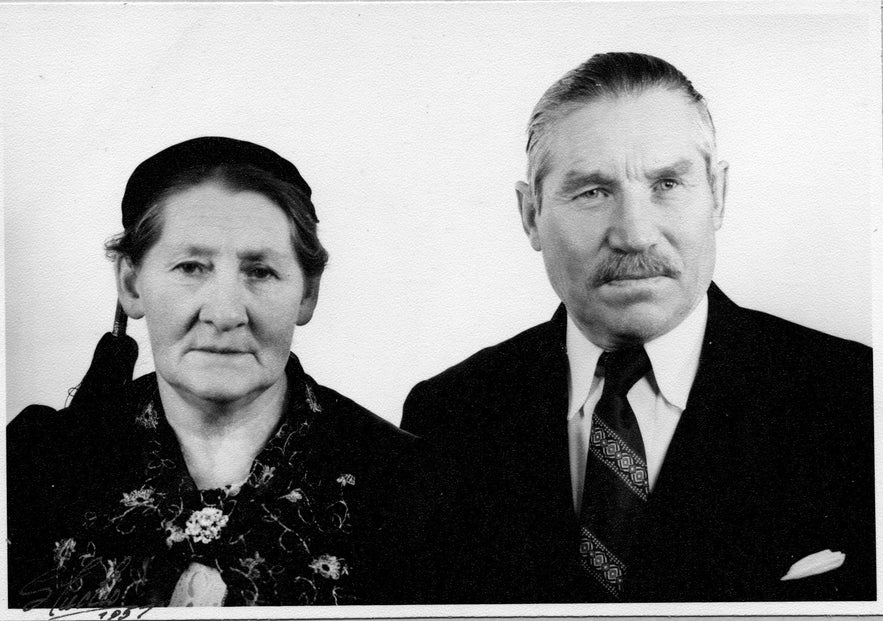
My great-grandparents, who lived at Ingjaldssandur
Ingibjörg was born in the beautiful Hellnar in Snæfellsnes, but Guðmundur was born in Kleifar in Seyðisfjörður in the Westfjords and lived in 8 places in the Westfjords before he moved to Sæból.
I have written another travel blog about the time Guðmundur was caught in a large avalanche in 1910 in Hnífsdalur in the Westfjords, when he worked as a fisherman on the motorboat Vonin.
When the land at Sæból in Ingjaldssandur became available, Ingibjörg left her family in West Iceland to reunite with her fiancé and become a farmer in this remote valley in the Westfjords.
They had hoped for land in the fertile Borgarfjörður, but no land was to be had there.
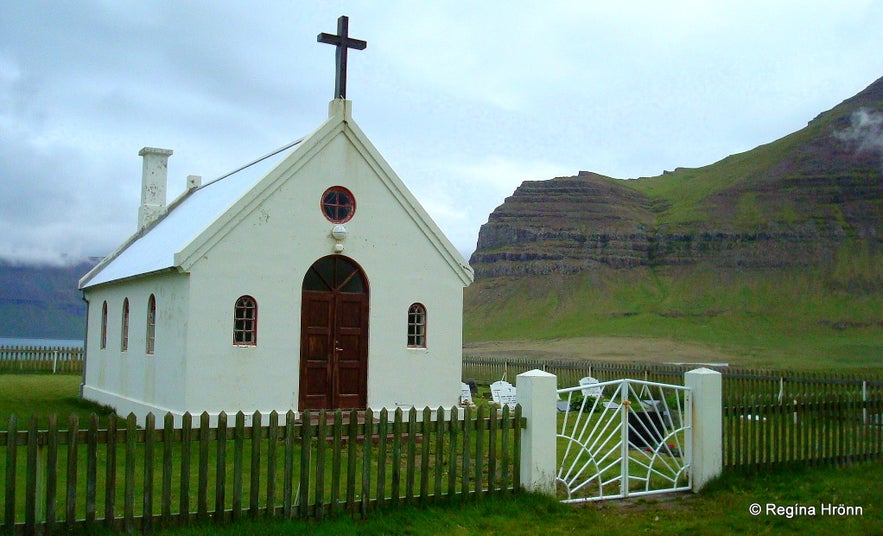
Sæbólskirkja church back in 2010, when it still had the neon cross. It was changed back to a Celtic cross the following year
Guðmundur and Ingibjörg had 8 children together: 7 daughters and 1 son. All but their son and the eldest daughter later moved to Reykjavík and the surrounding areas in South-West Iceland.
Guðmundur and Ingibjörg got married at Sæbólskirkja church in 1915 and lived for 31 years at Sæból at Ingjaldssandur, farming and fishing.
In 1946, they moved to the southwest corner of Iceland, where most of their daughters already lived, and worked at Kolviðarhóll for some time.
Their only son, Sigurvin, bought the land from his parents and continued to live at Sæból.
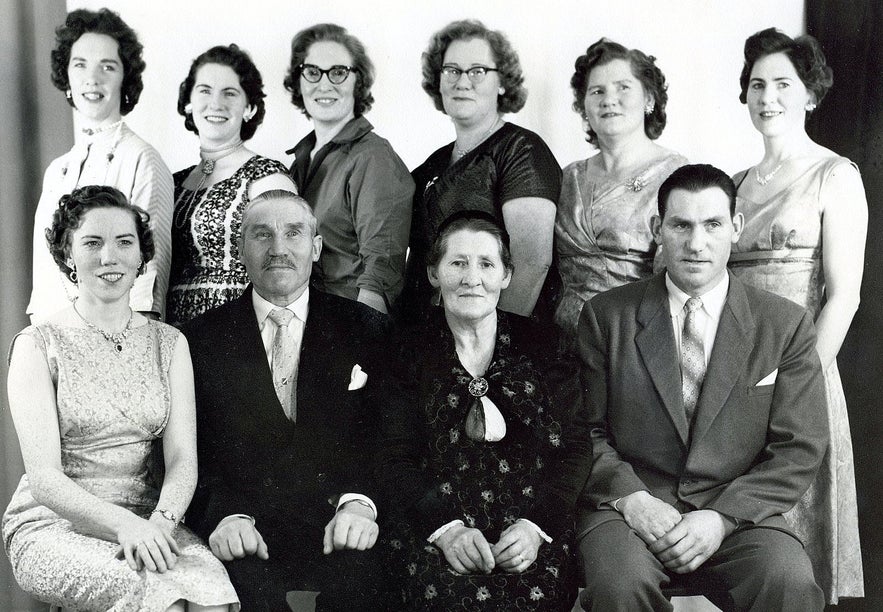
A family photo of my maternal grandmother's siblings and parents - the last sibling died in 2022
Guðmundur wrote his memoirs, which are invaluable to us, his descendants. He was also an excellent poet and wrote several poems about Ingjaldssandur, where his love for this valley shines through.
My grandmother, who is 3rd from the left in the top row of the photo above, first visited Reykjavík in 1939 at the age of 16.
In 1940, my grandmother returned to the Westfjords, only to find out that she was pregnant at the age of 17, without even knowing about it until she gave birth to a baby daughter one night. My great-grandparents raised her daughter, Guðrún Björk (my aunt), and she lived at Sæból until she was 15.
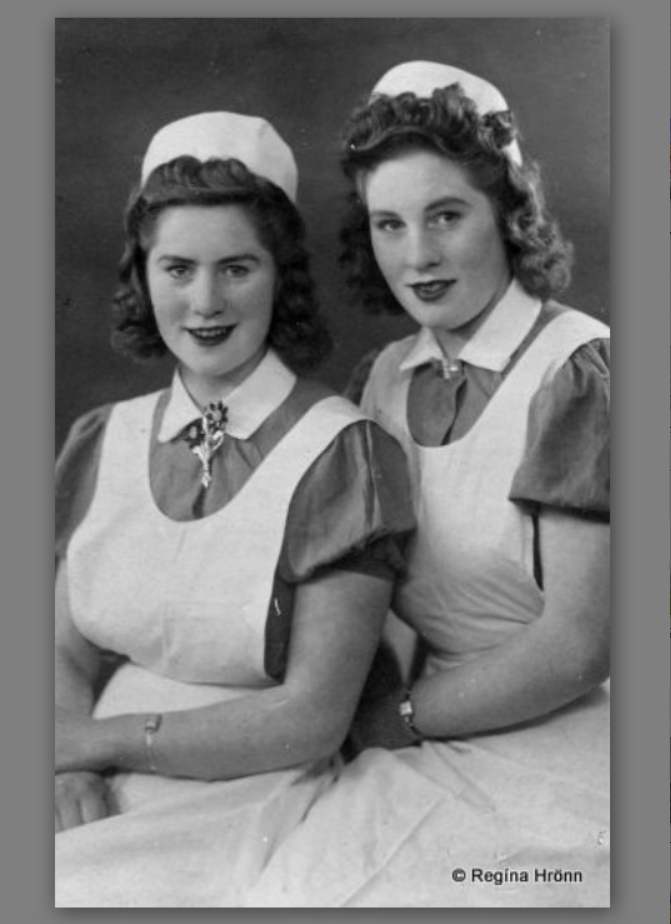 My grandmother to the right in the photo, and her sister Árný at the hospital in Ísafjörður
My grandmother stayed in Sæból in Ingjaldssandur until 1942, when she went to work at the hospital in Ísafjörður, the largest town in the Westfjords.
In 1943, she returned to Reykjavík to work in the kitchen of Tjarnarkaffi restaurant.
There, back in 1943, when she was 20 years old, she met a scrawny-looking fellow, Jens Pétur Thomsen, whom she was told to feed because he weighed only 47 kilos at the time, she told me.
He was living in Copenhagen during the occupation in WW2, and the Germans sent him to Iceland in a submarine to spy for them and send them weather reports. He became a double agent and worked for the British and Americans who had occupied Iceland.
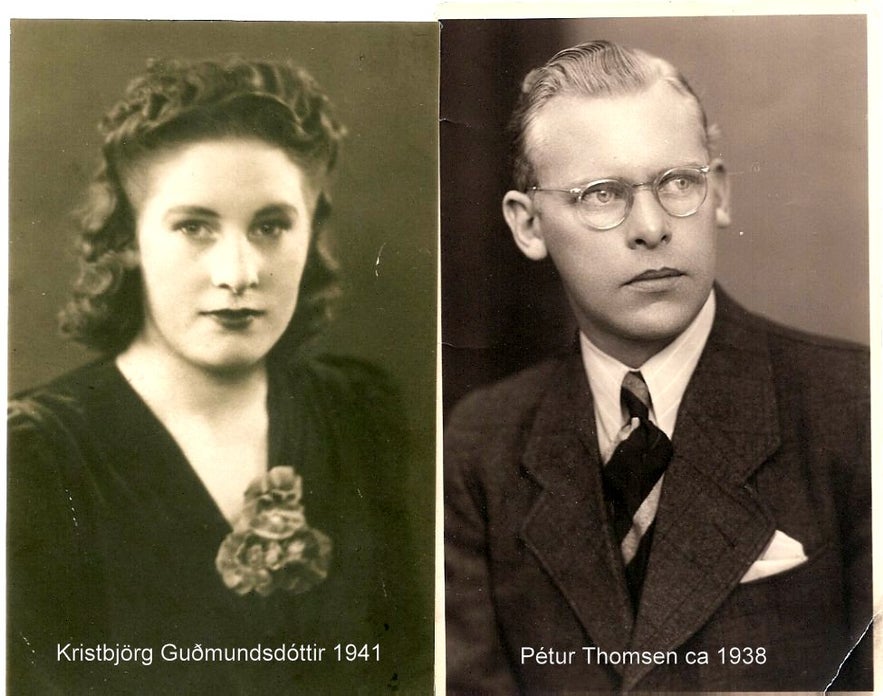
My maternal grandparents
Pétur Thomsen was 1/4 Danish, which makes me 1/16 Danish.
He and my grandmother stayed together until he died in 1988 (she died 20 years later in 2008), had 2 children together, and worked as photographers in Reykjavík.
These lovely people were of great importance in my life :)
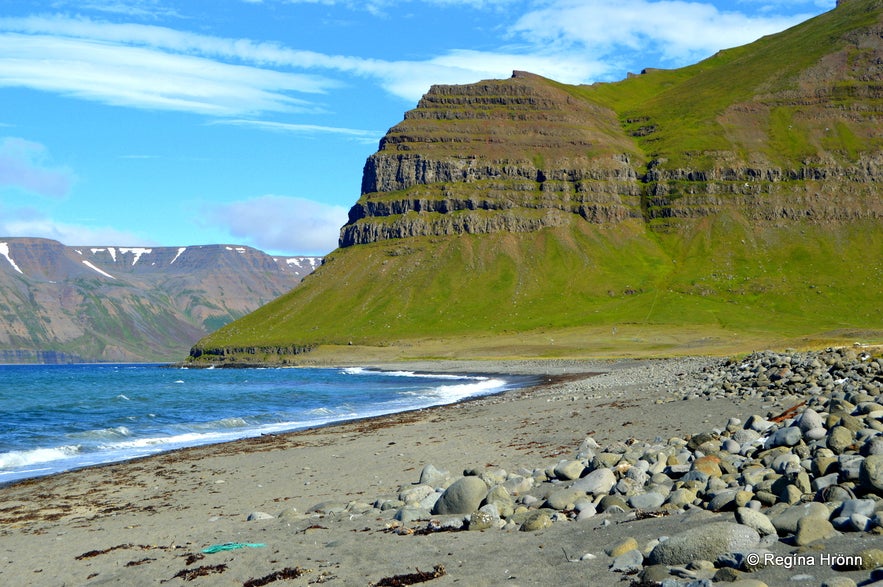
Ingjaldssandur
Now back to Ingjaldssandur... this remote place was only accessible in the wintertime by boat and later by plane.
The valley has mountains on 3 sides and the open sea - it must have been very secluded back then, and still is in the wintertime.
They could also "ganga fjörurnar" walk on the beaches when the tide was out.
Ingjaldssandur in the cold summer of 2024
In my great-grandfather's memoirs, I read that often drift ice from Greenland would drift to Ingjaldssandur, and my great-grandfather mentions how interesting it was to see these huge icebergs so close to land.
One year, the drift ice carried with it around a hundred trees, most of them 19 feet long! The trees were a great asset back then, as Iceland is severely lacking in trees.
This wood was used to build houses and as firewood.
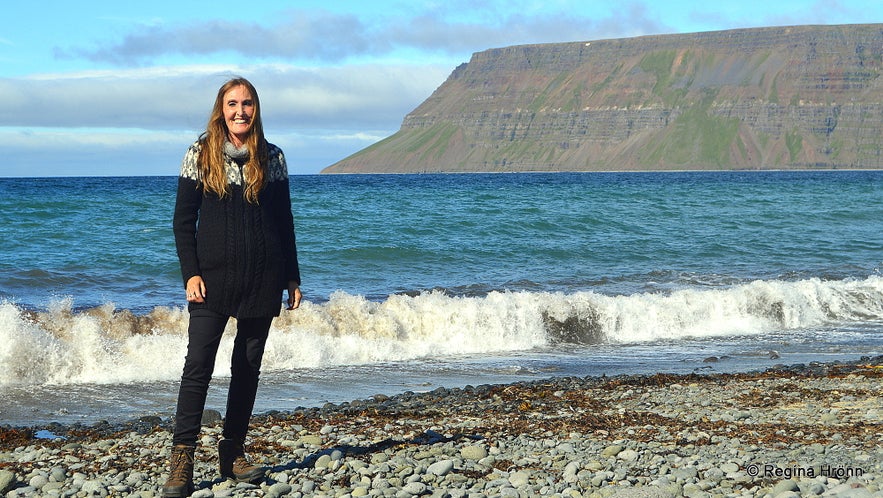
On the beach at Ingjaldssandur
Sometimes the drift ice brings stray polar bears to Iceland, but I am glad that didn't happen to my family at Ingjaldssandur!
But while visiting Strandir in the Westfjords, I heard an account of a polar bear at Ingjaldssandur that was killed and stuffed with straw.
Even though my grandmother lived by the open sea, she never learnt to swim, as it was not customary back then to teach people to swim. Every child in Iceland learns to swim, and almost every town and village in Iceland has a geothermal swimming pool. These swimming pools are very characteristic of Iceland.
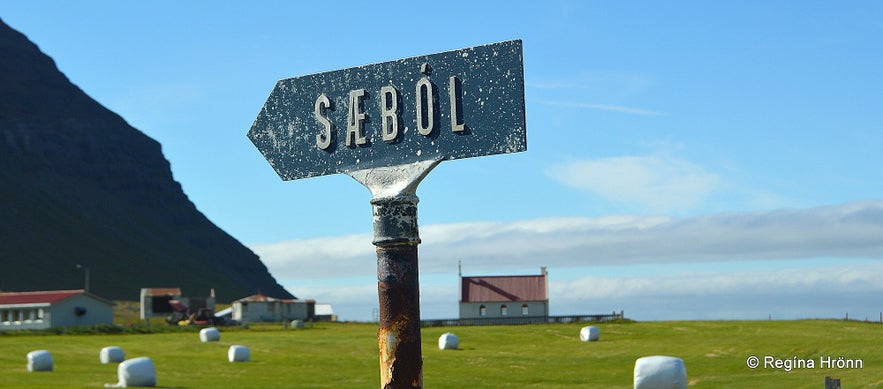
Sæból at Ingjaldssandur
Only one farmer is left in Ingjaldssandur now, who lives in the valley year-round. Elísabet Pétursdóttir, or Bettý, is her name. She moved to Sæból 2 back in 1989 and lives in the house built by my great-uncle Sigurvin.
Her mother was from Ingjaldssandur, but her father was from Reykjavík, and as a young girl, Elísabet spent much time there with her grandparents, aunts, and uncles.
Do visit her - she knits and sells woolen goods, like sweaters and socks, which she knits during the long, dark winters. So if you want to buy an authentic piece of Icelandic woolen goods, then you will find the real deal at Sæból at Ingjaldssandur :)
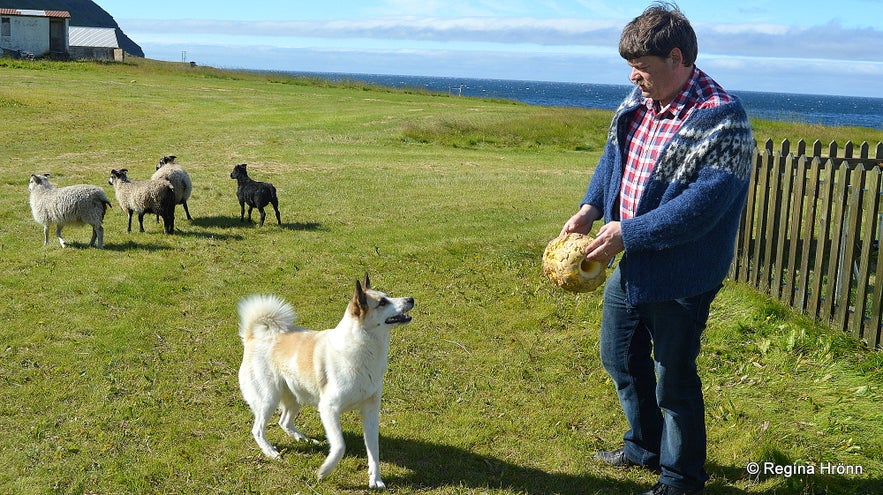
My husband playing with Bettý's dog and bottle lambs
I read an article in Bændablaðið in October 2018 that said Elísabet had finally reconnected to the outside world. She was without a TV connection for 2 years and had poor internet and phone connections.
Now, plans are to install fiber-optic lines in the valley.
I was happy to see that Bændablaðið - the Farmers' Magazine used one of my photos of Ingjaldssandur in their article :)
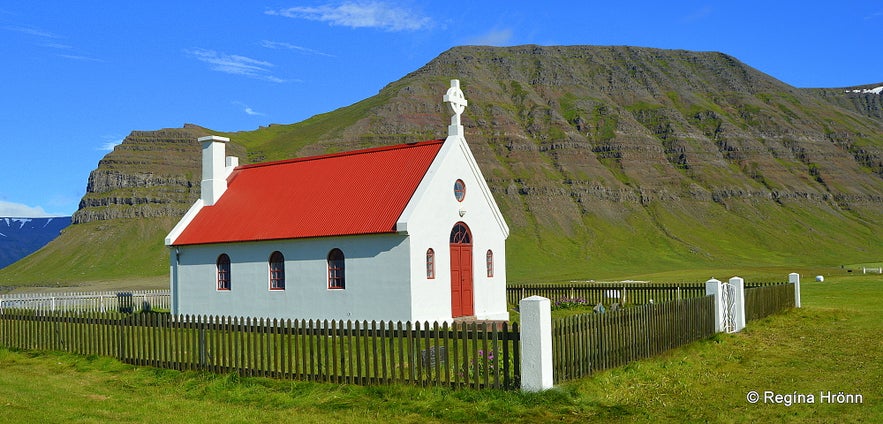
Beautiful Sæbólskirkja church
At Sæból in Ingjaldssandur, almost right by the sea, you will notice a lovely white church, Sæbólskirkja church, consecrated on the 29th of September 1929. The churchyard was consecrated in 1932.
I find the Celtic cross on Sæbólskirkja church so pretty - it is so characteristic of the church.
The earliest mention of a church here dates to around 1200. I found a memorial stone in the old churchyard with a plaque.
It says the last church built on the old church site was erected in 1858.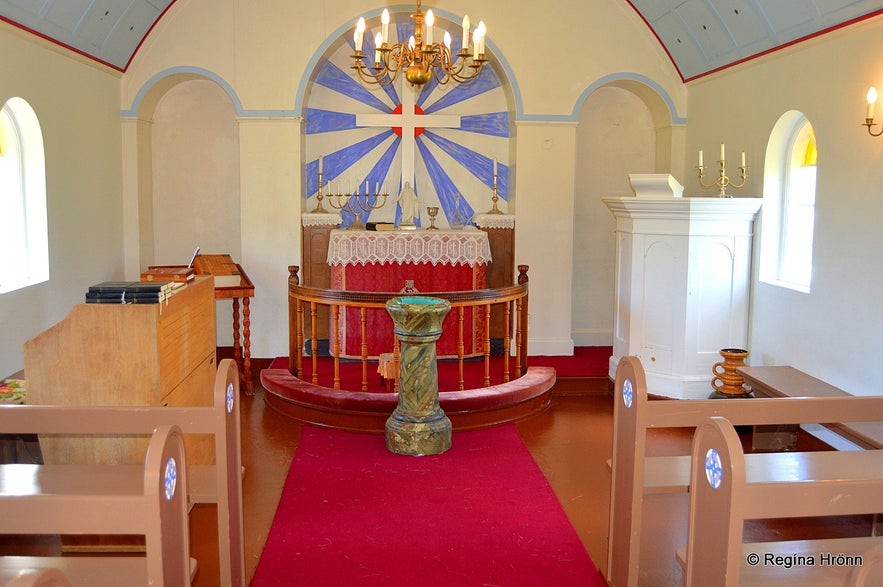
Inside Sæbólskirkja church
That church blew away in a big storm on January 25th, 1924. I remember my grandmother telling me a story about a big storm back in 1924 that swept the old church away and shattered it.
At that time, my grandmother was only 1 year old. That big storm was called Halaveðrið.
My great-grandfather describes this storm in detail in his memoirs. Many church objects were lost :(
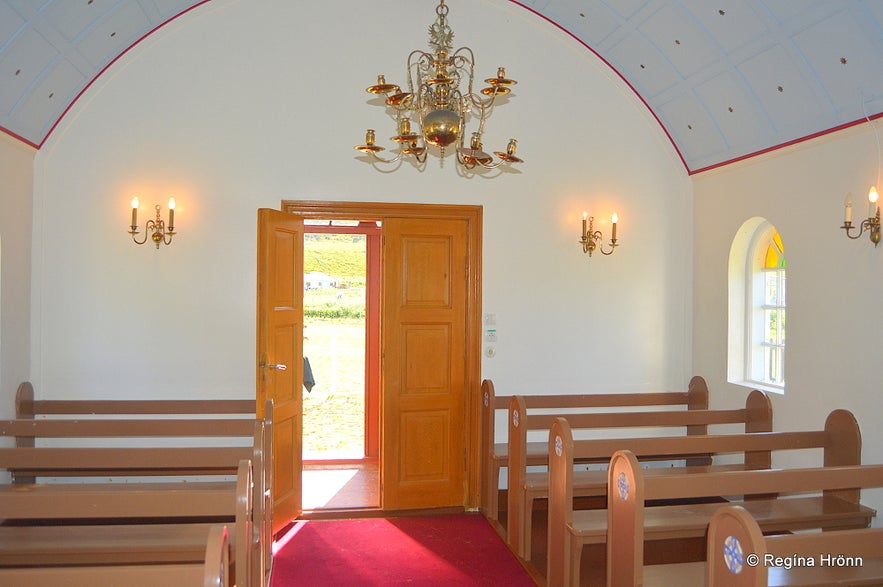
Inside Sæbólskirkja church
The noted State architect Guðjón Samúelsson designed the new concrete church, and the noted sculptor (whom I adore), Guðmundur Einarsson from Miðdalur, created the bowl for the baptismal font.
Guðmundur's artwork is highly valuable today. I own two of his pieces, which I inherited from my grandfather.
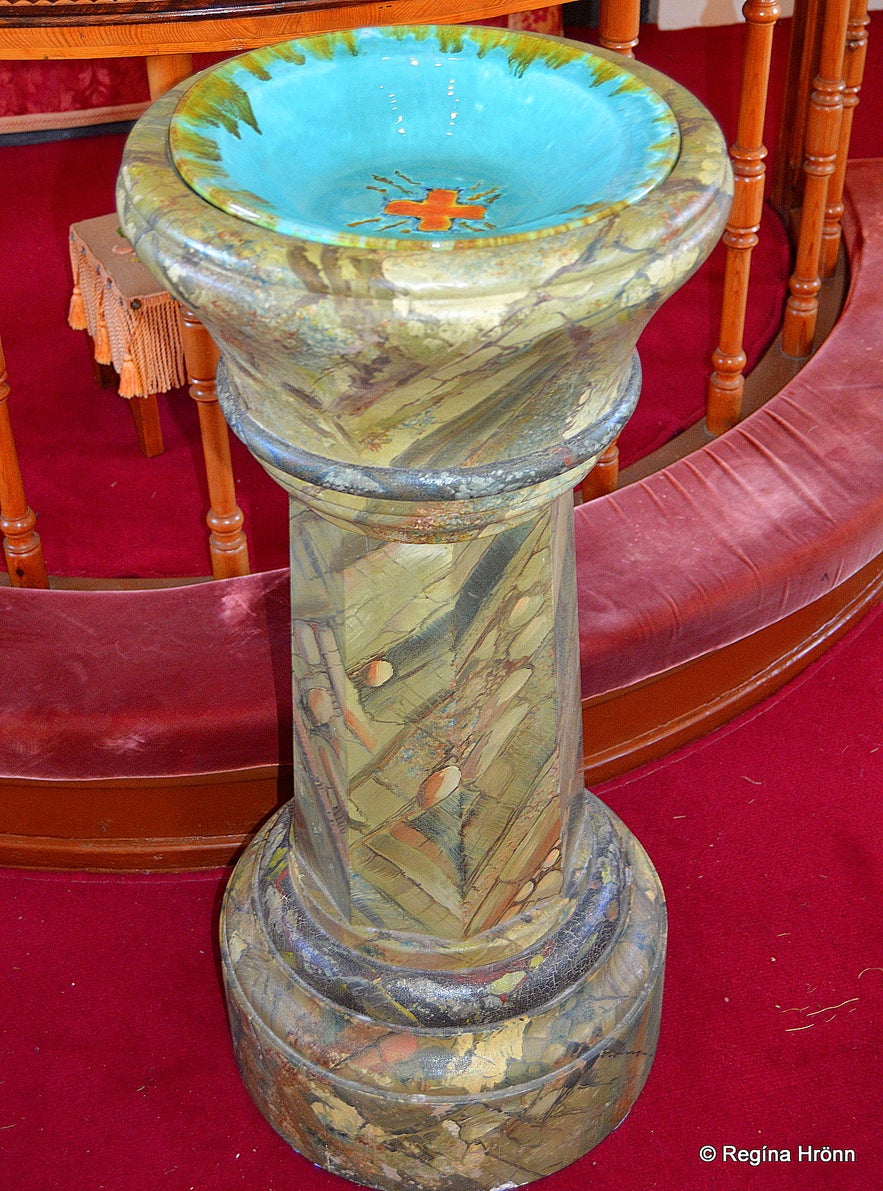
The baptismal font - ceramic bowl by Guðmundur from Miðdalur
A paten from 1736 belongs to the church, and when you visit the church, you will see an old copper chandelier from 1649, which is very old for Iceland.
14 Danish names are engraved on the chandelier. It is believed to have been a donation from a ship crew, which got saved from danger at sea by Ingjaldssandur.
There are many such stories in Iceland, of foreign ships being saved - or lost at sea - by Iceland.
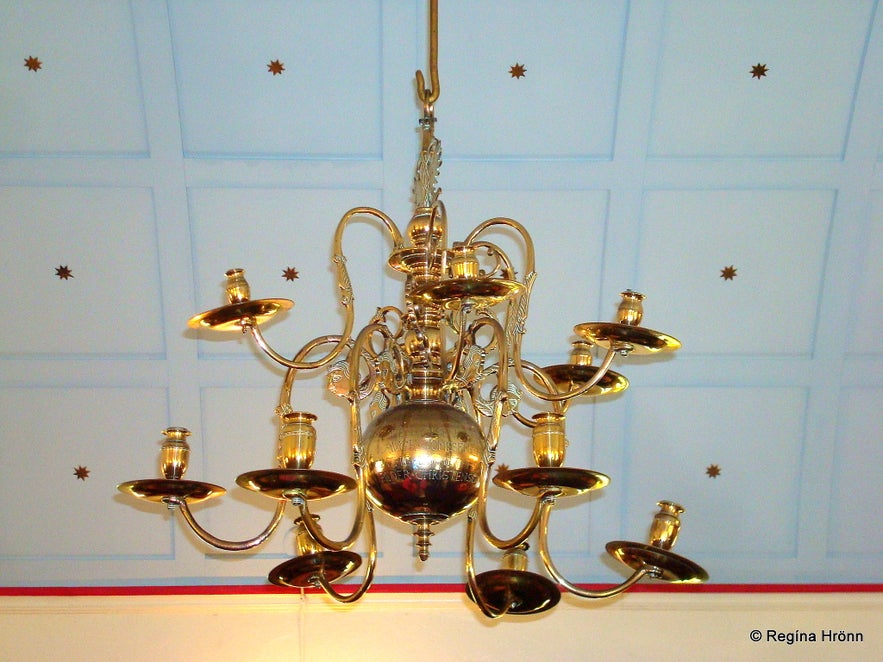 The old copper chandelier
Jón Sveinn Jónsson, the farmer at Sæból, carved the pews and altar rails.
I love visiting these small farm churches; to me, they are pure gems dotted around the countryside.
I sit inside, make a prayer, and think about all the history that has been made in these churches.
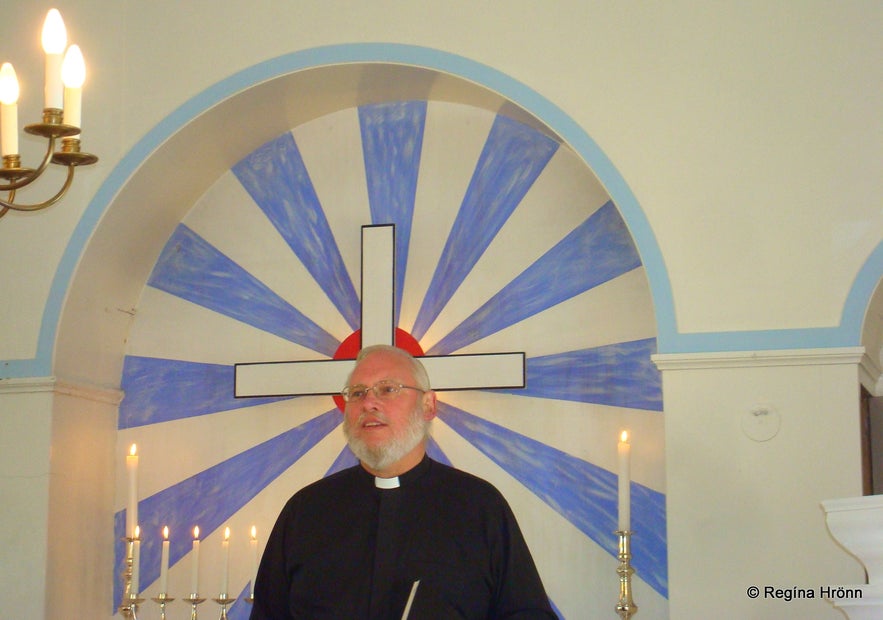
My uncle, Rev. Birgir Thomsen, in Sæbólskirkja church
Above is a photo I took at the family reunion, when my uncle, Rev. Birgir Thomsen, held a service for his relatives at Sæbólskirkja church during our visit to Ingjaldssandur.
The cross of light is dedicated to Rev. Sigtryggur Guðlaugsson (1862-1959) from Núpur, who is believed to have made 900 trips over Sandsheiði heath to serve his congregation during his 33 years of service!
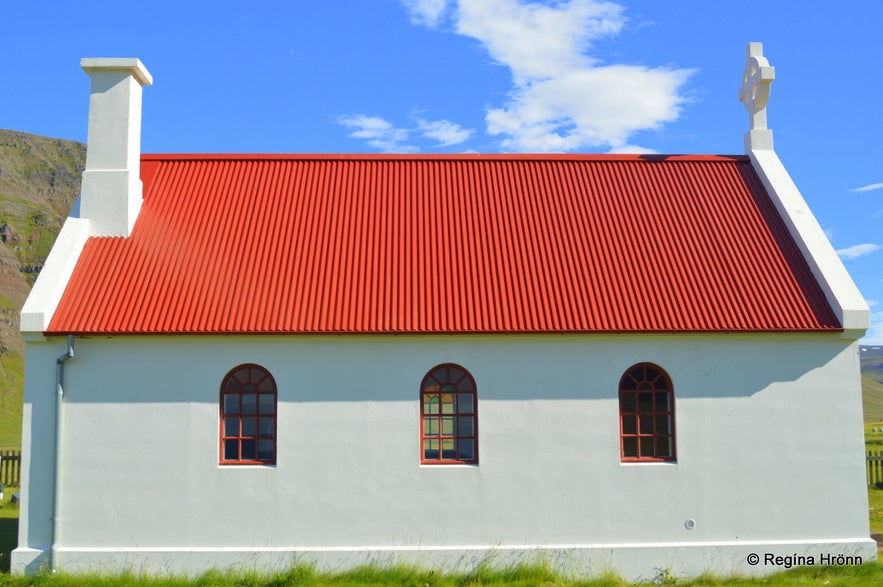
Sæbólskirkja church - corrugated roofs are so typical for Iceland
An electric cross was installed on the church on the 27th of September 1964, replacing the by now broken Celtic cross. So the electric cross must have been lit up by a motor generator before 1967, when electricity came to the valley.
But the weather being what it is at Ingjaldssandur, the light bulbs kept exploding.
So, in 2011, when Sæbólskirkja church was being repaired, a new Celtic cross was erected in place of the electric cross.
I don't know why Guðjón Samúelsson chose a Celtic cross for Sæbólskirkja, but its prominent feature is its arches.
Maybe he wanted an arch-shaped cross as well, to complement the arches in the church. Celtic signs are also carved and painted on the pews in the likeness of the Celtic cross.
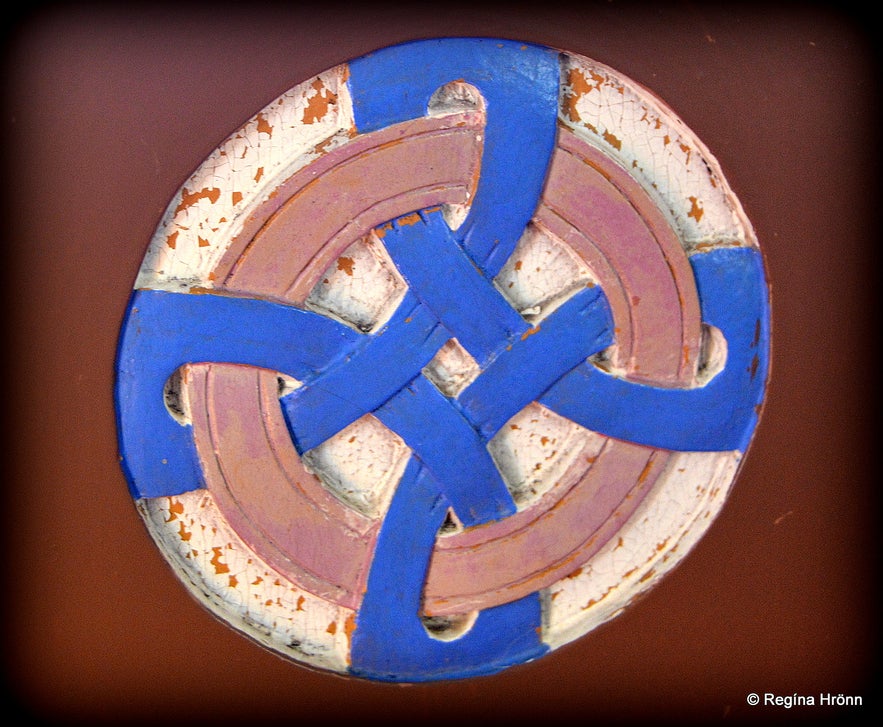 Celtic carvings in the pews
When Guðmundur Hagalín lived at Sæból, he visited the burial mound of Ingjaldur Brúnason, the settler of Ingjaldssandur. The burial mound is located on Mt. Barði.
The story goes that in burial mounds, money is hidden, and it is not to be tampered with.
Guðmundur once began searching for money in the burial mound; he looked back at Ingjaldssandur and saw the church on fire!
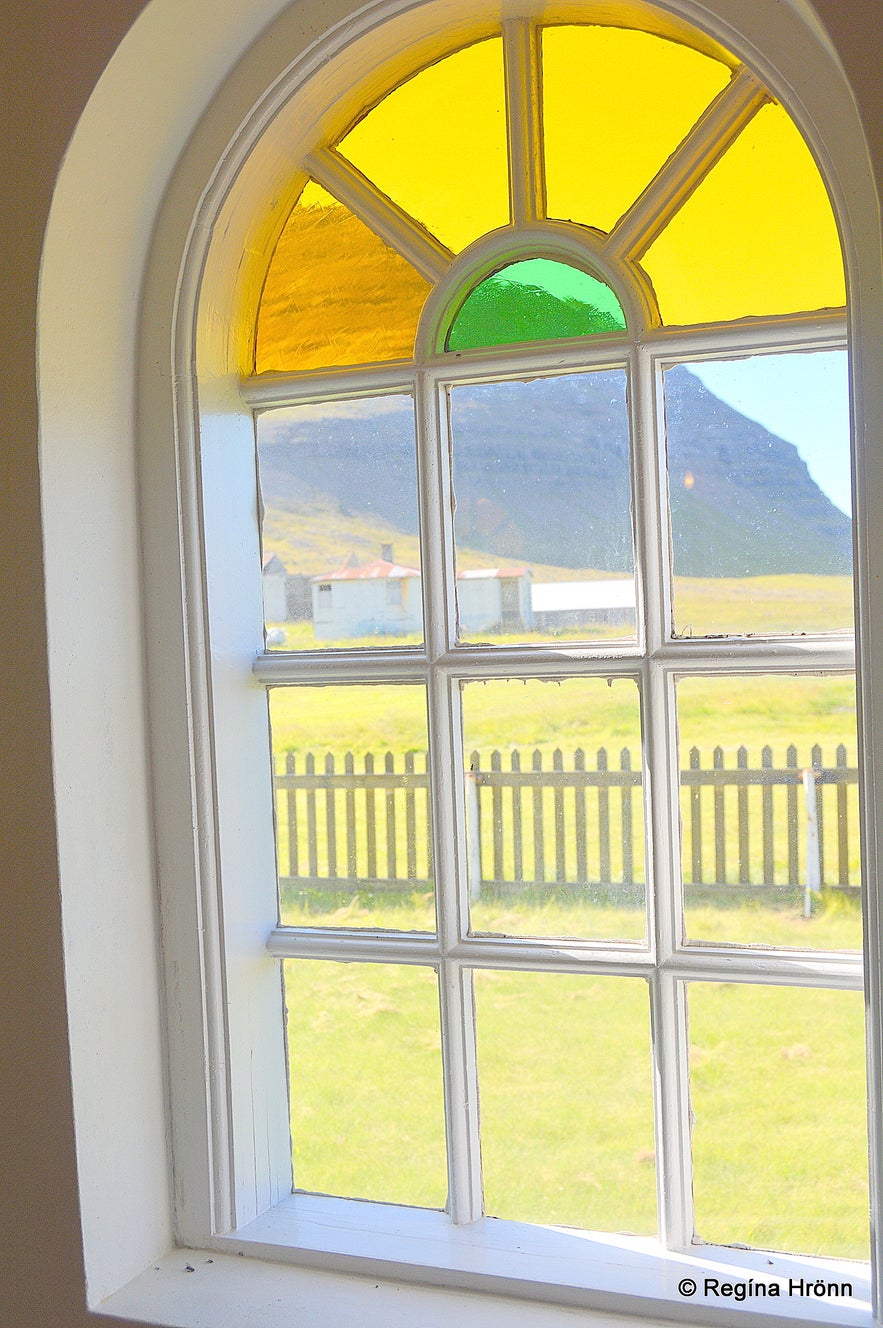
Inside Sæbólskirkja church, looking out
He hurried back to Sæból, but when he got back there was no fire. Since then, the burial mound of Ingjaldur has not been tampered with.
There are several such accounts of churches being on fire when spots with spells on them have been tampered with.
(From the book Álög og bannhelgi by Árni Óla)
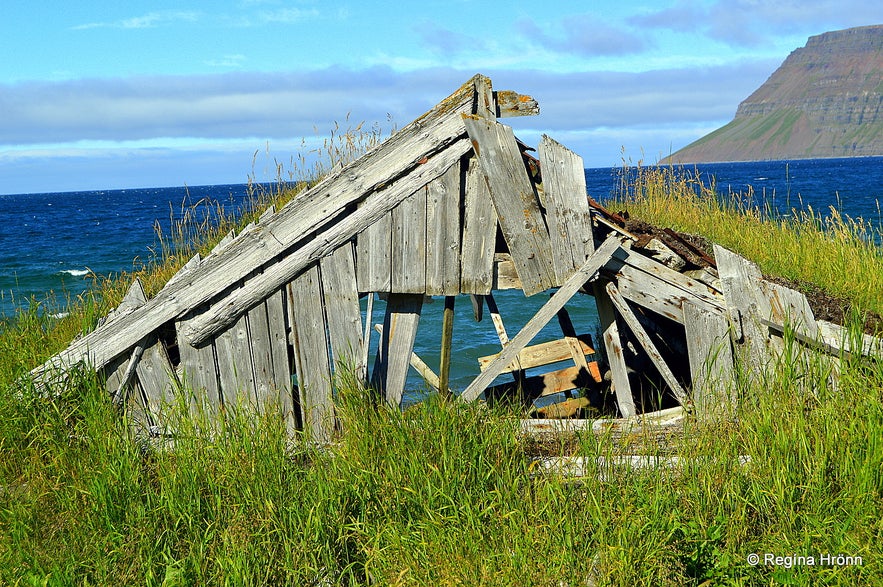
Ruins at Ingjaldssandur
Ingjaldssandur was named after the settler of this area, Ingjaldur Brúnason.
His great-grandson was Ljótur hinn spaki - Ljótur the tame, who lived at Álfadalur at Ingjaldssandur and was killed there.
Accommodation is available at Sæból farm III, with all modern amenities.
I would love to stay here for the night to escape the stresses of modern life and experience the silence and tranquillity of a remote valley in the Westfjords of Iceland.
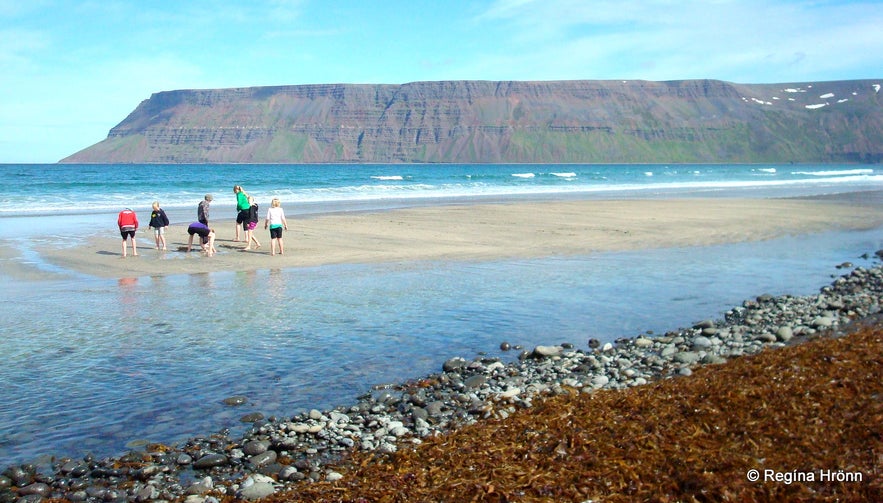
Family reunion at Ingjaldssandur
On a day during the family reunion, my extended family - the descendants of my great-grandparents who had lived at Sæból in Ingjaldssandur - visited Ingjaldssandur and spent a whole sunny day in the valley.
On that day, this remote place came alive again, much like it must have been back when 100 people lived here.
My photos above and below are from the family reunion - notice the pink sand, which is characteristic of the Westfjords.
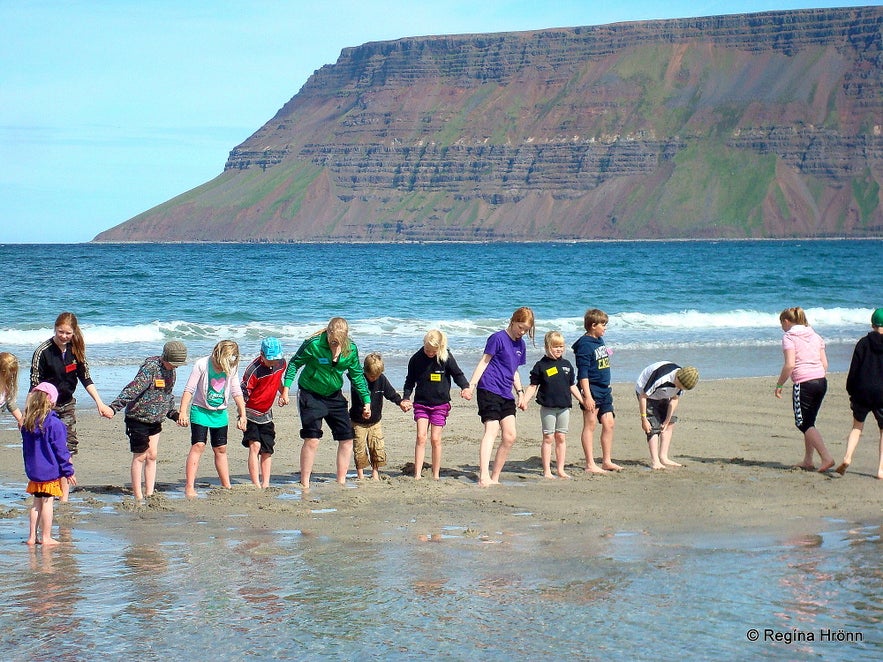
Family reunion at Ingjaldssandur
The whole of Iceland, apart from the Westfjords, the Snæfellsnes peninsula, and Akranes town, has black lava sand beaches.
I remember listening to my grandmother in awe when she told us about the PINK beaches of her birthplace - how I wanted to see this pink sand, especially as pink was my favourite colour back then :)
We were so lucky that the weather was fine, sunny, and lovely all day, so that we could have a barbecue and picnic outside by the community meeting house, Vonaland.
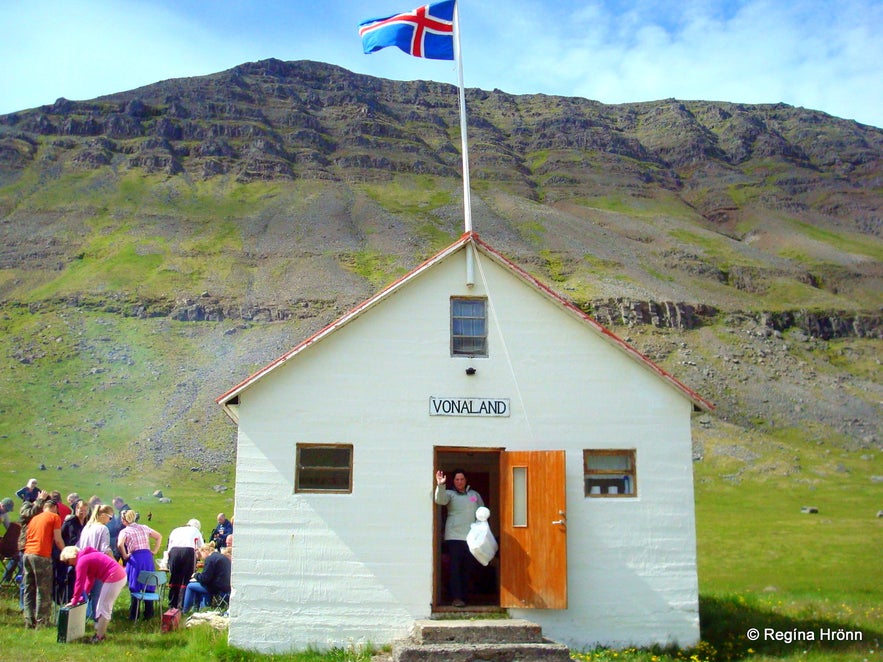
My second cousin Ingibjörg waiving from Vonaland. My great-grandmother's name, Ingibjörg, lives on in my extended family
Once a year, there are festivities in Ingjaldssandur by Vonaland during the first weekend of August when the Sandaballið ball takes place, and the valley fills up with people having fun.
I really want to join these festivities, but my husband is an entertainer, so it is difficult as he is always working during this long weekend, which is the busiest travel weekend in Iceland.
The Waterfall Ósómi
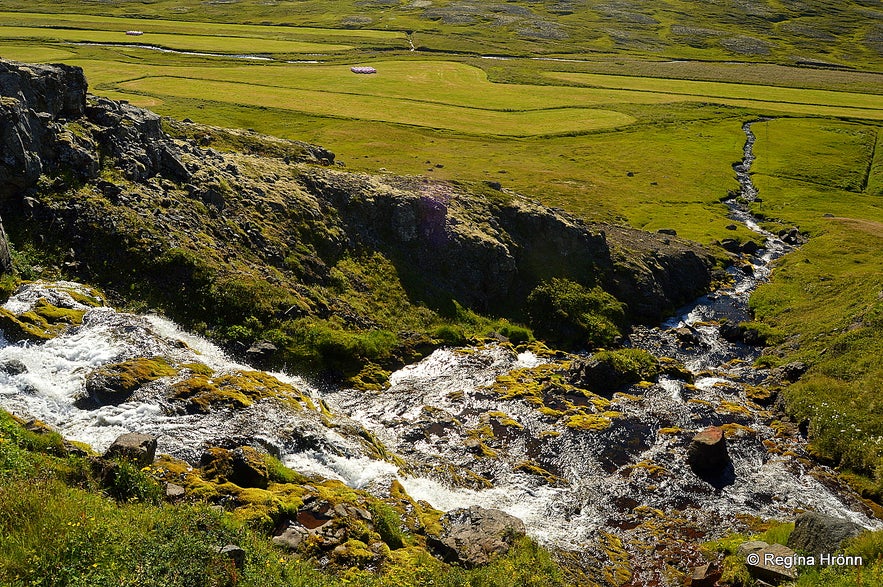
The waterfall Ósómi
When visiting Ingjaldssandur, don't forget to walk behind the hidden-away waterfall, Ósómi.
Ósómi means indecency in Icelandic, but it can also mean the Resonance of the mouth of the river or the source, which I find more likely in this case.
It is best to leave the car by the bridge at the Þverá river. and walk down by the river, which creates beautiful, smaller waterfalls until you reach the part of the river where you can walk behind the waterfall - see my photo below.
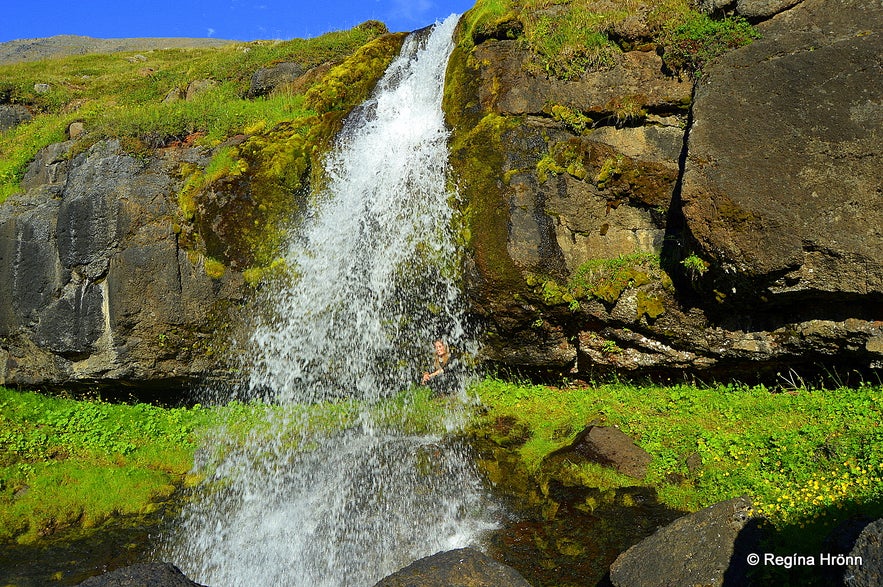
The waterfall Ósómi
The weather was so smashing that I decided to wash my hair in the waterfall - I just stuck my head in and let the water do the work - it was just heavenly.
It made me wonder if my grandmother and her sisters had done the same thing, and I am sure they did. If only these surroundings could talk, I bet they had many a romantic story to tell ;)
I wish I had paid more attention when my grandmother was telling me stories. I remember a lot, but as I had never visited Ingjaldssandur back then, I didn't know the surroundings.
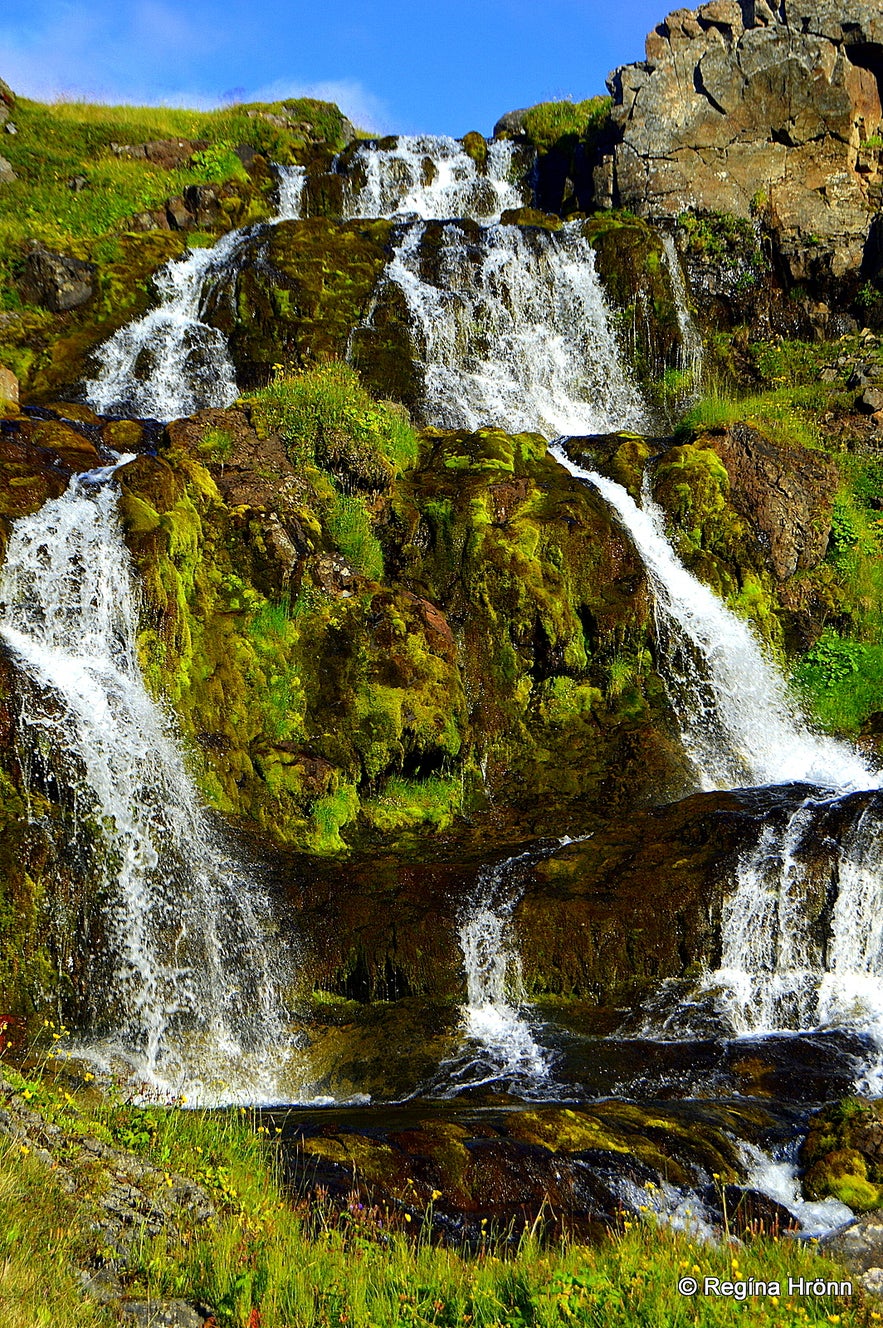
The waterfall Ósómi
What I remember her telling me is elves (hidden people) to whom she had talked! And her eldest sister even wrote down her encounter with an elf woman she met in the valley.
Back then, it was nothing out of the ordinary to have encounters with the elves. I am still hoping to see an elf in nature one day.
I often converse with the beings in waterfalls, but I have not yet seen an elf in nature; I have only heard them sometimes. And I got a gift from them once as a thank-you for cleaning up in their surroundings.
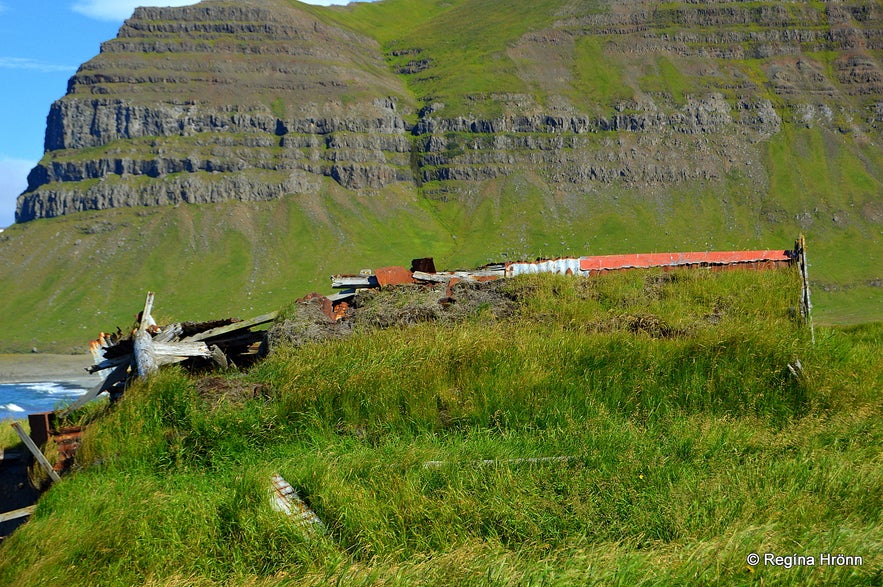
Ruins at Ingjaldssandur
There is a "álagablettur," a spot with a spell on it, at Ingjaldssandur; maybe we can call them enchanted spots. There are many such spots all over Iceland, which we Icelanders respect and would never think of tampering with.
As we all know, if we tamper with the spell of such places, bad things will happen. Often, elves live in these spots, and by, for example, mowing the grass, we disturb them or ruin parts of their homes.
Here in Villingadalur at Ingjaldssandur lived Jón Jónsson from Sæból (around 1886). Jón didn't want to believe in such old stories and moved the spell spot and gathered the hay; this was strictly forbidden.
The same year, on the 20th of December, Jón was killed in an avalanche. A search party of 4 men also got caught in an avalanche, and two of them were killed.
(From the book Álög og bannhelgi by Árni Óla - from the manuscript collection of Magnús Hj. Magnússon).
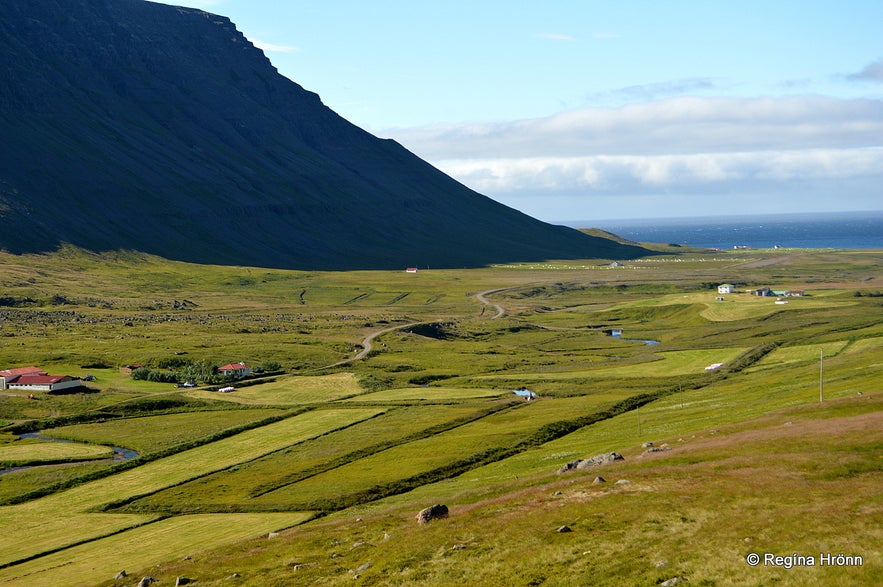
Ingjaldssandur
I found another account in the same book about a rock with a spell on it. The rock stood by the door of a sheep barn at the farm Háls (close to the Ósómi waterfall); tampering with it or moving it would cause the sheep to die.
The rock caused problems for the farmers as snow would gather around it in the wintertime.
A farmer, Vilhjálmur Jónsson, at the farm Háls, didn't believe in this old tale and moved the rock. The following winter, after a sudden thaw, the sheep barn filled with meltwater, killing all the sheep but one!
Vilhjálmur left the farm after this incident.
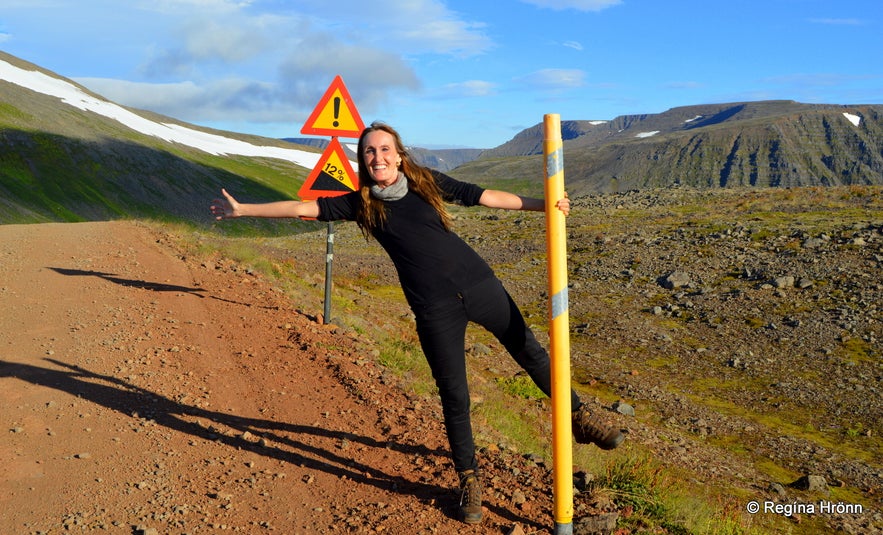
The road leading to Ingjaldssandur
After visiting the waterfall, it was time to return. At the top of the mountain was a sign indicating a 12% descent over 4 km.
And look at the height of the poles, which measure the depth of the snow, they are as tall as I am (1.66 m)! Now we can see why there is no driving to Ingjaldssandur in the wintertime during heavy snowfall!!
My last photo was taken on the other side of the mountain as we descended the winding road into Dýrafjörður. Sigríður Mailína, Guðmundur's mother, was born in Dýrafjörður.
I tell you a little bit about her in this travel blog: The lovely little Village Þingeyri in the Westfjords of Iceland.
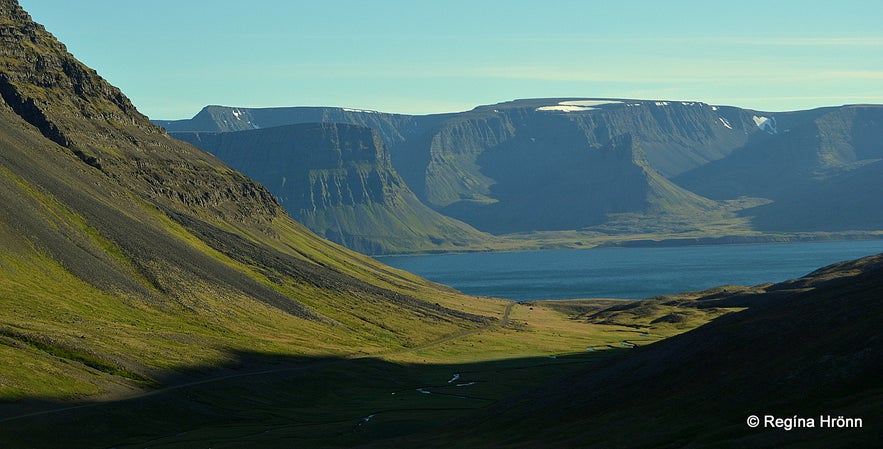
The view of Dýrafjörður returning from Ingjaldssandur
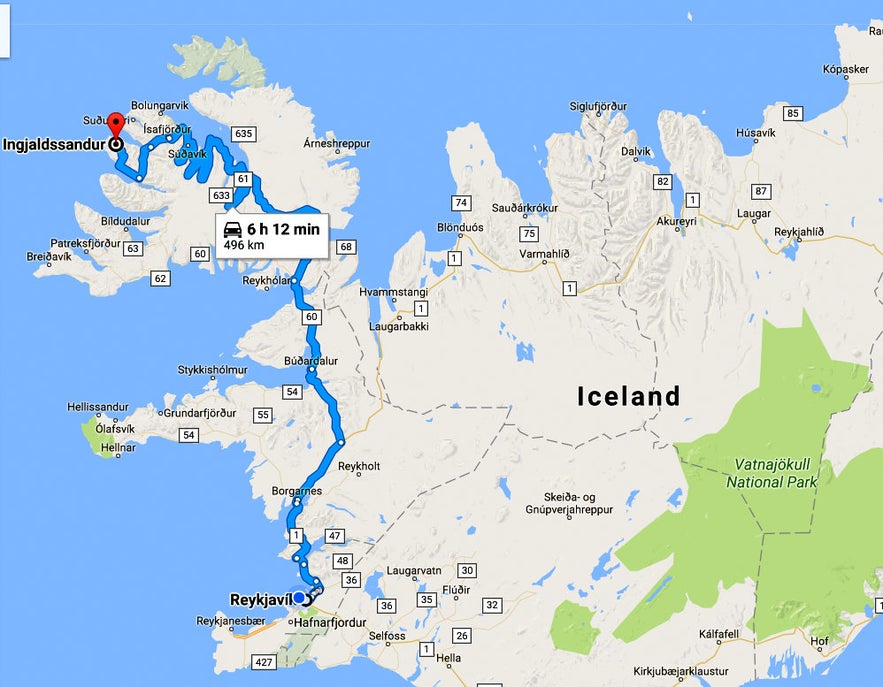
If you rent a car in Reykjavík and drive up to the Westfjords, Ingjaldssandur is about 496 km from our capital city.
There are many interesting stops on the way, so I would advise you to make the most of the journey and spend several days exploring the Westfjords.
If you want to visit the Westfjords, then there are plenty of tours to choose from once you are there.
Guided tours in the Westfjords
I have joined some of them, f.ex, the Natural Wonders of the Westfjords, where you visit one of the largest sea-bird cliffs in Europe and get up close with the puffins, and the fantastic Tour of the Kjaranbraut Avenue and Dynjandi, the Jewels of the Westfjords.
And if you want to know more about the Westfjords of Iceland, then I have written several travel blogs about this wonderful place:
Arnarfjörður - the Sea Monster Fjord in the Westfjords of Iceland
The majestic Dynjandi Waterfall
The Natural Wonders of the Westfjords of Iceland - Látrabjarg Bird Cliff & Rauðasandur Beach
Kjaran's Avenue - the most dangerous Road Construction in the Westfjords of Iceland
Calm Water Kayaking by Ísafjörður - the Kayaking Centre of Iceland
and...
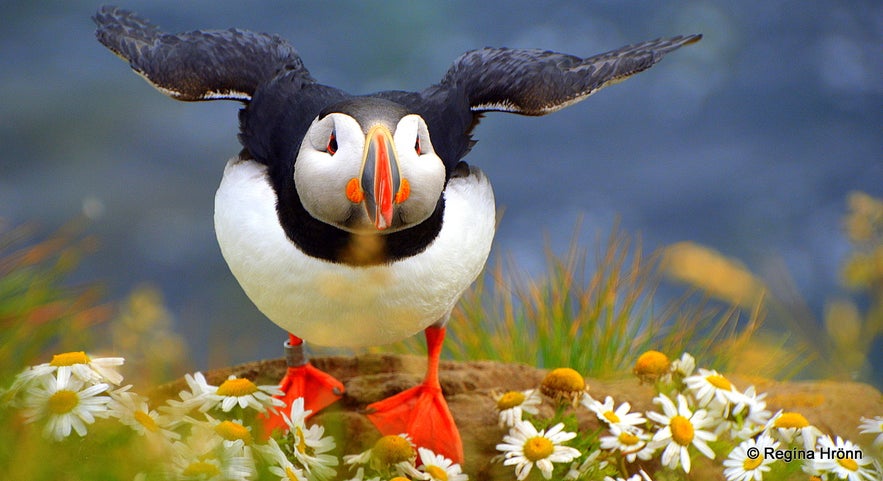
A puffin posing at Látrabjarg sea cliff
Hot Pools in the Westfjords of Iceland
A Visit to Kollsvík Cove in the Westfjords - the smallest Settlement in Iceland
Here you can see the exact location of Ingjaldssandur on the map. The distance from Núpur in Dýrafjörður to Sæból in Ingjaldssandur is 23 km on road 624.
Have a lovely time in the beautiful Westfjords of Iceland :)

Hi, my name is Regína Hrönn, and I was born and raised here in Iceland.