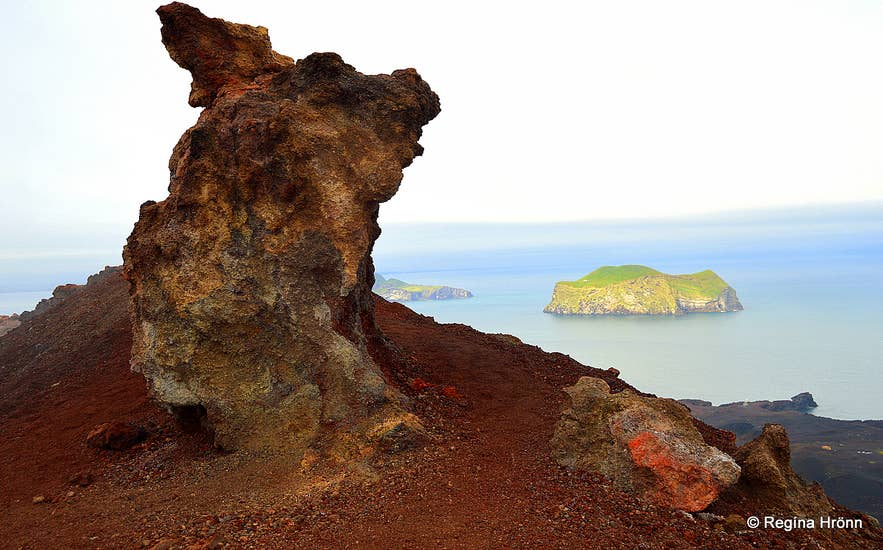
In this travel blog, I am going to show you the maroon Eldfell volcano - the Fire Mountain - which was created in the volcanic eruption of 1973, in the Westman Islands.
The eruption began right next to Vestmannaeyjabær, the town on Heimaey Island, and all the island's inhabitants had to flee to the mainland of Iceland.
Top photo: on top of the Eldfell volcano
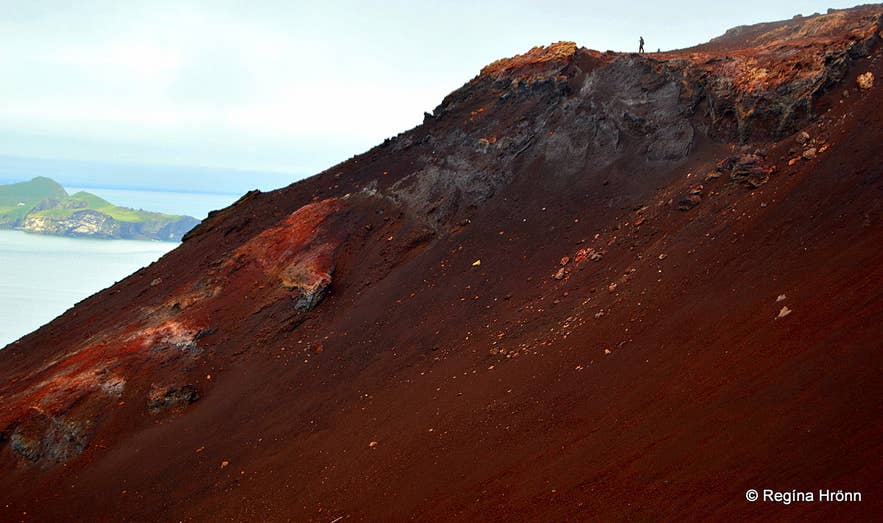
Mt. Eldfell Volcano in the Westman Islands
The volcanic eruption started on the 23rd of January 1973 and lasted until the 3rd of July!
More than 400 houses were damaged and buried beneath the cinders and pumice - some of them even got buried under 3-10 meters of cinders!
Some of these houses have now been excavated, and one of them, you can see at the Eldheimar - the Pompeii of the North Museum.
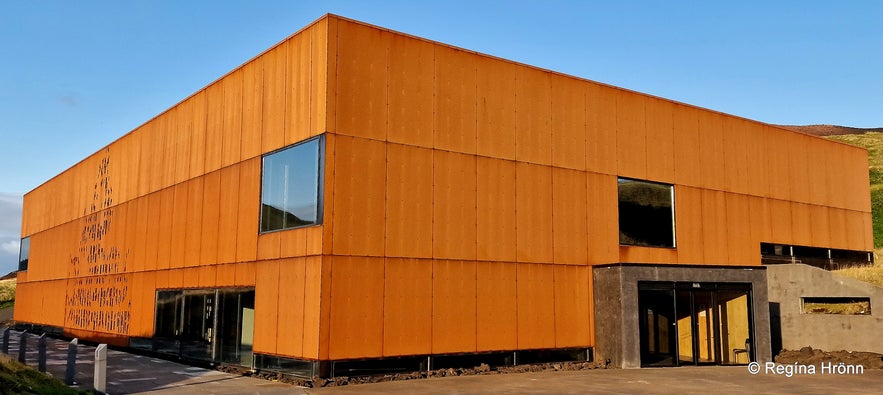 Eldheimar museum
Mt. Eldfell was created in that particular volcanic eruption. It is more than 200 meters high and towers over Vestmannaeyjabær town, constantly reminding them of this terrible, historic eruption.
Heimaey Island, which is the largest and only inhabited island in the Westman Island archipelago, was enlarged by more than 2 km2 by this thick lava flow (from 11.2 km2 to 13.4 km2) as it moved down into the sea.
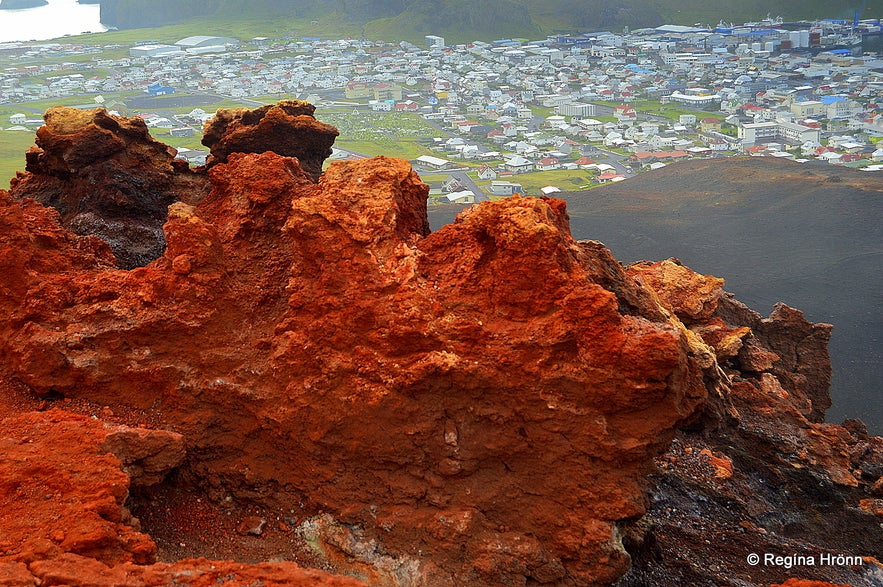
Mt. Eldfell Volcano in the Westman Islands
To gain a deeper insight, I hiked to the top of this maroon volcano.
It is a bit steep, not too steep though, but I had to stop a couple of times to catch my breath and take in the beautiful view.
Unfortunately, it was foggy during my visit, but still, I had a beautiful view of the Westman Islands.
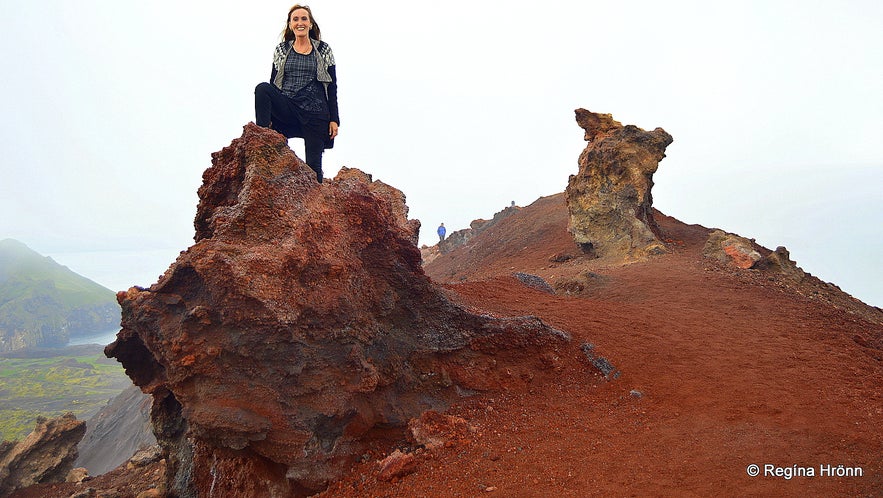
On top of the Eldfell volcano
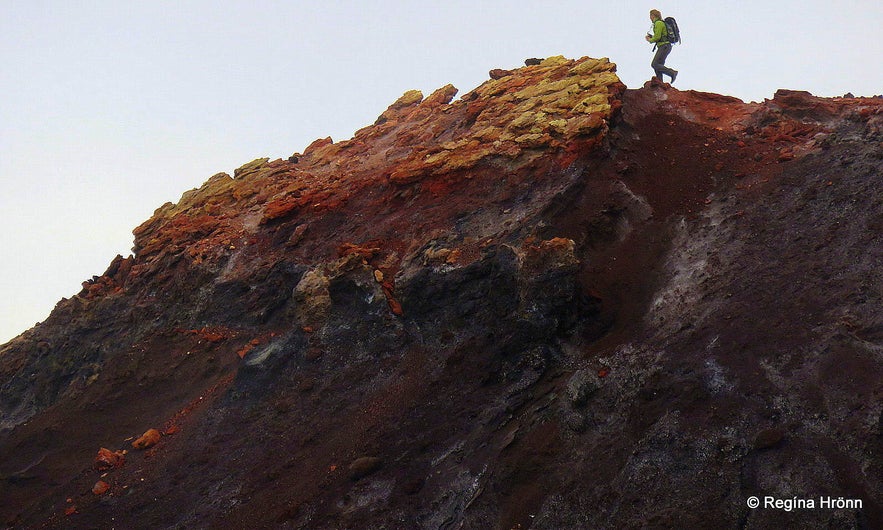
I hurried as I couldn't wait to stand on the rim of the crater and see the colourful lava formations and the view from the summit.
The hike to the top takes only 15 minutes, and it is so worth it for the wealth of scenery and awe-inspiring rock colours.
You will find big, very colourful lava chunks up here on the volcano. It truly is an amazing place; one of the out-of-this-world type locations where you can only say "WOW"!
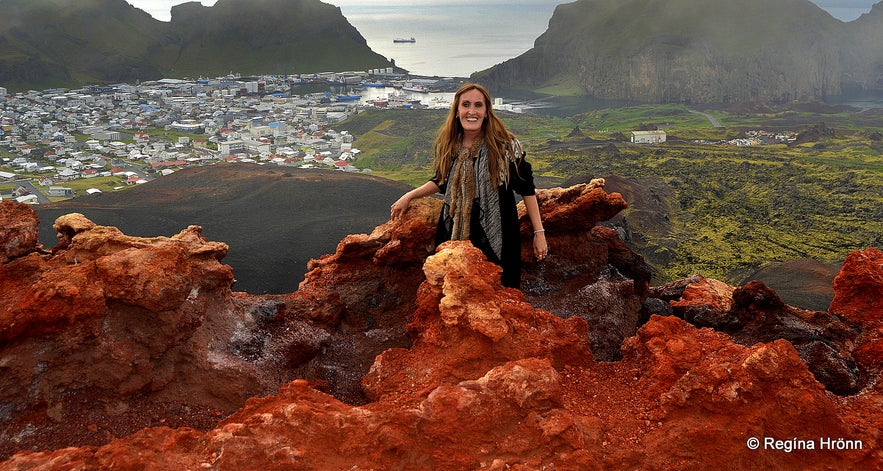
The lava here is amazing
The lava is so bright and takes on so many hues of red that I was in awe.
The lava on top of Mt. Eldfell is still hot in places, and steam was coming from underneath. Just imagine how hot this volcano still is, 53 years after the eruption!
After this cataclysmic event, from 1978-1988, the houses in the Westman Islands were heated by the volcano's intense heat.
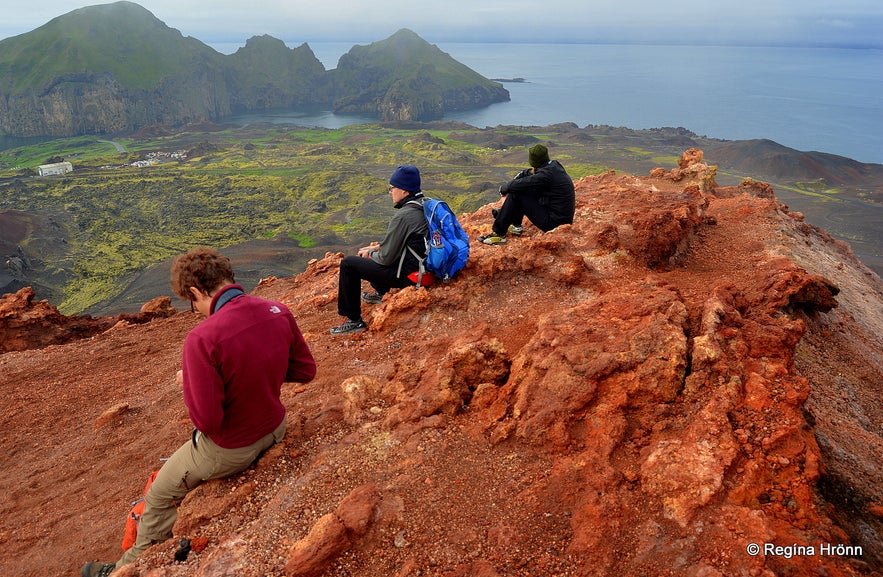
On top of the Eldfell volcano
Every mountain in Iceland has to have a name, and this new mountain couldn't be without a name for long.
Our morning paper, Morgunblaðið, asked Icelanders to come up with a name for the new volcano and send it to them.
Many wanted to call the new volcano Kirkjufell or Church Mountain, but there is a very popular mountain by that name in the Snæfellsnes peninsula in West Iceland.
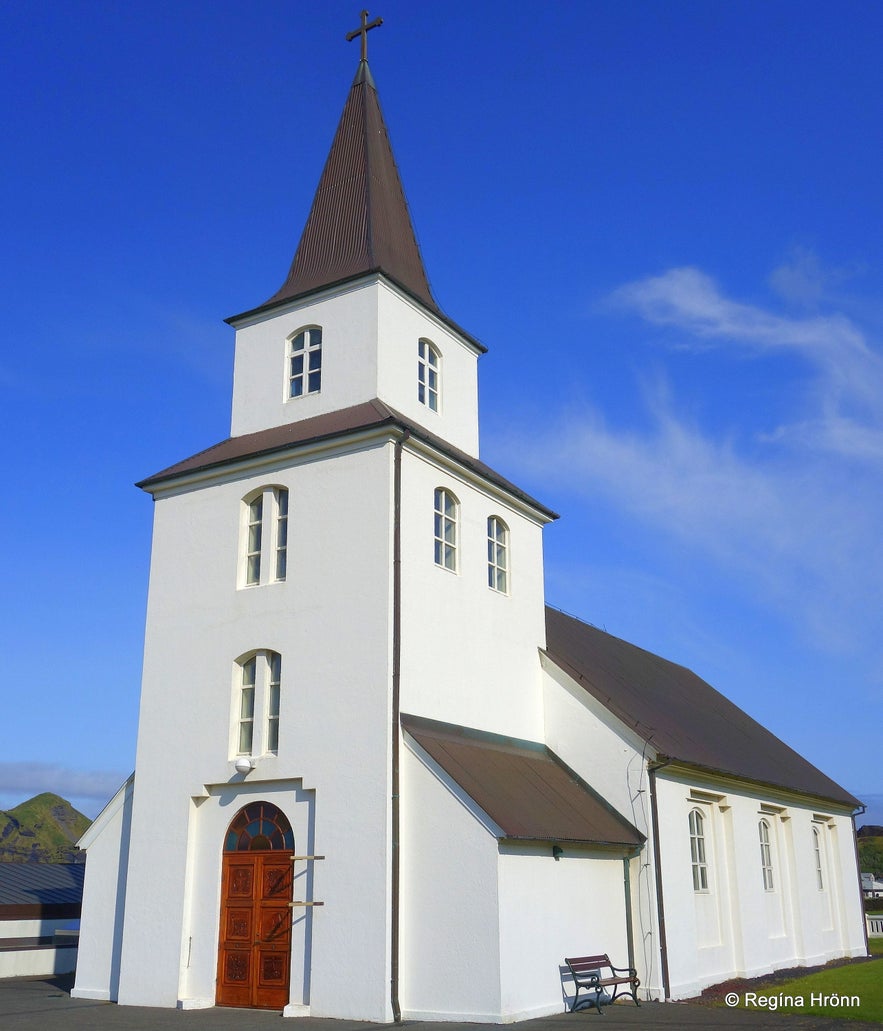 The Landakirkja stone church dates back to 1778
There was a church on this spot from 1269 to 1573, and a vicarage until 1837, both now buried under 100 meters of lava.
This spot, Kirkjubær, is one of the historical spots in the Westman Islands. A new Lutheran church, called Landakirkja, was built in Lönd in 1573; the church on this spot later became a chapel.
Jón Þorsteinsson was a minister in the Westman Islands from 1612 until he was killed by the Algerian pirates in the so-called Turkish raid on the 17th of July 1622.
Eldfell volcano
He hid with his wife, 2 children, and more people in a cave, but was found by the pirates, killed, and his wife and 2 children were captured and sold into slavery.
Jón's final words after 2 blows to his head were: "Herra Jesú, meðtak þú anda minn" - or "Jesus, receive my spirit". The 3rd blow split his head open!
After his murder, Jón Þorsteinsson got the name Jón the Martyr. Reading the story about his horrible fate and the fate of the poor islanders during the pirate attack makes my blood curdle.
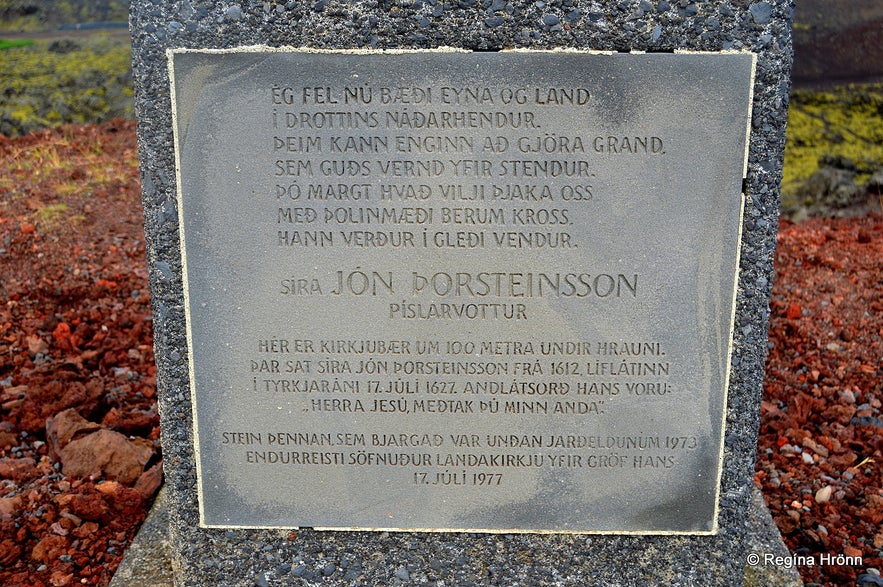
The memorial for Jón and Kirkjubær
You will find a monument in remembrance of Kirkjubær and Minister Jón Þorsteinsson at the base of the volcano Eldfell (see part of it in my photo above).
In 1816, almost half of the inhabitants of the Westman Islands lived here at Kirkjubær.
This stone was rescued from the volcanic eruption in 1973 and restored above the grave of Jón by the congregation of Landakirkja church on the 17th of July 1977.
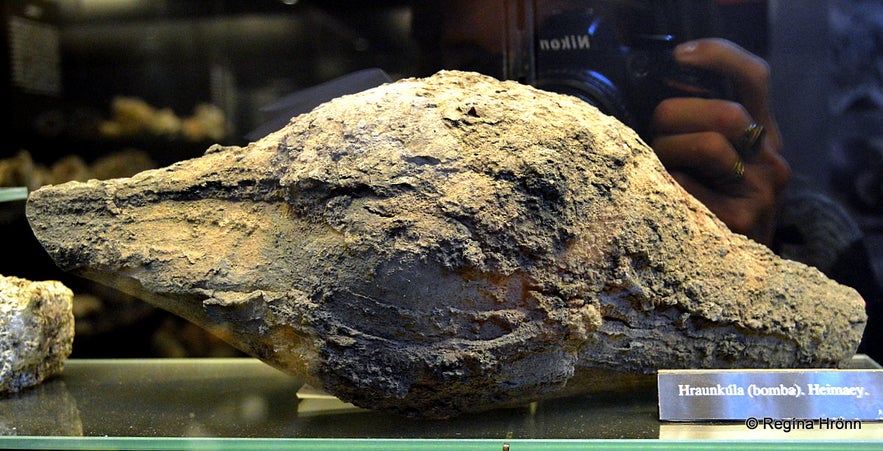
Hraunkúla - a lava bomb
Now, back to the name suggestions for this new volcano. Amongst the 20+ name suggestions, which were sent to Morgunblaðið newspaper, were Bæjarfell, Hrollur (Tremor), Þrymur, and Gribba (Bitch). These names show what Icelanders thought of this lava-spewing mountain.
The name Eldfell won, reminding people of the volcanic eruption that sent lava bombs into the town, which set the homes of the islanders on fire! I found this lava bomb in the photo above on display at the Sæheimar aquarium.
Just imagine these lava bombs flying high up in the air at great speed and twirling around themselves - thus becoming oval in shape! As if the lava flow wasn't enough! These dangerous lava bombs set many houses on fire during the volcanic eruption in 1973.
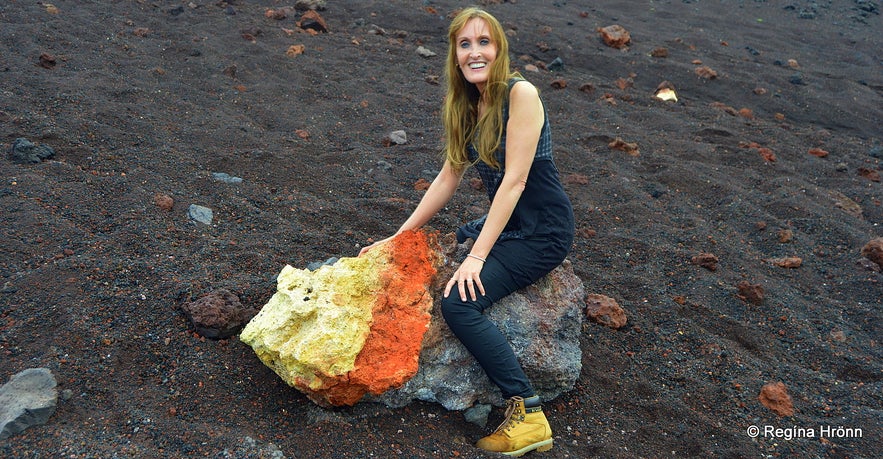
A colourful lava rock at the base of the Eldfell volcano - when I visited in 2020, it had been ruined
I am always amazed to see the big chunks of this colourful lava - this lava looks so beautiful, and this area is so serene, but imagine what it must have looked like during this terrible volcanic eruption back in 1973!
I sit on this colourful lava so you can see how big it really is. By now, I had descended from the volcano and was exploring its base.
On the guided tour, which I have mentioned in another travel blog, our local guide told us that the lava is first black, then red, and sulphur lava, which is orange to yellow, signals the end of the volcanic eruption. So the colours of this lava rock above mean something to geologists.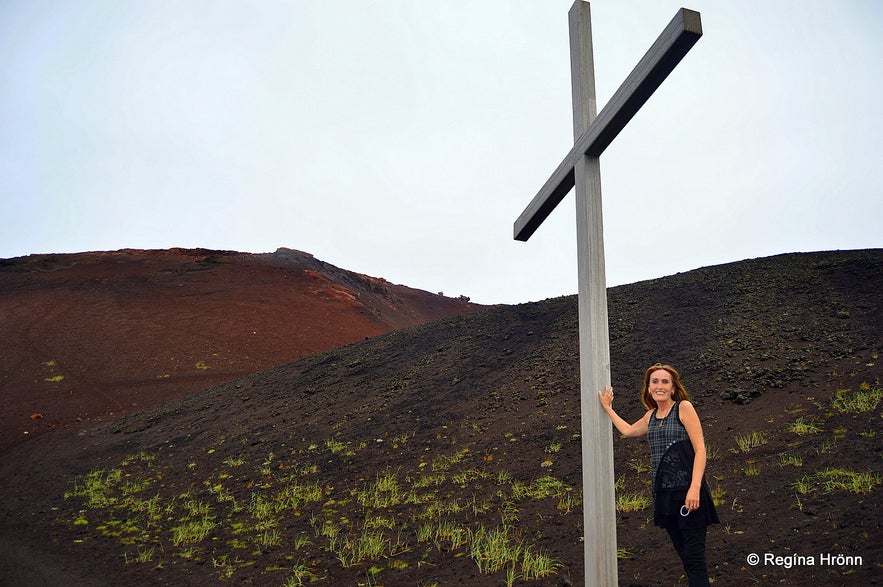
The memorial cross
There is a big wooden cross at the base of the Eldfell volcano.
You might wonder why it was erected in this location. It was erected after a fatal accident happened on this spot.
A man was working on the revegetation of Heimaey Island after the eruption, and his machinery tipped over.
Visiting the Eldfell volcano on a sunny day in 2023
Every year, at the celebration of the end of the volcanic eruption (goslokahátíð) in Eldfell volcano on the 3rd of July in 1973, a service is held on the first Sunday in July by this big cross.
I had a view of Helgafell volcano when I was hiking to the top of Eldfell volcano, but as I mentioned earlier, it was foggy on this day, which gave an unwanted blue hue to my photos :(
So I added a photo of Helgafell, which I took on another visit to the Westman Islands.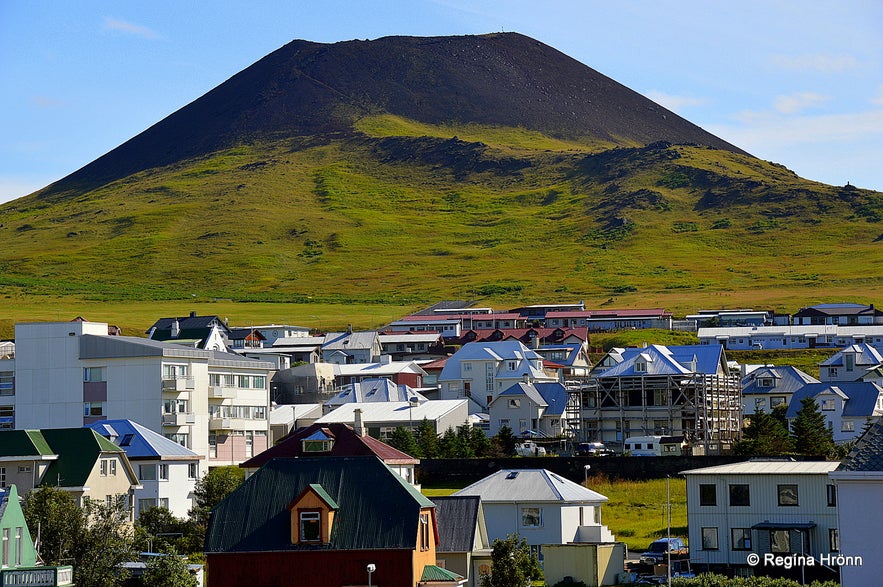
Mt. Helgafell
Helgafell is a 227-meter-high dormant volcano believed to have erupted some 5000 years ago.
During the volcanic eruption in 1973 at Eldfell, many photographers hiked to the top of Helgafell for a good view of the eruption, and from there they had an excellent view of the eruption and the surrounding areas.
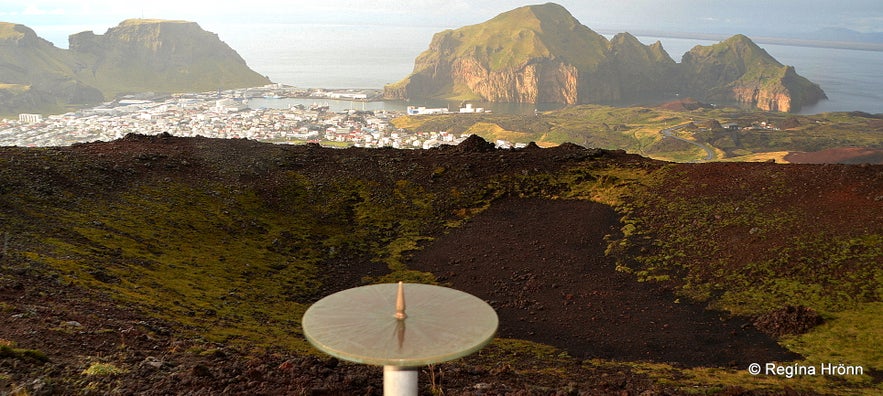 The view from Mt. Helgafell during a heavy shower of rain
It must have been strange, sitting atop a dormant volcano, watching a new volcano being born while the old one trembled and shook from the seismic activity of its birth!
We hiked on Mt. Helgafell in the fall of 2023, and during our visit, the heavens opened.
It is an easy 10-15-minute hike.
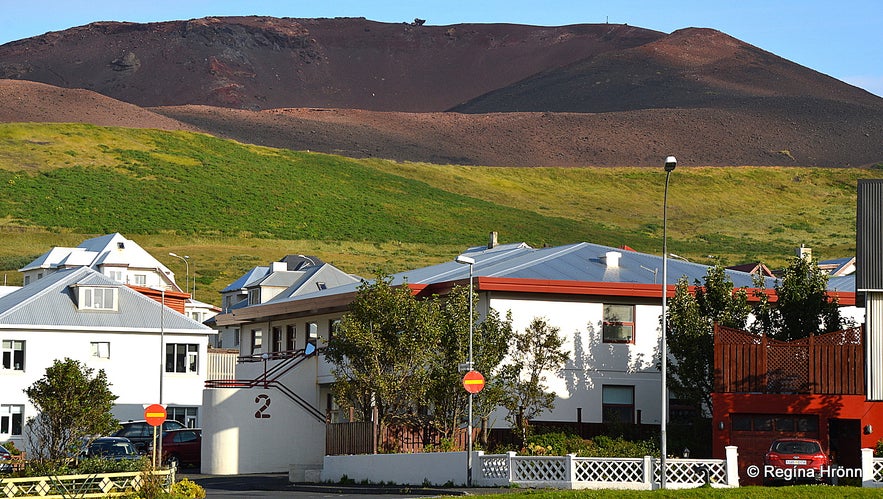
Eldfell volcano - see how close it is to the houses
Situated on the top of Helgafell, a view-dial almost swayed during the eruption of Eldfell.
Many of you, who read my travel blog, know that I seek out and photograph all the view-dials in Iceland, many of which were made by my father-in-law.
The name Helgafell is said to derive from the Settlement of Iceland in 874, when the blood-brothers Ingólfur and Hjörleifur arrived.
Hjörleifur had enslaved some Irish people on his way to Iceland. They ended up killing him in 875 and fled from the mainland to the islands.
You can read this story in my travel blog:
The historical Hjörleifshöfði promontory and the Viking blood-brothers Ingólfur and Hjörleifur
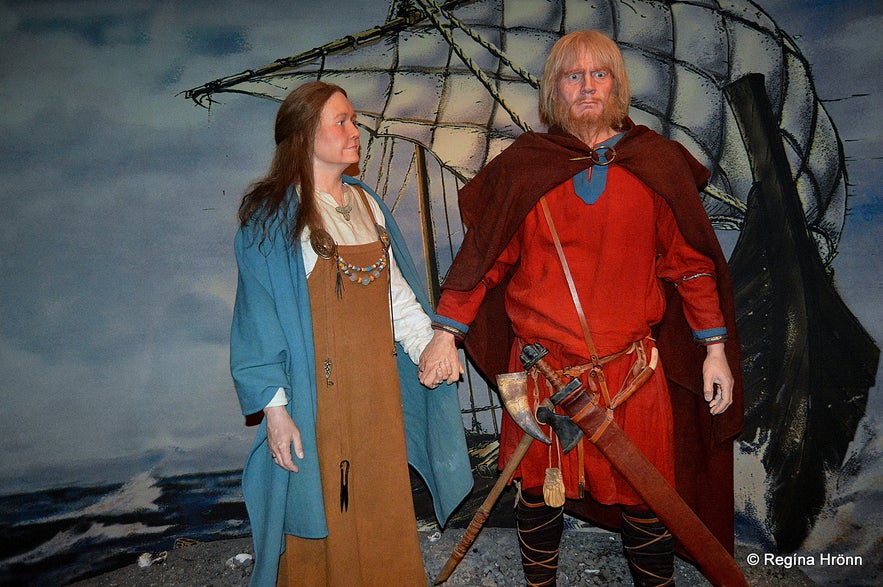
Hallveig and Ingólfur at the Saga Museum in Reykjavík
The settler of Reykjavík, Iceland's capital city, Ingólfur Arnarson (see my photo above, which I took at the Saga Museum in Reykjavík), followed the Irish people to the islands after they killed his blood-brother and brother-in-law, Hjörleifur Hróðmarsson.
Ingólfur and his men tracked them down, surprised them as they were eating, and killed them.
One of the Irishmen, Helgi, was killed on Helgafell, and thus the volcano got its name.
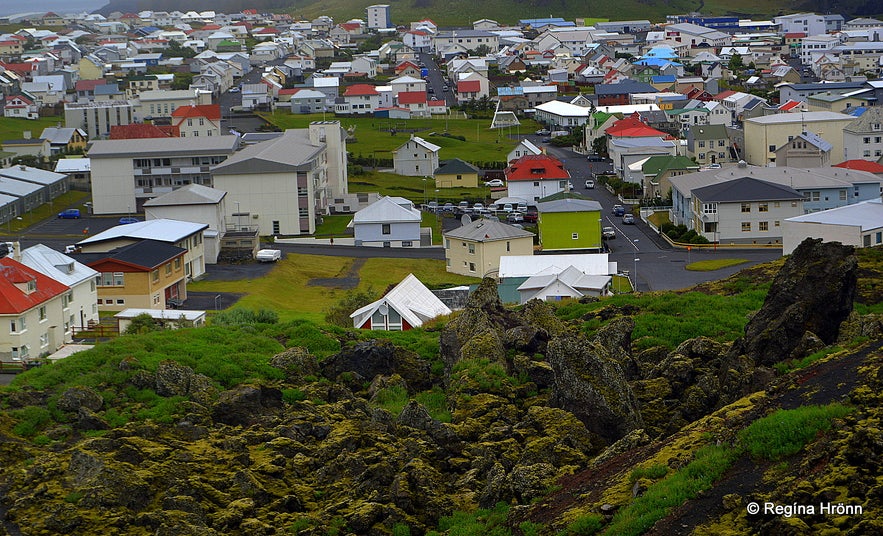
See how close the lava is to the houses
If you want to know more about the volcanic eruption in the Westman Islands, a visit to the Eldheimar Museum - the Pompeii of the North is a must.
There, you can see a house that was buried under a heavy load of lava and ash, but many of the Islanders lost their homes this way, and there are still many houses buried deep under layers of ash, as I told you earlier in this travel blog.
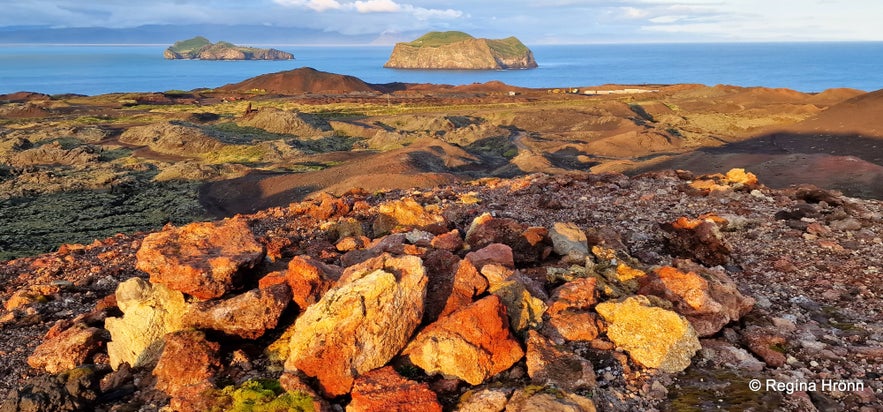 Hiking on Mt. Eldfell in 2023 in the evening sun, 50 years after the volcanic eruption
If you want to read up on the Westman Islands and what there is to see and do there, then I have written several other travel blogs about my day trip to the Westman Islands:
Westman Islands - Sæheimar - Have you ever met a Puffin Up Close and Personal?
Westman Islands - the Puffin and Volcano Tour - Local Guidance
Herjólfsbærinn - Herjólfur's old farmstead in Herjólfsdalur valley in the Westman Islands
The Westman Islands - Eldfell volcano & Eldheimar - the Pompeii of the North in Iceland
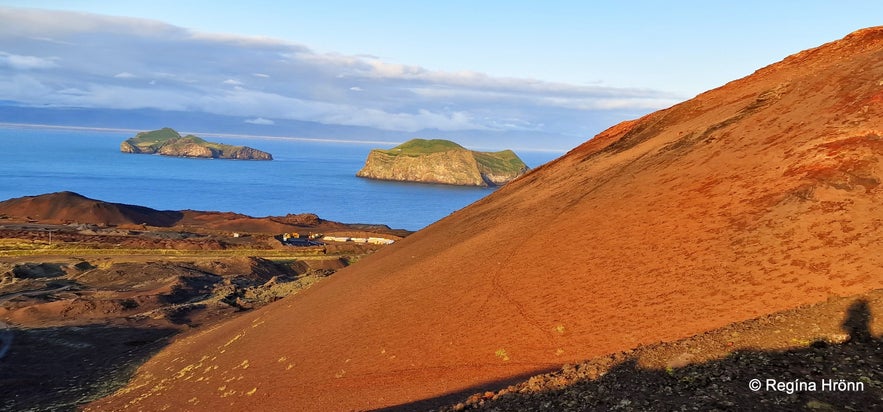 Hiking on Mt. Eldfell in the fall of 2023
To visit the Westman Islands, you can rent a car in Reykjavík and drive to Landeyjarhöfn and catch the ferry Herjólfur over to the islands and take tours of the island itself, as I did on one of my visits.
Or explore it on your own, as I have done many times. Being guided around by a local is always preferable.
You can also book a private tour from Reykjavík to the Westman Islands.