By the harbour in the lovely little village of Djúpivogur in East Iceland, you will find a bay called Gleðivík or Merry Bay.
In that bay, a hidden treasure is to be found - a distinctive outdoor artwork hidden away from sight.
This is an artwork by the popular Icelandic visual artist, Sigurður Guðmundsson, called Eggin í Gleðivík - the Eggs at Merry Bay. The noted artist Sigurður Guðmundsson has received several international awards for his visual artwork.
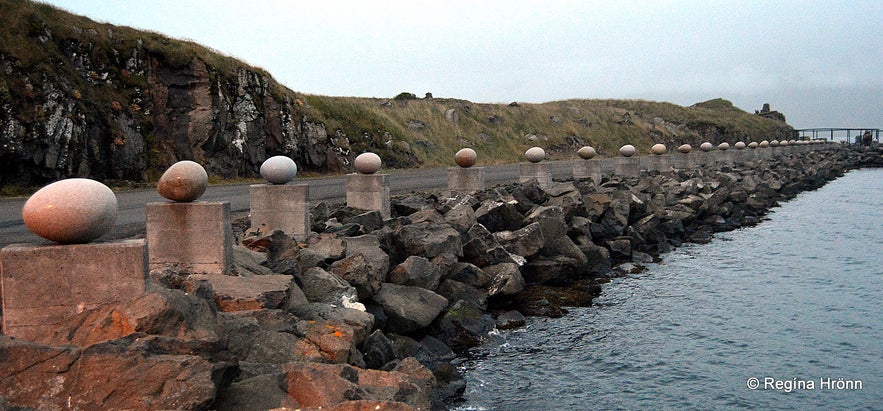
Eggin in Gleðivík - the Eggs at Merry Bay
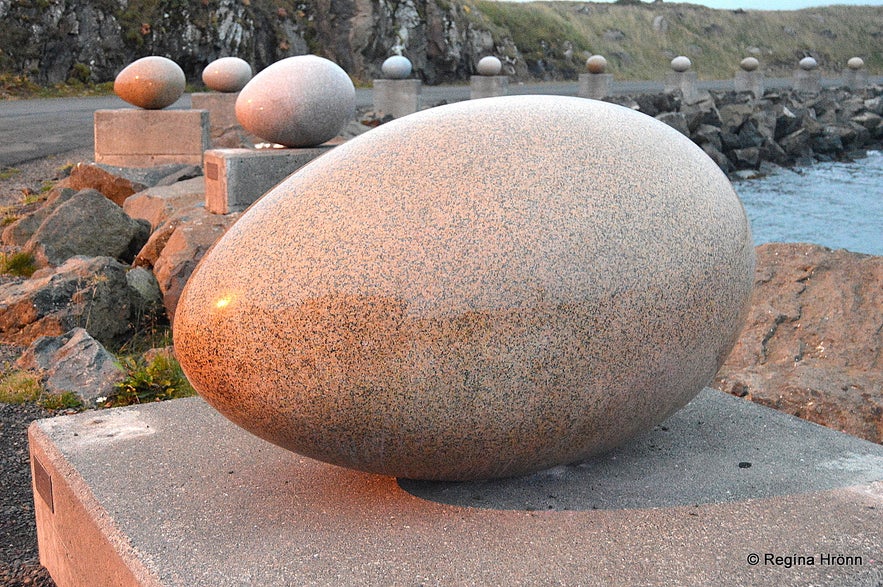
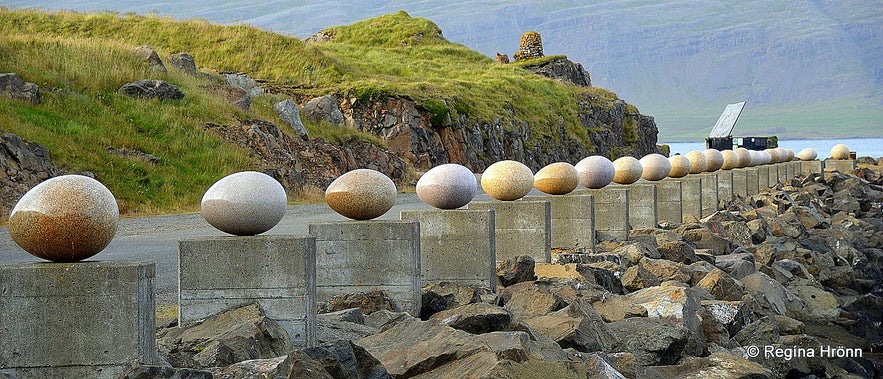
The outside artwork consists of 34 huge granite eggs, which represent the eggs of each of the nesting birds in this area, many of which are migrating birds, flying over to Iceland from far away to lay their eggs in Iceland.
The Eggs at Merry Bay are made of Chinese granite and imported from China, where the artist Sigurður lives part of the year with his wife.
They also own a home in the village of Djúpivogur called Himnaríki, or Heaven.
The granite eggs are all the same size or similar in size, except one, which is much larger than the others.
This distinctive artwork was revealed on the 14th of August 2009, and on the official website of Djúpivogur village, you can see photos from the unveiling of the eggs.
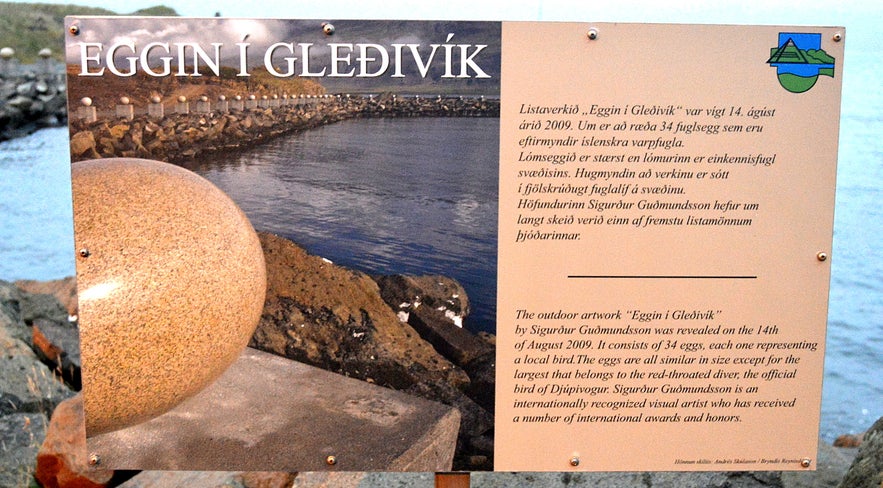
The information sign by Eggin in Gleðivík - the Eggs at Merry Bay
The molten plinths in Merry Bay are remnants from the landing of fish by the port.
Here, fish was landed and transported by a conduit on the plinths into the rendering of the fish-factory Bræðslan.
The old fish factory now hosts a contemporary art exhibition in the summertime. Times have changed here in the little fishing village of Djúpivogur.
The District Manager of Djúpivogur had been pondering what to do with these old plinths, so he consulted the visual artist Sigurður Guðmundsson.
Sigurður immediately came up with the idea of the granite eggs and put his idea into action. He said that, by the time of the inauguration of his artwork, he had never created such a large artwork in such a short time, but the artwork itself is 200 meters long!
A photo of my last visit to Djúpivogur, again dusk setting in, but brighter than during my first visit
Each one of the 34 eggs is an exact replica of the egg of the bird in question.
The eggs are all different in shape, nuance, and colour. Most of the bird species represented by the eggs are migratory, and the best time for bird-watching in Iceland is from June to August.
It is such beautiful artwork, eggs represent growth, new beginnings, and the future, and it is amazing how many emotions the Eggs of Merry Bay can stir up :)
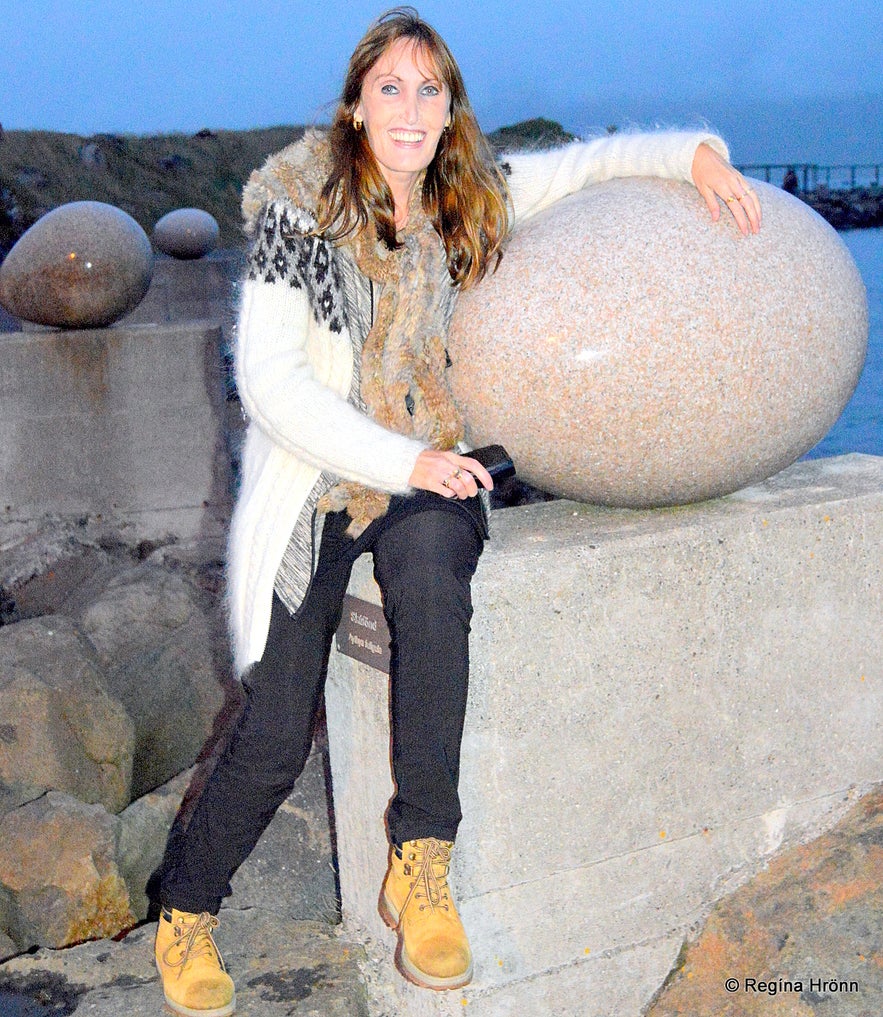
Eggin in Gleðivík - the Eggs at Merry bay - here you can see how big they are
The Eggs of Merry Bay have become the main attraction of Djúpivogur, and I am sure that one day they will become the symbol of the village.
Small castings of the eggs in a gift box can be bought in Djúpivogur village. I think they would make a lovely gift for bird watchers.
My photos were shot in twilight on a September night, but I boosted the light a bit so the eggs could be seen.
I added two photos of myself with the eggs so that you can see how big they really are. The biggest one is much larger than the others and represents the egg of the official Djúpivogur bird, lómur, the red-throated diver.
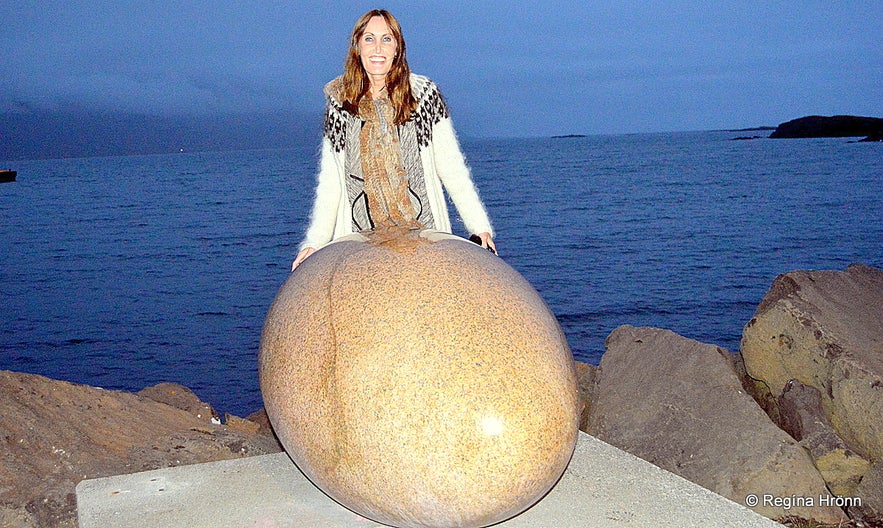
By Eggin in Gleðivík - the Eggs at Merry Bay
You will find a sign leading to Gleðivík - Merry Bay, which is just outside the village, or some 900 meters from the village centre.
There is more to see in Djúpivogur, though, and I just wanted to point the eggs out to you, as they are hidden away when you enter the village. I would not want you to visit Djúpivogur without seeing these huge eggs of Merry Bay.
The latest I've heard about the eggs is that plans are to move them, as a fatal accident occurred in Gleðivík bay.
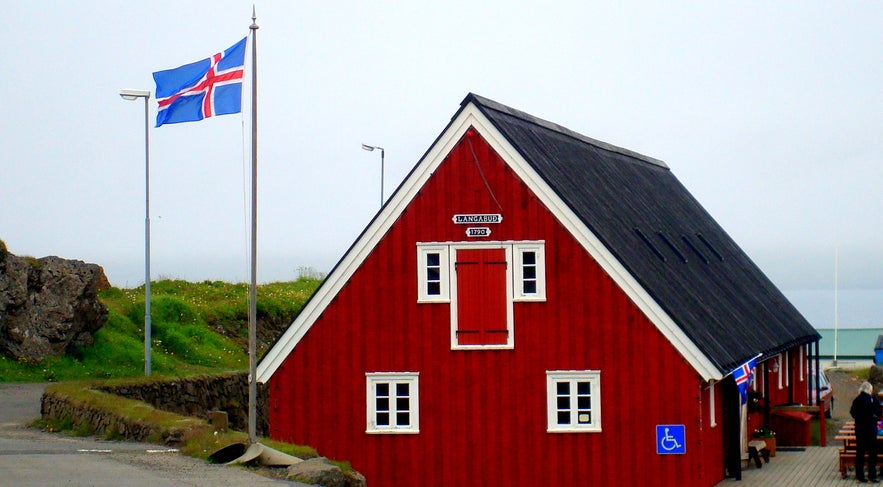
Langabúð in Djúpivogur
The population of Djúpivogur is 472, and fishing, fish processing, and tourism are the primary industries in this small village.
The Cultural Centre of Djúpivogur, located in the beautiful red-painted timber house called Langabúð, hosts a section devoted to the noted sculptor and woodcarver Ríkarður Jónsson (1888-1971).
Langabúð is the oldest house in Djúpivogur, built in 1790 - it is fitting that Ríkarður's memory and work are honoured in the house in which he was born.
Langabúð was built on the ruins of earlier buildings from 1589, and back then, German merchants started trading with Djúpivogur.
The Danish Trading Monopoly then took over trade from 1602 to 1786!
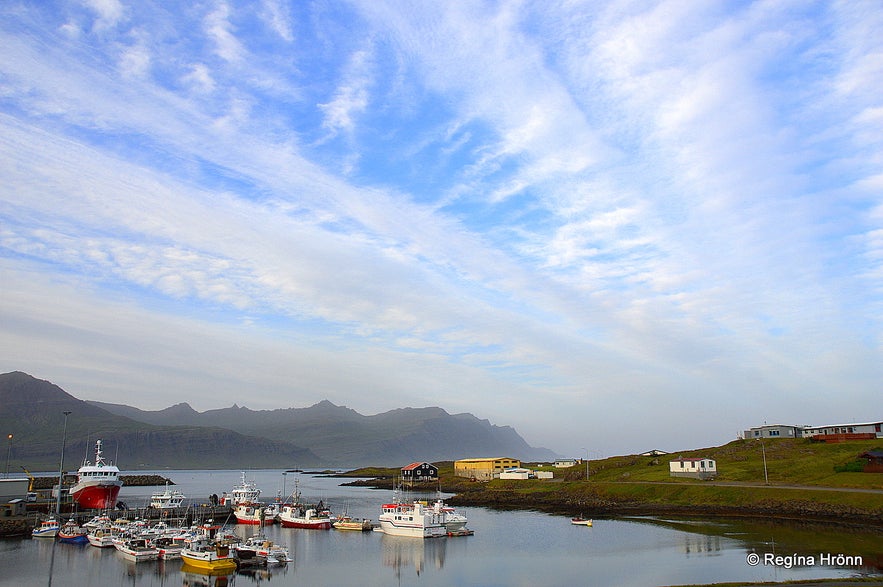
Djúpivogur harbour
The pyramid-shaped Mt. Búlandstindur (1,069 m) is the landmark of Djúpivogur, and we believe that extraordinary powers are at work in this mountain.
Due to the Austfjarðaþoka or the Fog of the Eastfjord, I have not always been able to get a decent photo of Mt. Búlandstindur. The Fog of the Eastfjords is a well-known phenomenon here in Iceland.
Finally, in 2020, I was able to get a decent photo of Mt. Búlandstindur while visiting the distinctive Blábjörg - the Blue cliffs in Berufjörður fjord.
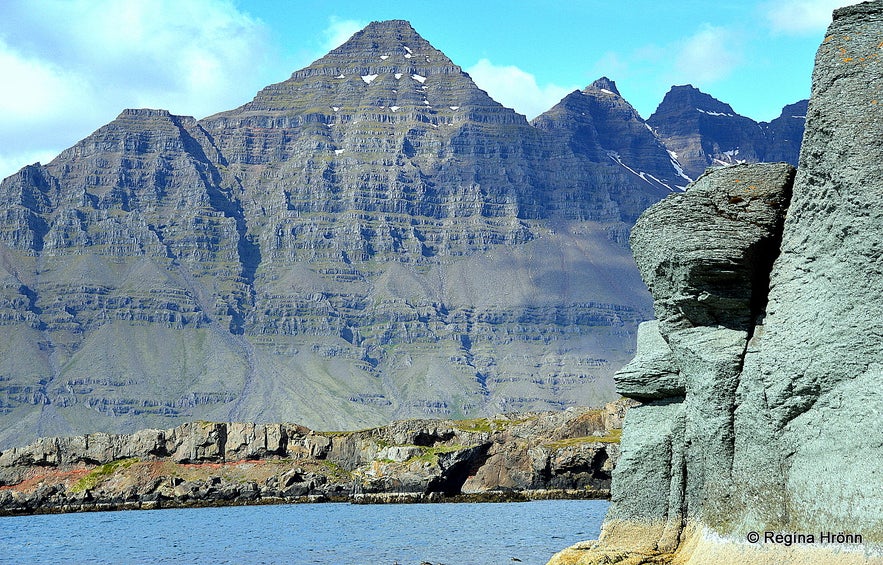
Mt. Búlandstindur and Blábjörg cliffs in Berufjörður fjord
In the summertime, there are daily boat tours to Papey island - the Friar's island, which is named after the Irish monks, who were here in Iceland along with other Irish people (or that is what we think) when the Vikings arrived around the year 874.
When the Vikings settled Iceland, the monks seem to have left. We don't know the whole story, though, and there are some speculations that Irish people may have settled in Iceland before the Vikings arrived.
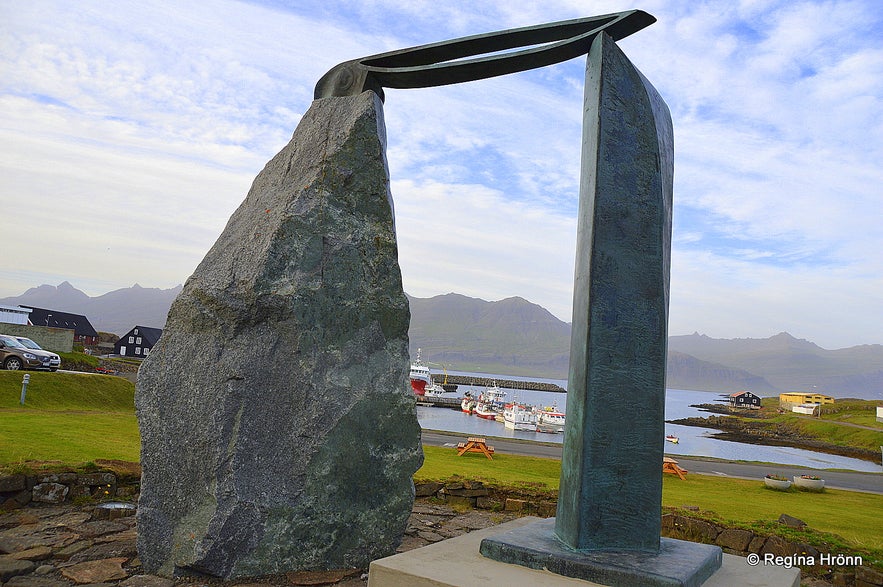
Artwork in Djúpivogur
Back in 1989, I went to Djúpivogur to catch a ride on a freight ship carrying salt cod (bacalao) from Djúpivogur to Portugal.
I was young and wanted to save some money, so instead of flying to Portugal, my girlfriend and I decided to catch a ride on this freight ship, even though it meant that we would be sailing for 5 days before reaching Portugal ;)
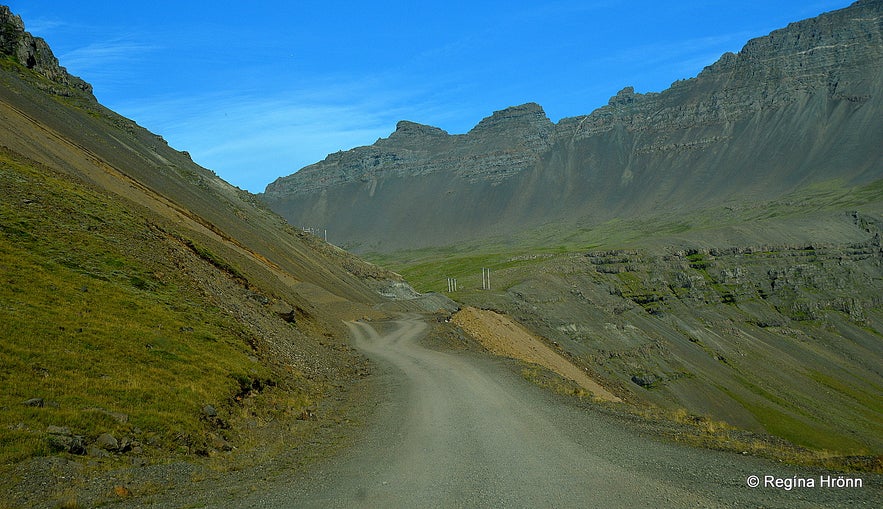 Almannaskarð pass - the old road
Back then, there was no tunnel through the steep Almannaskarð pass from Höfn, so we had to drive up the steep mountain.
My girlfriend and I had booked a night at Hotel Höfn and had just gone to sleep when we were awakened by the captain of the freight ship telling us that they were leaving earlier - in the middle of the night, to be exact and that he had already sent one of his crew members to pick us up!
That guy drove up the steep mountain of Almannaskarð pass at a speed of 100 km/hour - scaring the living daylights out of us!
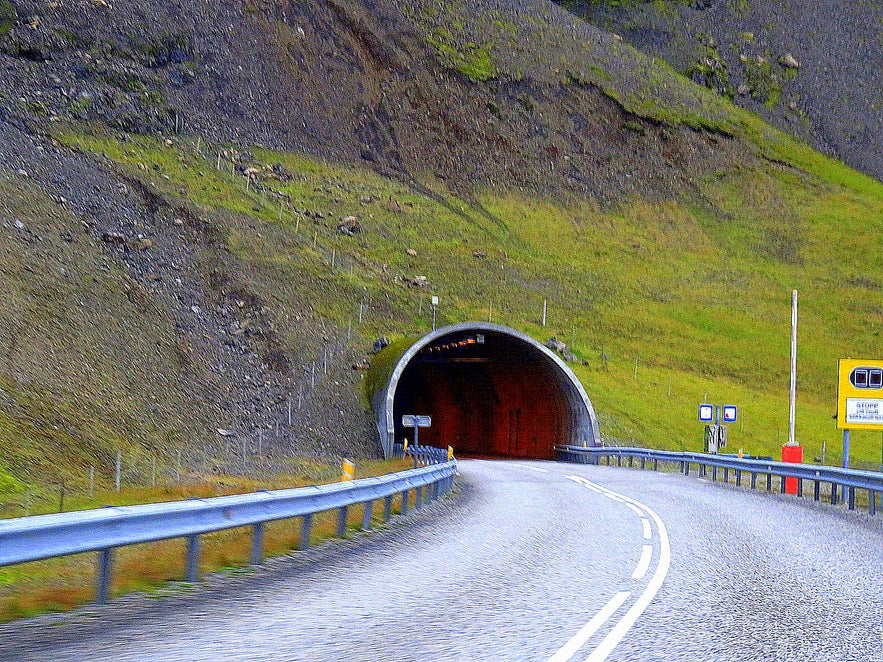
The Almannaskarðsgöng tunnel
I am very grateful for the 1.3 km long Almannaskarðsgöng tunnel on Ring Road 1, which was opened in 2005, leading from just east of the town of Höfn and up to the Eastfjords of Iceland!
The view-dial in Djúpivogur by Bóndavarða
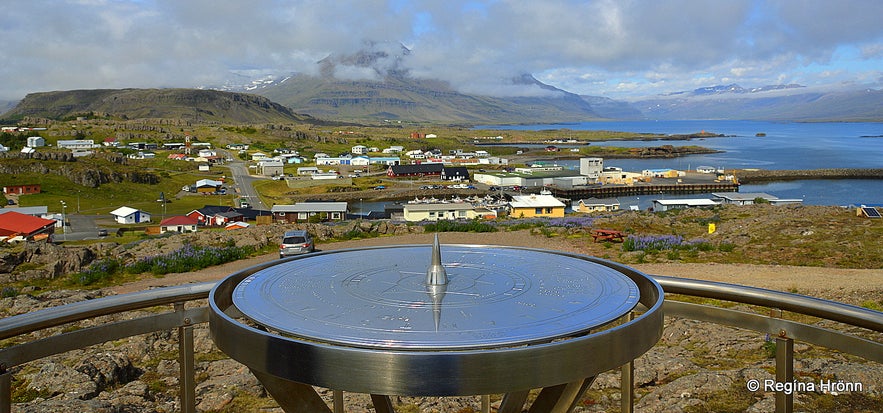
Here, clouds are blocking the view of Mt. Búlandstindur
Wherever I travel in Iceland, I always look for a view-dial, as the making of these view-dials runs in my husband's family.
The chromium-plated view-dial in Djúpivogur was erected in 1997.
It has a time of three hours (eyktir) and shows the outlines and names of the surrounding mountains.
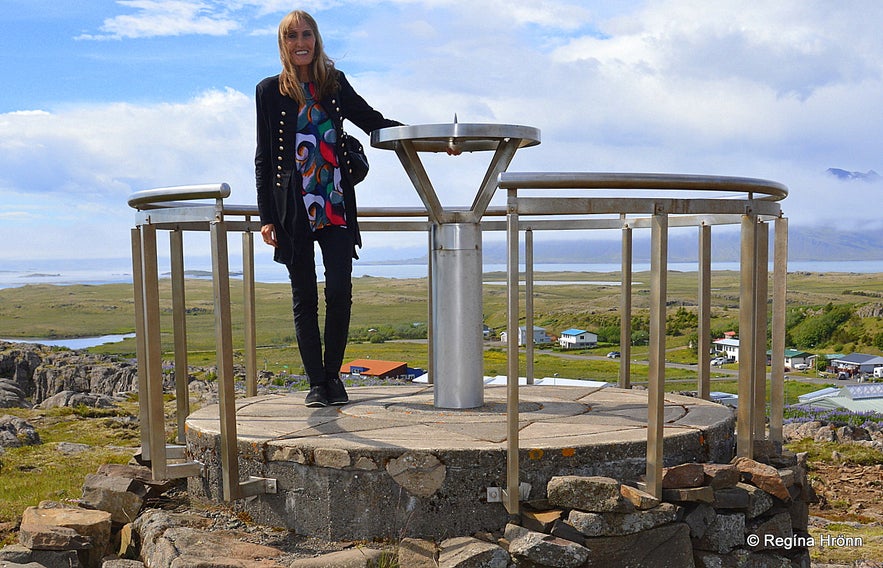
By the view-dial by Bóndavarða
This view-dial was designed by my father-in-law, Jakob Hálfdanarson, and his assistants were Jón Víðis Jakobsson (my husband) and Þórný Björk Jakobsdóttir (my sister-in-law).
The design of the view-dial is so pretty: it sits on a grid atop a steel pillar and is surrounded by a steel railing. The molten base is in the image of a star.
The view-dial in Djúpivogur is located by Bóndavarða, from where there is a great view.
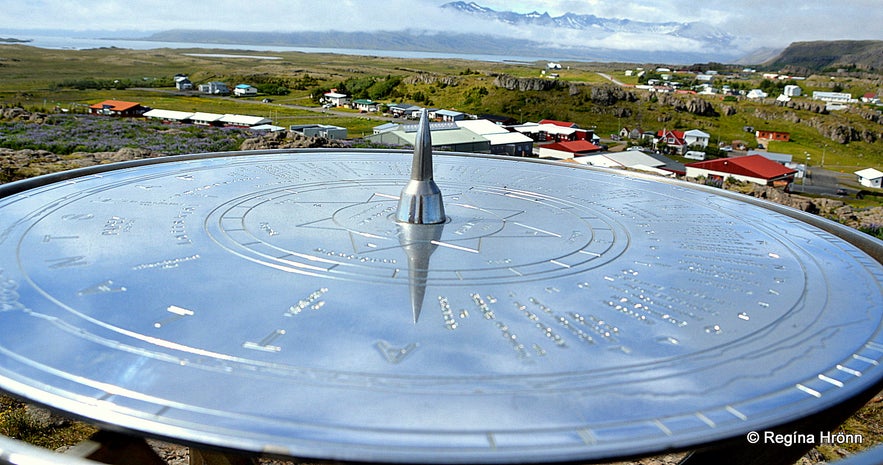
The view-dial by Bóndavarða
To reach Djúpivogur in East Iceland, you can rent a car in Reykjavík and drive for some 554 km on Ring Road 1 or 104 km if you come from the town of Höfn in the south-east.
A sign leads you to Gleðivík from Djúpivogur's centre. The egg sculptures are just outside the village, about 900 m away.
I have written several other travel blogs about East Iceland if you want to know more about this beautiful part of Iceland:
East Iceland is dotted with beautiful little villages and hidden secrets
The Eastfjords of Iceland - the beautiful Fjords in Fjarðabyggð
Have a lovely time in East Iceland :)

Hi, my name is Regína and I was born and raised here in Iceland. Since 2013 I have written 320 travel blogs about various interesting places to visit in Iceland. I hope you enjoy reading my travel-blog :)