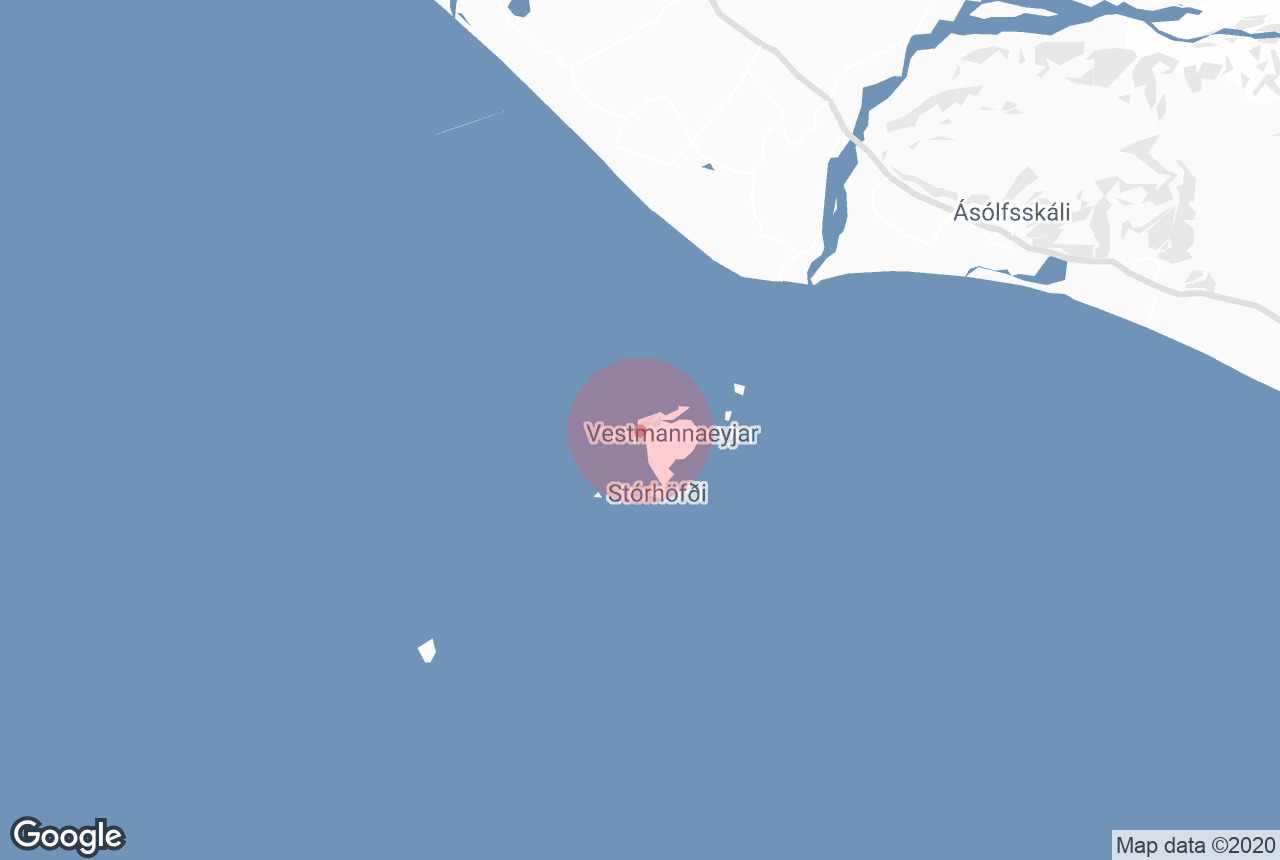

The Elephant Rock is a natural rock formation on the Westman Islands archipelago, located approximately 7.4 kilometres off Iceland's South Coast.
Photo from Wikimedia, Creative Commons, by Diego Delso. No edits made.
저희의 콘텐츠를 신뢰할 수 있는 이유
가이드투아이슬란드는 아이슬란드에서 가장 믿을 수 있는 여행 플랫폼으로, 매년 수백만 명의 여행객이 저희와 함께 아이슬란드를 방문합니다. 저희의 모든 콘텐츠는 아이슬란드를 누구보다 잘 아는 현지 전문가들이 작성하고 검토하므로, 정확하고 신뢰할 수 있는 최신 여행 정보만 제공합니다.
The Elephant Rock can be visited by those who rent a car or take a Westman Islands tour, then take a ferry from Landeyjahöfn or Þórlakshöfn to the Westman Islands. Here, they will need to take a one-hour boat trip to see it.
The Westman Islands, or Vestmannaeyjar, are a cluster of 15 islands and around 30 reefs created by undersea volcanic activity. Covering around 13 square kilometres, the largest of these islands, Heimaey, is the only inhabited one of the cluster. The Elephant Rock is just one of many magnificent features to be found here.
Formation and Appearance
The entire archipelago of the Westman Islands rests in the Southern Iceland Volcanic Zone, and was formed during numerous volcanic eruptions. As a result, the islands boast multiple remarkable rock formations and unmatched volcanic landscapes.
The Elephant Rock fascinates visitors because it resembles the head of a giant elephant which has submerged half its trunk underwater, as if attempting to quench its thirst with the Atlantic Ocean. The elephant-shaped formation can be found on the cliffs of Heimaey, making it the elephant island.
Many have also pointed out the rock's resemblance to H.P. Lovecraft's cosmic daemon Cthulhu, a monstrous sea creature with the face of an octopus. The likeness is complete with a cleft in the rock where the Lovecraftian creature's eyes would be, and the resulting shadow bestows an eerie and lifelike quality upon its face.
Fundamental to the rock's realistic appearance is the fact that it's entirely made from basalt; this makes the "skin" of the creature appear wrinkled.
Historical Volcanic Activity
The Elephant Rock is believed to have been formed during one of Mt. Eldfell's many eruptions. The most recent of these was Eldfell's 1973 eruption, which resulted in the evacuation of Heimaey's entire population, although the Rock itself is much older.
This most recent catastrophe, however, created many of the tourist attractions that currently compete with the Elephant Rock for popularity. Of course, there is the Eldfell Crater, but also the Eldheimar Museum, which documents the tale of how the island was saved from total destruction.
Other reasons to visit the Westman Islands include its incredible birdlife and whale watching opportunities. After all, it is home to the largest population of nesting Atlantic Puffins in the world in summer, and the country's number one hot spot for finding creatures such as Fin Whales and Orcas.
Many puffin and whale watching boat trips are combined with visits to the Elephant Rock, allowing you to marvel over both Iceland's wildlife and its geology.