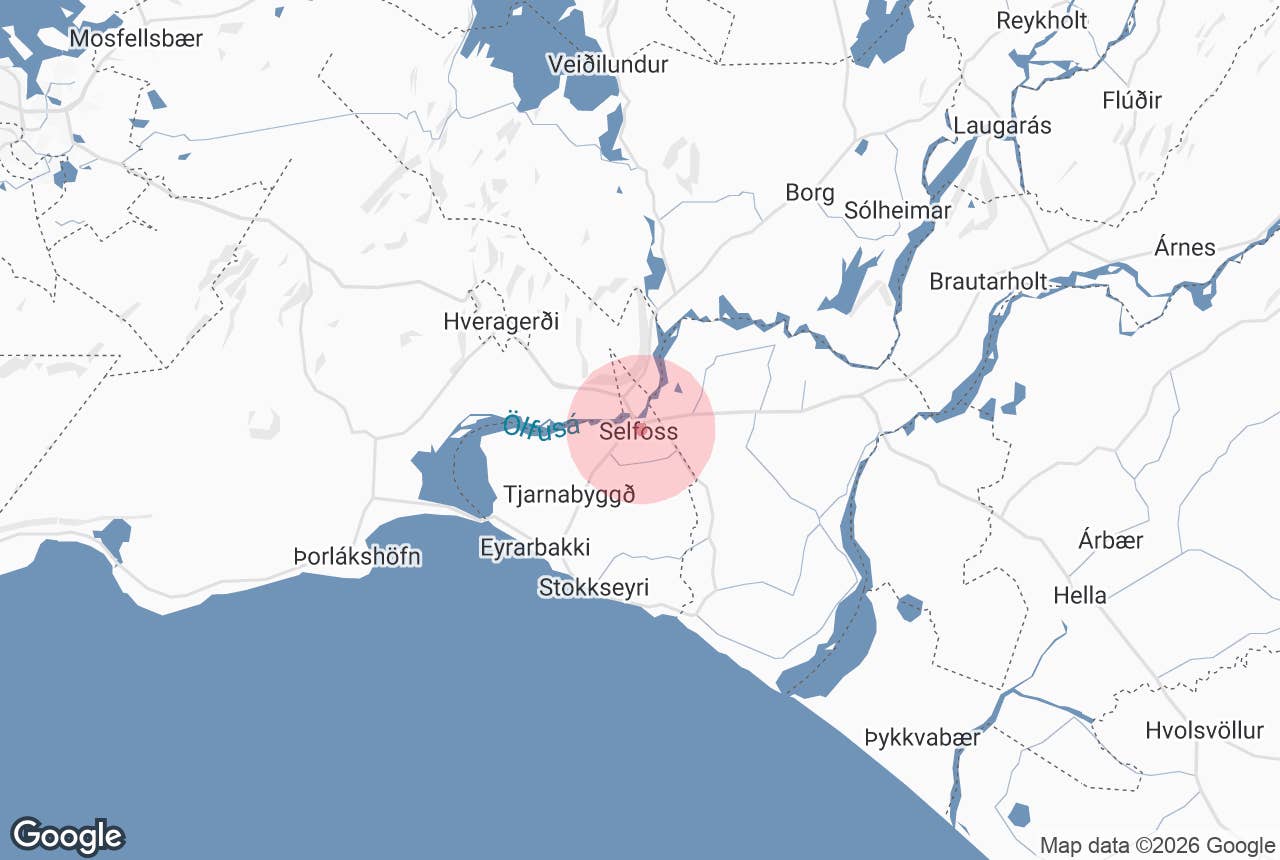

Selfoss is a town of about 6,512 people in South Iceland, by the banks of the river Olfusá, one of the largest rivers in the country. The town is a centre of commerce, farming, horticulture and small industries in South Iceland.
Browse a large range of South Coast tours in Iceland.
저희의 콘텐츠를 신뢰할 수 있는 이유
가이드투아이슬란드는 아이슬란드에서 가장 믿을 수 있는 여행 플랫폼으로, 매년 수백만 명의 여행객이 저희와 함께 아이슬란드를 방문합니다. 저희의 모든 콘텐츠는 아이슬란드를 누구보다 잘 아는 현지 전문가들이 작성하고 검토하므로, 정확하고 신뢰할 수 있는 최신 여행 정보만 제공합니다.
Located 50 kilometres (31 miles) from Reykjavík, it is the largest town outside of the capital area in the southwest. It sits on the Ring Road that encircles the country, and is one of the last stops en route to the South Coast.
The name is Selfoss is somewhat of an anomaly. The word ‘foss’ in Icelandic means ‘falls’, therefore place names such as Gullfoss, Goðafoss and Svartifoss all refer to waterfalls; there is even a waterfall in the north also called Selfoss. In the town, however, the river is flat, and no one is quite sure why it is named such.
History of Selfoss
Records of the lands near Selfoss date back to the first man to permanently move to Iceland, Ingólfur Arnarson; it was said he spent the winter of 873 to 874 AD here, beneath the mountain that overlooks the town, Ingólfsfjall. However, it was not permanently settled, according to the Book of Settlements, until just after 1000 AD.
Being inland, Selfoss was an agricultural centre, at a time when most economic centres were the fishing towns (the coastline is 15 kilometres, or nine miles, away). More commerce came to the region in 1891, when a suspension bridge was built over the river Olfusa, connecting the agricultural south to the capital. This bridge was so important to the country’s infrastructure and economy that is was guarded by British troops in World War Two, after the Allies invaded Iceland following the fall of its colonial ruler, Denmark, to the Nazis.
The town was small at the beginning of the 20th Century with just around 40 inhabitants. Its exponential growth over the next decades came from the rise in trade due to the bridge, and the establishment of a large dairy farm and local store which needed employees. More recently, it has become seen as a desirable place to move for those who want to escape the stresses of city living or raise a family closer to the nature. It also has a large college.
In 2008, an earthquake struck the town, damaging roads and buildings, killing a number of sheep, and injuring 30 people. The same geological forces that threaten the town, however, also provide opportunity for it, as the activity in the area means that the greenhouse industry has flourished.
Culture at Selfoss
Selfoss is a cultural hub in the southwest. Every year it has the Sumar á Selfossi festival, which translates to Summer in Selfoss, which includes a fete, musical performers, and an evening bonfire. The town also has the Bobby Fischer Centre, a museum on the life of chess champion; his grave is located nearby.
Sports are very popular in the town, most notably football, basketball and handball, largely due to the student population.
In 2018, the town announced that it was creating a new town centre, in which it would have reconstructions from historical buildings all around the country. This, no doubt, will only increase tourism and culture in the area.