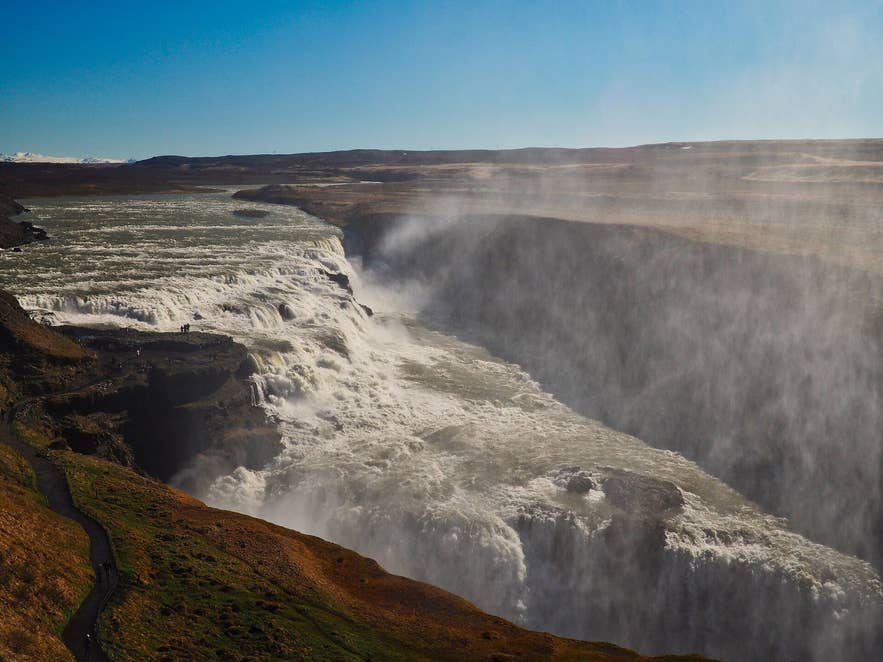
Gullfoss dropping into the canyon. Photo: joiseyshowaa, CC BY-SA 2.0
Gullfoss Canyon (Icelandic: Gullfossgljúfur, "Gullfoss gorge", also called Hvítárgljúfur) is the deep canyon that the Hvítá river plunges into at Gullfoss, the waterfall of the Golden Circle in South Iceland.
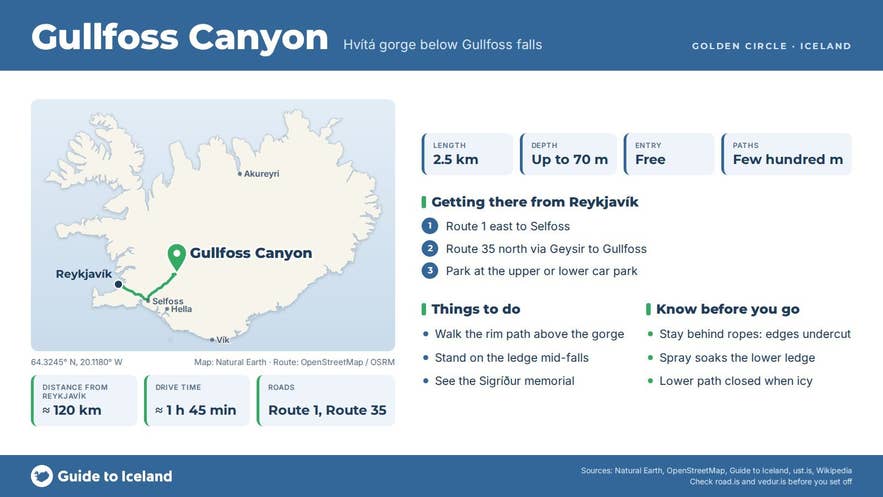
The canyon runs about 2.5 km downstream from the falls and is up to 70 m deep, with near-vertical walls of layered basalt and sediment. Most visitors come for the waterfall and barely notice the gorge they are standing above; this page is about Gullfoss Canyon itself.
Key Takeaways About Gullfossgljúfur
- A 2.5 km gorge up to 70 m deep that the Hvítá drops into at Gullfoss, on the Golden Circle in South Iceland
- Cut by the Hvítá since the end of the last ice age, possibly helped by a huge glacial outburst flood; the falls drop 11 m and about 20 m, roughly 32 m in all
- Seen from the Gullfoss rim path and the rock ledge between the drops; no access to the canyon floor
- About 120 km / 1 h 45 min from Reykjavík on paved roads via Route 35; open all year, lower path closed when icy
- No entrance fee; café and toilets at the upper car park
Why visit Gullfoss Canyon
Gullfoss is unusual among big waterfalls because the river does not fall off a cliff into open ground.
The Hvítá, which drains Hvítárvatn at the edge of Langjökull, approaches over a wide, three-stepped "staircase" of rock, drops 11 m, turns sharply and falls a further 20 to 21 m straight into a crevice about 20 m wide that lies at right angles to the river. From the paths the river seems to vanish into the earth.
That crevice is the head of Gullfossgljúfur, and the canyon then carries the river south-west for about 2.5 km before the valley opens out near the old farm of Brattholt.
The walls tell the geological story.
The Hvítá probably began flowing here at the end of the last ice age, about 10,000 years ago, and there are two theories about the gorge: that it was carved in one enormous glacial outburst flood (jökulhlaup) when meltwater dammed at the ice edge broke loose, or that the river has cut it steadily ever since the ice melted.
The Environment Agency of Iceland considers the second the more likely. In the gorge you can read the layers: grey basalt lava at the lips of the falls, with a bed of sediment nearly 10 m thick between the lava flows, made of conglomerate, mudstone and, on top, a loose pebble conglomerate.
That pebble layer is about 8 m thick at the falls but around 40 m thick at the head of the gorge, and the river washes gravel out of it easily, which is why the falls are undercut and keep retreating upstream; the canyon is estimated to lengthen by about 25 cm a year.
The river's average flow is put at roughly 110 to 140 m³/s depending on the source, higher in summer than in winter, and the largest floods measured have reached about 2,000 m³/s; in 1930 and 1948 the river filled the canyon to the brim and swept away bridges further downstream.
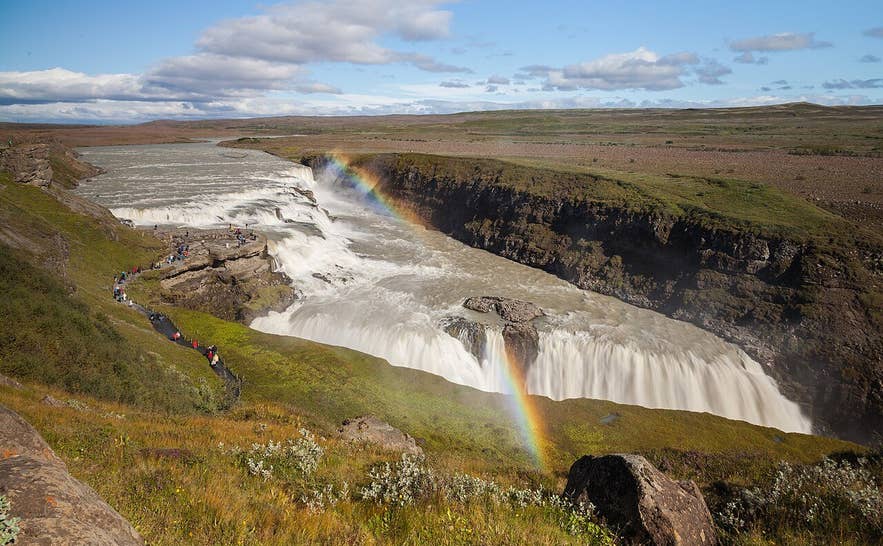
Gullfoss canyon with a rainbow. Photo: Diego Delso, CC BY-SA 4.0
The canyon also has a human story. Sigríður Tómasdóttir, born at Brattholt in 1871, fought the lease of the falls to investors who planned to dam them for electricity early in the 20th century.
With the lawyer Sveinn Björnsson, later Iceland's first president, she tried to have her father's lease annulled; the courts ruled against the family, but the lease payments stopped in 1928 and the contract lapsed, the dam was never built, and the state bought the falls around 1940.
She is popularly credited with saving Gullfoss, although historians note that the schemes failed mainly for lack of money. A memorial to her by the sculptor Ríkarður Jónsson was unveiled on the canyon rim in 1978, and the falls and gorge were formally protected in 1979 as a 164 ha nature reserve (friðland).
A little below the falls, in the canyon, is a sheltered hollow called Pjaxi, noted for its birch scrub and lush vegetation.
How to get to Gullfoss Canyon
Gullfoss is about 120 km from Reykjavík, roughly 1 hour 45 minutes by car.
Take the Ring Road (Route 1) east to Selfoss and then Route 35 north, or go via Þingvellir and Laugarvatn (Routes 36, 365 and 37) to Geysir and on to Gullfoss on Route 35.
The roads are paved and open all year. Flúðir (about 32 km by road) and Reykholt in Biskupstungur (about 26 km) are the nearest villages with services.
There are two car parks. The upper car park, by the Gullfosskaffi café and shop, has toilets and the start of the upper path, which leads to the viewing platform above the falls and follows the canyon rim for the best overall view of the gorge.
The lower car park, used by coaches and visitors with reduced mobility, is closer to the river, and from it a path leads out to the rock ledge between the two drops, where the canyon opens directly below you. A staircase links the upper and lower areas. Walking distances are short, a few hundred metres on each path.
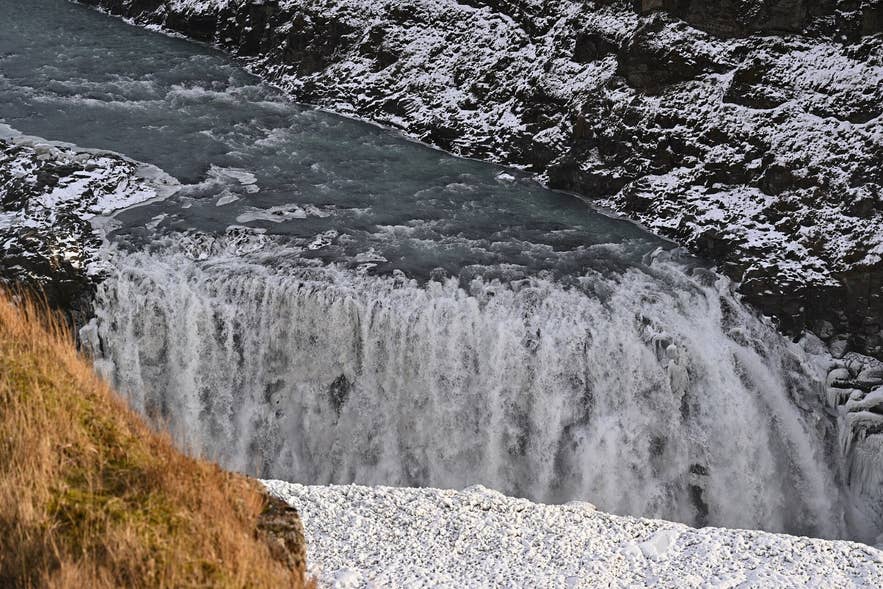
Gullfoss canyon in winter. Photo: G. Edward Johnson, CC BY 4.0
Best time to visit
Summer (June to August) gives the fullest flow, rainbows in the spray in the afternoon, and access to both paths. September and October are quieter with autumn colours on the rim.
In winter the gorge is rimmed with ice and the spray freezes on the paths; the lower path to the ledge is closed by the rangers when it ices over, but the upper rim path normally stays open and the view into the frozen canyon is worth the cold.
Early morning and late afternoon avoid the midday tour-bus peak at one of Iceland's busiest sites.
Safety and practical tips
- Stay behind the ropes and on the marked paths. The canyon edges are undercut and wet basalt is extremely slippery.
- The spray soaks everything within tens of metres of the lower ledge. Wear a waterproof layer and protect cameras and phones.
- In winter use spikes or crampons on the paths and respect closures of the lower path; the mist turns it to sheet ice.
- There is no entrance fee. Parking has been free; check for any parking charge on arrival. The café and toilets are at the upper car park.
Nearby attractions
- Gullfoss Waterfall – about 0.3 km away
- Friðland við Gullfoss (Gullfoss Nature Reserve) – about 1.4 km away
- Geysir Geothermal Area – about 9.0 km away
- Strokkur Geyser – about 8.9 km away
- Brúarhlöð Canyon – about 8.8 km away
- Secret Lagoon – about 22.8 km away
Tours that visit Gullfoss Canyon
- Private 10-Hour Golden Circle Tour From Reykjavik With Optional Secret Lagoon or Blue Lagoon – a private Golden Circle day that stops at Gullfoss, where you can walk both paths and look down into the canyon.
- Amazing 11-Hour Golden Circle Minibus Tour with Kerid Crater & Sky Lagoon from Reykjavik – a small-group Golden Circle day including Gullfoss, Kerið crater and the Sky Lagoon.
- Amazing 6 Day Summer Vacation Package in Iceland with Game of Thrones Locations & Glacier Hiking – a six-day summer package whose Golden Circle day includes Gullfoss and the walk down toward the canyon.