

Description
Summary
When to book
Most travelers book about 4 weeks ahead. The price is the same all year, so book the date that suits you. July and December are the busiest months.
Description
Visit the three best-known sights of the Golden Circle on this small-group minibus tour from Reykjavik, with an extra stop at Kerid Crater, a volcanic crater lake.
You are picked up at your hotel or guesthouse in Reykjavik in the morning, then head to the first stop of the day: Thingvellir National Park.
Thingvellir National Park is known for its geology and scenery, as it lies between the North American and Eurasian tectonic plates. The rift between them, which runs all the way through Iceland, is more visible here than anywhere else in the country. As the plates pull apart, they open ravines filled with clear water between stretches of moss-covered lava rock.
Thingvellir National Park is a UNESCO World Heritage Site because of its history. Iceland's parliament, the Althing, was founded here in 930 AD and is one of the oldest parliaments in the world. As you walk through the park, information signs tell you about its long history.
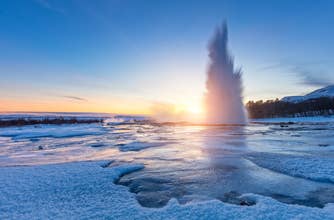
Next, you head to the Haukadalur Valley, a geothermal area known for its geysers. The Great Geysir, which gave all others their name, is mostly inactive, but its neighbor, Strokkur Geyser, erupts every few minutes, about 17 times an hour, usually shooting water 49 to 66 feet (15 to 20 meters) into the air. You can watch it erupt several times as you walk among the hot springs and steaming vents.
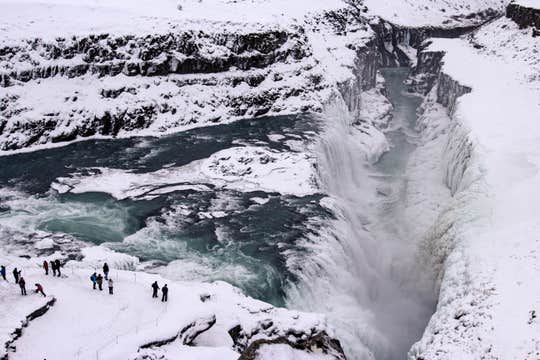
The last stop on the traditional Golden Circle is Gullfoss Waterfall, one of the best-known waterfalls in Iceland. Known as the Golden Falls, it drops in two tiers into a deep canyon. In fair weather, you can walk out to a platform close to where the water falls, and there are also viewing platforms opposite and above it.
While most Golden Circle tours return to Reykjavik at this point, you make an extra stop at Kerid Crater, a volcanic crater lake 886 feet (270 meters) wide and 180 feet (55 meters) deep. The red and orange rocks of the crater contrast with the blue lake at its bottom, which stays there all year.
Check availability by choosing a date.


 34%