Those of you who have read my travel blogs know that I look for Viking ruins and burial mounds all over Iceland.
In this travel blog, I want to show you the ruins I found in the middle of a lava field on the Reykjanes Peninsula: Húshólmi and Kirkjulágar.
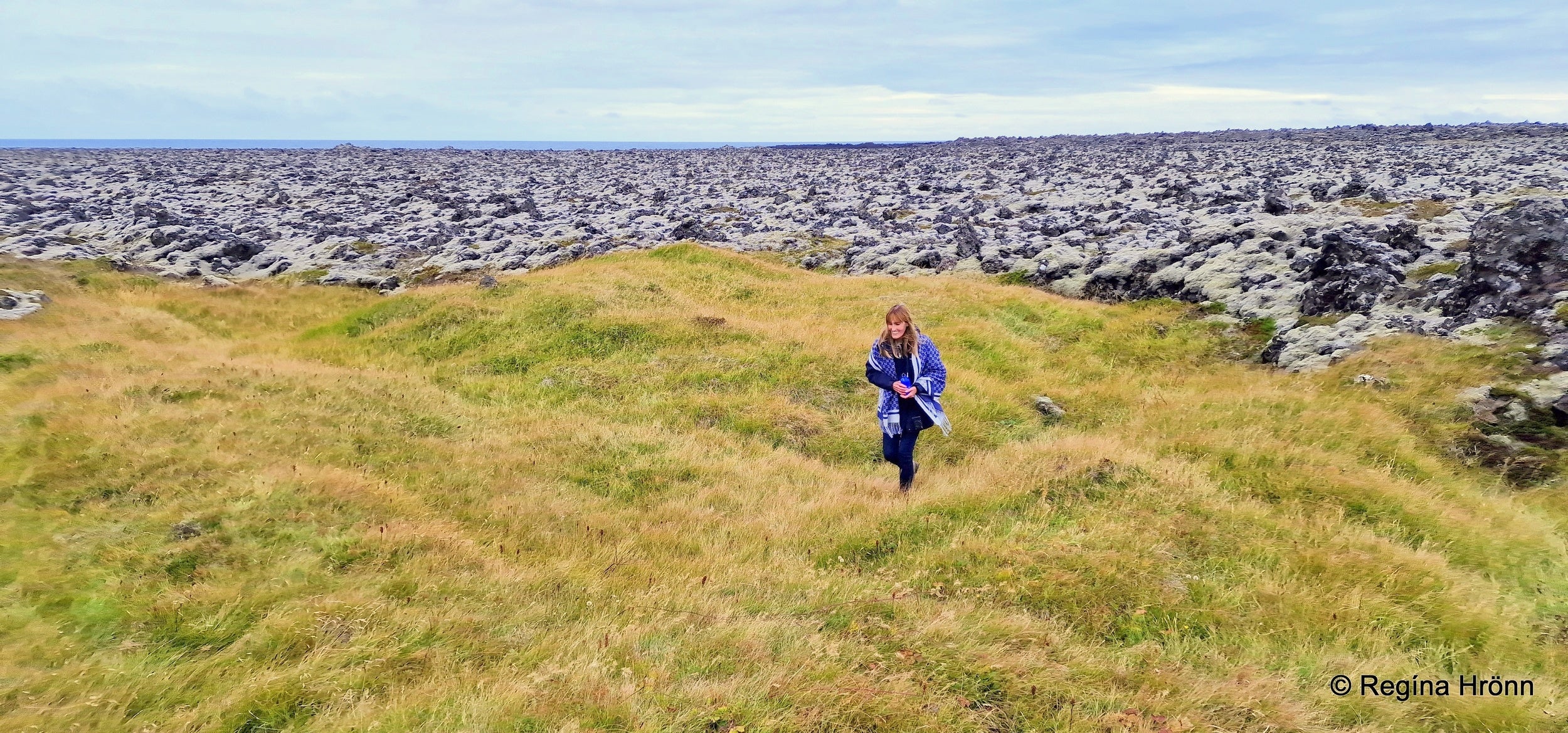
At Húshólmi, you will find the ruins of a church and longhouses. The Ögmundarhraun lava field surrounds these ruins, and we have no idea who lived there.
Top photo: Walking amongst the ruins of an ancient longhouse and a church
Ruins of a longhouse
Specialists believe that the ruins at Húshólmi may date back to Iceland's early settlement, or even to before 870.
The ruins lie in the old Krýsuvík, and they were miraculously spared from a volcanic eruption when the lava flow rushed towards the settlement.
You will find here outlines of many old ruins, postholes, ancient walls, and enclosures.
It is really amazing to find such ruins, a testament to the old ways of living in Iceland. Just imagine if the farms had not been spared; we wouldn't even have known there was such an old settlement in this area.
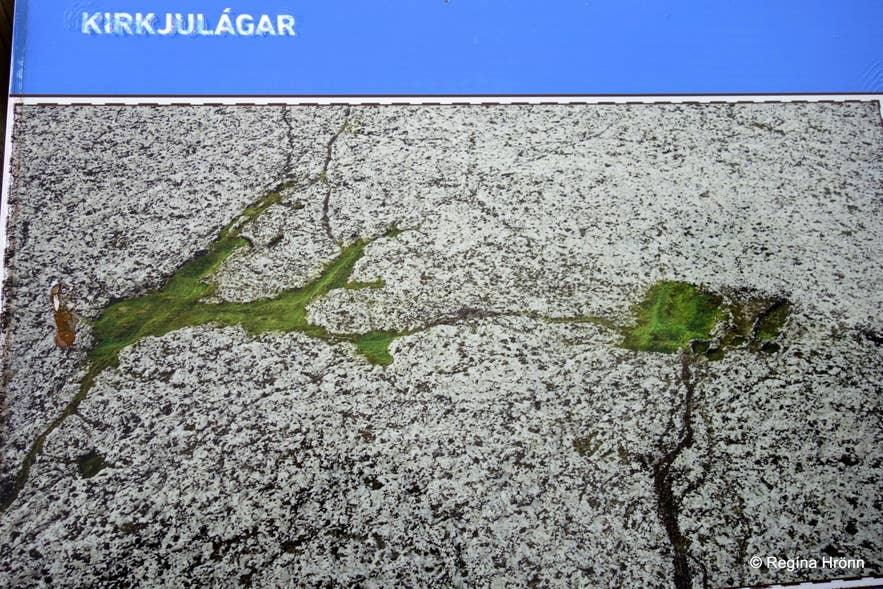 The information sign at Kirkjulágar
There must be many more ruins buried beneath the lava that we don't know about, as the lava must have partly flowed over these farms, the farmstead of old Krýsuvík.
How many old farmsteads are under the Ögmundarhraun lava field, and what else might be hidden there? There might be farm animals beneath it, more ancient farms and structures, Viking artifacts; we will never know.
This is the problem with lava flows: they are devastating forces that destroy everything in their path.
The Krýsuvík farm was then moved to the roots of Mt. Bæjarfell, close to where the new Krýsuvíkurkirkja church now stands.
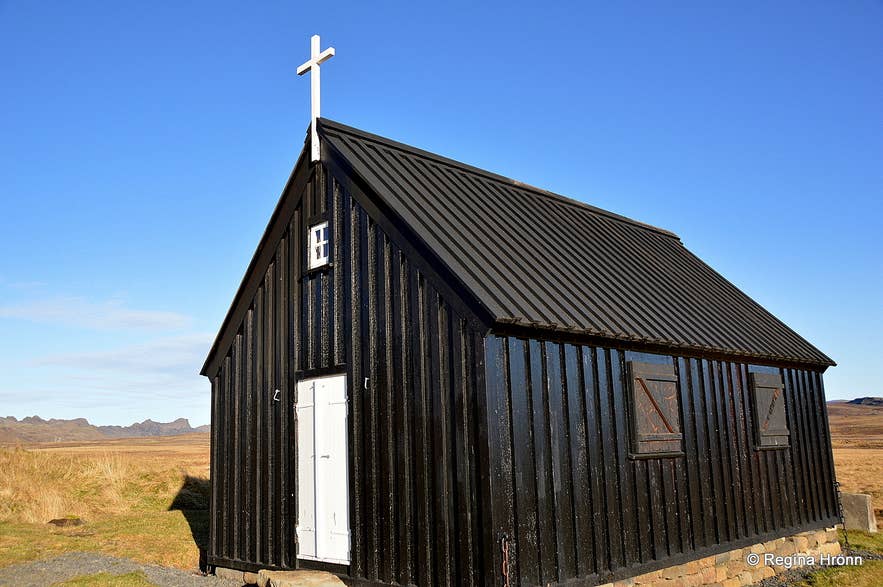
Krýsuvíkurkirkja church
During the eruption around 1151, the lava flow also miraculously spared the church.
But the church in the old Krýsuvík remained at its original location for several centuries before being abolished in 1563.
Above is a photo of the newly built Krýsuvíkarkirkja timber church (built in 2020 and consecrated in 2022, replacing an older church from 1857, which burnt down), but the church at Húshólmi was a turf church.
Krýsuvíkurkirkja church is on the other side of Suðurstrandarvegur road; you can reach it by driving along Krýsuvíkurvegur.
The church ruins at Húshólmi
The church, which remained at Húshólmi, seems to have been referred to as the church at Hólmastaðir after the volcanic eruption (ref. Ferðabók Eggerts og Bjarna 1772).
I know of 2 other churches where the lava flow either stopped very close to the church or around it: during the Mývatnseldar volcanic eruption in 1724-1729, the lava flow spared the Reykjahlíðarkirkja church at Mývatn and went all around it, and the Skaftáreldar volcanic eruption in 1783 by Kirkjubæjarklaustur stopped very close to the chapel.
We call it miracles. And we can only imagine how hard the people prayed for the lava flow not to reach their homes and churches.
 Hiking along Húshólmastígur path
Húshólmi is an interesting area to visit and relatively easy to reach; the hike is only about 1.1 km.
Now, that said, can we consider hiking through a lava field easy?
It is never easy or safe to walk on lava, as it is covered in moss (hraungambri - lamb's wool moss), and we never know what lies beneath the moss: cracks, fissures, fox lairs (we found one), and what have you. 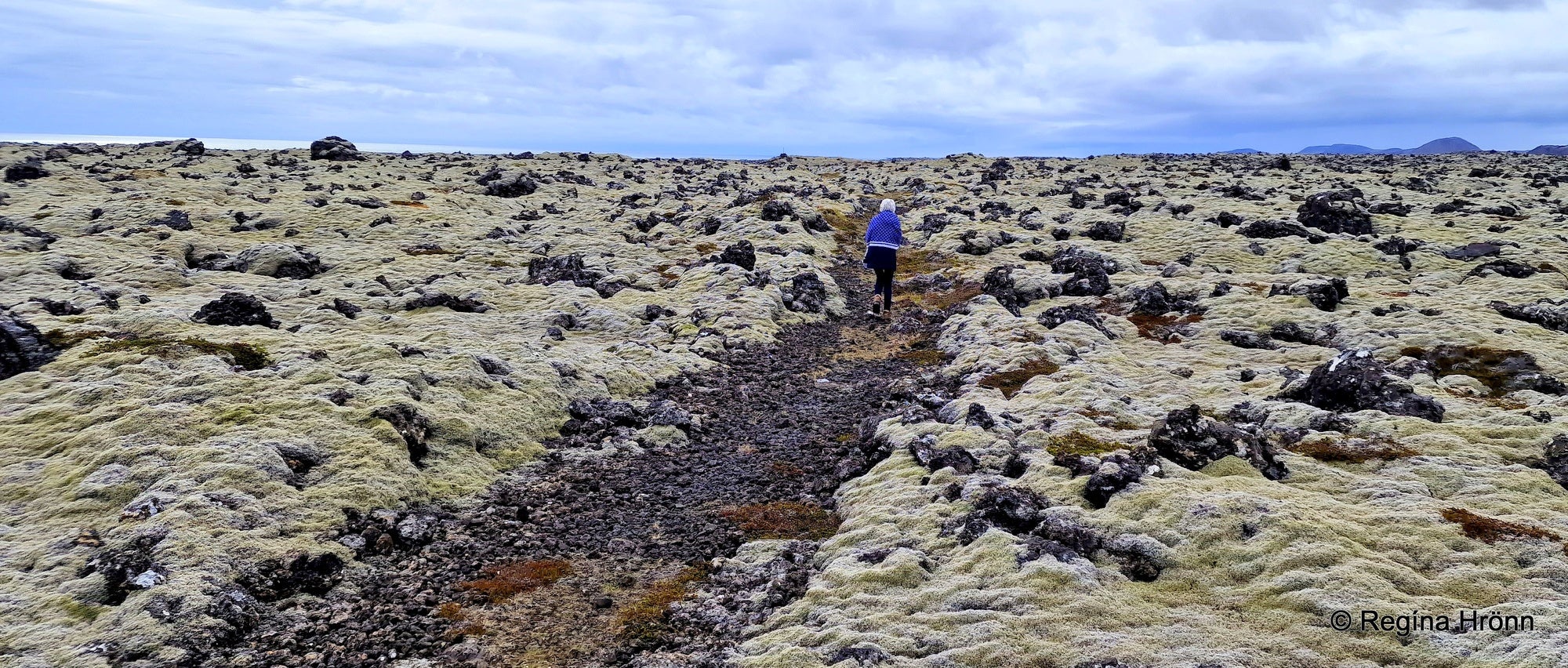 Hiking through endless moss-covered lava on the Húshólmastígur path
To reach Húshólmi and Kirkjulágar, we followed the Húshólmastígur path, which makes the hike much easier. When was this path built through the lava?
It must be very old, and it might even date back to when people visited the miracle church, which was spared by the lava.
We are just guessing here, as we unfortunately have no sources on Húshólmi and its inhabitants.
It is not easy to make a path through a lava field, and we are very grateful to people who took on such a task.
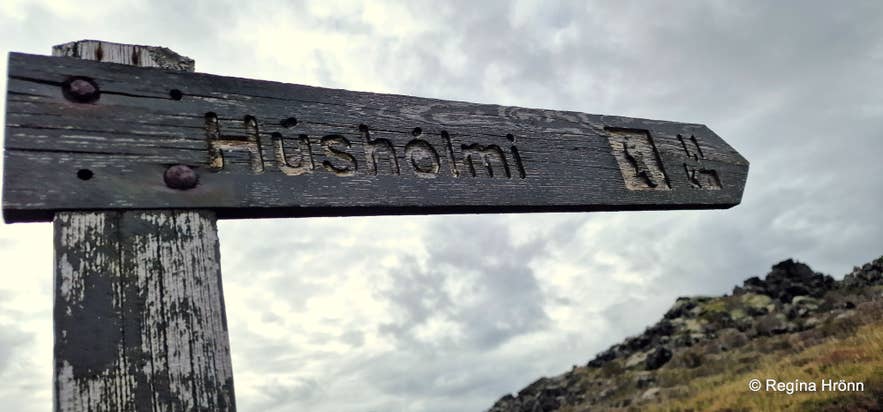 The sign at the beginning of the hike
Maps and a worn driftwood sign mark the beginning of the hike.
The hike to Húshólmi seemed much longer than 1.1 km, though, as we were not quite sure what to look for. And we stopped several times by other ruins and got lost, as it were.
And the landscape was just lava and more lava covered with moss and some cool lava formations.
We saw cairns and folds. And we looked for round sheepfolds and an old shelter for fox hunters, which I had seen marked on a map of this area at the beginning of the hike.
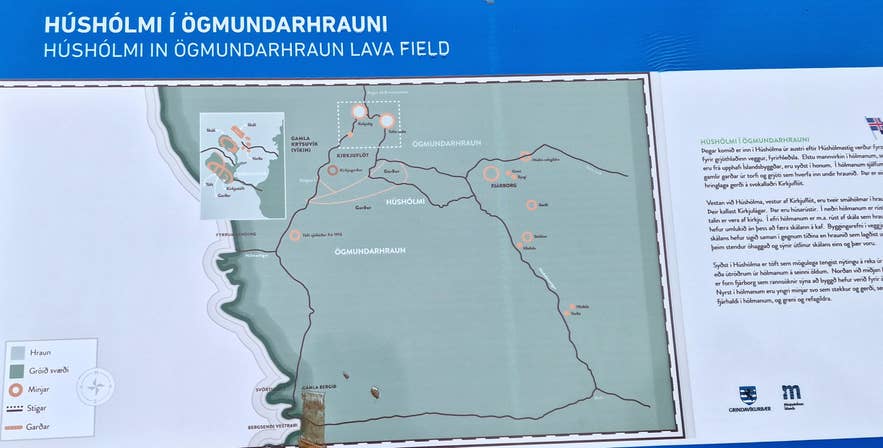 The map at the beginning of the hike
On the map, you will see marked ruins of a corral, a sheep pen, a lair, a shelter, and other structures.
There were grassy plains in some spots in between the lava, so if you don't know what the ruins look like, then it can be pretty confusing.
I would have needed a guide to find all these rock structures. Just keep to the path and don't look for the other structures on the information sign, and you will be fine.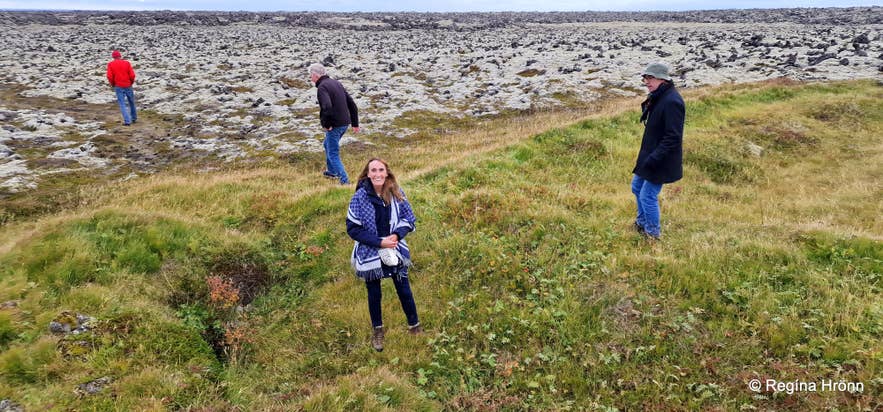 There were 5 of us looking for the Húshólmi ruins.
And we were not the only ones lost in the lava field; we met 3 Icelandic men who were also searching for the ruins, unsure of how to find them.
I had read beforehand that it is surprisingly difficult to find the ruins, and that is maybe why not many people visit them.
Since none of us knew how to reach Húshólmi, we decided to look for the ruins together.
We just carried on walking towards the sea and hoped for the best.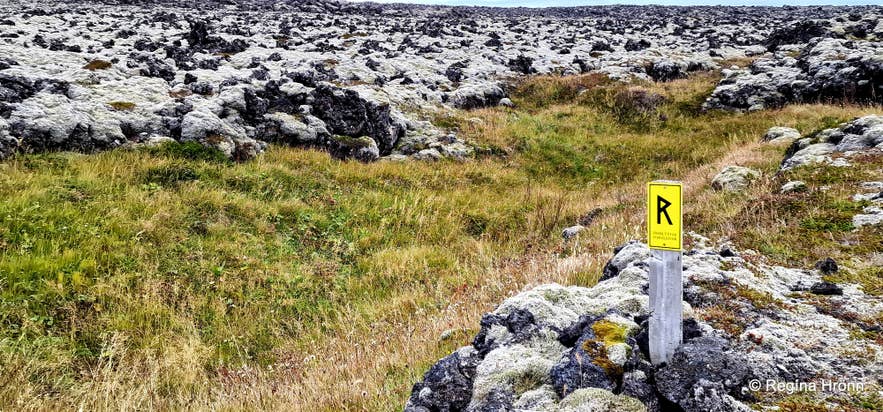 The ruins are marked with the yellow sign indicating protected old ruins
Then we saw information signs and the yellow sign indicating that the ruins are old and protected, and we knew we had finally reached the Húshólmi ruins.
On the yellow sign is written "friðlýstar fornleifar" - protected antiquities.
I have shown you the yellow sign in other travel blogs about Viking ruins and archaeological sites: Ancient Archaeological Viking Ruins I have visited on my Travels in Iceland.
 This yellow sign indicates that here we have protected antiquities
The sign is not always present, as it might have blown away or been stolen, making it very difficult to find such antiquities.
In my next travel blog about the burial mounds of Krýs and Herdís, which are close by, I show you how difficult it was to find the correct site, since there was no yellow sign marking it.
Also, at the Berserkjadys burial mound on the Snæfellsnes peninsula, the sign was missing.
 Húshólmi - ruins of a longhouse
We arrived at Húshólmi from the east, and the first thing you will see is a wall made of layers of rock.
West of the Húshólmi longhouse ruins are Kirkjulágar, where the old church stood. Here we also have Kirkjuflöt and a graveyard.
A circular rock wall surrounds the ruins of the church. Such circular walls seem to have surrounded the churches in old times.
The church door in the ruins faces west, as is the tradition when building churches.
You can see a circular lava wall in my travel blog: Grafarkirkja Turf Church in North Iceland - the Oldest Turf Church in Iceland.
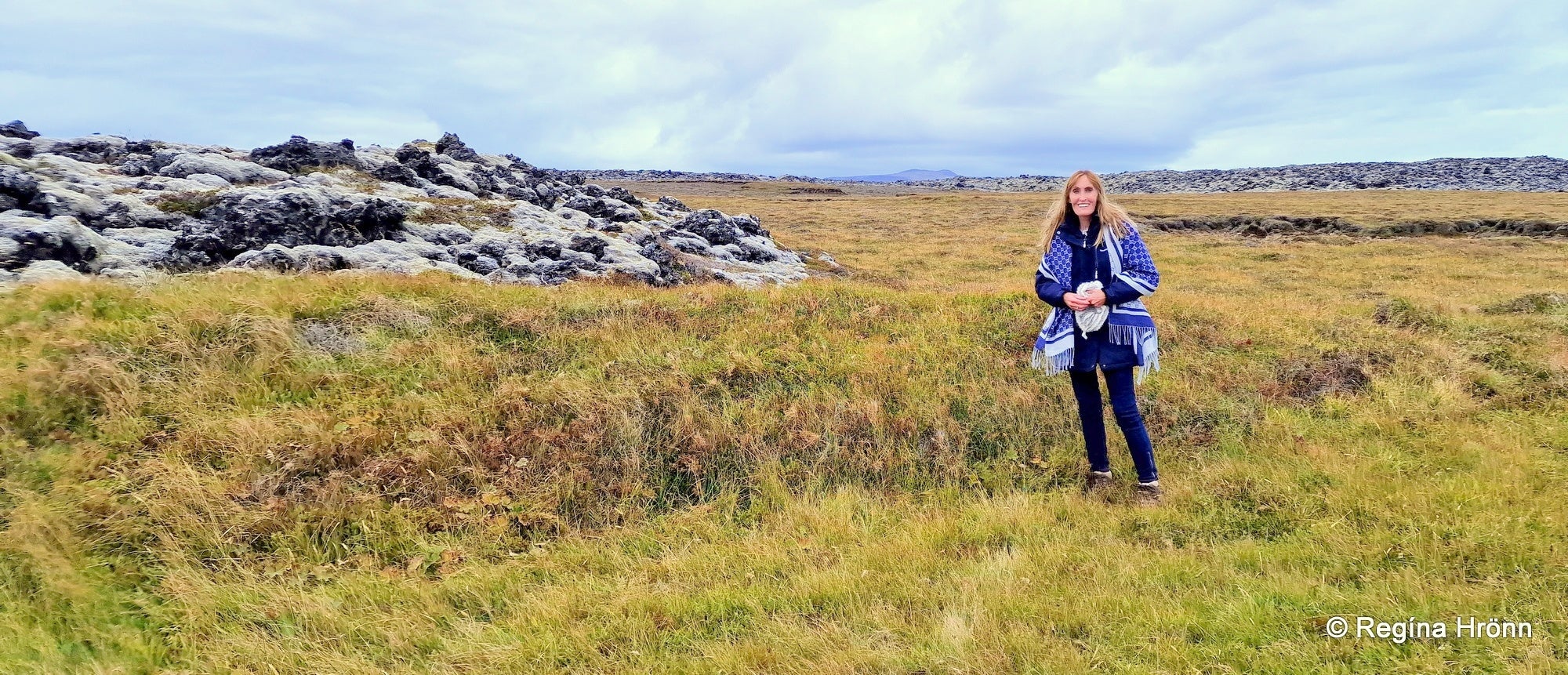 By the old wall from the early settlement age
There are 3 ancient rock walls at Húshólmi, believed to date back to before 870.
In 1987, geologists Haukur Jóhannesson and Sigmundur Einarsson cut a cross-section through one wall to examine its age.
The ancient wall, one of Iceland's oldest structures, is 150 cm wide and 40 cm tall. The two geologists gathered from the layers of ash from different eruptions that it was built before 870, since there was no ash layer from the Middle Ages eruptions beneath the wall.
They found the settlement layer with ash from the Bárðarbunga and Torfajökull systems dating to 870. And the Middle Ages layer (miðaldalagið) from an eruption here on the Reykjanes peninsula back in 1226-1227.
 The information sign by the ancient lava wall
I was reading the Íslendingasaga of Sturlunga the other day, written in the 13th century by Sturla Þórðarson.
The eruption from 1226-1227 is mentioned there: "Kom upp eldur úr sjónum fyrir Reykjanesi" - Fire appeared from the sea by the Reykjanes peninsula, and: "Þessi vetur var kallaður sandvetur og var fellivetur mikill, og dó hundrað nauta fyrir Snorra Sturlusyni út í Svignaskarði" - This winter was called the winter of sand and death of animals, and Snorri Sturluson lost a hundred cattle in Svignaskarð.
(Ref. Íslendingasaga Sturlu Þórðarsonar (1974), pages 82 and 86).
Ögmundarhraun lava field
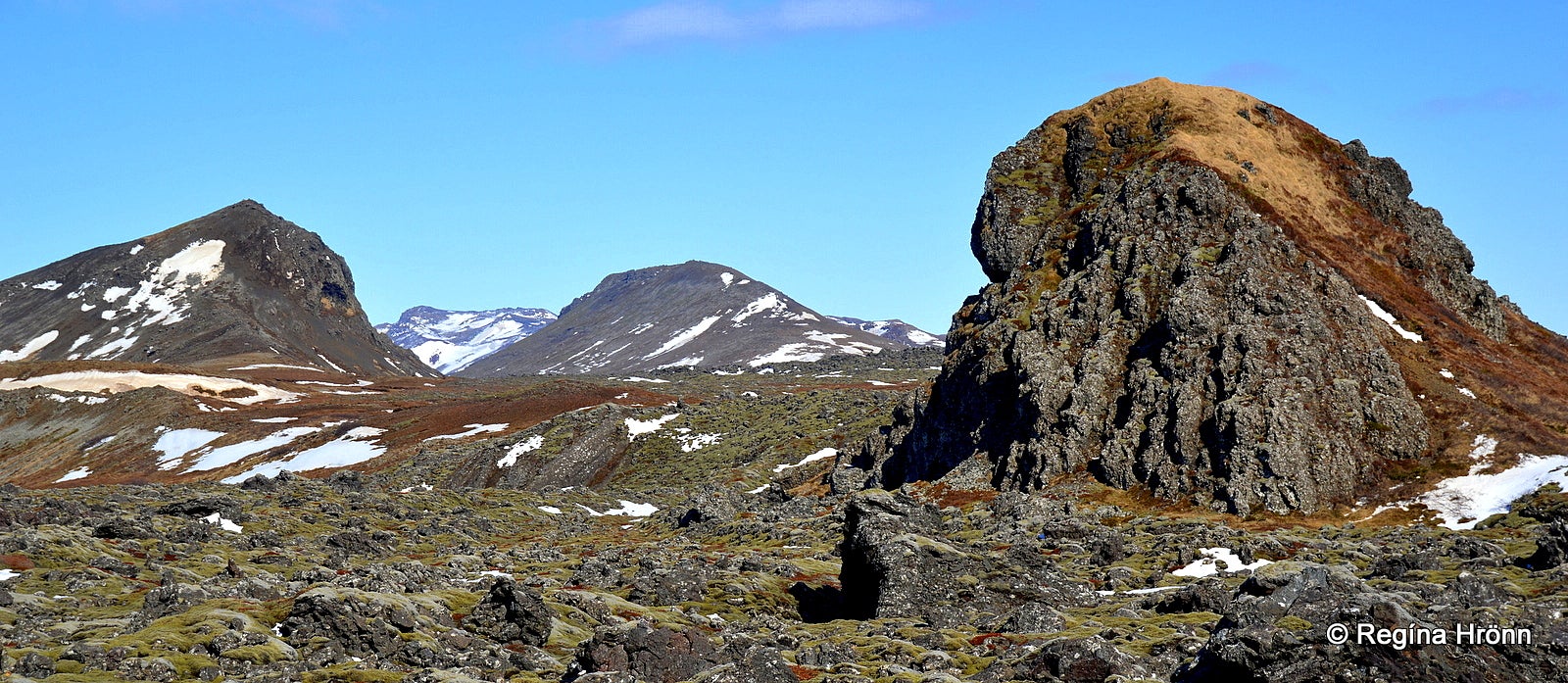 Mt. Latsfjall - Mt. Krýsuvíkur-Mælifell in the distance
The eruption that created this lava field, Ögmundarhraun, is called Krýsuvíkureldar - the Krýsuvík Fires.
They erupted from 1151 to 1188, and the crater rows (not continuous) are 25 km long from their beginnings to their ends. Ögmundarhraun lava field is around 16-18 km2.
The lava flowed between Mt. Krýsuvíkur-Mælifell and Latsfjall mountain (a very distinctive small mountain, which looks like an elf-church) and south into the sea along a 7.5 km shoreline.
 Resting on top of the ancient ruins of a longhouse in Húshólmi
It must have been a sight when the piping hot lava met the cold Atlantic Ocean.
What a terrible ordeal this was for the people living in this area. I hope everyone was able to escape from this area before the lava flow destroyed their homes.
It is the same series of eruptions that created the Kapelluhraun lava field quite far away from Húshólmi, which I showed you in my travel blog: Barbörukapella - the Chapel of St. Barbara in Kapelluhraun.
The Ögmundarhraun lava field was most likely formed in several eruptions with short intervals, as we have learnt from the latest eruptions on the Reykjanes peninsula, where we, much to our surprise, have witnessed some 11 eruptions in the past few years!
See my travel blogs:
The Volcanic Eruption in Mt. Fagradalsfjall and Geldingadalir in SW-Iceland.
A Helicopter Ride to the Volcanic Eruption in Mt. Fagradalsfjall in SW-Iceland.
 A cairn in the Ögmundarhraun lava field
I found a mention of Ögmundarhraun in Þjóðsögur Jóns Árnasonar - the Compilation of Jón Árnason:
"Krýsuvík was originally settled down by the sea outside Krýsuvíkurberg, but was later abandoned when fire broke out in the mountains to the north and lava flows ran here and there down between the ridges. The easternmost flow was the largest.
A shepherd from Krýsuvík was a short distance away from the farm with his flock of sheep.
He saw the red lava flow forcing its way with tremendous speed from the cleft above the farm and racing out over the lowland.
 The lava flows are shown on one of the information signs
He saw no hope of escape, waited with his flock of sheep for whatever would come, and trusted in God, which means that this was in Christian times (Christianity was adopted in Iceland in the year 1000 - RHR).
The lava flow passed all around him and harmed neither him nor the flock except, some say, for one sheep.
That place has since been called Óbrennishólmi (Unburnt Islet), where he stood.
The lava ran over the entire lowland and out into the sea, but the field at Krýsuvík and the farmhouse remained unharmed, though it was nearly inaccessible once the lava had cooled down.
 Vegetation in the Ögmundarhraun lava field
The farm was then moved to what is now Krýsuvík, that is, higher up and to the east-northeast.
When the eruption was over, and the lava field had solidified, people began building a road across it to Grindavík, and all of it was cleared except for the easternmost portion.
It was so rugged and hard that a road could not be built across it."
(Translated into English from Þjóðsögur Jóns Árnasonar - Volume IV - page 133)
 Is this one of the structures in the lava field?
On the same page, the folklore continues to tell us about a path in the lava field and how Ögmundarhraun got its name. Ögmundur is a male name, but who was this Ögmundur?
I was unsure whether to add this story here, as the Ögmundardys - the Burial mound of Ögmundur - is marked on the Landmælingar map beneath Mt. Mælifell, which is relatively far from Húshólmi.
In this folklore, we are told it concerns old Krýsuvík, which was later moved to the site of the better-known Krýsuvík today.
 The lichen on the lava rock in Ögmundarhraun looked like a fried egg
The story goes like this:
A man was named Ögmundur. He was a fierce berserk and roamed around the country, harming many men.
He arrived at Krýsuvík and asked for the farmer's daughter's hand in marriage.
The farmer was too afraid to refuse and promised him his daughter's hand in marriage on one condition: that he build a path across the lava field.
The berserk agreed and began carving a path from the west, but the farmer stood at the eastern edge of the lava.
 Vegetation in the Ögmundarhraun lava field - autumn colours
Ögmundur worked like mad, energetically carving a path across the lava. But as he reached the eastern side and had finished, he had become worn out.
The farmer gave him a mortal blow and buried him there (dys=a burial mound visible above ground).
You will find a pile of rocks by the path, referred to as the burial mound of Ögmundur (leiði Ögmundar or Ögmundardys). It stands on a rock.
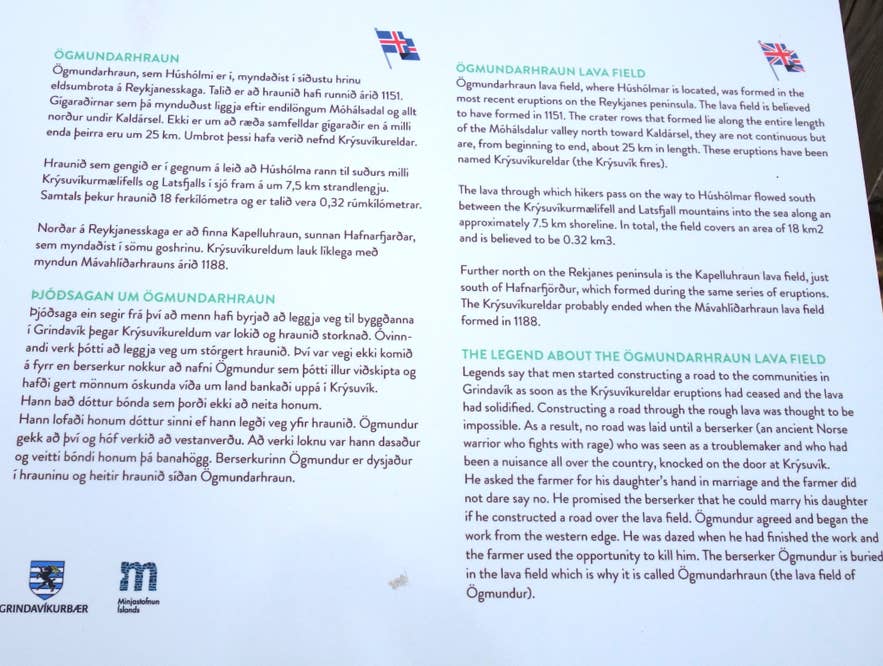 We can read about the berserk on the information sign at Ögmundarhraun
The path across the lava is deep and narrow, and in many places it is hewn through large lava rocks.
The path is uneven, and even with steps or sills, as the old four-line stanza tells us about (written in latter times):
Eru í hrauni Ögmundar, ótal margir þröskuldar,
fáka meiða fæturnar, og fyrir oss brjóta skeifurnar
Meaning:
In the Ögmundarhraun lava field, there are many sills,
Which hurt the feet of the steeds and break the horseshoes.
From then on, the lava field is called Ögmundarhraun.
 A structure in the Ögmundarhraun lava field
And where the farm Krýsuvík stood earlier is now called Húshólmi. There were water shortages most of the time.
You can see very few ruins there, but some remain."
(Translated into English from Þjóðsögur Jóns Árnasonar - the Compilation of Folklore of Jón Árnason).
As I mentioned earlier, the Ögmundardys burial mound and that path are by Mt. Krýsuvíkur-Mælifell, not here.
This story is similar to the story in the Sagas about the Berserkjahraun lava field on the Snæfellsnes peninsula.
 Is this a structure or a ridge in Ögmundahraun?
I tell you that story in my travel blog: Berserkjagata on Snæfellsnes Peninsula - is this the Oldest Man-made Road Construction in Iceland?
You can see the similarities between the two stories about the berserks: one is told in two of the old Sagas (Eyrbyggja Saga and Heiðarvíga Saga), and the other remains in folklore.
Maybe there was a Saga about the people who lived at the old Krýsuvík - Húshólmi, but many of our Sagas were lost, which is indeed a great loss.
 Lava in the Ögmundarhraun lava field
Landnámabók - the Book of Settlements tells us that Þórir haustmyrkur (autumn darkness) settled this area: "Þórir haustmyrkur settled Selvogur and Krýsuvík, but his son Heggur lived at Vogur. His other son's name was Böðmóður".
The other mention of Þórir is that his brother, Steinn mjögsiglandi Vígbjóðsson, settled Skógarströnd in West Iceland.
Steinn mjögsiglandi is my ancestor 30 generations back.
The Húshólmi ruins are close to the sea, as the name Krýsuvík indicates. "Vík" means cove, and in my next travel blog, I will tell you about Krýs and Herdís and show you where we think their burial mounds can be found, relatively close by.
Krýs and Herdís may have been the daughters of Þórir haustmyrkur, but the only sources we have about them are in our folklore. They are believed to have given the names Krýsuvík and Herdísarvík to the coves.
The Folklore of Krýsa and Herdís & a Hike on Stóra-Eldborg & Litla-Eldborg
Krýs can also mean a depression between a ridge and a mountain.
 Hiking in the Ögmundarhraun lava field
This hike to Húshólmi is a loop, but we returned the same way so we could check out some ruins we saw on the way.
Next time, we will do the whole circle.
Let's treat this delicate, one-of-a-kind area and remarkable ruins with utter respect, take only photos, and leave nothing behind but our footsteps.
 At Húshólmi - Kirkjulágar
You can reach Húshólmi by car from Suðurstrandarvegur road number 427. If you are coming from Krýsuvíkurvegur road number 42, you turn left on a short gravel road marked Húshólmi, where you can leave your car.
There are many more interesting sights in this area: to the east of Húshólmi are Selalda and Krýsuvíkurbjarg, and to the west is Selatangar, with its many ruins of fish-drying sheds.
Ref:
Þjóðsögur Jóns Árnasonar: Volume IV- pages 133-134
Húshólmi - merkilegur staður í umdæmi Grindavíkur - Ómar Smári Ármannsson
Map of the Reykjanes peninsula
Have a lovely time on the Reykjanes peninsula :)

Hi, my name is Regína Hrönn, and I was born and raised here in Iceland.