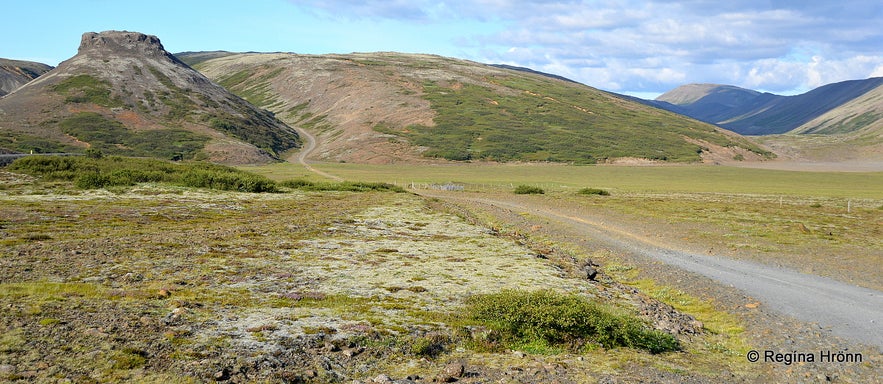
In this travel blog, I am going to tell you about an easy hike on Mt. Meyjarsæti, by Hofmannaflöt plains in South Iceland, next to Þingvellir National Park.
Mt. Meyjarsæti is neither a tall nor a big mountain, only 237 meters, and Landmælingar Íslands - the National Land Survey of Iceland refers to Meyjarsæti as a hill, but I'd like to think that I was hiking on a small mountain :)
Top photo: Mt. Meyjarsæti
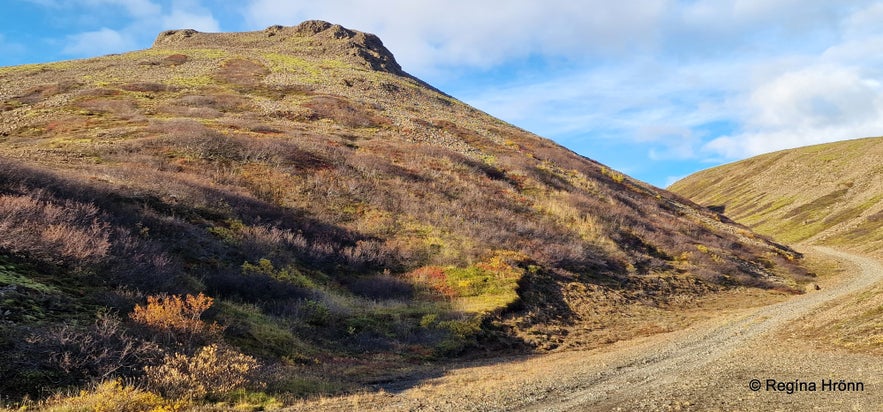 Mt. Meyjarsæti
This small mountain is an old, beautifully shaped volcanic neck that visitors often overlook.
That is why I want to tell you about this area: some very interesting events are said to have taken place here, which gave the mountain and the plains their names.
Here, the big troll games supposedly took place, where the half-trolls and the strongest men of Iceland competed against each other to find out who was the strongest man in Iceland.
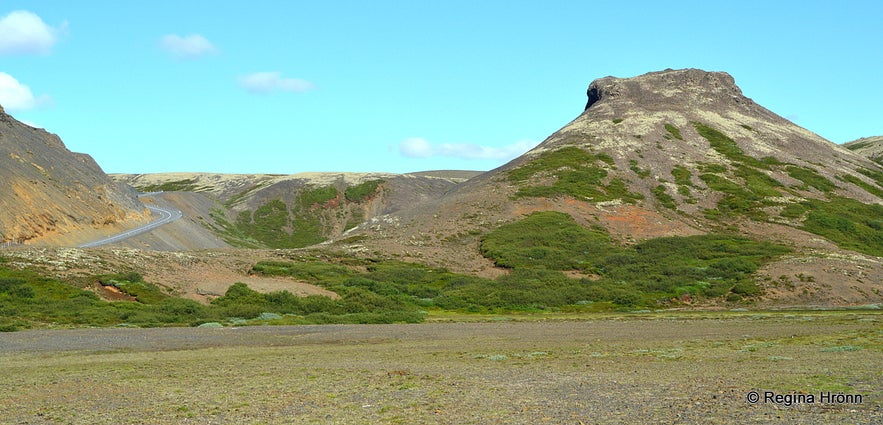 Here you can see how close to each other Mt. Ármannsfell and Mt. Meyjarsæti are
Such a title is still sought after in my country, and we have annual competitions to find out who is the strongest man in Iceland. And Iceland has even held the title of the world's strongest man.
In my last travel blog, I told you about Ármann in Mt. Ármannsfell and the Troll Games on Hofmannaflöt Plains in South Iceland.
The story is told in a later-time saga called Ármannssaga hin yngri, which tells us of the half-troll Ármann, the protector of this area.
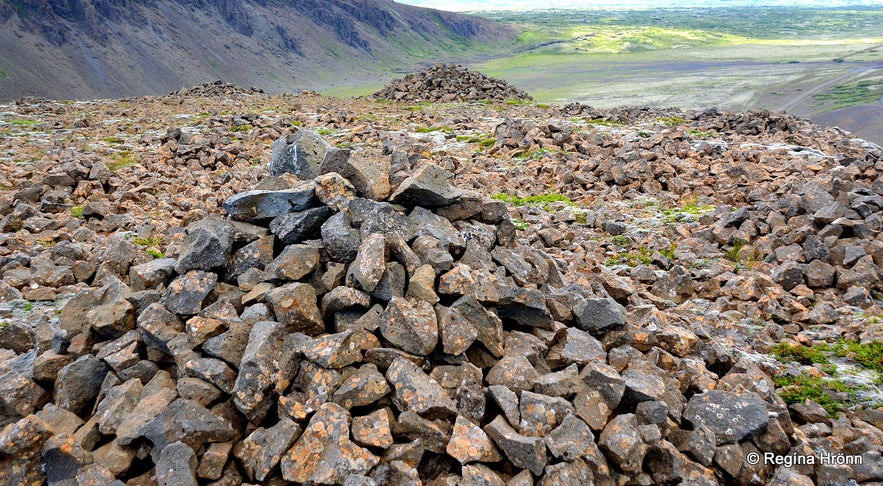 The rocky top of Mt. Meyjarsæti
When we can connect a story to the landscape and the place names, it becomes much more interesting and alive, in my opinion.
In Þjóðsögur Jóns Árnasonar - the Compilation of Icelandic Folklore by Jón Árnason, Jón mentions that women sat on Mt. Meyjarsæti - Maiden's Seat and watched the troll games on the Hofmannaflöt grassy plain (Volume II, page 122).
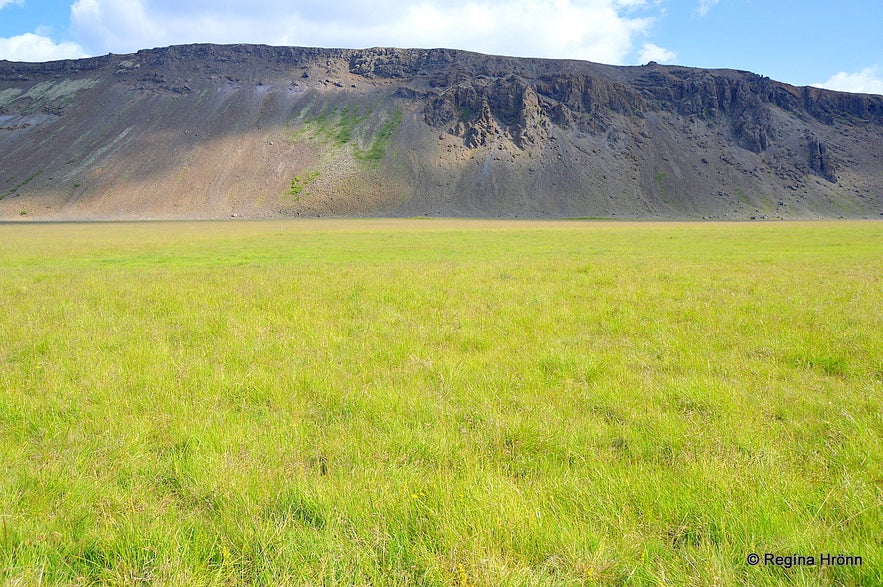 Hofmannaflöt plains and Mt. Fremra-Mjóafell
Ármann had held a party, where the guests were arguing about who was the strongest man in Iceland, and it was decided to invite all the half-trolls and the strongest men in all of Iceland, to find out who, in fact, was the strongest of them all.
Ármann organized games on the Hofmannaflöt plains, which were his turf, as he lived in a cave in Mt. Ármannsfell.
This event is said to have occurred around the time of Iceland's settlement, when Ármann had been living here for about 20 years.
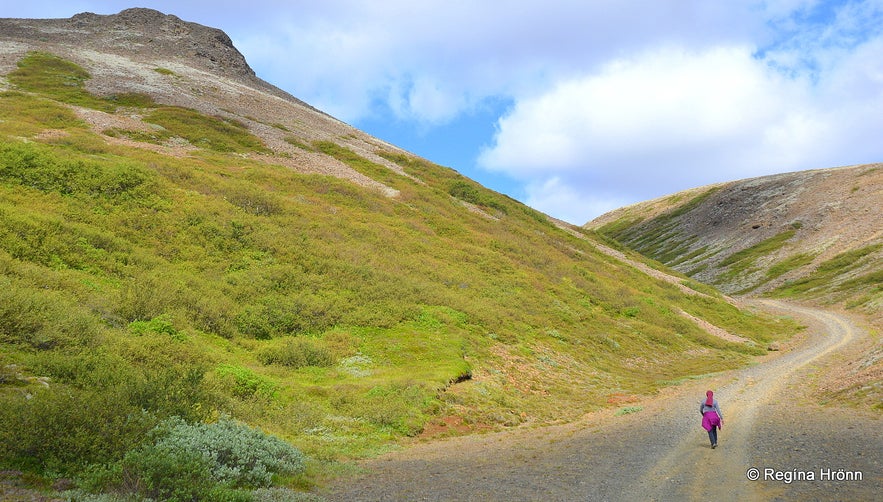
Hiking to Mt. Meyjarsæti
And that is how Hofmannaflöt plains got its name. The protector of the Snæfellsnes peninsula, Bárður Snæfellsás, was a relative of Ármann and was in charge of the games with him.
He said as he ended the games:
"This gathering will be remembered, and I believe that nowhere else has such a handsome group of boys or energetic champions gathered.
And this field, where we have met, shall be named Hofmannaflötur plains. And they shall remember that we met here".
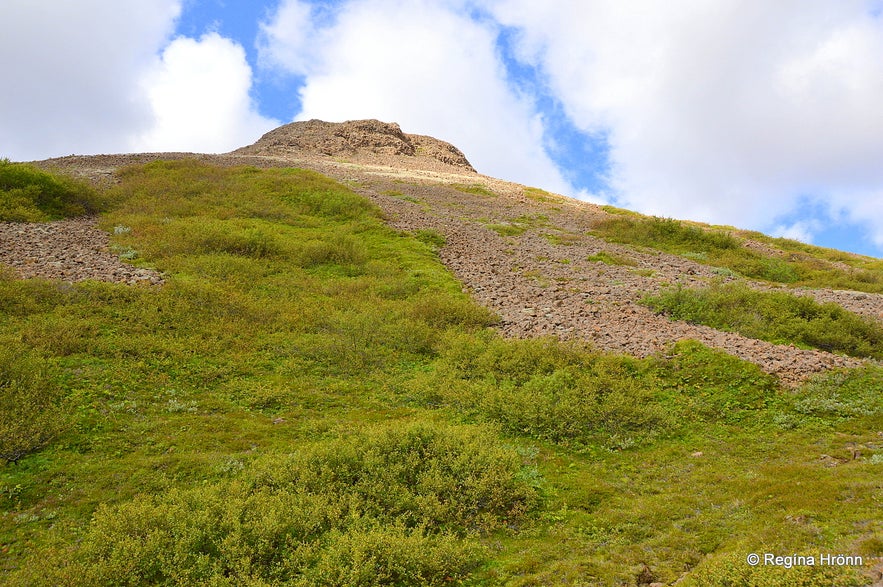
Hiking alongside Mt. Meyjarsæti
My grandparents owned a summer cottage at Þingvellir when I was little, and when we had picnics and picked berries by Hofmannaflöt plains, they would tell me stories about Mt. Meyjarsæti and the battle of the trolls on the Hofmannaflöt plains.
So this story is passed on from generation to generation. And if you read Icelandic, then you can read it by yourself here: Ármanns saga hin yngri. 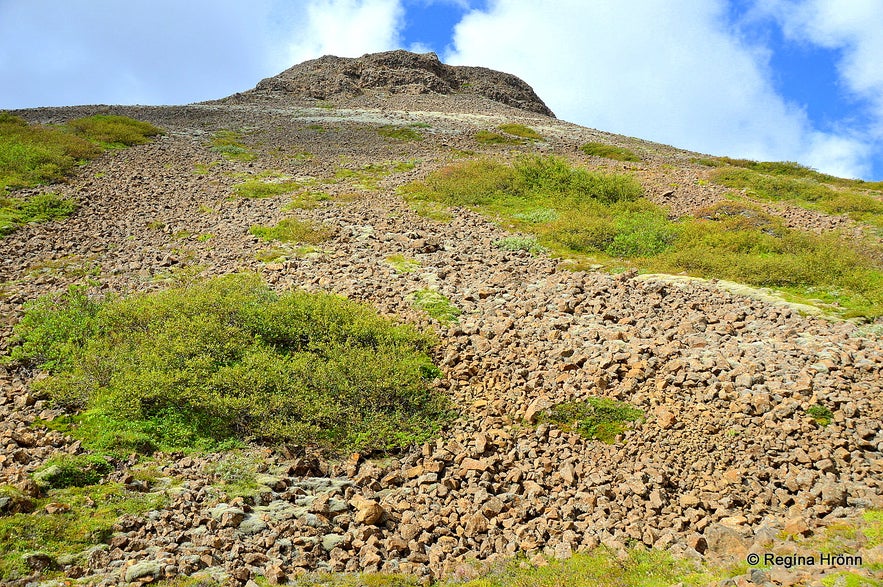
The rocky slopes of Mt. Meyjarsæti
Ármanns saga hin yngri (the younger one) was most likely written by Halldór Jakobsson in the 18th century. It tells us about events that occurred at the same time as the 42 Old Sagas, but we don't have an old Ármanns Saga.
The old Icelandic Sagas, written in the 13th and 14th centuries, tell us about the lives of the settlers and their second- and third-generation descendants living in Iceland.
Many Sagas were lost, which is a significant loss, and I feel the loss when, for example, reading the Heiðarvíga saga, parts of which are lost forever.
 A Moomin elf on top of Mt. Meyjarsæti :)
So I often think about how many invaluable Sagas were lost and am very grateful for the Sagas that were preserved. I have read them all and love visiting the areas in Iceland where they took place.
Let's presume that Ármanns saga happened, as it greatly enhances the experience of visiting Hofmannaflöt plains and Mt. Meyjarsæti. And it is most likely based on old events.
I hiked on Mt. Meyjarsæti with my friend, but hiking on this pretty mountain had been on my agenda since I was a little girl.
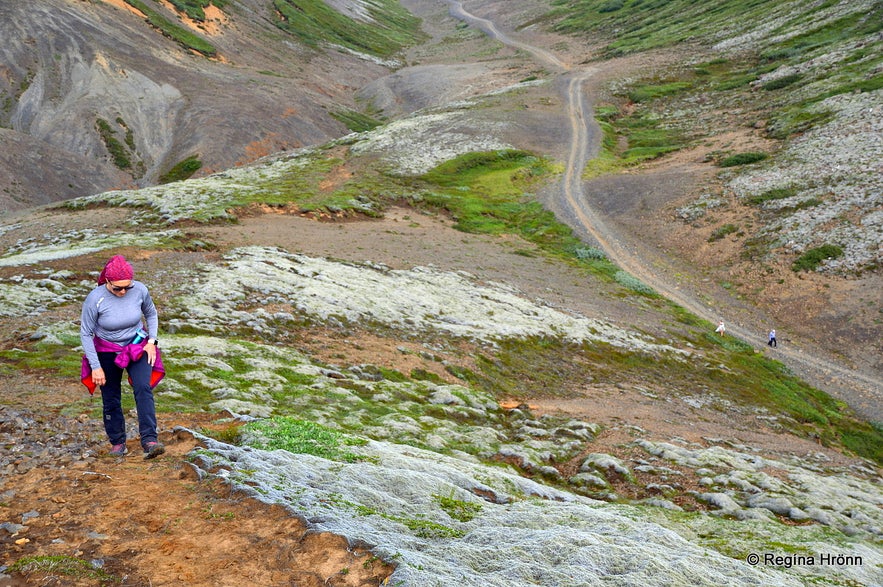
You can see my neighbours to the right in the photo, leaving the mountain
While hiking on Mt. Meyjarsæti, there were only 2 people around, and they turned out to be my next-door neighbours, with whom I had chatted in the morning as we were both carrying cameras ready for adventure.
Little did we know that we were going on the same hike. And we were even carrying the same book with us on the hike 25 gönguleiðir á Þingvallasvæðinu - 25 hikes in the Þingvellir area :)
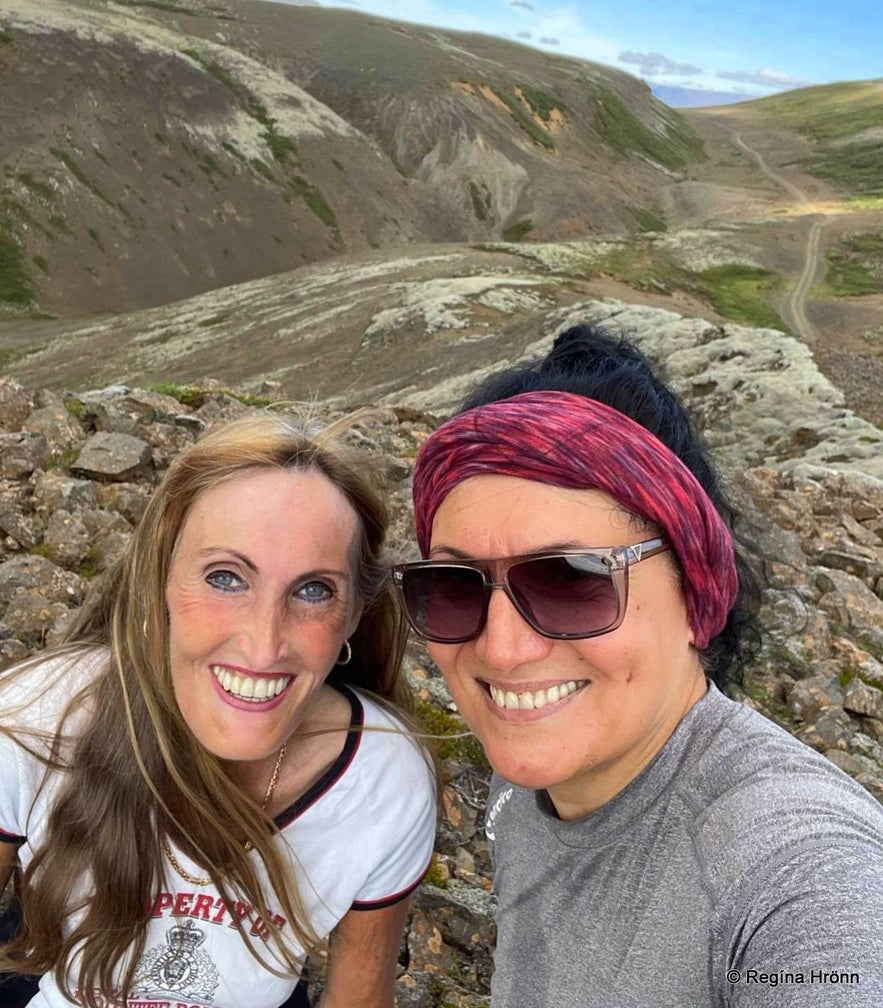
On top of Mt. Meyjarsæti, you can see the old road behind us
We followed the old and rocky road on the east side alongside the rocky slopes of Mt. Meyjarsæti.
It is easy to hike to the top of Mt. Meyjarsæti, as a track has been formed through the moss by previous visitors.
It is a scar in the moss, which can take up to 100 years to grow. And this scar will not heal as people will continue to hike on Mt. Meyjarsæti, so this cannot be helped. Let's refrain from ruining the soft moss unnecessarily, though.
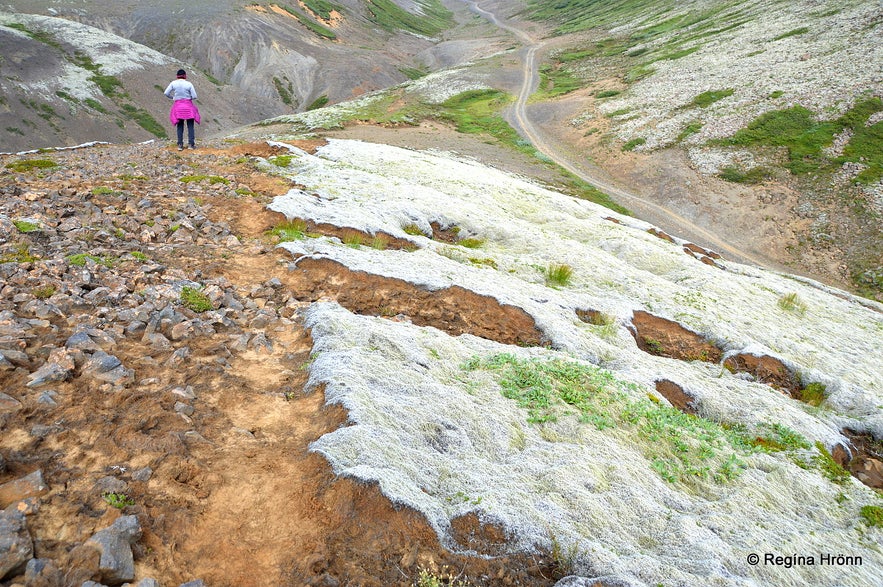 The path is a scar in the moss
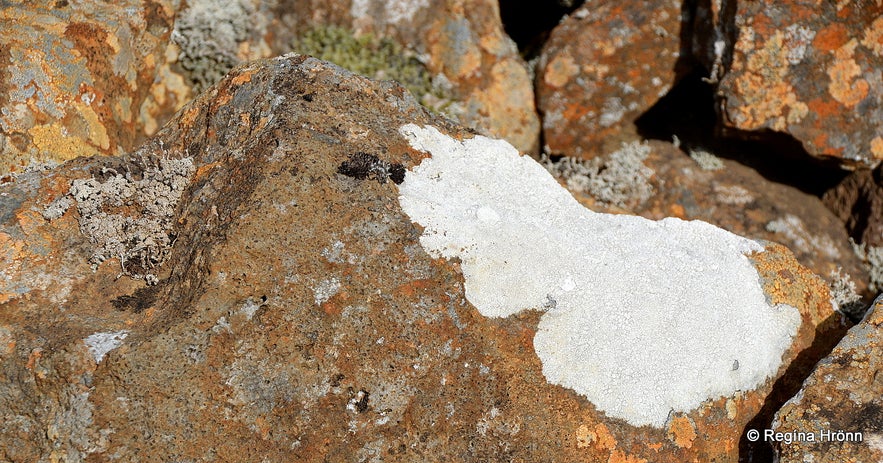
On top of Mt. Meyjarsæti, it is so rocky that it is almost impossible to sit down without having a cushion, as gray basalt covers the top.
It is so rocky that it was even difficult to walk on top of Mt. Meyjarsæti.
If the maidens in the olden days sat on top of the mountain, then I bet that they carried a cushion with them. Or they sat on the slope, which makes more sense, but as I passed the side of Mt. Meyjarsæti, I noticed that the slope is quite rocky as well.
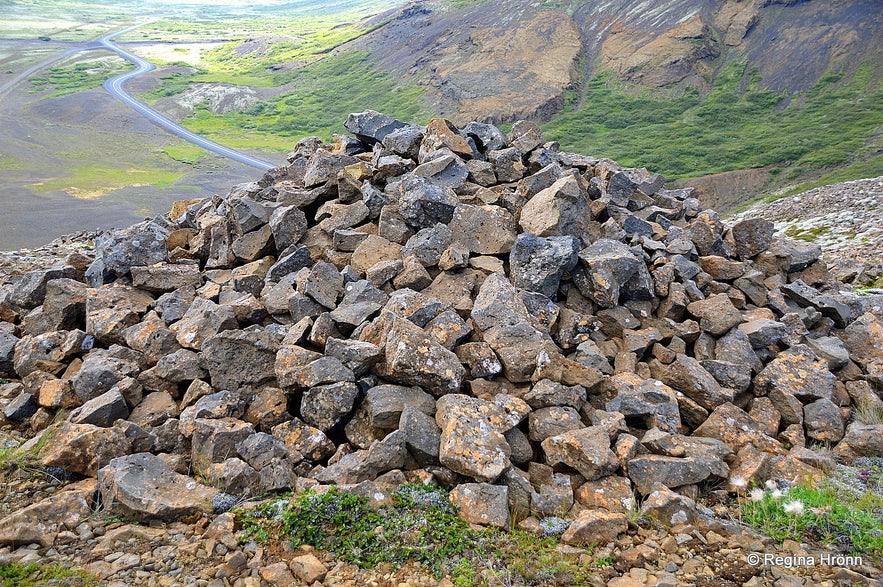
Gray basalt covers the top of Mt. Meyjarsæti, and 2 cairns have been erected on top
Ármanns saga hin yngri tells us that Þórálfur from Fell sat on the slope because Ármann didn't want him competing in the games, as he was entirely out of control. So he was banned from the games, much to his dismay.
His son, Þórir, and his grandson Bergþór from Bláfell, who was only 10 years old at the time, competed in the games, but poor Þórálfur had to stay put.
Until another half-troll also named Þórálfur approached him, taunted him, and dragged him onto the Hofmannaflöt plains, where they fought with extreme force.
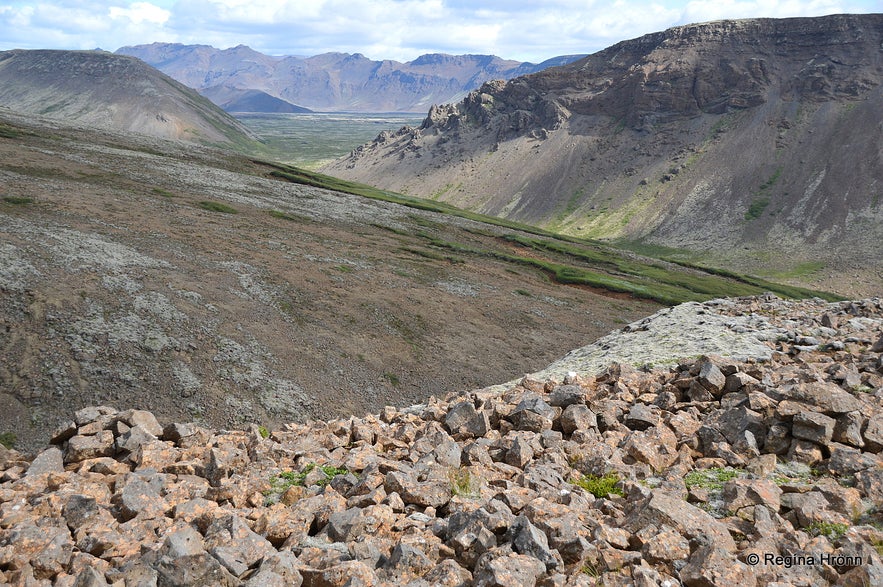
The view from Mt. Meyjarsæti to the northeast, Mt. Innra-Mjóafell, Draugaháls, and many more
The shape of Mt. Meyjarsæti resembles a seat; it looks like there is a seat on top of it. But once you reach the top, it is just rocks and more rocks.
The view from the top is beautiful. To the east, you can see Mt. Innra-Mjóafell, and to the north, Goðaskarð.
I was not sure which mountains I was looking at, as there were so many.
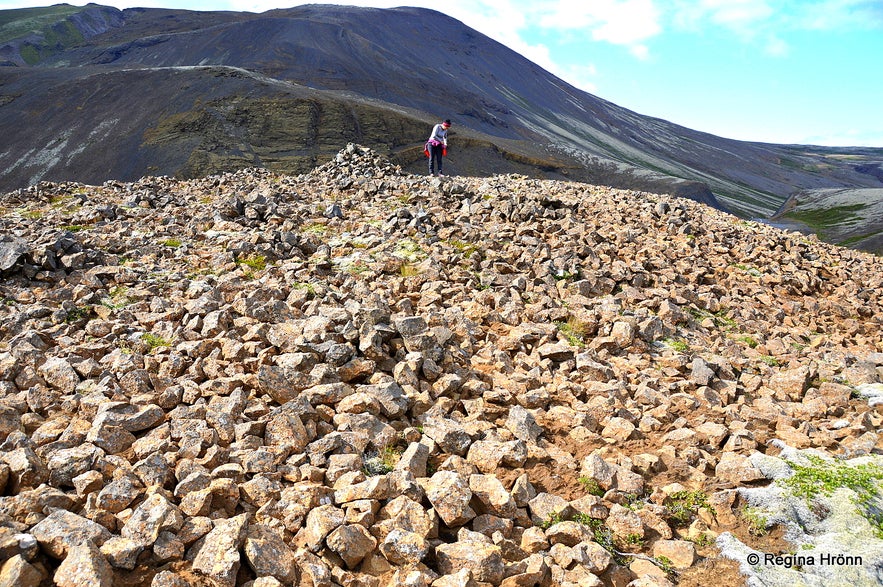 The rocky top of Mt. Meyjarsæti, looking northwest, for a moment, the black cloud moved
A really dark cloud lingered for a long time while we were enjoying the view, which affected my photos.
As the light was so poor for photos, I don't have a decent photo of the southern view from Mt. Meyjarsæti, which, for example, shows Mt. Hrafnabjörg, where Ármann worked on a farm guarding sheep before he settled in Mt. Ármannsfell.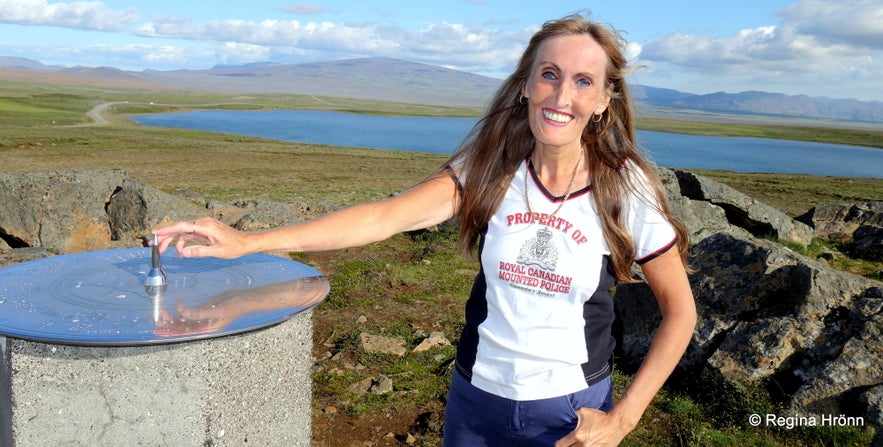
My father-in-law designed the view-dial at Uxahryggir
I will go back with the Peak lens app, or with my father-in-law, who is an expert at identifying mountain names, as he is the designer of view-dials in Iceland that show the names and heights of the surrounding mountains.
When you stand on top of Mt. Meyjarsæti, you can see the road on both sides of the mountain pass Sandkluftir, the old road to the right, and the new road, which cuts into the east side of Mt. Ármannsfell to the left.
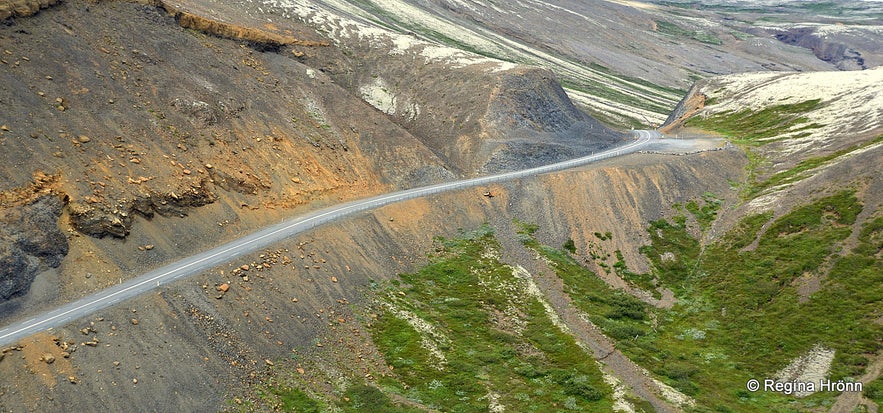
The newer road on the west side cuts into Mt. Ármannsfell
After taking in the view for a while, we followed the old road to Lake Sandkluftavatn, which almost disappears in the summertime as it almost dries up.
The first car to drive to Kaldidalur valley (Cold Valley) passed through Kluftir (Sandkluftir) in 1927.
And for some time, this was the only road between the south, north, and west. Times have changed for sure. 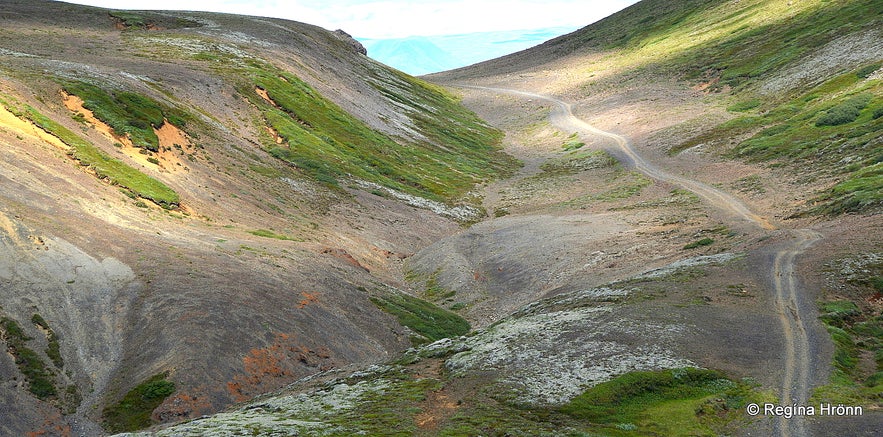
The old road through Sandkluftir as seen from the top of Mt. Meyjarsæti
There was a problem, though: this road often got blocked by piles of sand.
Sometimes the sandstorm got so bad that people would have to leave their cars behind and seek help at Þingvellir. And the car's paint and the car itself could get ruined by the sand.
I once got caught in a sandstorm at Sólheimasandur in South Iceland, and I can tell you it is no fun. I would not want to be outside in one.
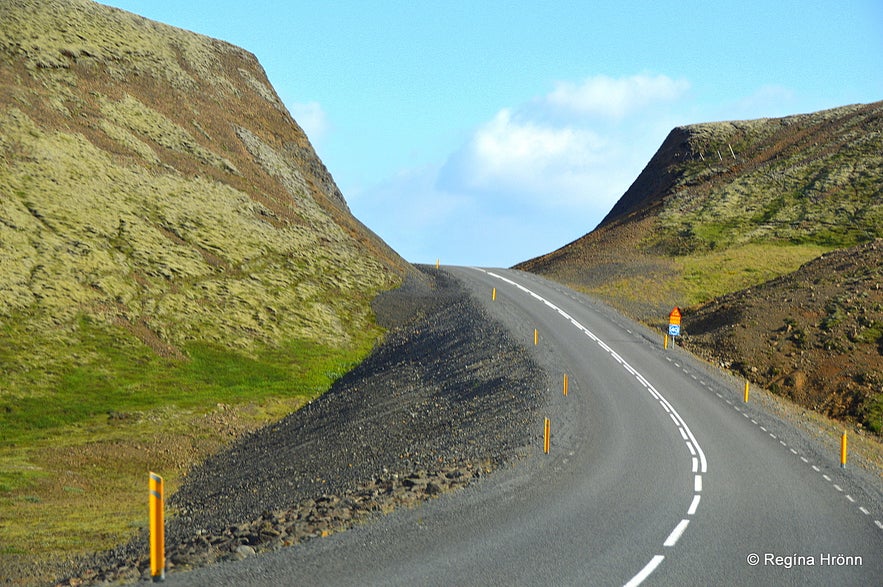 Uxahryggjavegur no 52
I read in NAT - Hofmannaflöt that during the spring thaw, a relatively deep pond is formed on the plains.
And that many travellers coming from the Kaldidalur valley lost their cars through the ice on the pond.
The new road was moved west closer to Mt. Ármannsfell, and is on its slopes, as you can see in my photos, as the old road east of Mt. Meyjarsæti and Lake Sandkluftavatn was so often filled with sand.
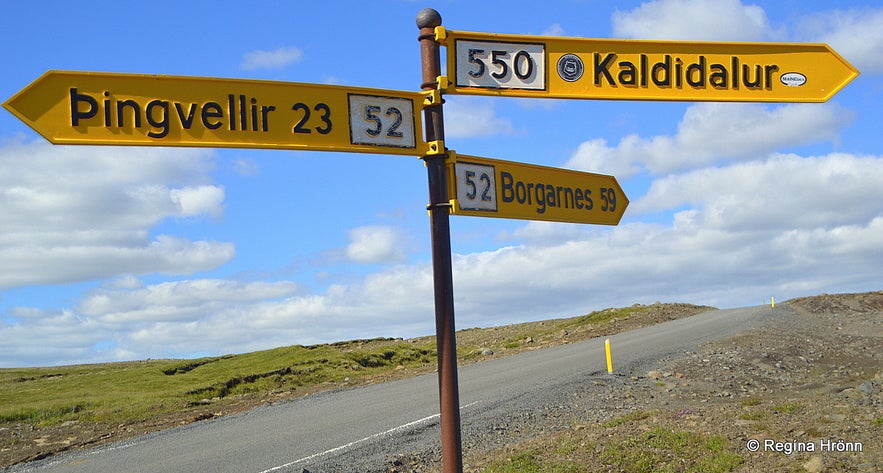 Road signs for road number 52 and road number 550
The name of Kaldadalsvegur road no 550, from Þingvellir (road 36) to Lake Brunnavatn, was changed to Uxahryggjavegur road no 52 (Vegagerðin).
Road no 52 will take you all the way to Borgarfjörður via Lundarreykjadalur valley, whereas Kaldadalsvegur road 550 is a highland track. Kaldidalur means Cold Valley.
This gravel road is slow, with views of glaciers, and ends in Húsafell.
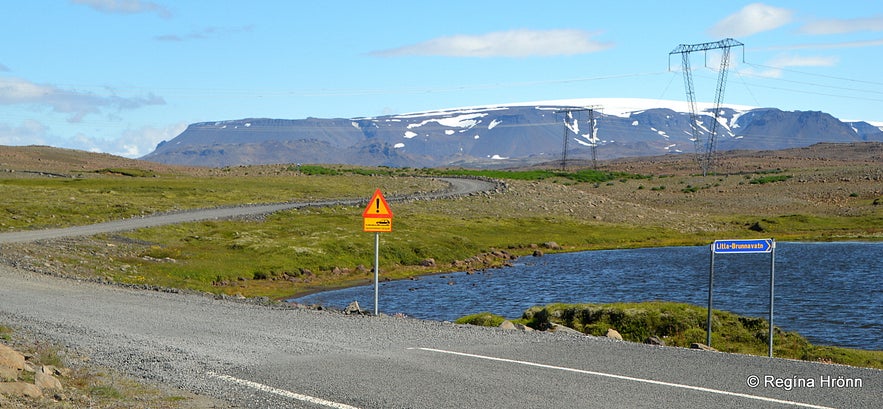 The road 550 Kaldadalsvegur starts here
A part of the reason why Vegagerðin - the Road Administration of Iceland changed the name and number of this road is so that foreign travellers would not get lost on Kaldadalsvegur road 550, and know where to turn for Borgarfjörður via Uxahryggir.
I have heard several stories about foreign travellers who have become lost in this area, asking for directions on how to return from the bad road, Kaldadalsvegur.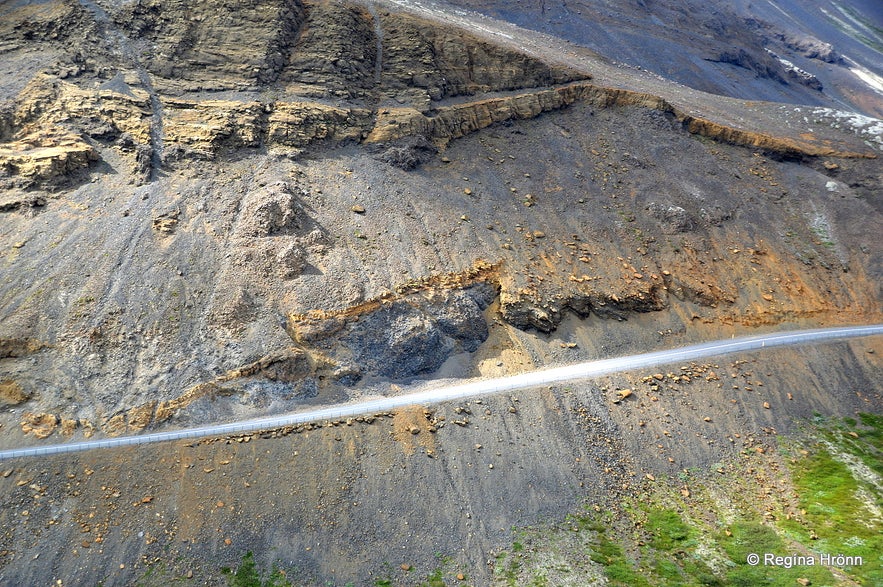 Uxahryggjavegur no 52 cuts into Mt. Ármannsfell
After our hike on Mt. Meyjarsæti, my friend and I continued driving on road 52, went to Lundarreykjadalur valley, and had a dip in a hot pool there.
Remember Bárður Snæfellsás's son-in-law, the Chieftain Oddur in Tunga, who accompanied him to the games on the Hofmannaflöt plains. He lived in Tunga in Lundarreykjadalur valley.
I have written another travel blog about what there is to see and do in Lundarreykjadalur valley:
Lundarreykjadalur Valley in West Iceland - the Natural Hot Pools Krosslaug and Englandshver
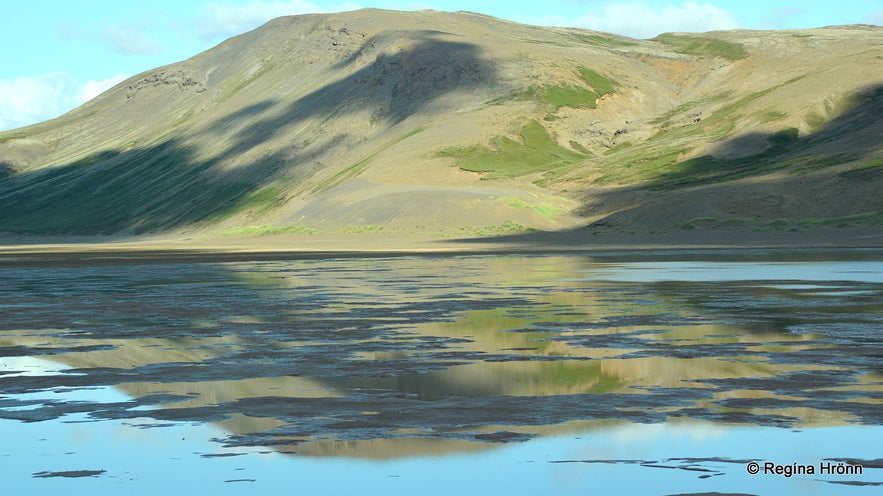
Lake Sandkluftavatn and Mt. Ármannsfell
Now, on with the hike after this detour.
There is only a short hike from Mt. Meyjarsæti to Lake Sandkluftavatn.
This lake almost disappears in periods of drought during the summertime, but looked quite lovely on our August hike, a bit shallow though, and we could see that it had dried up a bit.
We revisited Meyjarsæti and Lake Sandkluftavatn in October 2025 and walked on the dried-up mud.
I was afraid I might sink in the mud, but so late in the year, it was totally dried up.
 See how cracked the mud is in Lake Sandkluftavatn and how far away the lake is
We could see sand heaps east of Lake Sandkluftavatn, where the old road had been earlier.
Now it was nowhere to be seen.
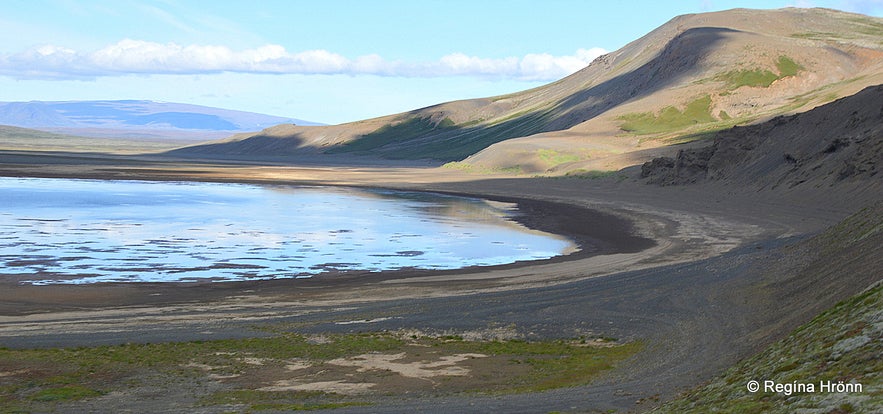
Lake Sandkluftavatn as seen from the main road
We could have hiked in a circle by the lake and finished our hike on the other side of Mt. Meyjarsæti, but I wanted to go back the same way and see Mt. Meyjarsæti and Hofmannaflöt plains in a different light.
Mt. Meyjarsæti looked quite different on the reverse hike. I zoomed in on it, and with this black cloud casting a dark shadow over it, it looked like a troll's lair.
Which made me think of the troll games again.
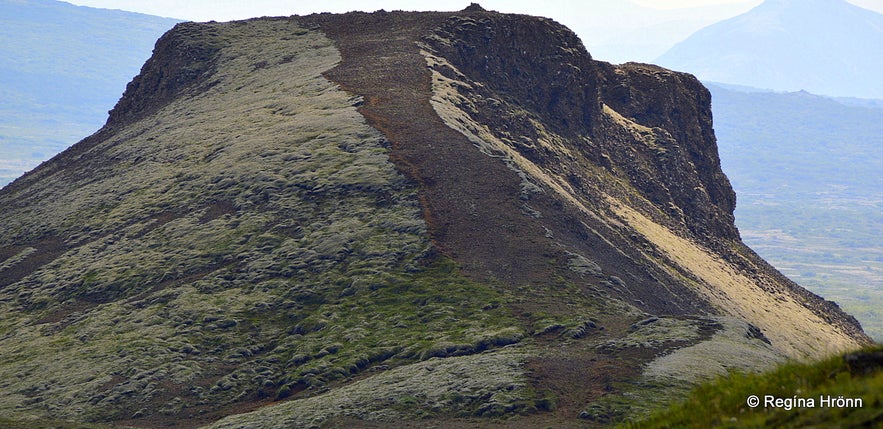
I zoomed in on Mt. Meyjarsæti on our way back to the car
But it was not only during the troll games that women would sit on Mt. Meyjarsæti and admire the men.
I am sure that on these plains there were other games with maidens/women watching.
As through here was the thoroughfare from the north, the east, and the west. The people from the east arrived via the Eyfirðingavegur road south of Mt. Skjaldbreið.
The people from the west arrived via Uxahryggir, and those from the north arrived via the Kaldidalur valley.
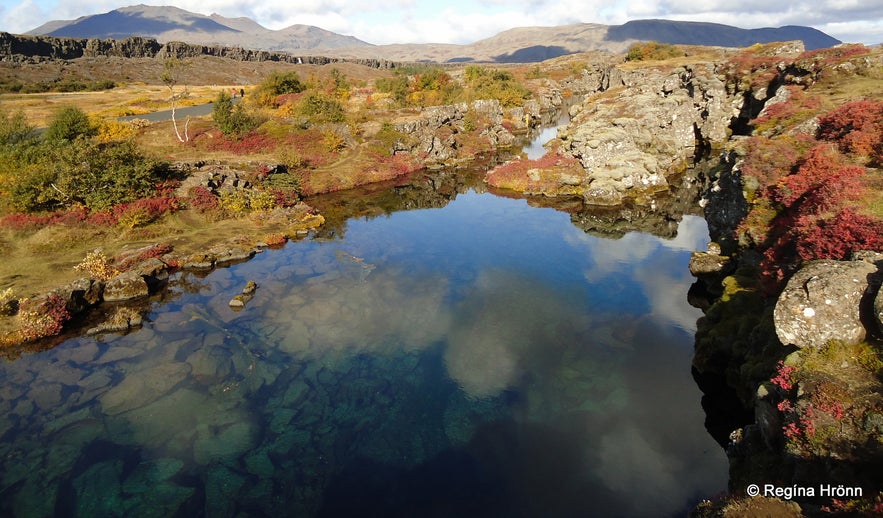 Þingvellir national park - Mt. Ármannsfell is to the right above the water-filled fissure
People were coming from these 3 directions of Iceland to attend Alþingi.
They would meet up and catch up at Hofmannaflöt plains before entering Alþingi at Þingvellir, which convened for 2 weeks in June from 930-1798, when it was moved to Reykjavík.
At Alþingi, people from all over Iceland would meet up, and disputes were settled, fines were paid, duels took place, and marriages were arranged, for example, the ill-fated marriage of Gunnar at Hlíðarendi and Hallgerður langbrók from Njálssaga - the Saga of Burn Njáll, the queen of the Icelandic sagas.
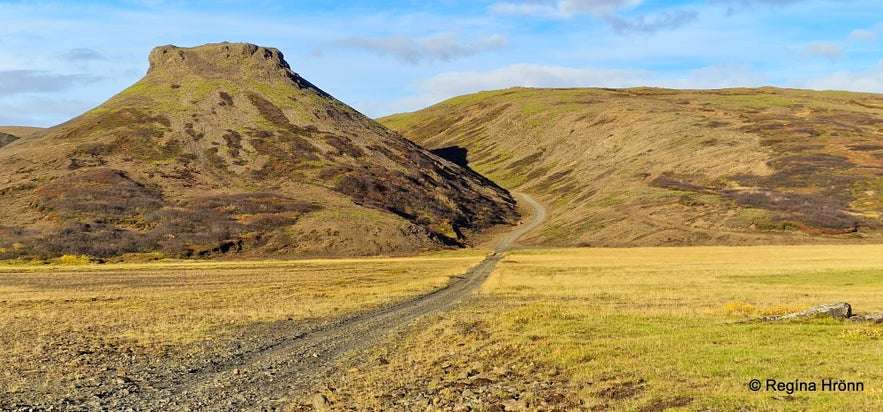 Mt. Meyjarsæti
What I missed photographing, as I only read about it afterward, is an ancient, protected section of the old road on the south side, which we stepped on during our hike without knowing how old it was.
I remember thinking how convenient this was, having stepping stones like this on the rocky old road. I must go back to photograph them.
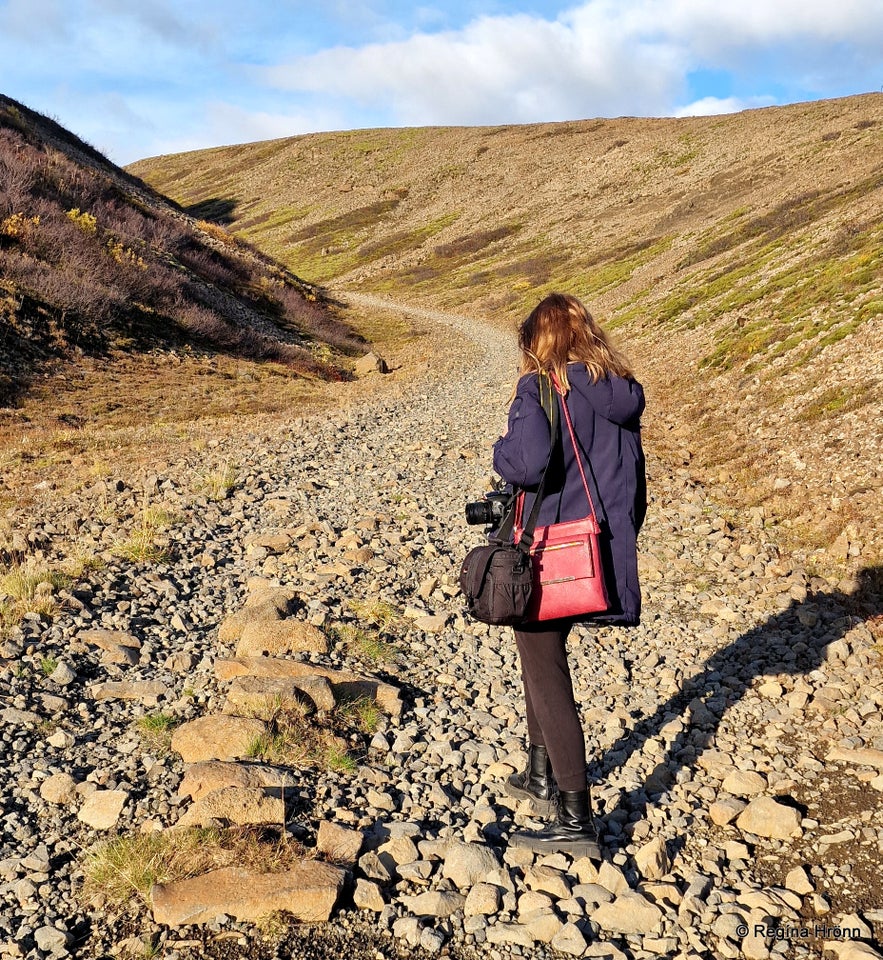 The ancient, protected rocks
In October 2025, we drove to Þingvellir to see the autumn colours, and visited Mt. Meyjarsæti and Lake Sandkluftavatn, and I found the ancient, protected part of the road.
The hike was about 7 km, a lovely, easy hike, though very rocky, so wear good hiking shoes.
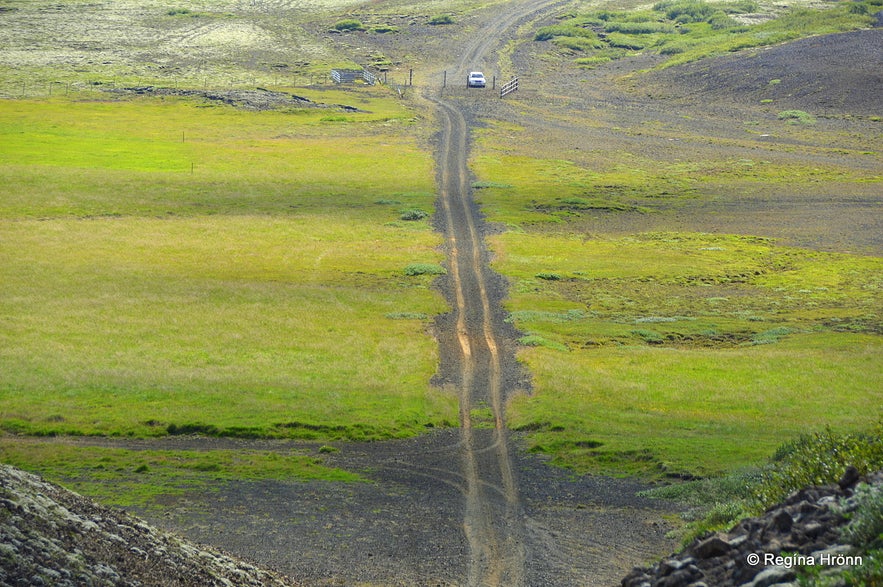 I zoomed in on the straight road leading to our car
A straight road leads through the Hofmannaflöt grassy plain to the car. Can you see the gate in my photo above?
This gate is actually a sheep disease prevention measure, and as such, it is imperative to close the gate behind you when you go on the hike and when you return to the car.
If we don't, disasters can happen like scrapies spreading, which will result in a whole flock of sheep having to be put down.
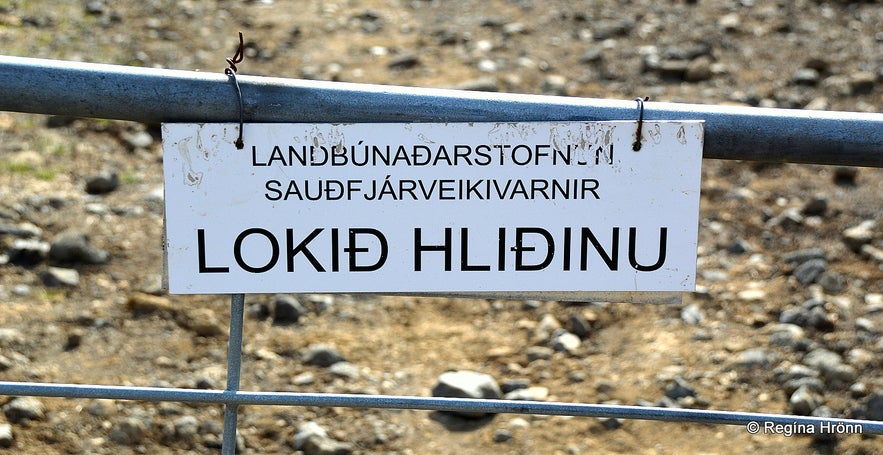 Sheep disease prevention - close the gate
And there are many such occurrences, which are devastating both for the sheep and the farmer. And we as a nation feel for the farmer and the sheep. So let's be extra careful and keep the gates closed at all times.
As I mentioned earlier, I am sure that most travellers pass Hofmannaflöt plains and Mt. Meyjarsæti without giving them a second glance.
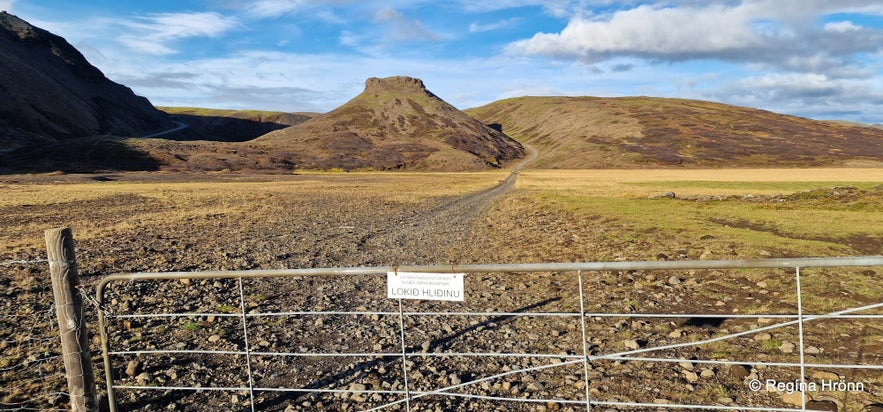 Mt. Meyjarsæti and the gate
Since the road was moved west of Mt. Meyjarsæti, this beautiful area was, so to speak, cut off.
I hope that my 2 travel blogs about Ármann in Mt. Ármannsfell and the troll games on Hofmannaflöt plains, and the hike on Mt. Meyjarsæti will spark your interest in this area.
And maybe you will stop here and go on a hike yourself, or walk to the plains and imagine the big troll games on Hofmannaflöt.
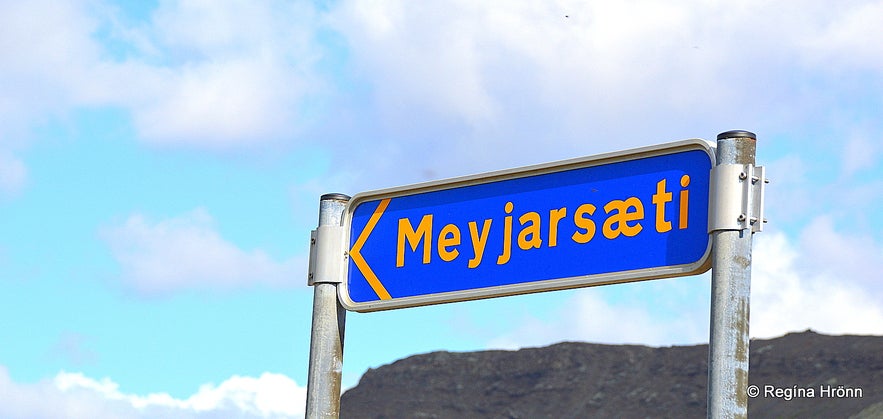
The road sign by Mt. Meyjarsæti
Here is the location of Mt. Meyjarsæti on Google Maps. Mt. Meyjarsæti is wrongly marked, though, but if you zoom in, you can see the top of Mt. Meyjarsæti and the two roads on each side of it.
Have a lovely time in Iceland :)
Sources:

Hi, my name is Regína Hrönn, and I was born and raised here in Iceland.