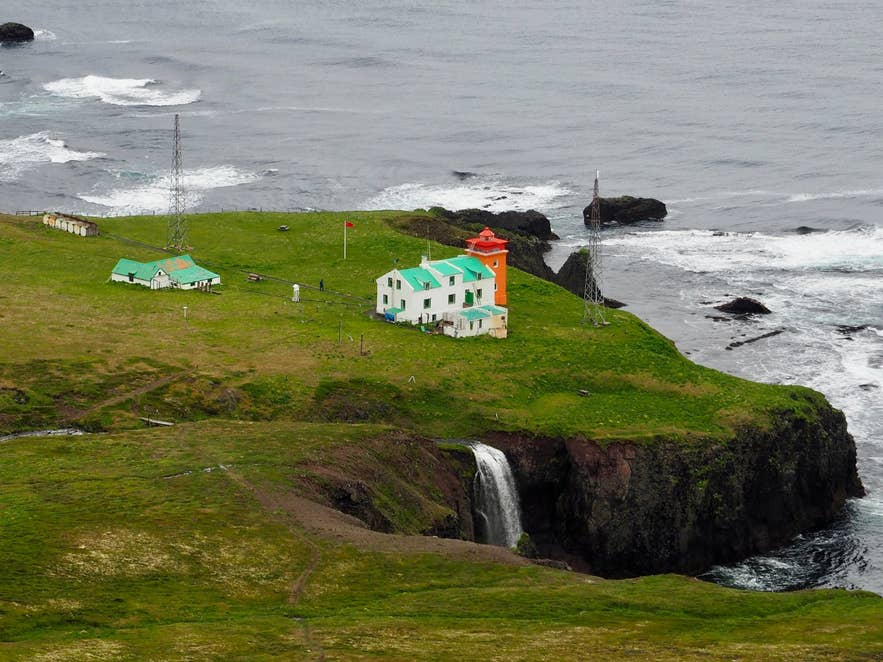
Hornbjargsviti lighthouse in Látravík. Photo: RagnarHeidar, CC BY 4.0
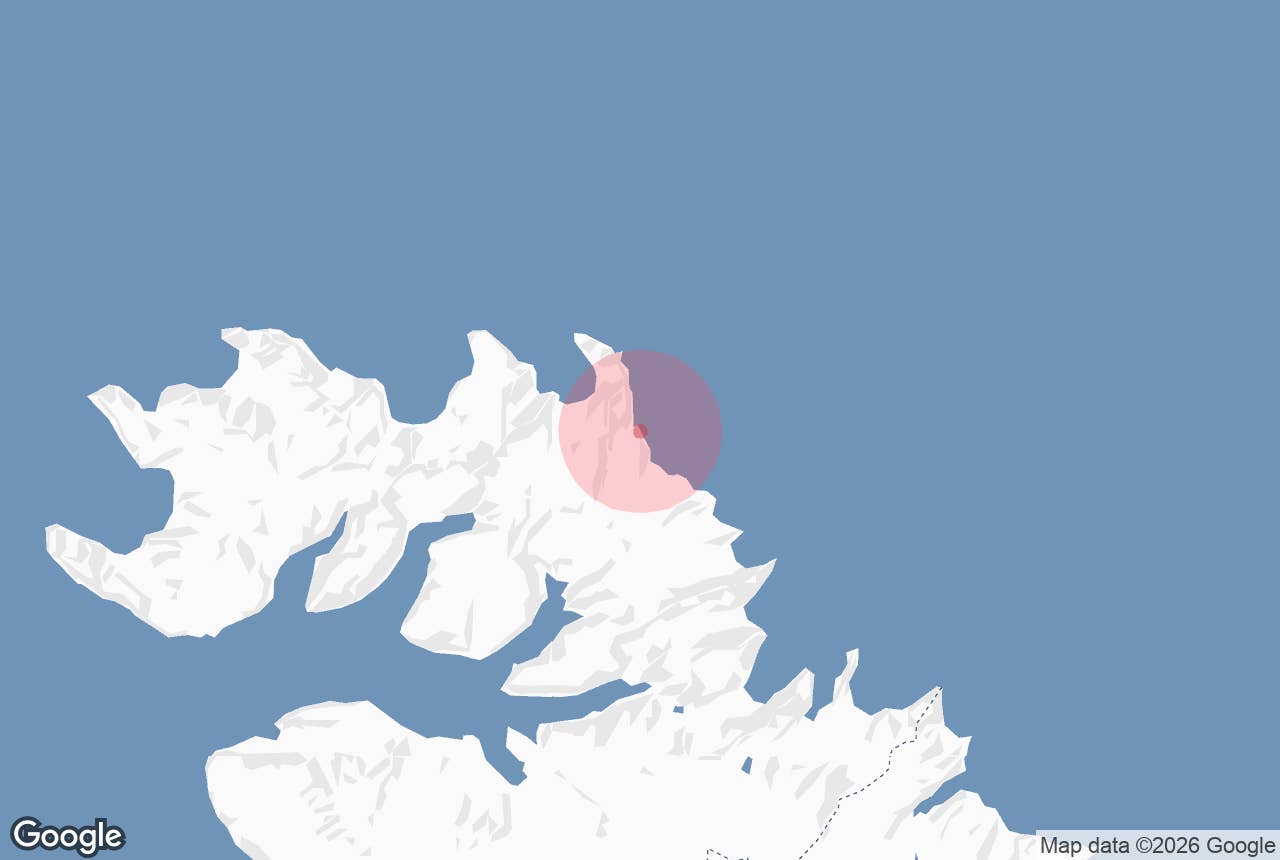
Látravík Lighthouse (Hornbjargsviti, "Hornbjarg beacon") is a lighthouse and mountain hut in Látravík, a small bay on the north coast of Hornstrandir Nature Reserve in the Westfjords, just east of the great bird cliff Hornbjarg.
It is one of the most remote staffed huts in Iceland, and the only place with bookable beds under a roof on the coast between Hornvík and Reykjarfjörður.
There is no road within tens of kilometres; you arrive by boat or on foot, and the Hornbjargsviti hut is the natural overnight stop for hikers walking between Hornvík and the bays to the east.
Key Takeaways About Hornbjargsviti
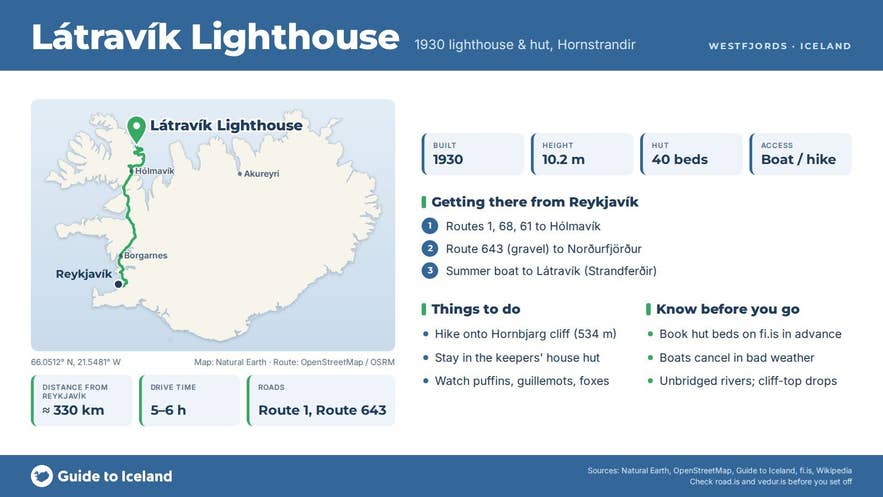
- 1930 lighthouse (10.2 m, engineer Benedikt Jónasson) in Látravík, just east of the Hornbjarg bird cliff
- Keepers' house is now a Ferðafélag Íslands hut sleeping 40, with kitchen, showers and campsite; warden in summer
- Automated in 1995 (solar and wind power, automatic weather station); last keepers left then
- Reach it by summer boat from Norðurfjörður, or by boat from Ísafjörður to Hornvík and a hike of most of a day over Hornbjarg or through Kýrskarð
- Hut open roughly mid-June to early August; book beds on fi.is
Why visit Látravík Lighthouse
Hornbjargsviti lighthouse was built in 1930 to a design by engineer Benedikt Jónasson and stands 10.2 m high on the low headland at Látravík. It was lit by gas until the 1960s, then by electricity from a small hydroelectric plant on the stream behind the station.
In 1995 it was converted to solar and wind power and fitted with an automatic weather station, and the last keepers left.
Until then it was a staffed station, and the keepers' house, outbuildings and small hydro plant are what make Látravík feel like a settlement rather than a single tower.
Látravík itself was farmed only from 1872 to 1909, and is counted as the last piece of common land in Iceland to be settled.
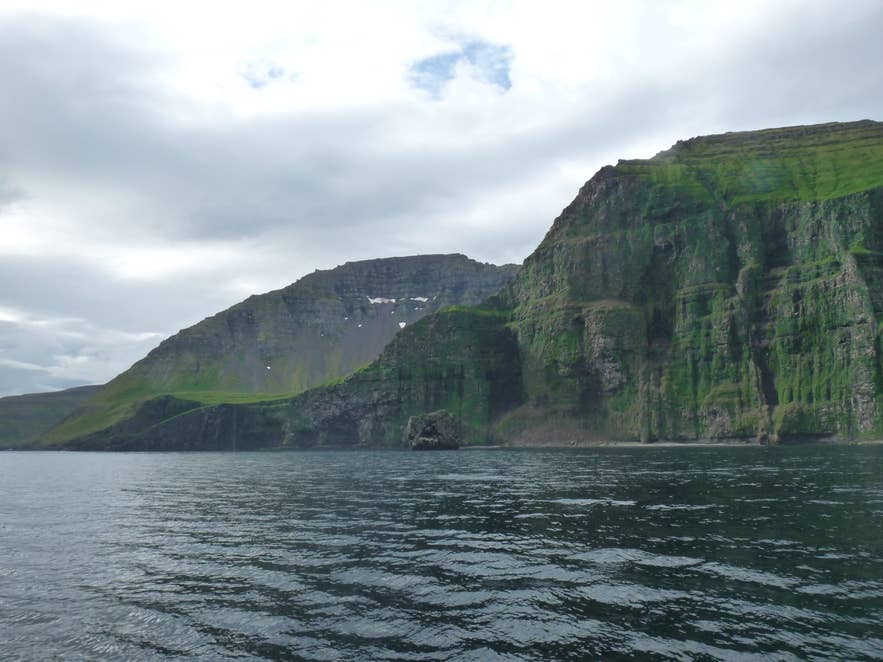
Hornbjarg cliffs from the sea. Photo: Smiley.toerist, CC BY-SA 4.0
Hornbjargsviti is now run by Ferðafélag Íslands (the Icelandic Touring Association) as a mountain hut. The keepers' house sleeps 40 people in seven rooms of beds and bunks and has a full kitchen with electric and gas stoves and running water, toilets, showers, a drying room for wet gear and a charcoal grill outside.
A camping area beside the house has access to toilets and a cooking space in a converted sheep shed. A warden lives on site in summer. For hikers who have been in a tent for several days, hot water and a roof at Hornbjargsviti are worth planning a route around.
The setting is the main draw.
Hornbjarg, one of the three great bird cliffs of Hornstrandir, rises to 534 m at Kálfatindur a few kilometres to the west and is home to vast numbers of seabirds in summer: guillemots, Brünnich's guillemots, razorbills, kittiwakes, fulmars and puffins. Arctic foxes, protected within the reserve and unafraid of people, often trot past the hut.
Hornstrandir has had no permanent residents since the 1950s apart from the lighthouse keepers, and apart from the hut and a handful of summer houses the land has been left to recover, so the vegetation is thicker and the wildflowers more abundant than in most of Iceland.
The hike from Látravík up onto Hornbjarg and down into Hornvík is one of the classic walks in the country.
How to get to Látravík Lighthouse
There is no road. Two routes are used:
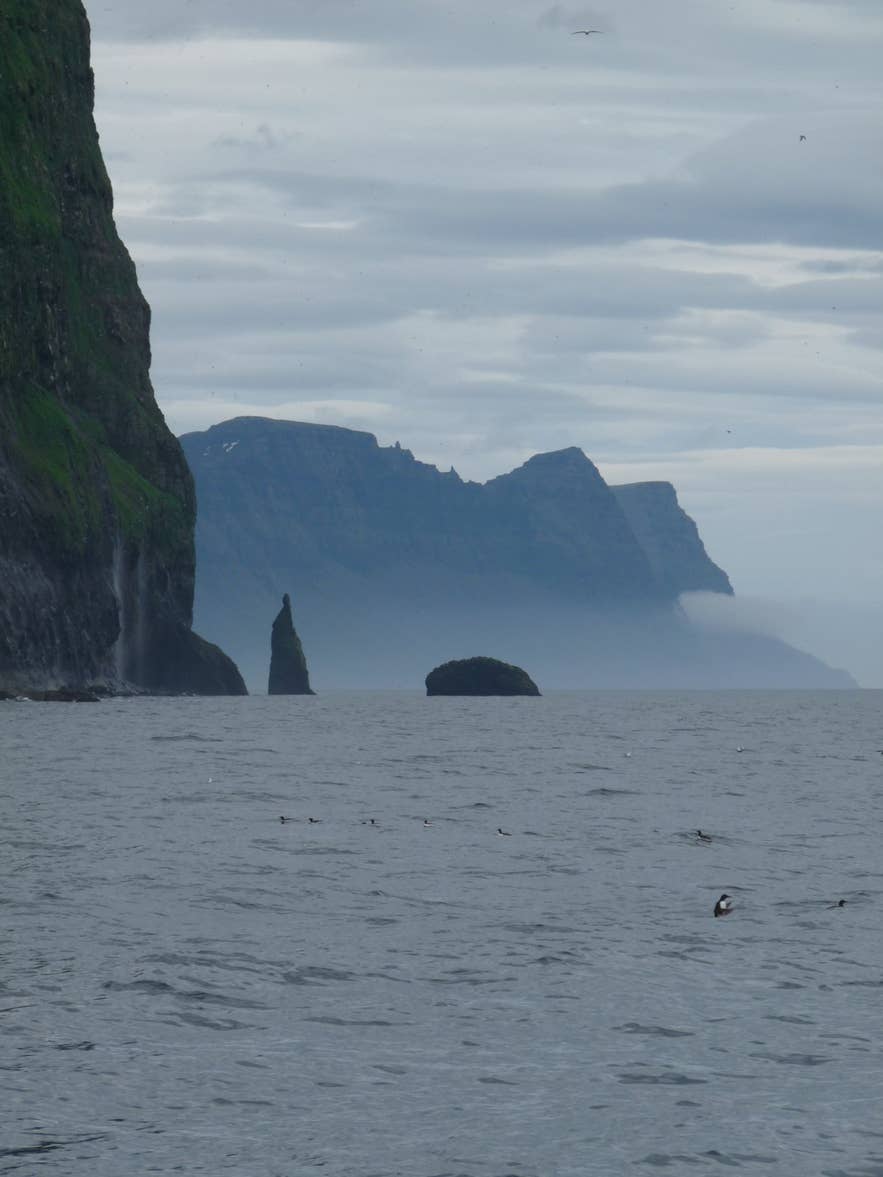
Sea stacks between Hornvík and Látravík. Photo: Smiley.toerist, CC BY-SA 4.0
- By boat from Norðurfjörður in Strandir, on the east side of Hornstrandir. Scheduled summer boats (Strandferðir) run to Látravík and other bays. Norðurfjörður is roughly 330 km (five to six hours) from Reykjavík: Route 1 north, then Route 68 and Route 61 to Hólmavík and Route 643 (Strandavegur) up the coast, the last long section gravel.
- By boat from Ísafjörður to Hornvík, then on foot. From Hornvík the trail climbs over Hornbjarg or through the Kýrskarð pass (326 m, Environment Agency figure) and descends to Látravík; the direct route via Kýrskarð is about 7 km, the cliff-top route over Hornbjarg much longer, so allow most of a day. Ísafjörður is roughly 415 km from Reykjavík by road or a 40-minute flight.
Boats run only in summer, typically from late June into August, and are cancelled in bad weather, so build spare days into any plan. Book boats and hut beds in advance through the boat operators and fi.is.
Best time to visit
The hut is open from roughly mid-June to early August and locked outside that period. Late June and July are best: the boats run, the birds are on the cliffs, the midnight sun lights the north coast, and the snow has mostly gone from the passes. Wildflowers peak in July. By mid-August the puffins have left and services wind down.
Safety and practical tips
- Hornstrandir is a wilderness with no roads, shops or rescue services nearby. Carry everything you need, including food for extra days in case the boat cannot land at Látravík.
- Mobile coverage is limited across the reserve, although there is a signal at the hut. Register your travel plan on safetravel.is.
- The cliff-top path on Hornbjarg has steep drops and can be slippery in fog. Stay back from the edge, especially in wind.
- Rivers on the trails are unbridged and rise with rain and snowmelt.
- Weather on the north coast changes fast and can be cold even in July. Bring full waterproofs, warm layers, a hat and gloves.
- Hut beds and camping at Hornbjargsviti are charged per person by Ferðafélag Íslands. Check current prices on fi.is.
- Leave no trace: there are no bins, and all rubbish goes home with you. Do not feed the foxes.
Nearby attractions
- Hornbjarg – about 6.3 km, the bird cliff west of the bay
- Hornvík – about 7.0 km
- Hornvík campsite – about 5.2 km
- Drifandi waterfall – about 4.8 km
- Haelavikurbjarg – about 11.3 km
- Hesteyri Whaling Factory – about 21.9 km
Tours that visit Látravík Lighthouse
- Once-in-A-Lifetime 3-Day Hiking and Glamping Tour of Hornstrandir Nature Reserve From Isafjordur – on day two the group hikes from its Hornvík base camp over the Kýrskarð pass down to the Látravík lighthouse for lunch, then returns via the Almenningar pass and Drífandi waterfall.