Iceland holds the world’s largest population of Atlantic puffins. Each summer, almost 2.7 million pairs, or about 4 million breeding puffins, nest on its cliffs and offshore islands, roughly a third of the global population. This guide maps the main colonies, the best time to visit, and the tours that get you closest without disturbing the birds.
Many people come to Iceland hoping to go puffin watching. And once you spot them in real life, it is easy to understand why. With their brightly colored bills, watery little eyes, and wonderfully clumsy walk, Iceland’s puffins are simply impossible not to love.
Why You Can Trust Our Content
Guide to Iceland is the most trusted travel platform in Iceland, helping millions of visitors each year. All our content is written and reviewed by local experts who are deeply familiar with Iceland. You can count on us for accurate, up-to-date, and trustworthy travel advice.
Iceland has the world’s largest breeding population of Atlantic puffins, estimated at 2 million pairs. A separate count of Iceland’s biggest puffin colonies recorded 2,679,000 burrows, but not every burrow holds a breeding pair. Non-breeding young birds also visit the colonies, making puffins a popular sight on whale-watching and puffin tours.
If puffins are on your Iceland bucket list, you are in exactly the right place. This guide will show you where to see puffin colonies up close, whether you join guided tours in Iceland or prefer setting off on self-drive adventures of your own.
For this guide, we also spoke with Dr. Erpur S. Hansen, Director of South Iceland Nature Research Centre and Iceland’s go-to puffin researcher, who shared his insights on the colonies worth seeking out and what responsible puffin watching really means today.
You will also find tips for photographing puffins and watching them responsibly, along with advice on where to stay in Iceland. This makes it easier to stay close to the action and enjoy more time with these unforgettable little birds. Ready to learn more? Keep reading.
Key Takeaways
-
Iceland is home to around 40% of the world’s Atlantic puffins, the largest breeding population anywhere, with an estimated 3 million breeding pairs (about 6 million individuals) nesting along the coast.
-
Puffins arrive in Iceland between late April and May and usually leave again by August or early September.
-
The best time to see puffins is from May through mid-August, especially during early mornings and evenings.
-
Top puffin watching spots include the Westman Islands, Latrabjarg Cliffs, Grimsey Island, and the small islands near Reykjavik.
-
Puffins can be seen from land or on boat tours, depending on the location.
-
Always keep a respectful distance and never disturb puffin nests or burrows.
Best Time to See Puffins in Iceland

Timing really matters when it comes to seeing puffins in Iceland. Much like the northern lights, sightings can never be guaranteed. Still, understanding when puffins arrive and how long they stay can make a big difference.
This section explains how the puffin season works in Iceland, which months offer the best chances to see them along the coast, and when conditions are most favorable for spotting these charming birds up close.
Seeing Puffins in Iceland in Spring
Spring marks the return of puffins after a long winter spent out at sea. The first birds usually arrive in Iceland in April, when they begin settling into nesting areas along coastal cliffs.
At this time of year, puffins can be seen preparing their burrows, though numbers are still building and activity is quieter than later in the season. If you’re traveling in Iceland in spring, you may spot early arrivals at places like Dyrholaey or the Westman Islands. It is a great time to catch the very beginning of puffin season.
Seeing Puffins in Iceland in Summer
Summer in Iceland is the best time to see puffins. From May through mid-August, puffins are out in full force. This is when they nest along the cliffs, feed their chicks, and fly back and forth with fish tucked into their colorful beaks.
It is the perfect season to visit places like Latrabjarg Cliffs, the Westman Islands, or Borgarfjordur Eystri, where large puffin colonies are easy to spot up close. By late August in Iceland, the birds begin heading back out to sea, so it is best not to wait too long if puffins are high on your Iceland bucket list.
Seeing Puffins in Iceland in Fall
By autumn, most puffins have already left Iceland. A few may still be around in early September, but by the middle of the month, they are usually back out at sea.
While Iceland in fall is still beautiful, it is not the best season if seeing puffins is a top priority. The busy cliffs that buzz with life during summer become much quieter.
Seeing Puffins in Iceland in Winter
During winter, puffins are far out in the North Atlantic and not around Iceland at all. These months are spent at sea, where they dive for fish and live a solitary ocean life.
If seeing puffins is a priority, winter is not the right time, and planning a summer trip is your best option. That said, a visit to Iceland in winter still offers plenty to love, from snowy landscapes to unforgettable northern lights tours and other winter experiences.
Best Time of Day to See Puffins in Iceland

The best time of day to see puffins in Iceland is usually early in the morning or later in the evening. This is when puffins are most likely to be at their nesting sites, resting in their burrows or moving around the cliffs.
During the middle of the day, many puffins head out to sea to fish, which can make nesting areas feel much quieter. This is also why many puffin tours in Iceland are scheduled for mornings or evenings, when sightings are more likely, and the experience is at its best.
Local Tip: Pack binoculars and a windproof jacket, even in midsummer. Exposed sites like the Látrabjarg cliffs in the Westfjords and the Dyrhólaey promontory on the south coast catch a stiff Atlantic breeze, and temperatures can drop to 5°C (41°F) in minutes. Once you reach the cliffs, sit still for a few minutes before approaching the edge — puffins relax quickly and will often pop out of their burrows within arm’s length. Listen for a low growl coming from underfoot. That sound is how puffins communicate inside their burrows, and it is a reliable sign you are standing right above an occupied nest.
Best Places to See Puffins in Iceland

Puffins love Iceland’s dramatic coastline, and in summer, they show up in some incredible places. They nest along grassy cliffs and rocky edges, often in huge colonies, which makes spotting them surprisingly easy once you know where to go.
One of the most fun ways to see puffins up close is from the water, such as on this puffin boat tour, where a boat cruises right next to cliffs. Luckily, there are also plenty of spots in Iceland where no boat is needed at all. From clifftop paths to coastal viewpoints, puffins can often be seen just a few steps away.
Keep reading to find the best places and the easiest ways to enjoy puffin sightings across Iceland.
The Best Places to See Puffins in Iceland from Land

Puffins are surprisingly picky when it comes to where they nest, so spotting one outside of well-known puffin areas is rare. Most of the time, if a place is not known for puffins, you will not find any there.
However, Iceland does have a few memorable puffin stories. One night, tour guides Paulina Pierzak and Armann Aegisson came across a puffling wandering through downtown Reykjavik, likely confused by city lights. After a night of rest in a simple cardboard box with water and a few crackers, the little bird was strong enough to be released back into the wild.
In another case, a horticulturalist named James McDaniel discovered a lost puffin hiding between two greenhouses in Selfoss, more than three miles (five kilometers) from the coast. With a bit of care, that puffin was also safely returned to nature.
Stories like these are very much the exception. For the best and most reliable chance to see puffins from land, it is far better to visit one of the well-known puffin spots listed below, where colonies return every summer, and sightings are far more predictable.
Puffin Watching at the Látrabjarg Cliffs

Sitting at the far western edge of Iceland, the Latrabjarg Cliffs are a paradise in the Westfjords.
While the cliffs are impressive year-round, summer is when they really come alive. Puffins are the main attraction, but they share the cliffs with other Icelandic birds like guillemots, northern gannets, auks, and an incredible 40% of the world’s razorbills. The sheer number of birds is hard to describe, with colonies covering the cliffs and filling the air with constant movement and sound.
Well-marked walking paths lead right to the cliff edges, making it easy to watch the birds as they nest or swoop out over the ocean. With a bit of care, it is possible to get close. Just remember to keep about three feet (one meter) from the edge to avoid disturbing hidden puffin burrows.
For a deeper experience, a friendly local guide can lead a scenic 7-hour puffin and bird-watching tour in the Westfjords from Patreksfjordur.
Puffin Watching at the Dyrhólaey Rock Arch and Promontory

Latrabjarg is incredible, but getting there from Reykjavik is a serious journey. The drive takes around seven hours, which can feel like a bit of a mission if you are staying in the capital. The good news is that there are places to see puffins closer to Reykjavik, especially along Iceland’s South Coast. One of the most popular spots is Dyrholaey Rock Arch.
Dyrholaey curves out from the cliffs into the crashing ocean. Up close, the cliffs reveal striking hexagonal basalt columns. Seeing puffins here is easy too, whether you choose a summer self-drive along the Ring Road or join a South Coast day tour. It is a great stop if you are heading to the sites of the southeast, such as Skaftafell Nature Reserve and the Jokulsarlon Glacier Lagoon.
Puffins nest all around Dyrholaey, and they can be spotted both from the beach and from the clifftop viewpoints. The colonies are smaller than at Latrabjarg, but there are still thousands of puffins throughout summer, often just a short walk away.
Since Dyrhólaey is accessible and popular, it can get busy during peak summer. For visitors hoping to trade the crowds for something more peaceful, Dr. Erpur S. Hansen, Director of South Iceland Nature Research Centre, points to several lesser-known colonies worth the detour.
Ingolfshofdi is a remote nature reserve rising from the black sands of the southeast, reached by a tractor-drawn wagon. Hafnarholmi in Borgarfjordur Eystri, out east, offers boardwalks and viewing platforms that let you get remarkably close without disturbing the birds.
In North Iceland, Drangey rises dramatically from the waters of Skagafjordur as a quiet, bird-rich haven. And in the Westfjords, the islands of Grimsey in Steingrimsfjordur and Vigur in Isafjardardjup are peaceful spots where puffins share the cliffs with other seabirds, far from the busier mainland stops.
Puffin Watching at the Tjörnes Peninsula

The Tjornes Peninsula is a small, remote peninsula in North Iceland, known for two things: ancient fossils along its west coast and rich birdlife on the east. The fossils attract visitors year-round, and birds like the rock ptarmigan stick around through winter. But when puffins arrive, the whole area really comes to life.
Several easy birdwatching trails wind along the coast, leading straight to puffin nesting areas. It is a calm, uncrowded place to watch them going about their day, with the sea stretching out in front of you.
A great advantage of birdwatching from Tjornes is the fact that, when looking out to the ocean, you have a good chance of spotting whales and dolphins. Tjornes sits right next to Husavik and Skjalfandi Bay, often called the capital of whale-watching in Iceland, which makes this spot extra special for wildlife lovers.
Puffin Watching at Ingólfshöfði Cape

Further along the South Coast from Dyrholaey, between Skaftafell and Jokulsarlon, you can find Ingolfshofdi Cape and Nature Reserve. This hidden gem of a destination is surrounded by mighty cliffs and is only accessible by crossing the dunes to its northwest. Its sheltered, protected location makes it a thriving home for Iceland's puffins and other birds.
Like at Latrabjarg, you can expect to see the puffins nesting with a number of other species, such as kittiwakes and guillemots. You can also expect to see dozens of seafowl that include many of the country's saltwater duck species.
This nook on the South Coast is often overlooked by travelers, so it is the perfect place to come if you want to admire puffins without the crowds. A good way to take in the surroundings and, of course, get to meet the puffins is on a beautiful 1.5-hour hiking & puffin watching tour of Ingolfshofdi.
Puffin Watching in the Westman Islands (Vestmannaeyjar)

The Westman Islands, or Vestmannaeyjar, off the South Coast of Iceland, have the largest Atlantic Puffin colony in the world. Thirty different species nest over the archipelago, but puffins are by far the stars. They nest on most of the islands, including the only one with a human population, Heimaey.
On Heimaey, it is possible to take a boat tour, which will introduce you to islands teeming with puffin life. If you wish to spend more of your time on land, however, there are colonies in the cliffs here too. A highly recommended way of seeing the puffins and more of what the islands have to offer is on a scenic 1-hour small island boat tour in the Westman Islands.
One of the most up-close puffin viewing experiences on Heimaey can be found on the Stórhöfði Peninsula. A scenic coastal path runs along the west side of the island, staying mostly flat and easy to walk. Along the cliffs, puffins nest right beside the trail, often just a few steps away, making it one of the easiest places in Iceland to observe them at close range.
The puffins are so numerous in the Westman Islands that there is a puffin rescue tradition in the town where the children help pufflings make it back to the ocean. These are puffins that have wandered away from the cliffs, confused by the lights of the town. Finding a lost puffin in the Westman Islands is a regular occurrence.
Local Tip — The Westman Islands Puffling Patrol: Every August, fledgling puffins (called pysjur in Icelandic) leave their burrows and head for the open ocean for the first time. Many get confused by the lights of Heimaey town and crash-land in the streets. For decades, local children have spent late-summer evenings collecting these stranded pufflings in cardboard boxes, then releasing them safely from the cliffs the next morning. If you visit Heimaey in mid-August, ask at the Sea Life Trust visitor center about joining a community release — it is one of the most uplifting wildlife experiences in Iceland.
The Best Places to See Puffins in Iceland by Boat

There are several advantages to taking a boat tour to see puffins rather than just walking up to them on the shore.
A boat tour allows you to watch puffins doing more than just guarding their burrows, such as bobbing in the water and diving for fish. It also provides a better chance to see more of the animals that many hope to catch in Iceland, such as humpback whales (which also migrate to Iceland for the summer) and white-beaked dolphins.
Puffin Watching from Reykjavík

Taking a puffin boat tour from Reykjavik's Old Harbor seems too convenient to be true, but from May to August is more than a possibility. Two islands out in Faxafloi Bay, Akurey and Lundey, become the nesting grounds for thousands of these darling creatures every summer.
Boats on puffin tours in Reykjavik have been visiting these islands for years. They’re small enough to get close to the islands safely and quietly, yet still have a sheltered area in case the weather becomes problematic. There are binoculars on board so that you can get a perfect view of the nesting puffins.
It is also possible, however, to combine your puffin watching trip with whale watching. Faxafloi Bay has a wealth of life, with white-beaked dolphins, harbor porpoises, minke whales, and humpbacks all frequently seen in the summer months.
Puffin Watching from North Iceland

It is as easy to take a puffin watching boat tour from the northern towns of Akureyri and Husavik as it is from Reykjavik. Throughout the summer, multiple operators set out into Eyjafjordur and Skjalfandi, respectively, and return with incredible success rates.
From Husavik, you can book a puffin and whale-watching tour on a RIB vessel to head out in search of diverse wildlife. From Akureyri, puffins are less concentrated, but whale-watching tours often keep an eye out for seabirds as well. These trips regularly pass along the rugged coastline of Eyjafjordur, where puffins and other seabirds are often spotted both on the water and along the cliffs.
For more puffins in North Iceland, Grimsey Island holds about 99,900 puffin burrows, according to our study of where to find birds in Iceland. You reach Grimsey Island by flight from Akureyri or by ferry from Dalvik.
Puffin Watching from the Snæfellsnes Peninsula

Breidafjordur is the fjord that separates the Snaefellsnes Peninsula and the Westfjords. It has many little islands dotting it and fertile waters, making it a perfect place for puffins to nest.
There are multiple boat trips you can take from the historic town of Stykkisholmur that will allow you to explore the fjord and see these birds, both nesting and hunting in the waters.
For example, you could take a magical 2-hour seafood cruise from Stykkisholmur, which combines a cruise with a freshly caught seafood dinner served as sushi. Though it is available throughout the year, taking this tour between May and September almost guarantees that you will see several islands in the distance with thriving puffin colonies.
Puffin Watching from East Iceland

Just off the shore of East Iceland is another enormous puffin colony that can be reached by boat. Papey is a small, low-lying island that’s long been uninhabited. Now, it is a paradise of birds (with puffins and guillemots being the main residents) and seals.
If taking a self-drive tour around Iceland, you can visit this town when you head from the Hofn area to Egilsstadir, the largest settlement in the east. This part of your journey is mainly comprised of sightseeing landscapes, so interrupting it with a boat trip to Papey can make for a great way to break up the day.
For one of the easiest and safest puffin encounters in Iceland, Borgarfjordur Eystri is hard to beat. Boardwalks and viewing platforms allow visitors to get remarkably close without disturbing the birds or damaging their burrows. Around 10,000 pairs of puffins nest here from mid-April through mid-August. While the detour off the Ring Road takes a bit of extra effort, the drive itself is stunning, and the experience feels well worth it once you arrive.
Puffin Watching on Grímsey Island

Another place in Iceland where you are guaranteed to see a great colony of puffins is Grimsey Island, the only Icelandic territory north of the Arctic Circle. Grimsey is technically in North Iceland, but it deserves its own section when talking about puffins.
Most people visiting come only for the novelty of having their passport stamped with the proof they entered a polar region, and are surprised to find the wealth of birdlife present.
Something to be aware of if planning a visit to Grimsey is that, because of how far north it is, the puffins tend to migrate a little earlier than in much of the rest of the country. While in September, there will certainly still be a few puffins at, say, Westman Islands, they are likely to have already left Grimsey by mid-August.
Why Puffins Need Our Respect

The Atlantic puffin is more than an adorable photo subject. In 2015, the International Union for Conservation of Nature (IUCN) Red List moved the species to the Vulnerable category because of sharp colony declines across its North Atlantic range. Iceland is a critical stronghold: the country hosts an estimated 40 percent of the world’s Atlantic puffin population, the largest breeding population of any country, with the largest colony on the Westman Islands (Vestmannaeyjar).
The Westman Islands colony has seen particularly severe breeding failures in recent years. Researchers tracked by BirdLife International link the trend to warming seas, which push the sand eels that puffins feed their chicks farther from the cliffs. Many colonies now fledge only a fraction of the chicks they produced a generation ago.
The pressure isn’t only environmental. Puffins are still legally hunted in parts of Iceland, and according to Dr. Erpur S. Hansen, “the puffin harvest in Iceland hasn’t been biologically sustainable for decades.”
That matters at the dinner table too, as puffin is still served in some restaurants as a local delicacy.
“Supporting unsustainable harvesting by buying puffin meals is unethical behavior. Many tourists are unfortunately not informed about this state of affairs.”
— Dr. Erpur S. Hansen, Director of South Iceland Nature Research Centre
The takeaway for visitors is simple. Every quiet footstep, every wide berth around a burrow, and every boat captain who keeps a respectful distance helps a species that is counting on Iceland for its survival. The tips below are not just etiquette — they are conservation in action.
Tips for Responsible Puffin Watching in Iceland
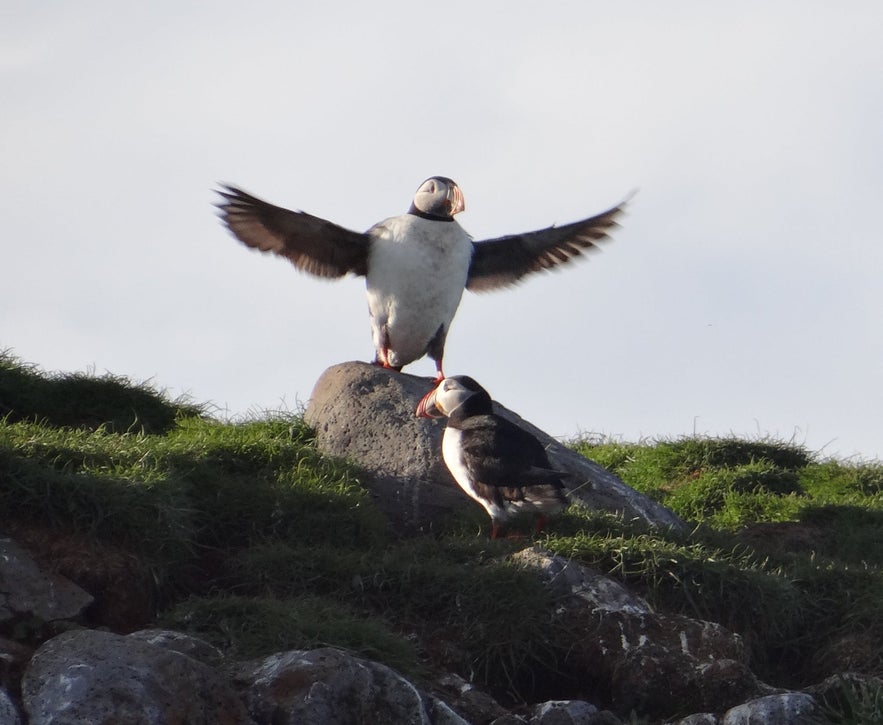
When puffins are nesting, they are often easy to spot and surprisingly comfortable around people. In many places, visitors can get quite close without the birds reacting much at all. That makes puffin watching feel very special and personal.
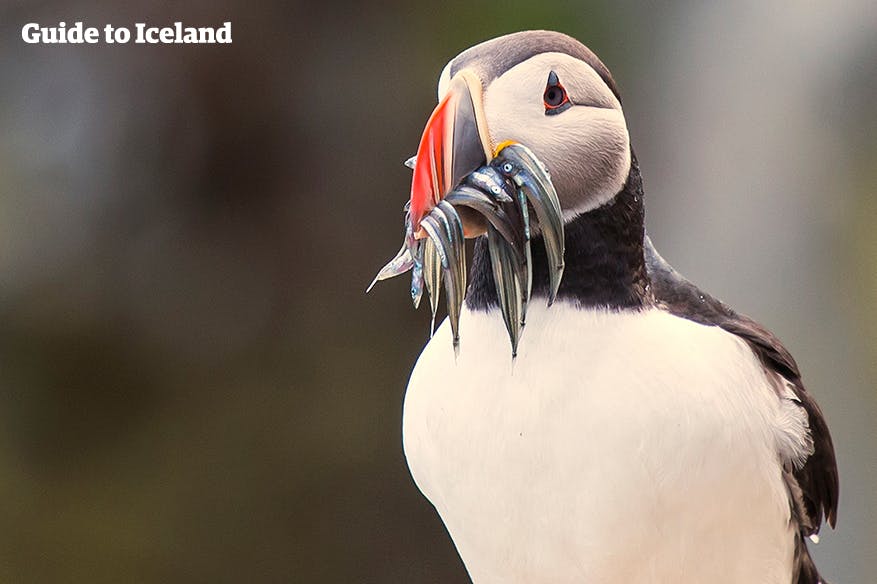 At the same time, this closeness means it is important to be mindful.
When we spoke with Dr. Erpur S. Hansen, he noted that this tolerance is highly dependent on whether the birds are hunted in that particular colony.
“Tourists cause disturbance in colonies where there is hunting. The puffins are scared of people, but they don’t differentiate between tourists and hunters.”
— Dr. Erpur S. Hansen, Director of South Iceland Nature Research Centre
In other words, in hunted colonies, visitors can cause real stress to the birds simply by being there. Puffins are wild animals, and small actions can make a big difference.
Keeping a respectful distance and following a few basic guidelines helps ensure the birds stay calm and the experience remains positive for everyone (including the birds).
-
Approach calmly and slowly - Move quietly and avoid sudden movements. Puffins are usually relaxed around people, but sudden noise or rushing can disturb them.
-
Stay back from the cliff edges - If watching puffins from above, do not stand right at the edge. Puffins dig burrows into soft ground, and stepping too close can collapse a nest. Cliff edges can also be dangerous for visitors, especially in areas hundreds of feet or meters high.
-
Do not touch puffins - Never try to touch a puffin unless it is clearly injured or lost and in need of help. Puffins are wild animals and should be left undisturbed whenever possible.
-
Keep a distance when watching from a boat - Boat tours should keep a respectful distance from nesting areas. This is especially important for vessels with louder engines, which can stress the birds.
-
Avoid feeding puffins - Do not try to feed puffins. They are excellent hunters and do not need human food, which can harm their health and behavior.
Where to See Puffins in Iceland: A Summary
| Location | Region | Best Months | Land or Boat | From Reykjavík | Best For |
|---|---|---|---|---|---|
| Látrabjarg cliffs | Westfjords | May–Aug | Land | ~6 hrs drive | Closest land approach in Iceland |
| Westman Islands (Vestmannaeyjar) | South Coast | Apr–Aug | Both | ~2.5 hrs + ferry | World’s largest colony |
| Dyrhólaey rock arch | South Coast | May–Jun | Land | ~2.5 hrs drive | Easy day trip from Vík |
| Ingólfshöfði Cape | Southeast | May–Aug | Land (tractor tour) | ~4.5 hrs drive | Adventurous, low-crowd visit |
| Tjörnes Peninsula | North Iceland | May–Aug | Land | ~6 hrs drive | Quiet alternative near Mývatn |
| Grímsey Island | North Iceland | May–Aug | Boat / flight | ~6 hrs + ferry | Arctic Circle bonus |
| Akurey & Lundey islands | Capital area | May–Aug | Boat | Departs city center | Half-day trip without driving |
| Borgarfjörður eystri | East Iceland | Apr–Aug | Land | ~9 hrs drive | Boardwalk viewing platform |
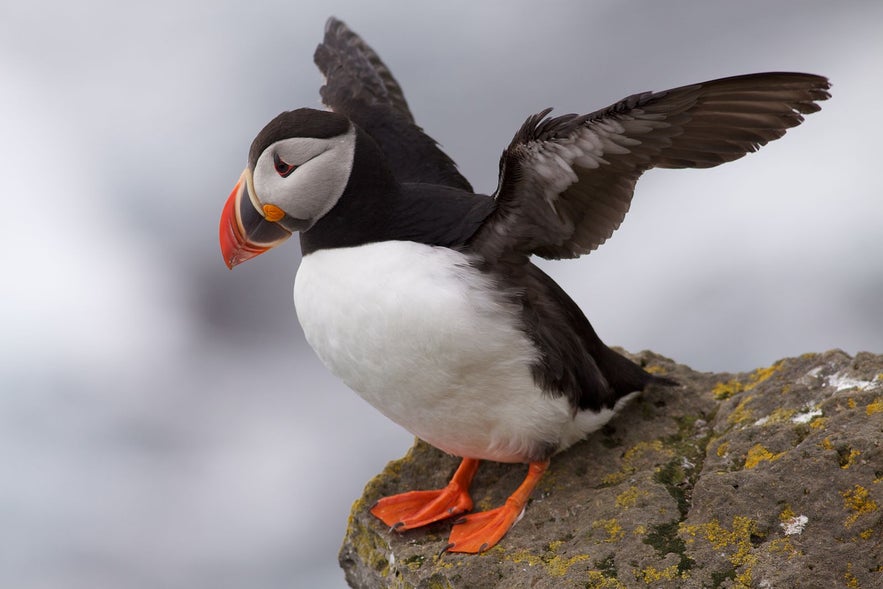
Iceland offers some of the best puffin watching in the world. Its dramatic coastlines, remote islands, and easy-to-reach clifftops are the best nesting spots for colonies. Whether it is the famous Westman Islands or the vast cliffs of Latrabjarg, each location offers its own memorable way to watch puffins going about their day.
A little planning makes all the difference. Visiting at the right time of year, knowing where to go, and choosing between land-based spots or boat tours helps turn a lucky sighting into a highlight of the trip. With the right approach, seeing puffins in Iceland can be one of the most rewarding wildlife experiences the country has to offer.
If puffin watching is just one part of your Iceland trip and planning feels a bit overwhelming, these Iceland itineraries can be a great place to start. They help you see how different experiences fit together, from wildlife spotting to scenic drives.
And for those who prefer everything organized in advance, vacation packages in Iceland quietly take care of routes, tours, and accommodations, making the journey feel smooth and stress-free.
What is the best time to see puffins in Iceland?
Are puffins in Iceland friendly to humans?
Are puffins in Iceland dangerous?
What is the best puffin tour from Reykjavik
What is the best puffin tour in Iceland?
Do I need binoculars to enjoy puffin watching?
Can you hold puffins in Iceland?
Are there tours that allow you to see puffins in Iceland up close?
Can you see puffins in Reykjavik?
Can you see puffins in Iceland in October?
Are puffin tours suitable for kids?
Is it ethical to eat puffins in Iceland?
Is seeing puffins in Iceland on your bucket list? Do you have any stories of encountering these birds in Iceland? Let us know in the comments below!

Hi, I’m Richard. I lived in Iceland for a decade, during which I traveled the country extensively and worked as a guide for several leading travel companies. I’m passionate about writing and sharing the best travel experiences Iceland has to offer so visitors can discover and enjoy the magic of this incredible country just like I did.