How many Arctic foxes live in Iceland? How did they come to live on the island? What are their typical habitats, and how can you spot one for yourself? Where in Iceland can you learn more about this incredible little canine and even grab a photograph? Read on to discover all there is to know about Iceland’s only native mammal, the Arctic fox.
The Arctic fox (Vulpes lagopus) is the only land mammal native to Iceland. These small, resilient animals have roamed the island for around 10,000 years, growing a dense coat that carries them through brutal winters.
The Hornstrandir Nature Reserve in the Westfjords offers your best chance to see an Arctic fox in Iceland. Our study of where to see Arctic foxes in Iceland looks at the country's main fox habitats and the areas with the strongest potential for sightings.
Accessible only by boat from Isafjordur, the reserve is home to Iceland’s largest Arctic fox population. You can join a fox-watching tour in Hornstrandir, where local experts know the best areas to spot these elusive animals.
Why You Can Trust Our Content
Guide to Iceland is the most trusted travel platform in Iceland, helping millions of visitors each year. All our content is written and reviewed by local experts who are deeply familiar with Iceland. You can count on us for accurate, up-to-date, and trustworthy travel advice.
Outside the Westfjords, travelers occasionally spot Arctic foxes on the Snaefellsnes Peninsula, in East Iceland, and across the remote Highlands. If you would rather guarantee a close-up, the Arctic Fox Center in Sudavik cares for rescued foxes.
This guide walks you through where Arctic foxes live, how to reach them, and the best places to stay in Isafjordur for easy access to Hornstrandir. Read on to plan your wildlife adventures in Iceland and maximize your chances of seeing the country’s only native land mammal.
Key Takeaways
-
Only native mammal: The Arctic fox (Vulpes lagopus) is the only land mammal native to Iceland. It arrived on its own at the end of the last Ice Age, around 10,000 years ago.
-
Population: About 4,700 adult Arctic foxes live in Iceland in spring 2024. The population has been monitored since 1979.
-
Size: Adults weigh 7 to 11 pounds (3 to 5 kilograms) and stand roughly 10 to 12 inches (25 to 30 centimeters) at the shoulder.
-
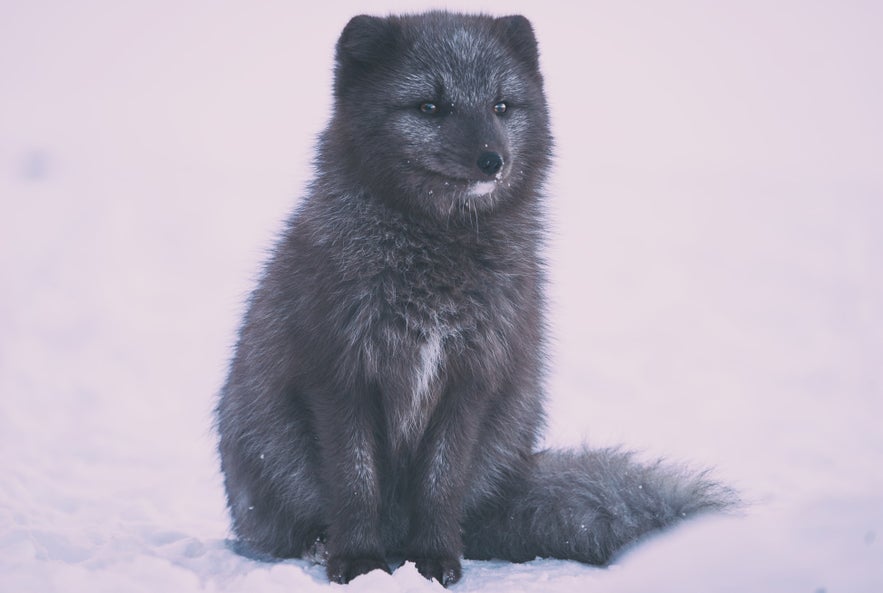
Coat colors: In Iceland, only about one-third of Arctic foxes turn white in winter. The rest keep a brown or gray “blue morph” coat all year.
-
Where to see them: The Westfjords, and especially Hornstrandir Nature Reserve, offer the best chance in the wild. The Arctic Fox Center in Sudavik Village keeps two rescued foxes you can meet.
-
Best time to visit: June and July, when Arctic fox cubs are at their dens and boats run to Hornstrandir Nature Reserve. August is still good for sightings.
What Are Arctic Foxes in Iceland
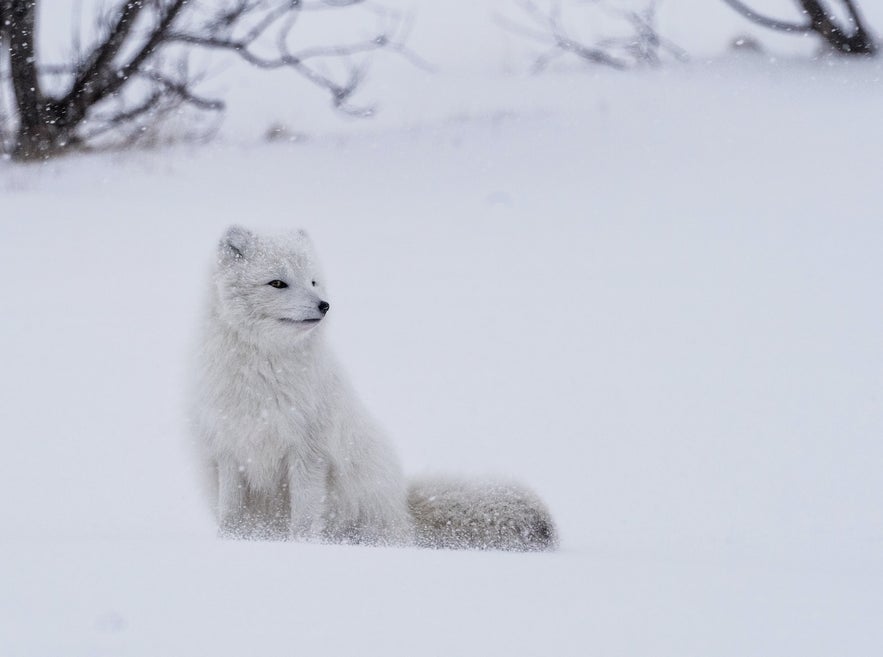
Photo by Jonatan Pie
The Arctic fox is Iceland’s only native mammal, meaning it reached the country without human help. Known locally as tófa or refur, Arctic foxes have evolved to thrive in Iceland’s harsh northern climate.
There are four subspecies of the Arctic fox: the Iceland Arctic fox, the Greenland Arctic fox, the Pribilof Islands Arctic fox, and the Bering Islands Arctic fox. You can recognize it by its compact body, short legs, small rounded ears, and thick fur. Its multi-layered coat can be white, brown, or gray, and it changes with the seasons for camouflage.

They have even been observed forming small hunting packs to better scour the countryside for food. A group of Arctic foxes is known as a “skulk” or “leash.” Arctic foxes typically live three to six years in the wild, though they can reach around 14 years in captivity.
Once hunted for their fur and to protect livestock, Arctic foxes are now protected by law, with hunting allowed under specific exemptions outside protected areas. The species remains an important part of Iceland's wild landscapes and natural heritage.
How Did Arctic Foxes Get To Iceland

The Arctic fox reached Iceland on its own at the end of the last Ice Age. Researchers from the University of Durham in the UK believe the foxes crossed frozen sea from Greenland and Scandinavia, using sea ice as a bridge thousands of years ago. Genetic research supports this theory, making the Arctic fox Iceland’s oldest native land mammal.
Every other land animal arrived later. Settlers brought cattle, sheep, and horses, while 18th-century traders introduced reindeer in a failed attempt to start a venison industry. The Icelandic horse may feel more closely tied to the country, but it was the fox that walked these lands first.
Where To See Arctic Foxes in Iceland
Hornstrandir Nature Reserve in the Westfjords is the best place to see Arctic foxes in Iceland, thanks to a hunting ban that has been in place since 1994. With almost no permanent residents and abundant seabirds as a food source, Arctic foxes are often much less afraid of humans than elsewhere in Iceland.
The most reliable way to see them is on a guided Arctic fox tour in Hornstrandir Nature Reserve or the Arctic Fox Center in the village of Sudavik. For a deeper wilderness trip, a 2-day Westfjords hiking tour also gives you a chance to spot foxes foraging along the coast.
Outside Hornstrandir, Arctic foxes turn up occasionally in wild areas like the Snaefellsnes Peninsula, Eastfjords, Vatnajokull National Park, and Thorsmork. Sightings here are unpredictable, so treat them as a bonus rather than something to expect.
Best Time To See Arctic Fox in Iceland

Photo by Jonatan Pie
June to July is the best time to see Arctic foxes in Iceland, although sightings are still possible in August. Long daylight hours, active fox dens with pups, and regular boat service to Hornstrandir make it the most reliable season for a sighting. Scheduled boats to Hornstrandir run from June to August, while guided Arctic fox and hiking tours can also run into September.
For a winter Arctic fox sighting in Iceland, travel to the Westfjords and stop by the Arctic Fox Center in Sudavik. Because access to Hornstrandir is restricted in winter, you would need to join guided wildlife tours or a photography expedition when the weather permits.
How To See Arctic Foxes in Iceland

Photo by Jonatan Pie
The best way to see Arctic foxes in Iceland is to join a guided tour in the Westfjords. Local guides know where the foxes are most active and how to watch them responsibly, which gives you a far better chance of a sighting than heading out on your own.
A 3-day Arctic fox midnight sun tour is a popular choice, pairing peak fox-watching season with the long daylight of summer. Keep in mind that Hornstrandir hiking tours run only from May through July, and occasionally into August, when the reserve is accessible by boat.
If you want a guaranteed close-up encounter, visit the Arctic Fox Center in Sudavik on a tour to the Arctic Fox Center. Founded in 2007, this nonprofit research center is the only institution in the world dedicated solely to the Arctic fox. Inside, you will find research displays and exhibits, and outside there is an enclosure with rescued live foxes.
Biology of the Arctic Fox in Iceland

The Arctic fox, also referred to as a snow fox, polar fox, or white fox, is a small carnivorous mammal built for extreme cold. It weighs 7 to 11 pounds (3 to 5 kilograms) and grows a thick coat that can be white, blue, or brown.
The Arctic fox tolerates cold better than almost any other Arctic mammal. Its coat is the thickest of any Arctic mammal and keeps it comfortable in temperatures as low as -58 F (-50 C). It stays warm through a combination of adaptations working together:
-
A dense, insulating coat with a warm undercoat
-
A thick layer of body fat built up before winter
-
Fur that covers even the pads of its paws
-
A specialized blood circulation system that limits heat loss through its feet

Photo by Jonatan Pie
The fox prepares for the cold season in advance. Through autumn, it packs on fat reserves and can increase its body weight by as much as 50 percent.
Its large, bushy tail, or brush, helps too. Measuring about 14 inches (36 centimeters) long, the tail aids balance while hunting and wraps around the fox like a blanket when it rests.
Unlike most sub-Arctic animals, the Arctic fox does not hibernate. Instead, it stays active and adapts to its surroundings, and the clearest sign of this is how its coat shifts color with the seasons in Iceland. Only about a third of Icelandic foxes turn white in winter, while the rest keep brown and gray fur that blends into the country’s rocky, snow-patched landscape.
Habitat of Arctic Foxes in Iceland

The Arctic fox lives across Iceland, but their numbers are highest where the birds are. Biologists track fox density by seabird density, which points to the Westfjords, where dramatic bird cliffs give the resident foxes a steady supply of eggs and fresh meat.
Hornstrandir is the standout spot, since foxes are protected there and roam freely without human intrusion. Each fox holds a territory of up to 3.5 square miles (9 square kilometers), but it will range well beyond that to find food.
Diet of Arctic Foxes in Iceland
Arctic foxes in Iceland are opportunistic feeders that eat birds, eggs, small mammals, and carrion. Their prey includes voles, mice, seal pups, and flightless young birds. When food is scarce, they turn to berries or even feces.
The Arctic fox is a skilled hunter, too. Watch closely, and you might catch one leaping into the air, curling its body, and diving snout-first into the snow to reach prey below. Its bushy tail helps here, giving the fox balance and quick movement as it pounces.

Outside Iceland, where larger predators like wolves and polar bears roam, Arctic foxes often scavenge the carrion these bigger animals leave behind. A fox will trail a predator for miles, waiting for an easy meal, and end up gnawing on the remains of a seal or caribou.
The Arctic fox can cover remarkable distances in search of food. In 2008, one fox from Bylot Island in northern Canada traveled about 3,100 miles (5,000 kilometers) in a single year. Scientists still have much to learn about how these animals use their habitat.
Reproduction and Behavior of Arctic Foxes in Iceland
Arctic foxes are monogamous animals, meaning that they have one mating partner for life. Mating takes place mainly in March, and most Arctic fox cubs in Iceland are born in late May. Arctic foxes typically have one litter per year.
Litters, also called kits, usually contain 5 to 12 pups, known as whelps (Arctic fox puppies). In the past, up to 25 offspring have been recorded in a single litter.
Whelps are raised in intricate burrows that can have up to a hundred openings. Many of these dens are centuries old and are reused by generation after generation of foxes, even though they sit empty for much of the year.

Each active den is usually occupied by a social family group consisting of the breeding male, the breeding female, the new litter of pups, and a second, non-breeding female vixen that helps raise and wean the litter. Dens are usually built about 1.2 miles (2 kilometers) apart to reduce competition between families.
Even so, raising a full litter is rare, especially when food is scarce. The weakest pups are often abandoned so the strongest can survive.
Arctic fox cubs remain at or near the den through the summer, making June and July good months for seeing them around their dens. They reach full size at about four months old, although they continue developing their hunting skills as they become more independent.
Threats to Arctic Fox Population

Monitoring of Arctic fox populations in Iceland began in 1979. Numbers were at a low of about 1,200 around 1980, then rose to a peak of just under 9,000 in fall 2007. Since then, the population has declined, with RÚV reporting a roughly 40% drop in Iceland’s fox population between 2011 and 2024.
What’s particularly unusual is how this diminishing population doesn’t fit the natural trend; animal populations will often rise and fall every few years or so, depending on the habitat and food scarcity.
That’s not to suggest population numbers have yet reached a critical level; Arctic foxes are classified as “Least Concern” by wildlife conservation agencies, meaning there is no threat of imminent extinction.
Hunting the Arctic Fox in Iceland

While the Arctic fox is protected in Hornstrandir Nature Reserve, it is still legally hunted in many other parts of Iceland. Hunters say the practice helps protect livestock and eider duck populations.
Foxes were once hunted for their prized fur, but the rise of mink fur farms has made fox fur nearly worthless. Den hunting continues in some areas, a practice in which every animal in the den, young or old, is slaughtered.
According to Iceland Review, the Environment Agency of Iceland says fox hunting no longer serves its purpose and costs more each year. Livestock does not appear to suffer, partly because sheep no longer give birth out in open pastures.
The Arctic Fox Center in Iceland

Photo by MoZie, from Wiki Creative Commons. No edits made.
The Arctic Fox Center (Melrakkasetrið) is a nonprofit research and exhibition center opened on September 15, 2007, in the fishing village of Sudavik in Iceland’s Westfjords. It sits in a renovated 19th-century farmstead, about 20 minutes from Isafjordur.
The center grew out of the fieldwork of Arctic fox experts Professor Páll Hersteinsson and Dr. Ester Rut Unnsteinsdóttir. Its exhibits include display boards of scientific research and photography, along with taxidermied foxes that show the animal’s real size and features.
Visitors can also meet two live Arctic foxes, Ingi and Mori. Both are blue morphs that were rescued as pups after their parents were killed in a legal hunt in 2015. Raised by people, they are curious and friendly, and they have become the center’s ambassadors.
Operating Hours
-
May and September: 9:00 AM to 4:00 PM
-
June to August: 9:00 AM to 6:00 PM
Tips for Responsible Arctic Fox Watching in Iceland

Photo by Jonatan Pie
For ethical Arctic fox watching in Iceland, head to the Hornstrandir Nature Reserve in the Westfjords, where these native mammals are legally protected. Watching them there is a privilege, so a few simple rules keep both the animals and their fragile habitat safe:
-
Never feed wild foxes. Feeding dulls their natural hunting instincts, exposes them to human illnesses, and teaches them to rely on people rather than the land.
-
Keep your distance from dens. Do not approach or corner a den site. If an adult fox starts alarm-calling, a sharp barking sound, you are too close, so back away slowly to avoid stressing nursing mothers.
-
Respect the denning season. Give active breeding dens a wide berth, especially in the peak summer months when pups are being raised.
-
Leave no trace. Pack out all your trash, including food scraps like fruit peels. Plants in this cold environment grow very slowly and break down poorly, so even organic waste lingers for years.
Plan Your Arctic Fox Adventure in Iceland

The Arctic fox is a true survivor and one of the most rewarding animals to see in Iceland. You can meet Ingi and Mori at the Arctic Fox Center or track a wild fox across Hornstrandir Nature Reserve. Either encounter ranks among the country’s most unique experiences. Start planning with our wildlife tours in the Westfjords.
Did you enjoy our article about Arctic foxes in Iceland? Did you get a chance to see one, or perhaps take a visit to the Arctic Fox Center in the Westfjords? Make sure to leave your comments and queries in the comment section below.
Is the Arctic fox the only native mammal in Iceland?
How many Arctic foxes live in Iceland?
Where can you see Arctic foxes in Iceland?
What is the best time of year to see Arctic foxes in Iceland?
Are Arctic foxes dangerous to humans?
What do Arctic foxes eat in Iceland?
How big is an Arctic fox?
Why are some Arctic foxes in Iceland not white?
How long do Arctic foxes live?

Michael Chapman is a British travel writer living in Reykjavík. A former scuba and lava cave guide, he draws on firsthand experience to write about Iceland’s nature and culture. He’s also the author of Hidden Iceland (2020).