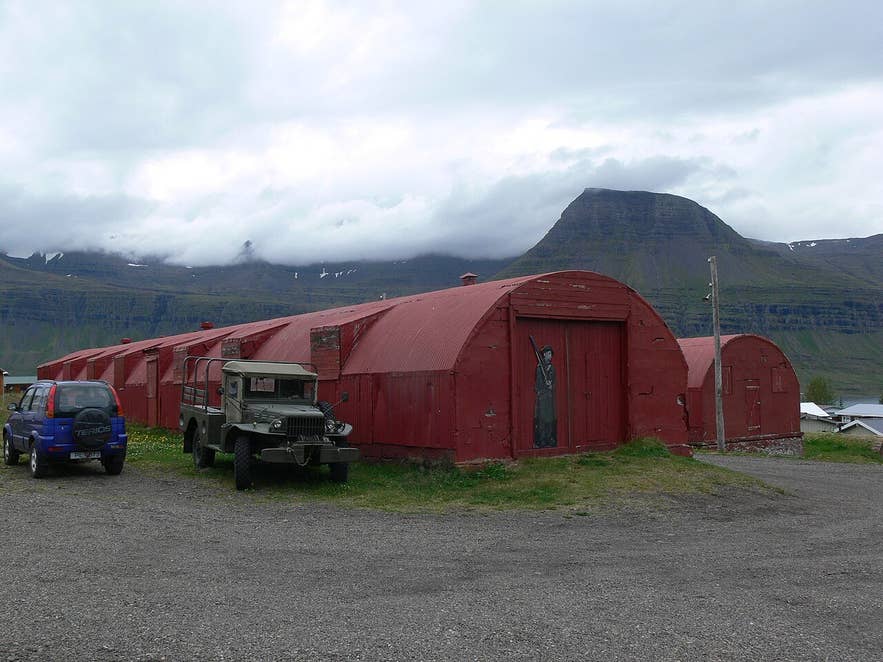
Wartime Museum Nissen huts, Reyðarfjörður. Photo: Christian Bickel, CC BY-SA 2.0 DE
The Icelandic Wartime Museum (Íslenska stríðsárasafnið, "the Icelandic war-years museum") stands at Heiðarvegur 37 in Reyðarfjörður, a town of about 1,450 people at the head of Reyðarfjörður, the largest fjord on Iceland's east coast.
The museum tells the story of 1940–1945, when this fishing village of some 350 inhabitants became one of the largest Allied bases in Iceland and was home to more than a thousand foreign soldiers at a time.
It opened in 1995 in surviving buildings of a wartime hospital camp above the town and is run by the culture office of Fjarðabyggð municipality.
Key Takeaways About Íslenska stríðsárasafnið
- WWII museum in surviving Nissen huts of an Allied hospital camp at Heiðarvegur 37, Reyðarfjörður; opened 1995, run by Fjarðabyggð
- British, Canadian, Norwegian and American troops were based here 1940–1945, over 1,000 at a time in a village of 350
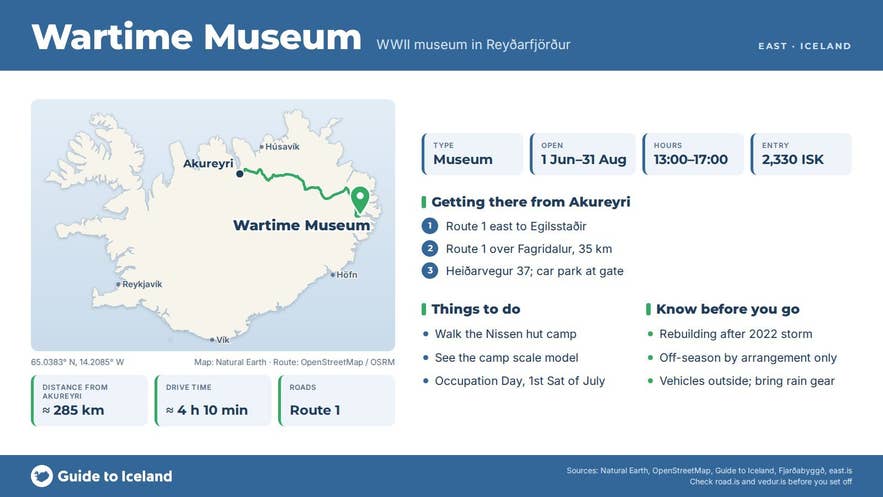
- Open daily 13:00–17:00, 1 June–31 August; by arrangement the rest of the year (sofn@fjardabyggd.is; opening fee applies)
- Adults 2,330 ISK, children free (2026); ticket valid a year at all four Fjarðabyggð museums
- Site being rebuilt after the 2022 storm; new premises due in phases from summer 2027, finishing around 2028. Occupation Day: first Saturday of July
Why visit the Icelandic Wartime Museum
Iceland was occupied by Britain on 10 May 1940, and Reyðarfjörður itself was occupied on 1 July 1940. Its deep, sheltered harbour and position on the east coast made it strategically valuable, and troops from four nations were stationed here over the following years. The British arrived first, together with a Canadian machine-gun battalion.
A Norwegian air force squadron operated four flying boats from the fjord. The Americans were the largest contingent for most of the war. The soldiers lived in clusters of Nissen huts around the village, while officers were billeted in the better houses in town.
The effect on a community of 350 people was enormous. The museum's exhibitions look at this from both sides: the ordinary soldier in camp and the villager whose quiet fjord suddenly had restaurants, a cinema and regular dances.
There is a scale model of the camp, original soldiers' and officers' quarters, a pub and cinema hall, and a large collection of objects and photographs covering everything from the threat of attack to daily routine and 1940s fashion. Military vehicles stand outside.
When the troops left in 1944–1945 they abandoned a great deal of equipment, and those leftovers became the core of the collection.
The buildings themselves are part of the exhibit. The Nissen huts were built as a hospital camp (spítalakampur) meant to receive wounded from an Allied invasion of Norway that never happened.
A storm on 25 September 2022 wrecked the site, destroying two of the three surviving original huts and damaging the roof of the exhibition building, and the museum stayed closed to visitors throughout summer 2023 before reopening in June 2024.
Fjarðabyggð has since decided to build new exhibition and event premises where the huts stood, with a more spacious exhibition area and a multipurpose hall.
Ground was broken in February 2026; in August 2026 the museum said the first phase should be ready for summer 2027, with a new permanent exhibition to follow and the whole project due to finish around 2028. Expect the site to change over the next few seasons.
Every year on the first Saturday of July the town holds Hernámsdagurinn, Occupation Day, at the museum to mark 1 July 1940, typically with a history walk from the town centre up to the museum, talks, wartime music and a film in the cinema hut.
How to get to the Icelandic Wartime Museum
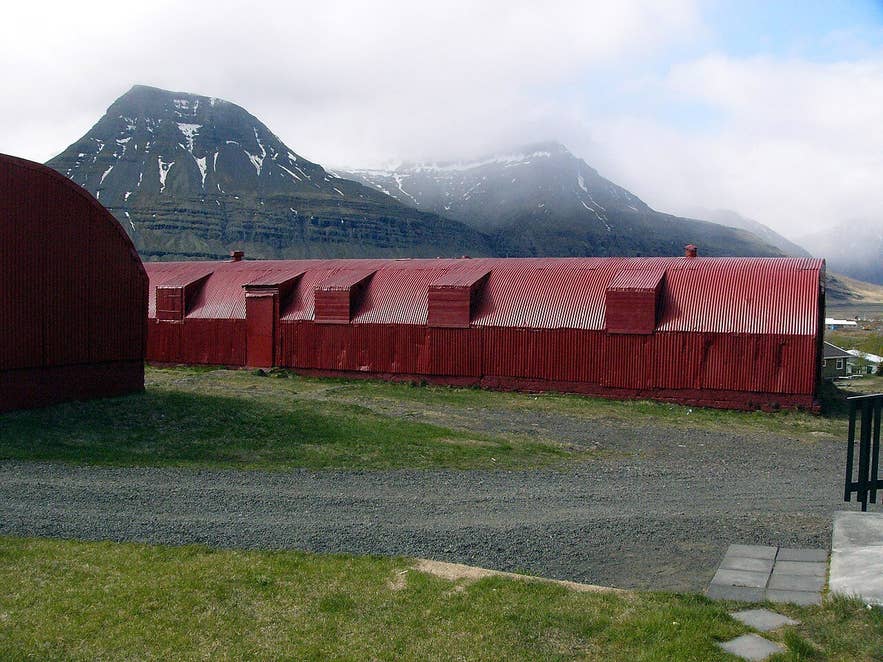
Nissen huts of the Wartime Museum. Photo: Christian Bickel, CC BY-SA 2.0 DE
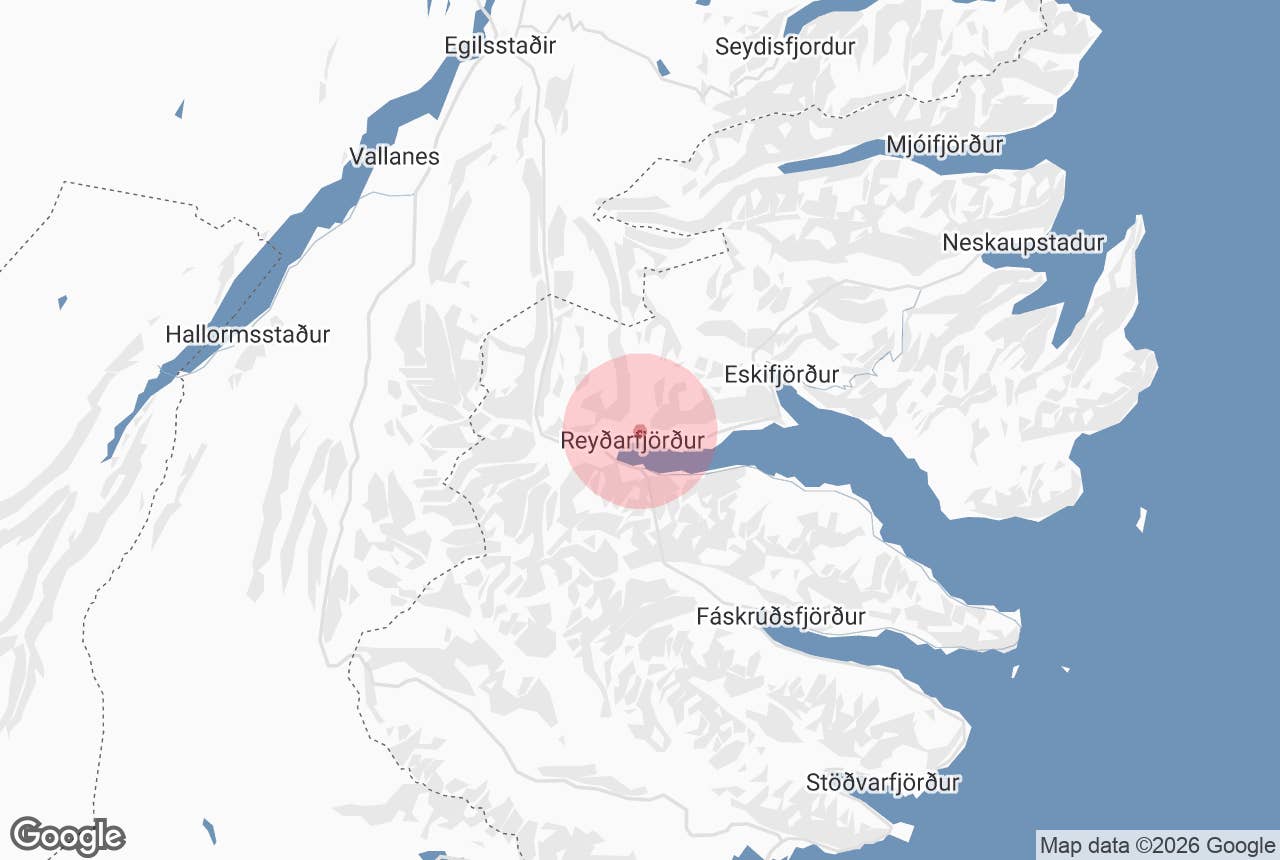
Reyðarfjörður is on Route 1 (the Ring Road), about 35 kilometres (30–35 minutes) southeast of Egilsstaðir over the Fagridalur pass, and is the hub of the Fjarðabyggð road network: Route 92 continues east to Eskifjörður and the Norðfjörður tunnel.
The Ring Road continues south through the Fáskrúðsfjörður tunnel along the coast (this coastal stretch has carried the Route 1 number since 2017).
From Reykjavík it is roughly 620–680 kilometres depending on the route, a drive of eight to nine hours or more, so most visitors come as part of a Ring Road circuit or fly to Egilsstaðir Airport, which has scheduled flights from Reykjavík.
In town, Heiðarvegur runs up the hillside above the main street, and the museum is signposted. There is a car park at the entrance and the walk to the door is short; the approach is being rebuilt along with the museum. The road is paved and open year-round; no 4x4 is needed.
Best time to visit
The museum keeps regular hours in summer only: 1 June to 31 August, daily 13:00–17:00. From September to May it opens by arrangement; email sofn@fjardabyggd.is in advance. Note that Fjarðabyggð charges a base fee for opening a museum outside regular hours, on top of admission.
Occupation Day on the first Saturday of July is the liveliest time to come. Reyðarfjörður has a reputation for fog and rain, but on clear summer days it often records some of the highest temperatures in Iceland.
Safety and practical tips
- Admission (from 1 May 2026): adults 18–67 2,330 ISK; seniors 67+, students and disabled visitors 1,940 ISK; groups of 20 or more 1,940 ISK per person; children 0–17 free; ICOM and FÍSOS members free.
- Allow about an hour. Much of the exhibition is indoors; the vehicles and hut sites are outside, so bring a rain jacket.
- Building work is under way on the site after the 2022 storm. Check the Fjarðabyggð museums page or ask at the Reyðarfjörður information point for the current state of the exhibition before planning a special trip.
- Fuel, shops, a swimming pool and restaurants are in Reyðarfjörður itself, a few minutes' walk down the hill.
- The museum is one of four Fjarðabyggð museums, and the ticket is valid for a year at all four (the Museum House in Neskaupstaður, the East Iceland Maritime Museum in Eskifjörður and the French Museum in Fáskrúðsfjörður).
When is the Icelandic Wartime Museum open?
How much is admission?
Why was there a military base in Reyðarfjörður?
Is this the same as the War and Peace Museum?
Is the museum open after the 2022 storm damage?
Nearby attractions
- Reyðarfjörður Village – 0.5 km, the town itself, a filming location for the TV series Fortitude.
- Búðará River and Canyon – 0.3 km, a short walk from the museum.
- Búðarárfoss Waterfall – 0.6 km.
- Hólmanes Nature Reserve – 9 km, the headland between Reyðarfjörður and Eskifjörður.
- Eskifjörður – 9 km, with the East Iceland Maritime Museum.
- Egilsstaðir – 35 km by road, the regional centre with the airport.
- Petra's Stone Collection – about 28 km in a straight line, in Stöðvarfjörður.
Tours that visit the Icelandic Wartime Museum
- 11-Day Self-Drive Tour of the Complete Ring Road & the East Fjords at a Relaxed Pace – day 4 of this self-drive package passes through Reyðarfjörður and suggests the Wartime Museum as a stop for history-minded travellers.