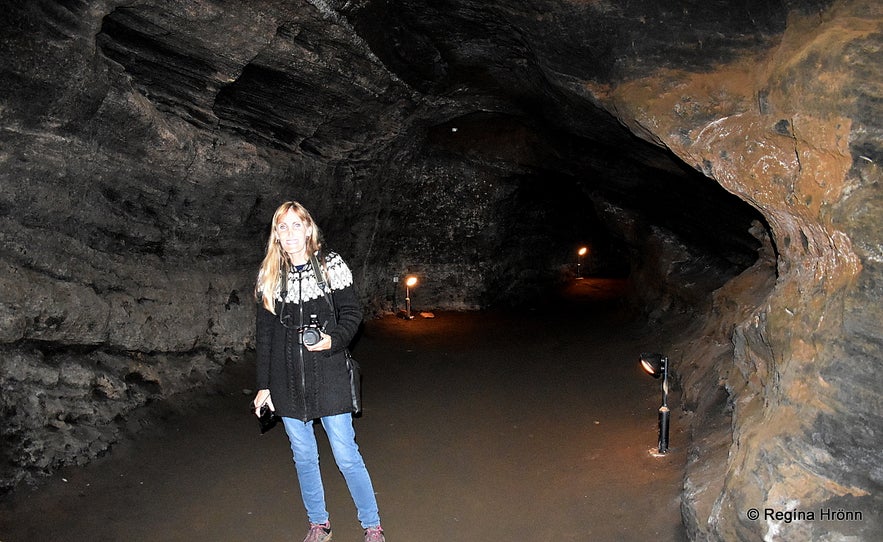
A couple of years ago, we visited Hellnahellir cave at Hellar in Landsveit upcountry in South Iceland. Hellnahellir is the longest manmade cave in Iceland and one of the most remarkable antiquities in my country.
Top photo: Inside Hellnahellir cave
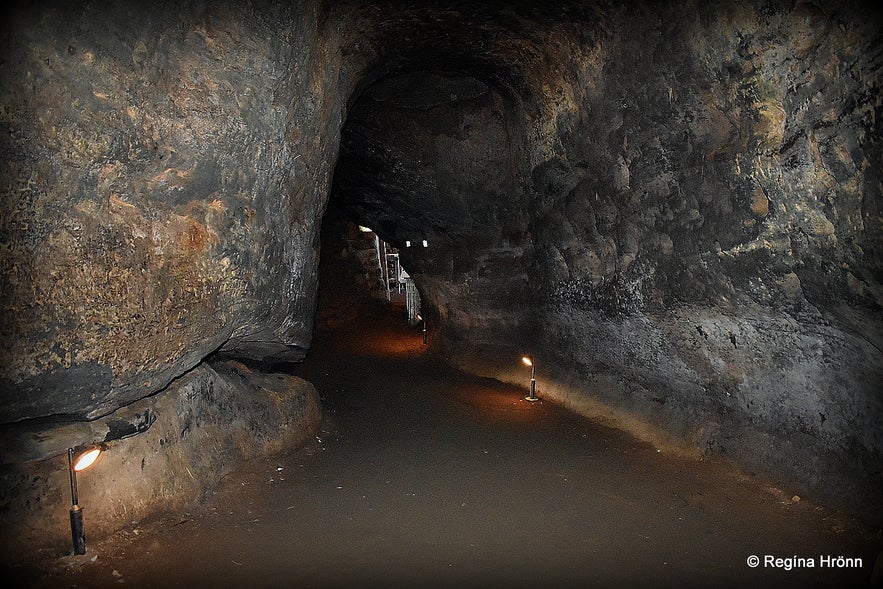
Inside Hellnahellir cave
The farm Hellar is built on Hellnahóll (Cave Hill) beneath Mt. Skarðsfjall, and the Hellar farm is first mentioned in the muniments of Skarðskirkja church (1332).
Here at Hellar, there are three caves that give a name to the farm Hellar - Caves.
They are man-made sandstone caves, and the largest, Hellnahellir cave, is the longest cave in Iceland, carved into sandstone.
It is almost 50 meters long, but it has remained a hidden secret, as it were.
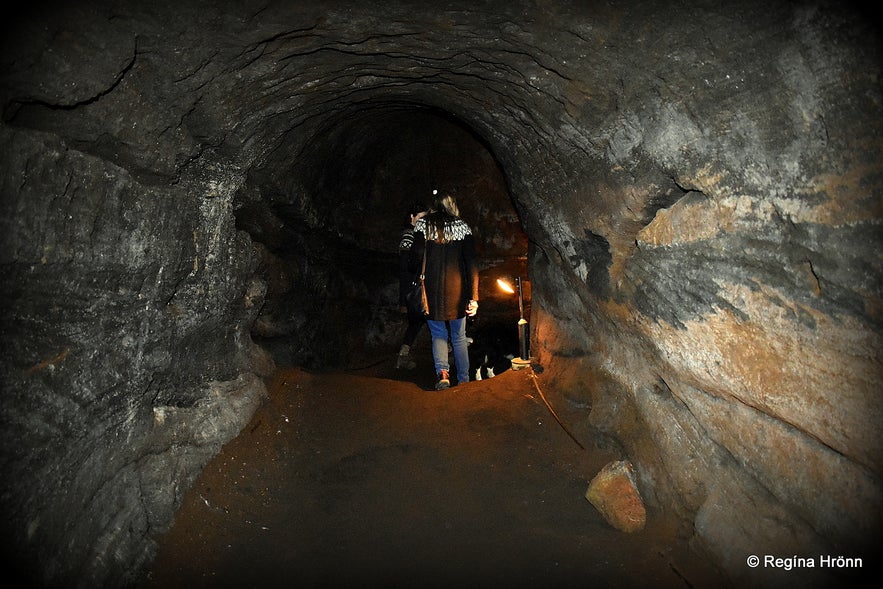 Walking into the darkness of the cave via Göngin - the Corridor
There are three caves here at Hellar: Hellnahellir, Lambahellir, and Hestahellir. And there seem to have been more caves called Kirkjur or Churches, but they have collapsed.
Children were told to keep quiet here by Kirkjur, and no racket was allowed. The same rule applies to elf spots in my country.
If we were to translate the names of the caves into English, they would be the Cave of Caves, the Cave of Lambs, and the Cave of Horses.
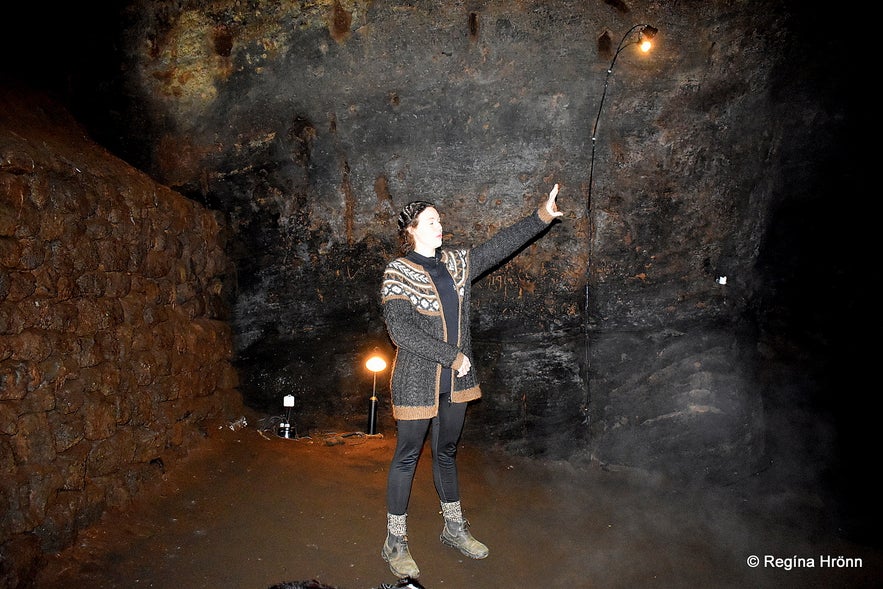
The farmer showed us the cave
Like the popular Caves of Hella, which are right by the ring road by Hella town, and other caves found in South Iceland, it is not known exactly how old they are or when and why they were made.
But they seem to predate the settlement of Iceland.
Landnámabók, the Book of Settlements of Iceland, tells us that there were some Irish monks here when the Vikings arrived in 874 AD, called Papar.
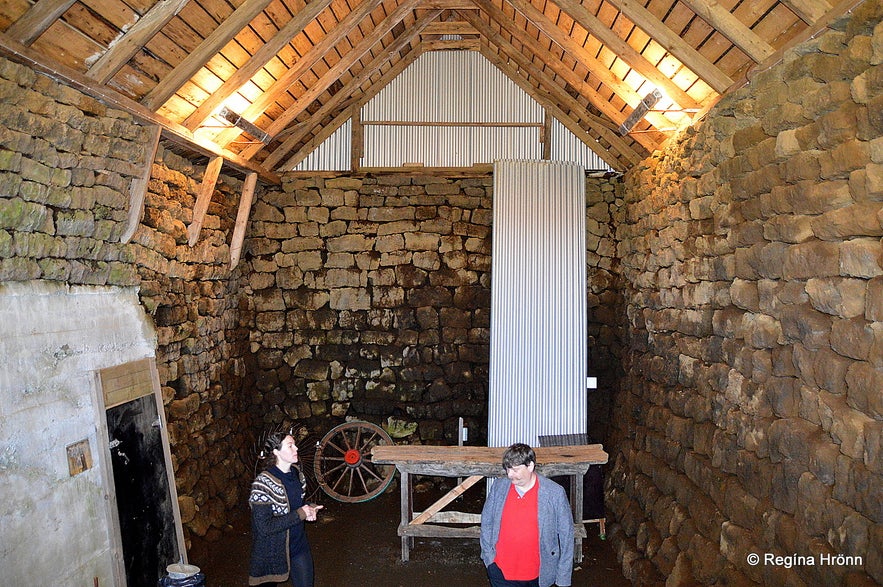 We entered the cave through the barn
They lived in sandstone caves in Ireland, so they might have inhabited these caves before the Vikings arrived.
And they might have arrived in Iceland some 150 years before the Vikings (ref. Grúsk - Árni Óla, page 36). So this preserved cave at Hellar farm is most likely more than a thousand years old.
It is written that the Papar left when the Vikings arrived and left some of their Christian belongings behind, but we only have the word of our ancestors for that; they might as well have been killed.
At least we know people shunned the caves, as if they were afraid of them. So what is the story here that we don't know about?
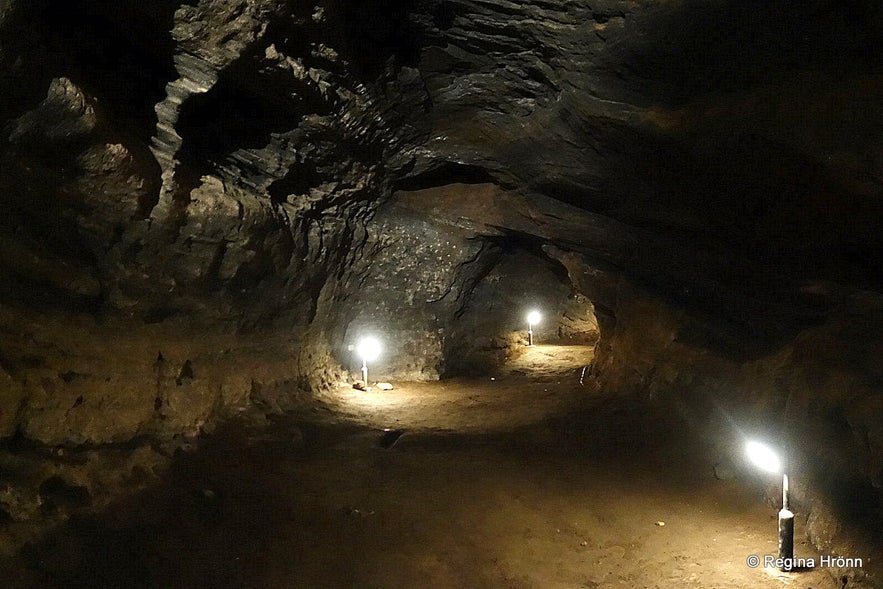
Hellnahellir cave
We were visiting the Caves of Hella on this beautiful summer day, and after our visit, we called the farmers at Hellar and asked if we could get guidance in the Hellnahellir cave, as I had long wanted to see it.
We paid an entrance fee of ISK 1,200. I don't know if it is possible to book a tour anymore, as their website has been down for a long time, and their Facebook page hasn't been updated.
But I will show you what the caves look like in this travel blog and tell you about the folklore associated with them.
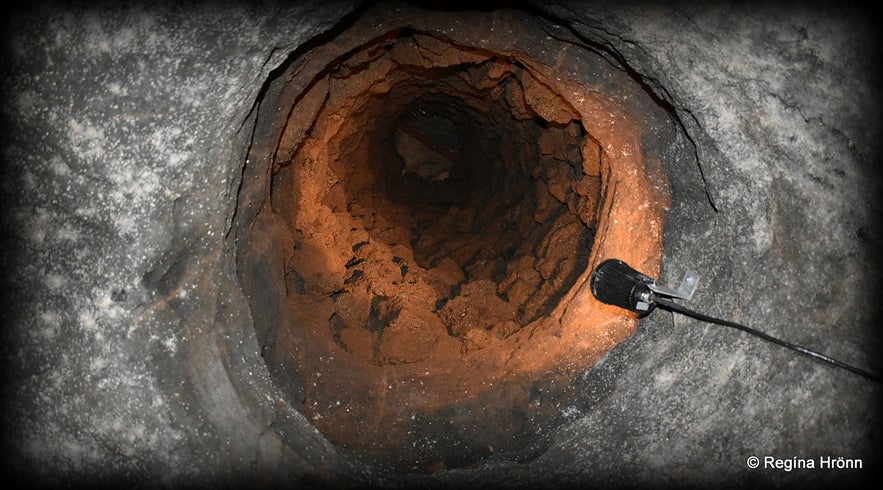 Vents in the ceiling
In the olden days, the caves were used, for example, as storage rooms for hay.
The cave has five chimneys or openings in the ceiling that might have let out smoke from fires and shed light inside the cave. Hay was shoveled into the cave through these openings.
Hellnahellir cave is 50 meters long and almost 200 square meters. It is divided into three caves called Heyhellir, Göngin, and Gamlihellir.
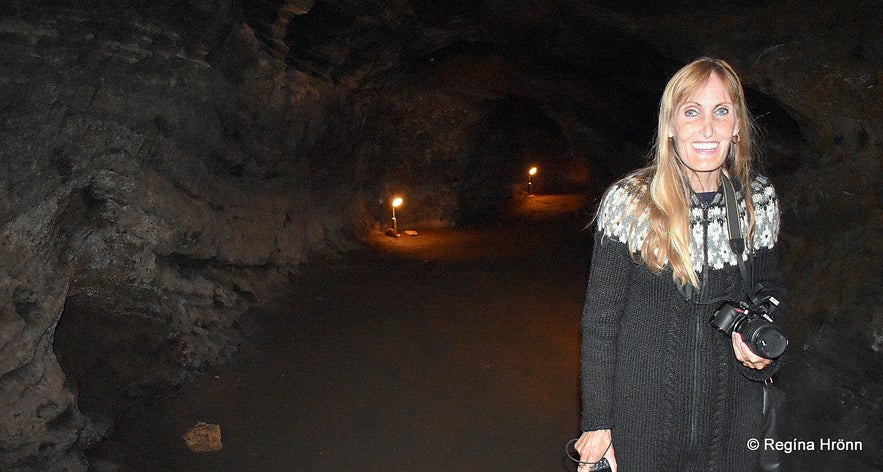 We used flash inside the cave as it was so dark
Translated into English, the names of the caves are the Cave of Hay, the Corridor, and the Old Cave, and the Corridor connects the other two caves.
There are many carvings on the walls of the caves, but none in the Corridor.
Heyhellir - The Cave of Hay
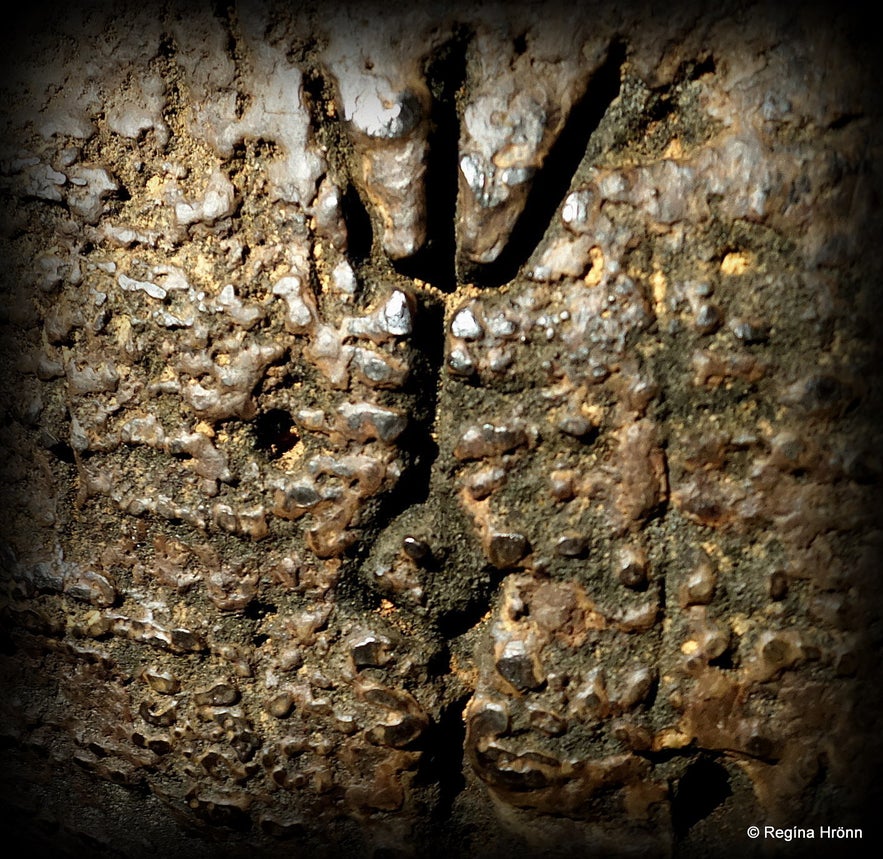
An engraving on the wall in Hellnahellir cave, which might be a home mark
We first examined Heyhellir, which has a ceiling up to 3-4 meters high.
Here you will find Dísukrókur, the Corner of Dísa, where it is believed that a mentally challenged woman, Dísa by name, was tied to the wall of the cave and kept there.
We don't know who Dísa was, but some say that this corner is haunted. Life for the mentally challenged was not easy in those days.
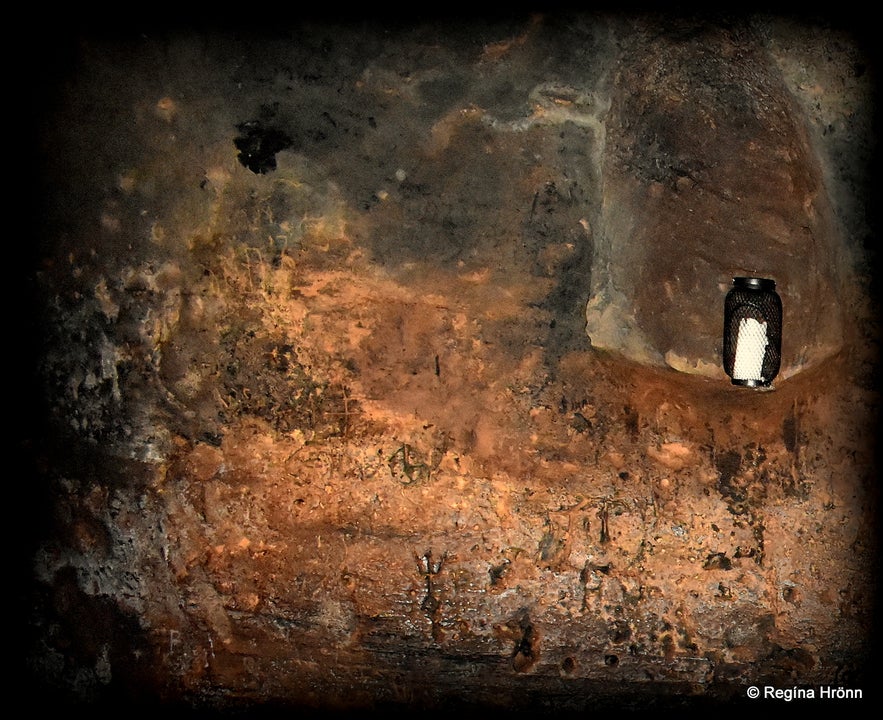 Dýrlingsstallurinn - the Niche of the Saint with flash
In my photo above and below, you will see Dýrlingsstallurinn - the Niche of the Saint. It is carved into the wall at a height of almost 2 meters.
The niche resembles a church window. It is 70 cm wide, 75 cm deep, and 1 meter tall (ref. Manngerðir hellar á Íslandi).
The story goes that the Irish monks (or whoever they were) used it as a place of worship and placed an icon in the niche.
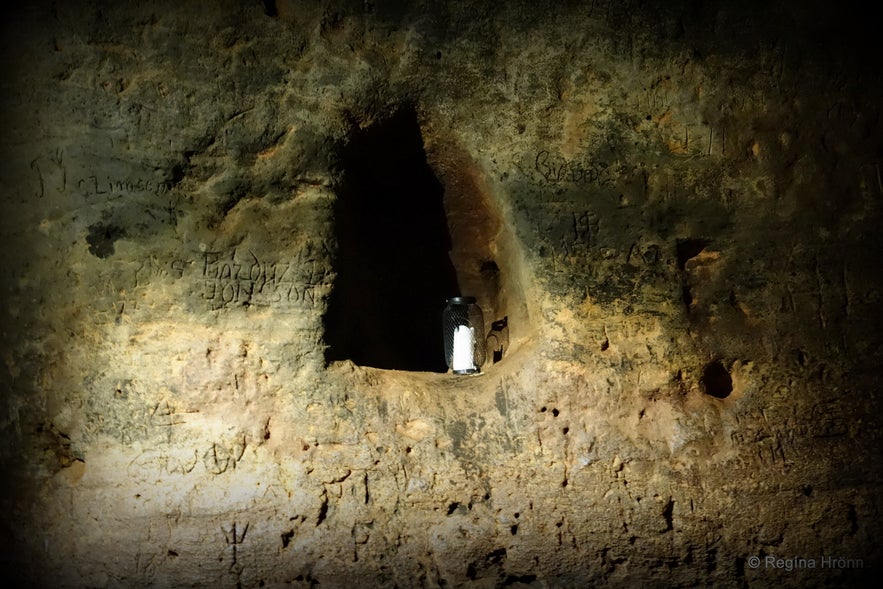 Dýrlingsstallurinn and various carvings on the wall
There are many dates, names, and signs carved into the wall, some of which are house marks (búmerki), and some of the signs look like Greek letters.
It is believed that one of the words in Roman letters is ábóti, meaning "abbot". Some of the engravings are the initials of the farmers.
In the cave, you will also find ogham engravings (ancient Irish script).
Somewhere in these caves at Hella, IHS (Iesus Hominum Salvator) is carved on one wall. I so wish I knew more about the people who used these caves and made these engravings.
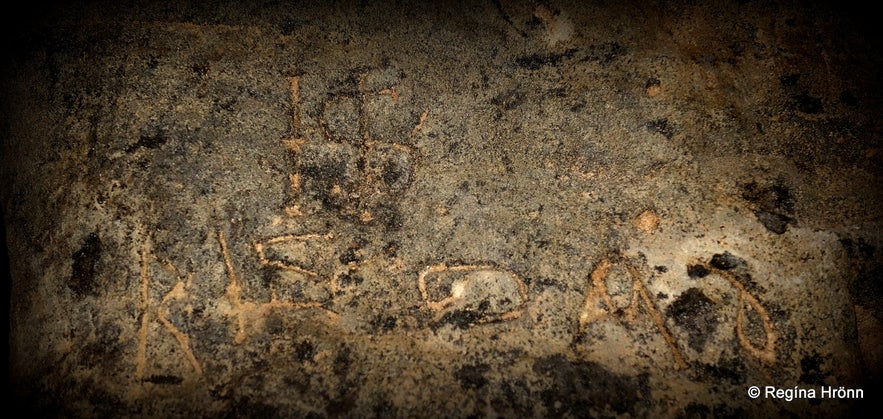 Carvings on the wall - out of focus, as it was so difficult to photograph the engravings
It was so challenging to photograph the engravings and signs inside the caves, and out of the countless photos I took, only a handful were in focus.
I used three cameras, but didn't have a good-enough mobile phone back in 2021 when I visited the caves.
If you look closely, then you will see the date 1687 carved somewhere on the wall, but the farmers at Hellar moved into the farm in the 17th century. This is the oldest date in the cave.
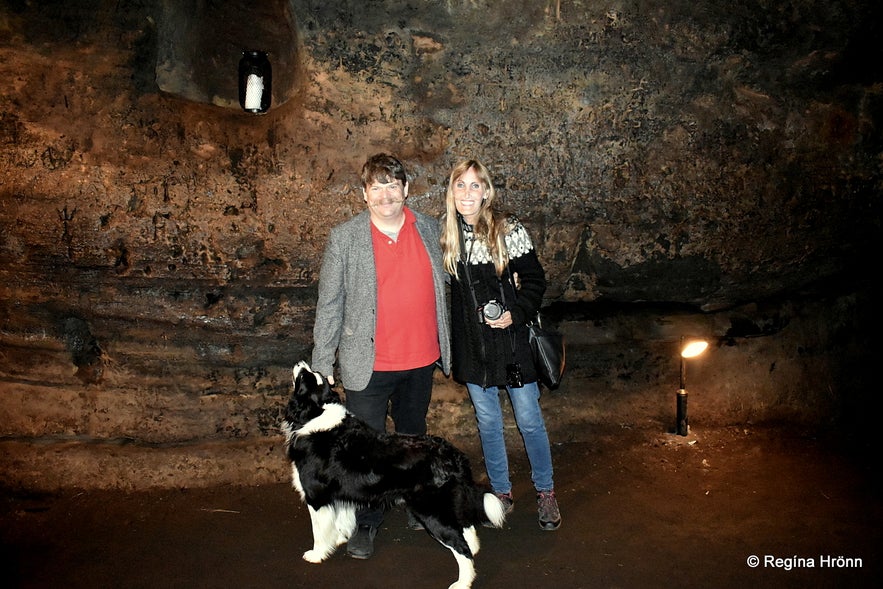
Dýrlingsstallur - the Niche of the Saint
We got our photo taken with the farmer's dog by the Niche of the Saint, and you can see we are not tall enough to reach the niche.
This is the wall in Heyhellir where you will find most of the signs, names, and dates carved into it.
After examining Heyhellir cave, we followed the guide through Göngin - the Corridor.
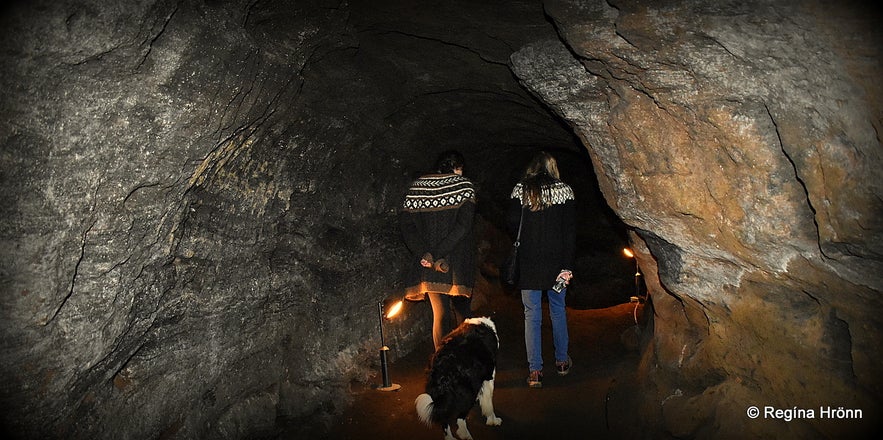
Walking through the Corridor
The Corridor is a curved connection between the two caves, Heyhellir and Gamlihellir. It is 11 meters long and approximately 2 meters wide and tall.
Gamlihellir - Old Cave

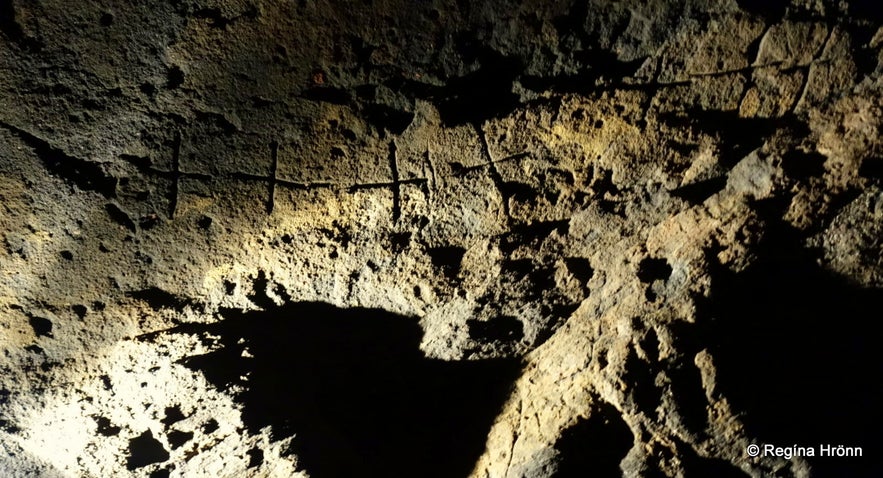
7 crosses in a row
Gamlihellir is not as large as Heyhellir, but its height is also some 3-4 meters.
There are also some carvings and engravings on the walls of Gamlihellir cave, nothing like in Heyhellir though. But in one place in the cave, there are seven crosses in a row carved into the cave wall, a pretty remarkable sight.
I had read about these seven crosses years ago in two books and was so eager to see them.
The Calf in at Hellar - Icelandic folklore
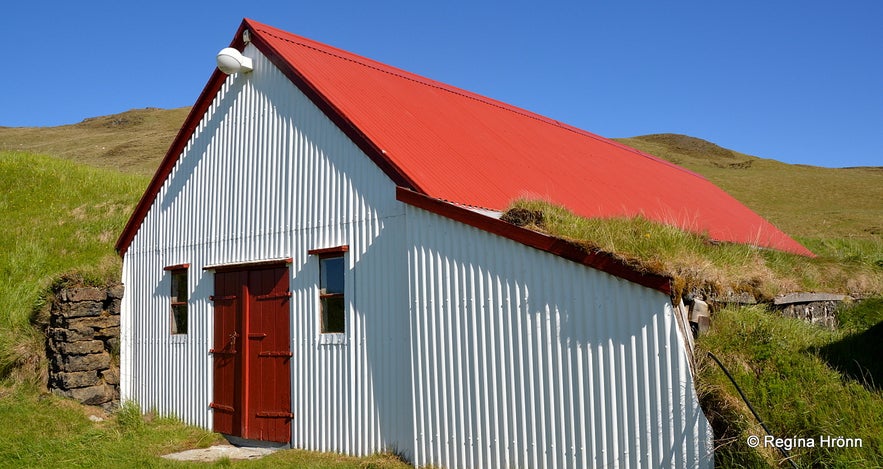 The entrance to Hellnahellir - the Cave at Caves
In Þjóðsögur Jóns Árnasonar - the Compilation of Folklore by Jón Árnason, I found a story about this cave. It goes something like this, roughly translated:
"There is a story about a cave at Hellar in Land, that is now used both as a cowshed and a hay rick (storage room for hay).
It is believed that this cave leads westward below the whole of Mt. Skarðsfjall and towards the Þjórsjá river.
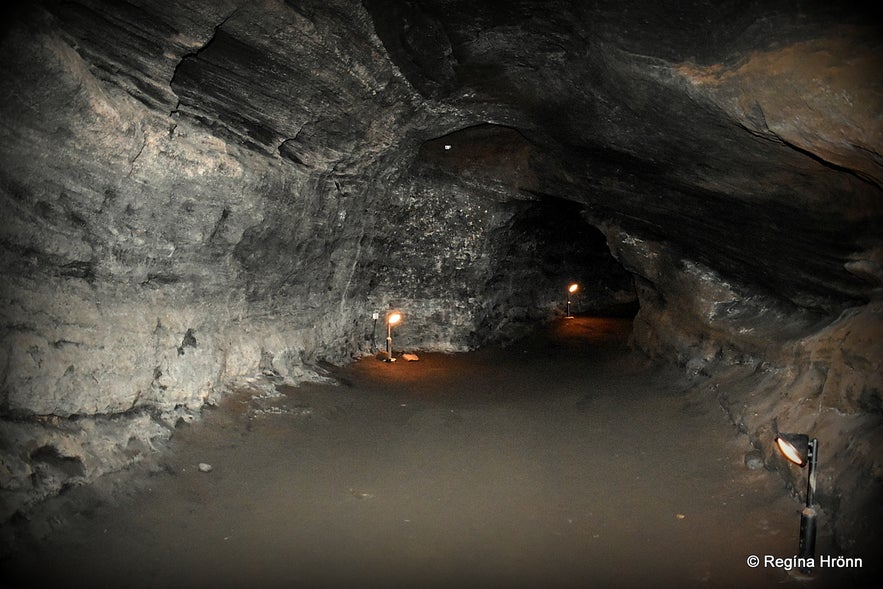 The calf escaped further into the caves
The story goes that once a calf in the hay rick at Hellar escaped into the main cave.
When the cowman noticed that the calf had escaped, he followed the calf for a long time. He believed he was heading northwest.
All of a sudden, he heard a roaring sound of water above his head.
There he stopped following the calf, and the calf continued, but the man didn't dare go any further and returned the same way.
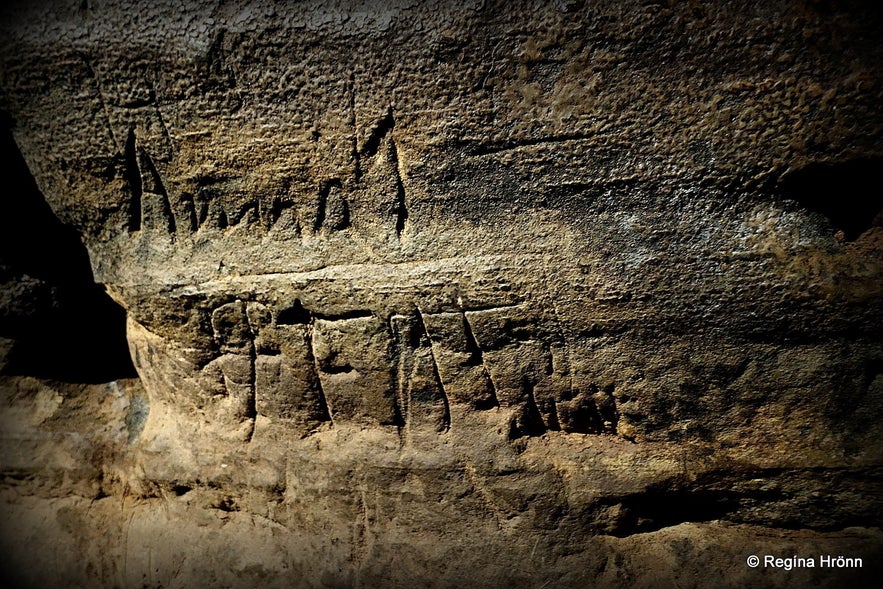
Carvings on the walls in Hellnahellir cave - they have faded over the centuries
He was sure that the massive water sound he heard must have been the Þjórsá river (Iceland's longest glacial river), and based his belief on the distance of the massive sound he had heard roaring above his head.
But the calf exited the cave a little bit later on at Stórinúpur in the Eystrihreppur district."
(Translated and recapitulated from Þjóðsögur Jóns Árnasonar: Hellar). There are other slightly different versions of this folklore.
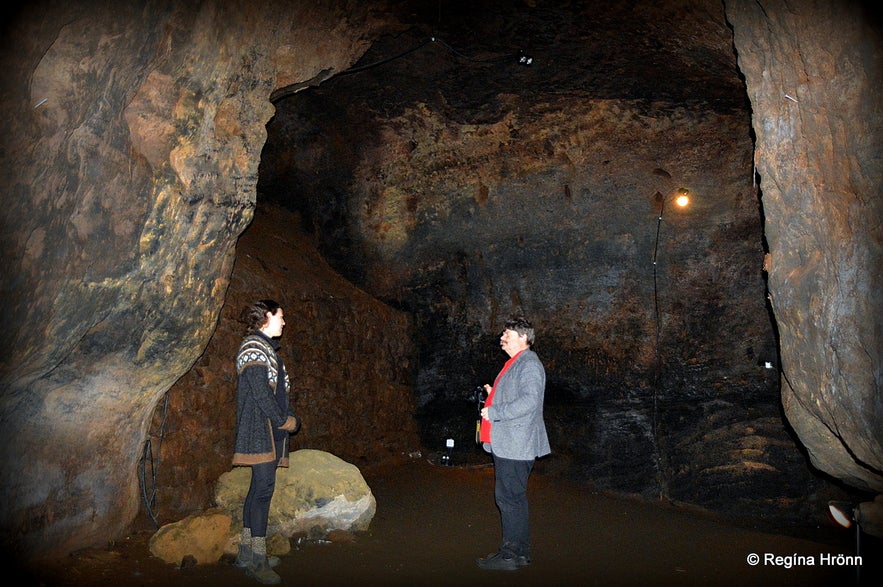 There must be superb acoustics in the cave
Concerts have been held at Hellnahellir, and it is sometimes referred to as Sönghellir - the Singing cave.
The Bishop of Iceland held a service for 200 people inside Hellnahellir cave in 2000. The service was held to commemorate the millennium of Christianity in Iceland.
In the year 1000, the Vikings adopted Christianity at Alþingi, the parliament at Þingvellir.
They had been believers of the old Norse faith, and not everybody was happy with this change in their belief system and didn't want to abandon their old gods, Óðinn and Þór.
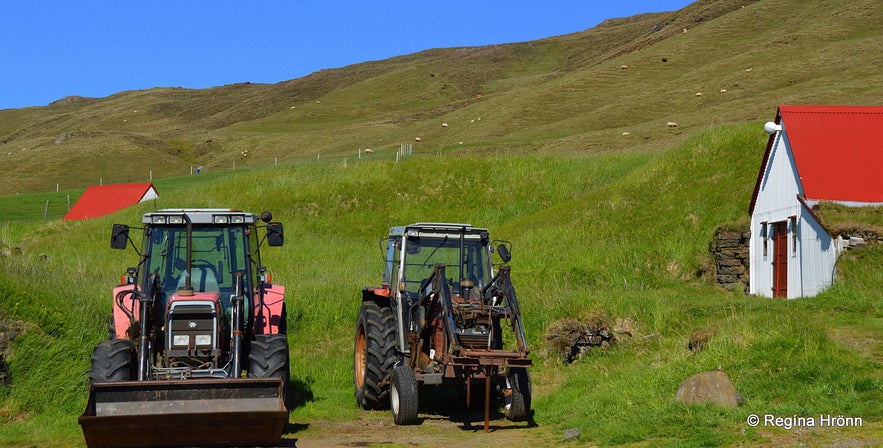 The caves as seen from the outside
Some of the settlers were Christian, like the settler woman Auður djúpúðga and her siblings Þórunn hyrna and Helgi bjóla, but their brother, Björn austræni, who settled at Bjarnarhöfn on the Snæfellsnes peninsula, didn't want to convert to Christianity.
The Irish thralls whom the Vikings brought to Iceland were also Christian. And the Irish, who seemingly inhabited Iceland long before the Vikings arrived and drove them away, or somehow incorporated them into their settlement.
What happened to them, we don't know, but there are some controversial theories. Were they Irish monks, Papar, or Irish inhabitants who lived here in Iceland before the Vikings arrived?
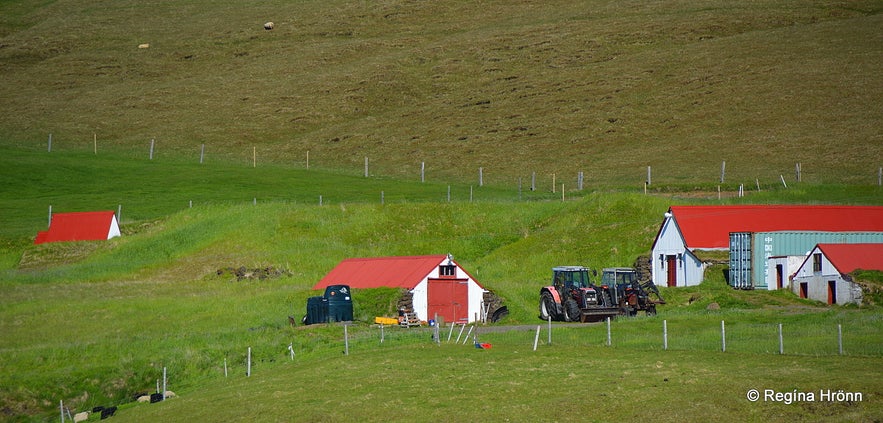
The entrance to Hellnahellir cave and another entrance with a red roof at the end of the cave
In my photo above, you can see how long the cave is.
It does not show from the outside that there are huge caves beneath the ground - a hidden world with a lost history.
The temperature in the cave is only around 4 degrees C, so always wear warm clothes when visiting the caves of Iceland.
Hellnahellir, the Cave at Caves, is approximately 25 km from Ring Road 1.
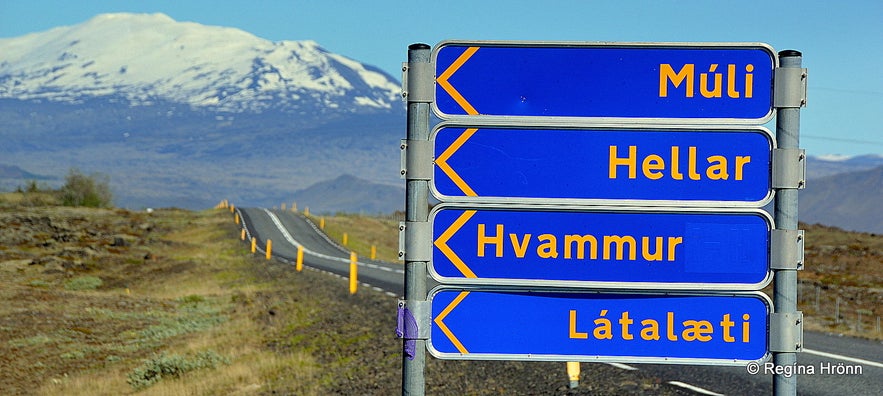 The road signs leading towards the cave - Mt. Hekla in the distance
Here you can see the location of Hellar on Google Maps and the distance to the Þjórsá river.
If you want to know more about caves in Iceland, then I have written an extensive travel blog about all the caves I have visited in my country: A Local's Favourite Caves in Iceland.
Have a lovely time exploring the caves of Iceland :)
Ref.:
Manngerðir hellar á Íslandi 1991 pages 207-213

Hi, my name is Regína Hrönn, and I was born and raised here in Iceland.