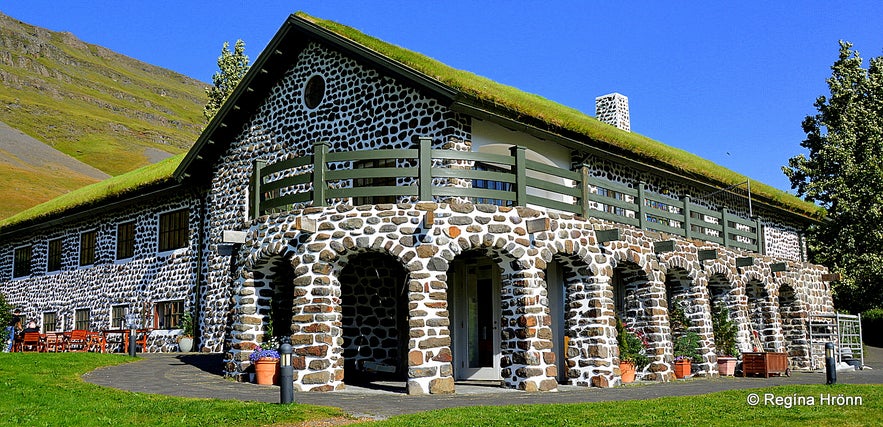
Skriðuklaustur is a beautiful place to visit on your travels in East Iceland. It is a Centre of History and Culture (Gunnarsstofnun) and one of Iceland's greatest historical sites.
The last Catholic monastery in Iceland, an Augustinian monastery, operated on this spot from 1493 to 1552. Its primary function over these 60 years was to attend to the sick.
This beautiful building is the former home of the noted author Gunnar Gunnarsson (1889-1975).
Top photo: Skriðuklaustur
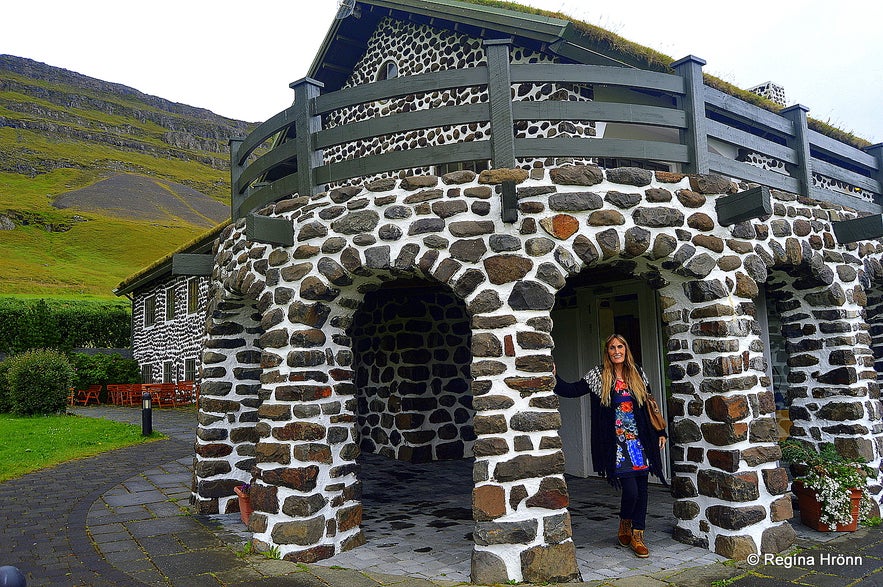
Visiting the beautiful Skriðuklaustur
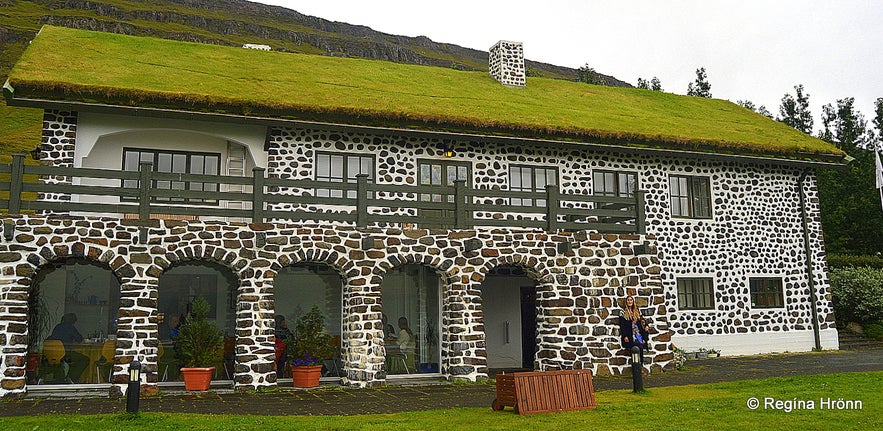
Gunnar built this manor at Skriðuklaustur in 1939. The German architect, Fritz Höger, a friend of Gunnar's, designed it. Fritz never came to Iceland, but I am sure that he was proud of how his beautiful work turned out.
It is a blend of a European mansion and a cloister with reference to traditional Icelandic turf houses.
I think it is a magnificent building and love the turf roof :) The double walls have turf insulation, and the concrete walls contain basalt rocks, giving this beautiful, one-of-a-kind Icelandic building a very distinctive look.
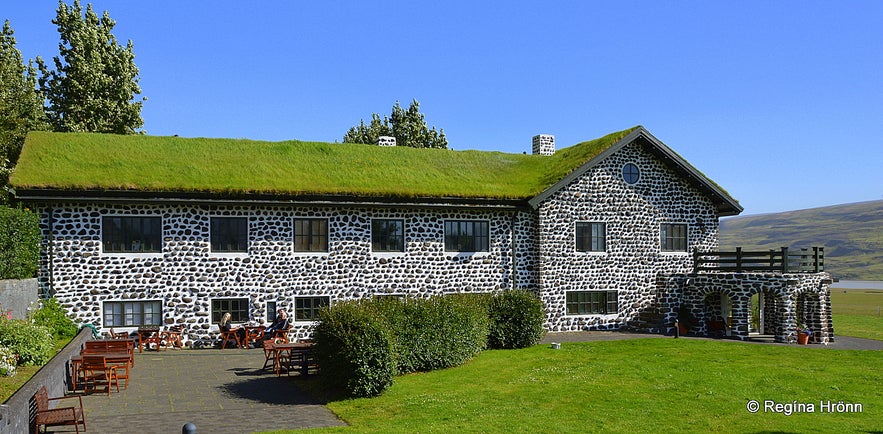
Skriðuklaustur
The ambulatory was added to the mansion in 1974-1982, and a new turf roof with a watering system was installed on the 100th anniversary of Gunnar Gunnarsson in 1989.
Gunnar had lived in Denmark for 30 years, and when he returned home to Iceland, he wanted to build a European manor in the Icelandic countryside. He was born in Valþjófsdalur in Fljótsdalur in East-Iceland, where he lived for the first 7 years of his life.
He built his 325-335 sq. m. manor on the land of Skriðuklaustur very close to his birthplace.
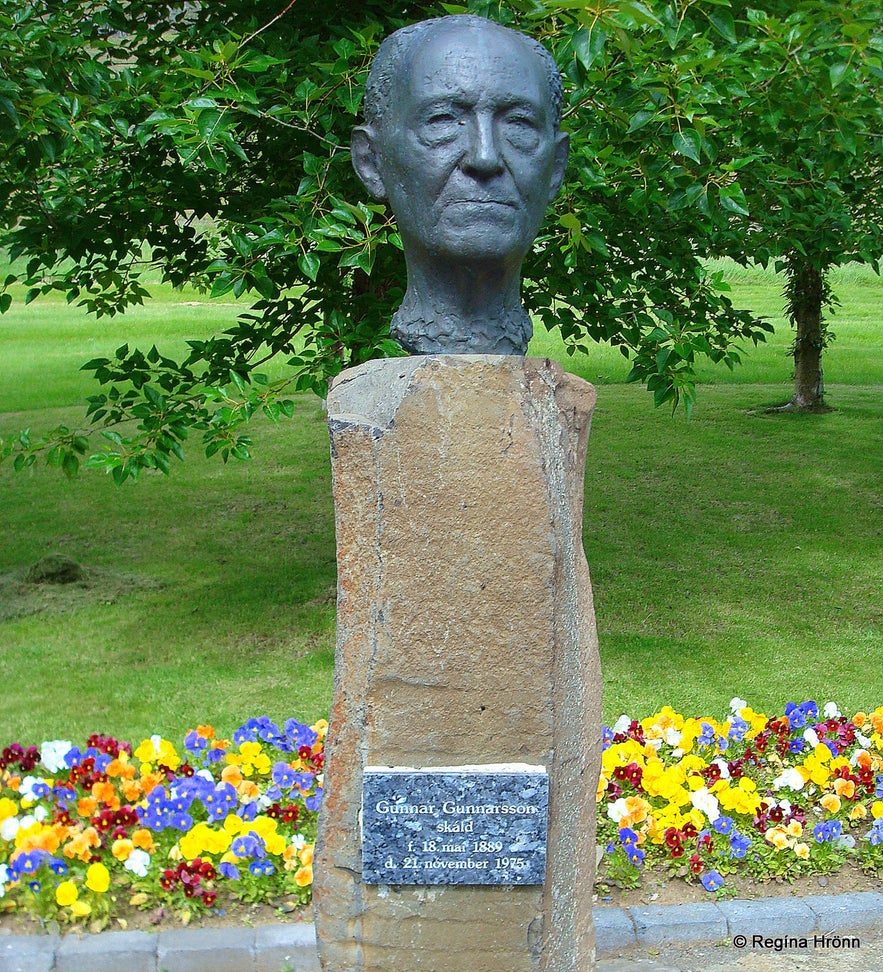
The memorial for Gunnar Gunnarsson at Skriðuklaustur
Gunnar had planned to build a total of 2,800 sq. m., with several outbuildings, and to engage in large-scale farming on his big estate, with up to 1,500 sheep.
He didn't manage to do so, even though some of us might think that the 350 sheep, 10 horses, 5 cows, cattle, pig, and hens he kept would be regarded as large enough.
Unfortunately, his timing was off: World War II began, and workers flocked from the countryside to villages and towns, where there was ample, better-paid work to be had.
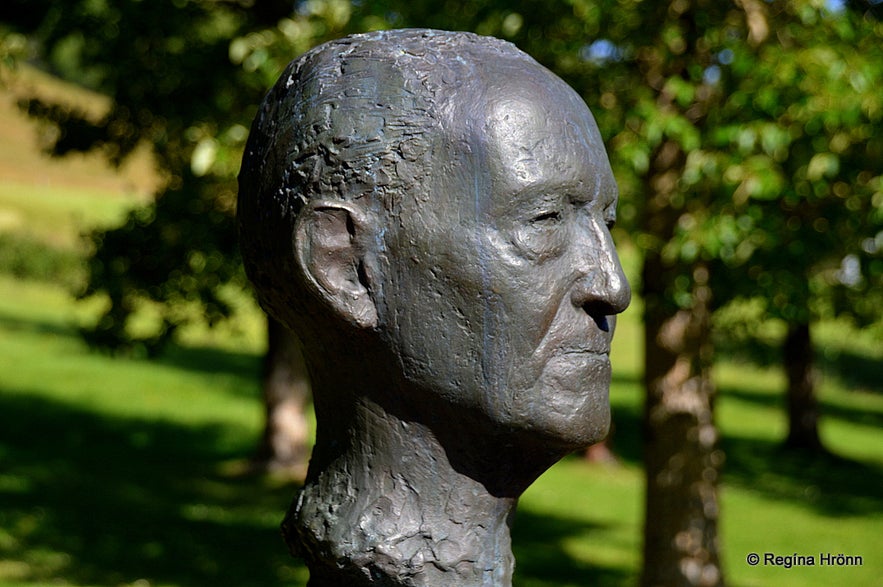
The bust of Gunnar Gunnarsson
Gunnar donated Skriðuklaustur to the Icelandic state 9 years later, in 1948, under the condition that it would be used for experimental farming and a residence for artists and authors.
Gunnar himself moved south to Reykjavík. At Klaustrið, artists and authors can apply for a stay at the writer's retreat.
Gunnarsstofnun is dedicated to Gunnar Gunnarsson's work, and you will find a bust of him in front of his former home.
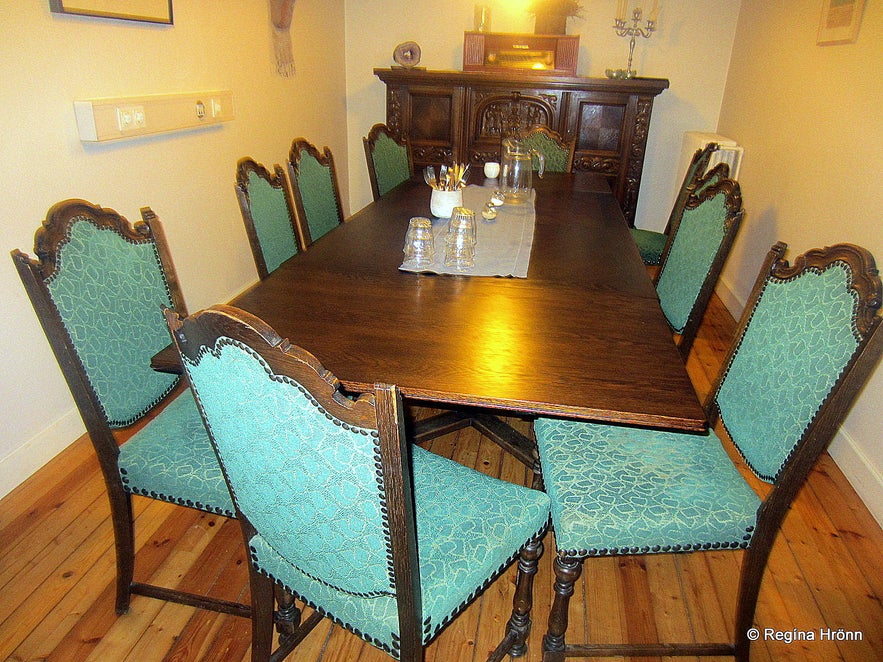
At Skriðuklaustur - I took this photo back in 2008, henge the quality of it
Gunnar Gunnarsson was a respected author and novelist, and mainly wrote in Danish.
Among his famous works is Aðventa - the Good Shepherd. It is a very popular book, written in 1936 on the ordeal of Fjalla-Bensi, Benedikt Sigurjónsson.
Aðventa was first published in Leipzig, Germany, and has since been translated into 10 languages!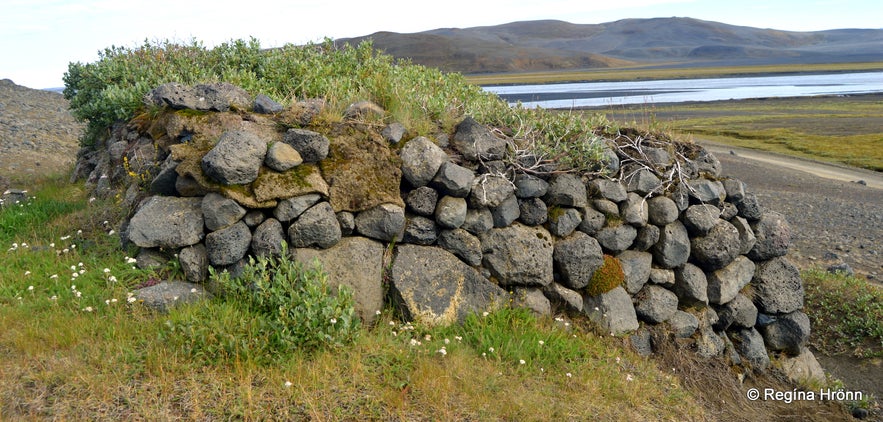
Tumbi was built with turf and rock
Back in 1925, when Fjalla-Bensi was searching for left behind sheep in the highland of Iceland, he got caught in a major storm and had to stay alone with the sheep in a little hut, made of turf and stone, during the holy time of Advent.
Much like this little hut in my photos.
I visited this hut on my way to the Askja caldera in the highland. It is the only hut I have seen with a tree growing on top of it, quite distinctive.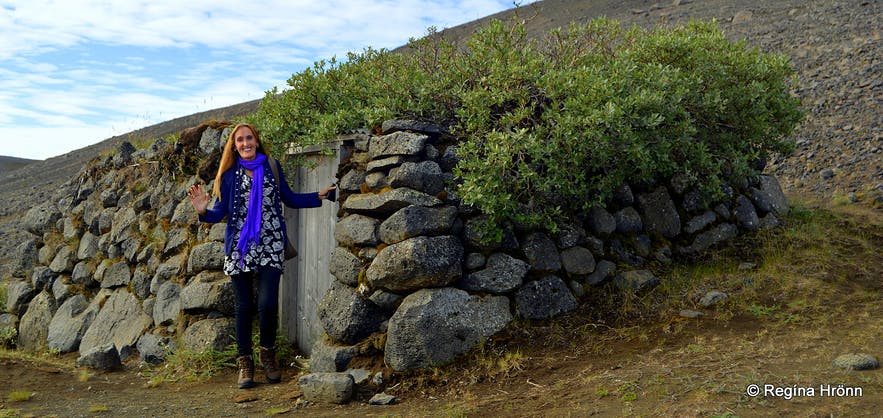
By Tumbi hut
It is cool visiting it in the summertime, but imagine what it must have been like being stuck in an awful blizzard in the highland of Iceland, alone in such huts.
Now, back to Skriðuklaustur, where exhibitions, concerts, and talks are held, amongst other events.
The manor reminds me of German and Danish mansions, and it is very lovely to find such a beautiful house here in East Iceland.
Skriðuklaustur
Skriðuklaustur has irregular opening hours, but in the summertime from June to August, it is open from 10-18. In May & September from 11-17, April from 12-16, and October 1st-15th from 12-16. These opening hours can change, so check out the website of Skriðuklaustur. August
If you are travelling outside these opening hours, you can phone ahead at +354 471-2990 to get a peek into this beautiful mansion.
There is an entrance fee to the museum, where you will also get guidance.
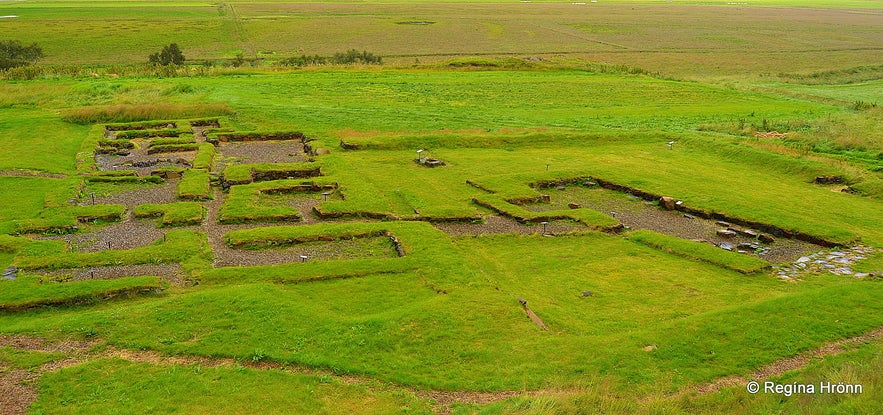
Archaeological excavations of the old monastery at Skriðuklaustur
Archaeological excavations of the old monastery at Skriðuklaustur
Beneath Gunnarshús manor at Skriðuklaustur, you will find ruins of the old monastery of Skriðuklaustur, which operated from 1493-1552.
The archaeological excavation began in 2002 and lasted for 10 years.
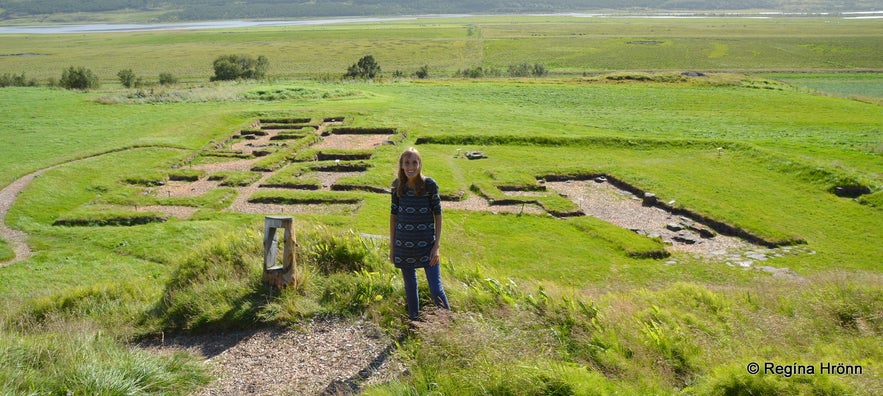
By the monastic ruins
During the archaeological excavation, old graves were dug up and the bones examined. This shed a new light on how the monastery functioned and the ailments of the patients at the hospital.
Around 260 skeletons were exhumed in the old cemetery.
Many of these bones show that the patients had serious illnesses: cancer, hydatid disease, smallpox, syphilis, TB, etc.
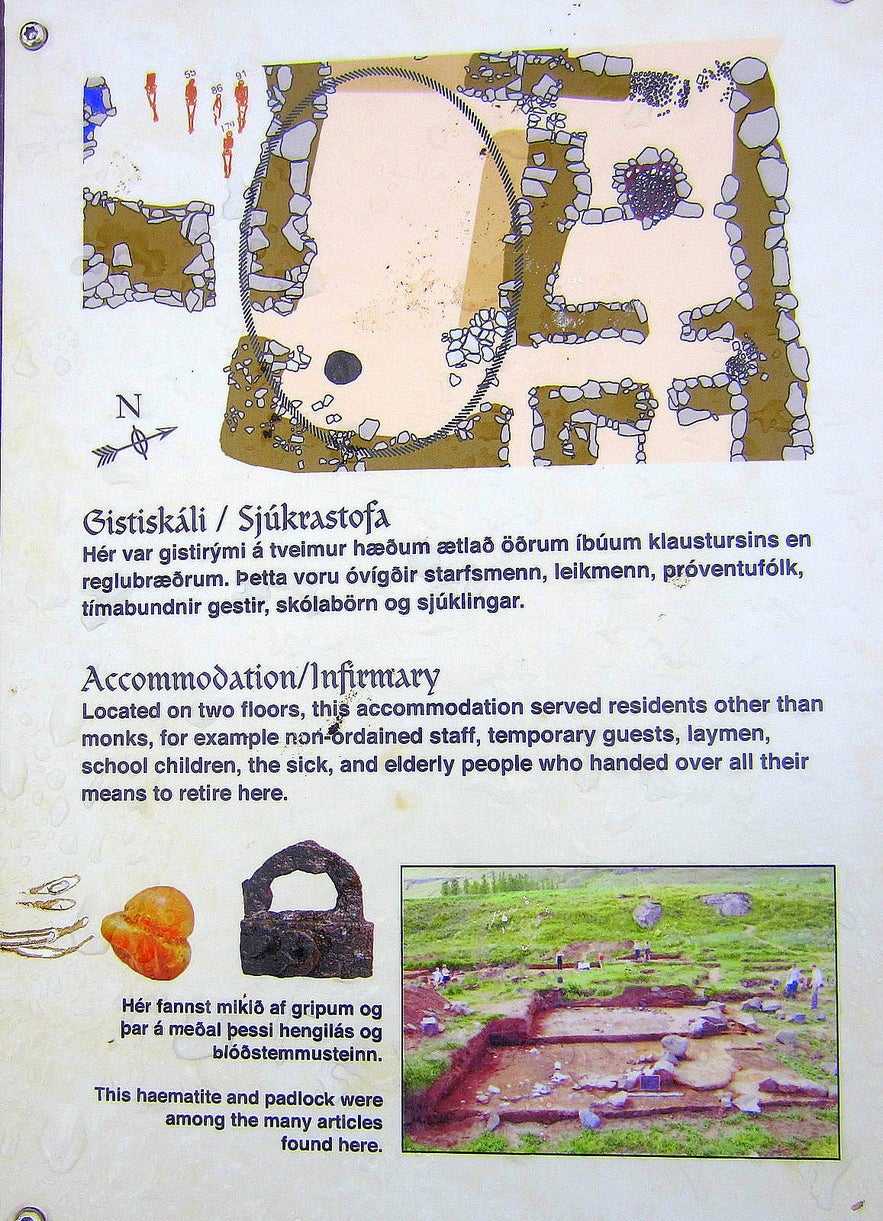
Information signs about the Archaeological excavations of the old monastery at Skriðuklaustur
Many skeletons of babies and premature babies were also exhumed.
Two of the graves in the cemetery were most likely the graves of priors, who were buried with women and children, as if they had been a family.
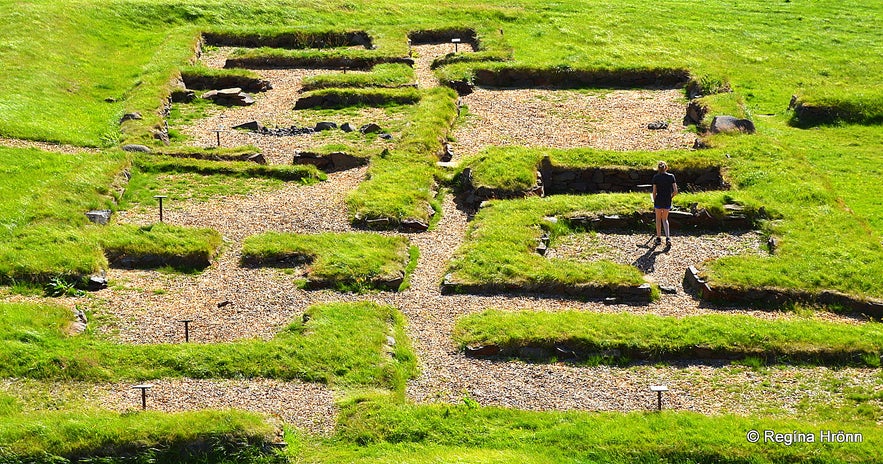
This might seem strange as the Catholic priors should have been celibate.
But it seems that different rules applied here in Iceland. It was a rule rather than an exception that clergymen had women and children.
They were not allowed to marry, though, but the women were called escorts.
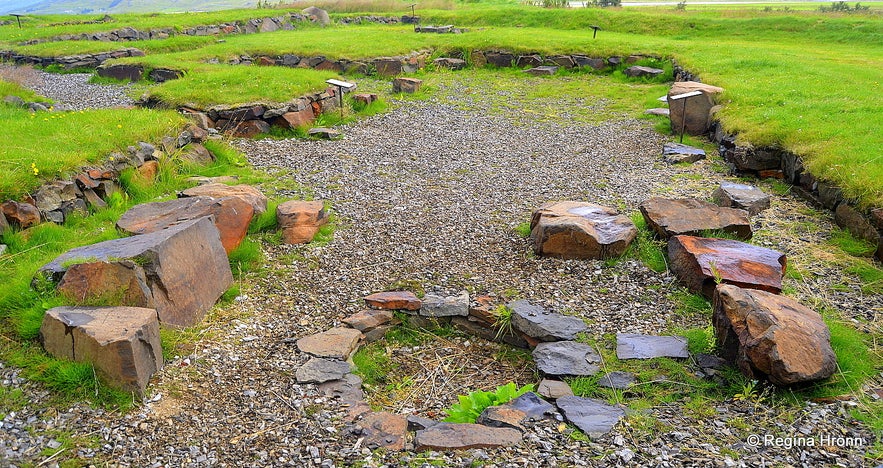
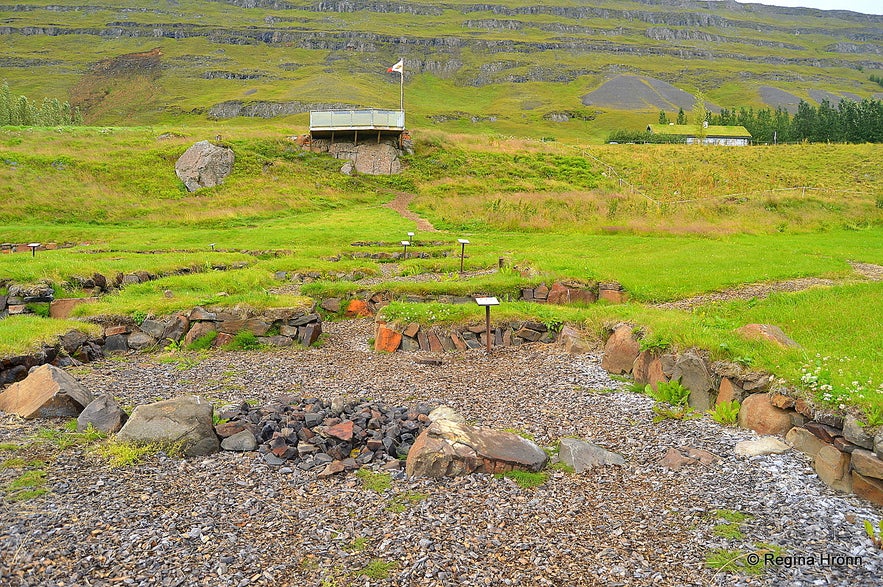
Every room in the monastery has been marked with its function, and an information sign has been added to provide better insight into the monastery's life and work.
You can walk around this area and have a "peek" into each room.
An excellent job has been done in presenting the monastery to visitors, even though nobody knows what it looked like. This lost monastery was 1200 sq. m. in size, which is large for Iceland.
I would have loved to see what it looked like when it was operating, even though I am happy that I was not alive during the dark Middle Ages in Iceland.
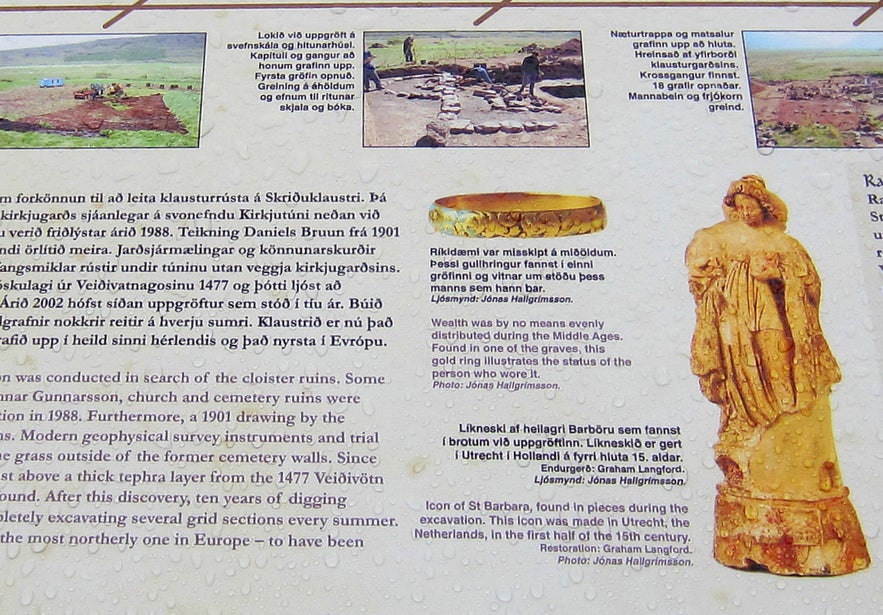
Here you can find an infirmary, a cloister garden with a well in the centre, sleeping quarters for the monks, the quarters of the bishop, a chapel, a pantry and a dining hall, a brewery, an infirmary, and many other rooms.
The cloister church, consecrated in 1512, was the most important building in the monastery. There are also night stairs for the monks to enter the church, as they needed to be able to access it 24/7.
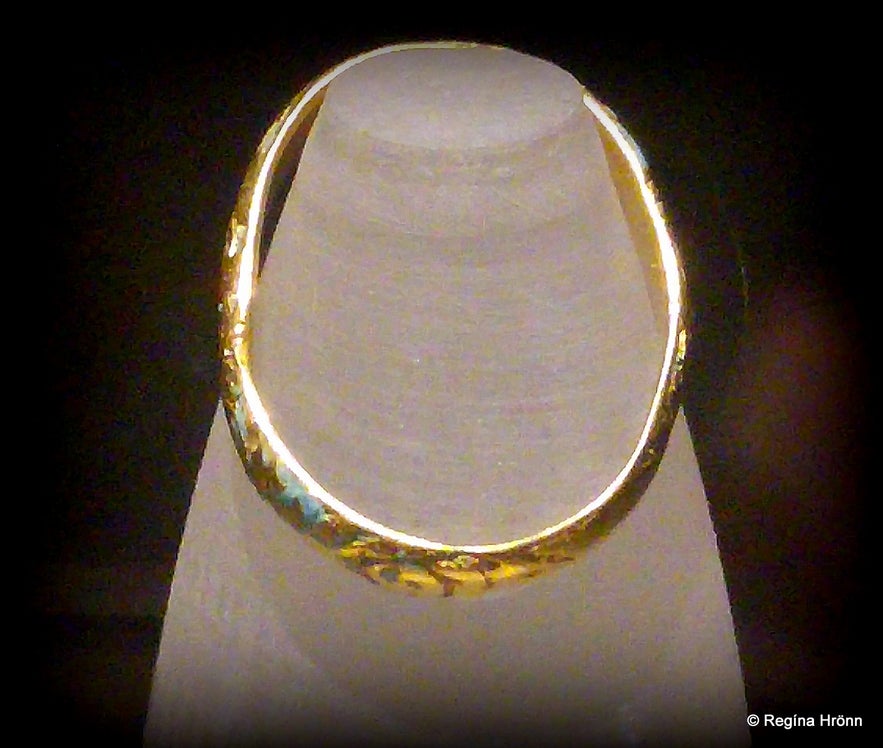
A ring found at Skriðuklalustur - very difficult to photograph through the glass
It is very interesting wandering around the different rooms, imagining what life must have been like during its time of operation.
Several objects were discovered during the excavation, including a beautiful gold ring (see my photo above), which I found on display at a temporary exhibition on monasteries in Iceland at the National Museum of Iceland.
The ring was found in a grave. It was customary for the nuns and monks to wear a golden ring as a symbol of their vow.
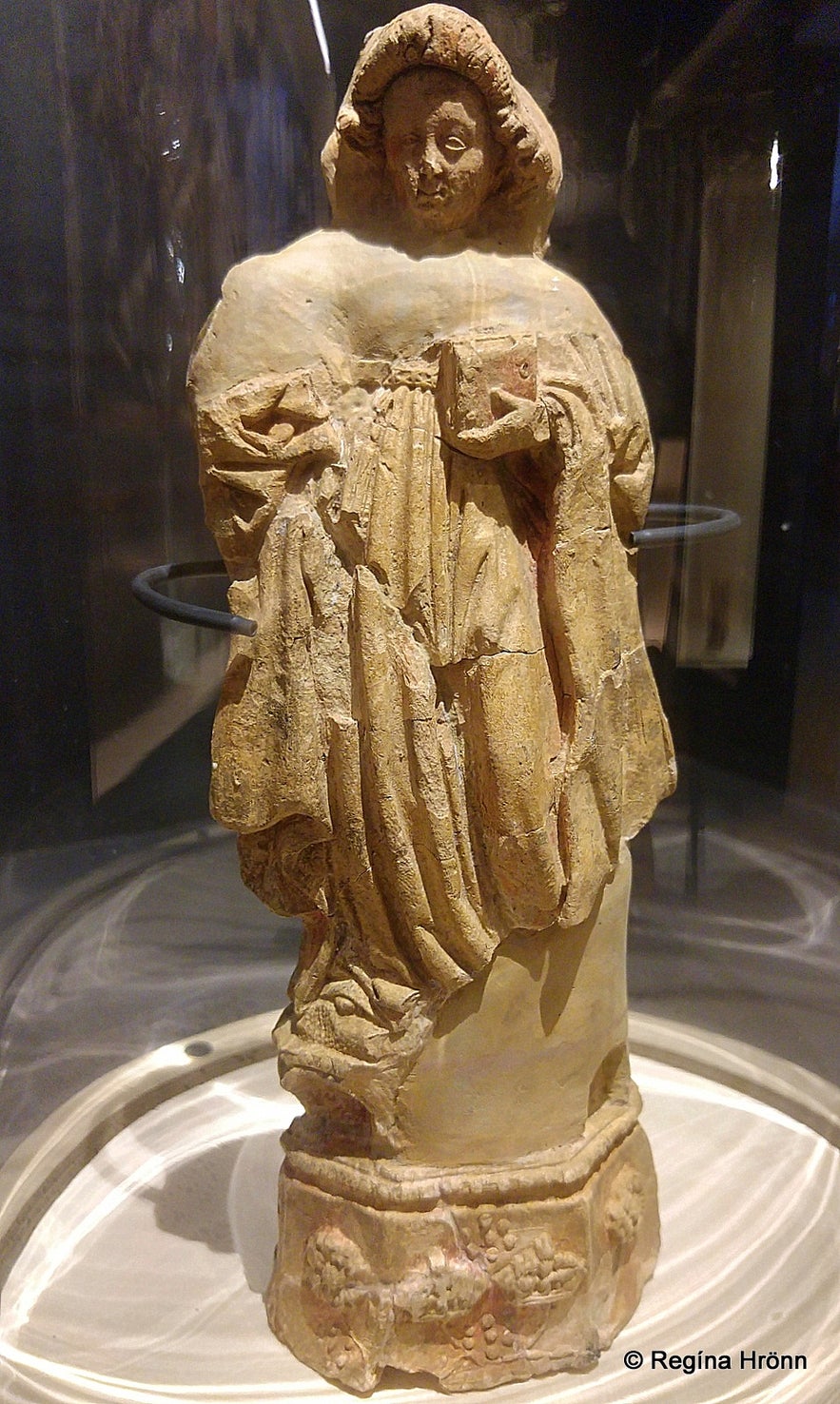
A figure of St. Barbara found at Skriðuklaustur
A figure of St. Barbara, dating back to the 15th century and made in Utrecht, Netherlands, was also discovered. The torso was found in pieces in the church, and the head in the kitchen.
It might have been broken and disfigured after the conversion to Protestantism in Iceland, which was common at the time.
You might notice that her symbol, the tower, is missing. St. Barbara was believed to protect against fever and sudden death. The figure was also on display at the National Museum of Iceland.
Some rosary beads, a knife, and a chess piece were also unearthed, to name but a few.
This is the only whole monastery excavated in Iceland and the northernmost monastery in Europe.
The grave of the vagrant Jón Hrak
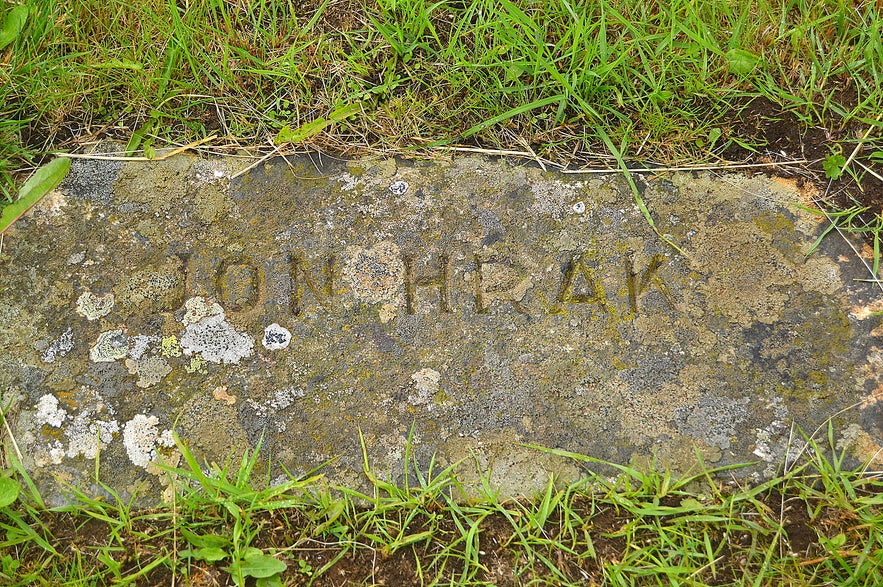
The grave of the vagrant Jón Hrak at Skriðuklaustur
Only one gravestone can be found in the cemetery by Skriðuklaustur, the grave and gravestone of the vagrant Jón Hrak.
There are many tales of this vagrant, and it was believed that he was buried here in the cemetery. What is unique about his grave is that he is not buried east-west, which is customary here in Iceland, but south-north (út og suður).
The Chief Forester Hákon Bjarnason (skógræktarsjóri) had a tombstone erected on the grave. A well-known poem about Jón Hrak goes like this in Icelandic:
"Kalt er við kórbak,
kúrir þar Jón Hrak.
Ýtar snúa austur og vestur,
allir nema Jón Hrak, allir nema Jón Hrak"
- in English:
" It is cold at the choir's back,
there lies old Jón Hrak.
Everybody is buried lying East and West,
everybody but Jón Hrak, everybody but Jón Hrak".
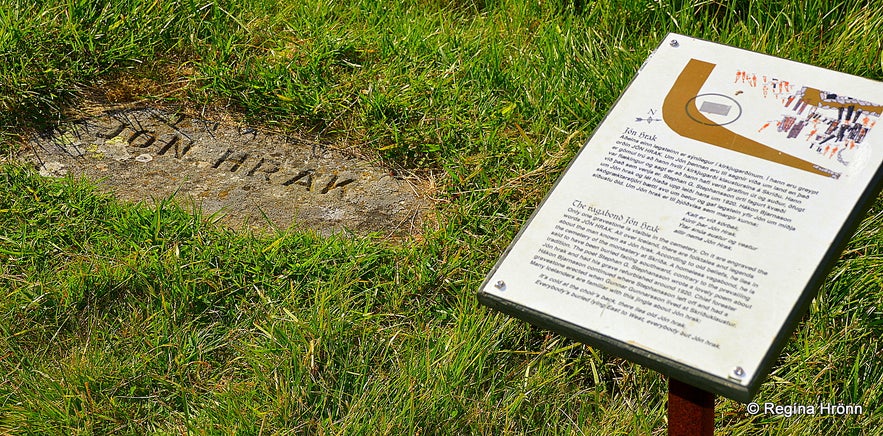
The grave of Jón Hrak
One of the reasons why Jón Hrak is believed to have been buried this way is that he was a vagrant and might have died in the dead of winter, so those who buried him didn't show him the respect of burying him properly.
Another reason might be that those who buried him didn't want him to return from his grave, so they turned him in the "wrong" direction.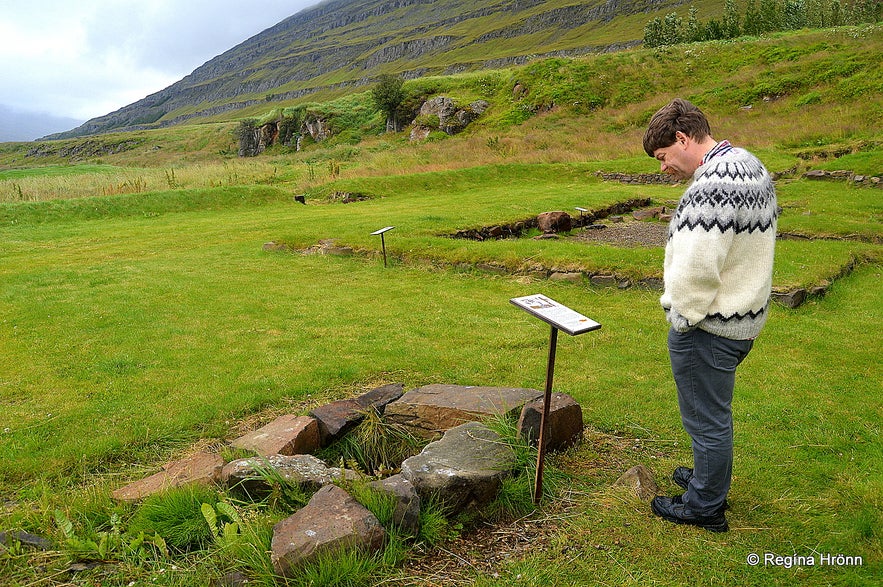
This is my Jón ;)
I found a story in Þjóðsögur Jóns Árnasonar - The Compilation of Folklore of Jón Árnason, which I often refer to in my travel blog, telling a different story of Jón "Flak" in a different cemetery, with the same poem, but here Jón "Flak" is repeating this poem after his death.
So this is not carved in stone, but an interesting story all the same.
Sesselja the sinner
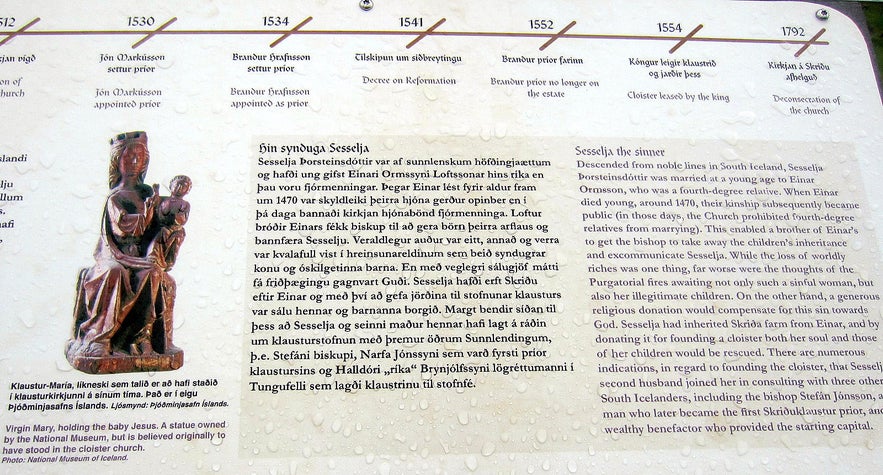
The information sign at Skriðuklaustur
I want to tell you, in a few words, how the old land of Skriða (now Klaustur) came into the possession of the Catholic Church. Sesselja Þorsteinsdóttir had married her second cousin once-removed, Einar Ormsson Loftssonar the Rich.
Einar died in 1470, and after his death, the cousinship to his wife was revealed, but at that time, it was forbidden for second cousins once removed to marry.
Einar's brother, Loftur, convinced the bishop to strip his brother's children of their inheritance and to excommunicate Sesselja. The only way for Sesselja to save her soul and the souls of her now illegitimate children was to donate the land Skriða, which she had inherited from her husband, to the Catholic church, for a monastery to be built there.
I got this story from an information sign on the excavation site, but I have not seen it anywhere else.
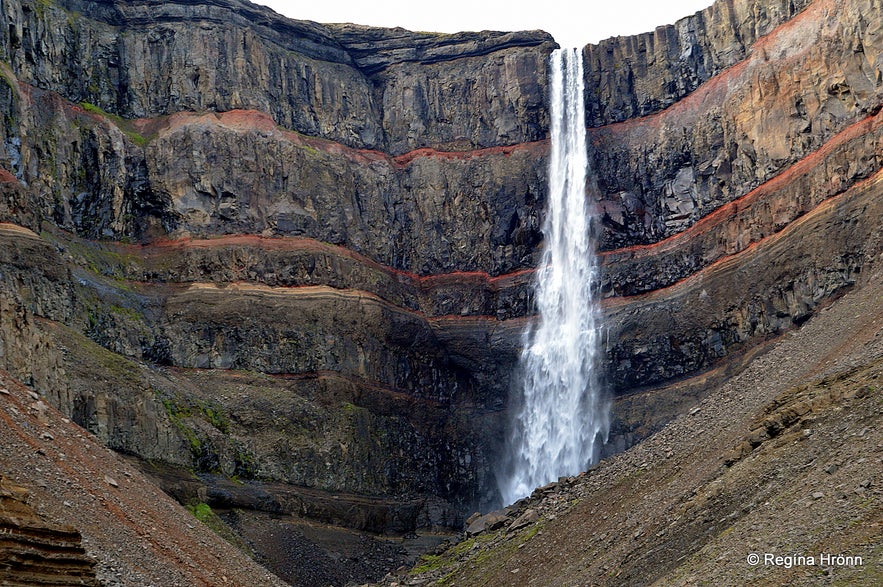
Hengifoss waterfall is in the vicinity of Skriðuklaustur
From Egilsstaðir, drive on Ring Road 1, then take route 931 to make a round-trip from Egilsstaðir around the lake, cross the bridge, and turn left on 933 for Skriðuklaustur.
To get back, take 931 back to Egilss, either on the same side you arrived or drive around the lake. That road is partly gravel.
Here you can see the location of Skriðuklaustur and Snæfellsstofa on the map.
I have written other travel blogs about interesting sights in the vicinity of Skriðuklaustur:
The majestic Hengifoss and Litlanesfoss Waterfalls in East Iceland
Hallormsstaðaskógur Forest in East Iceland - Iceland's largest Forest
Lagarfljótsormurinn Serpent in Lagarfljót Lake in East Iceland
Egilsstaðir in East Iceland and the Pearls of Fljótsdalur Valley
Have a lovely time in East Iceland :)

Hi, my name is Regína Hrönn, and I was born and raised here in Iceland.