I often visit the pretty little villages on the south coast of Iceland, Stokkseyri and Eyrarbakki, where the pace of life is very different from that of Reykjavík, Iceland's capital city, where I live.
In this travel blog, I will be showing you what I find so alluring about Eyrarbakki village, which has around 602 inhabitants.
Back in the 18th century, Eyrarbakki was a very vibrant community and served as a centre for fashion and culture in Iceland. Here you could find one of Iceland's biggest ports and trading centres, serving the south coast of Iceland all the way to Mt. Lómagnúpur.
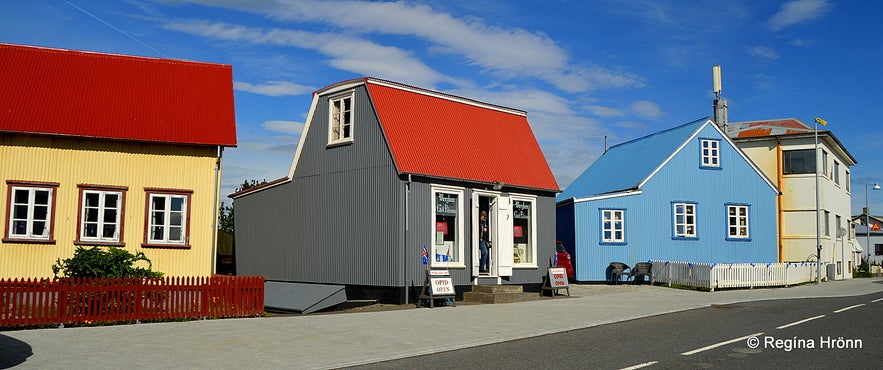
Nowadays, Eyrarbakki is so quiet yet offers so much. If you love quaint old colourful houses and a slow pace of life, then Eyrarbakki is the place to visit :)
Top photo: the colourful houses at Eyrarbakki
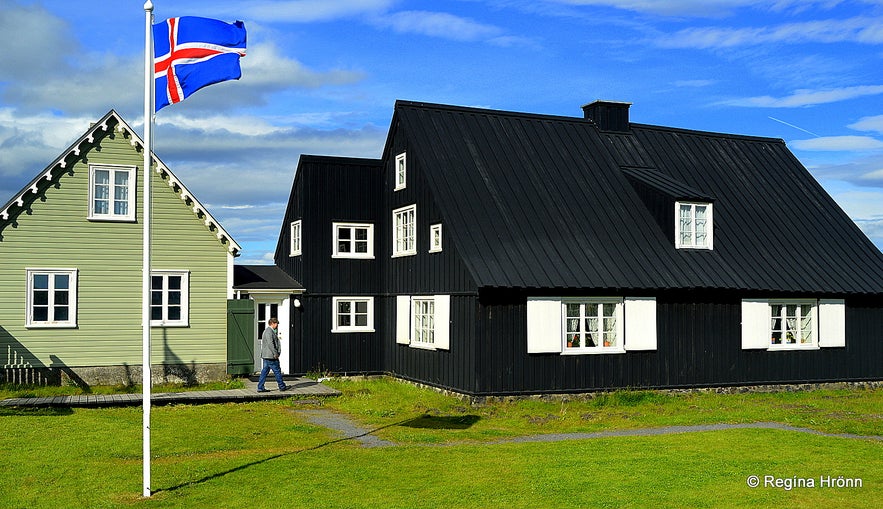
Húsið - the House - one of Iceland's oldest houses
Húsið - The House in Eyrarbakki village
The most prominent house in Eyrarbakki village is Húsið - the House, one of Iceland's oldest houses, built in 1765.
It was built when Eyrarbakki was one of the most vibrant commercial villages in Iceland, and Danish merchant families lived in it for some 200 years.
Viðeyjarstofa house, on Viðey island just outside of Reykjavík, is the oldest concrete house in Iceland, built in 1753-1755, and the old wooden house in Aðalstræti 10 in Reykjavík is considered to be the oldest house on the mainland, as it were, built in 1762.
Inside Húsið - the House in Eyrarbakki
Now, back to Húsið in Eyrarbakki. Back then, the majority of Icelanders lived in turf houses, and the modern wooden house Húsið was the centre for European art and culture in my country. From 1847 to 1916, Húsið was one of Iceland's greatest manors.
Almenna verslunarfélagið - Det almindelige handelskompagni, which was the largest trading company in Copenhagen back then, transported the kit house Húsið in 1765 from Denmark and erected it as a home for their store manager.
It remained as such until 1925/26. The name, Húsið, refers to it being the only timber residence in Eyrarbakki at the time.
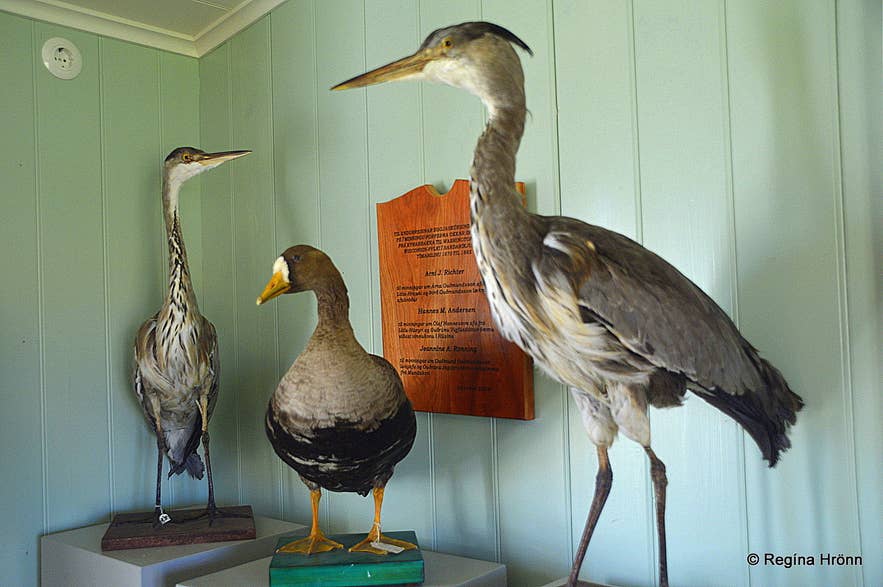 A selection of birds in Eggjahúsið
West of Húsið - immediately to the left when looking at Húsið from the street - you will notice a green-painted house, the Assistentahús house, built in 1881, where the owner of the store and his clerks lived. A connecting annexe lies between Húsið and the Assistentahús house.
In a small house behind Húsið, you will see the Eggjahúsið or the House of Eggs, where you can visit the Peter Nielsen collection of birds and eggs.
Peter Nielsen was the store manager of the old store and collected birds and eggs from Icelandic birds.
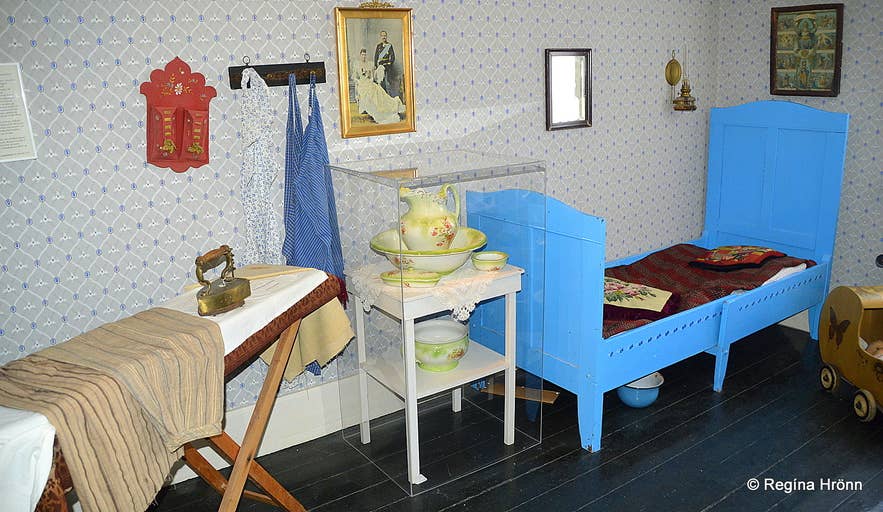
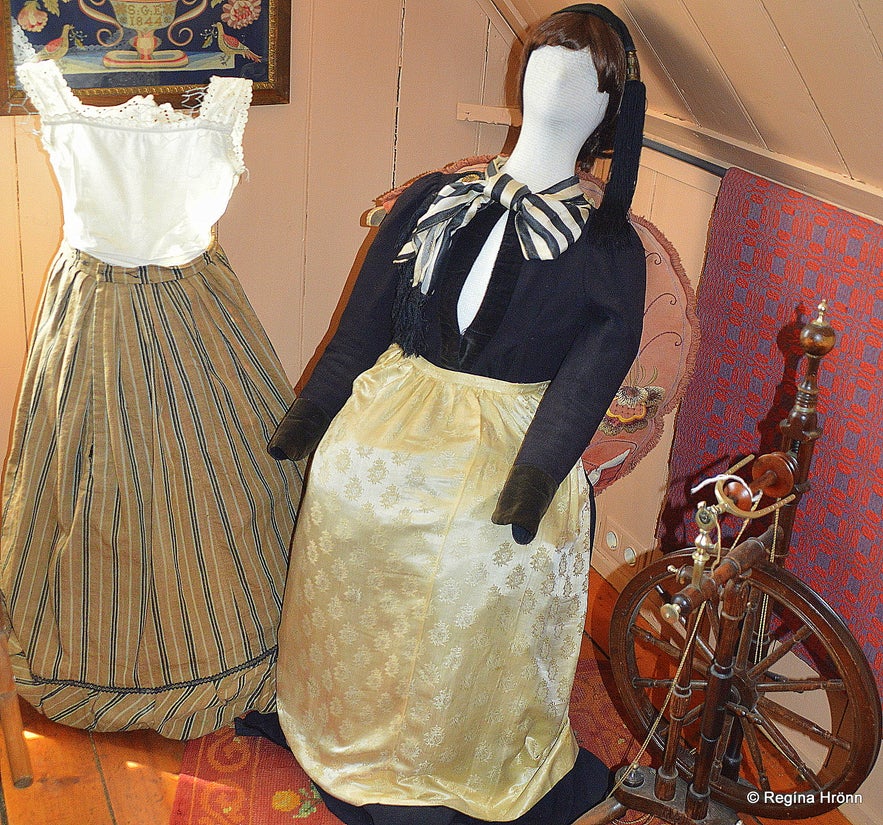
Inside Húsið - the House in Eyrarbakki
After the store manager and trading moved to nearby Selfoss in 1926, Húsið came into the possession of the National Bank.
In 1932, it became the private property of Halldór K. Þorsteinsson and Ragnhildur Pétursdóttir in Háteigur, Reykjavík, and was used as a summer cottage for a while. Ragnhildur Halldórsdóttir inherited Húsið after her parents' demise.
Friends of my family, Pétur Sveinbjarnarson and Auðbjörg Guðmundsdóttir, bought Húsið in 1979, and we visited it often.
Once we stayed overnight in this wonderful old timber house, and I have such fond memories of it. After the lady of the house, Auðbjörg, sold Húsið, it came into the possession of the State Treasury in 1992.
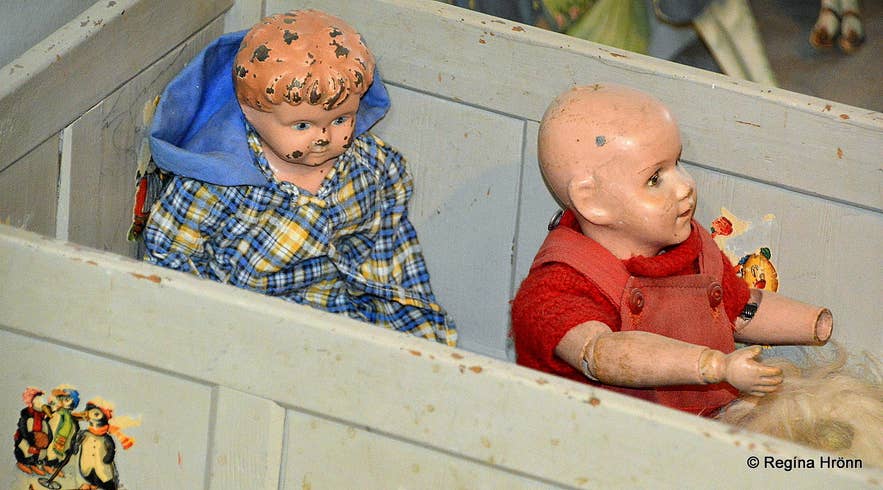
Old dolls in Húsið
A large amount of money was used for refurbishing it, and 3 years later, in 1995, it opened up as a heritage museum - the Árnessýsla Heritage Museum - the House at Eyrarbakki, and is now open to visitors during the summer months and upon appointment.
The house Húsið is the main showpiece. You can roam around it and have a peek into different rooms to see the living conditions of people back then.
Here, you will notice the big difference in the living conditions of the owners and the servants. Visiting this house feels like the inhabitants just stepped out for a moment.
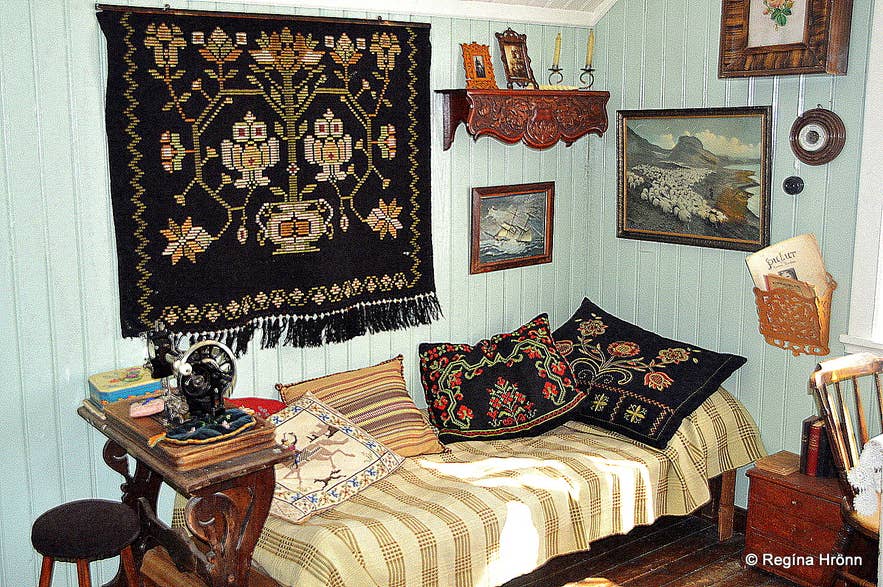
At the museum
In the beautiful drawing room, you will see photographs from the history of Húsið and trading in Eyrarbakki.
Wedding ceremonies are popular in this room, and I can for sure understand why.
The Assistentahúsið house has 6 exhibitions on two floors, exhibiting household things from Árnessýsla county.
Here you can see many exquisite artefacts and carvings, along with some more run-of-the-mill objects.
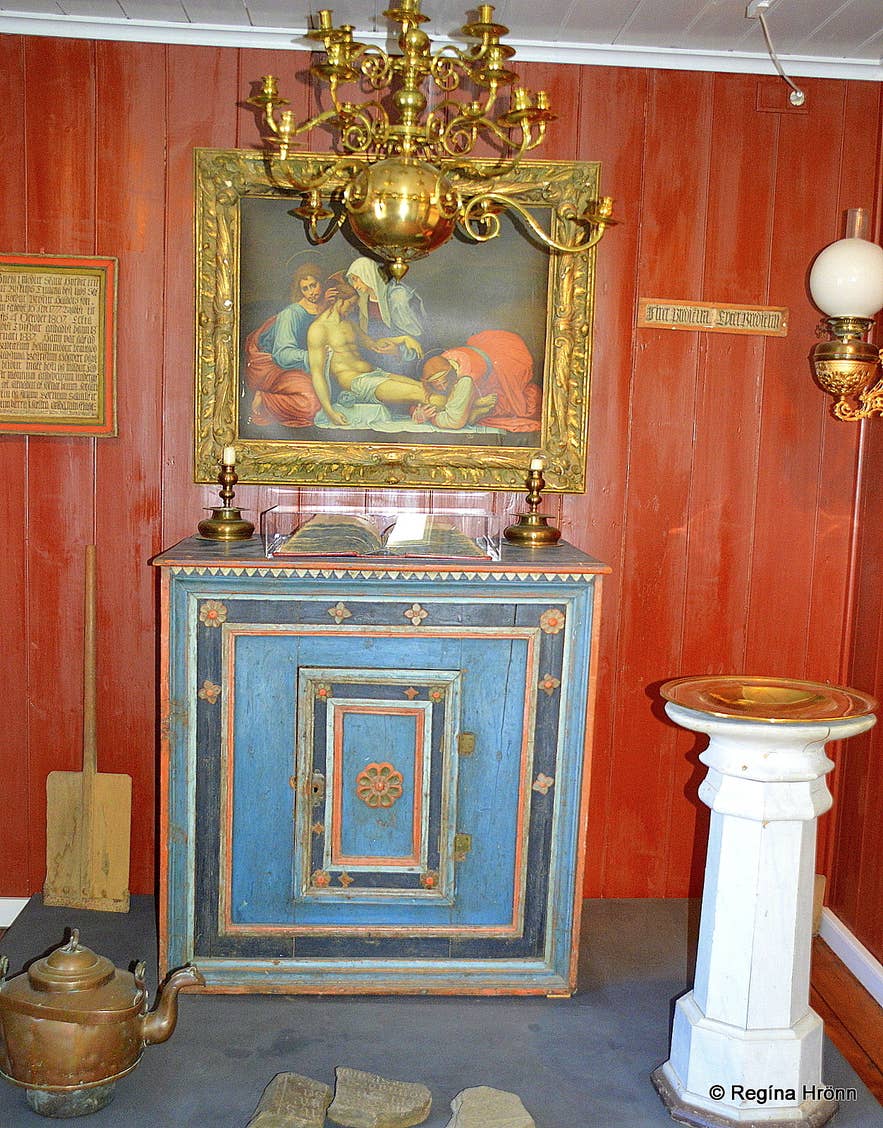 The old altar and church artefacts in Húsið
One of the exhibitions features church artefacts, including an altar and an altarpiece.
At another exhibition, you will learn about the immigration of Icelanders to the New World.
At yet another exhibition, you will see objects from the Lefolii-store, but a model of the Vesturbúðin store of the Danish Lefolii-store is on display outside by the memorial of drowned fishermen in Eyrarbakki.
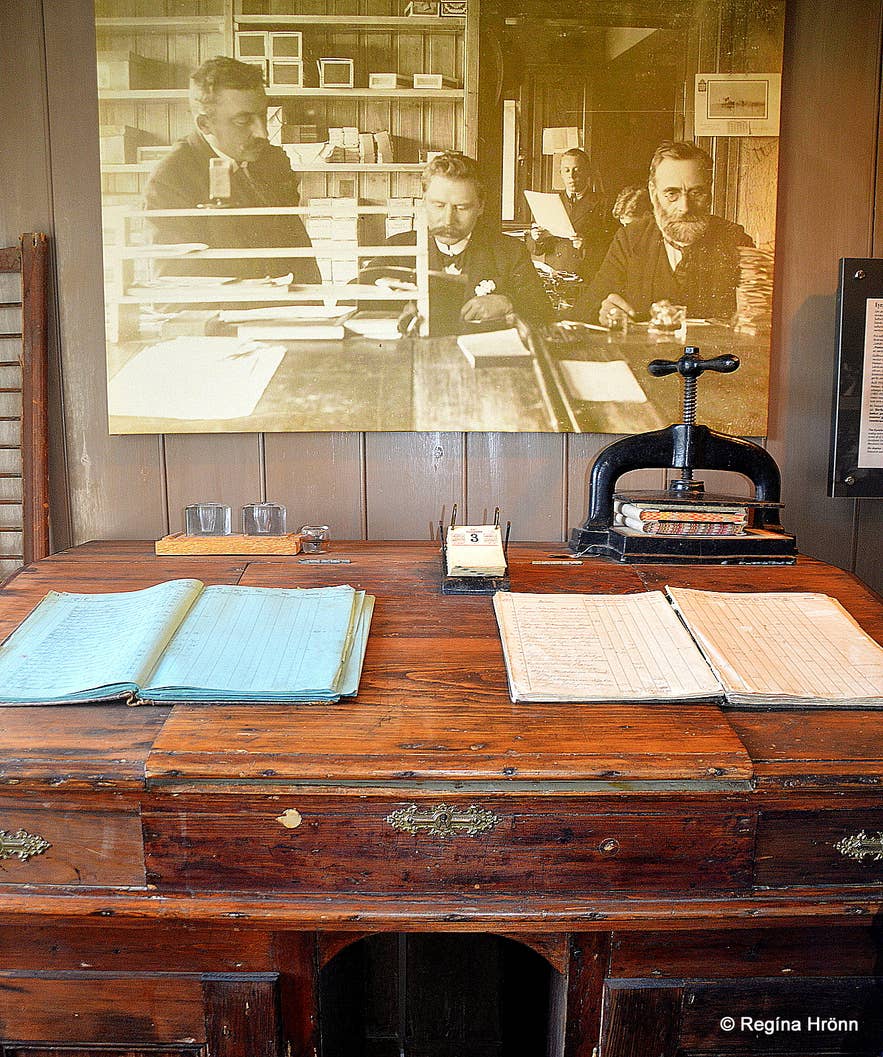
Inside Húsið - the House
By the model of the Lefolii store, you will find the memorial of drowned fishermen and those lost at sea by Eyrarbakki.
I call the location of such monuments the heart of the villages in my country.
Every seaside village and town in Iceland has a memorial of this sort, and I seek them out on my travels in my country and pay my respect.
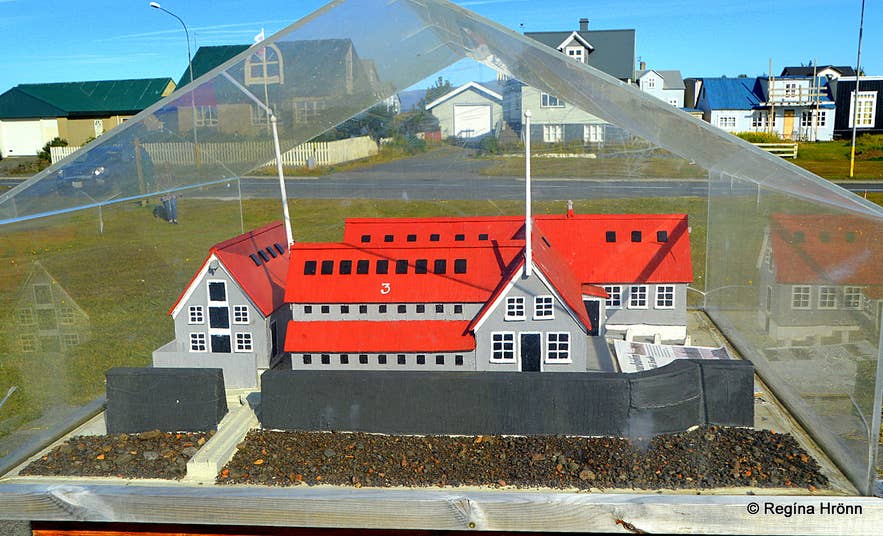
A model of the Vesturbúðin store of the Danish Lefolii-store
Fishing kept the Icelandic nation alive through the centuries, and the sea has claimed many a life, leaving grief-struck families ashore.
These monuments remind us of the harsh living conditions in Iceland through the ages.
Do stop for a while and pay homage to these memorials during your visit.
On the grounds of the memorial and the model, archaeological excavations are taking place (2017). From here, you can also visit a viewpoint for a beautiful view of the sea.
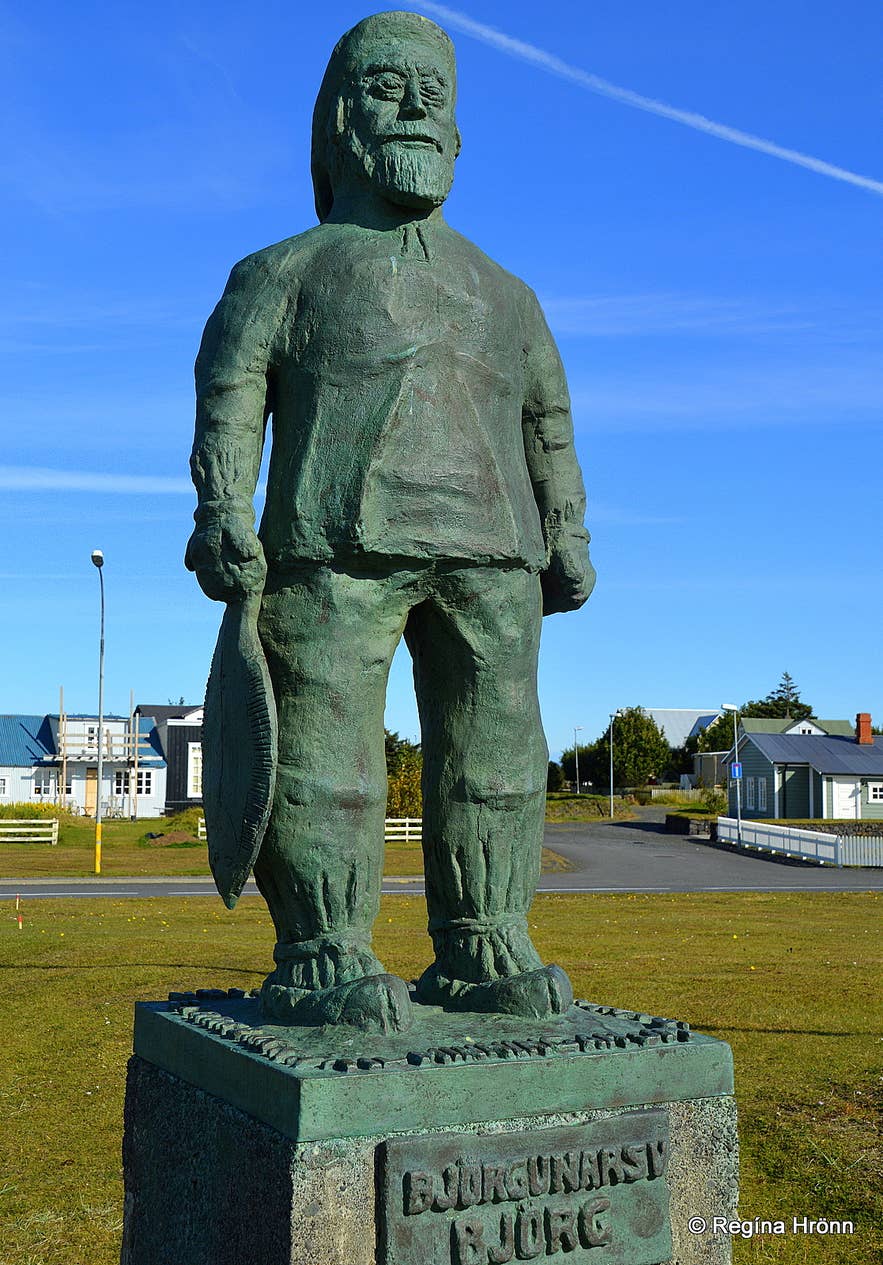
The monument for drowned fishermen at Eyrarbakki
You will find a couple of other museums in Eyrarbakki, such as Kirkjubær, a small house from 1920, where you can learn about the life of the common people in Eyrarbakki from 1920 to 1940.
And the Eyrarbakki Maritime Museum, where you can learn about the lives of the inhabitants of Eyrarbakki from 1850 to 1950.
The inhabitants of Eyrarbakki have surely put their pride into welcoming visitors to their village.
Verslun Guðlaugs Pálssonar - the little old Shop of Guðlaugur Pálsson
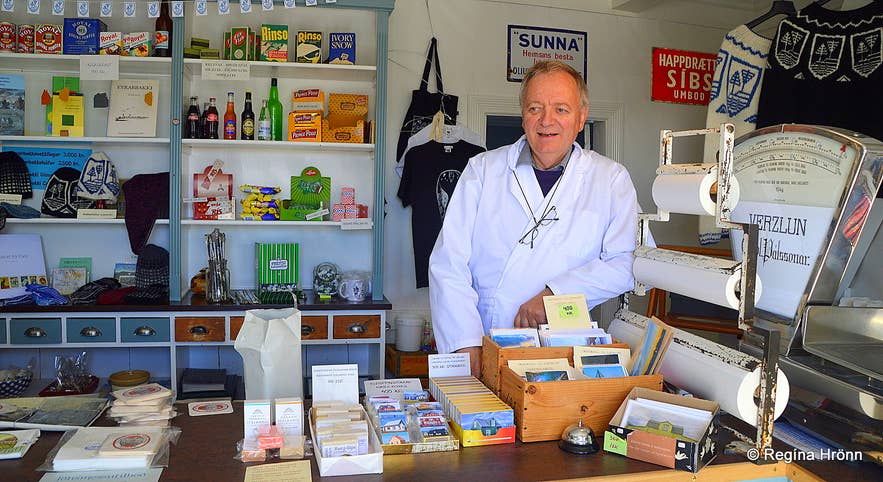
Verslun Guðlaugs Pálssonar - the little old Shop of Guðlaugur Pálsson - the new owner, Magnús Karel
In one of the colourful little houses in Eyrarbakki, you will notice a small convenience store.
This is Verslun Guðlaugs Pálssonar - the convenience store of Guðlaugur Pálsson, which he managed here at Sjónarhóll from 1919 until he died at 97 in 1993!
Before opening his store in this quaint little grey house with a red roof, Guðlaugur had been running it for 2 years at another location in Eyrarbakki.
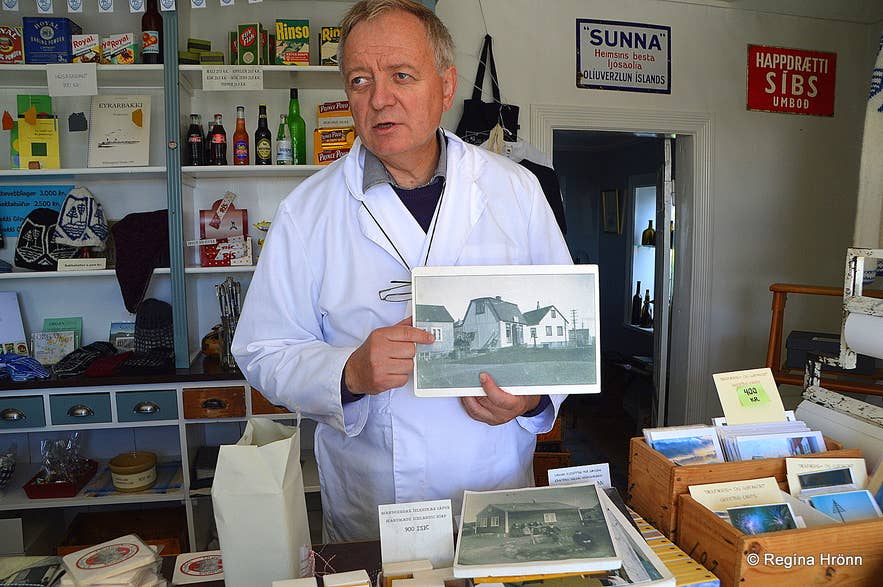
The owner of the store, Magnús Karel, showed us old photos of the store
This little store, Laugabúð, looks exactly the same as it did all these years ago, and visiting it is like stepping back in time.
Guðlaugur was a legend and won the Order of the Falcon for spending most of his life, all in all, 76 years, behind the counter.
He never used a calculator, but added and subtracted in his mind using only a pencil.
The store's counter is on display at Húsið, but stepping inside feels like stepping into a small museum.
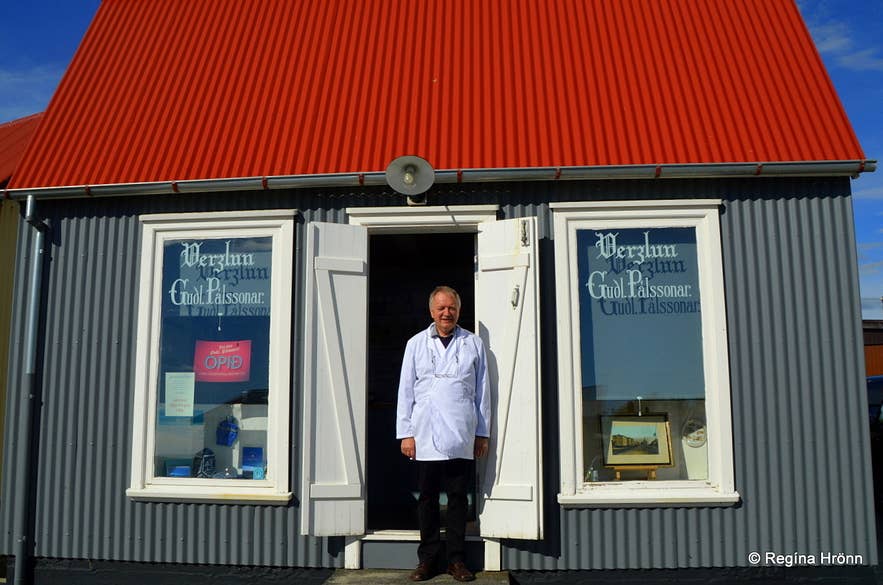
Verslun Guðlaugs Pálssonar - the little old Shop of Guðlaugur Pálsson
I pop into the store when I see that it is open, buy a couple of things, and reminisce. Last time I bought an excellent book about the Hvítá river for a very good price. The store is now mostly open at weekends.
Magnús Karel Hannesson bought the store and renovated it. I asked him to pose for me in the photo above, as the previous owner had when he was alive.
Bakkastofa Culture House
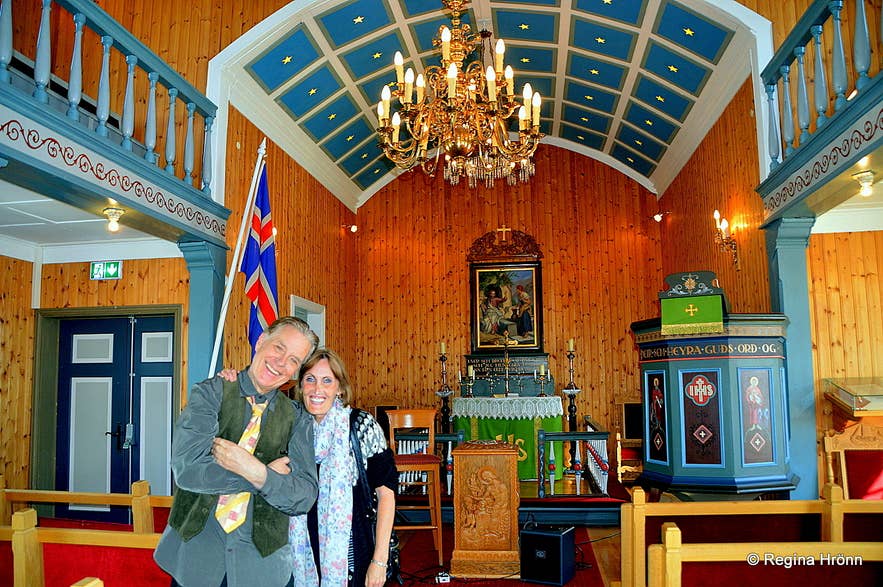
I met Valgeir in Eyrarbakkakirkja church
The lovely couple, Valgeir Guðjónsson and Ásta Kristrún Ragnarsdóttir, live at Bakkastofa in the Eyrarbakki village.
You might remember them from my travel blog, the Saga Music 101 - the Icelandic Viking Sagas portrayed in Songs.
They visit Reykjavík from time to time with their wonderful Saga Music 101 Show.
Valgeir and Ásta at Bakkastofa offer you an unforgettable visit to the quiet little village in which they live.
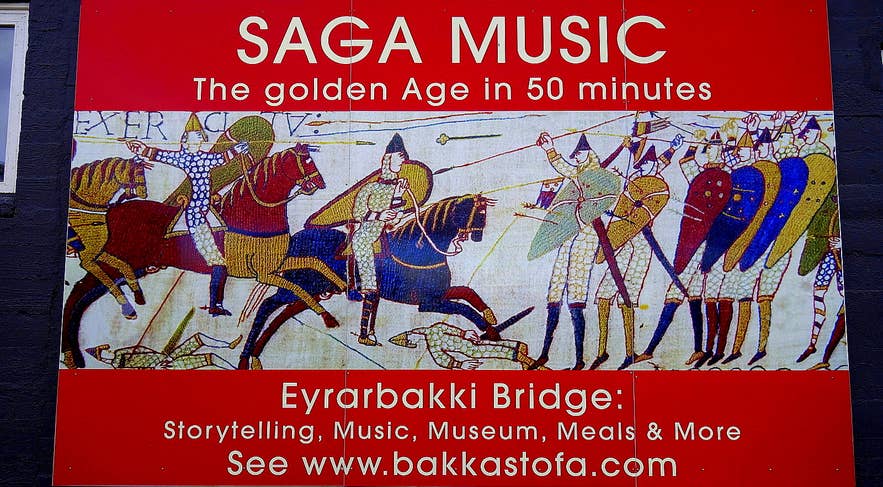
The show at Bakkastofa in Eyrarbakki
Groups of over 20 people can enjoy their show at the Old Fish Factory Venue across the street from Bakkastofa, but groups of fewer than 20 people can enjoy it at the couple's home, Bakkastofa.
Here you can enjoy music and storytelling and generally bask in good company, but Ásta is a fantastic storyteller, and Valgeir is a very well-known musician and used to belong to one of Iceland's most popular bands, Stuðmenn.
Ásta and Valgeir are extremely nice and lovely people, so do pay them a visit.
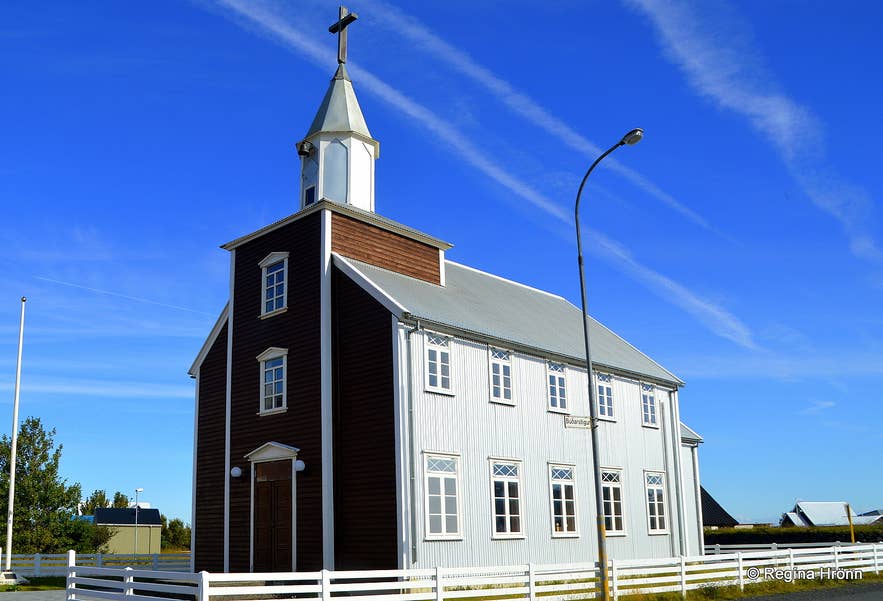
Eyrarbakkakirkja church at Eyrarbakki
When I visited Eyrarbakki during their village festival on Midsummer Day, I met Valgeir and Ásta in the village church, Eyrarbakkakirkja (1890), where Valgeir was performing.
They welcomed me with open arms and gave me such good compliments on my travel blog that I will never forget it: they are for sure an extraordinary couple :)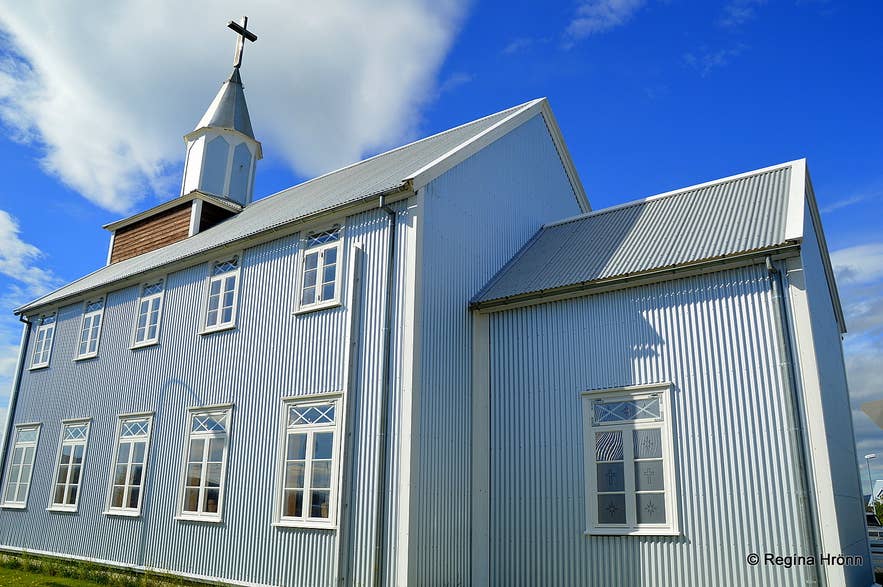
Eyrarbakkakirkja church
In Eyrarbakkakirkja church, you will see an altarpiece painted in 1891 by the Danish Queen Louise, the queen of King Christian IX (who, by the way, was the great-great-grandmother of Queen Margaret II in Denmark, Queen Elizabeth II in England, and King Harald V in Norway).
When the architect of the church, Jóhann Fr. Jónsson, sailed to Copenhagen to obtain wood for the church, he met the King and Queen of Denmark, and the Queen promised to paint an altarpiece for Eyrarbakkakirkja. That is how it came about that we have a royal altarpiece in this beautiful church :)
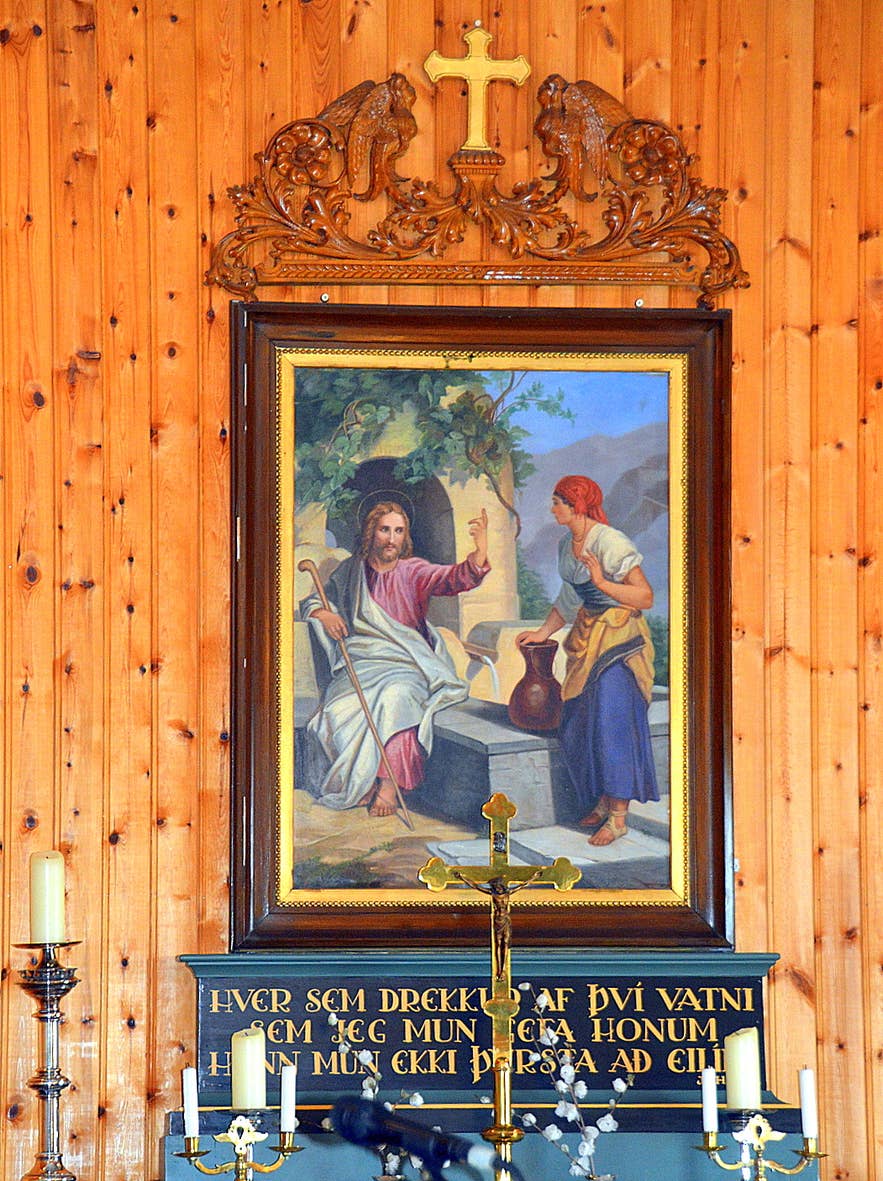
The lovely altarpiece in Eyrarbakkakirkja church
At Eyrarbakki, you can also enjoy a good meal at the cosy restaurant Rauða húsið - the Red House and stay overnight at Bakki hostel & Apartments.
In one location, when you enter Eyrarbakki village on the west side, you will encounter this sign by the shore pointing out that the next stop, straight south from where you're standing, is the South Pole.
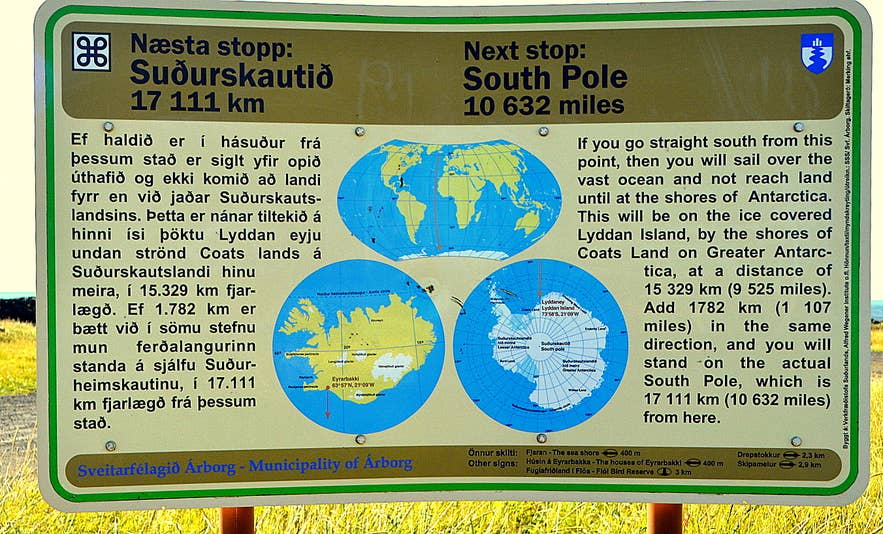
Next stop - the South Pole
In Eyrarbakki, as you leave the village on the east side, you will find, on your right, the oldest still-operating primary school in Iceland, established in 1852.
And as you drive a little bit further out of the village, you will notice a large white building also on your right-hand side.
This is Litla-Hraun prison, Iceland's largest maximum-security prison, established in 1929. The oldest building of the prison was originally erected to house a hospital for this area.
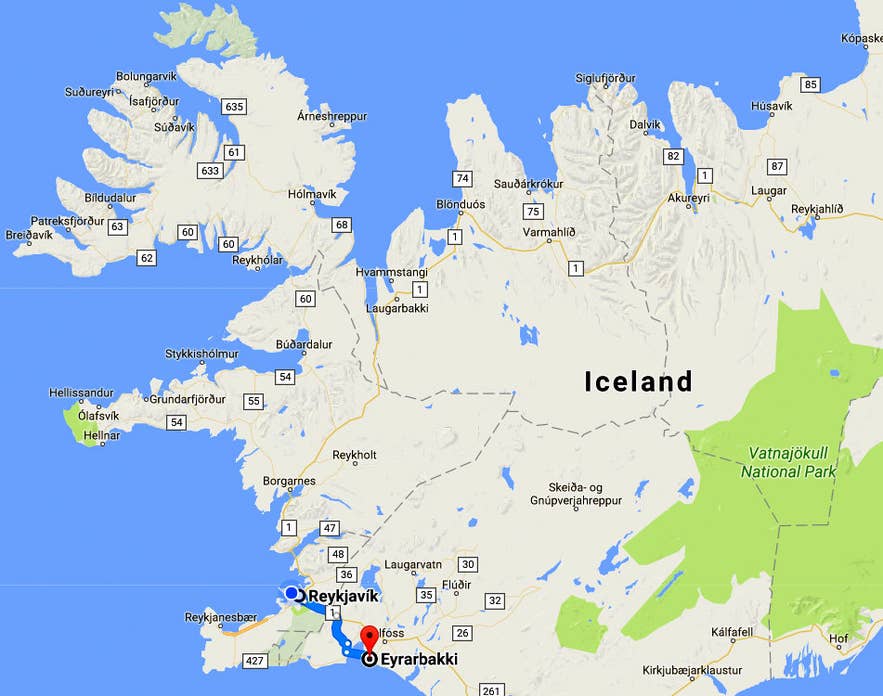
The drive from Reykjavík city to Eyrarbakki village is 53 km via routes 1 south and 39, which we call Þrengslin. Þrengslin is a less-traveled road, with a sign indicating the direction to Þorlákshöfn village.
You can rent a car in Reykjavík and drive to Eyrarbakki in less than an hour. On the way, you will pass Raufarhólshellir lava cave, so why not pop in for an hour's guided tour of the very colourful lava cave?
You will actually be driving over a section of the cave for a moment.
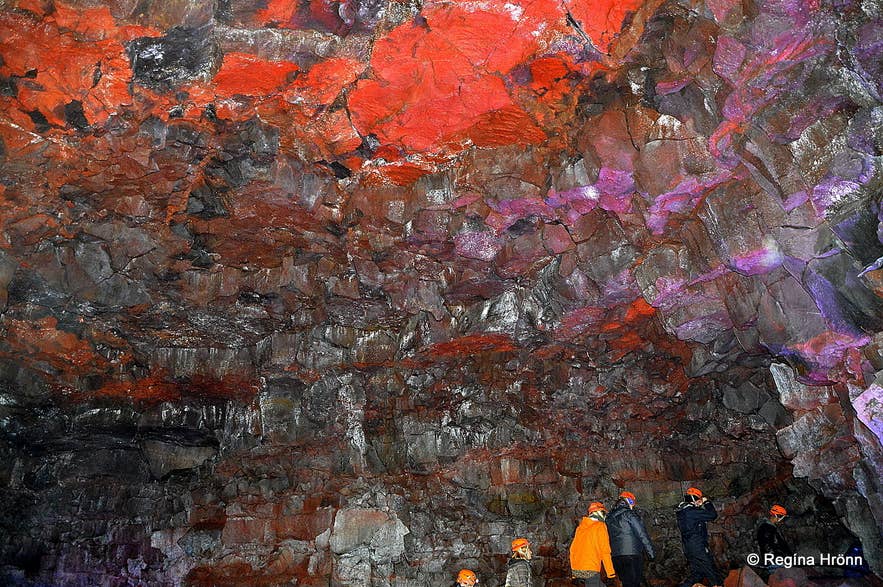
Raufarhólshellir lava cave
Eyrarbakki and its neighbouring village, Stokkseyri, are located between two massive glacial rivers: Ölfusá, Iceland's largest river by volume, and Þjórsá, Iceland's longest river.
The distance between these two villages is only 6.1 km, about 8 minutes by car.
We locals jokingly refer to these villages, Stokkseyri and Eyrarbakki, as Stokkseyrarbakki, as we regard them as a pair :)
After visiting Eyrarbakki village, I would recommend a visit to Stokkseyri - where you can visit the Wildlife Museum, the Ghost, Elves and Northern lights Museum, and Þuríðarbúð, a replica of a fishermen's hut, made of turf and rocks, which by the way belongs to Byggðasafn Árnesinga - Húsið.
I have written another travel blog about Stokkseyri village: The lovely Stokkseyri Village in South Iceland - the Home of the Wildlife Museum, Turf Houses and Kayaking.
 In another travel blog, I will show you more interesting sights along the south coast of Iceland.
This is a semi-circle that will take you to Ring Road 1 again, where you can continue on your travels to the sights on the south coast.
Have a lovely time at Eyrarbakki :)

Hi, my name is Regína Hrönn, and I was born and raised here in Iceland.