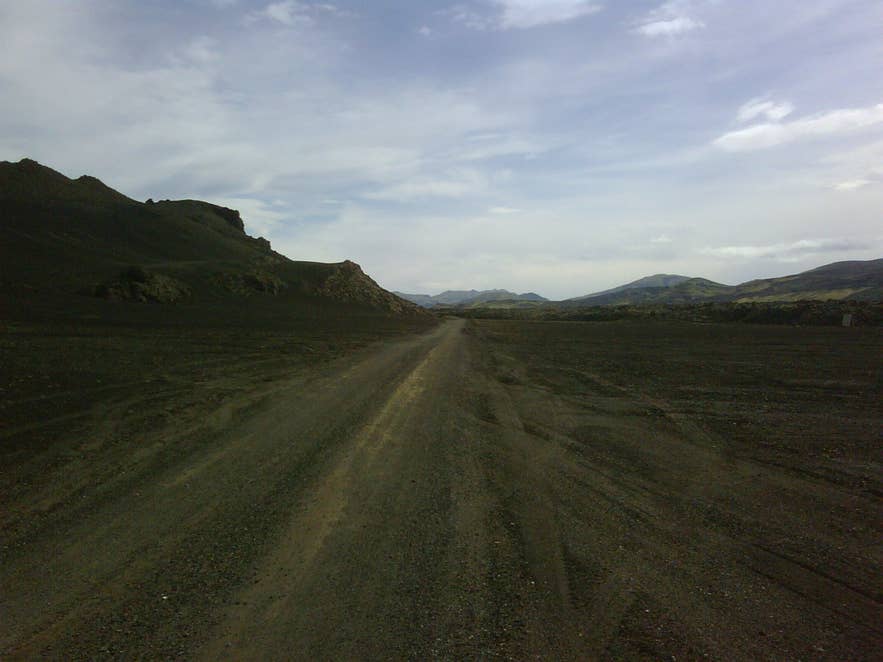
F225 past the Nýjahraun lava field. Photo: Pietro, CC BY-SA 3.0
The Nýjahraun lava field ("New Lava") is a young lava field in the highlands east of Hekla, in Rangárþing ytra in South Iceland.
It formed in 1878, when fissures opened about 10 km east of Hekla's main ridge beside the mountain Krakatindur, and the lava spread west and north of the peak towards the Valahnúkar hills.
The highland track Landmannaleið (F225) runs along its edge on the way to Landmannalaugar, so most visitors see it from the track or on a buggy or super-jeep tour out of Hrauneyjar.
Key Takeaways About Nýjahraun
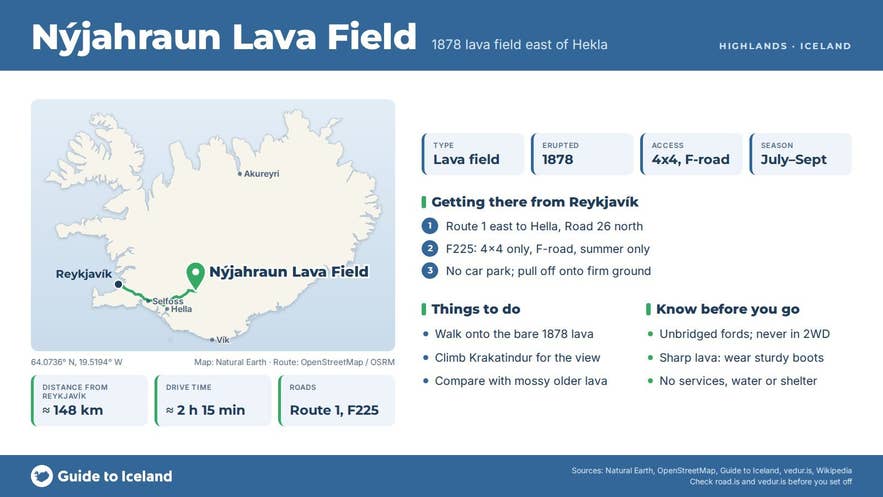
- Formed in a two-month fissure eruption that began 27 February 1878, about 10 km east of Hekla
- Lies along Landmannaleið (F225): 4x4 only, river fords, usually open from mid-June to late September
- About 148 km / 2 h 15 min from Reykjavík via Hella and Road 26; 40 km from Hrauneyjar
- Krakatindur, the móberg peak in the lava, is a short steep summit hike with views over the field
- No facilities, parking or fee; sharp young lava, so wear sturdy boots
Why visit the Nýjahraun lava field
Nýjahraun is one of the easiest places in Iceland to stand on lava that is barely 150 years old and still looks it.
The field is almost bare: dark, rough blocks of lava with only the first mosses and cushion plants taking hold.
The older Hekla lavas around it are covered in thick grey-green moss, so the age difference is visible at a glance.
The eruption began on 27 February 1878 and lasted roughly two months, ending in April. It was a small, mostly effusive event (VEI 2) that produced about 0.2 cubic km of lava from two parallel fissures and covered around 15 square km, with little ash and no recorded damage.
The vents sat on a fissure west and north of Krakatindur rather than on Hekla itself, which is typical of the Hekla volcanic system: the central volcano has erupted about 20 times since Iceland was settled (most recently in 2000), while shorter fissure eruptions break out on its flanks.
A similar eruption followed nearby in 1913 at Mundafell and Lambafit, also about 10 km east of Hekla, from 25 April to 18 May.
Krakatindur, the dark palagonite (móberg) peak that rises out of the lava north-east of Hekla, is the landmark of the area.
Hikers' reports describe it as a short, steep summit walk from the track, roughly 4 km return with 300-400 m of ascent on loose rock.
From the top you look west to Hekla's snow-streaked ridge, east to the red Rauðufossafjöll mountains and straight down over the whole of the Nýjahraun lava field.
How to get to the Nýjahraun lava field
Nýjahraun lies along Landmannaleið (F225), the western approach to Landmannalaugar. From Reykjavík, drive Route 1 east to Hella, take Road 26 north past Hekla and turn onto F225 north of Hekla.
It is about 148 km and 2 hours 15 minutes of driving from Reykjavík to the western edge of the lava field, and about 63 km (1 hour) from Hella. From the Highland Center at Hrauneyjar it is roughly 40 km (45 minutes) via Road 26 and F225.
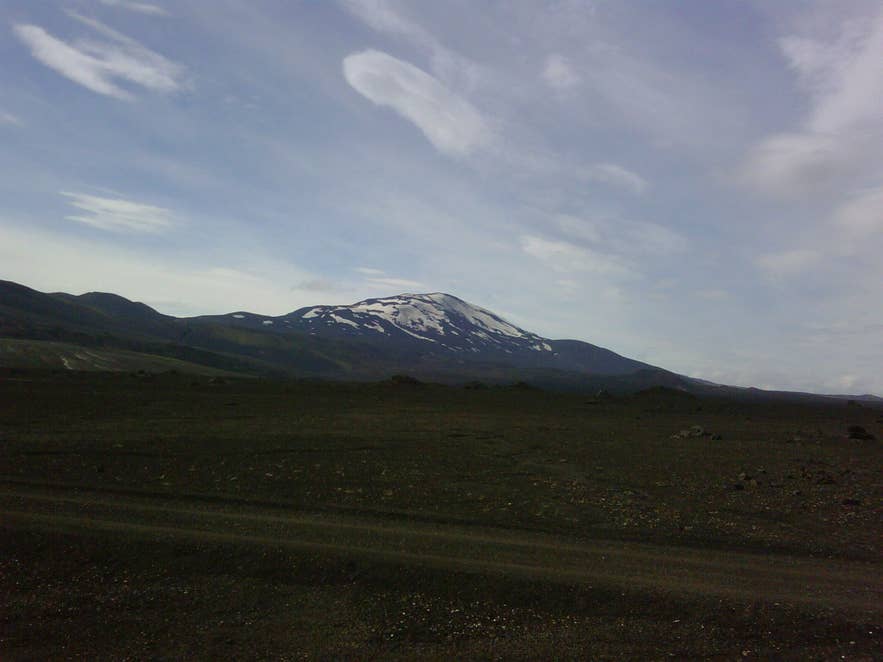
Hekla from the F225 by Nýjahraun. Photo: Pietro, CC BY-SA 3.0
F225 is an F-road: a 4x4 with good clearance is required, rental agreements for ordinary cars do not allow it, and the track includes unbridged river fords.
It usually opens around mid-June (Vegagerðin's 2021-2025 average opening date is 16 June) and closes with the first snows in late September or October; check road.is before setting out. There is no formal car park. Pull well off the track onto firm ground and walk onto the lava from there. The lava begins a few metres from the track.
Best time to visit
July and August are the most reliable months for access, with the fords at their lowest.
Early in the season there can still be snow patches and bright green moss after the melt; late August and September bring low sun that picks out the texture of the lava and fewer vehicles on the track. Outside the F-road season the track is closed to general traffic.
Safety and practical tips
- Young lava is sharp and unstable. Wear sturdy boots with ankle support and watch every step; a fall onto this rock will cut skin and gear.
- Weather changes fast at 600-800 m above sea level. Bring windproof and waterproof layers, a hat and gloves even in July.
- There is no mobile coverage in parts of the area, no toilets, no water and no shelter. The nearest services are at Hrauneyjar Highland Center and Landmannahellir.
- Fording rivers: check the depth on foot if unsure, cross slowly in low gear, and never ford in a 2WD car.
- Stay on the tracks and off the moss. The moss around the lava takes decades to recover from a single footprint or tyre track.
- Hekla is an active volcano with short warning times. Check en.vedur.is for alerts before you go.
- There is no entrance fee.
Nearby attractions
- Krakatindur - 3 km, the peak at the heart of the lava field
- Rauðaskál crater - 5 km
- Rauðufossar waterfalls - 7 km, red-bedded waterfalls below Rauðufossafjöll
- Landmannahellir - 8 km, huts and camping
- Hekla volcano - 13 km to the summit
- Dómadalur valley - 16 km further along F225
Tours that visit the Nýjahraun lava field
- Half-Day Landmannalaugar Buggy Adventure from Hrauneyjar Highland Center - a 5-hour buggy drive through the Fjallabak area that heads towards Rangárbotnar and pauses for a packed lunch with views over Nýjahraun and Krakatindur.
- Landmannalaugar and Highlands Buggy Tour from Hrauneyjar Highland Center - the 7-hour full-day version, with a midday break in the lava fields near Nýjahraun.