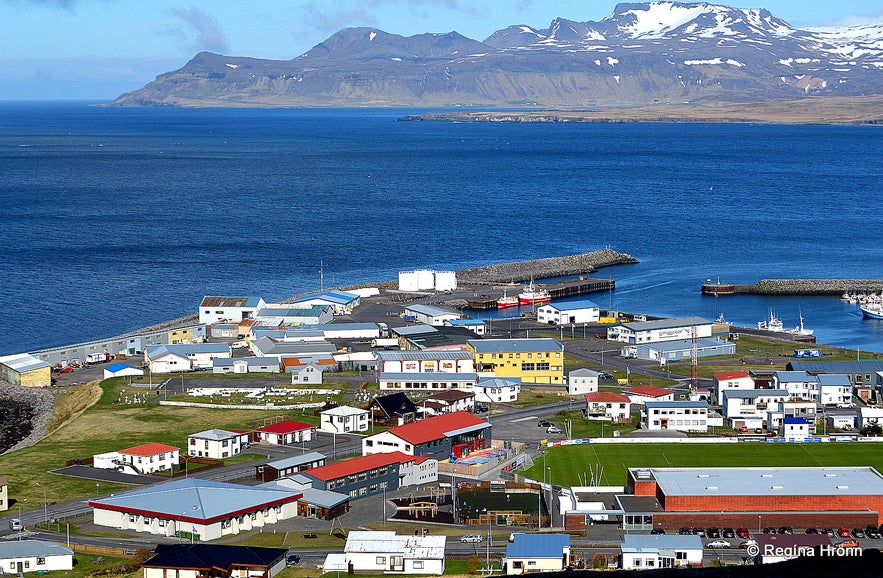
In this travel blog, I am going to show you Ólafsvík, a lovely little fishing town on the north side of the Snæfellsnes peninsula with a population of some 1,000 people.
As in every town and village in Iceland, you will find a museum here in Ólafsvík, a folk museum located in an old, preserved storehouse, dating back to 1844.
Top photo: Ólafsvík town as seen from the view-dial
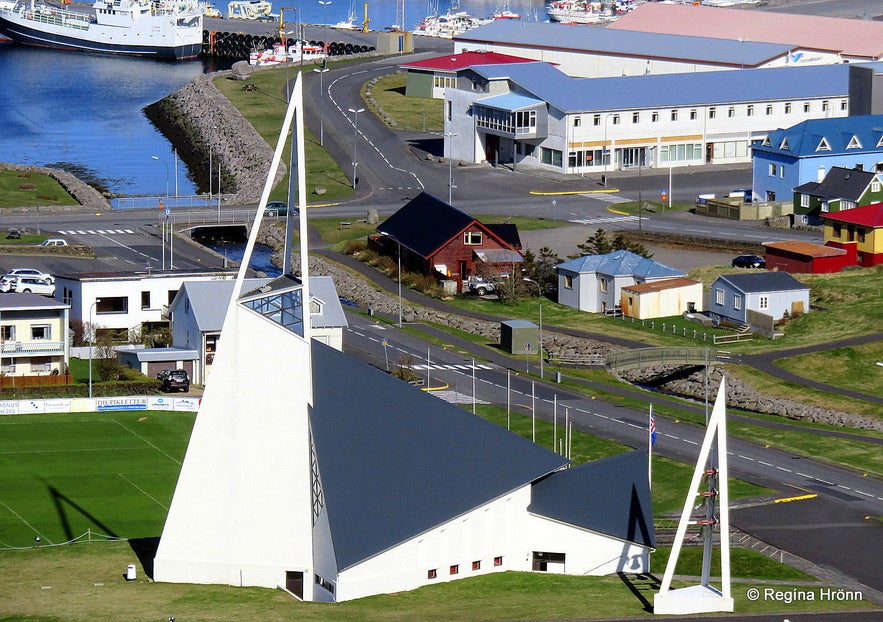
Ólafsvíkurkirkja church
Joined together, the neighbouring villages Hellissandur, Rif, and the town Ólafsvík are called the Snæfellsbær municipality.
Ólafsvík, or the Cove of Ólafur, is named after the settler of this area, Ólafur belgur. Landnámabók chapters 29 and 30 tell us the following: "Ólafur belgur settled the area between Enni to Fróðá and lived in Ólafsvík.
Then Ormur hinn mjóvi - Ormur the thin arrived on his ship in Fróðárós estuary and lived at Brimilsvellir for a while. He drove Ólaf belgur away from his settlement and settled the old Vík (Ólafsvík) between Enni and Höfði and lived at Fróðá."
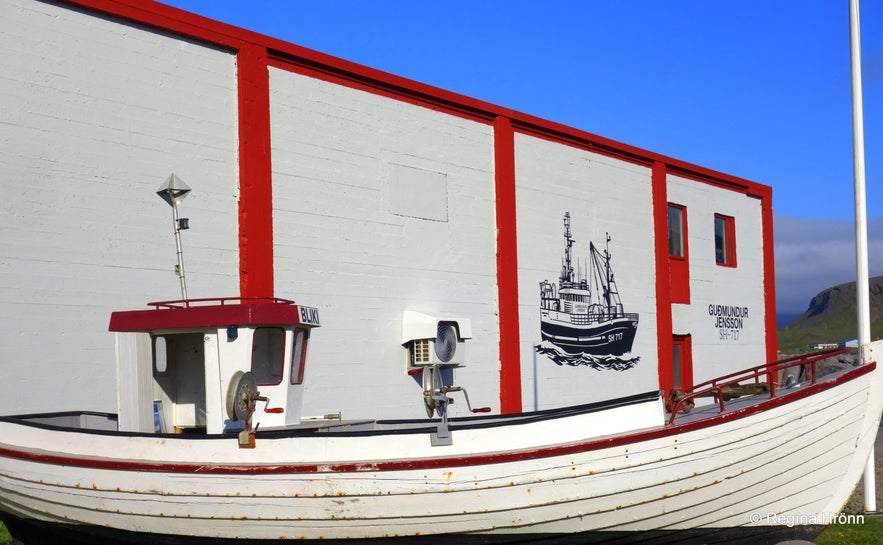 Ólafsvík is a fishing village
His son was Þorbjörn digri, whom we read about in Eyrbyggja, the old Saga that tells us about this area of Iceland.
Two stories intertwine, as his second wife was Þuríður, the daughter of Börkur hinn digri and Þórdís Súrsdóttir, who was the sister of Gísli Súrsson of Gísla saga Súrssonar.
These two Sagas are a great read, and I can wholeheartedly recommend them.
Ólafsvíkurkirkja church
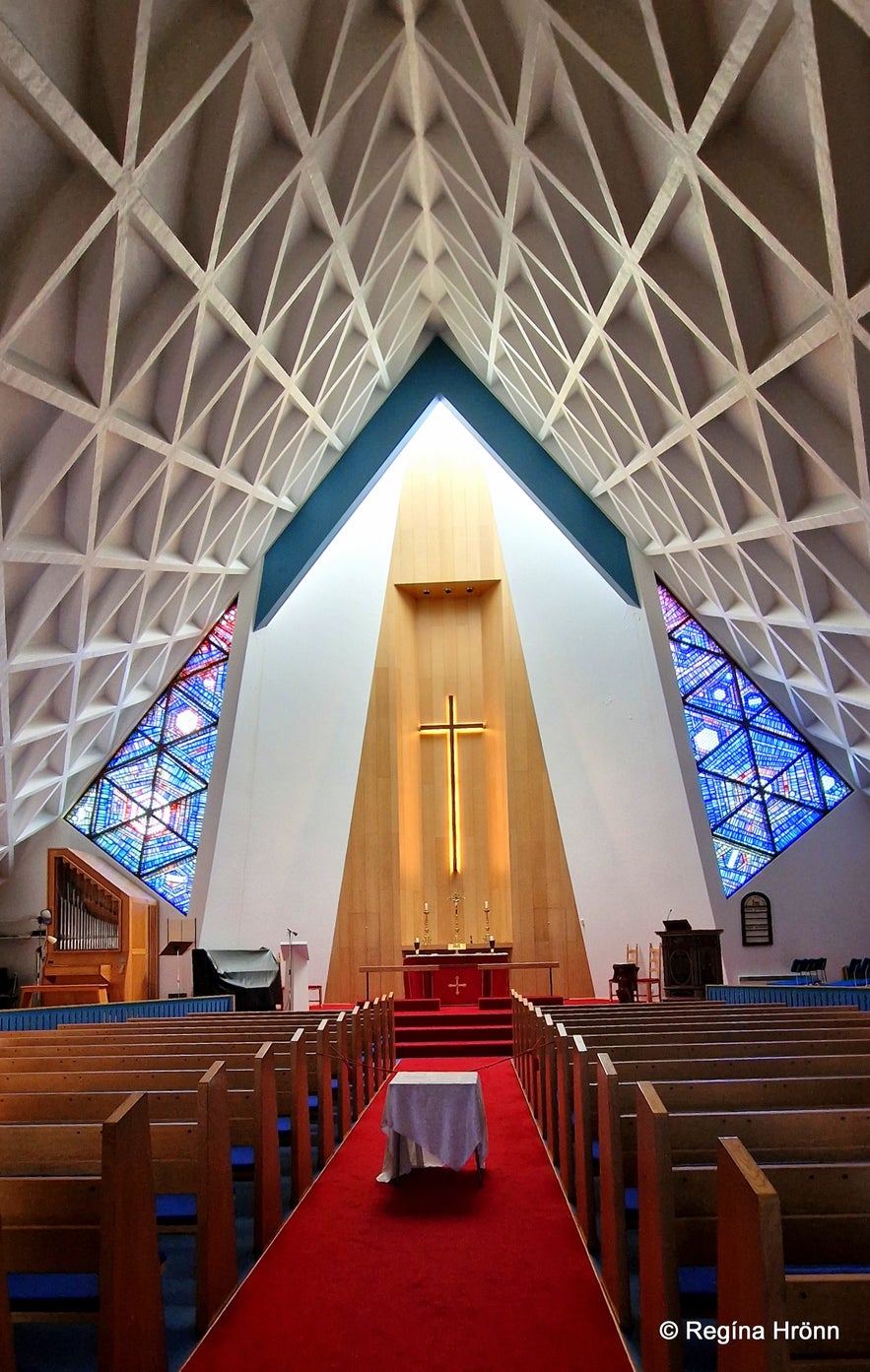 Inside Ólafsvíkurkirkja church
The landmark of Ólafsvík is the white, modern-looking church.
Ólafsvíkurkirkja church was consecrated in 1967. It is Iceland's first modern church building, and if you drive further on and visit Stykkishólmur town, you will see another big, white, modern-looking church.
These churches are so prominent that they have become the landmarks of these towns.
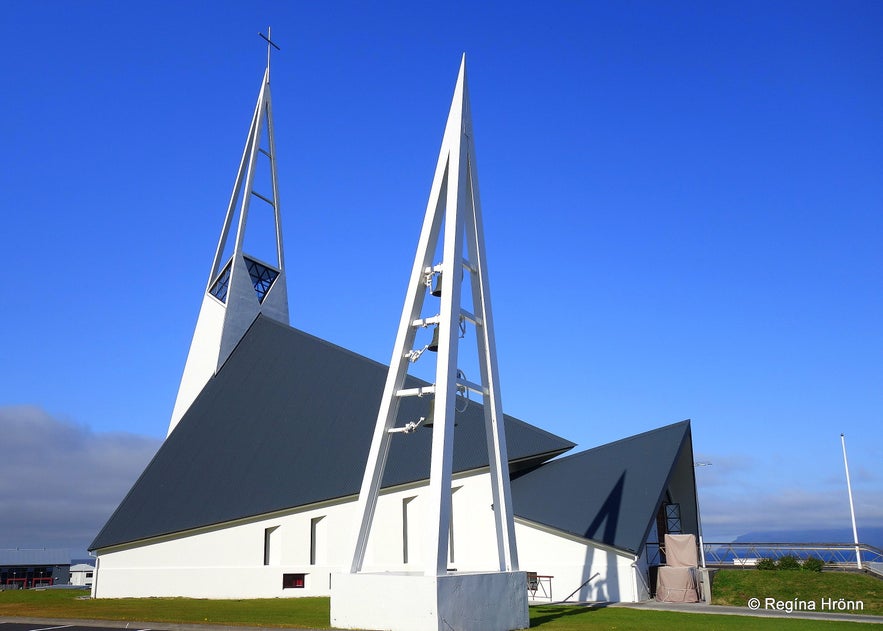 Ólafsvíkurkirkja church
If you drive around Iceland, you will see many traditional church buildings dotted all around the country, and in between, there are some unusually shaped churches.
I visit all the churches I see on my travels and often make a detour to visit churches, as I am so fascinated by them.
It is not easy to enter them, though, as most of them are locked due to vandalism, and I have to search for the key.
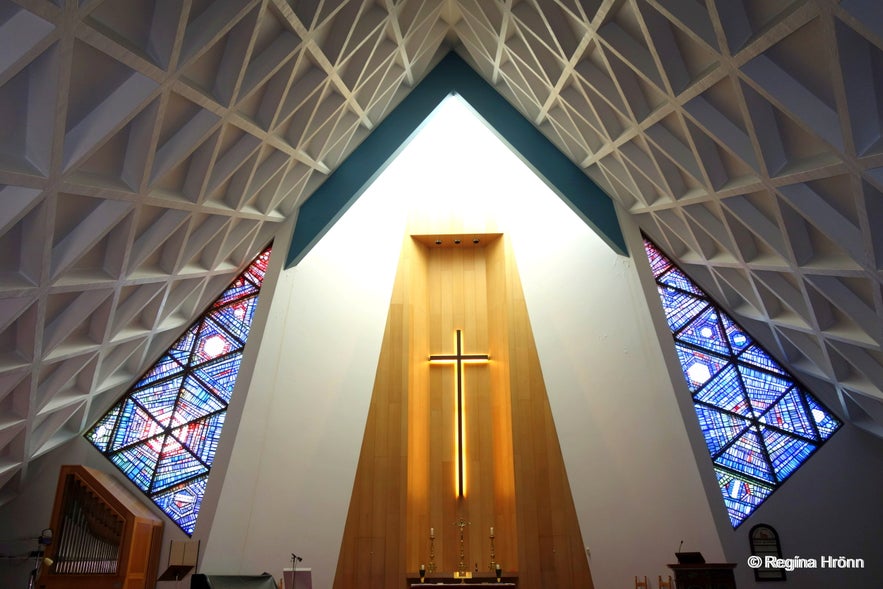 Inside Ólafsvíkurkirkja church
I think Ólafsvíkurkirkja church looks like a ship, but I have heard that if you look at it from above, it looks like outspread salted cod! It is made of triangles only, very distinctive.
I didn't go any higher than the view-dial, which isn't high enough to see if the church looks like a salted cod from above.
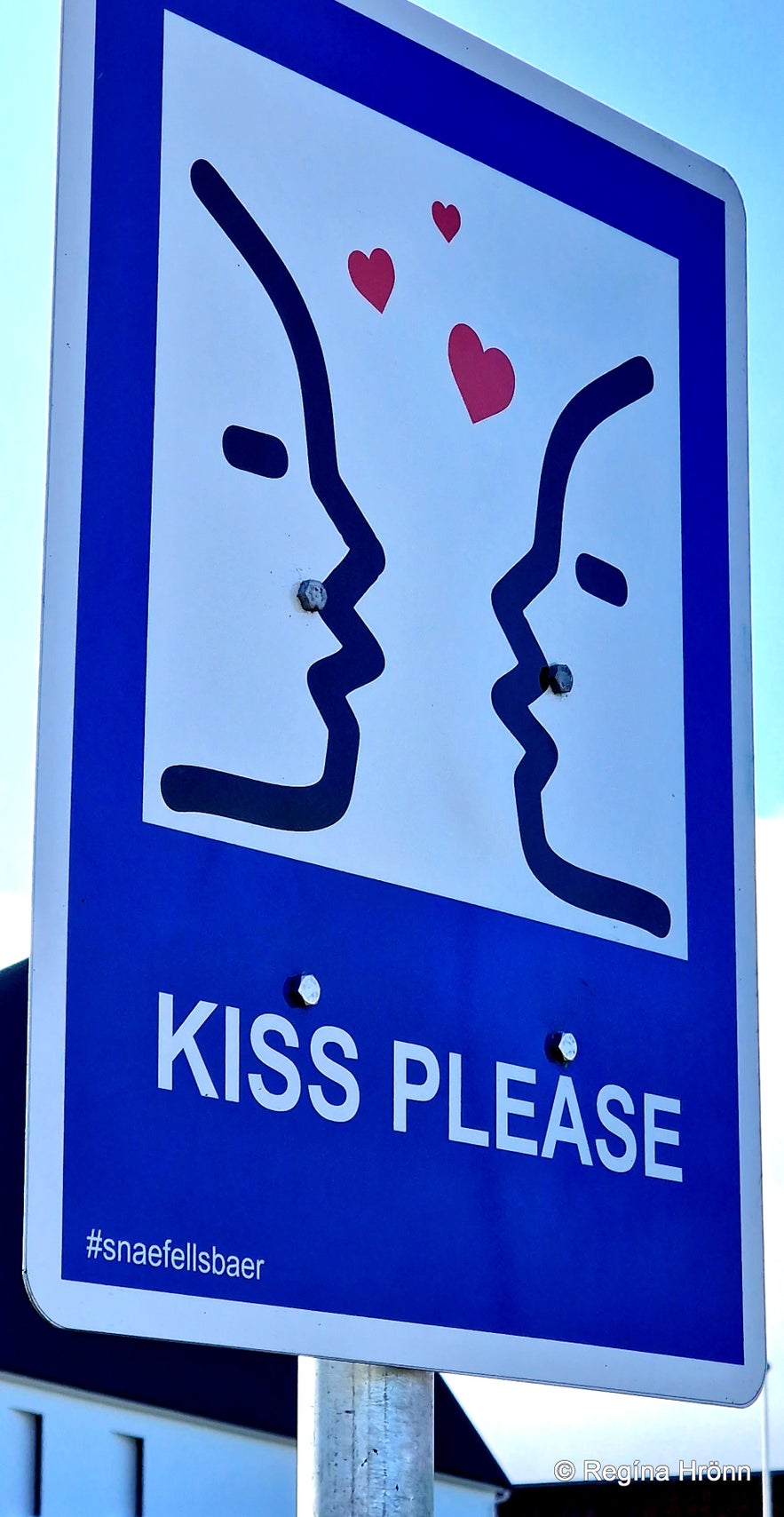 The new sign in Ólafsvík by the rainbow street - Kiss, please :)
Recently, a new sign was put up by the church - the "Kiss please" sign, where people are urged to have a photo of themselves kissing by the sign :)
Notice that it is not a drawing of people of the opposite sex, so everybody can kiss here and have their photo taken by the sign.
It has become a very popular sign, and in an interview with the mayor of Ólafsvík on TV, he said that he was still trying to get his wife to kiss him under the sign :)
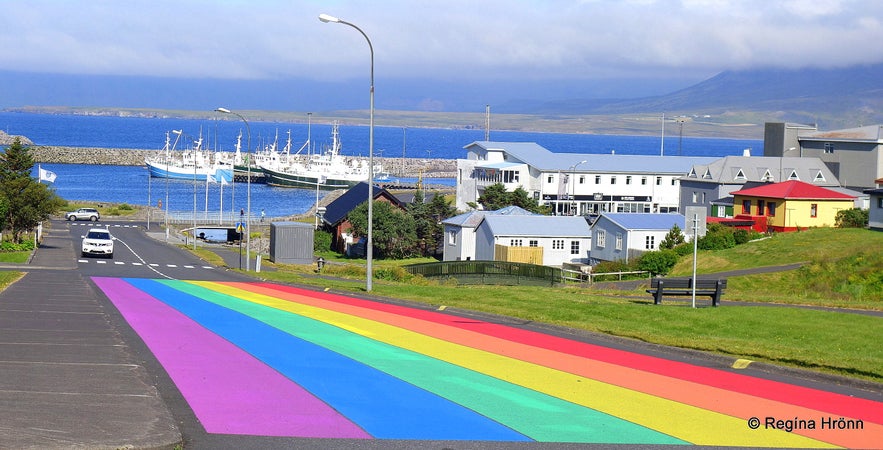 The rainbow street in Ólafsvík
The street leading up to the church is now a rainbow street in beautiful colours.
I love such streets and seek them out on my travels around my country. There are now many streets, sidewalks, and steps painted in rainbow colours.
In Reykjavík, parts of Skólavörðustígur street, a rainbow street, and in Akranes town, there was, for a time, the longest rainbow street in Iceland.
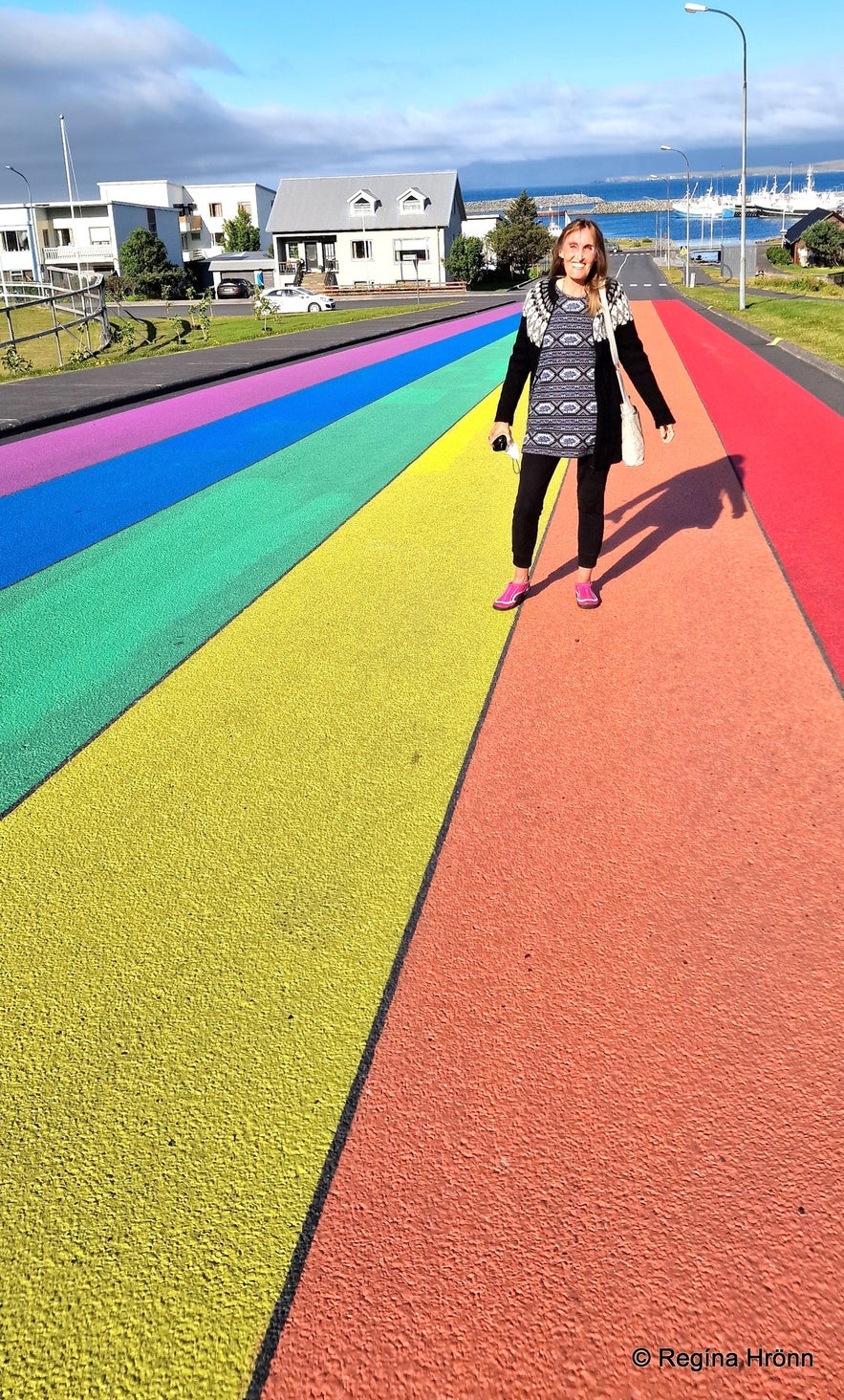 The rainbow street in Ólafsvík
And in Skagaströnd, you will find a rainbow sidewalk, just to name a few of the places in Iceland that have been decorated with rainbows.
Memorials for drowned fishermen
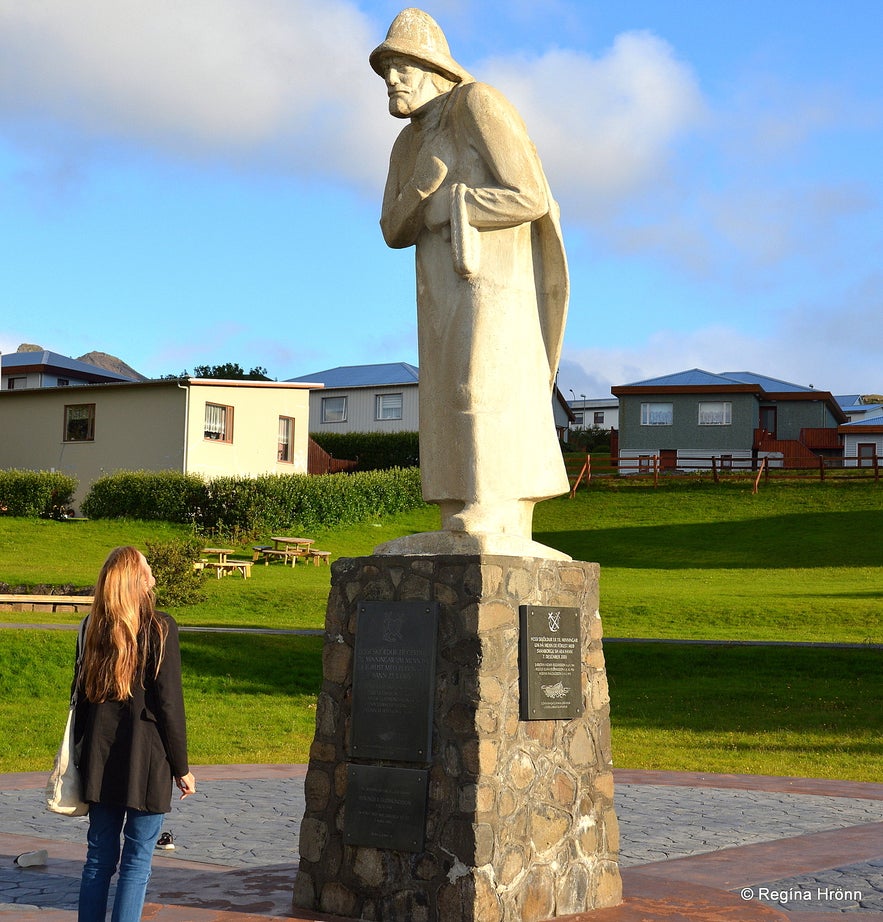 Memorial for drowned fishermen in Ólafsvík
As in other fishing villages and towns in Iceland, there is a beautiful monument in remembrance of fishermen and those lost at sea.
As I have told you before in many of my travel blogs, I always seek out these monuments, as, in my opinion, the heart of the fishing villages and towns in Iceland lies in them.
In Ólafsvík, you will find one of these monuments in Sjómannagarðurin - the Fishermen's Garden. Sjómannadagurinn - Fishermen's Day has been held for 73 years (2025) in Ólafsvík, but this day is celebrated all around Iceland.
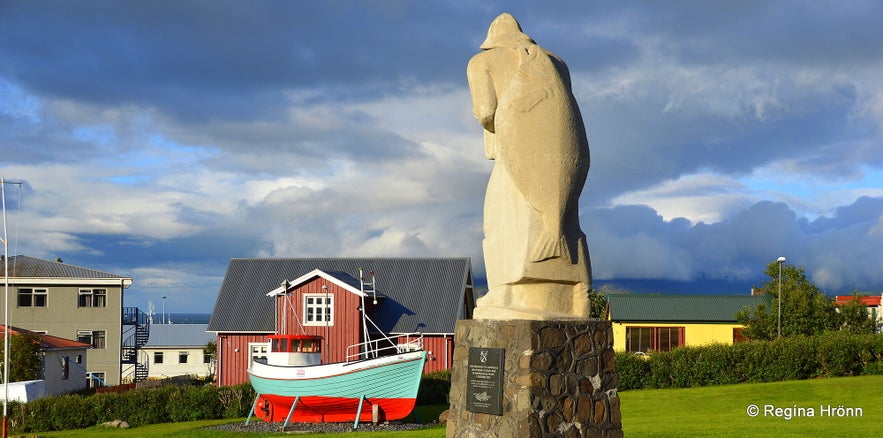
The memorial for fishermen in Ólafsvík in Sjómannagarður park
The memorial for drowned fishermen in Sjómannagarðurinn shows a fisherman carrying a big halibut (lúða) on his back.
It was made by Guðmundur frá Miðdalur, who was one of Iceland's best-known sculptors and the father of the artist Erró, who was born in Ólafsvík. The monument was erected on Sjómannadagurinn in 1961.
Another memorial for drowned fishermen is in the cemetery in Ólafsvík, for loved ones lost at sea.
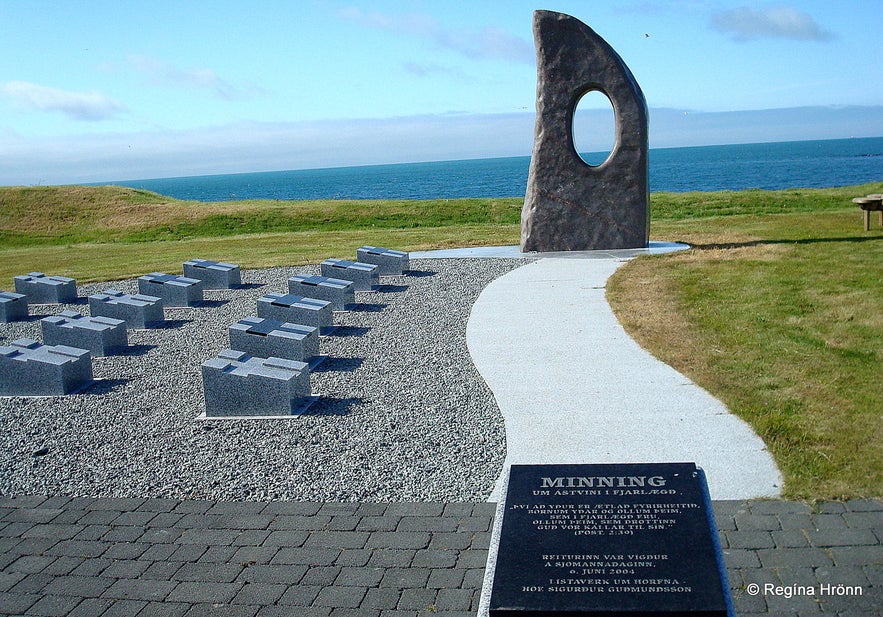
The monument for drowned fishermen in Ólafsvík
Two of my grandfather's sisters are buried in the cemetery in Ólafsvík, but they died of diphtheria only one day apart, the older one only 1-year old and the younger one 4-month old :( They were the oldest children of my great-grandparents.
Life sure was hard in the old days, and it breaks my heart when I go visit their small grave, which has only two first names written on the tombstone, Imba and Helga, and no surname, which was Ásmundsdóttir, as their father was named Ásmundur.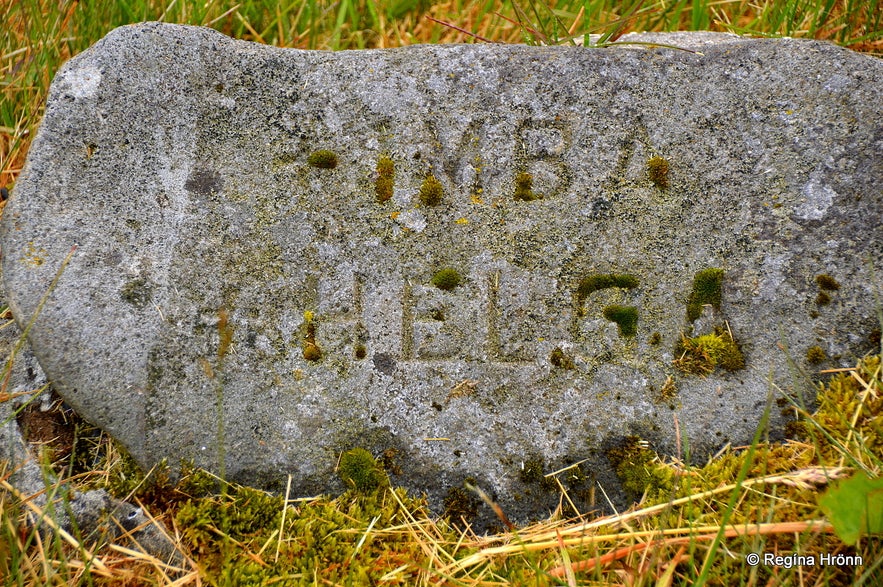
The grave of my two little great-aunts in Ólafsvík
When small children died, they were often buried with an adult, which was not the case with my two great-aunts, who got their own little grave together.
The family lived at Fróðá farm close by, but after the death of their two little girls, they moved to Grund and Suður-Bár farms in Grundarfjörður, where Ásmundur, my great-grandfather, lost his life at sea in Grundarfjörður fjord.
Ásmundur is buried in the Setbergskirkjugarður cemetery in Grundarfjörður, where many of my relatives are buried. The little girls' mother, Katrín, my great-grandmother, rests in Fossvogskirkjugarður in Reykjavík.
And these two little girls rest here, far from their families.
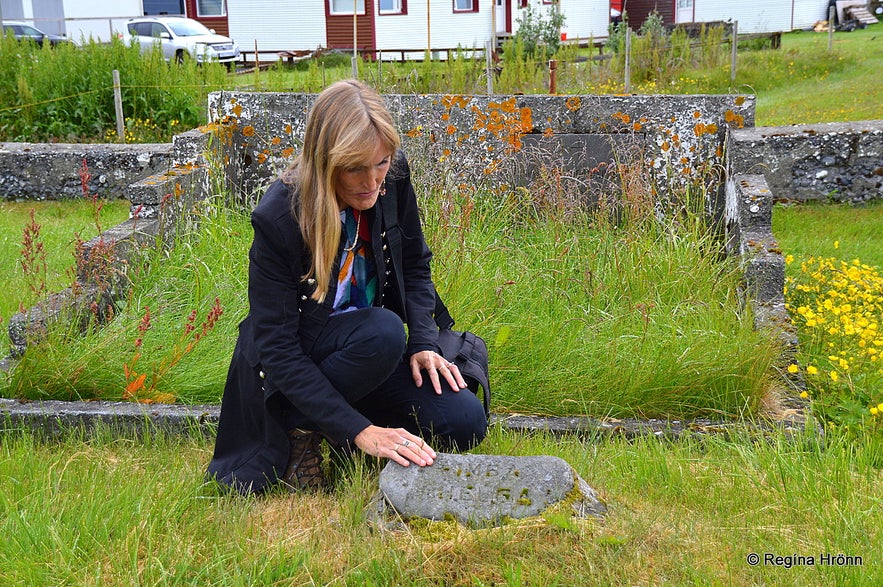
The gravestone, made by their grandfather, is so small and difficult to find in the cemetery
In Grenjaðarstaður up in North Iceland, I always visit the grave of my great-great-grandmother, who was the minister's wife and died of consumption after 4 of her small children died in a measles pandemic.
She, Regína Magdalena Sívertsen, is buried in the same grave as her 4 small children.
So many people lost several of their children in pandemics just 2 generations ago. Thank God for modern-day vaccinations, I say.
Ólafsvíkurenni
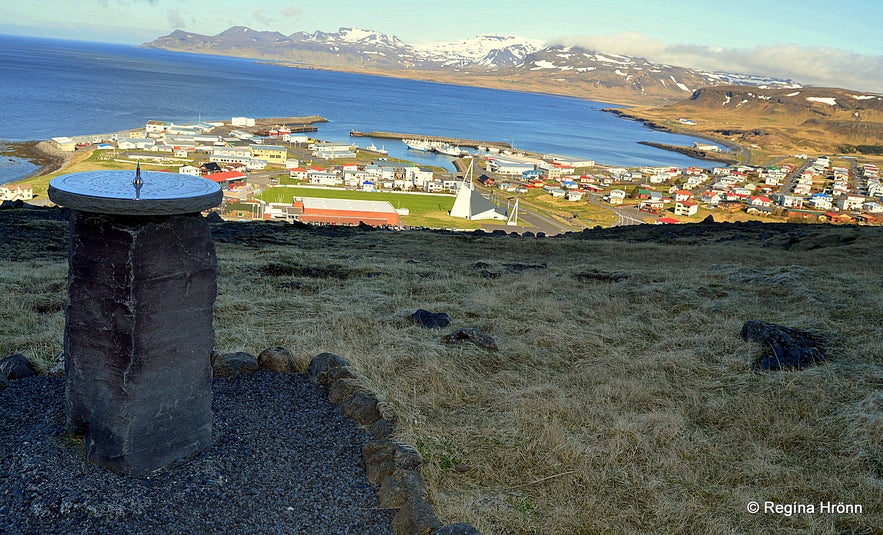
The view-dial at Ólafsvíkurenni in the shadow
The mountain towering above Ólafsvík is 418 meters tall and called Ólafsvíkurenni, or Enni for short. It is named after the settler of this area, Ólafur belgur, who settled the land between Fróðá and Enni, as I told you earlier.
The road lies through the screes, which is no problem on the new asphalt road, but when I was younger, I remember this road as being a bit scary, as it was high up, and landslides and avalanches are common here.
I saw avalanche barriers in the mountains above Ólafsvík, but you can see these avalanche barriers in many towns and villages around Iceland, situated below a mountain.
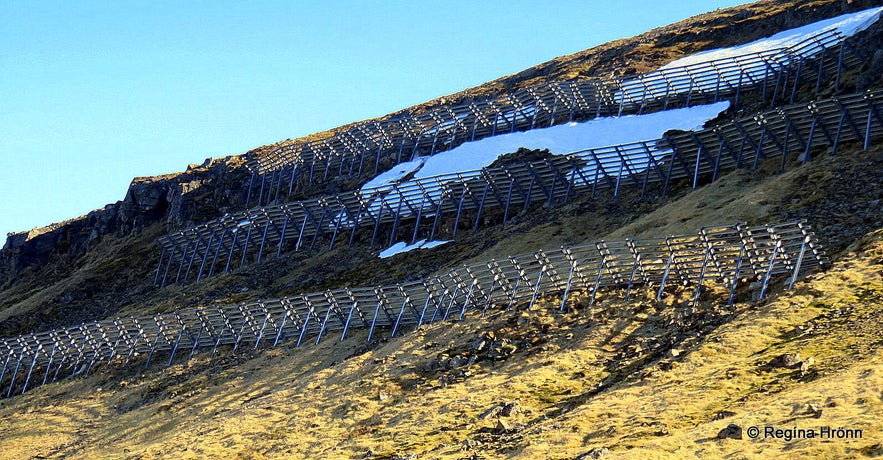
Avalanche barriers above Ólafsvík
If you look at my photo above, you will see what they look like and recognize them when you see them on your travels in Iceland. I have often been asked what they are.
There is one mention of the Icelandic elves - Hidden people beneath Ólafsvíkurenni in Þjóðsögur Jóns Árnasonar - The Compilation of Folklore of Jón Árnason. It tells the story of a man finding himself by the mountain on New Year's Eve.
The tide was in, and he couldn't get any further, and it looked like he would have to sleep outside on this special night.
All of a sudden, he saw a beautiful sight of 18 well-lit houses where elves were dancing to music.
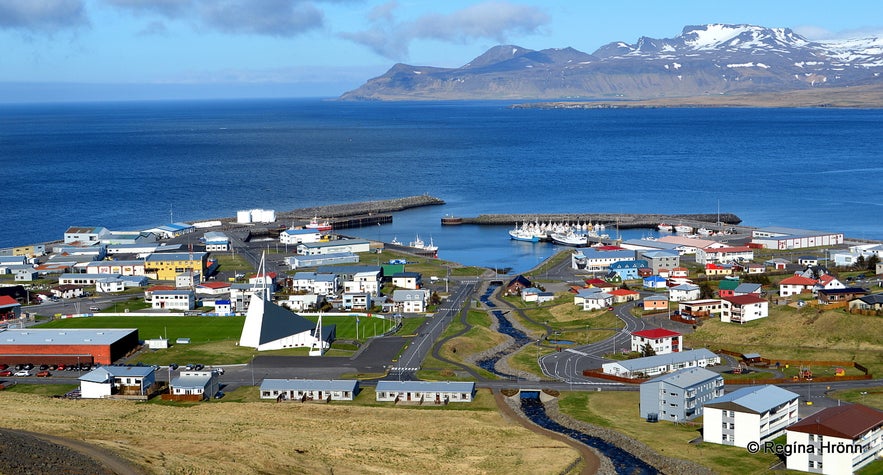
Ólafsvík as seen from above
I would love to see such a sight, but there are many accounts of elf sightings in Iceland like this one, so there may be hope for me yet.
The View-dial at Ólafsvíkurenni and Bæjarfoss falls
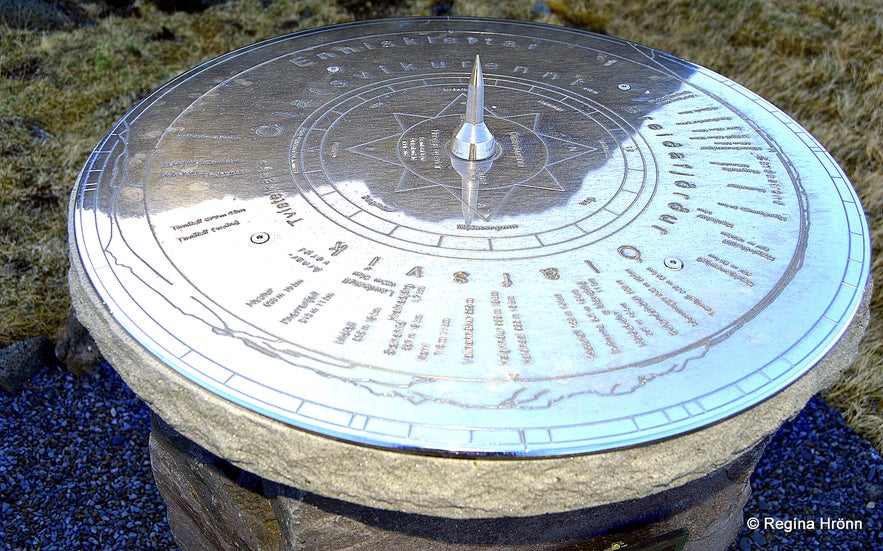
The view-dial at Ólafsvíkurenni
I would recommend a short hike up to Bæjarfoss waterfall, which has a drop of 50 meters.
What we did was drive up Enni to have a look at the view-dial - from there is a fantastic view of Ólafsvík, Fellsströnd, Breiðafjörður bay, and Barðaströnd, the southern part of the Westfjord region of Iceland.
We were there a bit late in the day, so the mountain had started casting a shadow on the view-dial, while Ólafsvík was bathed in the sunshine down below. Which also made most of my photos kind of blue.
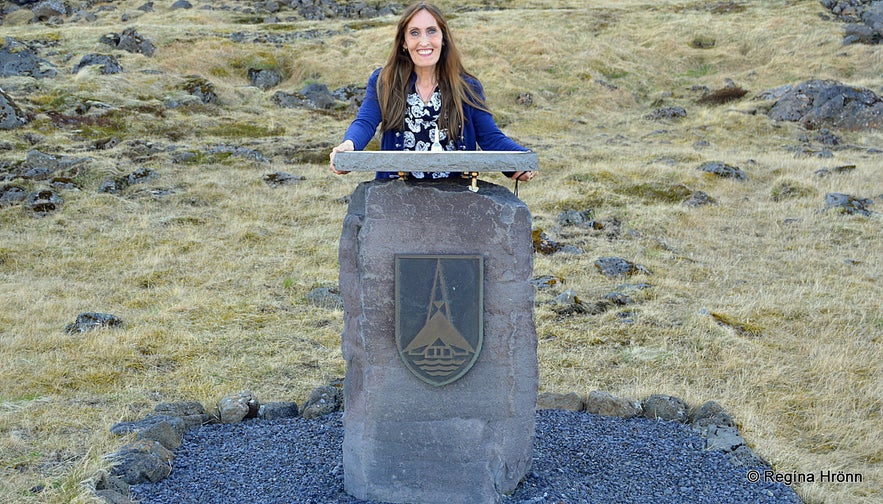
By the view-dial at Ólafsvíkurenni - in the shadow
The road is gravel, and you will find information signs at the turnoff. One of them has information about Enni.
It is written there that the view-dial was made by Hringsjárgerð Jakobs Hálfdanarsonar in 2005.
Jakob is my father-in-law, and I have a great interest in the view-dials around Iceland.
The view-dial was designed by Jakob, and his children Jón Víðis (my husband) and Þórný were his assistants. Framfarafélagið, Ólafsvíkurdeild erected the view-dial in August 2007.
It is chrome-plated and shows the names and height of the surrounding mountains. The view-dial stands on a basalt column.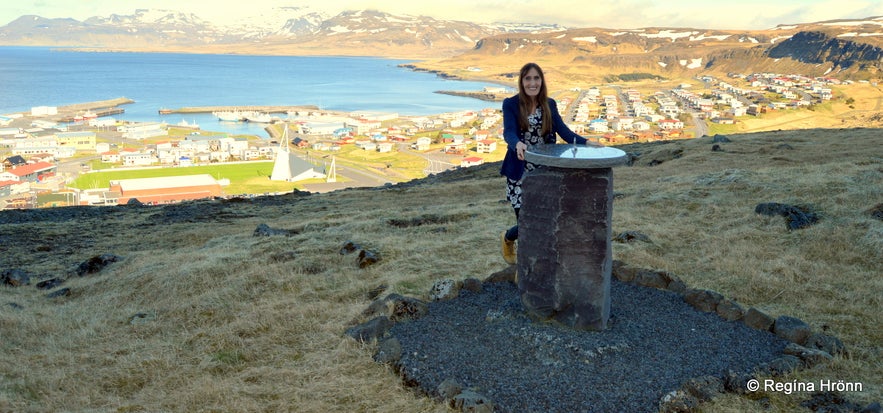
The view-dial at Ólafsvíkurenni in the shadow
A lot of work goes into these view-dials, and they are costly. It always saddens me to see people scratch their names or initials on the view-dials.
You will find a picnic area close to the view-dial, with a table and benches made out of driftwood from Strandir, but if you drive in Strandir, you will see driftwood in abundance. This spot is called Bekkurinn or the Bench.
Strandir is a very ruggedly beautiful area of Iceland. I have written about this area in my travel blog: The remote Strandir in the Westfjords of Iceland - Stillness & Sorcery.
Bæjarfoss waterfall
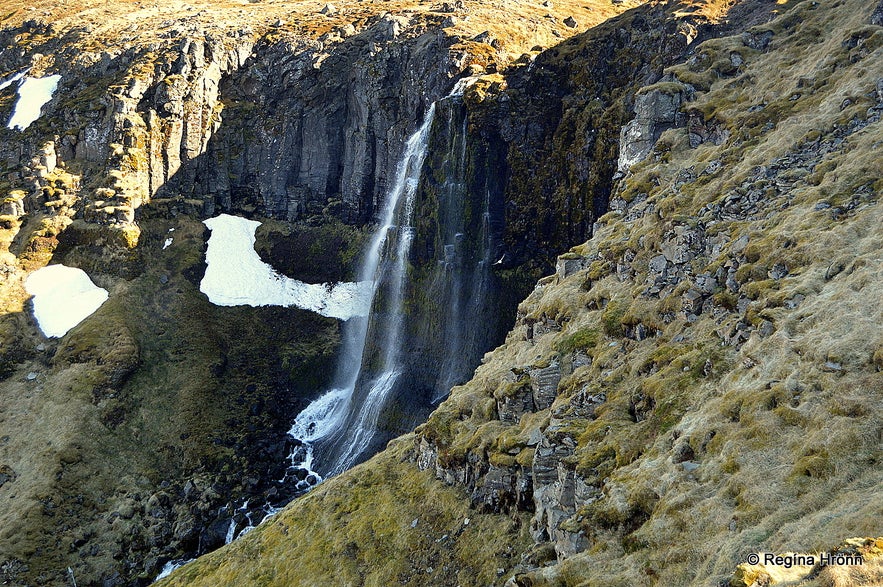
Bæjarfoss waterfall
From the view-dial, I walked up to the Bæjarfoss waterfall in Bæjarfossgil gorge and could stand relatively close to it, but I was too high up, so I walked down to the waterfall and visited it from below for a better view.
It is so majestic when you stand below it. It looks like a thin bridal veil.
It is quite a beautiful waterfall. Some of my photos were taken mid-May when it was still cold and grey, and the view-dial was in the shadow of the mountain
And there were snowbanks in the mountains by the waterfall.
Bæjarfossgil gorge is midway between Mt. Enni and Tvísteinahlíð.
No matter how often I have visited Ólafsvík, I have never been able to get a decent photo of Bæjarfoss waterfall.
I took a couple of photos, but they were all very dark. So I shot a video instead.
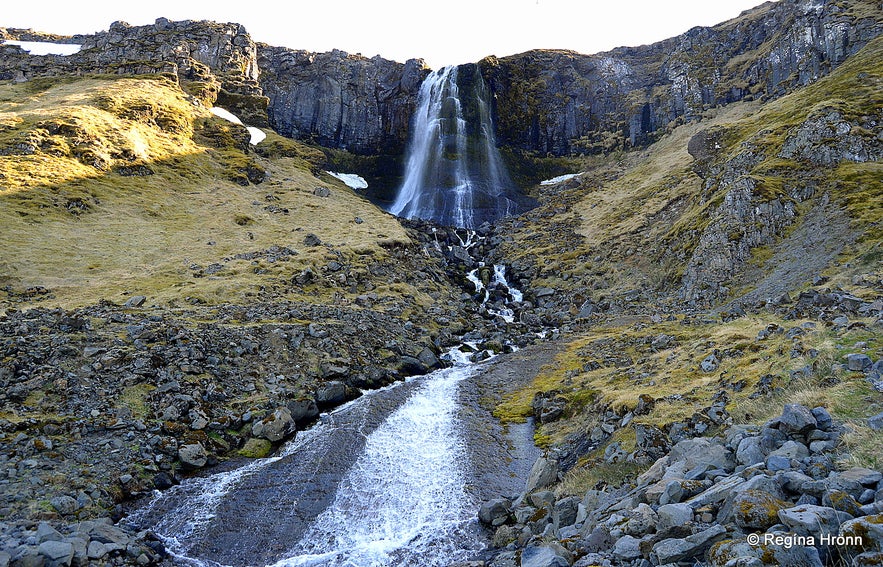
Bæjarfoss waterfall
The last time I visited and stayed in Ólafsvík village was in the summer of 2025. There was a strong northern wind, and it was only 7 degrees C.
We stayed at Við hafið guesthouse right by the sea and watched the storm-tossed sea from our window.
I also want to show you a beautiful spot just east of Ólafsvík.
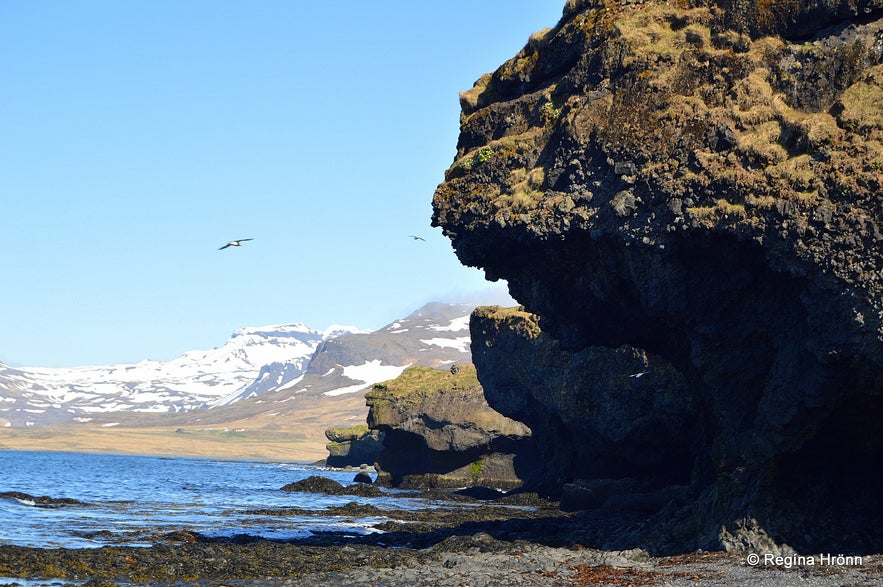
The rock giants by Ólafsvík
If you drive a little further and the tide is out, then you can visit this beautiful cliff beach where the rocks look like giants guarding the shoreline!
Around this beach, you will also see basalt columns. There are openings in the rocks, just be very careful that the tide doesn't come in unexpectedly!
There must be a story behind these rocks; they look too much like giants not to have some folklore of their own. 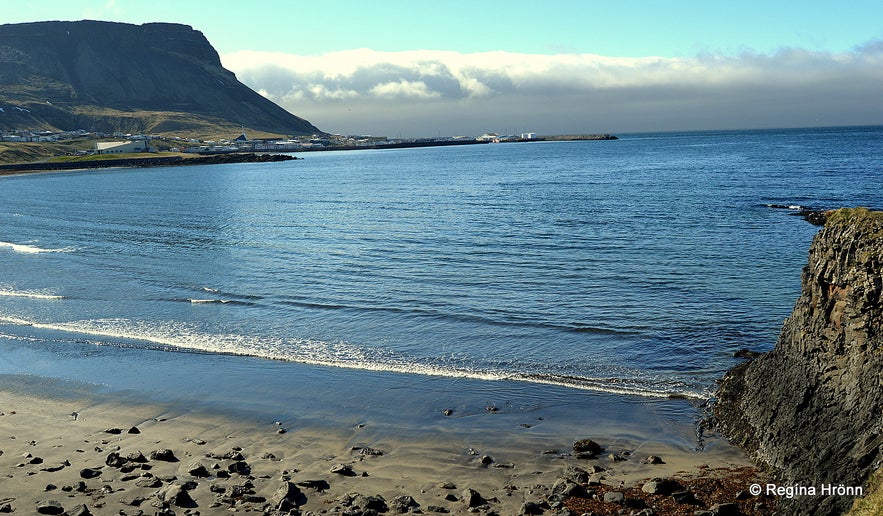
The view of Ólafsvík from the rock giants
In my photo above, you can see the distance from Ólafsvík to the rocky beach.
Ólafsvík is located by Útnesvegur road number 574. Just a short distance further on, the road joins the main road on the Snæfellsnes peninsula, the Snæfellsnes road number 54.
Here is the location of Ólafsvík on Google Maps

Hi, my name is Regína Hrönn, and I was born and raised here in Iceland.