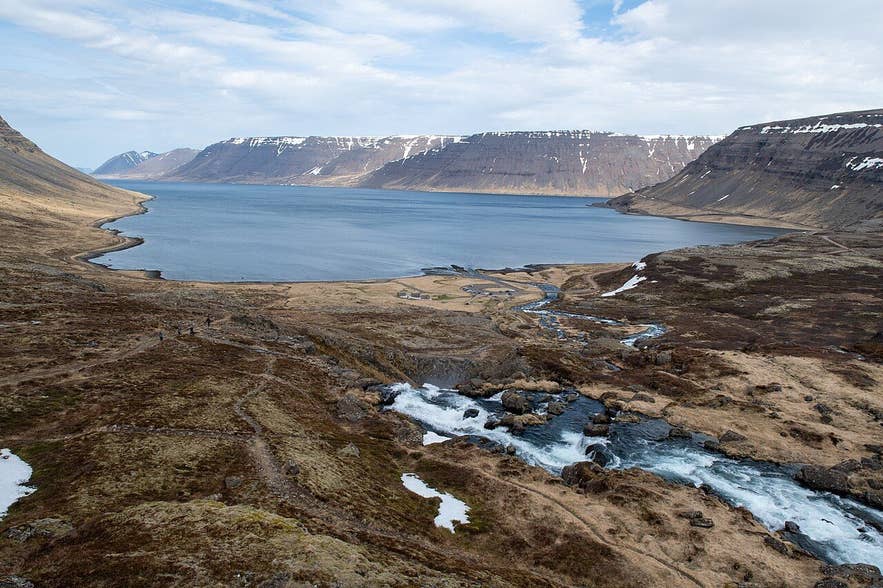
Dynjandisvogur from the waterfall path. Photo: Hansueli Krapf, CC BY-SA 4.0
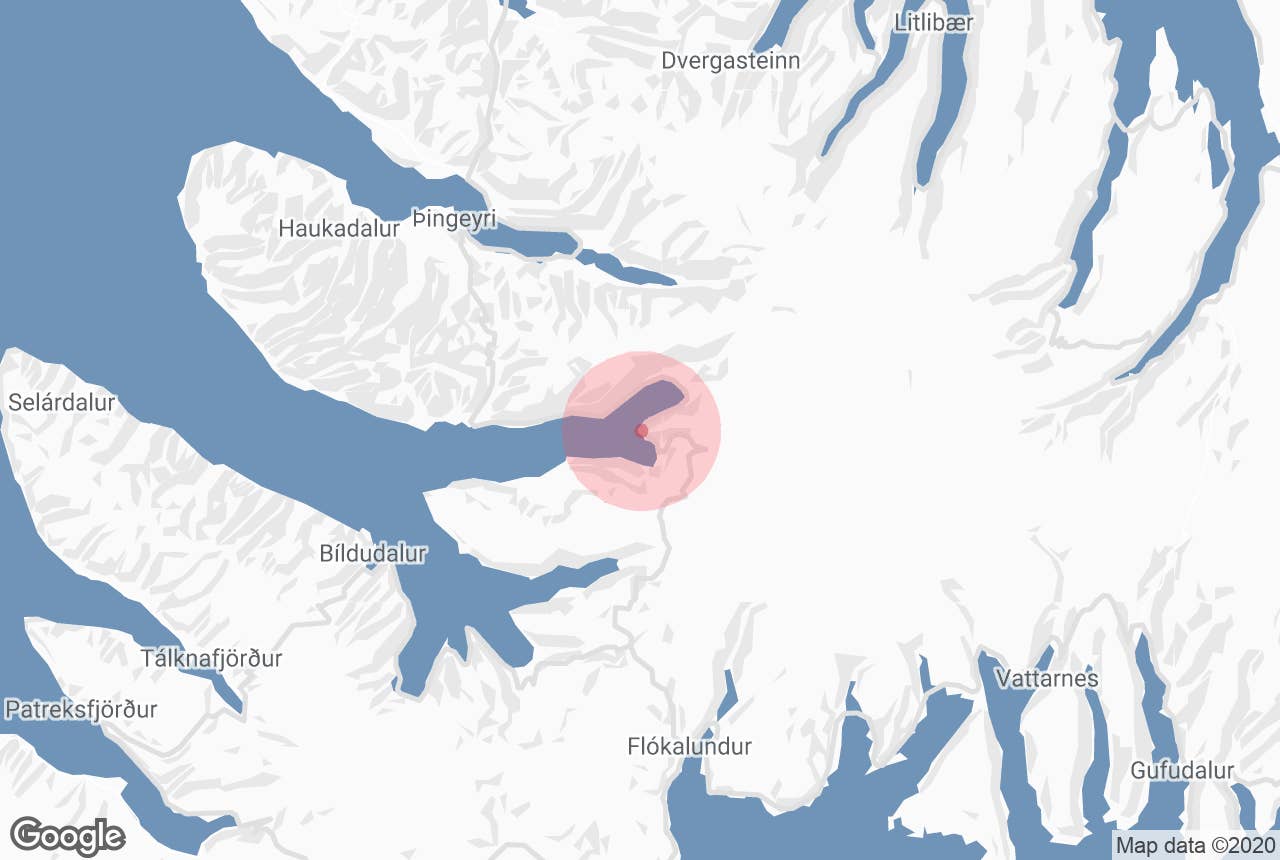
Dynjandisvogur is the small bay at the inner end of Arnarfjörður in the Westfjords, where the Dynjandisá river reaches the sea after tumbling over Dynjandi and seven smaller waterfalls. The name means "Dynjandi's cove".
Most visitors know it as the place where Route 60 swings round the head of the fjord to the Dynjandi car park, but the bay is part of the protected natural monument too, with 36 recorded bird species, seals offshore and a view straight up the river to the falls.
Key Takeaways About Dynjandisvogur
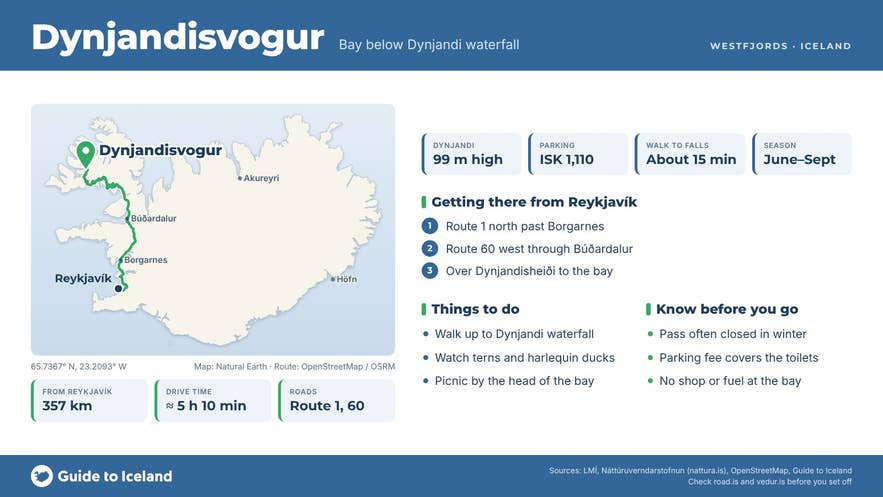
- Bay at the inner end of Arnarfjörður where the Dynjandisá reaches the sea below the 99 m Dynjandi waterfall
- Protected with the falls as a natural monument since 1981; 36 bird species recorded, including harlequin ducks at the river mouth
- On Route 60: about 59 km (under an hour) from Ísafjörður and 357 km (about 5 hours 10 minutes) from Reykjavík; no F-road
- Car park at the head of the bay with toilets open all year; parking service fee ISK 1,110 per car in 2026
- Best from mid-June to September; the Dynjandisheiði pass is often closed in winter
Why visit Dynjandisvogur
Dynjandisvogur is the bay that frames Dynjandi, one of the best-known landmarks of the Westfjords. From the head of the bay you look straight up the Dynjandisá river, past a staircase of smaller falls, to the 99-metre fan of Dynjandi at the top. Dynjandi is about 30 m wide at the lip and 60 m at the base.
Below Dynjandi, the river drops over seven more falls before it reaches the bay. Counted from the top, the Nature Conservation Agency names them Hæstahjallafoss, Strompgljúfrafoss, Göngumannafoss, Hrísvaðsfoss, Kvíslarfoss, Hundafoss and Bæjarfoss, though the names vary between sources. Bæjarfoss, the lowest, is the one nearest the sea.
The falls and their surroundings, including the bay itself, have been protected as a natural monument since 1981. The protected area runs from the tip of the Meðalnes headland along the mountain ridges around the bay and Dynjandisdalur valley, 6.4 square kilometres in all.
Wildlife and plants
Thirty-six bird species have been recorded in Dynjandisvogur. Arctic terns and oystercatchers stand out in the nesting season, whooper swans and eiders swim along the shore, and harlequin ducks gather at the mouth of the Dynjandisá.
In spring and autumn, hundreds of red knots feed on the shore on their way between Greenland or Canada and western Europe or West Africa.
Harbour seals haul out along the shores of inner Arnarfjörður and sometimes bask at the mouth of the Svína river at low tide. On land, 144 plant species have been recorded, including nationally rare ones such as round-leaved sundew.
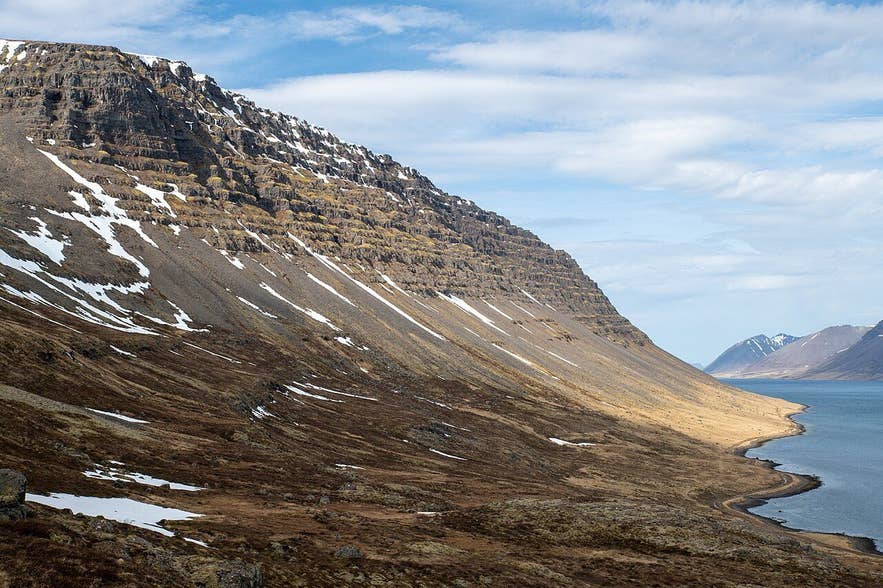
The south side of Dynjandisvogur. Photo: Hansueli Krapf, CC BY-SA 4.0
History
Dynjandi means roughly "the thundering one", and the roar of the falls carries a long way. For a time some people called it Fjallfoss, but the Nature Conservation Agency describes that as a misnomer traced to an 1839 parish description of Rafnseyri.
Behind the bay, Route 60 climbs onto Dynjandisheiði, a pass that reaches 500 metres. The road over it was built in 1959 and was the first road that let cars reach Ísafjörður. Arnarfjörður is said to be one of Iceland's sea-monster hotspots, and the Icelandic Sea Monster Museum sits in Bíldudalur on the fjord's south shore.
How to get to Dynjandisvogur
The bay lies on Route 60 (Vestfjarðavegur), the main road through the central Westfjords. From Reykjavík it's about 357 km, roughly 5 hours 10 minutes: take Route 1 north past Borgarnes, then Route 60 west through Búðardalur and over Dynjandisheiði.
From Ísafjörður, the nearest town, drive south on Route 60 through the 5.6 km Dýrafjarðargöng tunnel, which opened in October 2020. The head of the bay is about 59 km and just under an hour from Ísafjörður, and about 9 km from the tunnel's southern mouth.
From Route 60, the 700 m Road 621 (Dynjandavegur) leads down to the car park on the flat at the head of the bay, with spaces for cars, camper vans and buses and a turning area for coaches by the shore.
A side road, Mosdalsvegur, continues west along the bay to Laugaból. Some stretches of Route 60 in the area are still gravel while road works continue; they're passable for ordinary cars in summer, and there's no F-road or river crossing.
A paved path leads from the car park along the river to Dynjandi in about 15 minutes. It's accessible for wheelchairs as far as Hrísvaðsfoss, then becomes a rocky nature trail, with viewing platforms at three of the falls. You can also follow the Dynjandi Walking Trail.
Parking: the Nature Conservation Agency charges a service fee at the car park, which covers the toilets and other facilities. In 2026 it's ISK 1,110 for a car with up to five passengers and ISK 1,440 for six to nine.
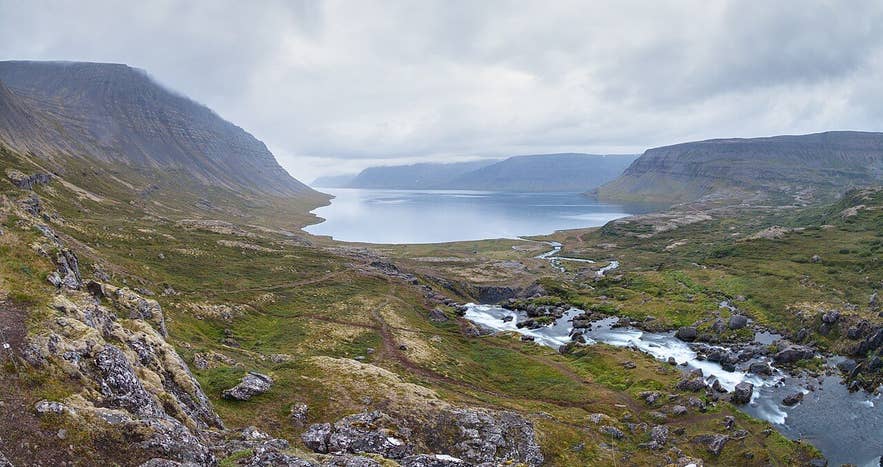
The Dynjandisá running down to the bay. Photo: Diego Delso, delso.photo, CC BY-SA 4.0
Best time to visit
Come between mid-June and September. Dynjandisheiði is often closed or impassable in winter, and even in May and early June the pass can be snowbound. The river carries the most water in early summer, when the snow on the heath melts. In summer, cruise passengers come on shore excursions from Ísafjörður, so the car park can be busy.
Safety and practical tips
- Check road.is for the status of Route 60 and Dynjandisheiði before setting out.
- The shore is uneven, with boulders and wet heath. Wear boots and take care on slippery rocks near the river mouth.
- Overnight stays are not allowed inside the protected area, except for one night's camping by people arriving on foot or by bicycle. Open fires are banned.
- There's no rubbish collection at Dynjandi, so take your litter with you.
- Toilets at the car park are open all year, and there are picnic tables and a stone hearth on the flat. There's no shop or fuel, so fill up in Ísafjörður, Þingeyri or Patreksfjörður.
- Rangers work in the protected area in summer.
Is Dynjandisvogur the same as Dynjandi?
Can I drive to the bay in a small rental car?
How much is parking at Dynjandi?
How long should I allow?
Can I camp at Dynjandisvogur?
What wildlife can I see?
Nearby attractions
- Dynjandi, about 0.7 km: the 99-metre waterfall at the head of the valley.
- Dynjandi Walking Trail, about 0.3 km: the path up past the lower falls.
- Hrísvaðsfoss, about 0.2 km: one of the smaller falls on the Dynjandisá.
- Hrafnseyri, about 11 km: birthplace of independence leader Jón Sigurðsson, with the Jón Sigurðsson Museum, about 11 km.
- Reykjafjarðarlaug Hot Pool, about 17.3 km: a geothermal pool on the south shore of Arnarfjörður.
- Icelandic Sea Monster Museum, about 18.6 km: in Bíldudalur.
Planning a wider trip? See our guide to the Westfjords.
Tours that visit Dynjandisvogur
Every tour to Dynjandi arrives at the car park at the head of the bay. The shore excursion from Ísafjörður port drives through the Dýrafjörður tunnel to Dynjandisvogur and spends about an hour at the waterfall before continuing to Hrafnseyri and Þingeyri.
- Small Group Shore Excursion to Dynjandi Waterfall and the Westfjords from Isafjordur Port
- Exciting 3.5-Hour Dynjandi Waterfall and Farm Tour from Isafjordur
- Private Dynjandi Waterfall & Westfjords Farm Tour from Isafjordur
- Dynjandi Waterfall Super Jeep Tour with Westfjords Photo Stops and Pickup from Isafjordur
- Dynjandi Waterfall & Westfjords Farm Small-Group Tour from Isafjordur
- Dynjandi Waterfall Shore Excursion from Isafjordur in Westfjords
Popular Tours to Dynjandisvogur Bay

 9.220 reviews
3.5-Hour Dynjandi Waterfall and Farm Tour from Isafjordur
Tour startsIsafjordurDuration3.5 hoursFrom 137USD 8.416 reviews
Small Group 10-Hour Hiking Tour in the Westfjords From Isafjordur
Tour startsIsafjordurDuration10 hoursFrom 548USD 105 reviews
Biking Tour in the Westfjords from Isafjordur
Tour startsIsafjordurDuration2.5 hoursFrom 144USD