In previous travel blogs, I have shown you the off-the-beaten-path waterfalls in Bárðardalur in North Iceland.
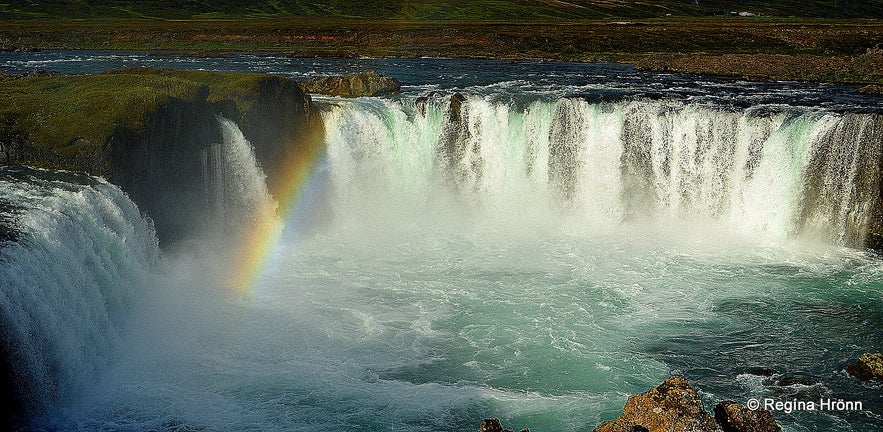
Now I want to show you the beautiful, historic Goðafoss, the best-known waterfall in the approximately 180 km-long Skjálfandafljót river, Iceland's 4th-longest river.
Goðafoss is located right by Ring Road 1 and is very accessible.
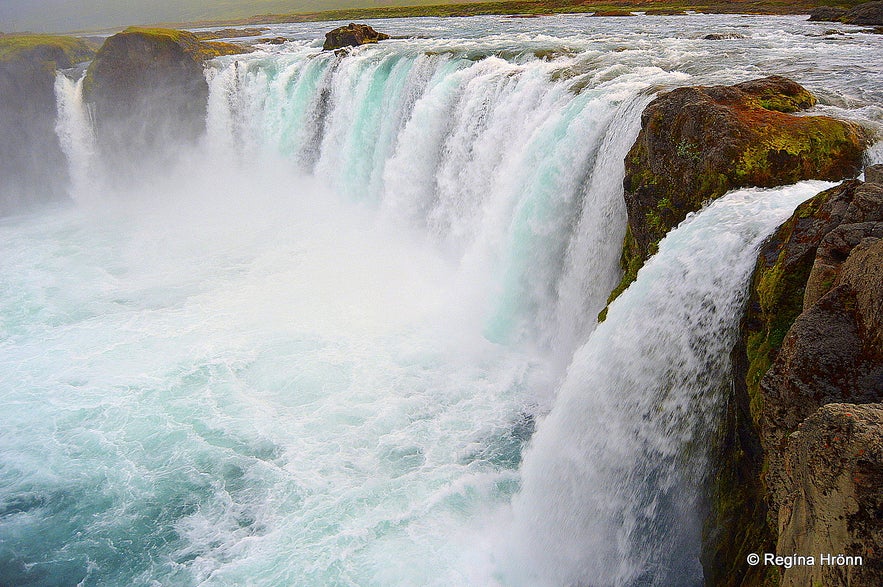
Photo taken from the west bank
Goðafoss has a drop of 12 meters (depending on where you measure it, though) and a width of 30 meters and forms a horseshoe shape or a semi-circle. It is divided by big rocks into two waterfalls.
The river, which is mainly a spring-fed river, originates between Vatnajökull glacier in the highland of Iceland and Tungnafellsjökull glacier, and runs its course into the sea in Skjálfandaflói bay further north. Direct run-off streams merge with the river.
There are 2 ways of approaching Goðafoss, which will give you a totally different view of this beautiful waterfall.
You can visit it from the parking lot on the west side, which leads right up to the brink of the waterfall. Let's be very careful here.
The other way is from a new parking lot on the east side, where a viewing platform was recently erected.
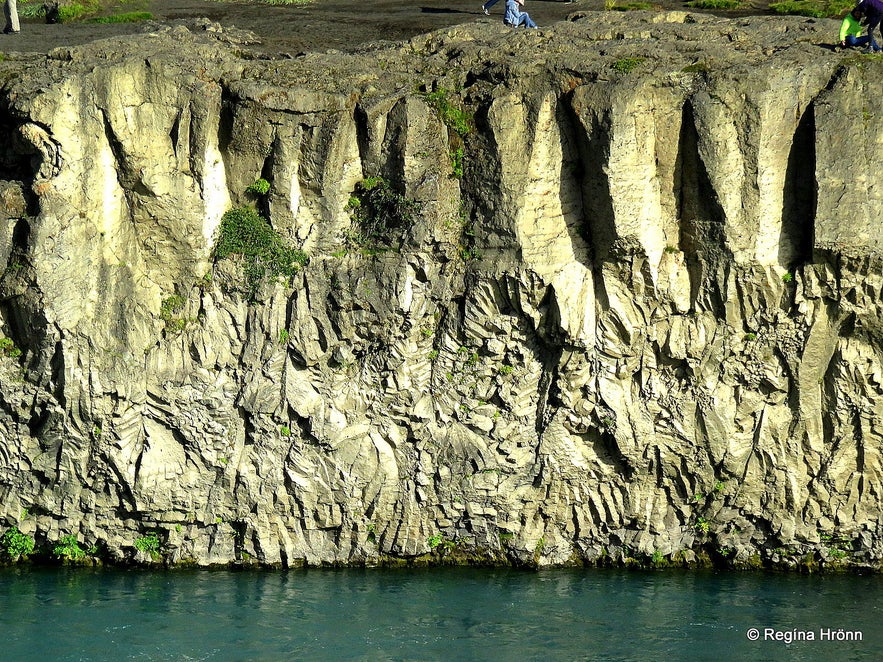
Photo taken from the east bank - beautiful basalt formations
The west side of Goðafoss is an island, which I don't think many people visiting the waterfall realize. The island is called Hrútey - Ram Island, and the river runs on both sides, with the main river on the east side.
From the east bank, you will see the extraordinary basaltic formations on the west side of the river, which create some beautiful shapes. They are so lovely, especially in the sun, and look like works of art.
The same scenery can be found around Aldeyjarfoss in Bárðardalur valley, which is one of the most elegant waterfalls I have seen in Iceland. The lava field here is about 9,000 years old and is called Bárðardalshraun.
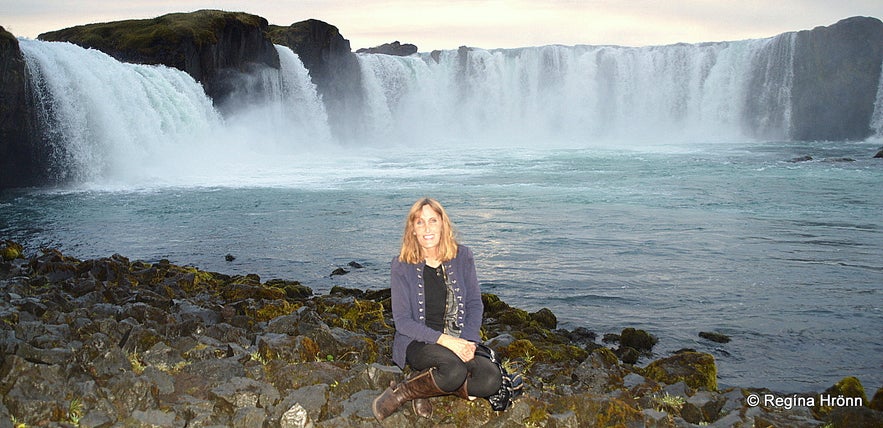
Photo taken from the level of the river on the east bank
From the east bank, you can walk down to the level of the river and see Goðafoss up close. It is a rocky path, so let's be careful here also. The photo above shows what kind of photos you can take if you go down to the river. It was late in the day on a September night when we took this photo, so it was pretty dark.
It is possible to cross a footbridge and walk in a semicircle up to the other side of the waterfall. It is worth visiting the waterfall from both sides, but nowadays I only visit Goðafoss from the east bank, as I prefer that side.
You can see that the photos I have added to this travel blog are taken during my many visits to Goðafoss. But even though I have visited Goðafoss countless times in my lifetime, this waterfall is always an obligatory stop.
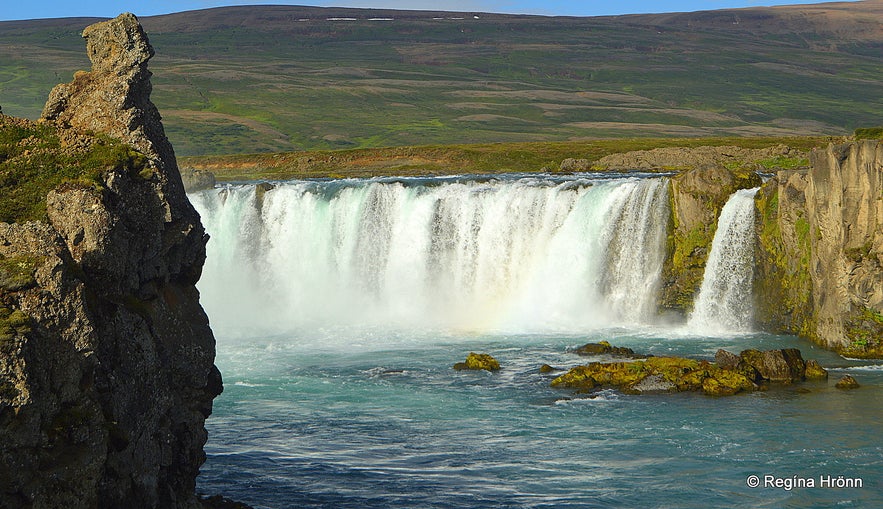
Photo taken from the east bank
I remember when there were very few tourists here, and if a couple of people were visiting Goðafoss, we would think it was crowded. Being a nation of only around 364,000 people, we locals have a different opinion of the term crowded than people from densely populated countries ;)
Now, Goðafoss has become a famous tourist attraction, attracting a myriad of visitors each year.
If you want to stay away from the crowds, try not to visit Goðafoss very early in the morning during the summertime, when the tours from the cruise ships docked at Akureyri are here. My photo below is from my visit to Goðafoss early in the morning, when cruise ship tours were visiting.
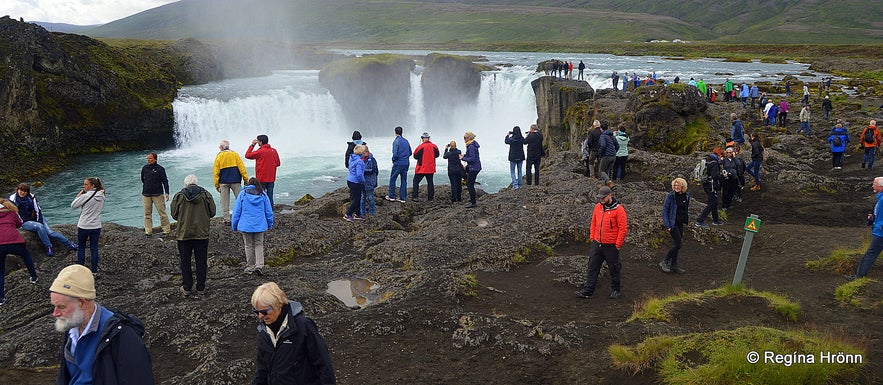
Tours from cruise ships - then it gets crowded by Goðafoss
Some people take the risk of going out on a limb here to get good photos. But this is a mighty river, and we don't want anybody falling in.
Be extra careful here, especially in the wintertime, when everything is frozen. Never go out on the ice by the waterfall, as it can break. We, locals, are horrified when we see how close people venture - literally out on a limb. It is like all caution is thrown to the wind. We want our visitors to be safe in Iceland.
See also: Travellers in danger at Goðafoss waterfall after snow and ice swallow walking paths.
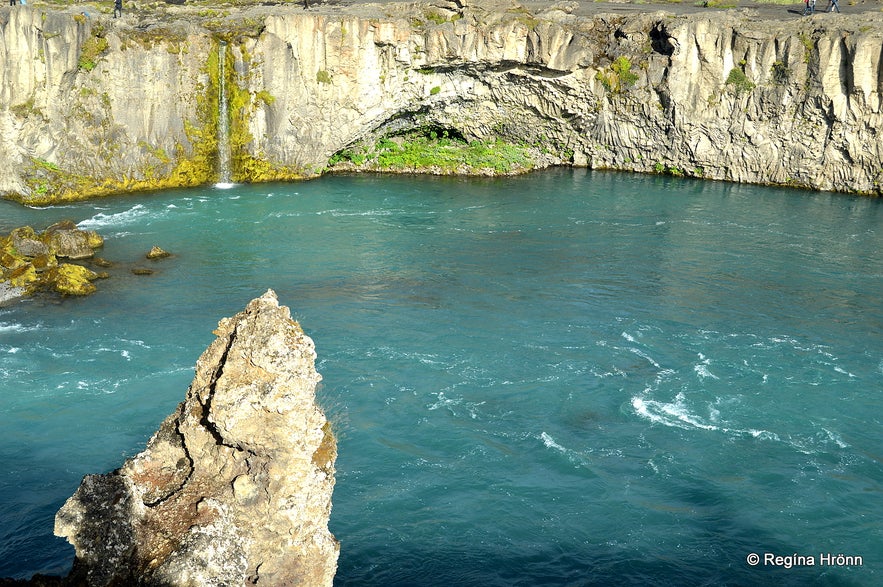
Photo taken from the east bank - Skjálfandafljót river
The colour of the Skjálfandafljót river is so beautiful; it ranges from a powdery blue, which I love, to greyish white.
In the thaw, in spring, the river turns brown and becomes very forceful.
Then you will really see a different Goðafoss than you do in the middle of summer.
Summer arrives late in Iceland, and when I visited Goðafoss at the beginning of June last year, the river was a roaring, brownish glacial river.
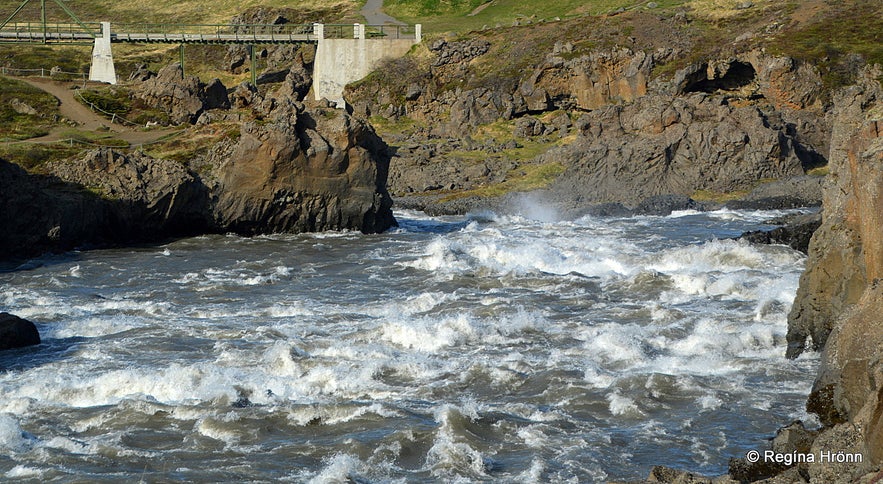
Photo taken from the east bank - Skjálfandafljót river
Just imagine how difficult it was to travel in Iceland before these mighty rivers were bridged!
Then these cold rivers were crossed on fords on horseback, and travellers would need a local guide to show them where it was relatively safe to cross the rivers.
Hansensgat and Geitafoss waterfall
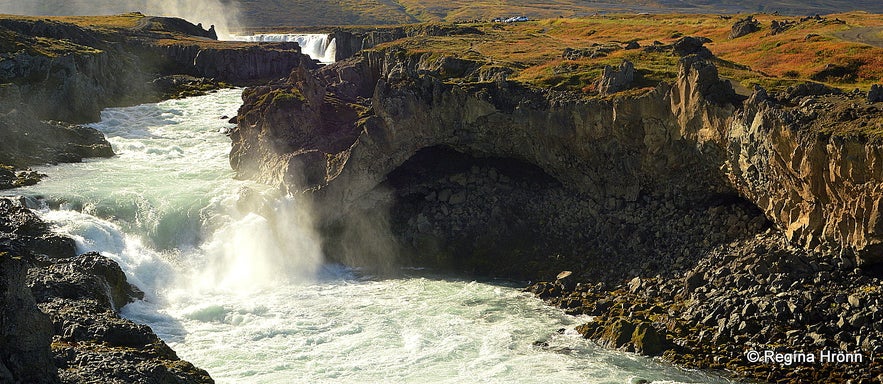
Geitafoss waterfall
At Goðafoss, you will see another much smaller but powerful waterfall downstream of Goðafoss called Geitafoss. This waterfall is only some 5 meters tall, but the river is extremely turbulent here.
Salmon swim up the Skjálfandafljót river as far as Geitafoss, but they cannot jump up the waterfall. If it could, it would be a pretty useless effort as the powerful Goðafoss is just around the bend.
When you visit Goðafoss from the west bank, you can walk close to Geitafoss by a small trail leading to it, and have a look at it from above.
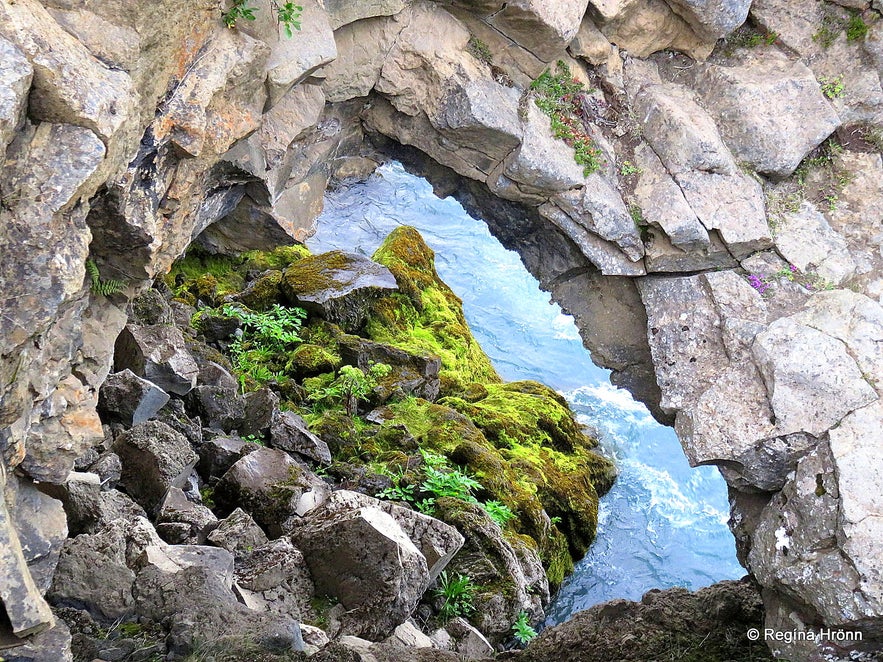
Hansensgat by Geitafoss
By Geitafoss, you will find a large hole, a natural rock arch called Hansensgat (or Hansen's Hole). And from there you can get a good look at the waterfall.
The name of the hole apparently stems from when Hansen, a pharmacist in Akureyri around 1900, fell into it. He survived.
Once a horse fell into the river and was hoisted through Hansensgat hole (ref. 171 Ísland by Páll Ásgeir Ásgeirsson).
And just recently, a tourist fell some 8 meters down steep cliffs by Hansensgat!
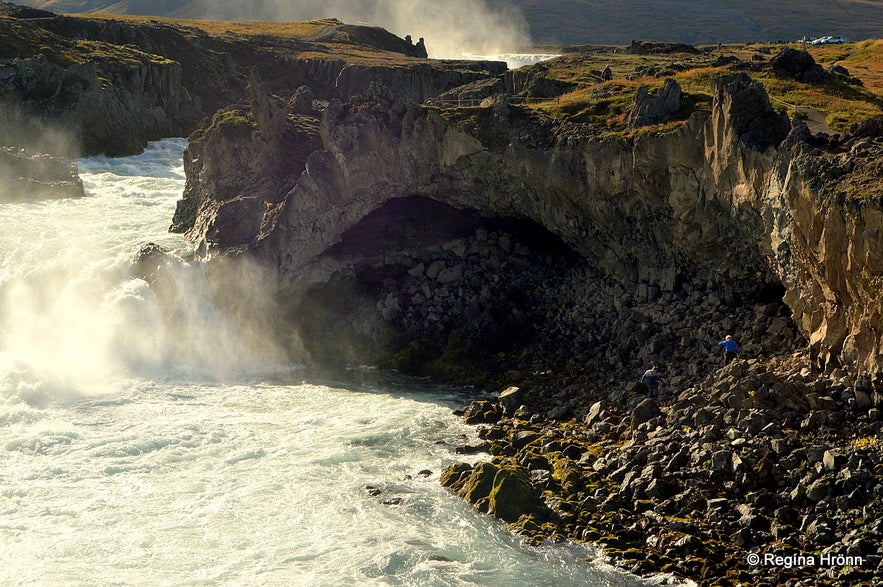
Geitafoss waterfall
The name, Geitafoss - Goats' Fall, stems from a farmer driving his sheep and goats here. Another cave by the river, just above Geitafoss, is Jötuhellir - Manger Cave.
According to a detailed survey I read about Goðafoss by the Archaeological Institute of Iceland, the farmer used to lower his sheep in a box from a cliff on the east side of the river, right above Geitabrú, an ice bridge.
He then drove his sheep through the hole in Hansensgat and into a cave called Jötuhellir. The landscape along the forceful river has changed due to massive floods, so this is not possible today.
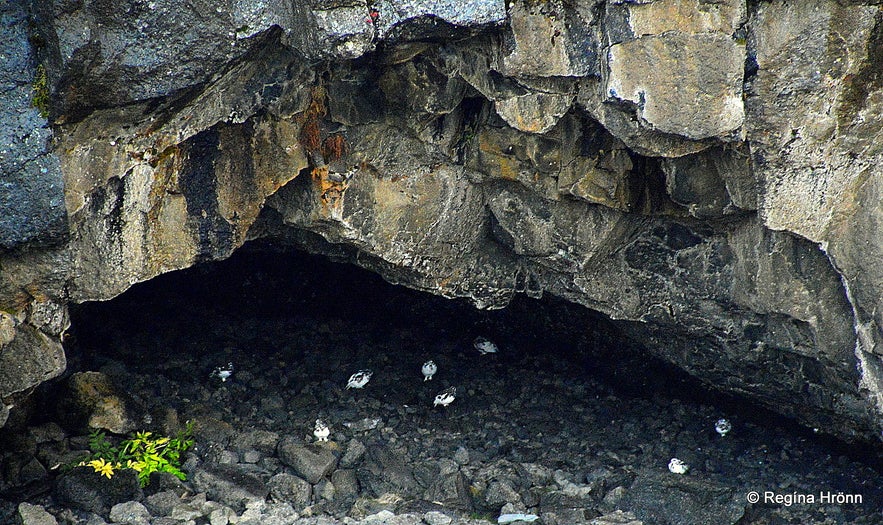
Ptarmigans in Jötuhellir cave
You will see Jötuhellir cave across the river when you visit the east bank. It is located a little further up the river than Hansensgat and Geitafoss.
A rock looking like a manger is said to be inside this cave.
Once during my visit in September, I noticed some white spots in the cave. When I zoomed in, I saw that the white spots were ptarmigans half-clad in summer clothing and half-clad in winter clothing.
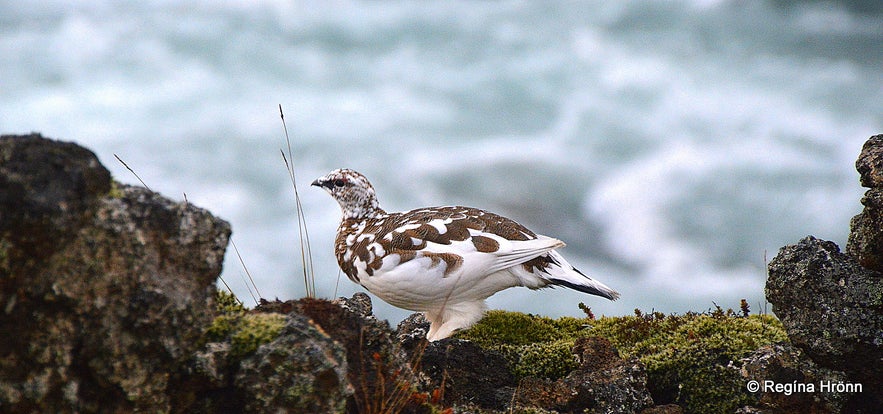
Ptarmigan by Skjálfandafljót
I also spotted one of them on the cliff next to me on the east bank. You see how difficult it is for it to hide when it is only half-clad. Then they are easy prey to the falcon.
Old Icelandic folklore states that the falcon doesn't realize until he eats the ptarmigan's heart that she is his sister.
He then gets so remorseful and filled with grief that he wails for the longest time.
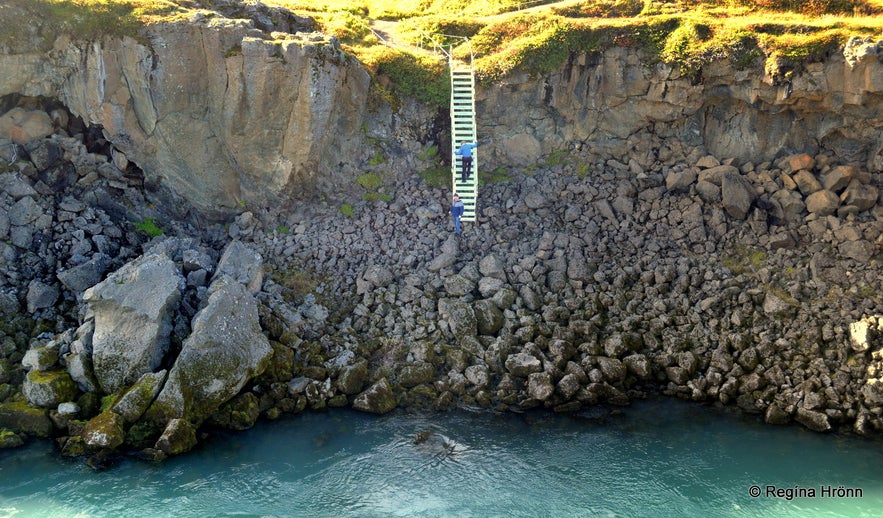
My husband and my father-in-law walking down to the river
You can climb down to the river on the west side by a steep ladder and have a look at Geitafoss from below.
You can also visit the Hansensgat from here, but the path is very rocky.
My husband and my father-in-law visited Hansensgat this way, but as I feel very wobbly on rocky surfaces, I stayed behind and took photos of them.
You can see them as blue dots in my photos.
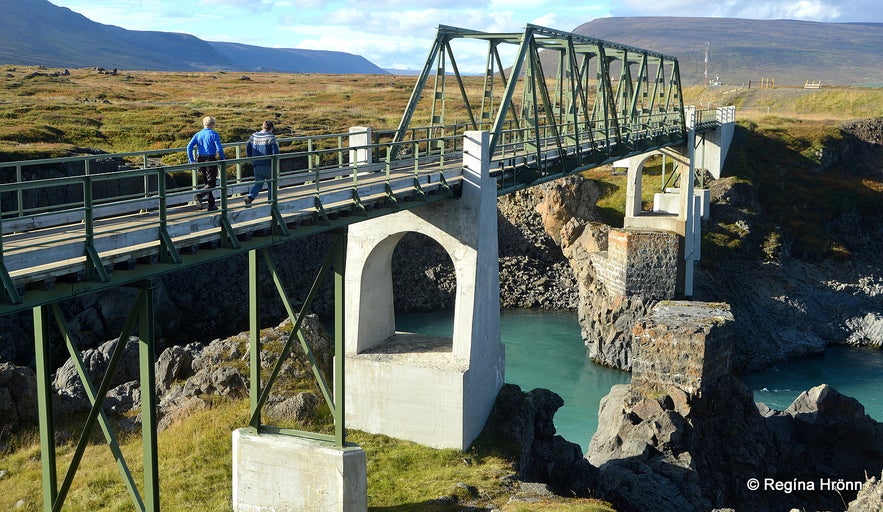
Skjálfandafljót bridge
The beautiful bridge over the Skjálfandafljót, located a little further downstream from Goðafoss, was built and consecrated in 1930. An older bridge was constructed in 1882-1883 at this location, and you can see its remains under the bridge.
When the bridge was consecrated in 1930, there were grand festivities, and even Pater Jón Sveinsson (1857-1944), the most beloved Icelander, Nonni himself, who was made an Honorary Citizen of Akureyri in the same year, was present.
Nonni had been invited to Iceland for the 1000th Anniversary of the Icelandic National Assembly (the Althing) in 1930.
See also my travel blog: Nonnahús and Nonni, the Honorary Citizen of Akureyri.
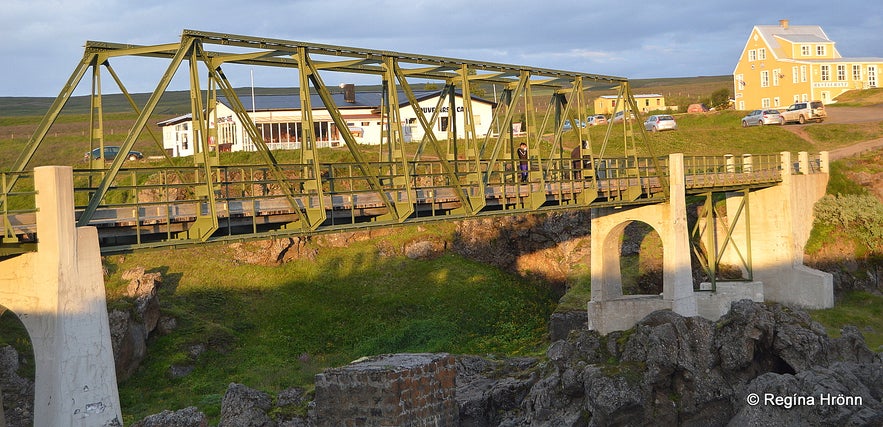
Skjálfandafljót bridge
This bridge is now a footbridge, and you can get some beautiful photos from it. The shape of the gorge makes it difficult to photograph the two waterfalls together, though.
The one-lane bridge further downstream on Ring Road 1 was built in 1972 for car traffic. The Road Administration of Iceland aims to add a new two-lane bridge slightly north of the current bridge and move the road.
Sölvahellir cave and the robber
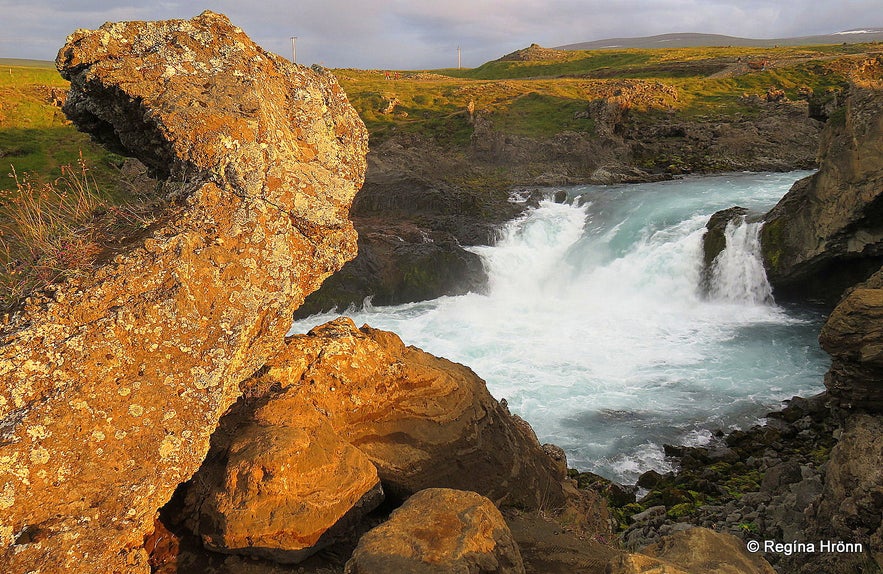
Geitafoss as seen from the west bank
Close to Geitafoss waterfall on the east bank, Sölvahellir cave lies hidden. The story goes that an outlaw named Sölvi lived in this cave for some time.
People had no idea where he was hiding, but one day he seemed off his guard and put his white linen clothes out to dry in the sunshine.
People from the valley, on the opposite side of the cave, noticed the white linen clothes and gathered that this was the hiding place of Sölvi; they attacked him and killed him.
(Translated into English from Þjóðsögur Jóns Árnasonar - the Compilation of Folklore by Jón Árnason - RHR)
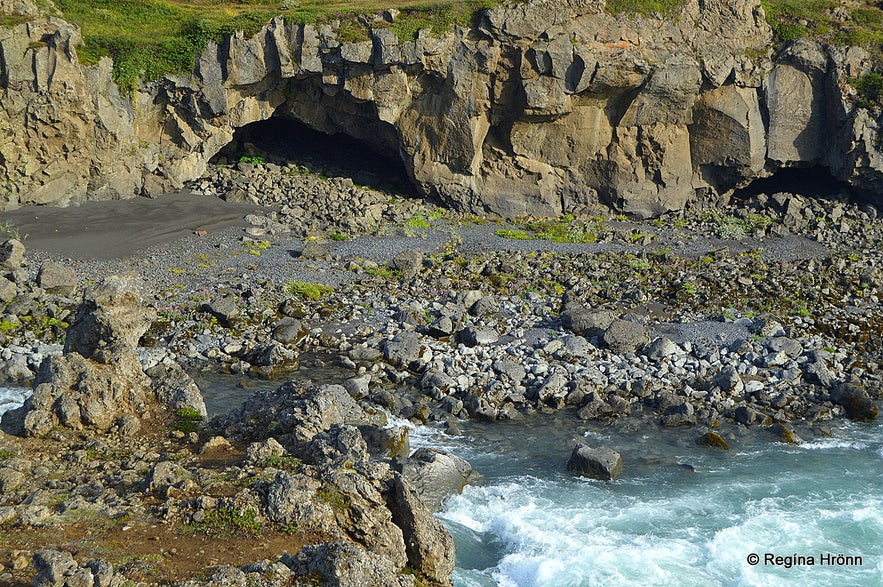
Here you can see Jötuhellir cave on the west bank, Sölvahellir is on the east bank
I haven't got a photo of Sölvahellir, but you can see a picture on page 15 of the aforementioned detailed survey of Goðafoss by Fornleifastofnun Íslands, the Institute of Archaeology of Iceland.
The cave is on the east bank of the river, around 1.2 m high, and 1 m wide.
The detailed survey was conducted to prevent any important old traces from being destroyed when the new paths and platforms were recently installed at Goðafoss.
Þorgeir Ljósvetningagoði & the Christianization
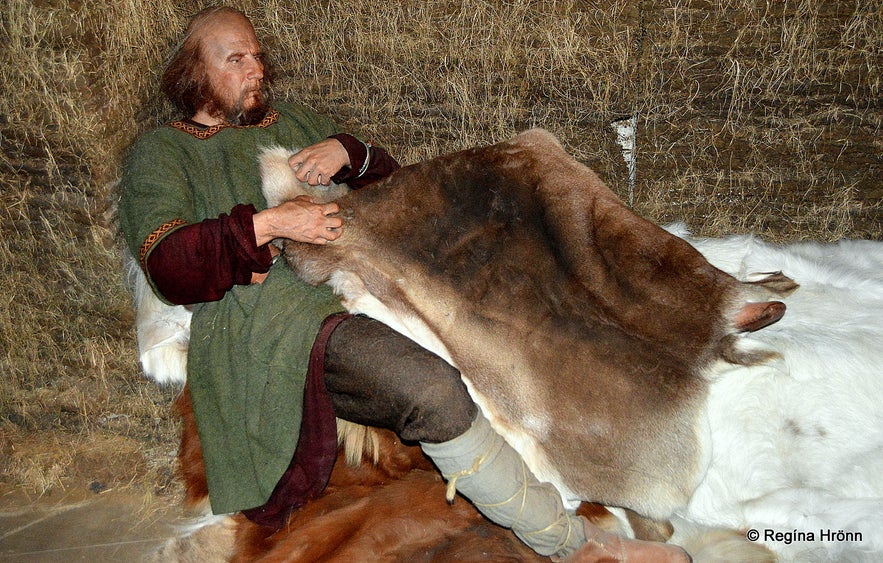
Þorgeir Ljósvetningagoði, as depicted at the Saga Museum in Reykjavík, which I recommend visiting while in Iceland
The name Goðafoss - the Waterfall of the Gods might have come about from a significant event in Iceland's history.
Back in the year 1000, the Lawspeaker Þorgeir Þorkelsson Ljósvetningagoði (born 940) was faced with a difficult decision at Alþingi, the old Viking Parliament at Þingvellir in southwest Iceland.
Þorgeir was both a Goði - a Chieftain, which means that he represented the chieftainship of the Ljósavatn district at Alþingi and the Lawspeaker at Alþingi from 985-1001, which was the highest position. So he was a very influential man.
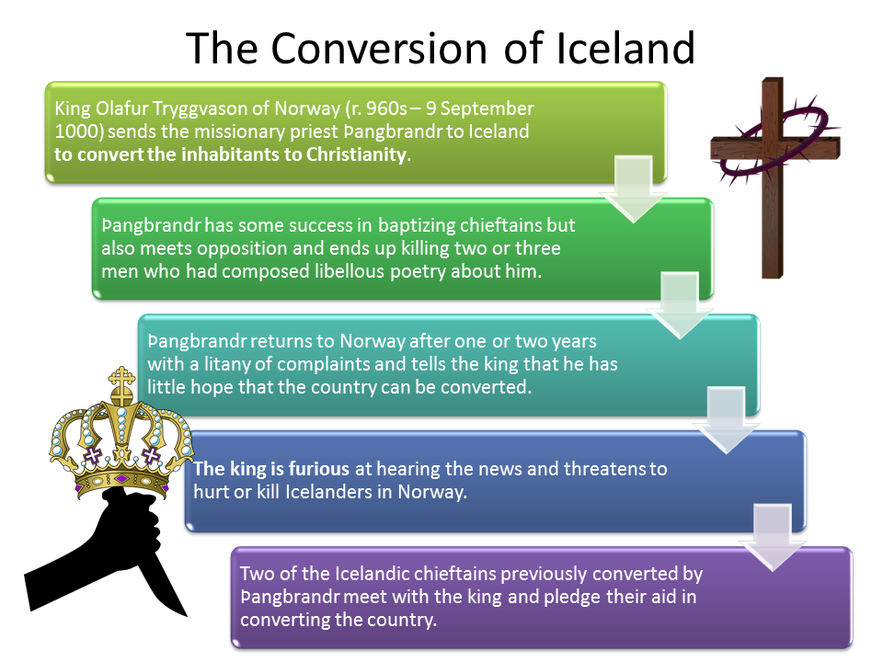
A slide from an online Medieval history course at the University of Iceland, which I attended. Photo credit Beth Rogers
Christianity was spreading in the countries around Iceland, and the Norwegian King Olav demanded that Icelanders convert to Christianity.
Most of the Vikings in Iceland were pagans, but some settlers were Christians, like Auður djúpúðga, the settler woman.
The photo above explains what was happening between Norway and Iceland at the time, which eventually led to Iceland's conversion.
There was great discord amongst the pagans and the Christians at Alþingi. The difficult decision was now in the hands of the Lawspeaker Þorgeir.
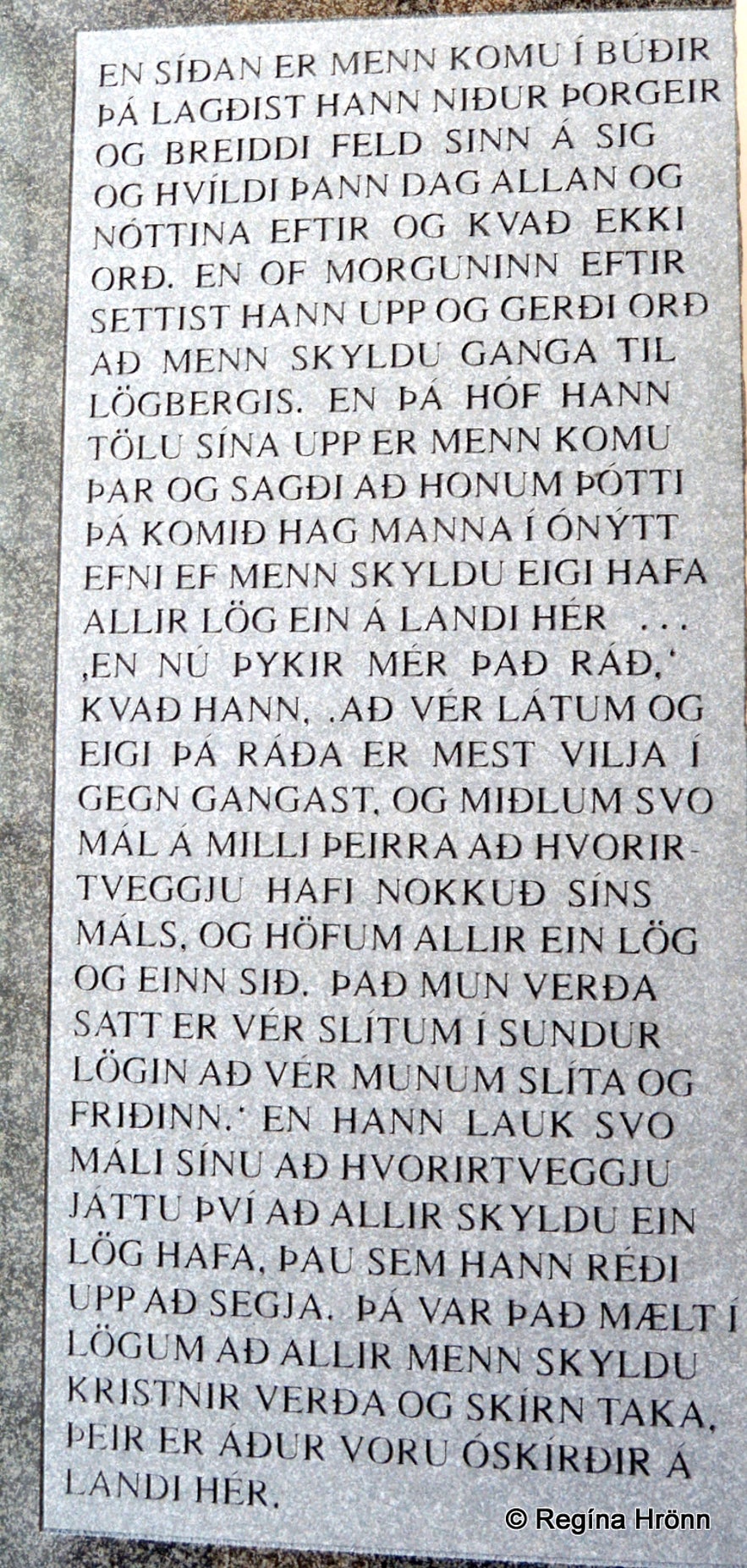
The chapter from Íslendingabók - Kristnisaga hangs on the wall of Þorgeirskirkja church.
Þorgeir had to choose between abandoning the old faith in the Norse gods and adopting Christianity, or leaving things as they were, thus opposing King Olav.
He withdrew and lay under a fur blanket (lagðist undir feld) for a day and night and then another day of equal length until he finally came out with the conclusion.
Lying under fur was considered powerful back then, as it was believed that those who did so acquired godly wisdom.
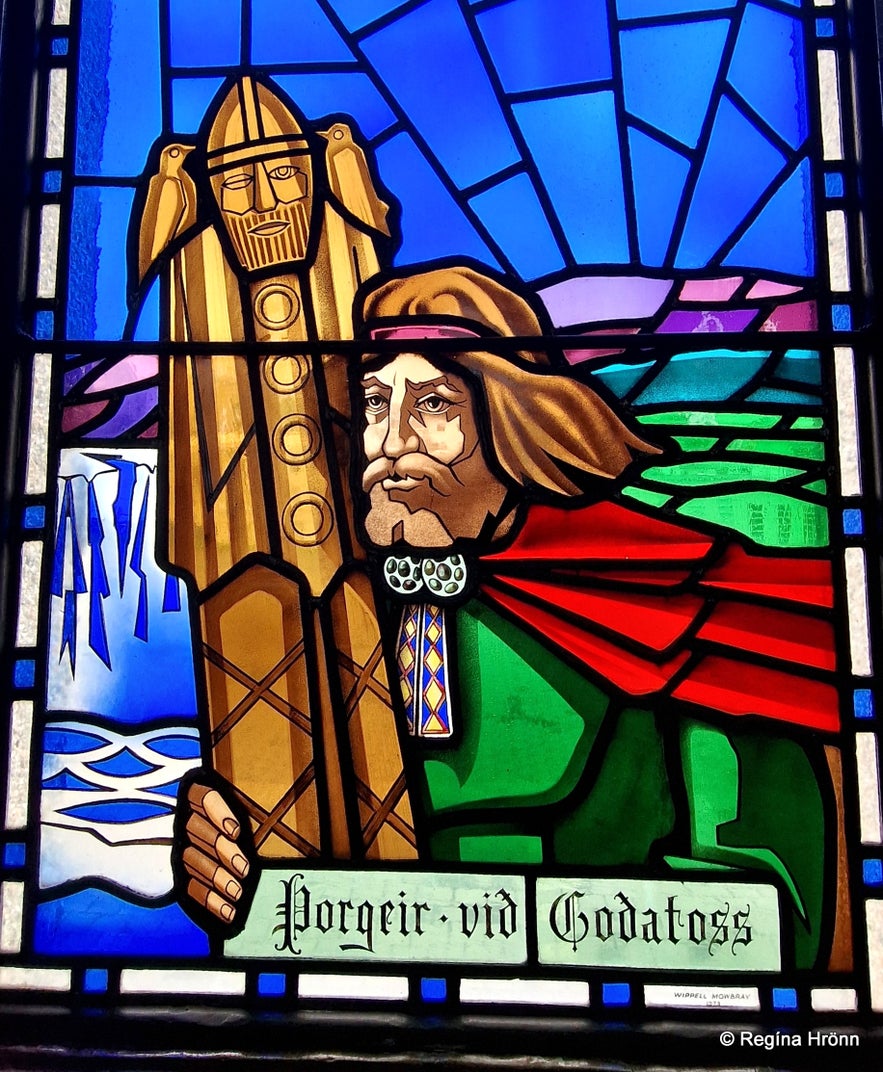 Þorgeir as depicted in one of the stained glass windows in Akureyrarkirkja church
Þorgeir concluded that it would be against the public interest if the inhabitants of Iceland were not to have one law in Iceland. In his words: "Það mun satt vera er vér slítum lögin, þá slítum vér og friðinn" meaning "It will prove true that if we tear apart the laws then we will also tear apart the peace".
Thus, Iceland became a Christian country without bloodshed. But bloodshed and blood vengeance were really common in the Viking age, as you can read about in my travel blog on the bloody Viking battles in Skagafjörður.
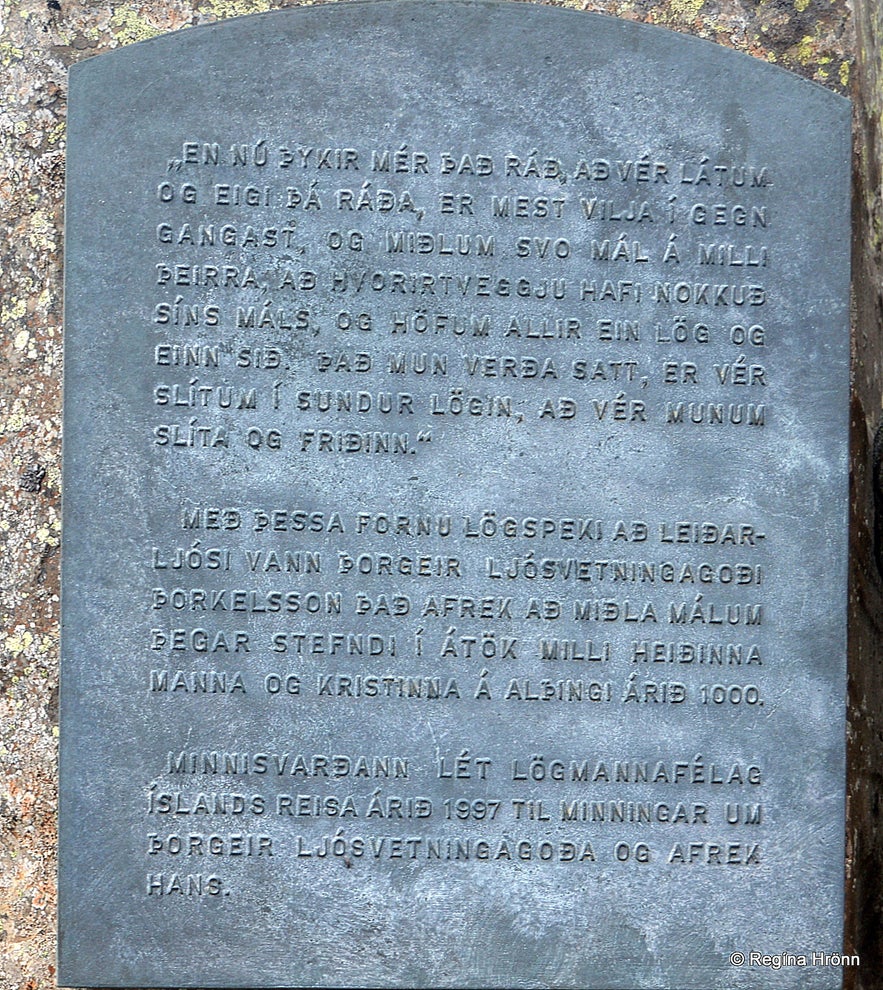
A memorial plaque for Þorgeir Ljósvetningagoði, erected by Goðafoss by the Bar Association of Iceland
Þorgeir, who himself was a pagan, then chose Christianity as Iceland's official religion and proclaimed that all men should be baptized. It was allowed, though, to secretly worship the old gods, as long as it wouldn't be discovered. If discovered, it would be punishable.
Þorgeir lived at Ljósavatn and built a church there, but Ljósavatn is around 2 km away from Goðafoss waterfall.
See also: Vikings and the Norse gods in Iceland.
The story of the conversion is written in Kristnisaga. The story of Þorgeir Ljósvetningagoði is found in Ljósvetningasaga (Icelandic version).
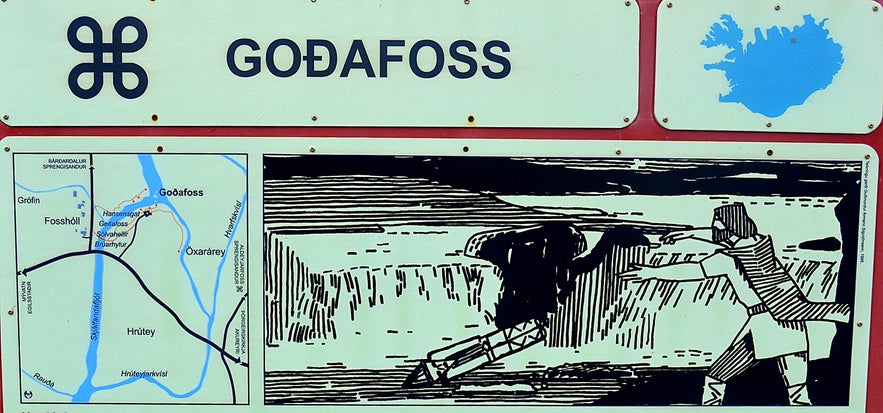
A drawing on the information sign of Þorgeir throwing the heathen gods into Goðafoss
You can also find an account of the conversion to Christianity in Njálssaga - the Saga of Njáll, which is referred to as the Queen of the Icelandic Sagas.
It is also commonly believed that Þorgeir Ljósvetningagoði cast his idols of the old pagan Nordic gods from his temple at Ljósavatn into Goðafoss after returning from Þingvellir.
This he is supposed to have done as a symbol of the conversion to Christianity.
Þorgeir was a heathen, and I think he didn't simply throw his old gods into the waterfall when he converted; he more likely put them to rest there and showed them respect. This must not have been easy for him.

Goðafoss waterfall
We have no old source for the god-throwing story, though. According to Vísindavefur, it was first mentioned in Kristian Kålund's book on Icelandic historic sights, published in 1879-82.
I own this collection of books and found it written there. The story has caught on, and we locals like to believe that it is true.
You will notice two protruding rocks on the edge of the gorge when you visit Goðafoss from the east bank. They have been identified by some as statues of the old Norse gods that were cast into Goðafoss.

Goðafoss waterfall and the two rocks
After the conversion at Þingvellir, the ministers of King Olav then baptized some of the heathens in cold water in the Öxará river at Þingvellir.
Some people from the north and south were baptized in Vígðalaug at Laugarvatn in South Iceland after the conversion, and people from the west were baptized in the warm pool Reykjalaug, also called Krosslaug pool in Lundarreykjadalur valley in West Iceland, as they didn't want to be baptized in the cold water of Öxará river.
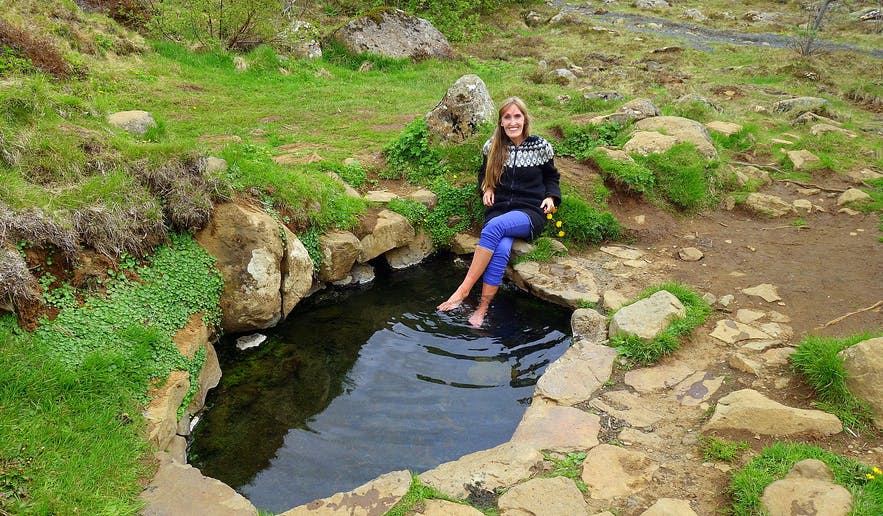
By Krosslaug in Lundarreykjadalur valley in West-Iceland
I told you about the baptism of the Westerners in my travel blog about Lundarreykjadalur and the hot pools.
That pool is warm, and people bathe in it nowadays.
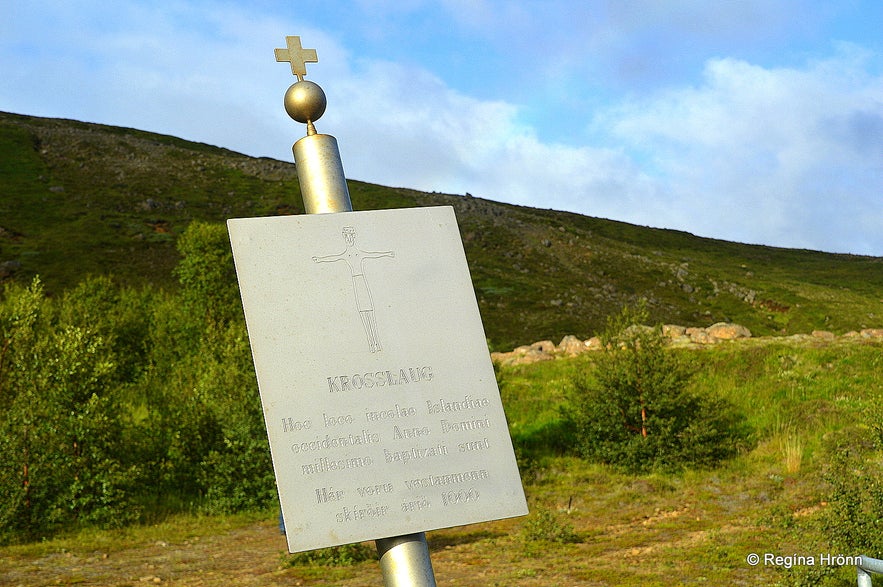
The sign leading to Krosslaug in Lundarreykjadalur in West-Iceland
Þorgeir is my ancestor 28 generations back, according to Íslendingabók - the Book of Icelanders, where we Icelanders can trace our genealogy.
Þorgeirskirkja church

Þorgeirskirkja church
A stone's throw away from Goðafoss, you will find Þorgeirskirkja church. It was erected in the year 2000 to commemorate the millennium of Þorgeir Ljósvetningagoði's decision to adopt Christianity in Iceland.
And in remembrance of Þorgeir Ljósvetningagoði himself, of course, as the church is named after him.
Having to make such a huge decision in the year 1000 at Alþingi must not have been easy, so kudos to Þorgeir for accomplishing it without bloodshed in a Viking country.
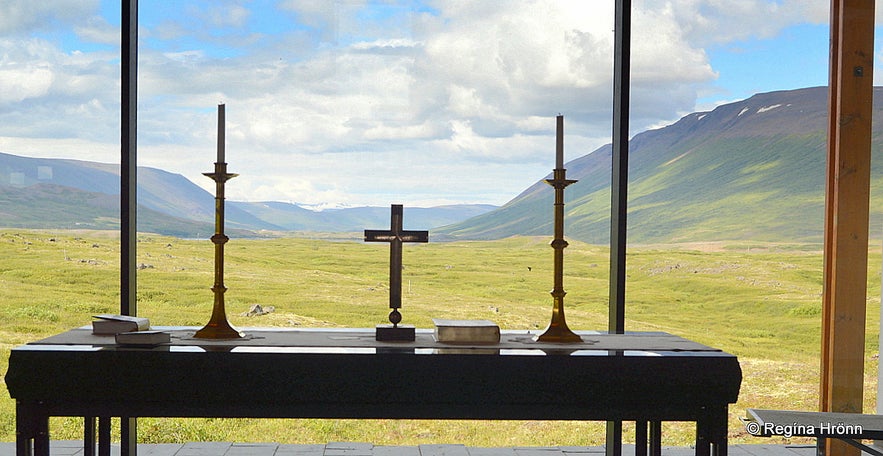
Þorgeirskirkja church
The altarpiece in Þorgeirskirkja church is very special; it is a large window behind the altar, showcasing the beautiful landscape of Ljósavatn and Ljósavatnsskarð and bringing light into the church.
Þorgeirskirkja church used to be open to visitors in the summertime. But during my last visit, I was told that it had unfortunately proved too costly to keep it open to visitors, so it is now closed.
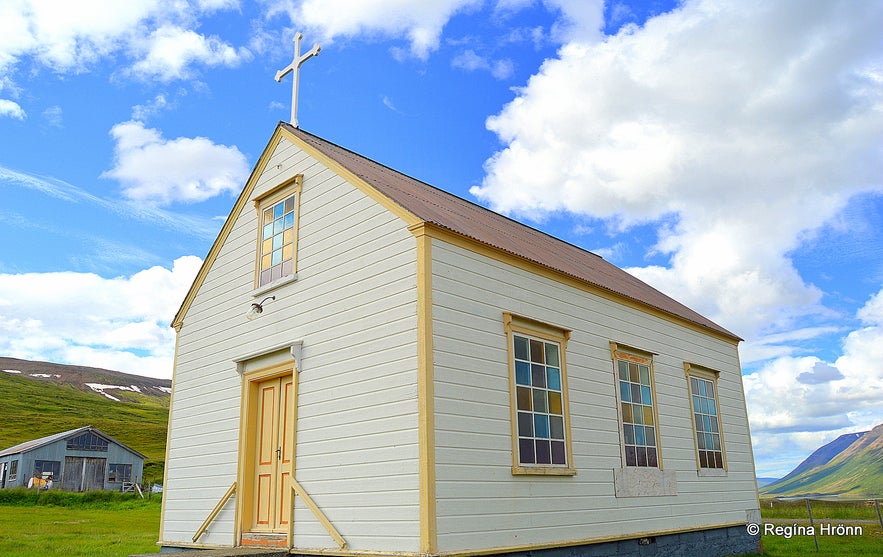
The older church, Ljósavatnskirkja, located at the farm of Ljósavatn, was built in 1891-1892.
Most churches around Iceland are locked now, much to my dismay, as my hobby is visiting all the churches I encounter on my travels in Iceland; there are around 380 in all, and I am up to 97%.
But due to theft and vandalism, we are forced to keep them locked.
Grettir the Strong and the waterfall
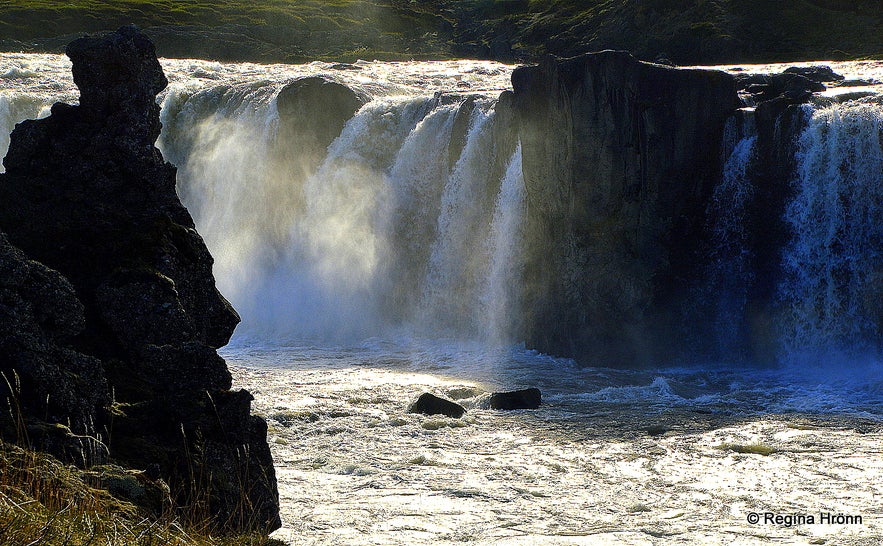
Goðafoss waterfall
A couple of decades after this very historic event, the outlawed Viking Grettir the Strong (born around 996) arrived in Bárðardalur valley. The purpose of his visit to the valley was to help some farmers out, who were dealing with a troll haunting their farm. Two men had disappeared from the farm without a trace.
Chapters 64-66 in Grettissaga - the Saga of Grettir tell us about the troll haunting in Bárðardalur and Grettir's wrestling with a terrible troll woman.
Even though Grettir was considered to be the strongest of all men, the troll woman almost proved to be too strong for him. After a long fight that took them all the way to the waterfall, he managed to cut off her right arm, and she fell into the waterfall.
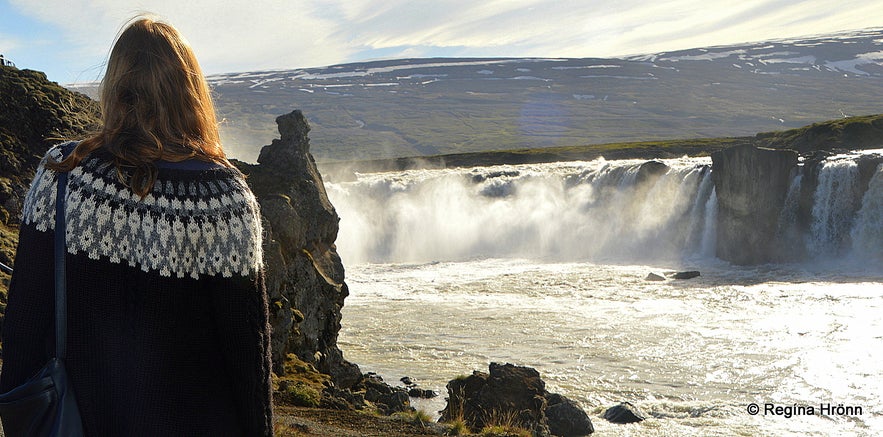
By Goðafoss waterfall
Later, Grettir dove into the waterfall, found a cave, and encountered another terrible troll. He managed to kill the troll and search the cave. He found the bones of 2 men, most likely the men who had disappeared from the farm in Bárðardalur at Christmas time 2 years in a row.
You can read up on this exciting story and all the gory details in my travel blog about Grettir and the waterfall. I originally put the story here in this travel blog, but it was getting way too long, so I moved it to the additional travel blog.
The story might have happened here at Goðafoss, although it is said to have occurred in the nearby Eyjardalsá river. But it is more dramatic connecting it to Goðafoss.
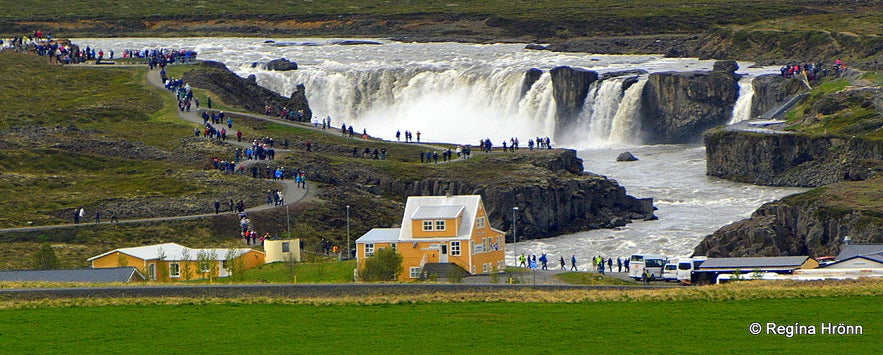
Photo taken out of a moving car from the heath leading to Laugar. Here you see almost the whole area by Goðafoss
Goðafoss isn't the only waterfall in Iceland named Goðafoss, but it is unarguably the best-known. You will find at least 6 waterfalls named Goðafoss, one of which is Goðafoss in the Hallardalsá river, which I wrote about in my travel blog about Strandir in the Westfjords of Iceland.
500 meters from Goðafoss waterfall, closer to Ring Road 1, are a guesthouse, a gift shop, and a restaurant.
When you come driving over the heath from the east, you will have a fantastic view of Goðafoss, as you can see from my photo above. I always try to take a good photo of it from the car, but it isn't easy, and the photo above is the best I could manage.
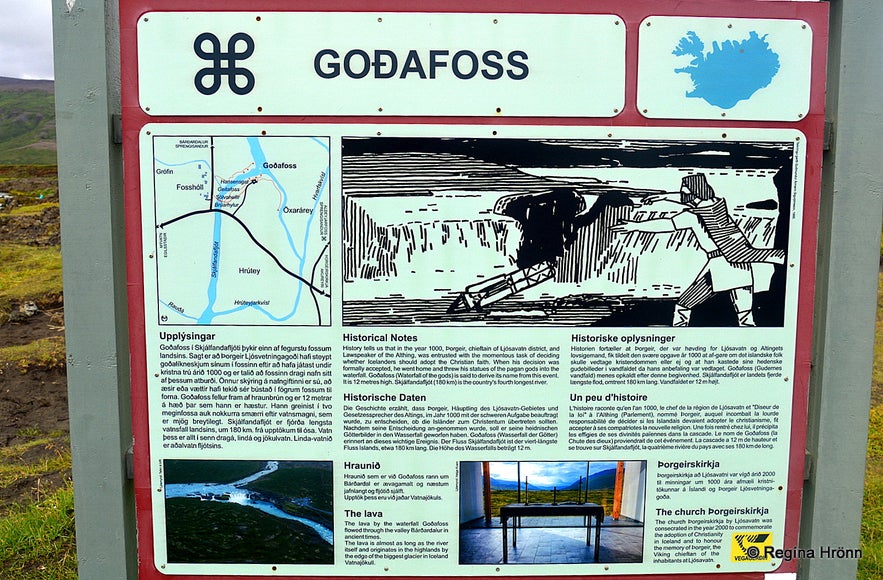
The information sign at Goðafoss
Further up in Bárðardalur - some 41 km - you will find two other beautiful waterfalls in the Skjálfandafljót river; Aldeyjarfoss waterfall, which is one of my favourite waterfalls here in Iceland, and the picturesque Hrafnabjargafoss waterfall.
It is well worth driving 40+ km to visit these 2 spectacular waterfalls. In my opinion, the Skjálfandafljót river is at its finest when Aldeyjarfoss cascades over a wall of beautiful basalt columns into a turbulent white and powdery blue pool.
Here, the beauty of nature blows my mind.
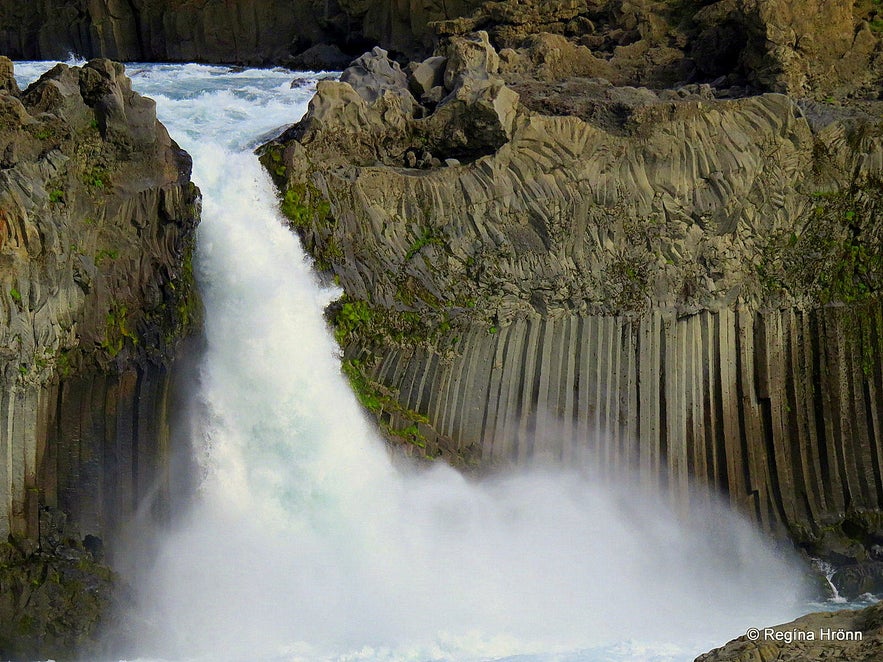
Aldeyjarfoss waterfall
Goðafoss is a part of the Diamond Circle. I have joined a guided tour twice and written about my experience, if you want to get acquainted with this ruggedly beautiful area of Iceland.
And I have, of course, travelled in this area myself many times:
The Jewels of the North - the extraordinary Diamond Circle in North Iceland - a travel blog
The Spectacular Diamond Circle in North Iceland - a travel blog
To visit Goðafoss, you can rent a car in Reykjavík and drive up north. The distance from Reykjavík is around 422 km.
The distance from Akureyri, the Capital of the North, is only 34.5 km. If you continue further, some 53 km, you will see the many attractions of Mývatn.
And Húsavík, the Whale Watching Capital of Iceland, is 47-50 km away.
See also:
Aldeyjarfoss Waterfall in North Iceland in extraordinary Basalt Column Settings
The picturesque Hrafnabjargafoss Waterfall in the Skjálfandafljót River in North Iceland
An Elf Woman catches a Rid across the Skjálfandafljót River in Bárðadalur - an Icelandic Folklore
Grettir the Strong and the Troll in the Waterfall - a Viking Saga from North Iceland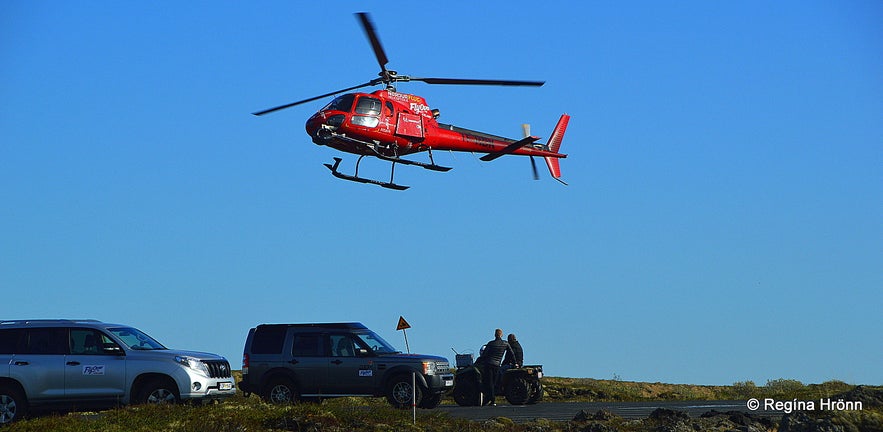
Fly Over Iceland photographing Goðafoss for their new project
Have a wonderful time at Goðafoss, which was finally preserved in June 2020.
Ref.
Grettissaga - the Saga of Grettir
Kristnitakan á Þingvöllum, Gunnar Kristjánsson

Hi, my name is Regína Hrönn, and I was born and raised here in Iceland.