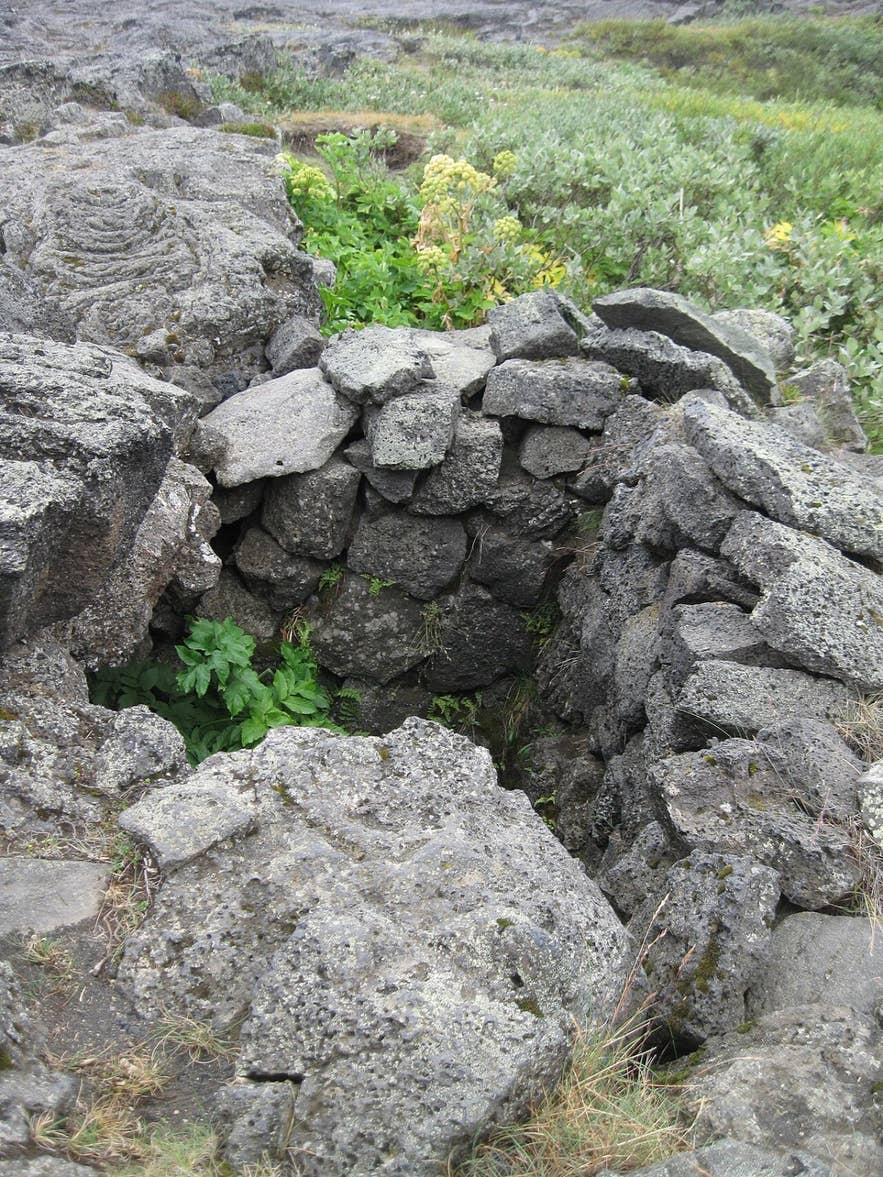
Fjalla-Eyvindur's hut at Herðubreiðarlindir. Photo: Ondrej.lhotka, CC BY-SA 3.0
Fjalla-Eyvindur's Hut, Eyvindarkofi in Icelandic ("Eyvindur's hut"), is the ruin of a tiny stone shelter at Herðubreiðarlindir, the spring oasis in the Ódáðahraun lava desert north of Vatnajökull.
Iceland's most famous outlaw, Eyvindur Jónsson, known as Fjalla-Eyvindur ("Eyvindur of the Mountains"), is believed to have spent a winter here, usually dated to 1774 to 1775, alone, in a hole in the lava barely two metres long.
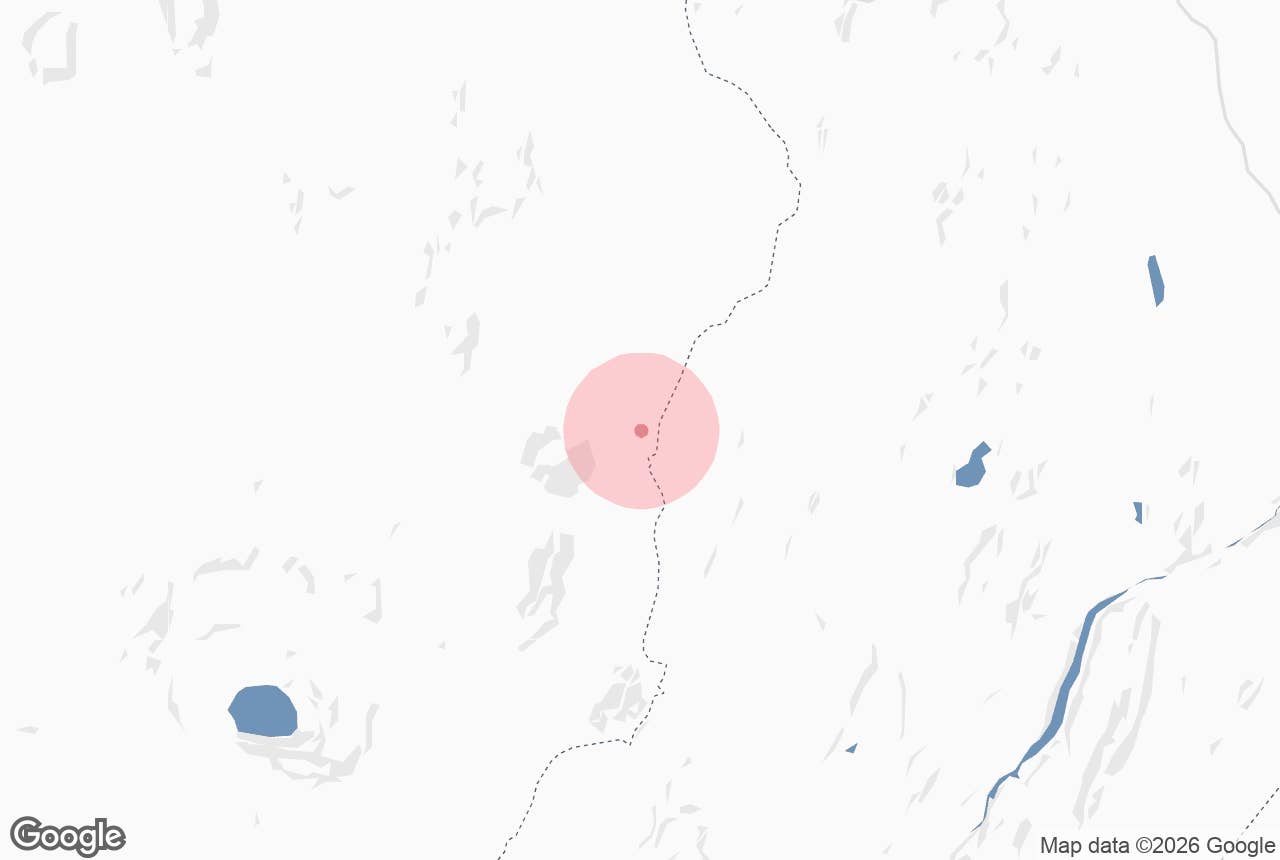
The ruin stands about 100 m north-west of the Þorsteinsskáli mountain hut, a five-minute walk from the campsite, and is one of the few places in the Highlands where an outlaw story can be matched to a physical site.
Key Takeaways About Eyvindarkofi
- Rebuilt (reportedly 1922) ruin of the shelter where outlaw Fjalla-Eyvindur is believed to have wintered, probably 1774-75, at Herðubreiðarlindir
- About 100 m from the Þorsteinsskáli hut and campsite on the F88, 60 km south of Route 1
- Large 4x4 only: two unbridged rivers (Grafarlandaá, Lindaá); the F88 is open roughly late June to September or early October
- Registered archaeological site inside Vatnajökull National Park; do not touch the stones
- Visited by the Mývatn super jeep day tour to Askja and Holuhraun
Why visit Fjalla-Eyvindur's Hut
Fjalla-Eyvindur was born in 1714 at Hlíð in Hrunamannahreppur, South Iceland.
Accused of theft, he fled into the interior around 1760 with his wife Halla Jónsdóttir, and the two lived as outlaws for roughly twenty years between hideouts at Hveravellir, Þjórsárver (where Eyvindarver carries his name), Hvannalindir and the Strandir coast.
Eyvindur is buried at Hrafnsfjarðareyri in the Westfjords; Halla died in 1792.
The Herðubreiðarlindir winter came after Eyvindur escaped capture at Reykjahlíð by Mývatn.
He headed south into the lava and built himself a shelter against the edge of a lava ridge: a stone chamber a good fathom long and half a fathom wide (roughly 2 by 1 m), roofed with slabs of lava and, according to the folk account, a horse's spine as a ridge beam, with lyme grass laid over the top.
A slab of rock fitted so neatly it looked planed closed the doorway. He built the hut against a rock from which a spring gushed, so that the water ran down right beside his bed and he could drink without going outside. By his own account it was the worst winter of his outlaw years.
He had no fire, no sheep to steal, and lived on raw horsemeat from horses he had taken in the autumn and on the roots of angelica, which still grows thickly around the ruin.
The hut later collapsed and was rebuilt on its old footprint, reportedly in 1922, so what you see is a reconstruction rather than Eyvindur's own stonework.
It is still a striking thing to stand beside: a rough rectangle of lava blocks sunk into the ground, angelica growing inside, with Herðubreið, the 1,682 m table mountain, a few kilometres to the south-west.
Herðubreiðarlindir itself is worth the stop. Springs rise from under the Ódáðahraun lava and join to form the Lindaá, which runs into Jökulsá á Fjöllum.
Around 70 plant species have been recorded in this green patch in the desert, and dwarf Arctic char live in the springs. The area has been a nature reserve since 1974 and part of Vatnajökull National Park since 2019.
How to get to Fjalla-Eyvindur's Hut
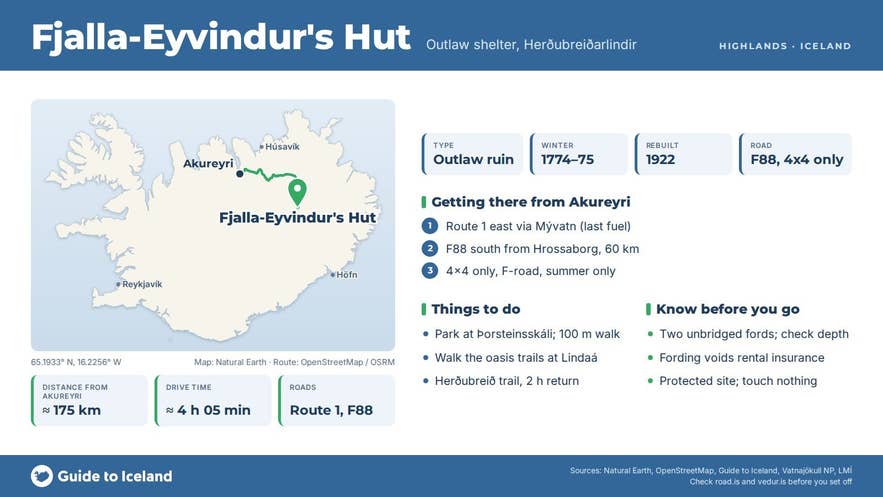
- Road: Herðubreiðarlindir lies on the F88 (Öskjuleið), about 60 km south of Route 1. The track leaves the Ring Road near the Hrossaborg crater east of Mývatn. It is also reachable from the Möðrudalur side via F905 and F910, which join the F88 south of the oasis.
- Vehicle: large 4x4 only. Coming from Route 1 you ford Grafarlandaá roughly 10 km before the huts and Lindaá just before them; both are unbridged and can exceed a metre after rain. Small 4x4s are not suitable, and river crossings are excluded from most rental insurance.
- Distance and time: Reykjahlíð at Mývatn, the last fuel stop, is about 30 minutes west of the turn-off on Route 1; allow 2 hours or more for the 60 km of track. From Reykjavík, Mývatn is roughly 470 km by Route 1.
- Parking and walking: park at the Þorsteinsskáli hut and campsite, run by Ferðafélag Akureyrar. The ruin is about 100 m to the north-west on a short path; the national park's educational trail through the Lindahraun lava (Hb2, 1.7 km) also passes it.
Best time to visit
The F88 usually opens in late June (between mid-June and early July in recent years), once the snow has gone and the rivers have dropped, and closes with autumn snow in September or early October.
July and August are the dependable months, with wardens and rangers on site and the campsite open; rivers are usually lowest in the morning. Outside the open season the site is unreachable.
Safety and practical tips
- Check road.is for the F88 status and safetravel.is for conditions, and leave a travel plan. Phone coverage is patchy.
- Never cross Lindaá or Grafarlandaá without judging depth and current first; if in doubt, wait or turn back.
- Facilities: the Þorsteinsskáli hut (sleeping-bag accommodation, booked through Ferðafélag Akureyrar), a campsite, toilets and a warden in summer. No shop or fuel. Camping outside marked sites is not permitted in the national park.
- Do not climb on or move the stones of the ruin. It is a registered archaeological site protected under Iceland's heritage law, and the walls are loose.
- Weather changes fast and sandstorms are common in dry spells. Bring warm layers, a windproof shell and water for any longer walk; there is little surface water elsewhere in Ódáðahraun.
Nearby attractions
- Herðubreiðarlindir (0.2 km): the oasis itself, with the huts, campsite, spring-fed Lindaá and marked walks.
- Herðubreið (4.9 km): the table mountain; a marked trail leads to its foot in about two hours return.
- Dreki (24.2 km): the ranger station and huts at Drekagil, about 33 km further by road (F88, then F910) on the way to Askja.
- Askja Caldera (24.1 km): the great caldera at the end of the road.
- Víti by Askja (28.6 km): the warm explosion crater beside Öskjuvatn.
- Hvannalindir (34.1 km): the other spring oasis where Eyvindur and Halla are thought to have lived for years; hut ruins there are supported by radiocarbon dating.
Tours that visit Fjalla-Eyvindur's Hut
- Super Jeep Tour to Askja Caldera & Holuhraun Lava Field with Transfer from Mývatn: a 12-hour summer (June to September) day tour from Mývatn that stops at Herðubreiðarlindir and the hut ruin on the way to Askja, Víti and the Holuhraun lava field.