We will also pass through 3 lovely villages on the South Coast, Stokkseyri, Eyrarbakki, and Þorlákshöfn.
There are only 3 lighthouses here on the South Coast Lighthouse Trail, as the south coast has very few harbours from Stokkseyri to Höfn in Hornafjörður, which is a long coastline with no harbours. The Westman Islands, on the other hand, have a good harbour.
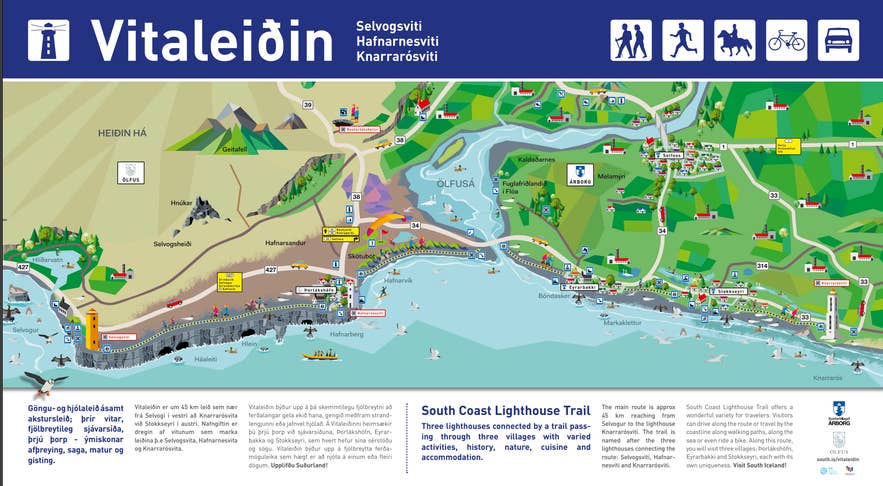
Top photo: The official Map of the South Coast Lighthouse Trail
Knarrarósviti lighthouse
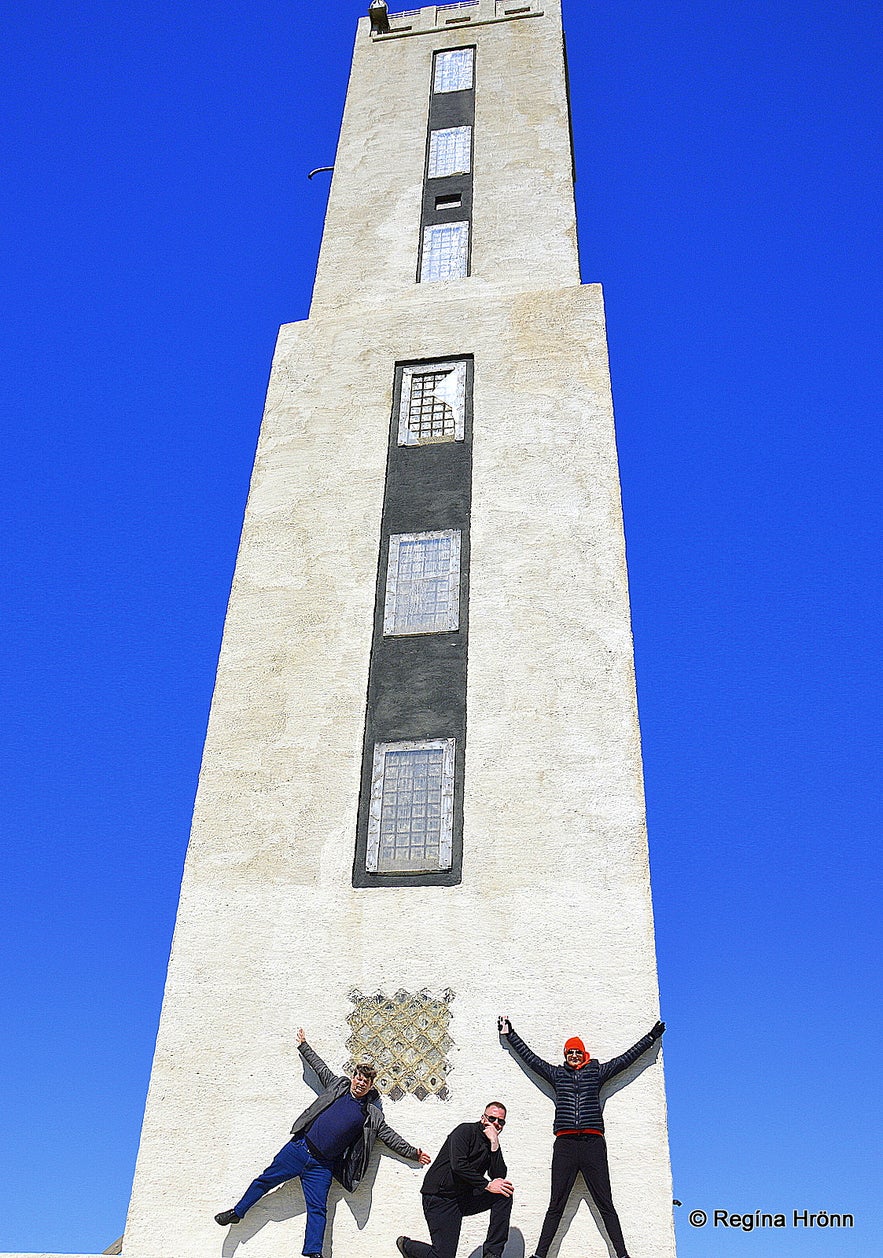
With my husband and friends at Knarrarósviti
I love treasure hunts and lighthouses, so when they were combined with sunshine, blue skies, and excellent travel companions, it made for a perfect day.
Our first stop was at the majestic-looking Knarrarósviti lighthouse, which marks the eastern end of the Lighthouse Trail.
Knarrarósviti (Baugsstaðaviti) was built in 1938-1939, in reinforced concrete, and blends Art Nouveau and functionalism.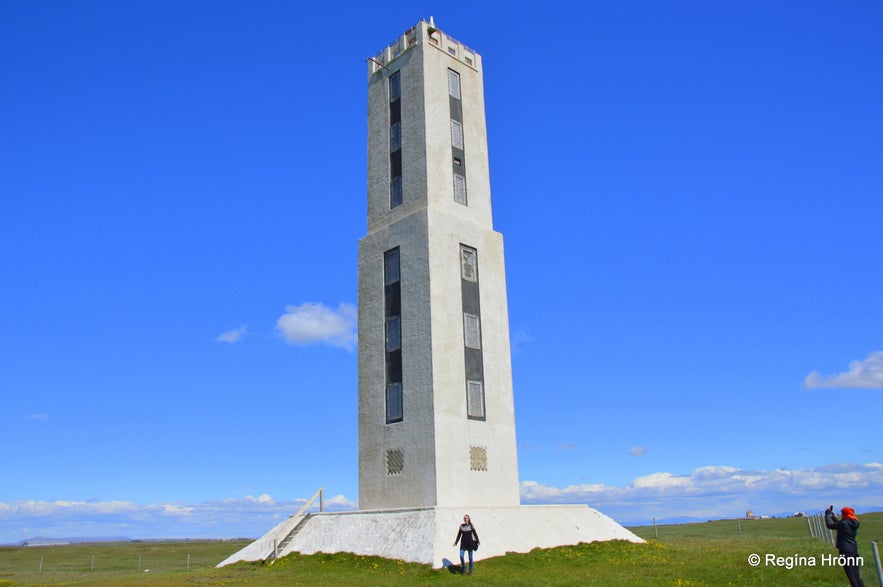 By Knarrarósviti
This lighthouse was the first lighthouse to be built out of such reinforced concrete, i.e., with steel bars to reinforce it.
Lighthouses serve as beacons of light for the seafarers, and one can only imagine the difference it made to have this tall lighthouse in this position, where many ships have perished.
Knarrarósviti lighthouse was the tallest building in South Iceland, at 26.2 meters, according to the information sign by Knarrarósviti. When I visited Knarrarósviti in 2026, the information sign was gone, and only the Lighthouse trail information sign was visible.
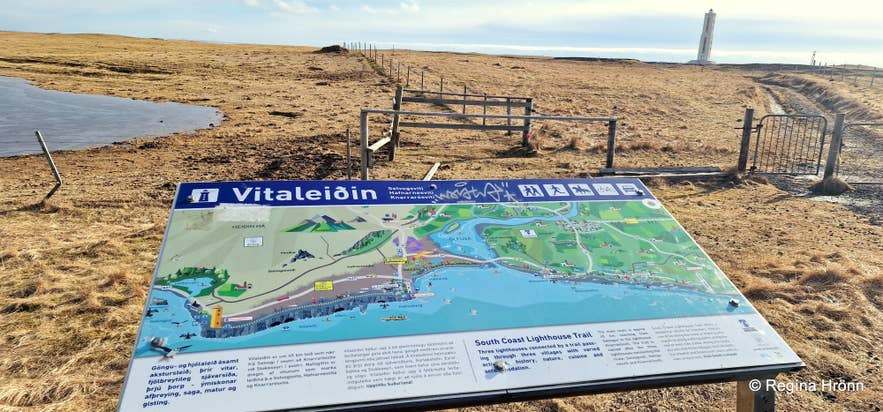 The map of the Lighthouse trail by Knarrarósviti - where has the other map gone?
Now, I read in the list of lighthouses of Vegagerðin - the Road Administration of Iceland that the height of Knarrarósviti is 22 meters. So which one is it?
For a limited time in the summertime, the lighthouse is open from 13:00-17:00. It wasn't open when we stopped by.
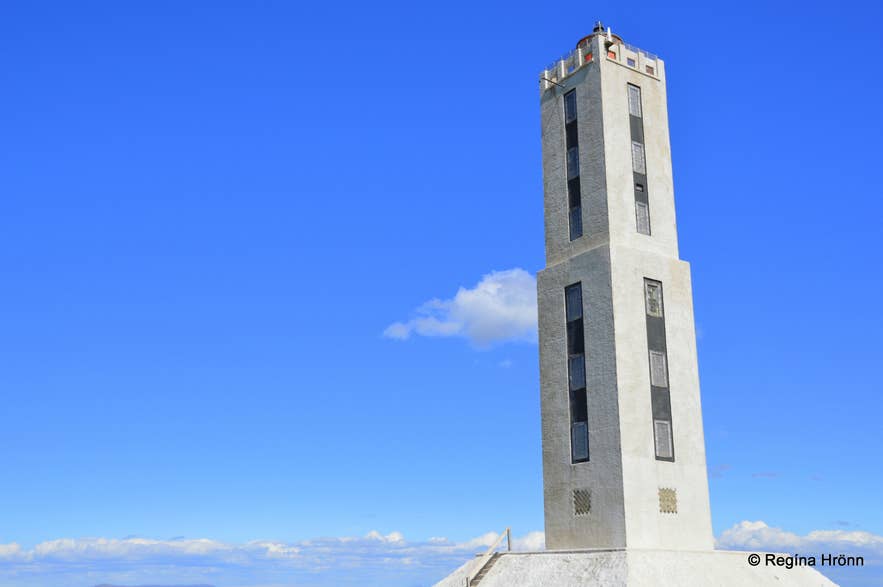
The majestic Knarrarósviti
Knarrarósviti was built by the engineer Axel Sveinsson, who designed many of Iceland's lighthouses.
Axel was influenced by the noted State Architect, Guðjón Samúelsson, who built many of Iceland's fine buildings.
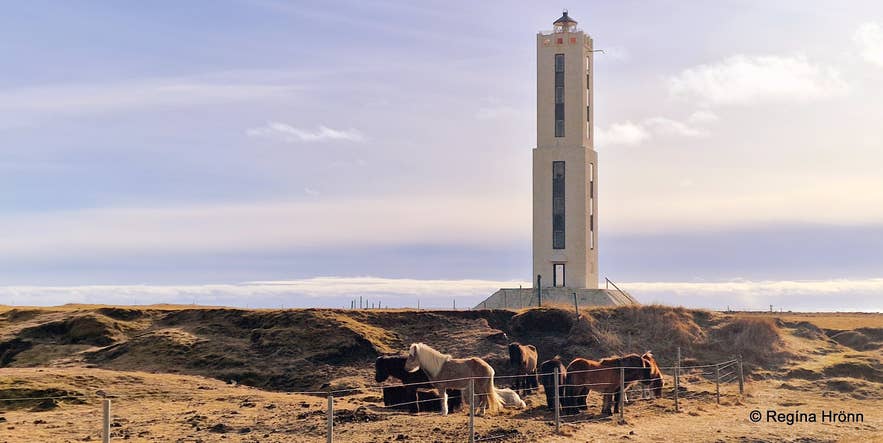 Horses by Knarrarósviti in 2026
I have seen a couple of other lighthouses around Iceland, built in a similar style, not the same as Knarrarósviti, which is unique as it is a two-staged lighthouse, but similar, e.g., Hraunhafnartangaviti in North-East Iceland, which protects one of Iceland's northernmost spots, and at Kálfshamarsvík on Skagi in North Iceland, where you will find the most beautiful basalt column beach in Iceland.
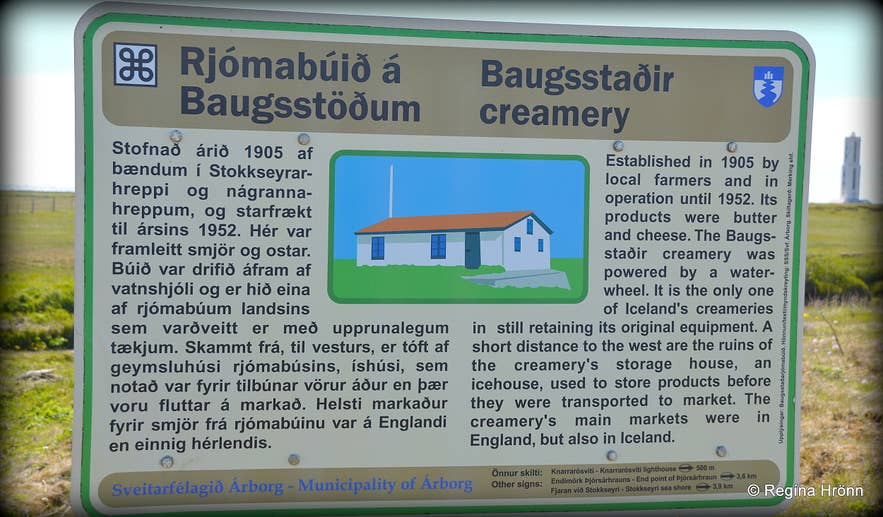
The information sign by Baugsstaðir creamery - Knarrarósviti in the distance
We also wanted to visit the Baugsstaðir creamery, which is close to Knarrarósviti, but it has very limited opening hours. I visited it back in 2008 and have not been able to enter it since.
As the information sign states, the local farmers established the Baugsstaðir creamery in 1905, and it operated until 1952, producing butter and cheese.
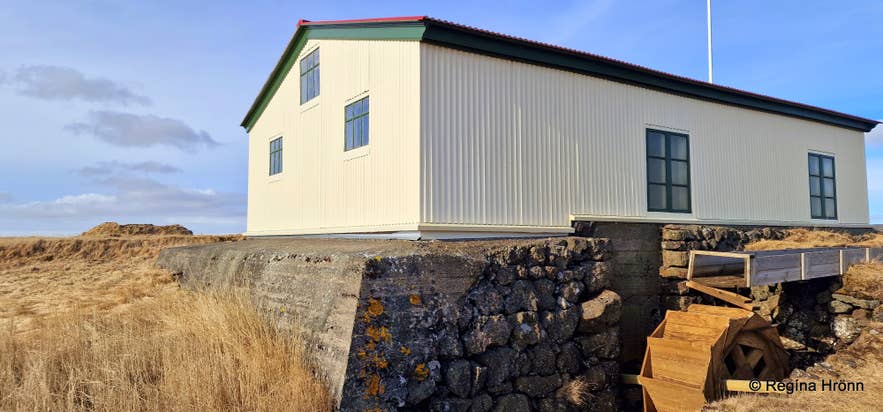 Baugsstaðir creamery
Even if you cannot enter, you can look at it from the outside and see the waterwheel that powered the creamery.
In the distance in my photo above, you see the turf and rock ruins of the storage house of the Baugsstaðir creamery. The dairy products were sold in Iceland and in England.
Stokkseyri Village - the Museum Village
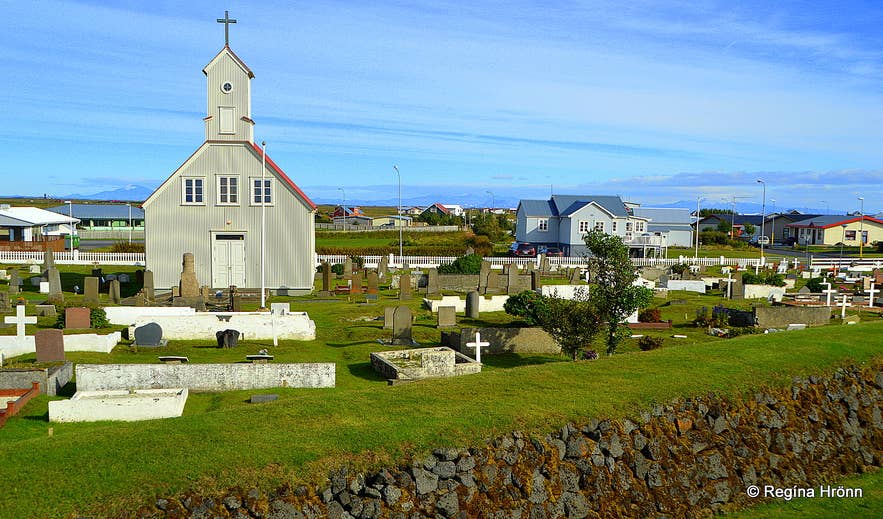
Stokkseyrarkirkja church
Now, it was time to go kayaking in Stokkseyri, the museum village west of Knarrarósviti.
Stokkseyri is the village in Iceland, often referred to as the museum village, due to its many interesting museums.
The population of Stokkseyri is 535, two of whom are related to me: my sister and my uncle. It is such a small village, but it has so much to offer:
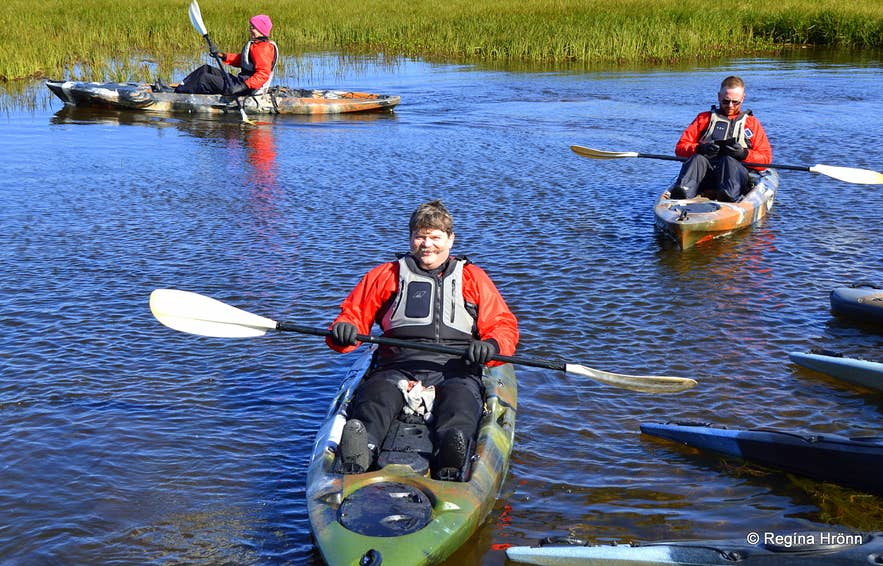
My friends kayaking in the canals
My friends had booked a kayaking tour, but I opted out and visited my sister and her husband at Veiðisafnið - the Wildlife museum in Stokkseyri instead.
We had two tours to choose from: the Family-Friendly 3-Hour Guideless Robinson Crusoe Kayaking Tour, which was right up my alley, but they thought that was too easy, and wanted to try kayaking in the sea.
So they chose the Power Challenge Circle Tour, which didn't sound inviting to me at all, so I opted out. They are all healthy, energetic people, whereas I struggle with my health and don't do power challenges.
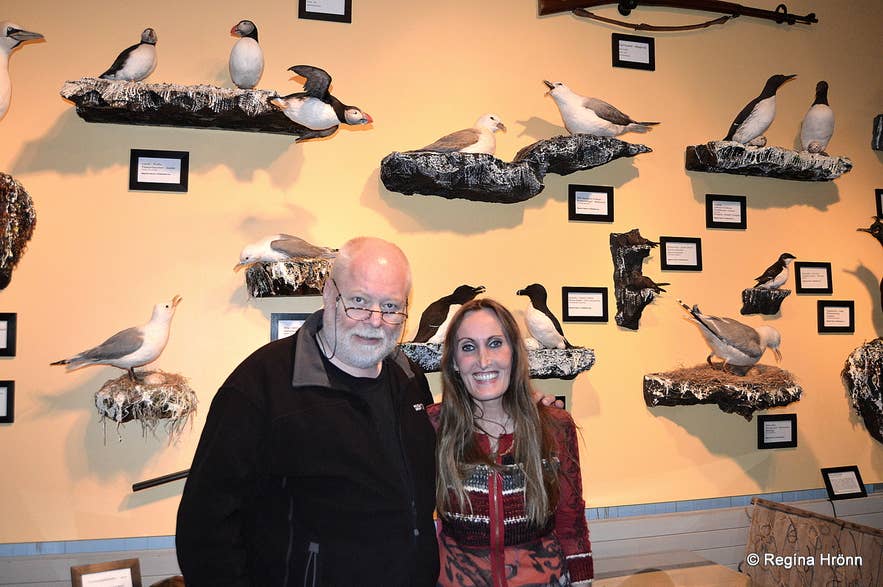
With my brother-in-law at the Wildlife Museum - he is very funny, and not at all this serious ;)
I accompanied them to the beginning of the tour, which was through the canals, to take a couple of photos of them kayaking.
We sat on the balcony of their condo at the museum and watched my husband and our friends enjoy kayaking in the sea in front of us.
The next stop on the Lighthouse Trail was in the village of Eyrarbakki, west of Stokkseyri.
Eyrarbakki village
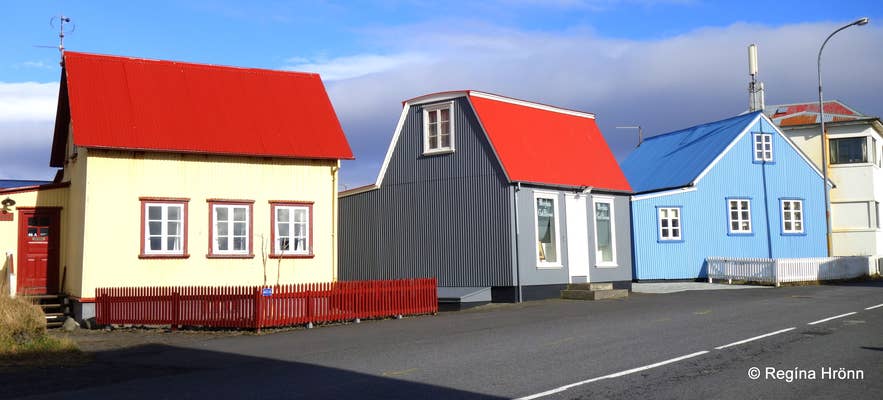
Colourful old houses in Eyrarbakki
These two villages, Stokkseyri and Eyrarbakki, are 7 km apart, and we locals often refer to them as Stokkseyrarbakki ;)
Here, the pace of life is so different from the hustle and bustle of Reykjavík, where I live.
The population of Eyrarbakki is 602, and the museum in this village is the beautiful old house, Húsið - the House, built in 1765, making it one of the oldest houses in Iceland.
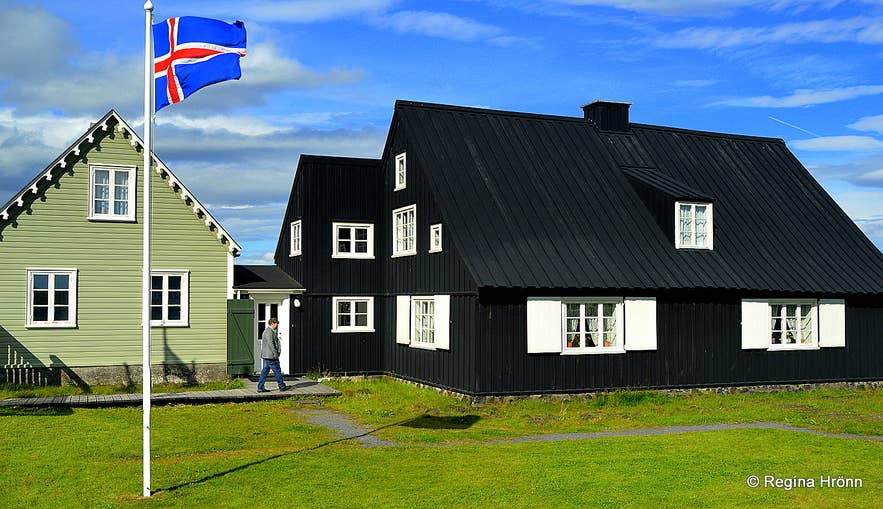
Húsið - The House in Eyrarbakki village
You will also find a quaint little old shop and beautiful little timber houses.
You can find out more about Eyrarbakki in my travel blog: The lovely little Village Eyrarbakki on the South Coast of Iceland & Húsið - the House
These villages on the south coast are often overlooked, but I recommend visiting them as you follow the South Coast Lighthouse Trail.
Humarinn við Hafið - the Lobster by the Ocean
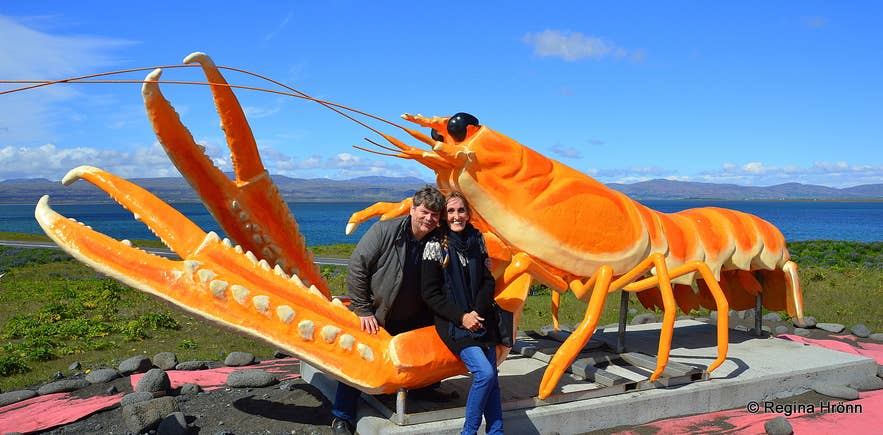 The big lobster by the Ocean in 2021
We carried on our way west to the next lighthouse, which is in the 3rd village, Þorklákshöfn, named after St. Þorlákur, who was the bishop of the Skálholt episcopal see in south Iceland from 1178 to 1193.
On our way to Þorlákshöfn village and Hafnarnesviti lighthouse, we made one stop and took a photo with the Lobster by the Ocean by the artist, fisherman, and ship's captain Kjartan Brynjar Sigurðsson.
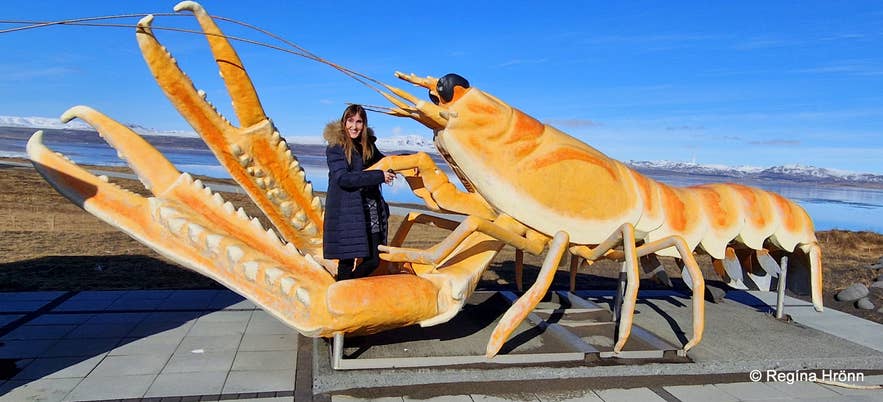 The lobster in 2026 - the colour has faded a bit
It is the largest lobster in Iceland, 6 meters long, made of fiber-plastic, erected in 2020, to honour fishermen.
Catching lobster (langoustine) was important for the hamlets Þorlákshöfn and Eyrabakki, and earlier on, there were great fishing grounds for langoustine here.
It is a good photo opportunity, and we always stop by the lobster, as there is also a great view from here of the estuary
My husband took the short video below. He is a professional magician, and loves taking videos of me appearing from behind things, without my knowledge ;)
This lobster is by the restaurant Hafið bláa - by the Ocean.
Unfortunately, this restaurant closed in February 2026. It is a shame, and I hope that it opens again in the near future. But the lobster is still there.
Don't miss visiting the beach, which you can enter by steps behind the restaurant.
I always go down to the beach here whenever I stop by this area. Most of the beaches in Iceland are black, apart from in the west, where you will find pink beaches.
But here on the south coast, the beaches are all black.
Here we are by the mouth of the river Ölfusá, Iceland's most voluminous river, which carries the glacial water from the Hvítá river, which cascades majestically as Gullfoss waterfall, and many other rivers.
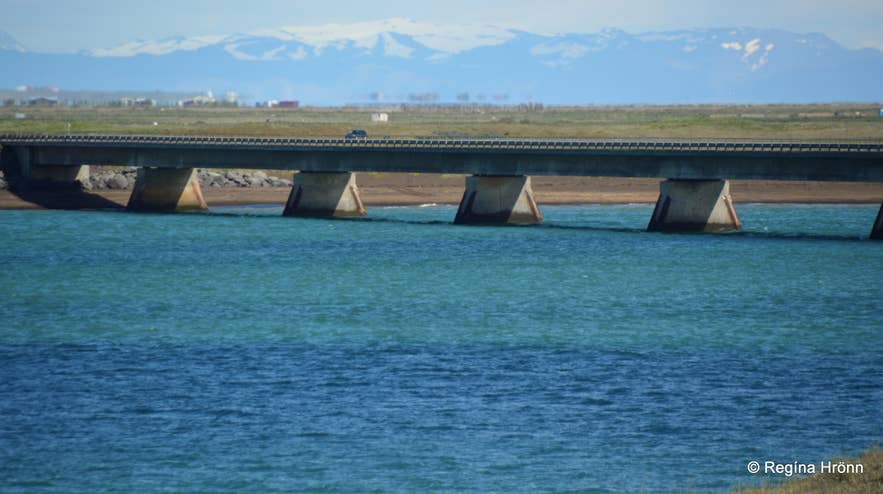
The bridge over the mouth of the river Ölfusá
The river passes through Selfoss town on its way to the sea, and here we cross the mouth of this massive river on a bridge, Óseyrarbrú, which was consecrated in 1988.
See also my travel blog:
The temperamental Giantess Jóra in Jórukleif and the Lava Pots by Selfoss in South Iceland
Hafnarnesviti lighthouse in Þorlákshöfn
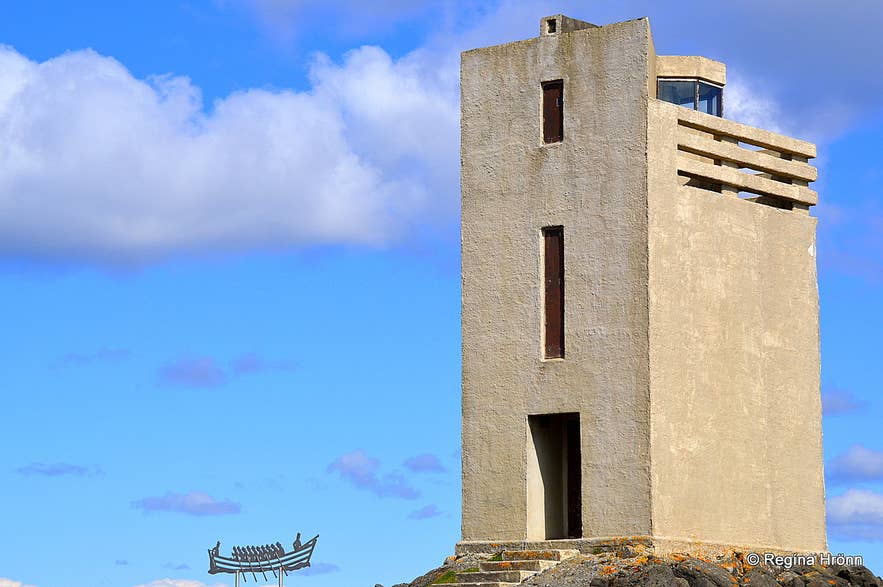 Hafnarnesviti lighthouse
Our next stop was at Hafnarnesviti lighthouse in the village of Þorlákshöfn (population a little over 2,000). We passed through the village and south towards the sea.
We followed the sign "útsýnisskífa" as we knew that by the lighthouse is a view-dial.
Hafnarnesviti lighthouse was built in 1951 and is one of Axel Sveinsson's lighthouses. It is not tall, only 8 meters high, but the light is 12 meters above sea level.
I don't know much about this lighthouse, to be honest, and there was no sign by it.
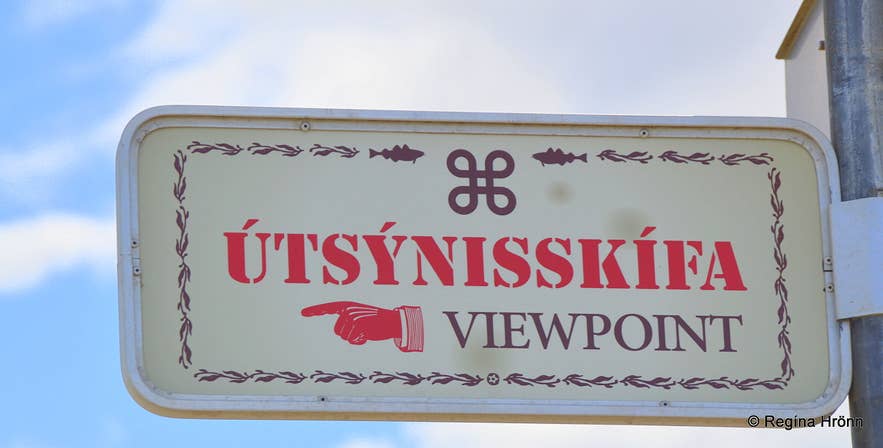 Útsýnisskífa - a view-dial
I know more about the artwork by the lighthouse. It is a ten-oared rowing boat, made from a steel sheet.
This artwork was made by Erlingur Ævarr Jónsson, a former ship captain of his own ship, Eyrún ÁR 66, in Þorlákshöfn. Erlingur was a fisherman for 50 years, of which 35 years were as captain.
He wanted to honour the history of seamanship in Þorlákshöfn, so he drew an old ten-oared rowing boat with 10 fishermen rowing it.
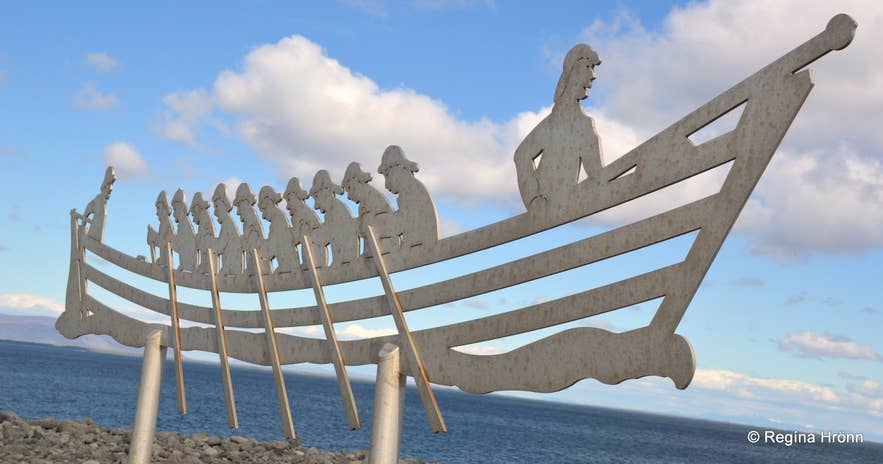
The artwork by the lighthouse
And this beautiful artwork was created. I love such artwork - kudos to Erlingur for bringing his idea to fruition. Respect to the heroes of the sea.
Mbl. - Auður setur svip á umhverfið
Auður djúpúðga - Auður the deepminded settler woman
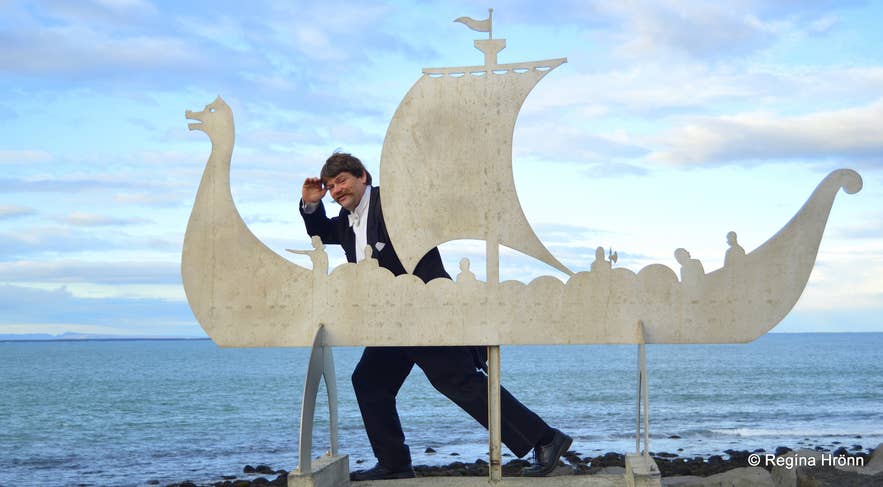
The Viking ship "knörr." And my husband, after he performed magic in Þorlákshöfn
You will find another artwork by Erlingur on the levee by the parking lot: a Viking ship cutout from a steel sheet, following Erlingur's drawings, and an information sign erected in 2016.
The story of its arrival, called a knörr in Icelandic, knarr in English, if I am not mistaken, dates back to the very settlement age of Iceland.
This ship carried one of Iceland's most remarkable settler women, Auður djúpúðga - Auður the Deepminded, her grandchildren, and their entourage.
This artwork was erected here, as at Hafnarskeið, west of the Ölfusá estuary, where Auður's ship was smashed to pieces. Everybody, fortunately, survived.
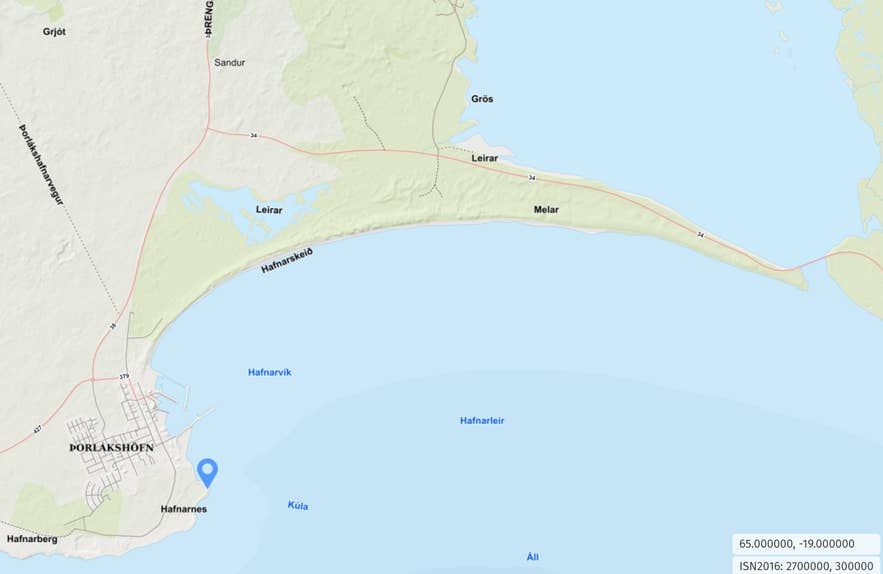 Þorlákshöfn, Hafnarnes, and Hafnarskeið - a screenshop of a map of Náttúrufræðistofnun
An old name for Hafnarskeið was Vikrarskeið, as mentioned in Laxdæla Saga and Landnámabók - the Book of Settlements.
Auður djúpúðga was the daughter of Ketill flatnefur, whom the Norwegian king Haraldur hárfagri had sent to the Hebrides to reconquer the islands.
Auður married Ólafur hvíti - Olaf the White, who conquered Dublin and became a king, making Auður djúpúðga a queen. After the death of Ólafur in one of his battles, she went to the Hebrides.
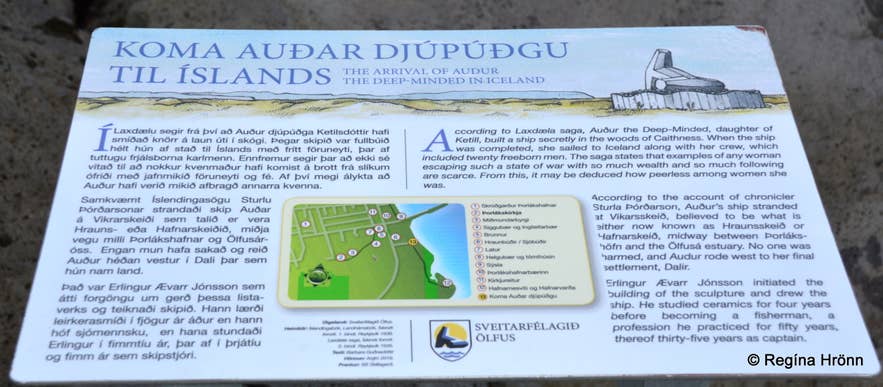 An information sign about Auður djúpúðga at Hafnarnes
They had one son, Þorsteinn rauður. He became ruler of parts of Scotland, but when he attempted to conquer all of Scotland, he was killed.
Auður took her seven grandchildren (6 girls and one boy) and fled to Iceland with her entourage, stopping in the Orkney and Faroe Islands, where she married off two of her granddaughters.
I tell you her story in my travel blog: Fellsströnd and Skarðsströnd in West Iceland - the Saga Circle of Iceland.
Auður had 3 siblings in Iceland and visited her brother Helgi bjóla in Kjalarnes, seeking shelter at his farm. He could only take in half of her traveling companions. I tell you a little about Helgi bjóla in my travel blog: Was the first Christian Church in Iceland built at Esjuberg in Kjalarnes?
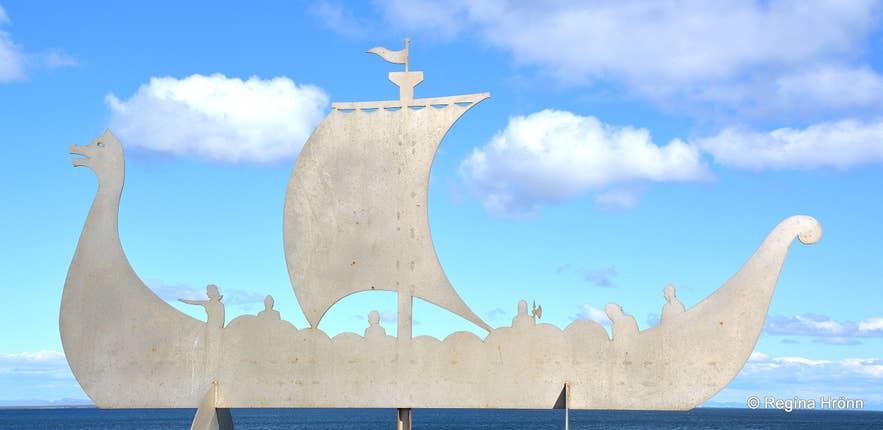 Auður's ship
Auður was offended and carried on to their brother, Björn austræni in Bjarnarhöfn, who took in her whole group. Auður djúpúðga then settled at Hvammur in Dalir, West Iceland, where Snorri Sturluson was later born.
Here at Hafnarskeið in 1718, the farmers rescued 170 people when a Danish battleship ran aground. This is the largest rescue mission in Iceland. Kudos to them.
The Giant - the land guardian of the south (bergrisinn)
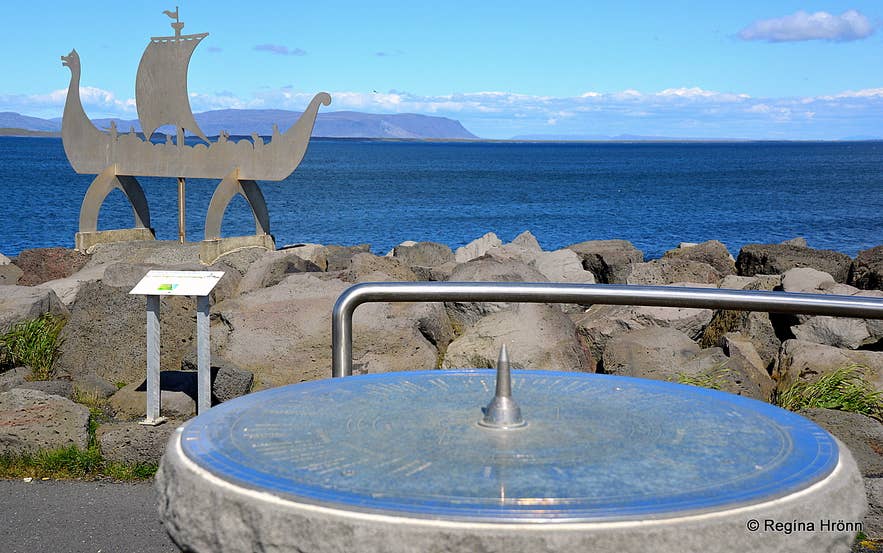
The Viking ship of Auður djúpúðga and the view-dial
Also, here at Hafnarskeið (Vikraskeið), one of Iceland's four land guardians, the giant appeared to the messenger of the Danish king Haraldur Gormsson, according to the Saga of Ólafur Tryggvason in Heimskringla (History of the kings of Norway), written by the noted Snorri Sturluson in the 13th century.
The chapter tells us about the messenger in the likeness of a whale, who starts in Vopnafjörður, where he meets the first land guardian, the dragon (drekinn). He then tried to take land in Eyjafjörður, where he was met by the second land guardian, the eagle (gammurinn).
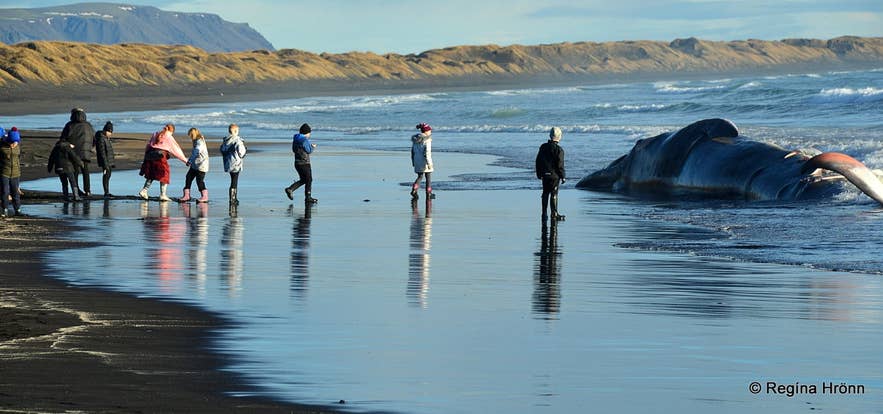 A beached whale in Hafnarskeið by Þorlákshöfn
In West Iceland, he met the third land guardian, the bull. And here by Hafnarnes (Vikraskeið), he met the 4th land guardian, the giant:
"He left there and went south along Reykjanes, intending to climb Víkarsskeið. A giant met him there, holding an iron staff in his hand; his head rose higher than the mountains, and many other giants were with him."
The View-dial in Þorlákshöfn
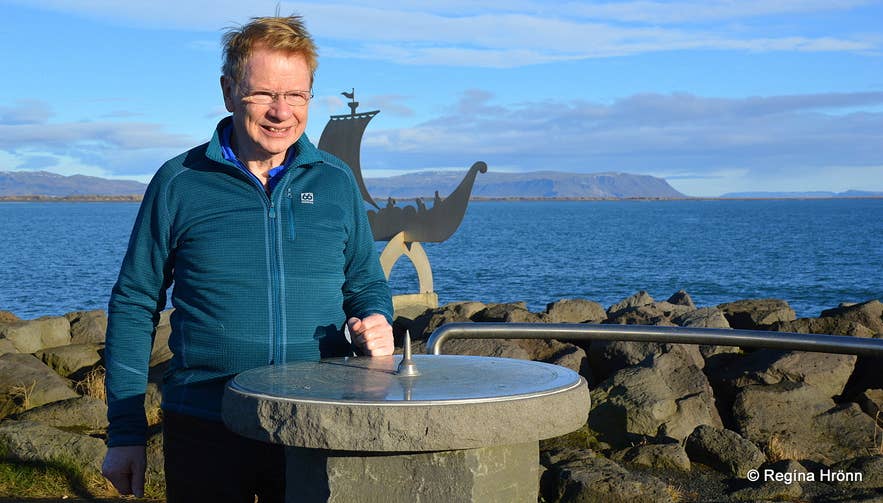
Jakob Hálfdanarson, my father-in-law, by the view-dial he designed at Hafnarnes
By the parking lot, you will also see one of the 90+ view-dials in Iceland.
The view-dial in Þorlákshöfn, erected in 2011 for the municipality Ölfus, was designed by my father-in-law, Jakob Hálfdanarson, and his assistants, Jón Víðis and Þórný, his children.
It is a chrome-plated copperplate mounted on a basalt column. It shows the names and heights of the surrounding mountains.
We track down and photograph all the view-dials in Iceland, as they are of special interest to us. We also visit all the churches in Iceland, and we have now visited 97% of Iceland's many churches. I include one of them, Strandarkirkja church, a little bit further on in this travel blog.
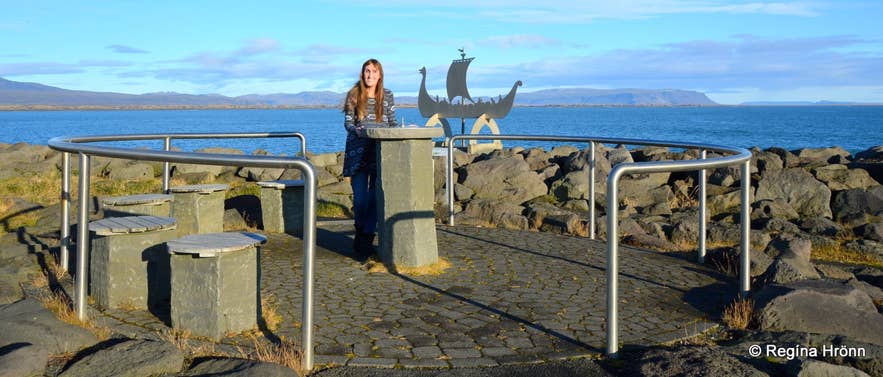 A steel railing surrounds the view-dial
And we thought to ourselves that next we have to track down Iceland's lighthouses.
It was a good start to begin with tracking down the lighthouses on the South Coast :)
So, let's visit the next lighthouse on the Lighthouse Trail, Selvogsviti, which marks the western end of the Lighthouse Trail.
Selvogsviti lighthouse
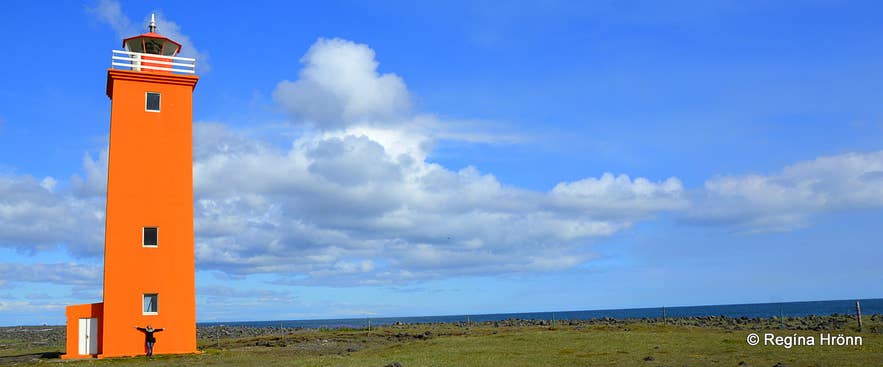
Selvogsviti lighthouse
We followed Suðurstrandarvegur (road number 427) and kept an eye out for Selvogsviti.
After a while, we spotted the orange lighthouse from the road and turned left onto the exit to the small community of Selvogur and Strandarkirkja church.
We then turned left onto an unmarked, bumpy road that seemed to lead to the lighthouse. We parked the car when the road got too bumpy (dreadful really) and walked to the lighthouse.
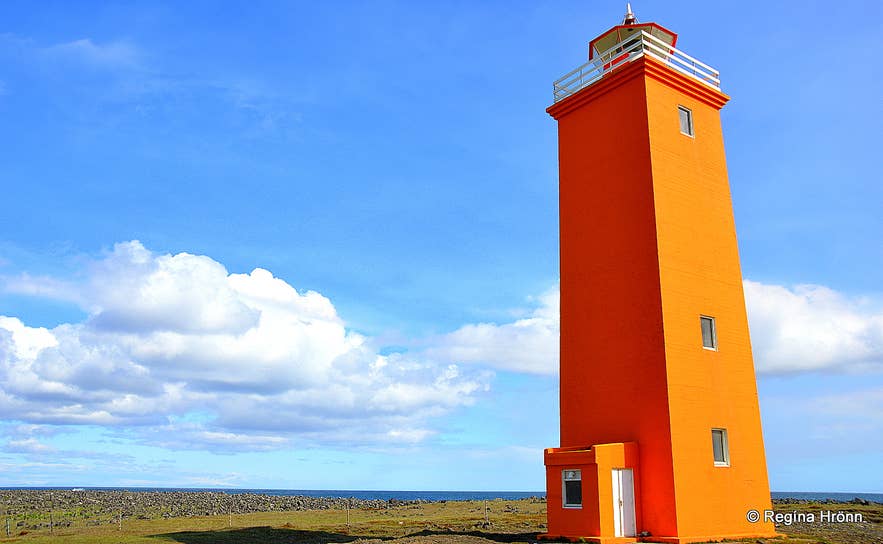
Selvogsviti lighthouse
Selvogsviti is the oldest of the 3 lighthouses on the Lighthouse Trail, built in 1919 and rebuilt in 1930-1931 after it had rusted. It is orange-painted, a square, cylindrical concrete tower.
I must confess that it is not easy to find consistent information about these lighthouses.
I found this information on the official website for South Iceland:
"The light height is 20 meters above sea level. In 1919, a 15-meter-high iron frame was built on Selvogstangi. It was fitted with a 3.3-meter-high light, a 200° dioptric 1000 mm lens, and a gaslight fixture."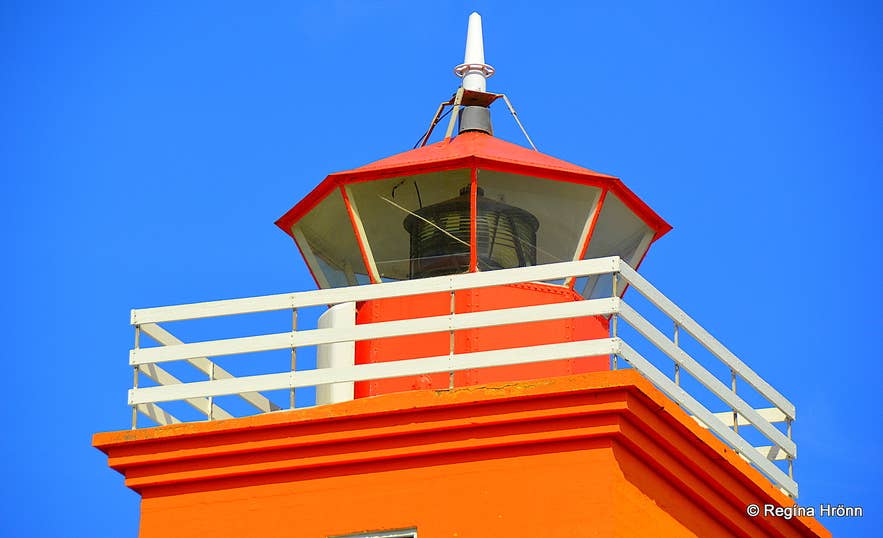 Selvogsviti
There was an older iron-frame lighthouse here at Selvogur, built in 1922, but it had rusted, so the current concrete lighthouse was erected in 1930.
In 1931, the lens, lighthouse, and gaslight fixtures (from the older lighthouse) were installed, and the lighthouse was ready for its important use.
The lighthouse was renovated in 1987, and electricity was added in 1988, along with a radar detector.
 Information from the Lighthouse trail map, Árborg and Ölfus communities combined forces
Here, close by, lived the priest Eiríkur Magnússon (1638 – 1716) at Vogsósar, a legend in Iceland, known for his magical skills. He is the one who rescued people from the female ghost in Reykjanes, which I told you about in my travel blog about the Gunnuhver hot spring.
We find many stories about Eiríkur in our folklore, including one that took place here at Selvogur, and we read about in Þjóðsögur Jóns Árnasonar - the Compilation of Folklore by Jón Árnason:
"It happened in Selvogur that a Turkish ship had come close to shore; a boat was put ashore and landed where it is called Sigurðarhúsabót. A farmer named Jón lived at Sigurðarhús (that is, east of Strönd). Jón went out to meet the foreigners.
They took him and stripped him, formed a ring around him, and pointed their swords at him, but they did not injure him.
 A stained-glass window by Grindavíkurkirkja depicts the Turks (Algerians) attacking Grindavík
Now the wind begins to rise, and the Turks return to the boat and release Jón. They row out into Strandarsund; there they linger for a while.
Then the ship casts off and drifts out to sea; the boatmen row after the ship but do not catch it while it is in sight."
(This is a part of the story "Tyrkjar koma í Selvogi", translated into English, from Þjóðsögur Jóns Árnasonar Volume I, pages 561-562.)
Eiríkur had been watching them from the Strandarkirkja graveyard and used his magic skills to drive them away, or else they would have killed Jón. And he reprimanded Jón, telling him he had no business approaching strangers (i.e., unknown foreigners).
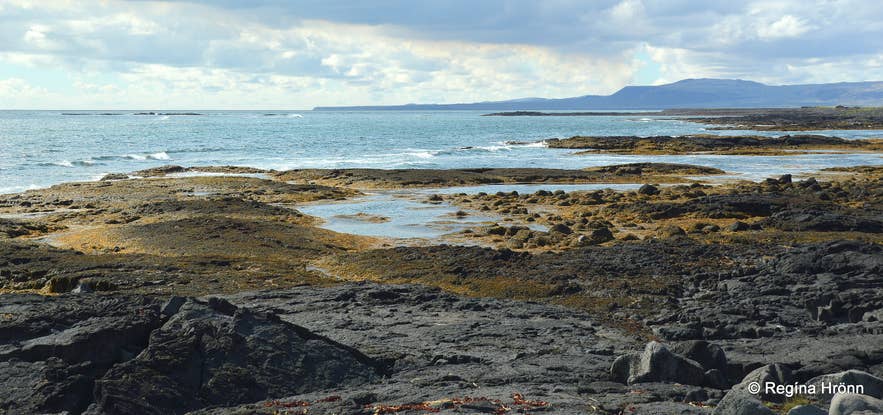 Selvogur cove - an ash cloud from a volcanic eruption in the distance
Now let's visit the miracle church, Strandarkirkja, which is very close by. When returning from Selvogsviti, continue driving in the small community of Selvogur until you reach Strandarkirkja church.
Strandarkirkja miracle church
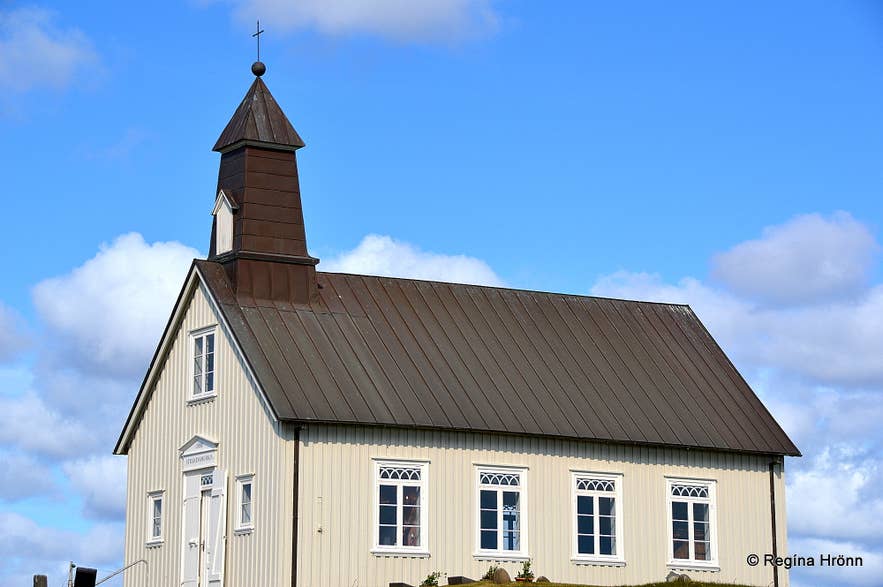
Beautiful Strandarkirkja church
Strandarkirkja (1888) is Iceland's votive church, and it is customary in Iceland to make a pledge to it when seeking an answer to an urgent prayer. I have made a pledge to the church, and so have several of my family members and ancestors, dating back many generations.
Once, Strandarkirkja church was one of the wealthiest churches here in Iceland because of votive offerings.
A legend from around the 12th century is associated with Strandarkirkja. It tells us how an angel saved the lives of sailors in peril.
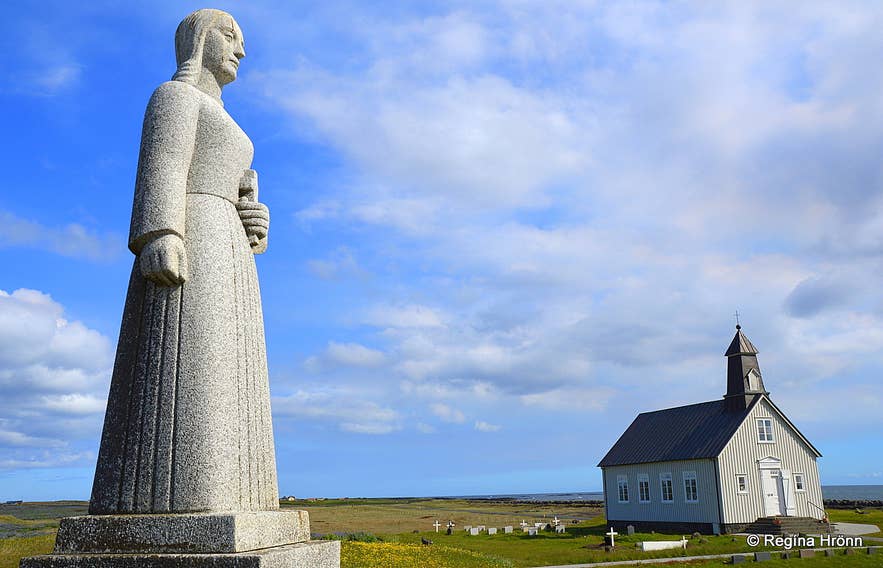 Strandarkirkja and the statue of the angel - Landsýn
"The story goes that a ship carrying wood was caught in a big storm, in total darkness. It was almost a sure death for the sailors, as the landing places in this area are rugged and strewn with reefs.
In despair, they knelt in prayer, asking God to save them. They pledged to build a church with the wood they were carrying, on the spot they would land, if they were to reach land safely.
A light being, an angel, suddenly appeared in front of them by the prow. Some of the stories say that they saw a light onshore. They followed the bright light through the dangerous surf and landed safely in a cove on a sandy beach.
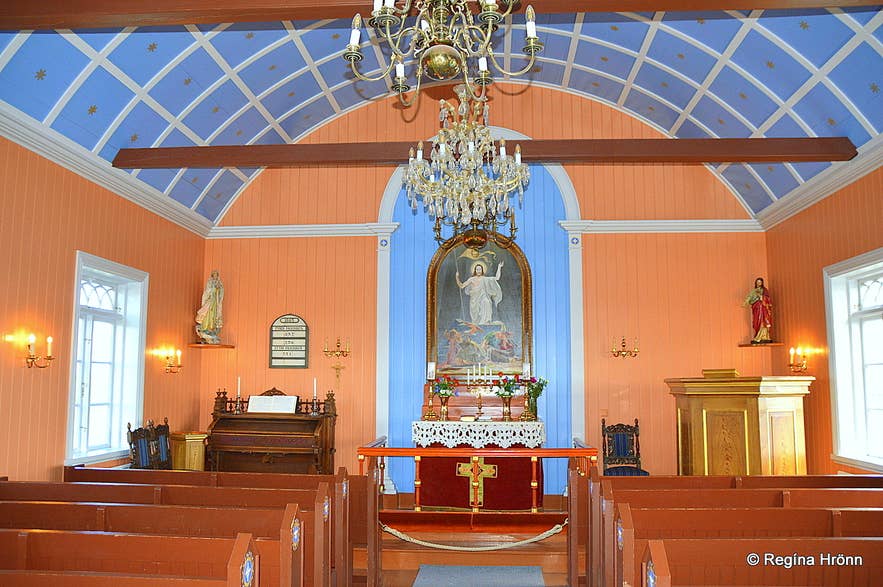
Inside Strandarkirkja
The sailors, who were grateful for the rescue, kept their promise and built a wooden church on the site, which they named Strandarkirkja.
Where they came ashore has, from that time, been called Engilvík or Engilsvík; Angel's Inlet."
You can read more about this lovely church in my travel blog: The holy Strandarkirkja Church in South Iceland - Iceland's Miracle Church.
You can continue visiting many more lighthouses on the Reykjanes peninsula, and make a whole day of it, like Reykjanesviti lighthouse and the two Garðskagaviti lighthouses at Garður.
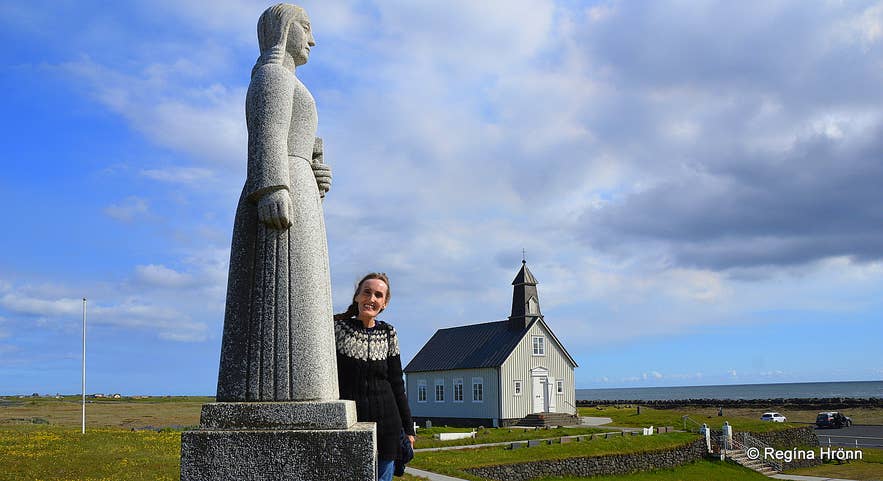
Landsýn was unveiled in 1950
The Lighthouse Trail doesn't include them, as they are in another county, Gullbringusýsla, whereas the Lighthouse Trail is in Árnessýsla.
In my last travel blog, I told you about Krýsa and Herdís, who fought over the county boundaries:
The Folklore of Krýsa and Herdís & a Hike on Stóra-Eldborg & Litla-Eldborg
Lighthouses, apart from their main vital function, are so picturesque, and visiting them is a delight. I somehow hear the heartbeat of Iceland when visiting lighthouses, when they send out beams of light to keep seafarers from peril.
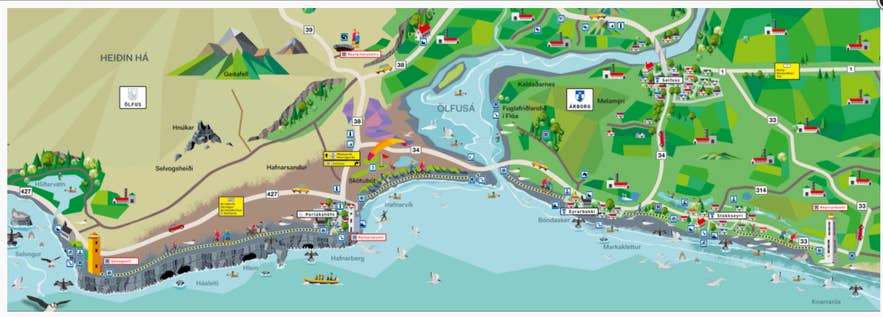 The South Coast Lighthouse Trail map
The Lighthouse Trail is around 45 km from Knarrarósviti to Selvogsviti.
As the lighthouses have shown the way for the seafarers, we are now shown the way between the lighthouses by following this trail.
To reach this area, you can rent a car and explore it on your own, and I hope that my travel blogs help to enrich your experience :)
Ref.:
Vitaleiðin - the South Coast Lighthouse Trail
Vitaleiðin - milli Knarrarós- og Selvogsvita
Þjóðsögur Jóns Árnasonar - the Compilation of Folklore of Jón Árnason

Hi, my name is Regína Hrönn, and I was born and raised here in Iceland.