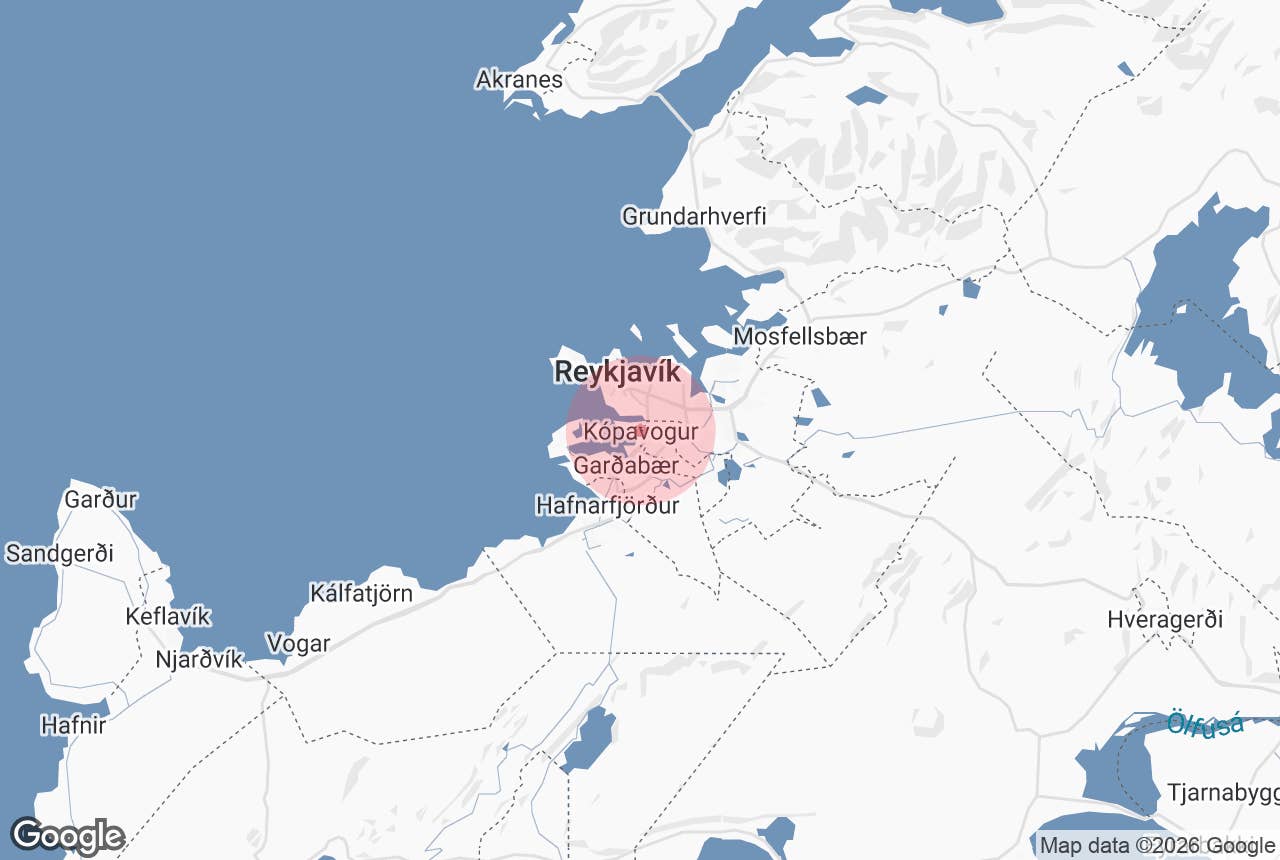
The Natural History Museum of Kópavogur (Náttúrufræðistofa Kópavogs, today also branded Náttúrusafn Kópavogs, "Kópavogur Nature Museum") is a small, free natural history museum at Hamraborg 6a in the centre of Kópavogur, the town that borders Reykjavík to the south.
It shares a building with the Kópavogur public library and stands next to the Gerðarsafn art museum and the Salurinn concert hall, the cluster of culture houses on Hamraborg. The Icelandic name means "Kópavogur natural-science institute"; Kópavogur itself means "seal-pup bay".
Key Takeaways About Náttúrufræðistofa Kópavogs
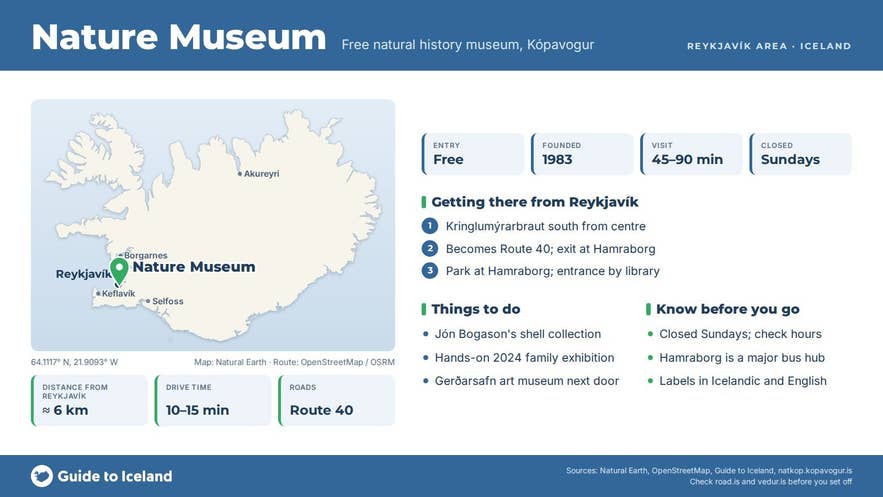
- Free town-run natural history museum at Hamraborg 6a, Kópavogur, sharing a building with the public library next to Gerðarsafn and Salurinn
- Founded in December 1983 around Jón Bogason's shell collection; about 790 objects including Icelandic birds, fish, mammals, insects and rocks
- New family exhibition "Brot úr ævi Jarðar" (Fragments from the Life of Earth) opened May 2024
- Open Mon–Fri 08:00–18:00, Sat 11:00–17:00, closed Sunday (check before visiting); allow 45–90 minutes
- About 6 km from central Reykjavík by Hafnarfjarðarvegur (Route 40); Hamraborg is a major Strætó bus interchange
Why visit the Natural History Museum of Kópavogur
The museum began with one man's shells. Jón Bogason was a self-taught naturalist who found several hundred animal species that had never been recorded in Icelandic waters, and a few that were new to science. A whole genus of molluscs, Bogasonia, is named after him.
His most remarkable find was eight living specimens of Micropilina minuta, a tiny shell that scientists had believed extinct, known until then only from fossils around 350 million years old. In 1983 he gave his collection to the town, which founded the museum in December that year.
Today the collection holds roughly 790 objects.
Alongside the shells you will find mounted Icelandic birds, including the water rail (keldusvín), which died out as a breeding bird in Iceland in the 20th century. A collection of eggs and nests, among them a white wagtail nest partly woven from human hair, found near a hairdresser's; Icelandic fish from cod to deep-sea anglerfish.
Three of Iceland's six wild land mammals (arctic fox, mink and wood mouse). Up to 300 insects, plus other arthropods such as sea spiders, Norway lobsters and barnacles. Whale baleen, walrus tusks and a lump of sperm-whale ambergris.
The geology section explains how Iceland formed, with samples of the country's common rock types, zeolite cavity fillings and fossils. The oldest rock in Iceland is about 15 to 16 million years old.
In May 2024 the museum opened a completely rebuilt exhibition, Brot úr ævi Jarðar ("Fragments from the Life of Earth").
It starts in space: the Sun has been shrunk to two metres across and the planets scaled to match (at that scale Earth would sit 215 metres from the Sun and Pluto eight kilometres away).
A wall timeline runs from the first life on Earth to the Mediterranean's fate 50 million years from now, and drawers and cupboards open to reveal the small and hidden.
Other sections cover the seasons and Iceland's migratory birds, and Iceland's volcanism: the island sits on two plates pulling apart one to two centimetres a year, with an eruption every three to five years on average. The exhibition was designed for families.
The museum moved into Hamraborg in May 2002, which brought it closer to the library and Gerðarsafn. Research, especially freshwater ecology for municipalities and in partnership with Icelandic and foreign institutions, was once a large part of its work.
How to get to the Natural History Museum of Kópavogur
The address is Hamraborg 6a, 200 Kópavogur. From central Reykjavík it is about 6 km and 10 to 15 minutes by car: take Kringlumýrarbraut south, which becomes Hafnarfjarðarvegur (Route 40), and leave at the Hamraborg exit. There is parking in the Hamraborg area.
Hamraborg is also a major Strætó bus interchange with frequent routes from the city centre, so the museum is easy to reach without a car. From the bus stops it is a two-minute walk; the entrance is on Hamraborg, in the same building as the library.
Best time to visit
The museum is indoors and open all year, so it suits a rainy or stormy day, a dark winter afternoon, or a few spare hours before a flight. It is closed on Sundays. Check the events calendar: the museum runs a regular programme of talks, workshops and a children's science school, mostly in Icelandic.
Safety and practical tips
- Admission is free.
- Opening hours (as published by the museum in October 2026): Monday to Friday 08:00–18:00, Saturday 11:00–17:00, closed Sunday. Hours can change on public holidays, so check natkop.kopavogur.is before a special trip.
- Allow 45 to 90 minutes. Combine it with Gerðarsafn next door and a swim at Kópavogslaug five minutes' walk away.
- Toilets are in the building, which it shares with the library. The museum describes its access for visitors with reduced mobility as good, and offers free guided tours for groups booked in advance by email.
- Do not confuse it with the Icelandic Institute of Natural History (Náttúrufræðistofnun, formerly Náttúrufræðistofnun Íslands), a state research institute rather than a visitor museum, nor with the Natural History Museum of Bolungarvík in the Westfjords.
Is the Natural History Museum of Kópavogur free?
How long does a visit take?
Is this the same as the Icelandic Institute of Natural History?
Is the exhibition in English?
Can I get there by bus?
Nearby attractions
- Gerðarsafn Kópavogur Art Museum – next door
- Kópavogskirkja – 0.2 km, the arched church on Borgarholt hill above Hamraborg
- Kópavogslaug – 0.5 km, the town swimming pool
- Nauthólsvík – 1.4 km, geothermal beach
- Sky Lagoon – about 2 km
- Perlan Museum – about 2 km
- Hallgrímskirkja – about 3.5 km
Tours that visit the Natural History Museum of Kópavogur
- Relaxed 14-Day Northern Lights Package Tour of the Ring Road with Snaefellsnes & Reykjavik – the Reykjavík days of this package leave time to visit the museum in neighbouring Kópavogur on your own.