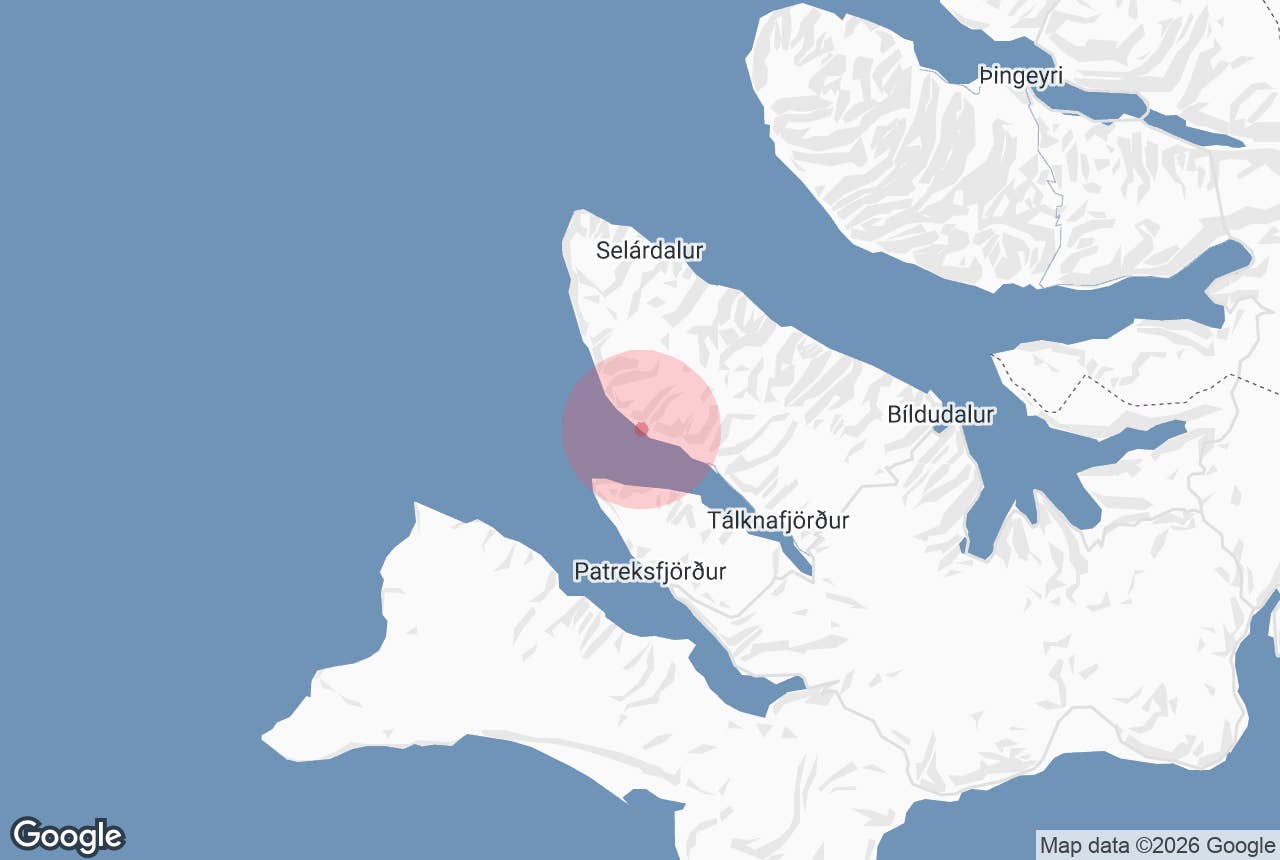
Sellátrar farm is an abandoned farm on the north shore of Tálknafjörður in the southern Westfjords, about 11 km west of the village of Tálknafjörður along Road 617.
The name is the plural of sellátur, "seal haul-out", a place where seals come ashore and pup, and seals are still seen along this shore.
Today Sellátrar is a summer house owned by descendants of the family who farmed it: a yellow house standing alone on a grassy slope above the fjord, with the stone walls of the old farm, a stream and a small grove of planted trees beside it.
The farm is the starting point for one of the best easy coastal walks in the southern Westfjords, out to the old fishing stations at Arnarstapi and the deserted valley of Krossadalur.
Key Takeaways About Sellátrar
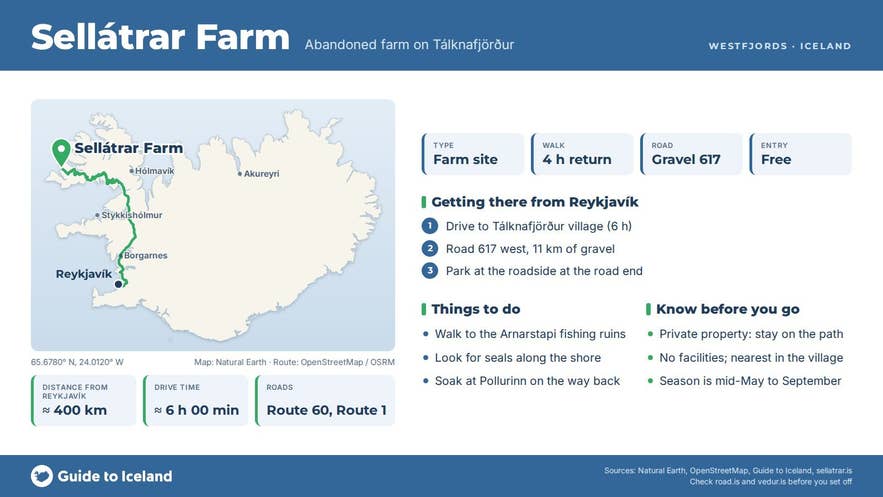
- Abandoned farm, now a private summer house, at the end of Road 617 about 11 km west of Tálknafjörður village
- Start of a level 4-hour return walk to the Arnarstapi fishing-station ruins and deserted Krossadalur
- Tour operators call its small planted grove 'Europe's westernmost' - local lore, not a surveyed fact
- Fishing stations here sent out 18 boats a spring in the 17th century (Jarðabók 1710); seals are still seen along the shore
- No facilities; nearest services and the donation-based Pollurinn hot pools are back towards the village
Why visit Sellátrar farm
Sellátrar is a quiet place with a long history. The coves just beyond the farm, the Stapavíkur, were among the busiest fishing stations in the Westfjords.
The Jarðabók land register of 1710 recorded that eighteen boats had rowed out from here each spring in the 17th century, before the smallpox epidemic of 1707 emptied the stations, and that 14 or 15 fishing huts had stood there.
Three coves, Traðarvík, Hvalvík and Arnarstapavík, held the landing places and turf-roofed huts, and the remains of stone walls and drying racks are still visible at Arnarstapi. Rowing resumed later and continued past 1900: cod was salted and wolffish was dried on stone walls.
Motor boats began to replace rowing boats in the Westfjords from 1902, and the open-boat stations at the mouth of the fjord fell out of use during the early 20th century.
The farm itself was taken over in 1895 by Kristján Arngrímsson and the midwife Þórey Eiríksdóttir, who first rented it for twelve quarters of butter a year; their daughter Ingibjörg and her husband Einar Jónsson later bought it, and the house today belongs to the extended family as a shared summer home.
Sellátrar was the last inhabited farm on this shore: Arnarstapi and Krossadalur beyond it have been deserted since about 1940, and in 1988 Sellátrar was still described as the outermost occupied farm on the north side of the fjord, where the road ends.
Local tour operators point to the small grove of trees here as the westernmost grove in Europe. Trees do not grow easily this far out on the Westfjords coast, so the planted trees around the house stand out from a long way off. Treat the "westernmost in Europe" claim as local lore rather than a surveyed fact.
Above the farm rises Sellátrafjall, 484 m, with the narrow valley Sellátradalur running up behind it.
The view from the shore takes in the whole of Tálknafjörður, the cliffs of Tálkni on the south side, and Patreksfjörður bay to the west.
Seals, eiders and other seabirds are usually in sight, and the white sand of Sveinseyri is a few kilometres back towards the village.
How to get to Sellátrar farm
Tálknafjörður village is about 390-400 km from Reykjavík by road, roughly 5 and a half to 6 hours including the Dynjandisheiði section, or less driving if you use the Baldur ferry from Stykkishólmur to Brjánslækur (check the ferja.is timetable).
From Patreksfjörður the village is about 19 km over the Mikladalur pass on Roads 63 and 617. From the village, follow Road 617 (Tálknafjarðarvegur) west along the north shore of the fjord.
The gravel road passes the hot pools at Pollurinn and the church at Stóri-Laugardalur before reaching Sellátrar after about 11 km, where it ends. A normal car is fine in summer; the road is narrow, and the outer section may not be cleared in winter, so check road.is.
Park at the roadside by the farm without blocking the track to the house, which is privately owned.
The coastal walk begins at the farm: an old path across flat gravel flats leads to the ruins of Arnarstapi under the mountain Krossi, then on along an older track to Krossadalur, the outermost farm on this shore, with views west over Patreksfjarðarflói bay. Return the same way along the coast.
The owners' website describes the round trip as about 4 hours and suitable for everyone; the ground is level but stony.
Best time to visit
Mid-May to September is the season. Road 617 is clear, the tour operators run their cycling and jeep days, and the seabirds are nesting. June and July give near-constant daylight and the best chance of calm fjord water for spotting seals.
Autumn colours in the grove and on the heath are good in September. Outside those months the road beyond Pollurinn may be snowed in and the walk is exposed.
Safety and practical tips
- Sellátrar is private property. Look at the house and ruins from the path and do not enter the buildings or garden.
- There are no facilities, shops or toilets here. The nearest are in Tálknafjörður village (fuel, swimming pool, shop, campsite), 11 km back.
- Mobile coverage along the outer fjord is patchy.
- The coastal walk is easy but long, with no shelter. Take wind and rain layers, water and food.
- Keep off the shoreline rocks in swell, and give seals and nesting birds space.
- The hot pools at Pollurinn on the way back are free to use (donation box); bring a swimsuit and towel.
Is Sellátrar farm open to visitors?
Is it really the westernmost grove of trees in Europe?
How long is the walk from Sellátrar to Krossadalur?
Can I drive to Sellátrar in a normal car?
What does Sellátrar mean?
Nearby attractions
- Pollurinn hot pool - geothermal pools above the fjord, about 6 km back towards the village
- Patreksfjörður - largest town in the southern Westfjords, 10 km across the fjord mouth and about 30 km by road
- Tálknafjörður - the village, 11 km, with a swimming pool and campsite
- Selárdalur valley - valley on Arnarfjörður with Samúel Jónsson's art farm, 10 km as the crow flies
- Bíldudalur - village with the Icelandic Sea Monster Museum, 19 km
- Garðar BA 64 shipwreck - Iceland's oldest steel ship, beached in Patreksfjörður, 20 km
- Látrabjarg bird cliff - the great bird cliff, 31 km
Tours that visit Sellátrar farm
- Cycling Tour in the Westfjords with Hot Spring Bathing & Transfer from Patreksfjordur - rides out along the north shore of Tálknafjörður with a stop at Sellátrar farm and its grove, then back to Pollurinn for a soak.
- Beautiful 9-Hour Westfjords Sightseeing and Culture Tour from Patreksfjordur - a jeep day around the southern Westfjords that visits "Europe's westernmost grove" in Tálknafjörður.