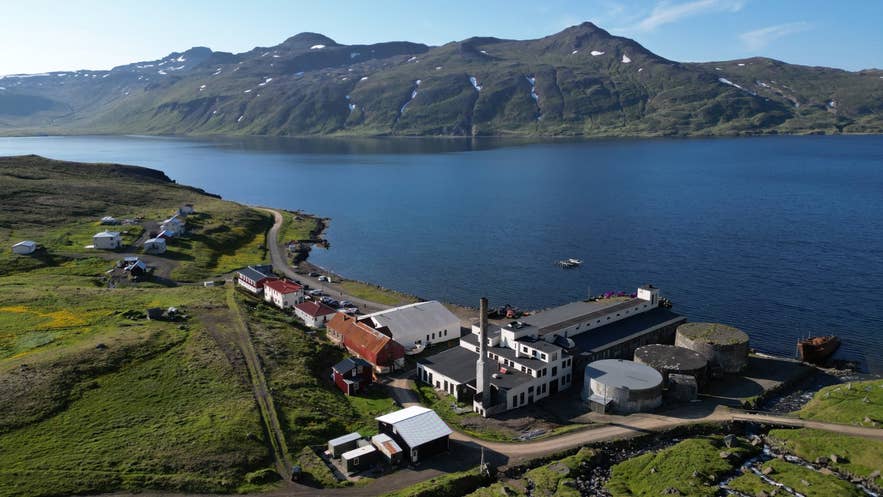
Djúpavík and the old herring factory. Photo: Johnnyxmas, CC BY-SA 4.0
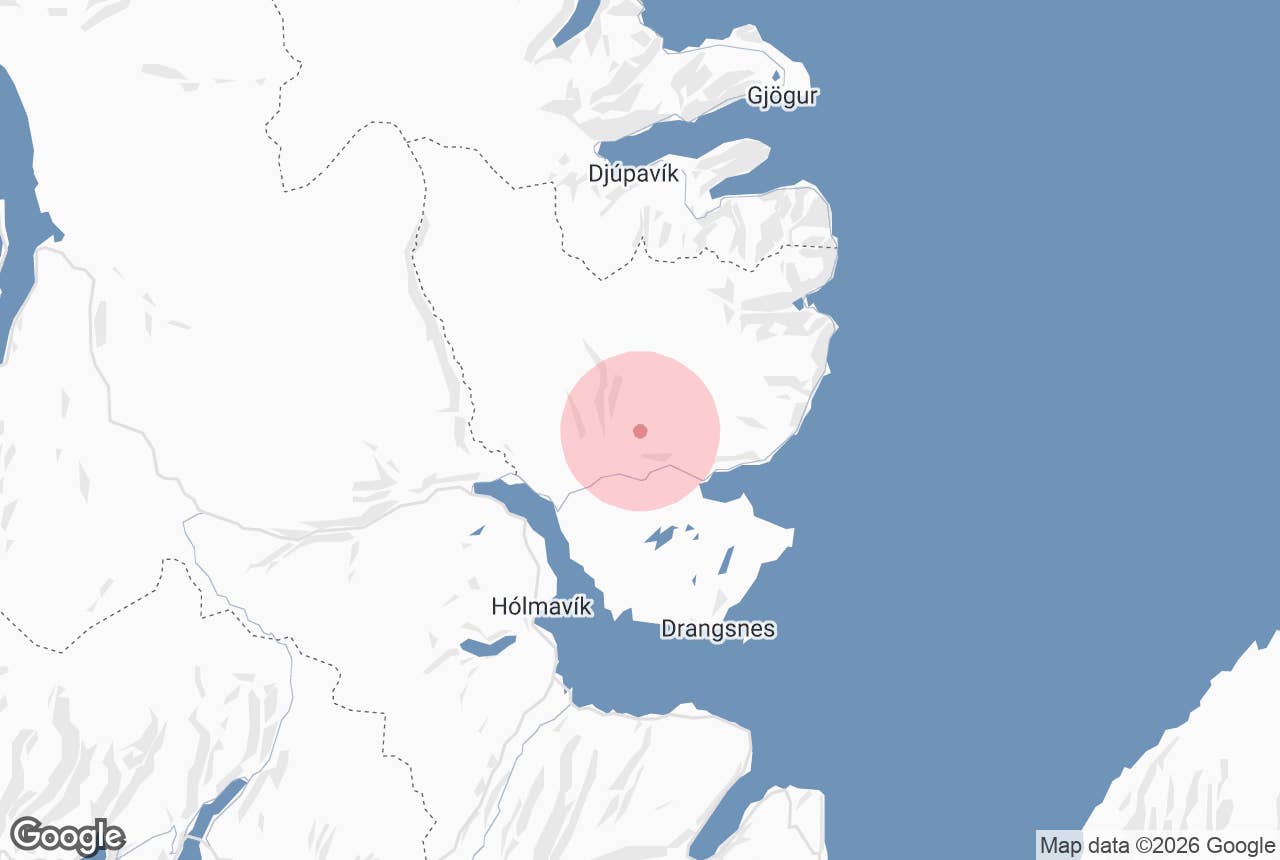
Strandir (Strandir, "the shores") is the long, thinly settled eastern coast of Iceland's Westfjords, facing the bay of Húnaflói. It runs roughly from Steingrímsfjörður, where the fishing village of Hólmavík sits on the north shore, north through Drangsnes, Bjarnarfjörður and Djúpavík to Norðurfjörður and the farms of Árneshreppur, Iceland's least populated municipality.
It is not a single sight but a region of about 3,000 square kilometres across three municipalities, with roughly 600 residents (2026), a coastline of driftwood beaches, geothermal pools by the sea, and a history of herring, sheep farming and seventeenth-century sorcery trials.
Key Takeaways About Strandir
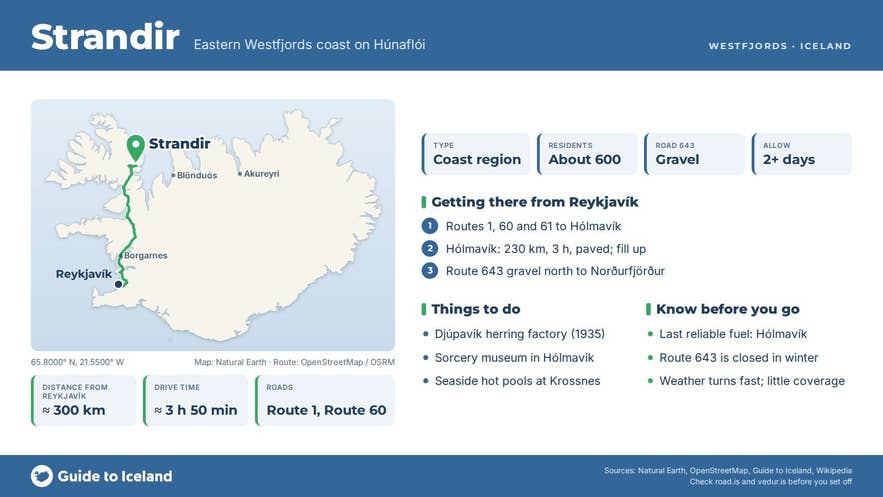
- Strandir is the eastern Westfjords coast facing Húnaflói, from Hólmavík north to Norðurfjörður, with roughly 600 residents.
- Hólmavík is 230 km (about 3 hours) from Reykjavík on paved roads; Route 643 north of it is gravel and closed in winter.
- Highlights: the Djúpavík herring factory (1935), the Museum of Icelandic Sorcery and Witchcraft, and seaside hot pools at Drangsnes and Krossnes.
- No F-roads, but allow two days or more and fill up with fuel in Hólmavík.
- The full coast is only practical from June to early September.
Why visit Strandir
Strandir is the part of the Westfjords most travellers skip. The villages are small: Drangsnes has about 70 residents, Djúpavík only a handful of year-round residents, and the whole of Árneshreppur about 60 (2026).
Driftwood from Siberia piles up on the beaches, carried across the Arctic Ocean by sea ice and currents, and farmers here have used it for fence posts and timber for centuries.
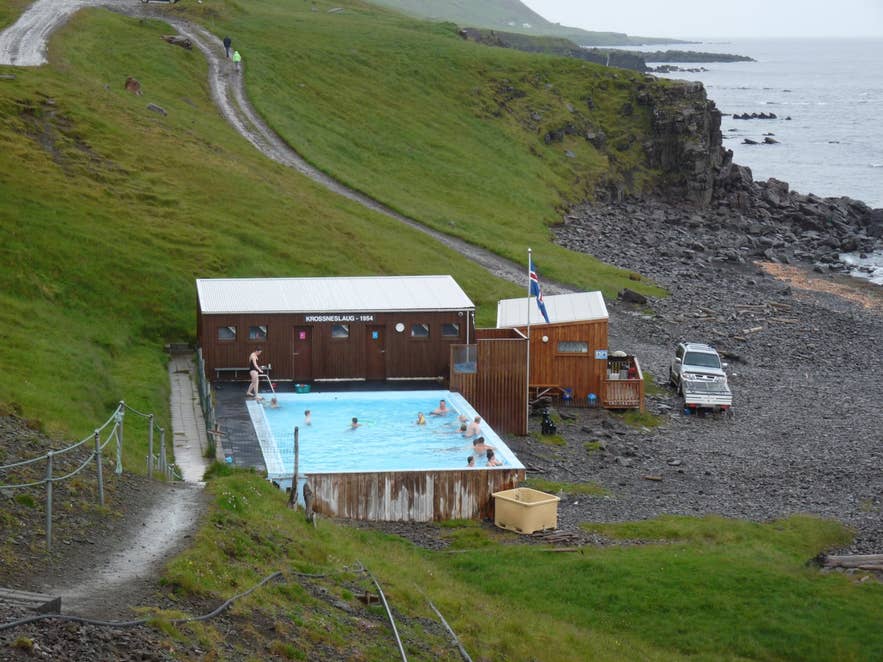
Krossneslaug pool on the Strandir shore. Photo: Smiley.toerist, CC BY-SA 4.0
The region has a distinct cultural story. The Museum of Icelandic Sorcery and Witchcraft in Hólmavík, opened in June 2000, documents the Icelandic witch hunts of the 1600s, when most of those burned were men, and displays magical staves, grimoires and the notorious necropants. Trékyllisvík, in the far north, was a centre of those trials.
Djúpavík, at the head of Reykjarfjörður, holds the ruins and surviving halls of a herring factory built in 1935. At 90 metres long it was the largest concrete building in Iceland and the first fully automated fish factory in Europe; the herring left and the plant closed in 1954.
The factory was bought in 1984 and since 1985 the old women's dormitory has been Hótel Djúpavík, and the factory halls host exhibitions and concerts, including a 2006 Sigur Rós performance during their Heima tour.
Geothermal water surfaces along the shore. Drangsnes has free hot tubs set into the sea wall across the road from the village, with views over to the island of Grímsey (the Strandir one, not the Arctic Circle island).
Bjarnarfjörður has Gvendarlaug, a warm pool blessed, according to tradition, by Bishop Guðmundur the Good. At the end of the road, Krossneslaug is a geothermally heated outdoor pool on the beach near the farm Krossnes by Norðurfjörður, with the open sea of Húnaflói as its view.
Wildlife is a draw too. Grímsey off Drangsnes hosts large seabird colonies including puffins, and Strandir is the gateway to the Hornstrandir Nature Reserve, with its Arctic foxes and the 534-metre Hornbjarg cliffs, reached by boat from Norðurfjörður in summer.
How to get to Strandir
From Reykjavík, the shortest way is Route 1 north past Borgarnes, then Route 60 (Vestfjarðavegur) through Búðardalur to Gilsfjörður, and Route 61 (Djúpvegur) over the Þröskuldar pass to Hólmavík: about 235 km and around 3 hours, all paved.
The alternative is Route 1 to Brú in Hrútafjörður, then Road 68 (Innstrandavegur) along Hrútafjörður, Bitrufjörður and Kollafjörður to join Route 61 south of Hólmavík; this is about 275 km. Hólmavík is the regional centre with a fuel station, shop, swimming pool and bus connection (Strætó).
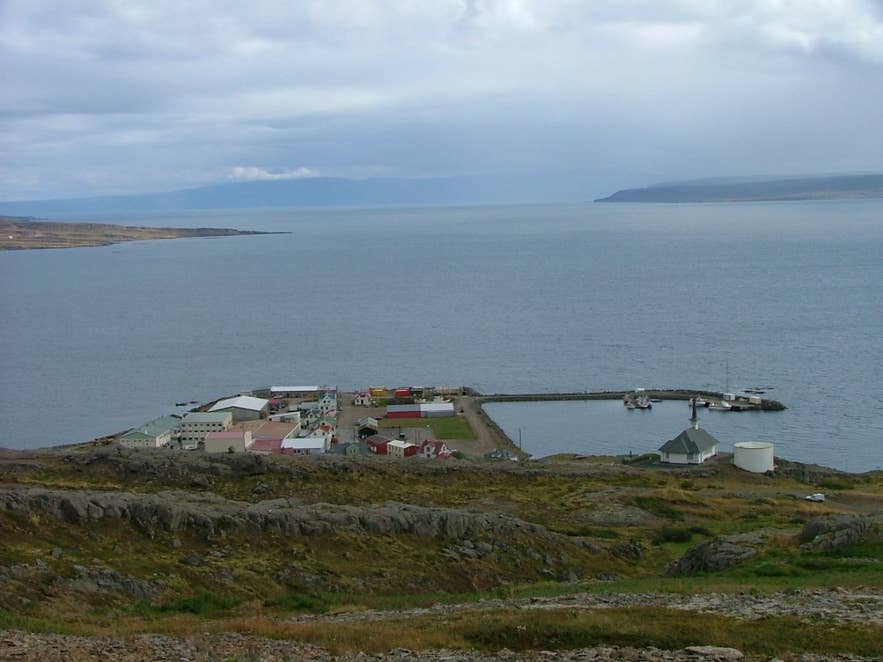
Steingrímsfjörður and Hólmavík. Photo: Sigurður Atlason, CC BY 2.5
North of Hólmavík the character changes. Route 643 (Strandavegur) follows the coast past Bjarnarfjörður, Kaldbaksvík, Djúpavík, Gjögur and Trékyllisvík to Norðurfjörður. It is gravel, narrow and slow, and it deteriorates north of Djúpavík. Reykjavík to Djúpavík is roughly 300 km and 4.5 to 5 hours in total.
Route 645 is the side loop to Drangsnes, rejoining 643 further north. Fuel is available in Hólmavík; there is a small pump at Norðurfjörður, but do not count on it, so fill up before leaving Hólmavík.
A normal car can manage 643 in dry summer conditions, driven carefully, but a vehicle with higher clearance is more comfortable and there are no F-roads. Allow at least half a day each way from Hólmavík to reach Krossneslaug, and treat the trip as two days or more.
In winter Route 643 north of Bjarnarfjörður has no regular snow clearing and is usually closed for months; it typically reopens in spring once the snow is cleared. Check road.is before setting out at any time of year.
Best time to visit
June to early September is the only practical window for the full coast to Norðurfjörður. Midsummer gives near-constant daylight and the seabird colonies on Grímsey are active until August.
Hólmavík, Drangsnes and the museum are reachable year round on Route 61, and winter can be beautiful on a calm day, but the northern road is closed and services beyond Hólmavík are minimal.
Safety and practical tips
- Weather turns fast on this coast and the wind off Húnaflói is cold even in July. Bring layers and a windproof shell.
- Drive slowly on gravel, keep right on blind rises and expect sheep on the road.
- There is little mobile coverage in places north of Djúpavík. Tell someone your plan.
- Shops, cafés and accommodation are few; Hótel Djúpavík, Kaffi Norðurfjörður and the guesthouses in Drangsnes and Hólmavík are the main options. Book ahead in summer.
- The Drangsnes hot tubs are free; the Sorcery museum and Krossneslaug charge admission. Shower before entering any pool.
- Driftwood beaches are private farmland. Walk, photograph, but do not take wood.
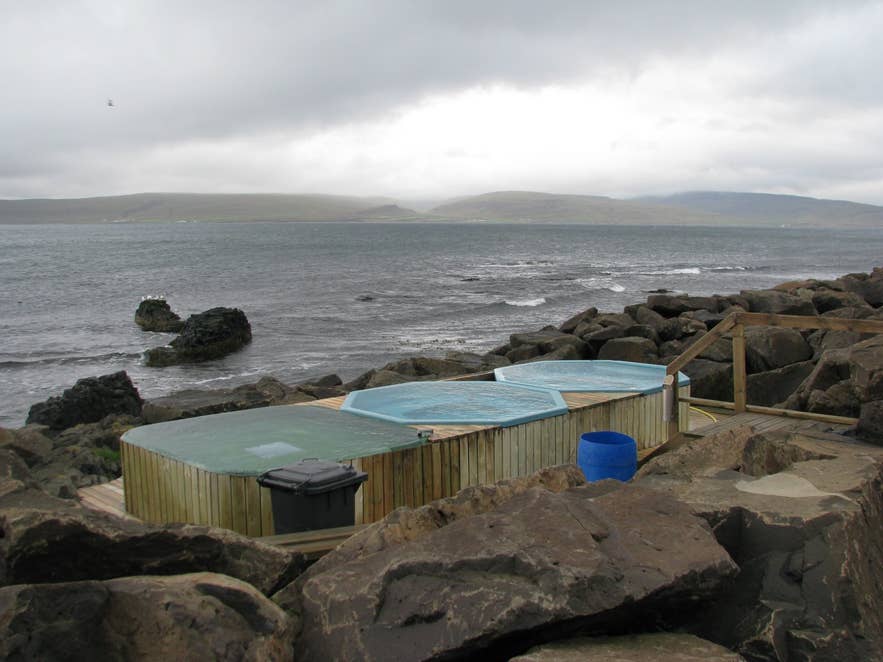
Shore hot tubs at Drangsnes. Photo: Bromr, CC BY-SA 3.0
Is Strandir part of the Westfjords?
Do I need a 4x4 to drive Strandir?
How far is Hólmavík from Reykjavík?
Can I swim in natural hot pools in Strandir?
Is Strandir open in winter?
Nearby attractions
- Hólmavík, the regional centre on Steingrímsfjörður.
- The Museum of Icelandic Sorcery and Witchcraft, in Hólmavík.
- Drangsnes Hot Tubs, 11 km from Hólmavík across the fjord.
- Gvendarlaug in Bjarnarfjörður, about 12 km from Hólmavík as the crow flies.
- Djúpavík, the herring-factory village 28 km north of Hólmavík in a straight line (much further by road).
- Krossneslaug, the seaside pool near Norðurfjörður, 13 km north of Djúpavík as the crow flies.
Tours that visit Strandir
- Private Day Tour to Strandir in Iceland's Westfjords from Reykjavik is a long private day trip from Reykjavík dedicated to the Strandir coast.
- Thrilling 7 Day Iceland Motorcycle Adventure Tour in the Westfjords with Waterfalls & Glaciers is a multi-day package whose Westfjords route rides the remote Strandir coastline.