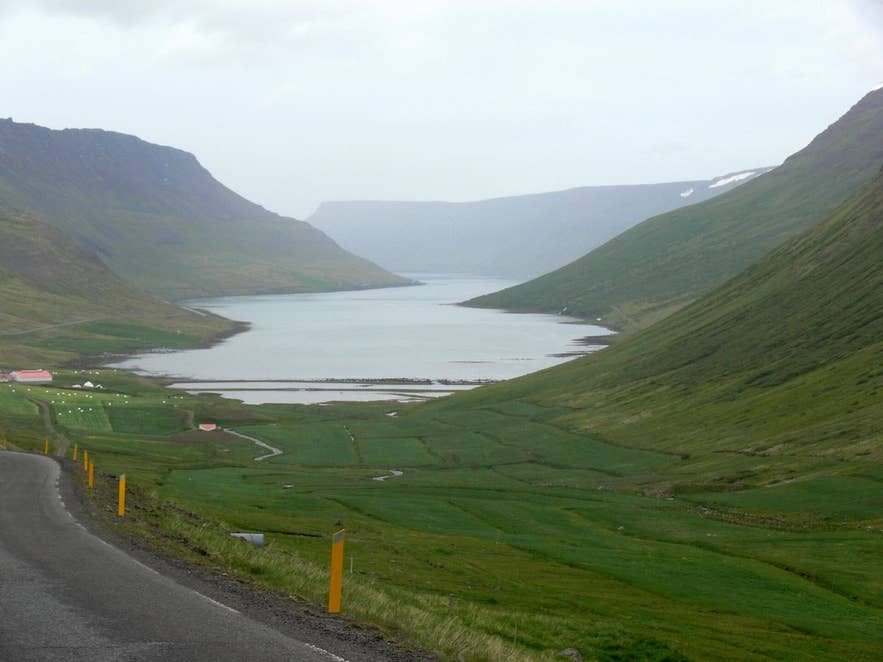
Súgandafjörður from Botnsdalur. Photo: Christian Bickel, CC BY-SA 2.0 DE
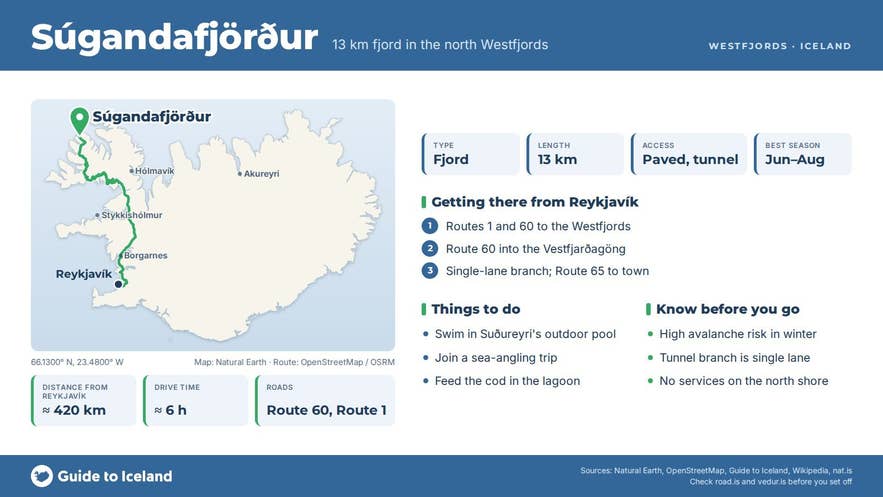
Súgandafjörður is a 13 km long fjord on the north coast of the Westfjords, the northernmost of the fjords that open off the old Vestur-Ísafjarðarsýsla district.
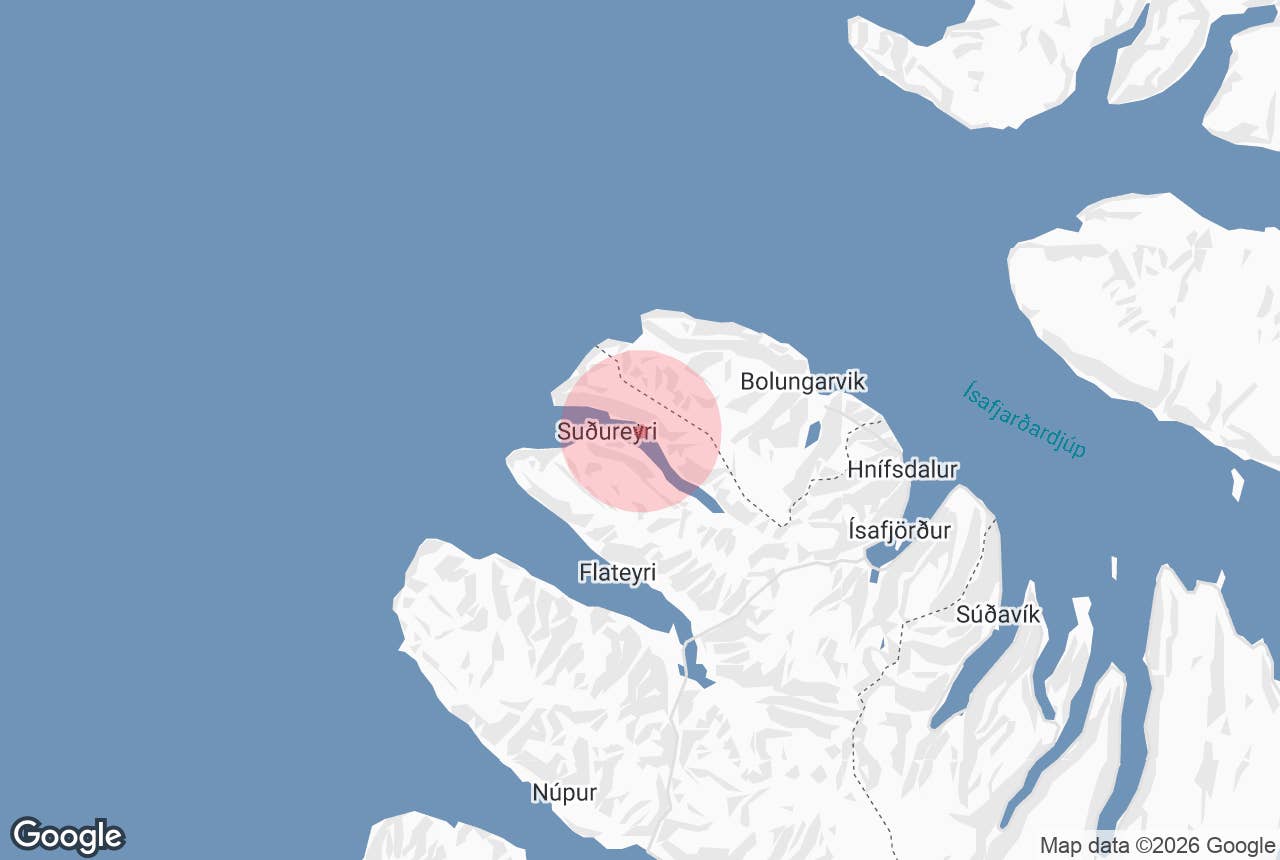
It runs in between the headland of Sauðanes to the south and the mountain Göltur to the north, and the fishing village of Suðureyri sits on a sand spit on its southern shore.
The name comes from its first settler, Hallvarður súgandi; "súgandi" is a form of the verb súga, to suck or draw, and in the Book of Settlements it is his nickname.
Key Takeaways About Súgandafjörður
- Súgandafjörður is a 13 km fjord on the north coast of the Westfjords; Suðureyri (about 300 people) is its only village.
- Reach it from Ísafjörður (23 km) through the single-lane Súgandafjörður branch of the Vestfjarðagöng tunnel, then paved Route 65.
- Reykjavík to Suðureyri is roughly 420 km via Route 60, about 6 hours; flights to Ísafjörður take about 40 minutes.
- Suðureyri has the only outdoor swimming pool in the Ísafjarðarbær municipality, plus sea angling, a cod-feeding lagoon and the Fisherman guesthouse and restaurant.
- Winter brings high avalanche risk and road closures; the north shore has only a rough summer track.
Why visit Súgandafjörður
Súgandafjörður is a textbook Westfjords fjord: narrow, with steep, high mountains dropping almost straight to the water and very little flat land. Where the fjord reaches the mountain Spillir, which stands over Suðureyri, it bends to the south-east, narrows and becomes shallower.
The slopes are fairly well vegetated for the Westfjords, and Selárskógur on the north shore is one of the largest continuous areas of birch and willow scrub in the region. Most of the shoreline is grey basalt shingle, but the two small spits on the north side, around Norðureyri, have black sand beaches.
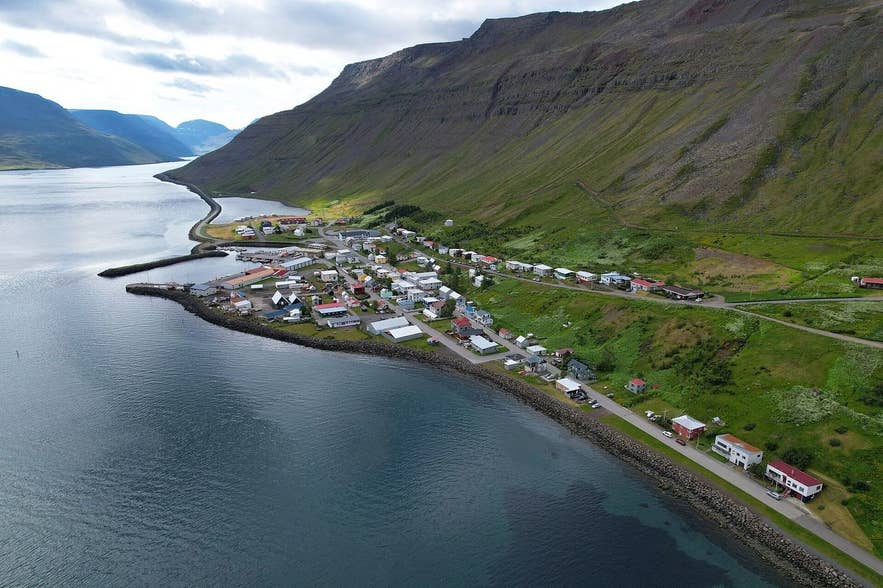
Suðureyri in Súgandafjörður. Photo: Steinninn, CC BY-SA 4.0
The village of Suðureyri (about 300 people) only grew up in the early 20th century with the mechanisation of fishing, and fishing is still its main business.
It has turned that into a visitor attraction: sea-angling trips, a lagoon just outside the village where you can feed cod, and a seafood trail around the village run by the local Fisherman company.
Suðureyri's houses are heated with geothermal water from the fjord, and its pool is the only outdoor swimming pool in the Ísafjarðarbær municipality, with a 17 m pool, two hot tubs and a paddling pool. The church dates from 1937.
The fjord has an industrial footnote: seams of lignite (surtarbrandur) are found in several places, and coal was dug from them in Botnsdalur, the valley at the head of the fjord, as late as 1940 to 1942.
At the mouth of the fjord, in the cove of Keflavík between Súgandafjörður and Skálavík, stands the remote Galtarviti lighthouse. In Staðardalur, a side valley above Suðureyri, is Staður, an old farm and church site.
According to the Book of Settlements, Hallvarður súgandi fought against King Harald Fairhair at the Battle of Hafrsfjörður in Norway, then sailed to Iceland and claimed Súgandafjörður and Skálavík as far as Stigi.
How to get to Súgandafjörður
Suðureyri is about 23 km from Ísafjörður and 29 km from Flateyri. From Ísafjörður, take Route 60 into the Vestfjarðagöng tunnel system, which opened in 1996.
Inside the tunnel, a signed branch leads to Súgandafjörður; this 3 km branch has a single lane, and vehicles pass each other in the signed passing bays, so follow the give-way signs. You come out in Botnsdalur at the head of the fjord, and Route 65 (Súgandafjarðarvegur), paved, runs along the south shore to Suðureyri.
Before the tunnel, the only road was over the Botnsheiði heath, which was usually impassable in winter.
From Reykjavík the drive to Suðureyri is roughly 420 km (about 6 hours) via Routes 1 and 60 through the southern Westfjords, entering the Vestfjarðagöng tunnel from Önundarfjörður; the longer way round Ísafjarðardjúp on Route 61 is about 470 km.
Or you can fly to Ísafjörður (about 40 minutes) and rent a car there. Across the fjord from Suðureyri, an unpaved summer road follows the north shore as far as the river Selá; there is no longer any permanent settlement on that side, only summer houses.
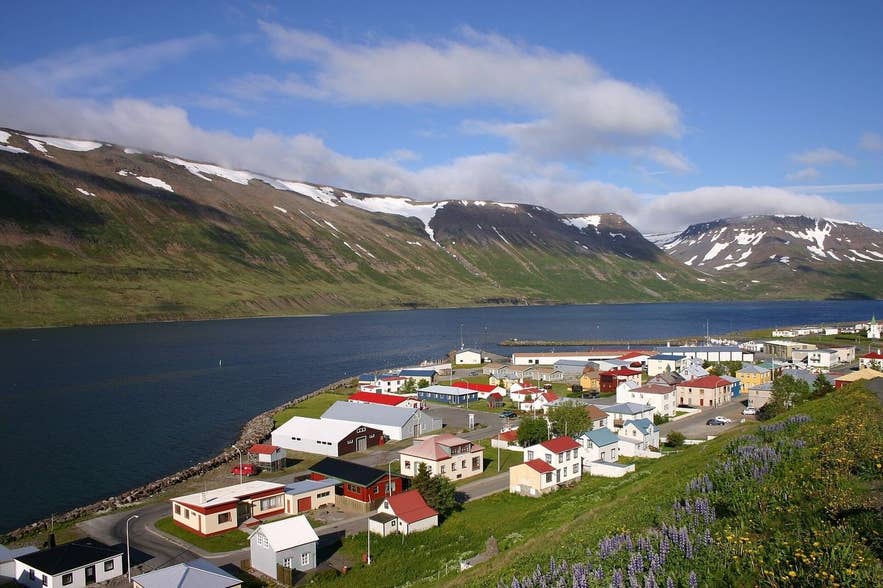
Suðureyri on Súgandafjörður. Photo: Brad Weber, CC BY-SA 3.0
Best time to visit
June to August is the season for sea angling, the lagoon, the cafe and the pool, and the north-shore track is only open in summer. Early September is quiet and the scrub on the slopes turns colour.
The fjord is accessible all year through the tunnel, but the whole area has a high avalanche risk and winter storms can close the roads, so check road.is in winter.
Safety and practical tips
- Avalanche risk is significant in many parts of the fjord in winter; obey road closures and do not park below steep slopes in snow.
- The tunnel branch to Suðureyri is single-lane: pull into the signed passing bays when oncoming traffic has right of way, and keep your headlights on.
- Services in Suðureyri: basic services including a shop and fuel, the Fisherman guesthouse and restaurant, a campsite and the outdoor pool. There are no services on the north shore.
- Sea-angling trips and seafood walks should be booked ahead in summer.
- Expect patchy phone coverage once you leave the village.
How do you pronounce Súgandafjörður?
Can I drive around the fjord?
Is the tunnel to Suðureyri safe to drive?
What is there to do in Suðureyri?
Where does the name come from?
Nearby attractions
- Sudureyri Village, the fjord's only settlement (2.1 km)
- Súgandafjarðarvegur, the shore road from the tunnel (5.6 km)
- Galtarviti Lighthouse at the mouth of the fjord (5.5 km)
- Önundarfjörður, the next fjord south (8.3 km)
- Flateyri (9.0 km)
- Bolafjall, the viewing platform above Bolungarvík (8.5 km)
- Ósvör Museum, a reconstructed fishing station (10.5 km)
- Isafjordur (15.8 km)
Tours that visit Súgandafjörður
- Customizable 8-Day Summer Self-Drive Tour of Iceland's Westfjords & Snaefellsnes Peninsula: the itinerary recommends Suðureyri, on its spit in Súgandafjörður, as a stop from Ísafjörður on day four, reached through the tunnel.