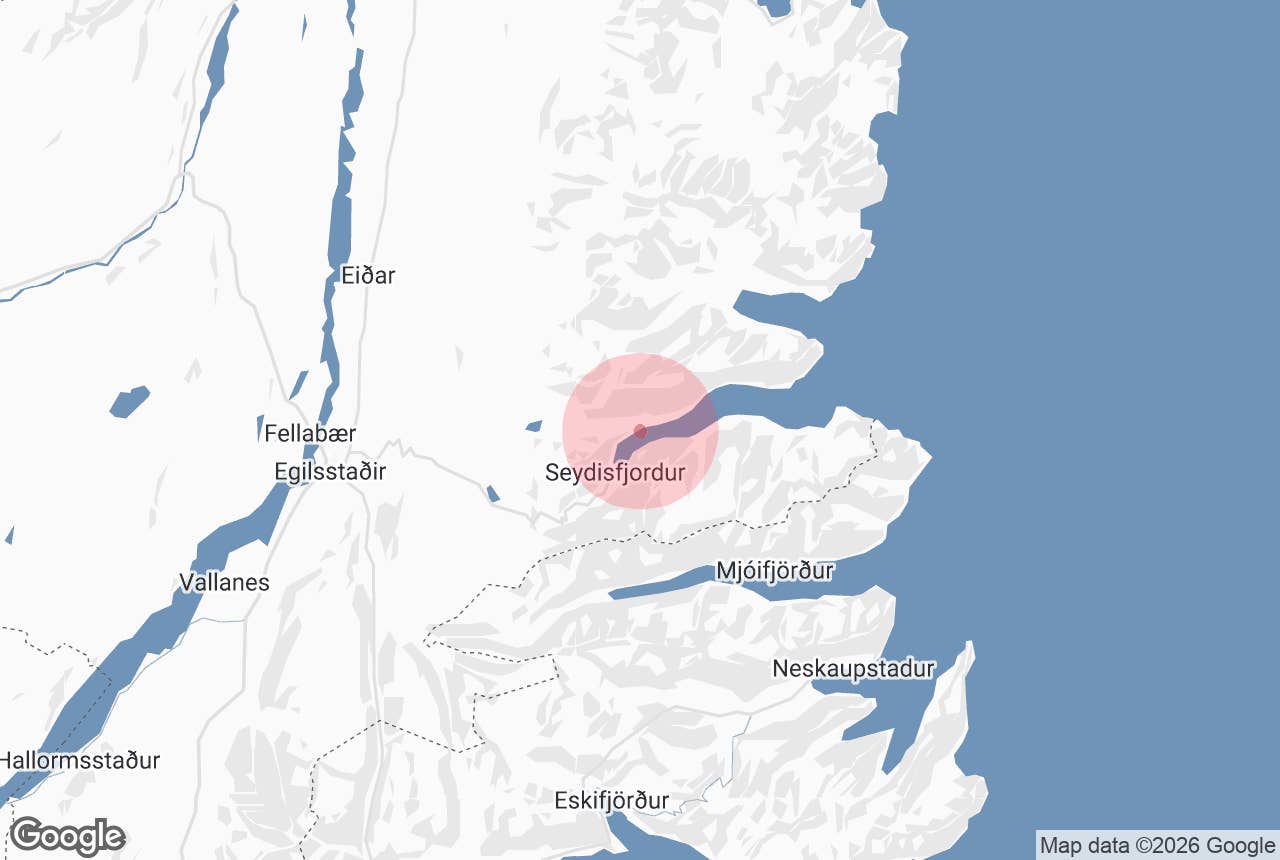
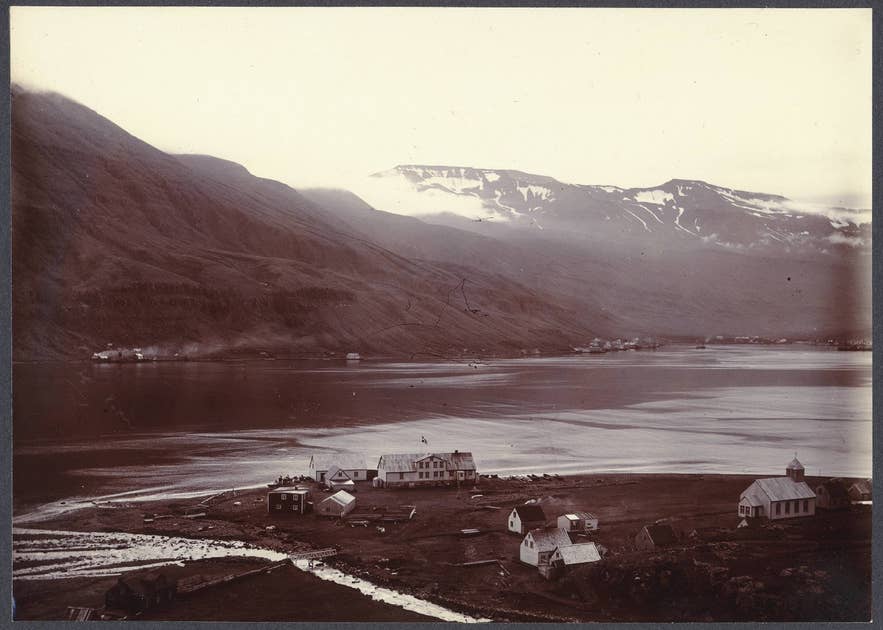
Vestdalseyri village around 1900. Photo: Frederick W.W. Howell, public domain
Vestdalseyri is an abandoned village site on the north shore of Seyðisfjörður in East Iceland, on the gravel spit (Icelandic eyri) where the Vestdalsá river reaches the fjord. The name simply means "the spit of Vestdalur", the valley behind it.
For just over a century, from 1851 to 1963, this was a small trading and fishing settlement with its own church, pier and warehouses. Today only foundations, stone walls and grassy mounds remain, about 3 km from Seyðisfjörður town, at the start of the Vestdalsfossar waterfall trail.
Key Takeaways About Vestdalseyri
- Trading and fishing village from 1851 to 1963 on the gravel spit at the mouth of the Vestdalsá, 3 km from Seyðisfjörður
- Seyðisfjörður's parish church stood here from 1882 until it was moved into town in the early 1920s (sources give 1920-22)
- Around 180 people lived here c. 1900; Gránufélagið ran its East Iceland trade from Vestdalseyri
- Free, open all year; ruins are protected, so walk lightly and move nothing
- Same lay-by as the Vestdalsfossar waterfall trail; the Seyðisfjörður e-bike tour stops here
Why visit Vestdalseyri
Vestdalseyri is older than the town across the fjord, which only gained its trading-town charter in 1895. Trading started here in 1851, and the site served as both a trading post and a whaling station in its early years.
Gránufélagið, the Icelandic trading company founded in 1869 to compete with the Danish merchants, built a large trading house and a pier at Vestdalseyri and ran its East Iceland headquarters from here.
One timber building was dismantled and shipped from Vestdalseyri to the Oddeyri spit in Akureyri in 1873, where it still stands as part of the old Gránufélag houses.
The parish church of Seyðisfjörður stood at Vestdalseyri from 1882, when it was moved here from the farm Dvergasteinn further out the fjord.
It first stood on the ledge above the spit, was blown over in a storm in 1894 and rebuilt down on the spit itself, and in the early 1920s it was moved into the growing town on the Fjarðaralda spit.
Its timber went into the pale blue Seyðisfjarðarkirkja that now closes the view down the Rainbow Street.
Around 1900 roughly 180 people lived at Vestdalseyri. Among those born or raised here were Vilmundur Jónsson, later Iceland's Director of Health, the poet Vilborg Dagbjartsdóttir, and the eccentric self-styled "Duke of St Kilda", Karl Dunganon.
During the Second World War the occupying forces set up camp on the spit, but by then the settlement was already losing out to the town across the fjord, and the last residents left in 1963.
Considerable ruins are still visible, and Vestdalur and Vestdalseyri are listed on Iceland's natural heritage register (náttúruminjaskrá) for their vegetation and cultural remains.
Behind the ruins, the Vestdalsá river drops down a staircase of waterfalls, the Vestdalsfossar, and the old route up Vestdalur was one of the busiest post and trade roads in East Iceland between about 1880 and 1910.
Built-up road sections, stone walls and cairns survive along it. In 2004 workers found human bones in a small cave near Vestdalsvatn, the lake at the top of the valley, together with more than 400 beads and some pins from the Settlement Age.
The remains were of a woman of about thirty who died around 940, one of the more significant archaeological finds in Iceland in recent decades; the finds are kept at the National Museum.
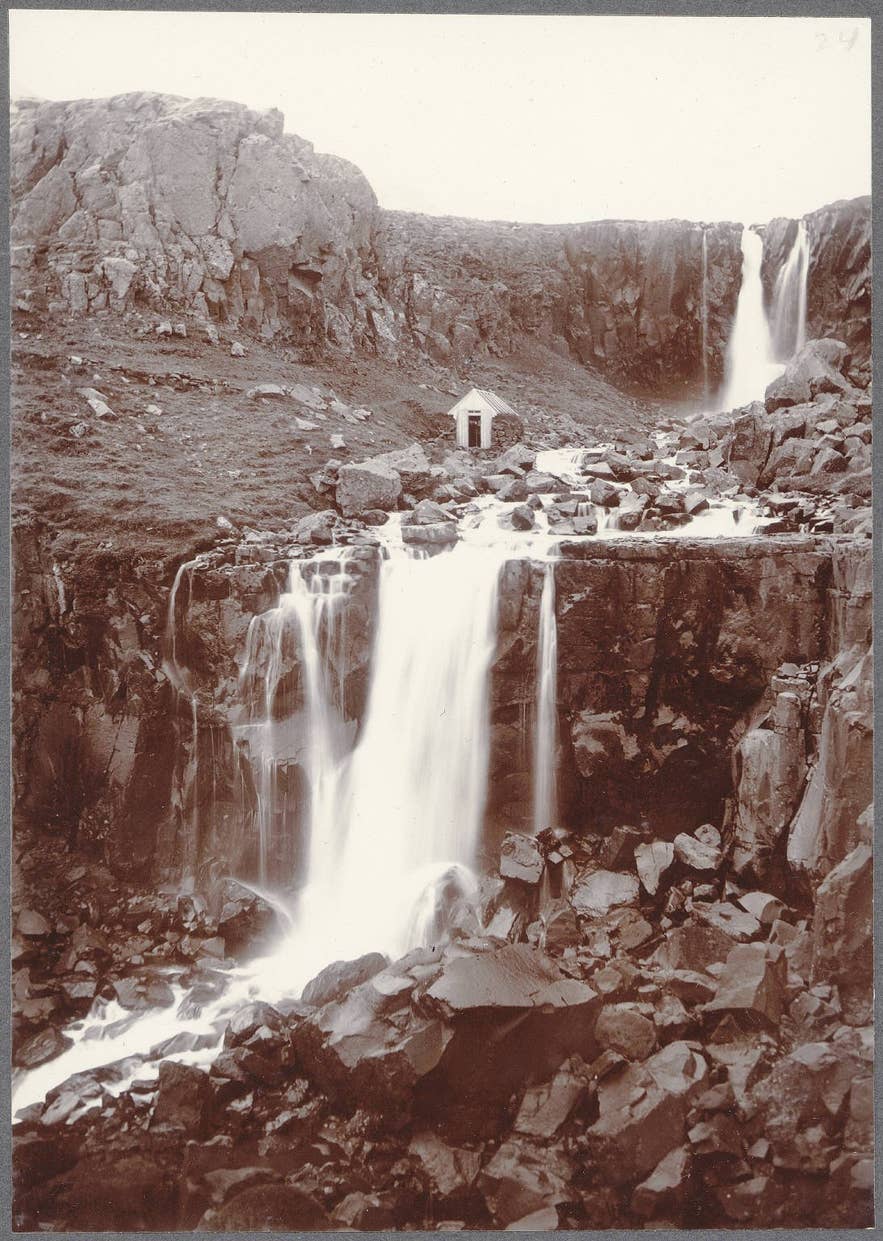
Vestdalsfoss above Vestdalseyri, c. 1900. Photo: Frederick W.W. Howell, public domain
How to get to Vestdalseyri
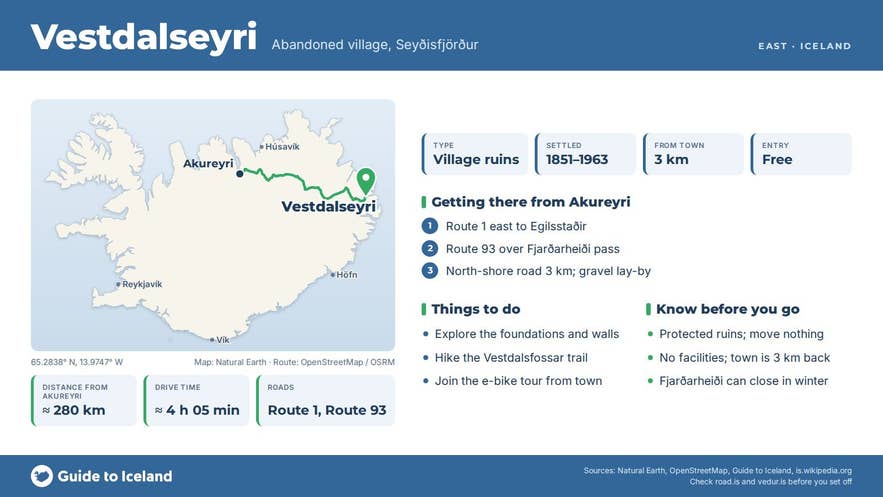
Seyðisfjörður is reached from Egilsstaðir on Route 93 over the Fjarðarheiði pass, about 27 km (roughly 30 minutes in summer; the pass is high and can close in winter storms).
Egilsstaðir is on the Ring Road in the east, about 630 km and roughly 8.5 to 9 hours from Reykjavík by either the south or the north coast, and has a domestic airport with flights from Reykjavík.
From Seyðisfjörður town, follow the road along the north shore of the fjord toward the farm Brimnes for about 3 km (around 6 minutes). A small unmarked gravel lay-by on the right, at approximately 65°17'02"N 13°58'30"W, serves as the trailhead; a "Vestdalsfossar" sign stands across the road.
The ruins of Vestdalseyri lie on the flat spit between the road and the sea, a few minutes' walk from the parking area, and the waterfall path starts on the same side of the river. No 4x4 is needed and there is no F-road. The Guide to Iceland e-bike tour below rides out here from town along the shore.
Best time to visit
June to September is the season.
The Vestdalsfossar loop (about 5 km, 2.5 to 3.5 hours with stops) and the longer Fjallkonustígur route up to Vestdalsvatn and the cave (about 6 km, 3.5 hours) are marked as June to September trails, and the upper valley holds snow well into early summer. The ruins can be visited whenever the shore road is open.
Safety and practical tips
- There are no facilities at Vestdalseyri: no toilets, shop or shelter. Everything you need is in Seyðisfjörður, 3 km back.
- The waterfall path is hilly and often wet, with mud, bog, wood-chip sections, rocks and plank bridges. Waterproof boots are advisable, and the upper sections become slippery in rain.
- The ruins are protected heritage. Walk on them lightly, do not move stones, and leave the stone walls and cairns along the old route as they are.
- Vestdalsvatn and the cave are a serious hike above the valley. Check conditions at the Seyðisfjörður information centre, and do not go up alone in poor visibility.
- Free to visit; no opening hours.
Is there anything left to see at Vestdalseyri?
How far is Vestdalseyri from Seyðisfjörður?
Can I combine it with the Vestdalsfossar hike?
When was Vestdalseyri abandoned?
Nearby attractions
- Vestdalsfossar Waterfall Trail, 0.3 km, starts at the same lay-by.
- Tvísöngur sound sculpture, 1.7 km, on the slope above town.
- Vestdalur, 1.8 km, the valley behind the spit, on the natural heritage register.
- Seyðisfjarðarkirkja, 2.9 km, the church that once stood at Vestdalseyri.
- The Technical Museum of East Iceland, 2.3 km.
- Gufufoss Waterfall, 6.2 km, on Route 93 above town.
Tours that visit Vestdalseyri
- Scenic 3-Hour e-Bike Hidden Waterfalls Tour from Seydisfjordur rides out from town to the abandoned farms at Vestdalseyri, where the guide tells the story of the 19th-century community, then continues to the Vestdalsfossar waterfalls, including the Arnarfossar cascade and a rock lookout at the last fall. Easy, June to August, minimum age 10.