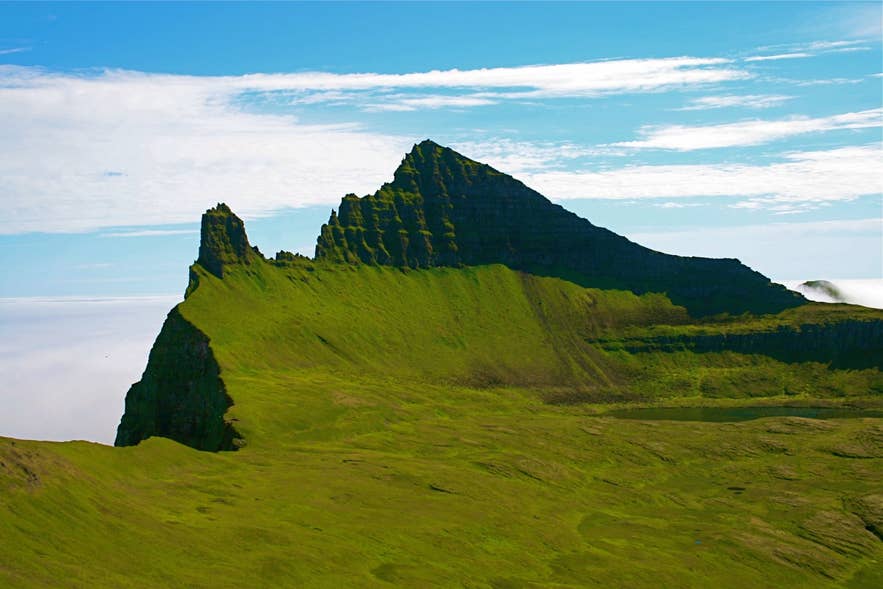
Hornbjarg cliff and Miðfell. Photo: Mickaël Delcey, CC BY-SA 3.0
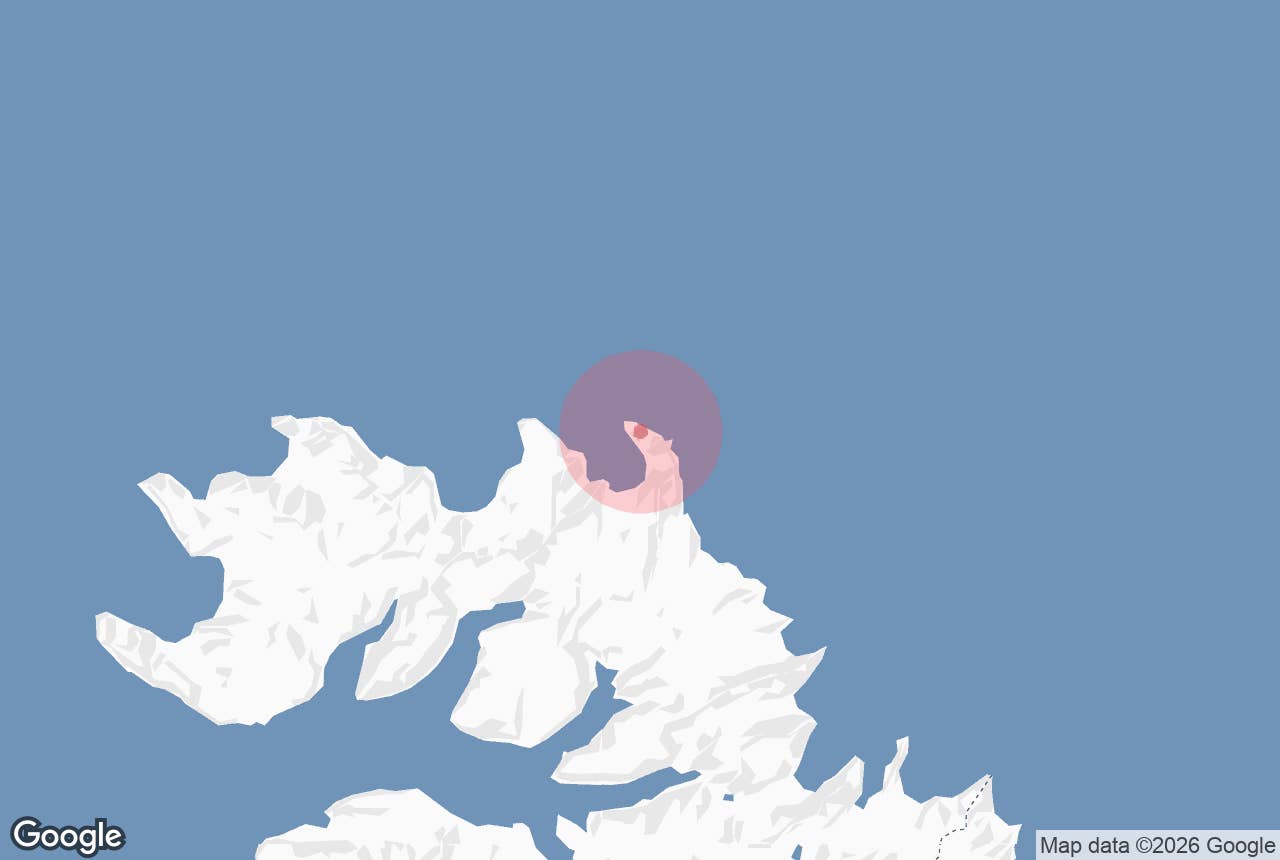
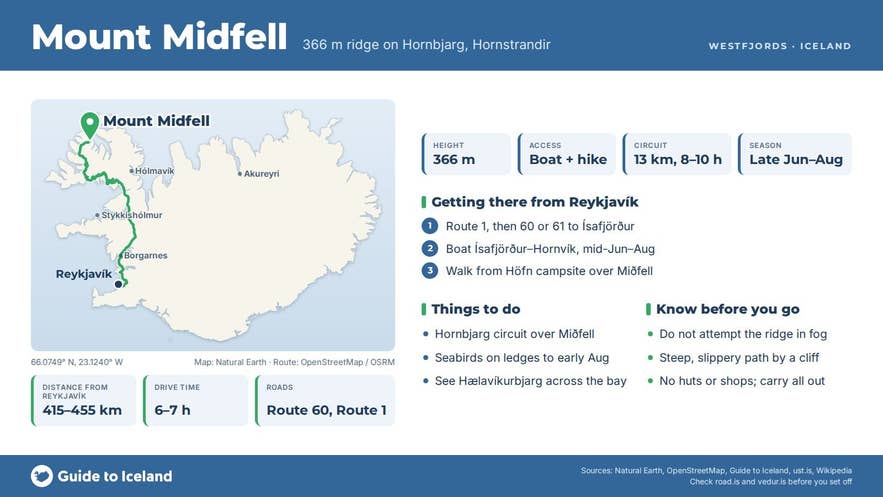
Mount Midfell (Icelandic: Miðfell, "middle mountain") is a 366-meter grassy ridge on the western side of Hornbjarg, the great bird cliff at the northern tip of the Hornstrandir Nature Reserve in Iceland's Westfjords.
It sits above the abandoned farm of Horn, between two green valleys, Ystidalur to the west and Miðdalur to the east, and it is the high point of the classic walk from the Hornvík campsite out around the cliff.
There are no roads here: every visitor arrives by boat and continues on foot.
Key Takeaways About Miðfell
- Miðfell is a 366 m grassy ridge on the western side of Hornbjarg, between the valleys Ystidalur and Miðdalur, above the abandoned farm Horn.
- No roads: boat from Ísafjörður to Hornvík (roughly mid-June to late August), then the 13 km, 8 to 10 hour Höfn–Hornbjarg circuit on foot.
- Hornbjarg is one of Iceland's largest seabird cliffs; birds are on the ledges from late May to early August.
- The path runs beside a very high cliff and is steep and slippery when wet; do not attempt it in fog.
- No shops, huts or fees; camp only at designated sites and carry everything out.
Why visit Mount Midfell
Hornbjarg is one of the largest seabird cliffs in Iceland. Its highest peaks are Kálfatindur (534 m) and Jörundur (429 m), together called Kálfatindar, and the cliff is home to millions of birds in summer, chiefly common guillemot, Brünnich's guillemot, kittiwake and gulls, with fulmar, razorbill, puffin and black guillemot also nesting here.
Miðfell is the shoulder of the cliff that a walker climbs first. From its grassy top you look straight across Hornvík bay to Hælavíkurbjarg, the twin cliff on the far side, and back toward Kálfatindar rising above you.
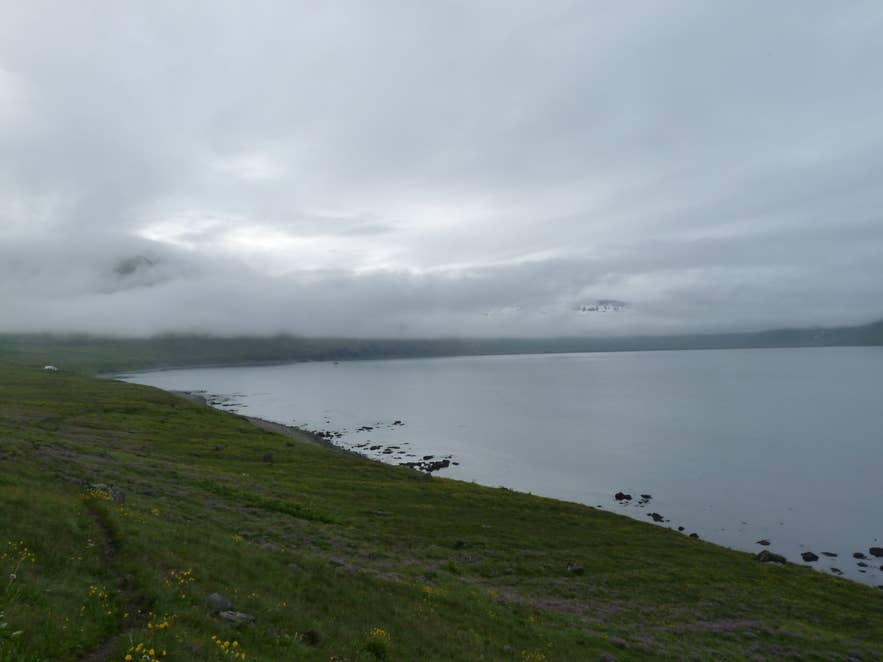
Hornvík bay from Hornbjarg. Photo: Smiley.toerist, CC BY-SA 4.0
What makes the walk special is the contrast. On one side the ground slopes gently toward the sea in grass, moss and wildflowers; on the other it ends in a vertical drop into the North Atlantic.
The pass of Svaðaskarð lies just beneath Miðfell, and from the ridge the path drops into Miðdalur, a steep green valley that gives some of the best views of the sheer cliff faces.
Horn, the farm at the foot of the mountain, was one of three settlements in Hornvík and was abandoned in 1946, two years after the other two, Höfn and Rekavík bak Höfn (one house at Horn was briefly lived in again in 1951–52).
Eggs have been collected on the cliff for centuries, and the Flateyjarbók saga tells how the sworn brothers Þorgeir and Þormóður climbed Hornbjarg, Þorgeir slipping and saving himself by clinging to an angelica stalk until Þormóður hauled him up. Arctic foxes are protected throughout the reserve and are often seen, and remarkably unafraid, around Hornvík.
How to get to Mount Midfell
Mount Midfell cannot be reached by car. The Hornstrandir reserve has no roads, so the journey is in three stages.
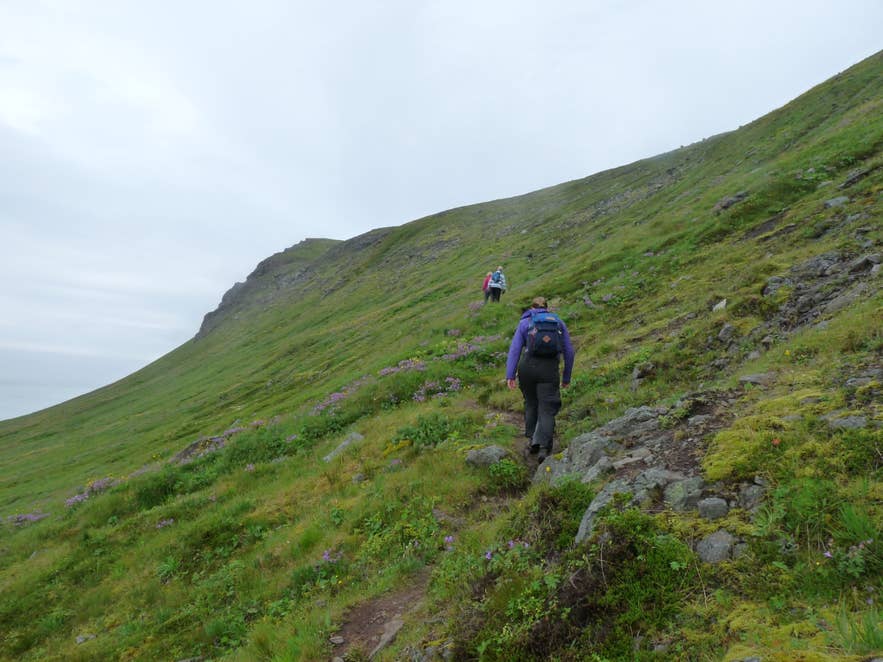
Hornbjarg cliff edge. Photo: Smiley.toerist, CC BY-SA 4.0
- Drive or fly to Ísafjörður, the main town of the Westfjords. By road it is 415 to 455 km from Reykjavík, about six to seven hours via Route 1 and then Route 60 or Route 61. Domestic flights from Reykjavík take about 40 minutes.
- Take a scheduled summer boat from Ísafjörður to Hornvík (bookable here). Boats run roughly from mid-June to late August, weather permitting, and the crossing takes around two to three hours; check the operators' timetables. Book ahead; seats fill in July.
- Walk from the campsite at Höfn in Hornvík. The Environment Agency of Iceland describes the Höfn to Hornbjarg circuit as 13 km and 8 to 10 hours. From the campsite you wade the Hafnarós river opposite the Kýrá, follow the shore east to the old farm at Horn below Ystidalur, then climb over Miðfell (366 m) and return through Miðdalur or the valleys above the farm.
Many visitors instead join a guided trek, which handles the boat transfers and the river crossings for you.
Best time to visit
Late June to mid-August. The boats only run in this window, the seabirds are on the ledges from late May until early August, and the valleys are at their greenest in July.
Snow often lies in the higher passes until late June, and by late August the birds have left and the boat schedule thins out. Between 1 March and 15 June, travellers must register their trip with the Environment Agency before entering the reserve.
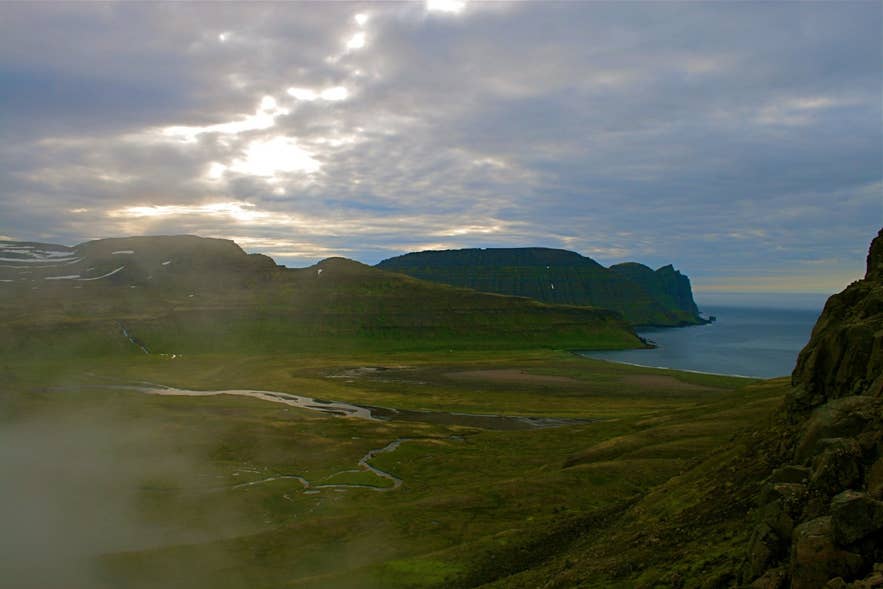
Hornvík bay, Hornstrandir. Photo: Silverkey, CC BY-SA 3.0
Safety and practical tips
- Weather changes fast. Fog is the main hazard on Miðfell, where the path runs close to the cliff edge; if visibility drops, stop and wait rather than guess.
- The path over Miðfell is steep and slippery when wet. Wear boots with good grip and use poles.
- Stay well back from the edge. The cliff is undercut in places and the grass can hide crumbling turf.
- River crossings: the Hafnarós wade is tidal and easier at low water. Carry wading shoes.
- There are no shops, huts, or fees in Hornvík. The campsite at Höfn has a basic toilet and a ranger in high summer. Camping is only allowed at designated sites, and everything you bring in must leave with you.
- Mobile coverage is patchy to non-existent. Carry a map, compass or GPS, and a charged power bank.
- Do not feed the foxes, and keep drones grounded; the reserve rules protect wildlife from disturbance.
How high is Mount Midfell?
Can I drive to Mount Midfell?
How long is the walk?
Is it dangerous?
When can I see the birds?
Nearby attractions
- Hornbjarg, the cliff itself, about 0.5 km away
- Hornvík, the bay below, about 3 km
- Innstidalur, the valley route to Almenningaskarð, about 3 km
- Hornvík campsite, about 4 km
- Hælavíkurbjarg, the cliff across the bay, about 6.5 km
- Hafnarskarð, the 519 m pass to Veiðileysufjörður, about 8.5 km
Tours that visit Mount Midfell
- Once-in-A-Lifetime 3-Day Hiking and Glamping Tour of Hornstrandir Nature Reserve From Isafjordur: on day one the group sails from Ísafjörður to Hornvík, walks the Hornbjarg cliffs, climbs the grassy slope to Mount Midfell and drops into Miðdalur before returning to base camp.