We conducted this study to pin down the best time to visit the Blue Lagoon, using our own booking records rather than guessing. The analysis covers the quietest hours of the day, whether the day of the week makes any difference, the cheapest months of the year, and how far ahead Blue Lagoon tickets are normally booked.
The Blue Lagoon sells timed entry slots, so you choose your hour the moment you buy your Blue Lagoon tickets. The entry time you choose changes both how many people you share the water with and how much you pay. Most advice on when to visit the Blue Lagoon is guesswork, so we checked that advice against real bookings instead.
Why You Can Trust Our Content
Guide to Iceland is the most trusted travel platform in Iceland, helping millions of visitors each year. All our content is written and reviewed by local experts who are deeply familiar with Iceland. You can count on us for accurate, up-to-date, and trustworthy travel advice.
This study analyzes 4,121 Blue Lagoon bookings covering 10,305 travelers, made through Guide to Iceland between August 2025 and August 2026. The findings in this study come from the 9,071 travelers whose bookings were not later canceled.
Key Findings
-
Evening is the best time to visit the Blue Lagoon on both crowds and price. The 8 pm slot is the quietest year-round entry time at 2.7% of all Blue Lagoon arrivals, and the cheapest at an average of 111 USD per adult.
-
Midday is the most crowded time at the Blue Lagoon. Just over half of all arrivals, 51.1%, land between 11 am and 3 pm, and the 1 pm slot alone takes 12.6% of all Blue Lagoon travelers.
-
The entry hour moves the Blue Lagoon price more than any other timing choice. Travelers paid an average of 138 USD per adult for a 5 pm entry against 111 USD per adult for an 8 pm entry, a 20% difference on an identical ticket.
-
Late afternoon is the worst value at the Blue Lagoon. The 4 pm and 5 pm slots are almost as quiet as the evening ones at 4.4% and 3.9% of arrivals, but they are the most expensive of the day at 135 USD and 138 USD per adult.
-
The day of the week changes the Blue Lagoon price more than it changes the crowd. Saturday and Tuesday are only 2.8% apart in the number of arrivals, while a Friday, Saturday, or Sunday visit averages 127 USD per adult against 121 USD from Monday to Thursday.
-
April is the cheapest month to visit the Blue Lagoon. Blue Lagoon admission averages 111 USD per adult in April against 132 USD per adult in July, with November at 117 USD and March at 119 USD as the next-cheapest months.
-
Most travelers book the Blue Lagoon late, but the midday slots still sell out. Half of all Blue Lagoon bookings are made within 25 days of the visit and 26.6% in the final week.
-
A quiet Blue Lagoon slot is not automatically the right slot. Outside the summer months, a 7 pm or 8 pm visit happens partly or entirely after dark, so the surrounding lava landscape is harder to see.
Cite This Article
Please link to this URL when referencing the findings or using the charts.
The Busiest and Quietest Times of Day at the Blue Lagoon
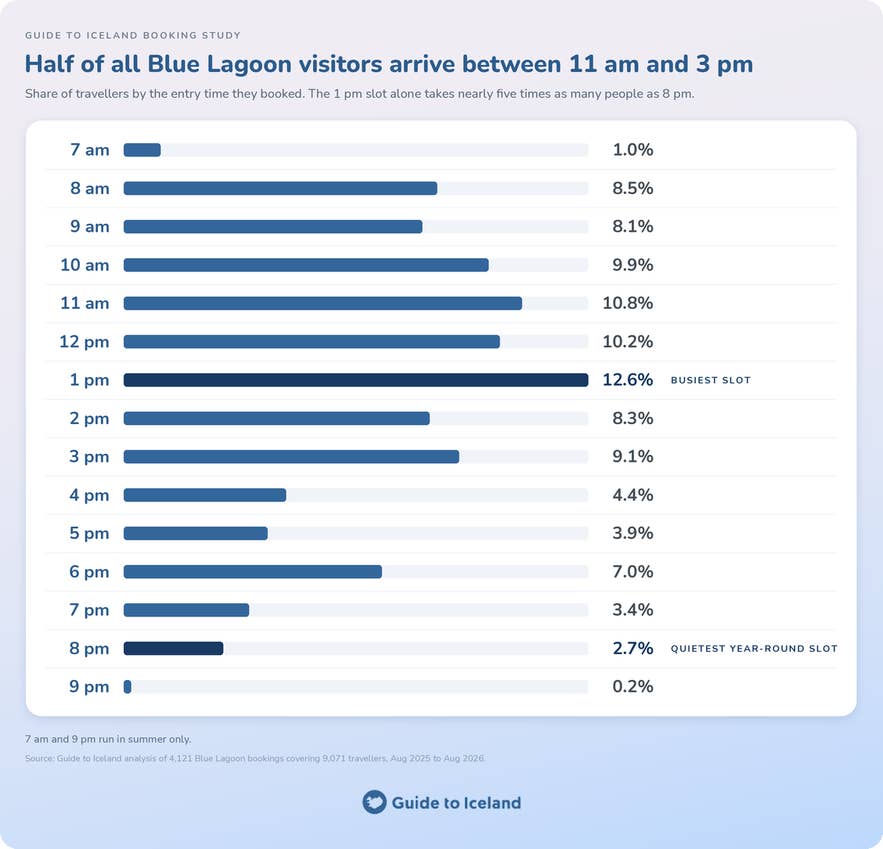 The busiest time to visit the Blue Lagoon is midday, with just over half of all arrivals, 51.1%, landing between 11 am and 3 pm. The 1 pm slot alone takes 12.6% of all Blue Lagoon travelers, nearly five times as many people as the 8 pm slot.
The crowd at the Blue Lagoon thins out in the evening, and every slot from 4 pm onward accounts for just 21.5% of arrivals across six entry times. Mornings at the Blue Lagoon are middling rather than quiet, as the four slots before 11 am take 27.4% of arrivals between them and the 8 am slot on its own is busier than 2 pm.
Blue Lagoon entry slots rank as follows by the share of travelers who choose them:
-
Quietest: the 8 pm slot takes 2.7% of all Blue Lagoon arrivals, 7 pm takes 3.4%, and 5 pm takes 3.9%.
-
Also quiet: the 4 pm slot takes 4.4% of all Blue Lagoon arrivals.
-
Busiest: the 1 pm slot takes 12.6% of all Blue Lagoon arrivals, followed by 11 am at 10.8% and 12 pm at 10.2%.
The Blue Lagoon's 7 am and 9 pm slots are emptier still, but they only run during summer opening hours and are not an option for most of the year. Every 7 am and 9 pm booking in our data fell in June, July, or August.
The Cheapest Slots at the Blue Lagoon
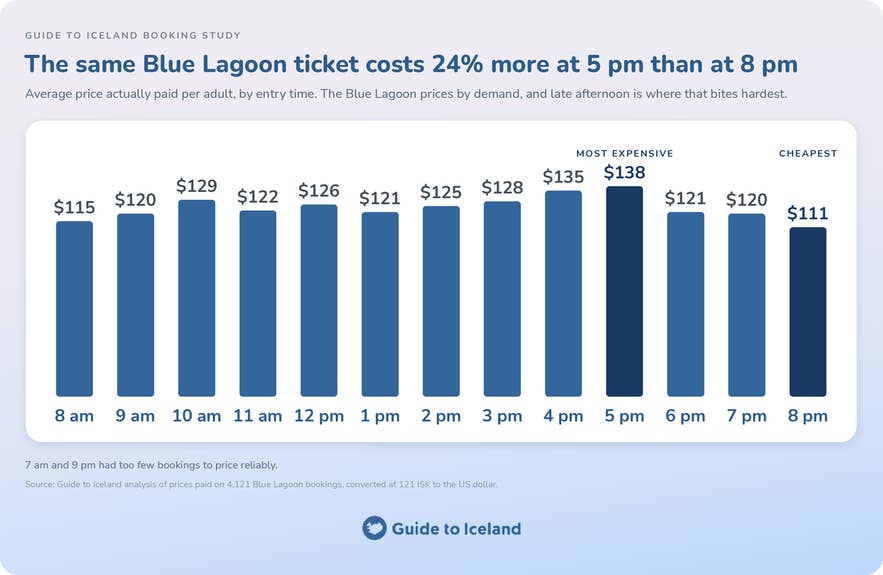 The Blue Lagoon prices its entry slots by demand, so the same Comfort admission costs noticeably different amounts depending on the hour you book. Travelers paid an average of 138 USD per adult for a 5 pm Blue Lagoon entry and 111 USD for an 8 pm entry, making the evening slot 20% cheaper for an identical ticket.
The cheapest Blue Lagoon entry times are in the evening, at an average of 111 USD per adult for 8 pm and 120 USD for 7 pm. The cheapest morning slot at the Blue Lagoon is 8 am at 115 USD per adult, followed by 9 am at 120 USD. The most expensive Blue Lagoon entry times are in the late afternoon, at 135 USD per adult for 4 pm and 138 USD for 5 pm.
The 7 pm and 8 pm slots are the only Blue Lagoon entry times that are both quiet and cheap, which is where the two savings stack. Late afternoon is the trap, because the 4 pm and 5 pm Blue Lagoon slots are almost as quiet as the evening ones but the most expensive of the day. The 8 am slot at the Blue Lagoon is cheap without being quiet, which still makes it the best-value morning entry for anyone who would rather not wait until evening.
The Most and Least Crowded Day at the Blue Lagoon
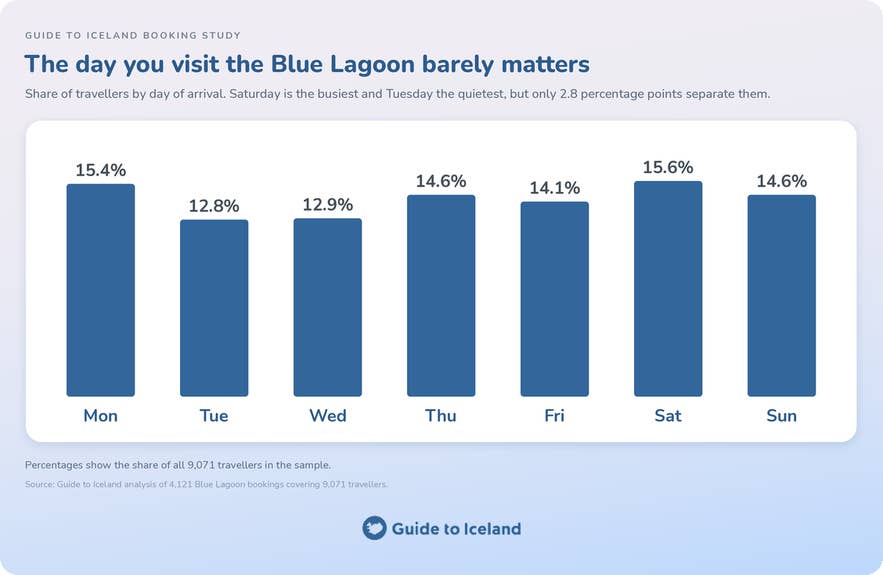 The day of the week changes how busy the Blue Lagoon is far less than the hour does. Saturday is the busiest day at the Blue Lagoon with 15.6% of all arrivals, and Tuesday is the quietest with 12.8%. The 2.8 percentage point spread between the busiest and quietest days at the Blue Lagoon makes the day you pick a much weaker lever than the entry time you book.
Price is the more useful weekday signal at the Blue Lagoon, where a Friday, Saturday, or Sunday arrival costs an average of 127 USD per adult against 121 USD from Monday to Thursday. Moving a Blue Lagoon visit from the weekend to midweek therefore saves about 5% per adult. A 5% weekday saving is real but small next to the 20% available from changing the time of day.
The Cheapest Month to Visit the Blue Lagoon
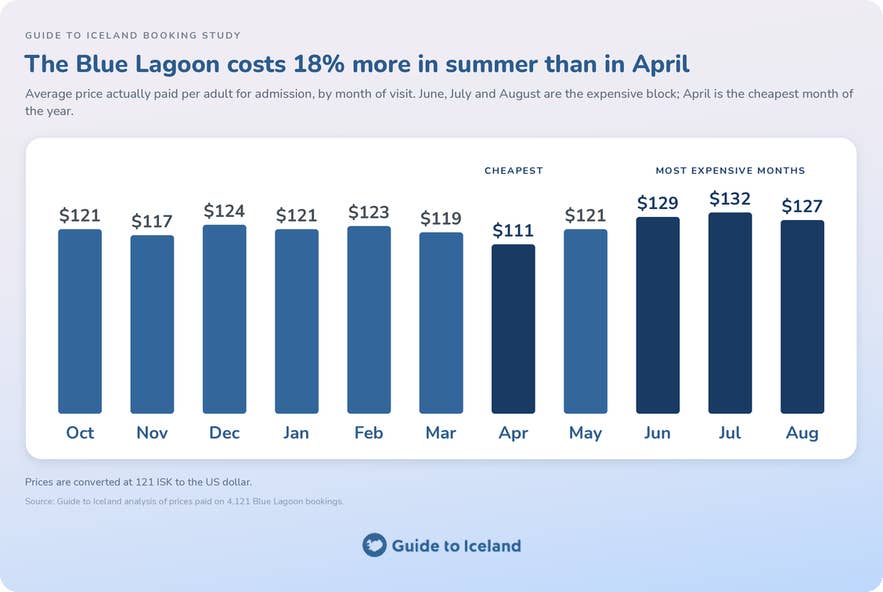 April is the cheapest month to visit the Blue Lagoon, at an average of 111 USD per adult, and July is the most expensive at 132 USD. Booking a Blue Lagoon visit in April rather than July saves 16% on the same ticket. The month you travel moves the Blue Lagoon price more than the day of the week does.
The most expensive months at the Blue Lagoon are June, July, and August, which is also Iceland's peak tourist season. The cheap window at the Blue Lagoon runs from October through May, and its three clearest low points are April at 111 USD per adult, November at 117 USD, and March at 119 USD. If your dates are still open, our guide to the best time to visit Iceland covers the wider trade-offs of each season.
April is also the most affordable month to visit Iceland overall, with a seven-day mid-range trip costing 2,505 USD per person. Our study on the cheapest time to visit Iceland found that Blue Lagoon prices rise in June before falling again in September for three consecutive years.
Of the two price levers at the Blue Lagoon, the hour beats the month: choosing the right time of day saves 20% on a ticket, against 16% for choosing the right month.
How Far Ahead Travelers Book the Blue Lagoon
 Half of all Blue Lagoon bookings are made within 25 days of the visit, and 26.6% are made in the final week before arrival. The Blue Lagoon is not a book-a-year-ahead attraction for most travelers.
The most popular Blue Lagoon slots still sell out, even though most bookings are made late. Demand at the Blue Lagoon concentrates at midday, so book early if your trip depends on a 1 pm entry on a specific date. Travelers who stay flexible about the hour can often still find an evening Blue Lagoon slot a few days out, and an evening slot costs less than a midday one.
Of the travelers in our data, 82% chose Comfort admission at the Blue Lagoon, and 18% chose Premium.
Conclusion: The Best Time to Visit the Blue Lagoon Based on Booking Data
 The best time to visit the Blue Lagoon is a midweek evening in April or November. A midweek evening in April or November wins on both measures at once, with the fewest people in the water and the lowest price on the ticket.
-
Best time of day: the 8 pm and 7 pm slots at the Blue Lagoon have both the fewest people and the lowest prices, while 8 am is the best-value morning entry despite being a busy one.
-
Times to avoid: 11 am to 3 pm is the most crowded block at the Blue Lagoon, and 4 pm to 5 pm is the most expensive.
-
Best day: a Tuesday or Wednesday visit to the Blue Lagoon saves about 5% per adult compared with a weekend visit.
-
Cheapest months: April at 111 USD per adult and November at 117 USD are the cheapest months at the Blue Lagoon, and June to August cost up to 19% more.
The Pros and Cons of Booking a Blue Lagoon Evening Slot
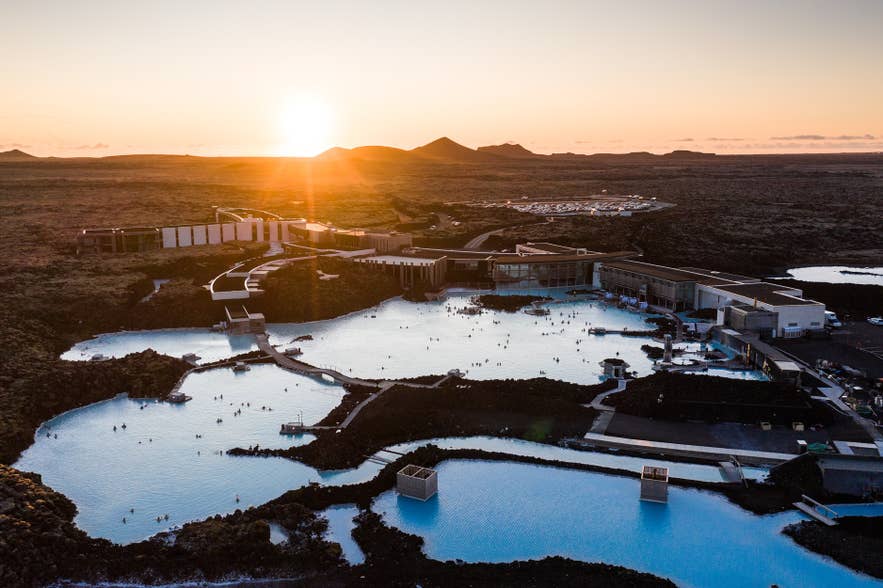 Evening slots at the Blue Lagoon work well for a practical reason beyond the numbers. Most day tours from Reykjavik run in the morning and early afternoon, which is exactly the block our Blue Lagoon booking data shows filling up. Arriving at the Blue Lagoon after the tour buses have left gets you the same lagoon with fewer people in it.
The quieter evening slots at the Blue Lagoon come with one trade-off, and that trade-off is daylight. Outside the summer months, a 7 pm or 8 pm visit can mean experiencing the Blue Lagoon partly or entirely after dark, with less visibility of the surrounding lava landscape. Anyone who wants to see the scenery should check the sunset time in Iceland for the date of their Blue Lagoon visit before booking.
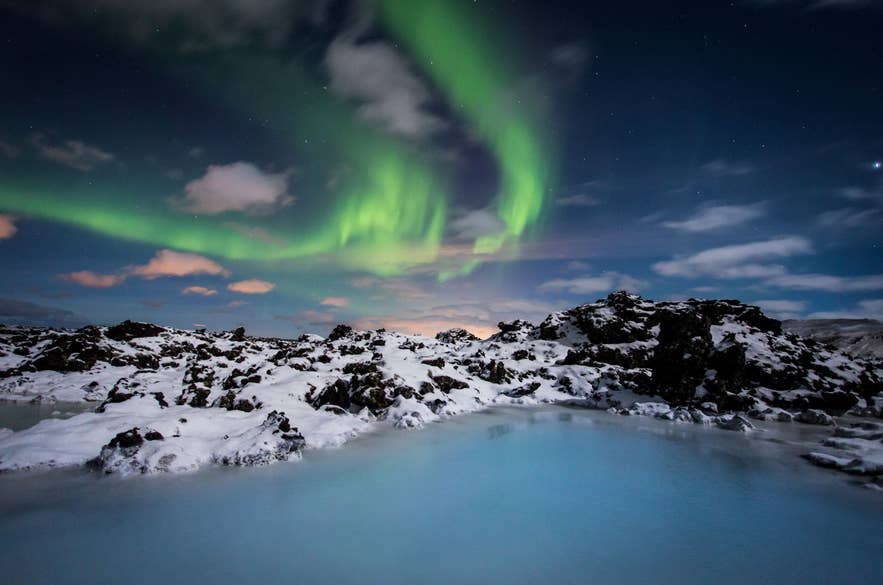
Darkness at the Blue Lagoon has its own charm, though. The Blue Lagoon is illuminated after dark, and the combination of softly lit water, rising steam, and the surrounding darkness can make an evening visit especially atmospheric. The Blue Lagoon itself describes winter darkness as part of the experience, and on clear nights there is even a chance of seeing the Northern Lights.
If your dates land in the busy midday block and you would rather not share the water, Iceland has plenty of alternatives. Our guides to the top geothermal spas in Iceland and the best natural hot springs can help you explore other options. For a broader comparison, see the most recommended hot springs in Iceland based on traveler comments and reviews.
Timing Your Blue Lagoon Visit Around Your Flight
 The Blue Lagoon sits on the Reykjanes peninsula, about 20 minutes from Keflavik International Airport and 45 minutes from Reykjavik. Travelers who rent a car can reach the Blue Lagoon as an easy detour in either direction, which makes it a natural first or last stop on an Iceland trip.
Those arrival and departure half days are worth planning around. Our study on how many days you need in Iceland found that a six-day Reykjavík-based trip gives you four full touring days and two half days. A Blue Lagoon visit fits neatly into one of them.
Travelers landing in Iceland in the morning can book an afternoon or evening Blue Lagoon slot on their arrival day and still have time to clear the airport, and the evening slots are the quiet ones anyway.
Travelers flying home can book an early morning Blue Lagoon entry before a midday departure, and the 8 am slot averages 115 USD per adult, one of the cheapest of the day. Leave enough margin between a Blue Lagoon visit and a flight, and check whether your airport transfer stops at the lagoon.
Staying near the Blue Lagoon solves the drive back to Reykjavik after a late 7 pm or 8 pm slot. The hotels near the Blue Lagoon put you within a few minutes of the entrance, which also makes an early morning entry on a departure day much less stressful.
How We Analyzed the Blue Lagoon Booking Data
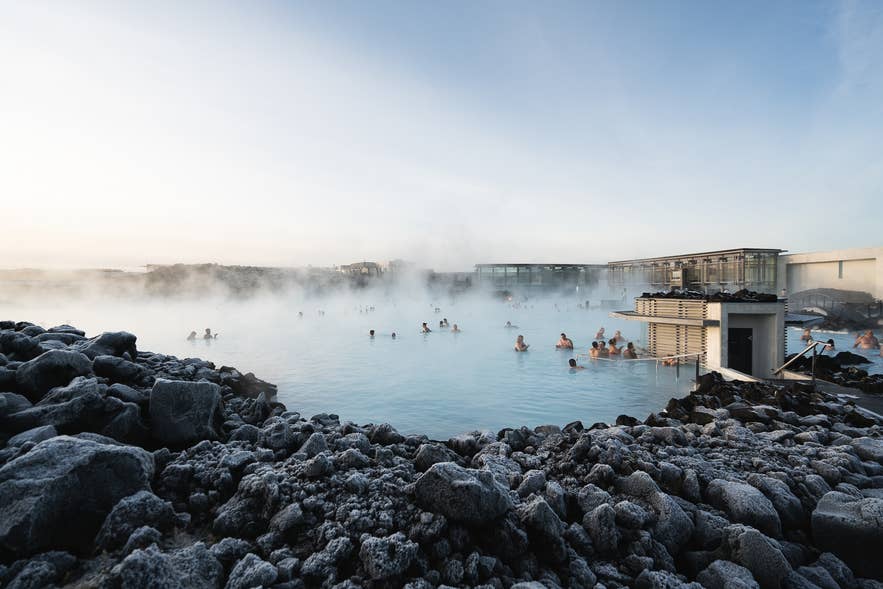 We analyzed 4,121 Blue Lagoon bookings made through Guide to Iceland between August 2025 and August 2026. Of those, 3,611 bookings covering 9,071 travelers were not canceled, and only the uncanceled bookings sit behind every figure in this study. Each Blue Lagoon booking record includes the entry slot booked, party size, and the price paid.
Booking data has one well-known trap: arrivals at the very start and end of a twelve-month window are missing their long-lead and last-minute bookings, respectively, which can distort a seasonal comparison. We tested for that distortion by re-running every ranking on a controlled subset that only counted bookings made within 60 days of the visit, and again at 30-day and 90-day windows. Entry-time shares moved by at most 1.6 percentage points, weekday shares moved by less than one point, and no ranking changed, so we used the full dataset throughout this study.
All prices in this study are the amounts travelers actually paid per adult, converted from Icelandic krona at 121 ISK to the US dollar. Blue Lagoon prices will move as the Blue Lagoon adjusts its rates and as the exchange rate shifts. Monthly figures in this study are averages per traveler, so short and long months compare fairly. All entry times given are Icelandic local time, which is GMT year-round.
Conclusion
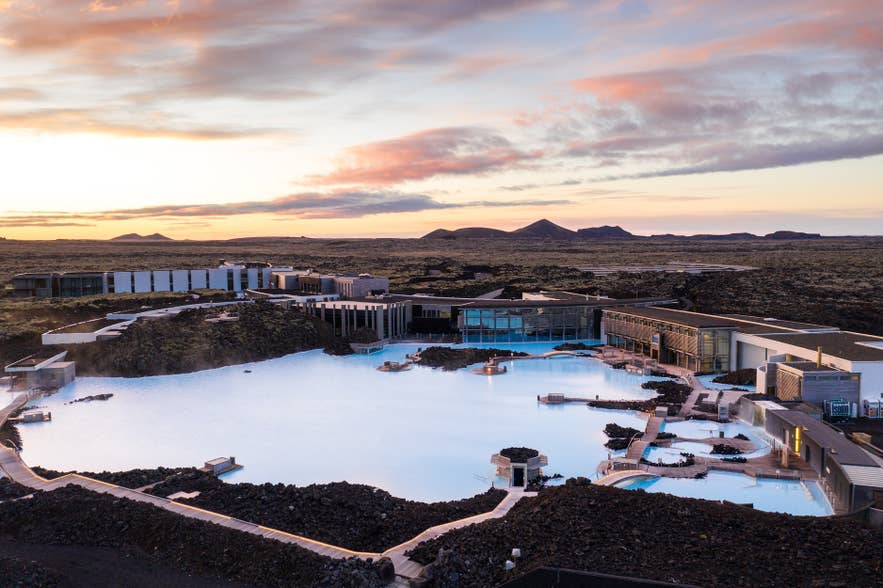 Time of day is the lever that matters most when booking the Blue Lagoon. An evening visit to the Blue Lagoon costs about 20% less than a peak-hour visit and puts you in the water with a fraction of the crowd.
The day of the week barely moves the needle by comparison, as a Friday, Saturday, or Sunday visit to the Blue Lagoon costs about 5% more per adult than the same visit from Monday to Thursday.
The month matters more than the day but still trails the hour: April is the cheapest month at the Blue Lagoon at 111 USD per adult, running 16% below the summer peak of 129 to 132 USD in June, July, and August.
In conclusion, the hour you book at the Blue Lagoon beats every other timing choice you can make.

Guide to Iceland Editorials is the shared byline for our content team. We use it on pieces several people worked on together, where no single writer owns the article, and on anything rewritten often enough that a personal byline would be misleading. We also publish our original data studies under this profile. Each study answers a question travelers ask about Iceland, using primary sources such as booking records, traveler reviews and public datasets, and every study is quality checked by human experts before it's published. Everything under this byline is researched and reviewed by people who live and work in Iceland. If you spot something out of date or want to suggest a correction, message us and it reaches the whole team.