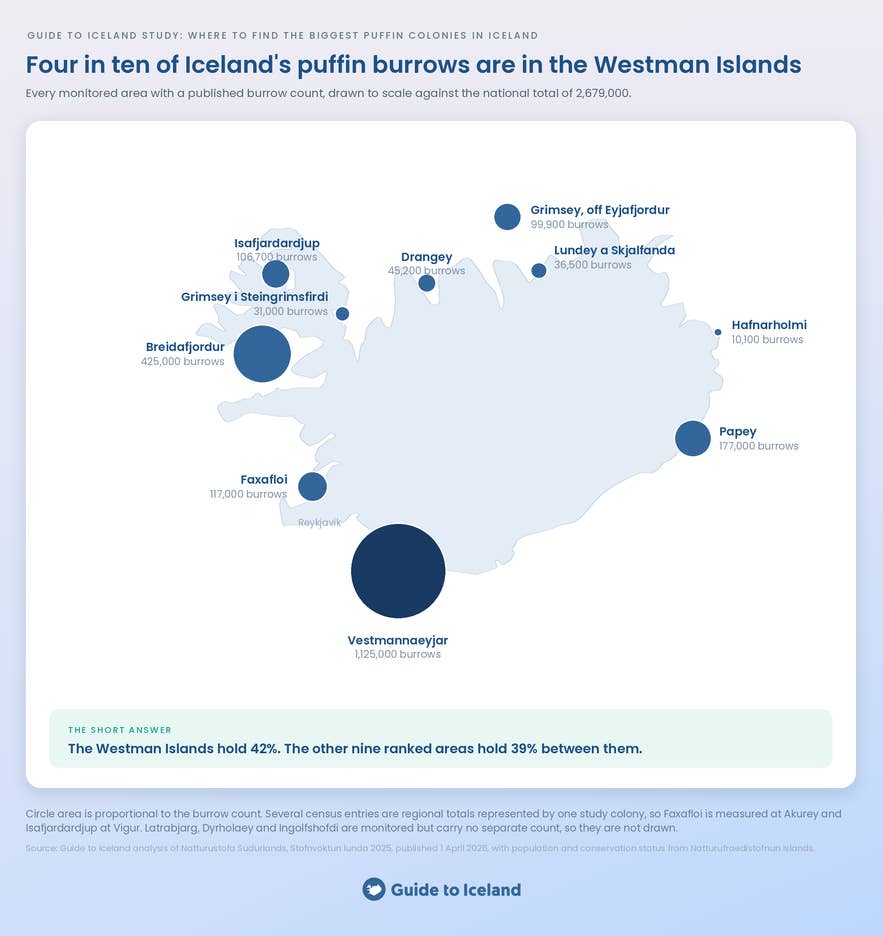
Iceland’s biggest puffin colonies are in the Westman Islands, which hold 1,125,000 burrows, 42% of the national total. Breidafjordur follows with 425,000 and Papey with 177,000. Guide to Iceland ranked every monitored colony to show where the birds are and which ones breed best.
Roughly 2 million breeding pairs of puffins nest in Iceland each summer, and this study maps where they are. Guide to Iceland ranked the areas with published burrow counts, measured how well each one raises chicks, and checked how hard each is to reach.
Puffins are among the best-known species in Iceland’s birdlife, but knowing where to find puffins in Iceland is only part of planning a visit. Four of the five largest colonies sit offshore. You can travel independently or join wildlife tours in Iceland, and our access comparison shows which sites need a boat.
Why You Can Trust Our Content
Guide to Iceland is the most trusted travel platform in Iceland, helping millions of visitors each year. All our content is written and reviewed by local experts who are deeply familiar with Iceland. You can count on us for accurate, up-to-date, and trustworthy travel advice.
The study draws on published research from Natturustofa Sudurlands, which has monitored 13 puffin colonies across four zones every summer since 2010. Researchers track how many nesting burrows contain eggs and how many chicks survive to leave the nest.
We used the national burrow census to rank the areas with published counts and calculate their shares of the national total. We also estimated each colony’s average chick production and year-to-year variation from the monitoring charts, then compared the results with visitor access.
The findings reveal a clear divide. The Westman Islands hold 42% of Iceland’s recorded puffin burrows, while northern colonies raise more than twice as many chicks per burrow as the South zone. Breeding results have improved, but Iceland’s puffin population remains less than half its size compared to the 1990s.
Key Findings
-
Iceland holds roughly 2 million breeding pairs of puffins, counted as 2,679,000 burrows across four monitoring zones.
-
The Westman Islands hold 1,125,000 burrows, 42% of the national total, more than the North and East zones combined.
-
The South zone raises 0.310 chicks per burrow against the North’s 0.684, so it produces fewer than half as many chicks per burrow.
-
National production has risen significantly since 2007, and 2024 was the best year of the century in the Westman Islands.
-
Iceland’s puffin population has still fallen more than 50% since 1995, and the species is Critically Endangered on the Icelandic Red List.
Cite This Study
The charts and data in this study are free to use under CC BY 4.0. Credit Guide to Iceland and link to this page. Every chart has an Embed button underneath it with ready-to-paste code.
Iceland Has About 2 Million Puffin Pairs
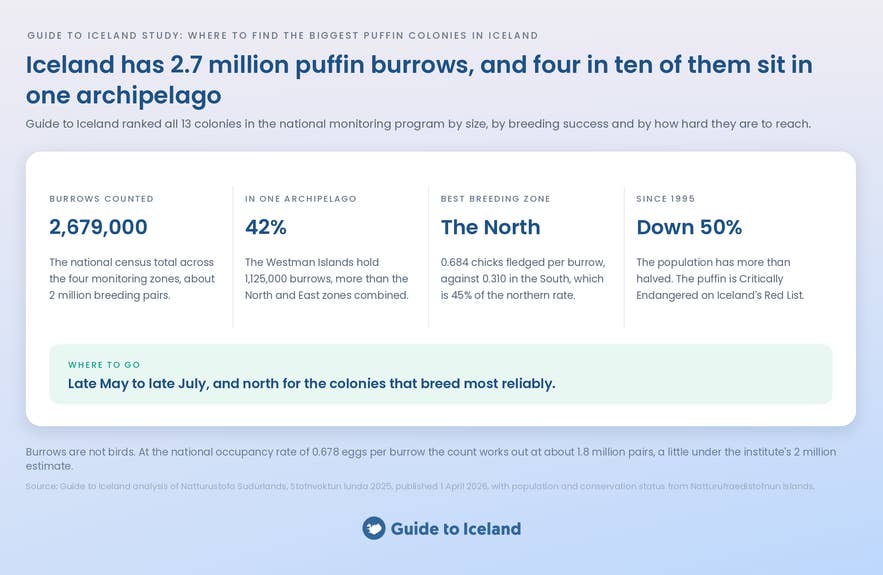
The Natural Science Institute of Iceland estimates that Iceland has around 2 million breeding pairs of puffins, or roughly 4 million breeding adults. A separate national census records 2,679,000 puffin nesting burrows.
Breeding pairs, individual birds, and nesting burrows are different measures. Each breeding pair consists of two adult puffins, but some burrows remain empty during the breeding season. On average, about 68% of Iceland’s puffin burrows contain an egg.
Applying the average egg occupancy rate to the national burrow count gives an estimate of about 1.8 million breeding pairs. This is slightly below the institute’s estimate of 2 million pairs. The estimates use counts taken at different times, so we include both figures.
With this, Iceland holds roughly a third of the global puffin population. Iceland’s puffins are also spread unevenly across the country. Comparing nesting areas shows where the largest concentrations live.
Ten Monitored Puffin Areas Hold 81% of Iceland’s Burrows
Ten areas carry a published burrow count in the national census, and together they hold about 81% of Iceland’s recorded puffin burrows. The Westman Islands lead with 1,125,000. Hafnarholmi in Borgarfjordur Eystri is the smallest at 10,100.
Burrow counts come from the national census table in the 2025 monitoring report. The share column is our calculation against the national total of 2,679,000 burrows, since the report publishes percentages by zone rather than by colony.
|
Rank |
Area |
Burrows |
Share of Iceland |
Zone |
Access |
|---|---|---|---|---|---|
|
1 |
1,125,000 |
42.0% |
South |
Ferry or flight |
|
|
2 |
425,000 |
15.9% |
West |
Boat |
|
|
3 |
177,000 |
6.6% |
East |
Boat |
|
|
4 |
117,000 |
4.4% |
West |
Boat, 10 minutes from Reykjavik |
|
|
5 |
106,700 |
4.0% |
West |
Boat |
|
|
6 |
99,900 |
3.7% |
North |
Ferry or flight |
|
|
7 |
45,200 |
1.7% |
North |
Boat |
|
|
8 |
Lundey a Skjalfanda, Skjalfandi Bay |
36,500 |
1.4% |
North |
Boat |
|
9 |
Grimsey i Steingrimsfirdi |
31,000 |
1.2% |
North |
Boat |
|
10 |
Hafnarholmi in Borgarfjordur Eystri |
10,100 |
0.4% |
North |
Road and viewing platform |
|
|
Other colonies in the North and East zones |
485,600 |
18.1% |
North and East |
Not individually monitored |
|
|
Unreconciled in the published census |
20,000 |
0.7% |
|
|
|
|
Iceland total |
2,679,000 |
100% |
|
|
Most remaining burrows are grouped under “Other colonies” because the census does not provide separate counts for those sites. The “Unreconciled” row shows a 20,000-burrow difference between the report’s regional totals and its national total.
Latrabjarg, Dyrholaey, and Ingolfshofdi are monitored too, but they carry no separate burrow count in the census table. All three appear in the report’s per-colony trend charts.
The Westman Islands Hold 42% of Iceland’s Puffins
The Westman Islands account for 1,125,000 of Iceland’s 2,679,000 burrows. That’s the entire South monitoring zone, and it’s more than the North zone at 402,300 and the East zone at 483,000 put together.
The scale of that concentration is easy to understate. Breidafjordur, the second largest area, holds 425,000 burrows. Every other monitored area in the country is smaller than 180,000.
Almost all of it sits on and around Heimaey, the only inhabited island in the group, and the landing point for day tours to the Westman Islands.
One caution about the figures. Several census entries are regional totals represented by a single study colony. Akurey itself holds 25,300 burrows and stands in for Faxafloi at 117,000. Vigur holds 38,400 and stands in for Isafjardardjup at 106,700.
Iceland’s Puffin Population Has Halved Since 1995
Iceland’s puffin population has fallen by more than 50% since the late 1990s, at an estimated rate of roughly 3% a year. The species was listed as Least Concern in Iceland in 2000. By the 2018 Red List it was Critically Endangered.
The Atlantic puffin is also classified as Vulnerable globally and Endangered in Europe. Those listings reflect steep declines across its North Atlantic breeding range, not in Iceland alone.
Iceland is home to close to half of Europe’s Atlantic puffins. Protecting Iceland’s breeding colonies is therefore important for the species’ future across Europe.
Iceland’s North Zone Raises More Than Twice as Many Chicks per Burrow as the South
Northern colonies raise about 68 surviving chicks for every 100 burrows surveyed, against 31 in the South. That is more than twice the rate. The West and East zones fall between these two figures.
Natturustofa Sudurlands’ puffin monitoring program measures how many chicks survive to leave the nest per burrow surveyed, which is how these rates are calculated. Southern and southwestern colonies had particularly low averages between 2010 and 2016.
For every 100 burrows surveyed in those years, the Westman Islands averaged just 11 surviving chicks, Dyrholaey 13, Ingolfshofdi 16, Akurey 26, and Breidafjordur 31.
Some surveys recorded no chicks surviving to leave the nest. The Westman Islands recorded this result in 2010 and 2011, while Ingolfshofdi recorded it in 2010, 2011, and 2014.
Puffin Production Across Iceland Has Risen Significantly Since 2007
Chick production across Iceland has risen significantly between 2007 and 2025, according to Natturustofa Sudurlands’ monitoring results. Improvements in the southern colonies account for much of that increase.
From 2017 onward, the Westman Islands averaged about 49 surviving chicks for every 100 burrows, up from 11 during 2010 to 2016. Akurey’s average rose to 68 chicks per 100 burrows, up from 26 over the same periods.
Despite this improvement, the Westman Islands’ average remains below the long-term average of every monitored northern colony. Results also vary year to year: the Westman Islands had a record year in 2024, followed by a below-average year in 2025.
More chicks surviving per burrow does not necessarily mean the puffin population is growing. Iceland’s breeding population remains far smaller than it was in the 1990s.
Drangey, Grimsey, and Vigur Raise Puffin Chicks Most Consistently
Drangey, Grimsey i Steingrimsfirdi, and Vigur average about seven surviving chicks for every ten burrows, with little variation between years. They are the steadiest performers among the monitored colonies.
For travelers choosing where to see puffins, colony size tells only part of the story. Breeding records show where puffins have raised chicks most reliably over the years, though they do not guarantee sightings.
We used Natturustofa Sudurlands’ monitoring charts to estimate each colony’s average number of surviving chicks per burrow and how much the results changed between years.
|
Colony |
Average chicks per 100 burrows, 2010 to 2025 |
Year-to-year variation |
|---|---|---|
|
Drangey |
72 |
Low |
|
Grimsey i Steingrimsfirdi |
69 |
Low |
|
Vigur |
69 |
Low |
|
Lundey a Skjalfanda |
67 |
Low |
|
Grimsey, off Eyjafjordur |
66 |
Low |
|
Hafnarholmi |
64 |
Low |
|
Papey |
54 |
Moderate |
|
Akurey |
50 |
High |
|
Breidafjordur |
40 |
High |
|
Vestmannaeyjar |
29 |
High |
|
Dyrholaey |
29 |
High |
|
Ingolfshofdi |
27 |
High |
Travelers interested in visiting one of these colonies can take a two-hour wildlife boat trip from Drangsnes to Grimsey i Steingrimsfirdi.
Southern colonies had much larger changes between good and poor breeding years. Dyrholaey recorded about 72 surviving chicks per 100 burrows in 2017, but no surviving chicks in 2023. Researchers suspected a mink had reached the headland.
Surveyors could not access Dyrholaey in 2024 or 2025, so neither year has a breeding result.
Puffins Occupy Icelandic Colonies Between Late April and Early September
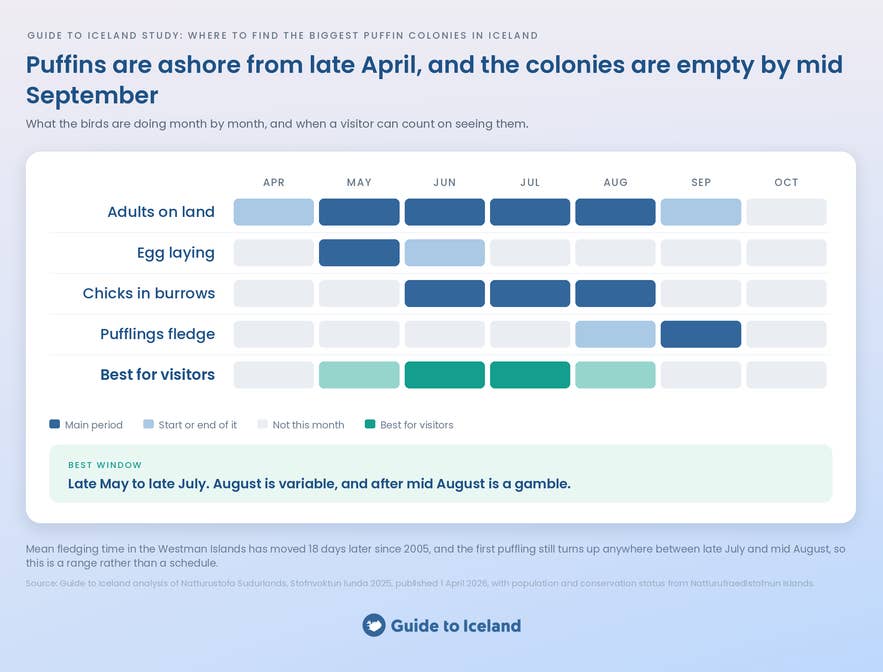
Puffins are ashore at Icelandic colonies between late April and early September. Numbers build through May, peak in June and July, and thin during August as young birds leave their nests and adults return to sea.
June and July are the main viewing months. Natturustofa Sudurlands surveys all 13 monitored colonies twice each summer, once in June and once in July, to track nesting and chick development. At Hafnarholmi in Borgarfjordur Eystri, puffins typically begin leaving after mid-August.
Young puffins in the Westman Islands now leave their nests later than they did historically. Research by Natturustofa Sudurlands, using records from 1937 to 2023, found an average delay of 18 days after 2005. Older guides may therefore give departure dates that are too early for young puffins.
Departure dates also vary between years. In recent seasons, the first young puffin found in the Westman Islands has appeared between late July and mid-August. Travelers should treat seasonal dates as estimates rather than a fixed schedule.
In late August and September, the Westman Islands’ “puffling patrol” helps young puffins that become disoriented and end up in town. Residents collect, weigh, and measure the birds before releasing them to sea. The organized patrol has operated since 2003.
|
Period |
What is happening |
What you will see |
|---|---|---|
|
Late April and early May |
Adults return to the colonies |
Birds arriving, numbers building, attendance patchy |
|
Late May and early June |
Egg laying |
Reliable numbers ashore, birds settling into burrows |
|
Incubation, about 40 days, then chick rearing |
The peak. Adults shuttling fish, heavy colony traffic |
|
|
Early August |
Chicks still in burrows |
Adults still provisioning, numbers beginning to thin |
|
Late August into September |
Chicks fledge |
Adults leaving fast, pufflings departing at night |
|
Mid-September onward |
Colonies empty |
Stragglers only |
Iceland’s Largest Puffin Colonies Require a Ferry, a Flight, or a Boat
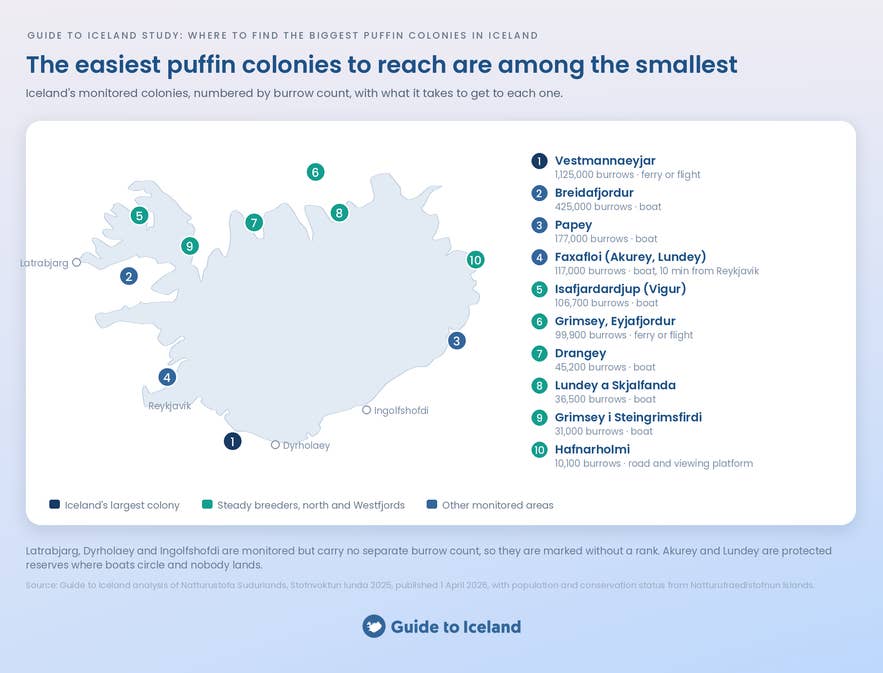
The three largest puffin areas all sit offshore. The Westman Islands need a ferry or a flight, while Breidafjordur and Papey need a boat trip. Hafnarholmi in Borgarfjordur Eystri, the smallest ranked site, is the only one reachable by road.
Smaller sites are often easier to reach. A short boat trip from Reykjavik or a drive to a viewing platform puts you close to the birds without a long journey. We compared the census counts with transport options to help travelers choose a site.
Akurey and Lundey are about ten minutes by boat from Reykjavik’s old harbor. Visitors watch puffins from the boats because landing on these protected islands is restricted. The wider Faxafloi area accounts for about 4% of Iceland’s recorded puffin burrows.
Hafnarholmi offers close-range puffin viewing from a platform accessible by road. The site holds just 0.4% of Iceland’s recorded burrows but consistently raises chicks successfully. Travelers can include it in an East Iceland itinerary or visit on shore excursions from Seydisfjordur.
Other puffin sites you can reach by road include Dyrholaey Peninsula on the South Coast and Latrabjarg Cliffs in the Westfjords, according to our study of where to find birds in Iceland.
The Westman Islands hold 42% of Iceland’s recorded puffin burrows, while Breidafjordur holds almost 16%. Travelers reach the Westman Islands by ferry or flight and explore the surrounding islands by boat. Boat tours to Breidafjordur depart from Stykkisholmur.
Tour options for visiting puffin colonies include:
-
From Reykjavik: Puffin watching boat trips from the old harbor visits Akurey and Lundey. Some whale watching tours also include puffin viewing in the bay.
-
From Seydisfjordur: A puffin shore excursion in Borgarfjordur Eystri takes visitors to Hafnarholmi’s viewing platform.
-
From Heimaey: A sightseeing boat trip from Heimaey harbor explores the outer Westman Islands and their nesting cliffs.
-
From Stykkisholmur: An island-hopping boat tour with a seafood tasting explores Breidafjordur’s islands.
-
From Husavik: A whale watching and puffin trip visits the puffin island in Skjalfandi Bay.
-
From Patreksfjordur: A guided bird tour visits the Latrabjarg cliffs, giving travelers an alternative to the long drive on gravel roads.
Local boat operators also serve Papey and Drangey. For more options, explore birdwatching tours in Iceland that visit puffin colonies during the breeding season.
Dyrholaey, Akurey, and Latrabjarg All Carry Access Restrictions
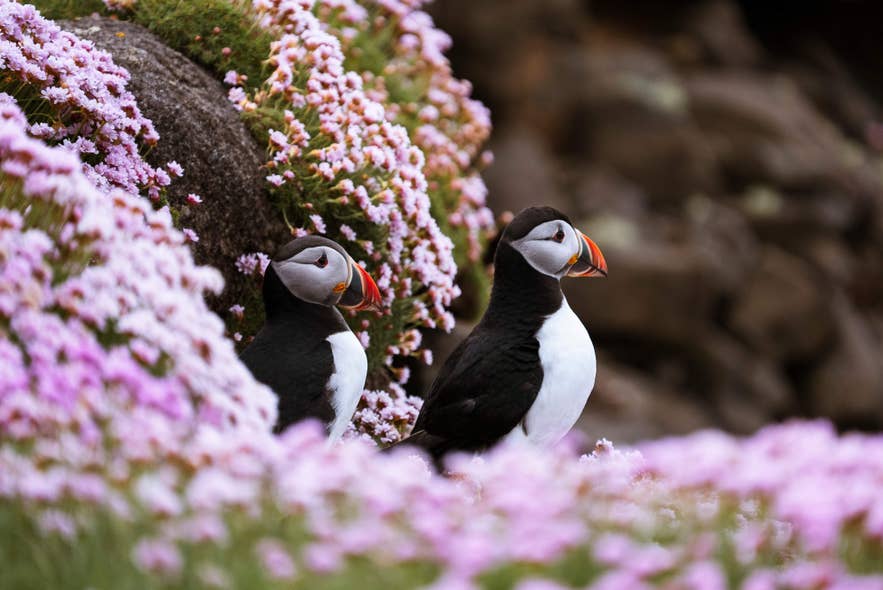
Dyrholaey closes overnight during the nesting season, Akurey requires a permit to land, and Latrabjarg requires a permit for drone flights. Each rule exists to protect nesting birds, and visitors should check the current terms before traveling.
At Dyrholaey, nesting restrictions apply from May 1 to June 25. During this period, the management plan includes overnight closures from 7 PM to 9 AM. A bird specialist reviews nesting conditions each year, so the areas affected by restrictions can change.
Akurey and Lundey are protected nature reserves where visitors need a permit to land, and drones are prohibited. Latrabjarg is also a nature reserve, and drone flights require a permit.
Puffin burrows can weaken the ground near cliff edges, causing sections to collapse without warning. Stay on marked paths and behind barriers to protect both yourself and the nesting birds.
Methodology and Limitations of This Study
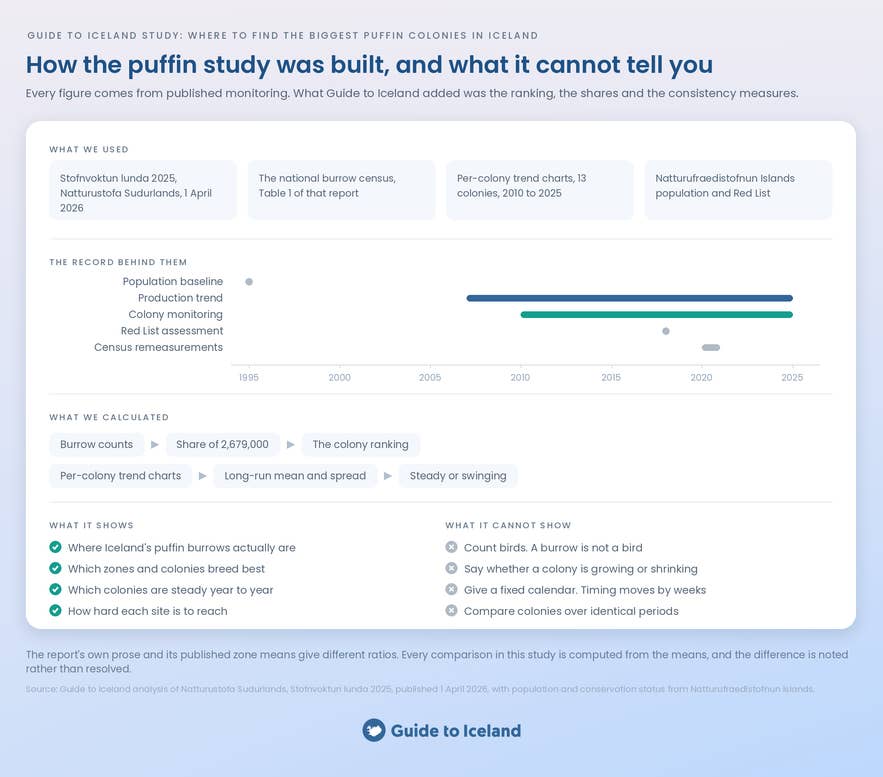
Data sources. Burrow counts and breeding results come from Stofnvoktun lunda 2025, published on April 1, 2026. Natturustofa Sudurlands has monitored 13 colonies twice each summer since 2010. Population estimates and conservation status come from the Natural Science Institute of Iceland.
Our contribution. We ranked areas by burrow count, calculated their national shares, estimated breeding averages and yearly variation, and compared visitor access. The finding that the North raises the most chicks per burrow and the Westman Islands the fewest comes from the source report.
Measures. Occupancy means eggs per burrow. Breeding success is the share of eggs producing chicks that survive to leave the nest. Production means surviving chicks per burrow, including empty burrows. Burrow counts are not bird counts: average occupancy ranges between about 62% in the South and 82% in the North.
Accuracy and updates. We estimated colony results from charts because the report does not publish the underlying numbers. Estimates are accurate to roughly three chicks per 100 burrows and match the North and South averages within two chicks per 100 burrows. We will update the analysis with each annual report.
Limitations
-
Counts cover different years. The census combines counts taken at different times, including recounts from 2020 and 2021.
-
Some counts cover whole regions. A figure listed beside a study colony may include surrounding colonies, rather than that island alone.
-
The regional and national totals differ. The four zones add up to 2,659,000 burrows, but the report states a national total of 2,679,000. We retain the published figures and show the 20,000-burrow gap.
-
Colony averages cover different periods. The Westman Islands have 19 years of data, while Drangey has 11. Years without surveys are excluded, not counted as years with no surviving chicks.
-
More chicks do not necessarily mean a growing population. A colony can raise chicks successfully and still lose birds if fewer adults survive.
-
We chose the before-and-after comparison. The split between 2010 to 2016 and 2017 onward is part of our analysis, rather than a division made in the report.
-
Monitoring zones differ from travel regions. The report places Borgarfjordur Eystri in the North zone, although travelers know it as part of East Iceland.
-
Some comparisons differ within the source report. The report’s text puts Westman Islands chick production at 36% of the North’s rate, while its tables give 45%. The text describes occupancy as 17% lower, while the tables give 24.8% lower. We use the published table averages for our calculations.
-
The breeding averages do not multiply exactly. Multiplying average occupancy by average breeding success does not reproduce the report’s average chick production. The measures may have been averaged differently.
-
The 18-day delay covers one colony. It is measured in the Westman Islands and is not a national figure.
-
No dataset counts adult puffins week by week. The seasonal guidance here is built from breeding stages and the monitoring survey schedule, not from attendance counts.
-
Seasonal dates and access rules can change. Breeding dates vary by weeks between years. Check current access restrictions with official sources before visiting.
Sources
-
Stofnvoktun lunda 2025, Natturustofa Sudurlands, April 1, 2026. Burrow counts, zone totals, and breeding results.
-
Natural Science Institute of Iceland. Population estimate, rate of decline, and Icelandic Red List status.
-
Umhverfisstofnun. Arrival timing and population decline since 1995.
-
Hansen, Puffin Productivity in South Iceland, TemaNord 2025:517. The 18-day delay in fledging time.
-
Borgarfjordur Eystri municipality. Laying and incubation dates, and departure timing at Hafnarholmi.
-
Umhverfisstofnun protected areas. Dyrholaey seasonal access restrictions.
Conclusion
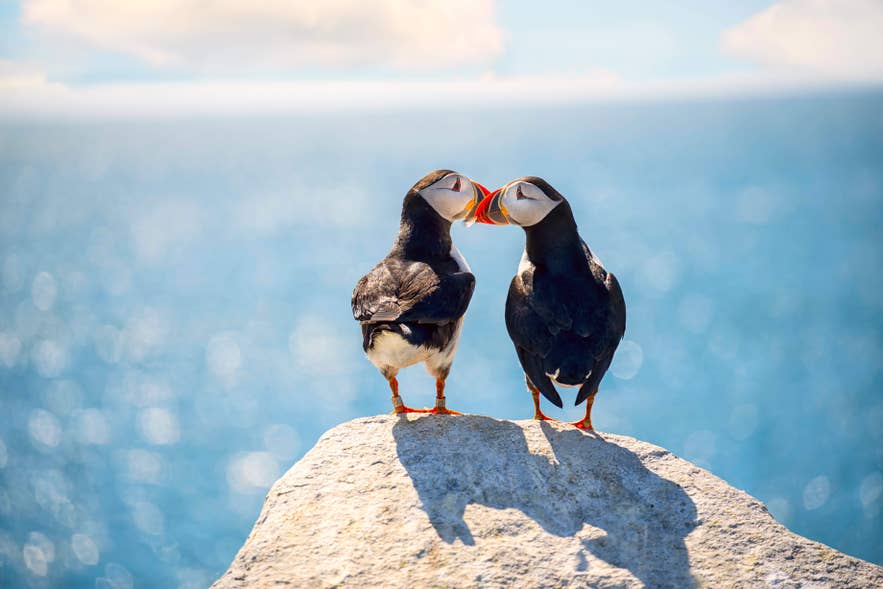
The Westman Islands hold Iceland’s largest concentration of puffin burrows, while northern and Westfjords colonies raise chicks more consistently year to year. Colony size and breeding results tell different parts of the story, and access also matters when choosing where to visit.
Choose the Westman Islands to explore Iceland’s largest nesting area, or consider Drangey, Grimsey i Steingrimsfirdi, and Vigur for their strong breeding records. For a short trip from the capital, puffin-watching boat tours from Reykjavik offer an easy way to see the birds.
Grimsey i Steingrimsfirdi lies off the Strandir coast, where harbor and gray seals haul out. Our analysis of where to see seals in Iceland lists Strandir as a summer seal-watching spot, which overlaps the main puffin months.
Plan your puffin visit for June or July, the main viewing months and the period when researchers survey the colonies. Puffin numbers build through May and decline during August as birds return to sea. Stay on marked paths and viewing platforms to avoid damaging burrows and disturbing nesting birds.
Guide to Iceland independently analyzed published puffin census and monitoring data for this study. Our marketplace offers tours to several locations covered here, but our commercial partnerships did not influence the analysis or findings.

Guide to Iceland Editorials is the shared byline for our content team. We use it on pieces several people worked on together, where no single writer owns the article, and on anything rewritten often enough that a personal byline would be misleading. We also publish our original data studies under this profile. Each study answers a question travelers ask about Iceland, using primary sources such as booking records, traveler reviews and public datasets, and every study is quality checked by human experts before it's published. Everything under this byline is researched and reviewed by people who live and work in Iceland. If you spot something out of date or want to suggest a correction, message us and it reaches the whole team.