Seals live along Iceland's coast all year, but they rest on land only at certain places and times. This study shows when and where travelers can stand on shore for the best chance of seeing them.
Seal watching in Iceland centers on two breeding species, the harbor seal and the gray seal. The national census estimated about 10,300 harbor seals in 2020. A separate count estimated about 6,700 gray seals in 2022.
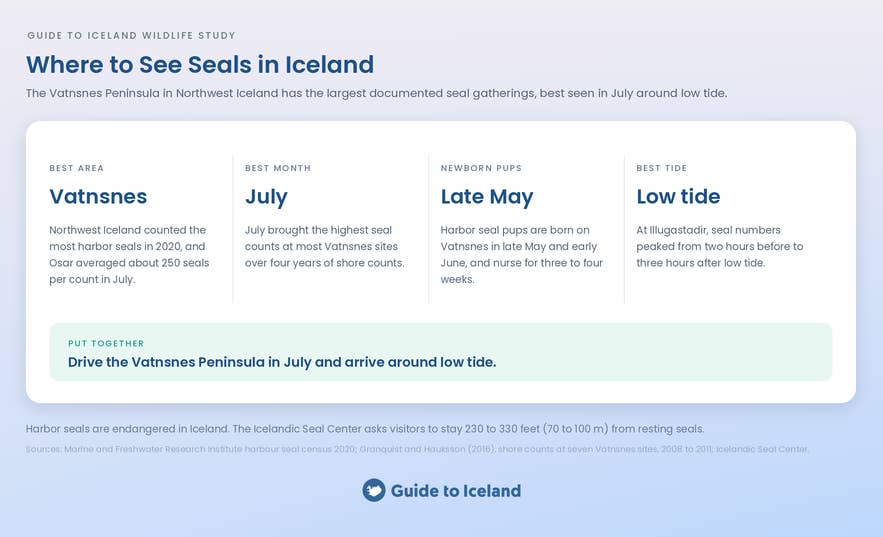
For the most seals on shore, we recommend visiting Iceland in July and driving the Vatnsnes Peninsula, a coastal loop in Northwest Iceland. Newborn pups appear there in late May and early June. Seals also feed year-round at Jokulsarlon Glacier Lagoon in Southeast Iceland, where boat tours bring them into view among the icebergs.
Why You Can Trust Our Content
Guide to Iceland is the most trusted travel platform in Iceland, helping millions of visitors each year. All our content is written and reviewed by local experts who are deeply familiar with Iceland. You can count on us for accurate, up-to-date, and trustworthy travel advice.
Key Findings
Guide to Iceland combined published research and official guidance to find where and when seals are easiest to see. The main sources are the national censuses, a four-year Icelandic Seal Center study of the Vatnsnes Peninsula, and the Seal Center's visitor guidance. The full list is in the methodology section.
-
Iceland's harbor seal population has fallen by 69% since 1980. The 2020 national census estimated 10,319 harbor seals, down from 33,327 in 1980.
-
Harbor seals are listed as endangered in Iceland. The Natural Science Institute of Iceland lists the species as endangered on the national red list, and the 2020 estimate sits 14% below the government's minimum target of 12,000 seals.
-
Northwest Iceland has more harbor seals than any other coastal area. Census observers counted 907 harbor seals on the Northwest Iceland coast in 2020, more than in any of the six other coastal areas.
-
Breidafjordur Bay produces most of Iceland's gray seal pups. The bay produced 963 of Iceland's 1,551 gray seal pups in 2022, which is 62% of the national total.
-
Iceland's gray seal population has held steady since 2005. The 2022 count estimated 6,697 gray seals and found no significant change in numbers since 2005.
-
Seal numbers on the Vatnsnes Peninsula have more than halved since 2010. Volunteers counted 441 seals along about 62 miles (100 km) of coast on and around the Vatnsnes Peninsula in July 2026. The same count found more than 1,000 seals a year from 2008 to 2010.
-
July brings the most seals ashore on the Vatnsnes Peninsula. A 2016 Icelandic Seal Center study of seven Vatnsnes resting sites found the highest seal counts in July at most of them.
-
Harbor seals on Vatnsnes give birth in late May and early June. The Seal Center study placed the main pupping period in late May and early June. Seals there shed their fur in late July and early August.
-
Low tide gives travelers the best chance of seeing seals on the rocks. Seal numbers at Illugastadir peaked from two hours before to three hours after low tide.
Cite This Article
The charts and data in this study are free to use under CC BY 4.0. Credit Guide to Iceland and link to this page. Every chart has an Embed button underneath it with ready-to-paste code.
At a Glance: Seal Watching in Iceland by Region
The table compares Iceland's main seal-watching coasts by the seals you can expect, the best months, road access, and visitor facilities.
| Site | Region | Seals to expect | Best months | Road access | Facilities |
|---|---|---|---|---|---|
| Vatnsnes Peninsula (Illugastadir and Hvitserkur at Osar) | Northwest Iceland | Mostly harbor seals | July for the most seals; late May and early June for pups | Route 711, about 43 miles (70 km) around, mostly gravel | Seal Center in Hvammstangi; a viewing shelter with binoculars and a toilet at Illugastadir (closed during eider nesting); a viewing platform at Osar |
| Ytri-Tunga Beach | West Iceland, Snaefellsnes | Mostly harbor seals, with gray seals at times | June to August | Signed turn-off from Route 54, about 99 miles (159 km) from Reykjavik | Parking |
| Jokulsarlon Glacier Lagoon | Southeast Iceland | Harbor seals | All year, with more seals reported in winter | Beside the Ring Road (Route 1) | Parking and boat tours |
| Strandir coast | Westfjords | Harbor and gray seals | Summer | Remote gravel roads; check road conditions first | None listed |
Two Seal Species Breed in Iceland, the Harbor Seal and the Gray Seal
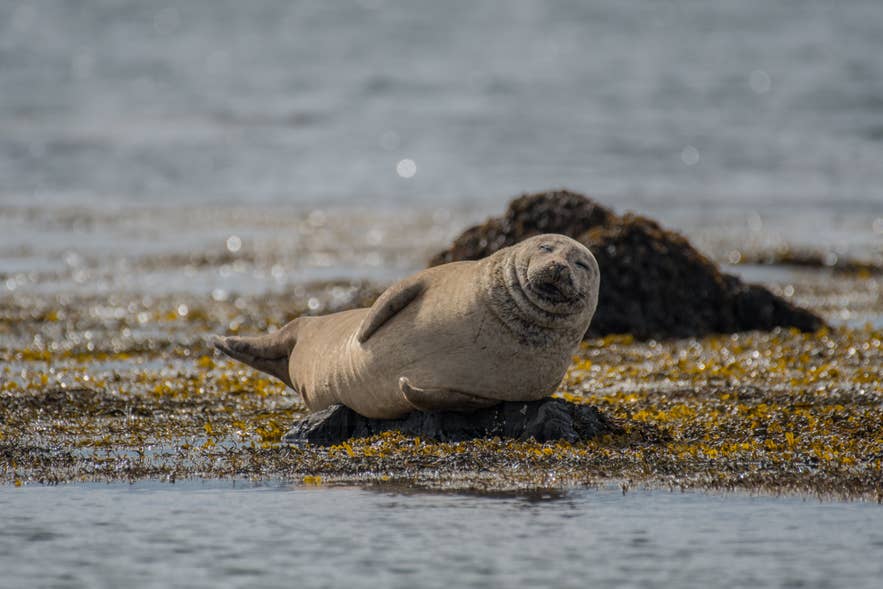
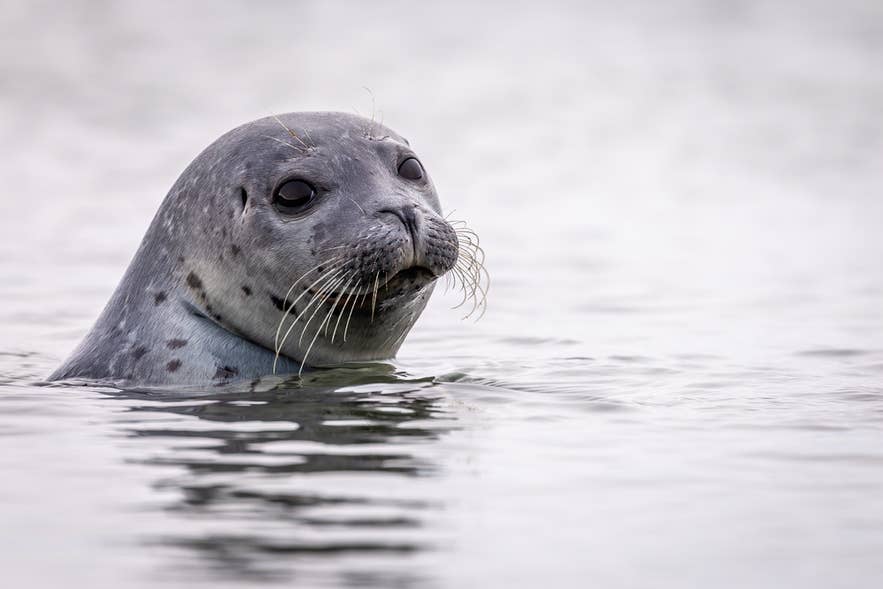
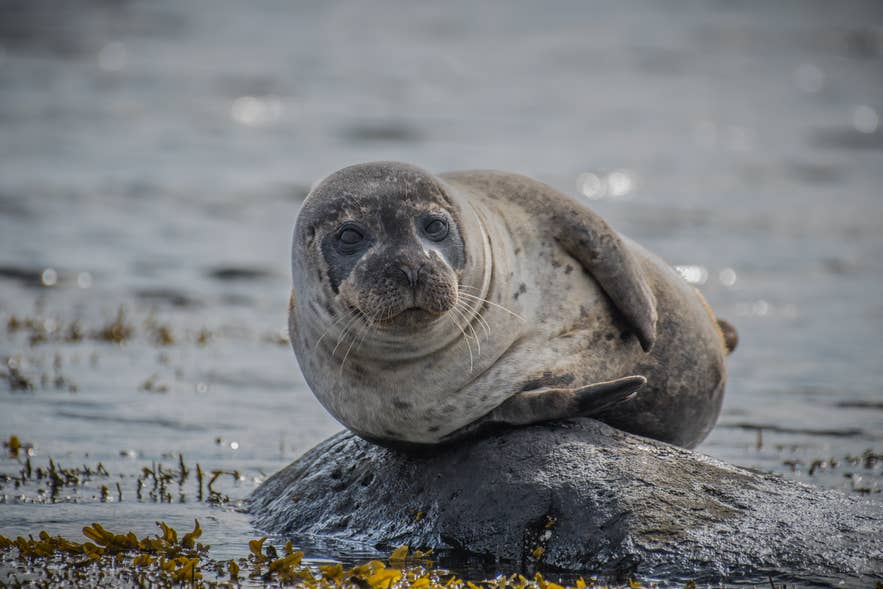
Iceland's coast is home to two seal species that give birth and raise their pups here. The harbor seal is the smaller and more common of the two, and it is the species found at most seal-watching sites.
Adult male harbor seals average about 5.6 feet (1.7 m) long and 214 pounds (97 kg), according to the Natural Science Institute of Iceland's harbor seal profile. Females are slightly smaller, at about 5.2 feet (1.6 m) and 205 pounds (93 kg). Harbor seal pups on Vatnsnes are born in late May and early June, already wearing a gray coat.
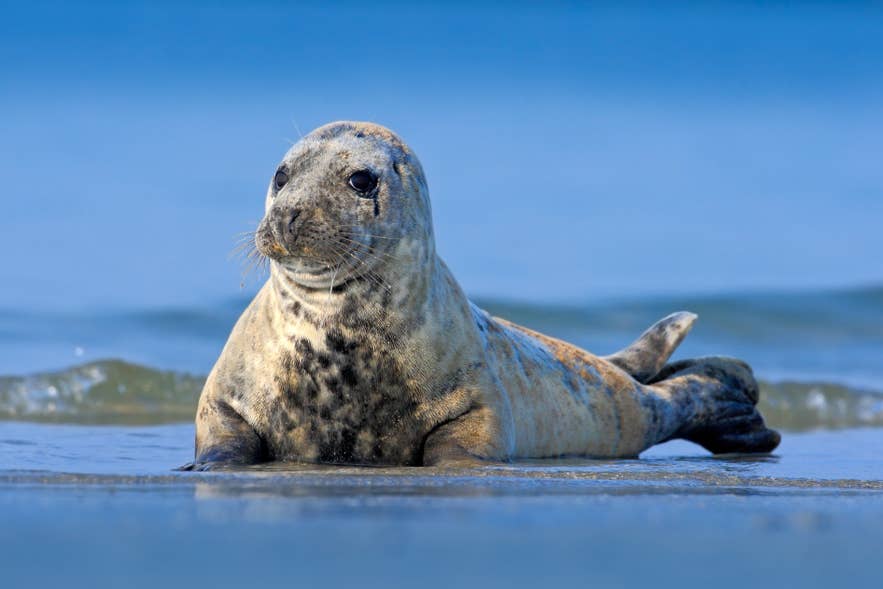 Gray seals are much bigger, reaching up to 7.9 feet (2.4 m) and around 660 pounds (300 kg), according to the Natural Science Institute of Iceland's gray seal profile. Adult gray seal males have a bigger head and a higher nose than females. Gray seal pups are born from September to November in a white coat, which they shed after three to four weeks.
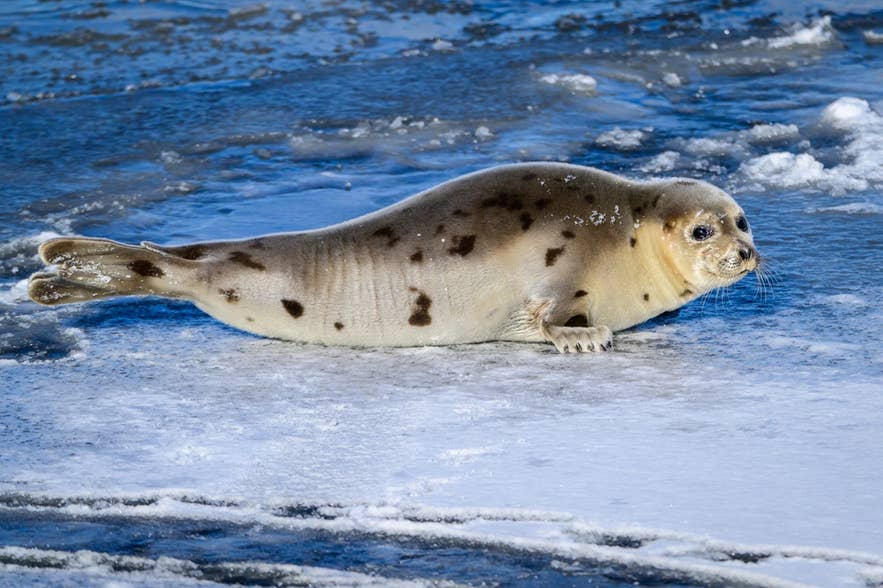 Harp seals also visit Iceland's north coast in summer, including Hunafloi, the wide bay east of the Westfjords. They breed far out on the sea ice, never in Iceland.
The Icelandic Seal Center's guide to the seal species of Iceland also covers the hooded seal, ringed seal, bearded seal, and walrus. All four turn up only as rare visitors.
Northwest Iceland Has More Harbor Seals Than Any Other Coastal Area
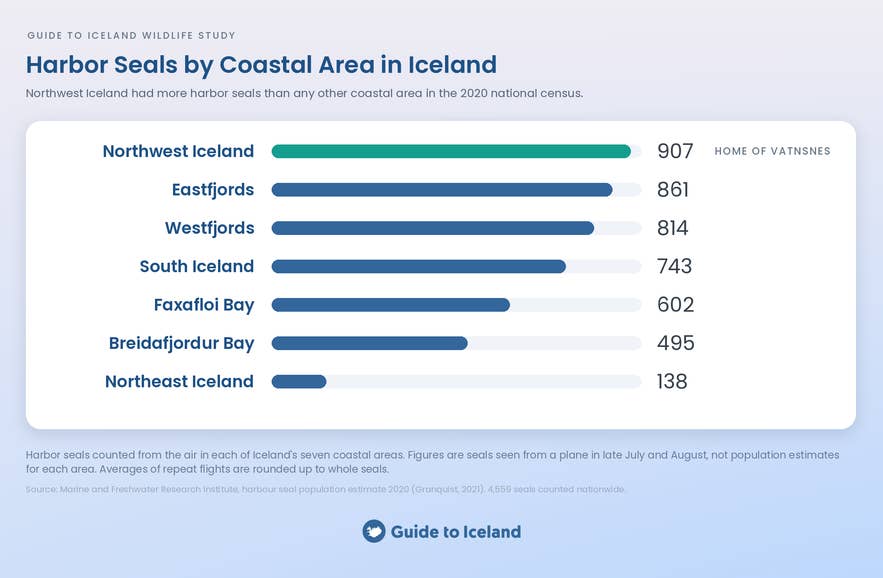
The 2020 harbor seal census found the largest group of Iceland's harbor seals along the Northwest Iceland coast. Observers counted 907 seals there, around a fifth of the 4,559 seals counted nationwide.
Northwest Iceland includes the Vatnsnes Peninsula, which juts into Hunafloi Bay. Census planes flew over Vatnsnes twice in 2020 because it is one of Iceland's key resting areas for harbor seals.
The Eastfjords came a close second, with 861 harbor seals counted. The Westfjords counted 814 seals, and South Iceland counted 743 seals. Faxafloi, the bay around Reykjavik, counted 602 seals, and Breidafjordur Bay counted 495 seals.
Northeast Iceland counted the fewest harbor seals, only 138. The census found no clear rise or fall in any coastal area between 2011 and 2020.
The Eastfjords hold almost as many harbor seals as Northwest Iceland, but the Icelandic Seal Center's seal-watching sites are all on Vatnsnes. That makes Northwest Iceland the easiest region to plan a seal-watching day around. These figures count seals seen from the air, so they show where seals rest rather than how many live in each area.
Iceland's Harbor Seal Population Has Fallen by 69% Since 1980
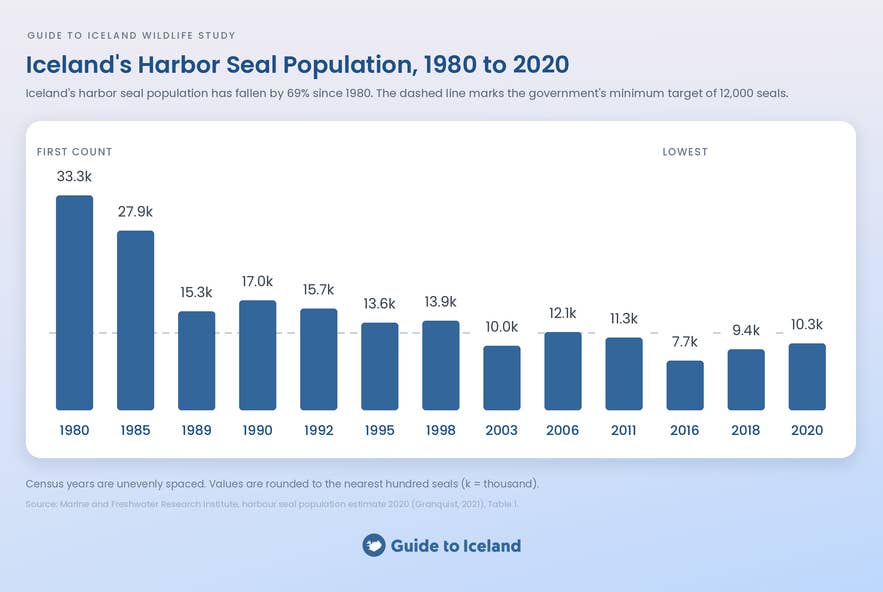
Iceland had an estimated 33,327 harbor seals when national counts began in 1980. The 2020 census estimated 10,319 seals, about a third of that number.
Most of the harbor seal loss came in the first decade of counting. The population roughly halved between 1980 and 1990, then kept falling more slowly.
Harbor seal numbers reached their lowest recorded point in 2016, at an estimated 7,652 seals, according to the 2020 harbor seal census report. Numbers have risen since then. The census team says the population now fluctuates around a stable minimum level.
In 2006, Iceland's government set a goal of keeping at least 12,000 harbor seals in the country's waters. If the population falls below that level, the government is expected to act to stop further decline.
The 2020 harbor seal estimate sits 14% below that minimum. The census team puts the chance that the population is below it at 82%.
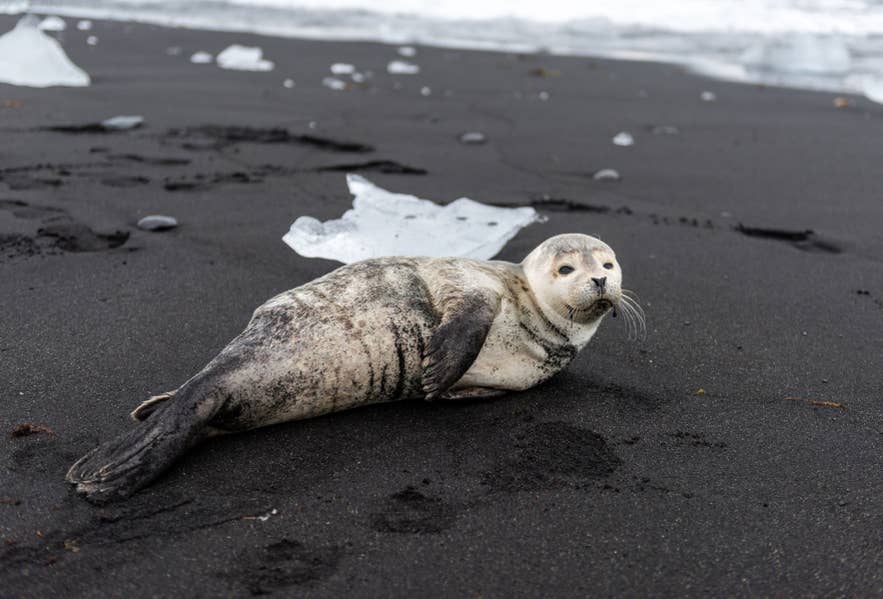 The Natural Science Institute of Iceland lists the harbor seal as endangered on the national red list of threatened species. The institute rated the species critically endangered in 2018 and moved it to endangered in 2021.
Drowning in fishing nets is now the biggest threat to Iceland's harbor seals. NAMMCO, the North Atlantic Marine Mammal Commission, estimates that more than 1,400 harbor seals drowned in fishing nets each year from 2014 to 2018. A 2019 regulation banning seal hunting ended most hunting, though landowners can apply to continue limited traditional hunting.
Disturbance from people adds to the pressure on harbor seals, especially during pupping and molting from May to August. Molting is the yearly shedding of a seal's fur, when seals rest on land for longer than usual. The Marine and Freshwater Research Institute's 2021 harbor seal stock assessment advises keeping disturbance at seal colonies to a minimum from May to August.
Breidafjordur Bay Produces Most of Iceland's Gray Seal Pups
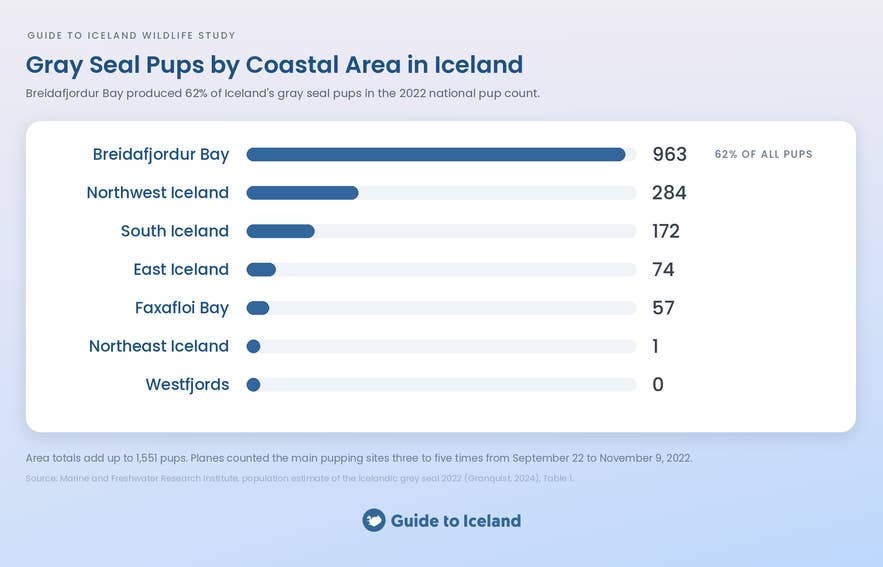
Breidafjordur, the island-filled bay between the Snaefellsnes Peninsula and the Westfjords, produced 963 of Iceland's 1,551 gray seal pups in 2022. That is 62% of the national total.
Northwest Iceland produced 284 gray seal pups, with the main sites on the Strandir coast, which the census counts within Northwest Iceland, and in Skagafjordur. South Iceland produced 172 pups, around Oraefi, the district between Skaftafell and Jokulsarlon, and the island of Surtsey.
East Iceland is a small but growing gray seal breeding area. Its pup count rose from 5 pups in 2005 to 74 pups in 2022.
The 2022 gray seal census estimated Iceland's gray seal population at 6,697 animals. That is 27% fewer than in 1982, but gray seal numbers have shown no clear trend since 2005.
The Natural Science Institute of Iceland lists the gray seal as vulnerable on the national red list. Gray seal numbers have fallen over the past 50 years or so, roughly three generations of seals, according to the 2022 gray seal census report. The population still sits well above the government's minimum target of 4,100 gray seals.
Many gray seal pupping sites are offshore islands. One of them is Surtsey, an island off the South Coast and a UNESCO World Heritage Site where visits are prohibited. Travelers are more likely to see adult gray seals swimming offshore or resting among harbor seals, as they sometimes do at Ytri-Tunga Beach.
Gray seal pups are born from September to November, with births peaking in October, according to the Seal Center's 2017 gray seal assessment. That assessment found peaks from October 2 in Breidafjordur to October 24 on the Strandir coast.
Best Places to See Seals in Iceland by Region
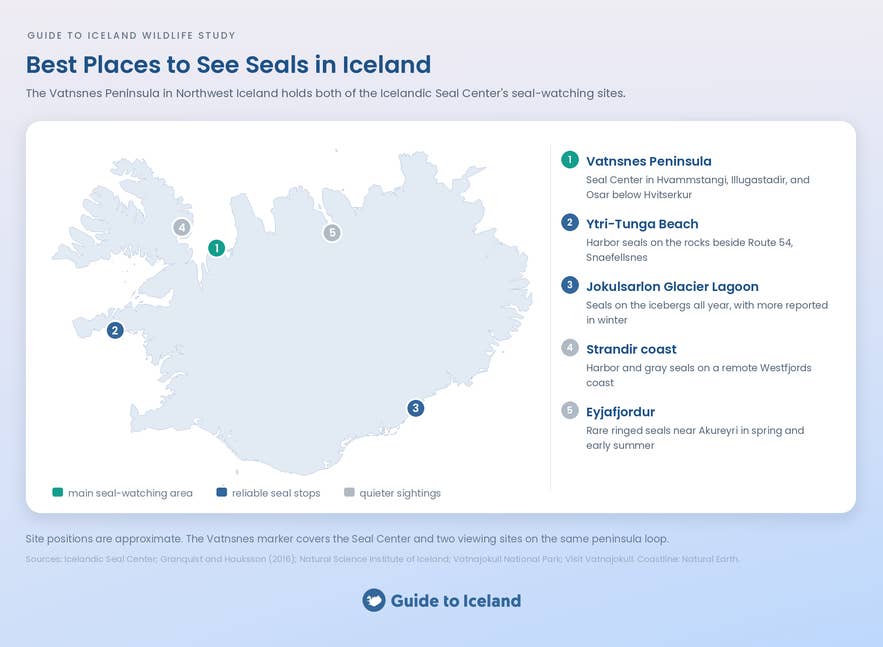
Iceland's best seal-watching sites fall into five places along the north, west, and southeast coasts. The map shows each one, from the Vatnsnes Peninsula in Northwest Iceland to Jokulsarlon Glacier Lagoon in Southeast Iceland.
Vatnsnes: Iceland's Main Seal-Watching Peninsula in Northwest Iceland
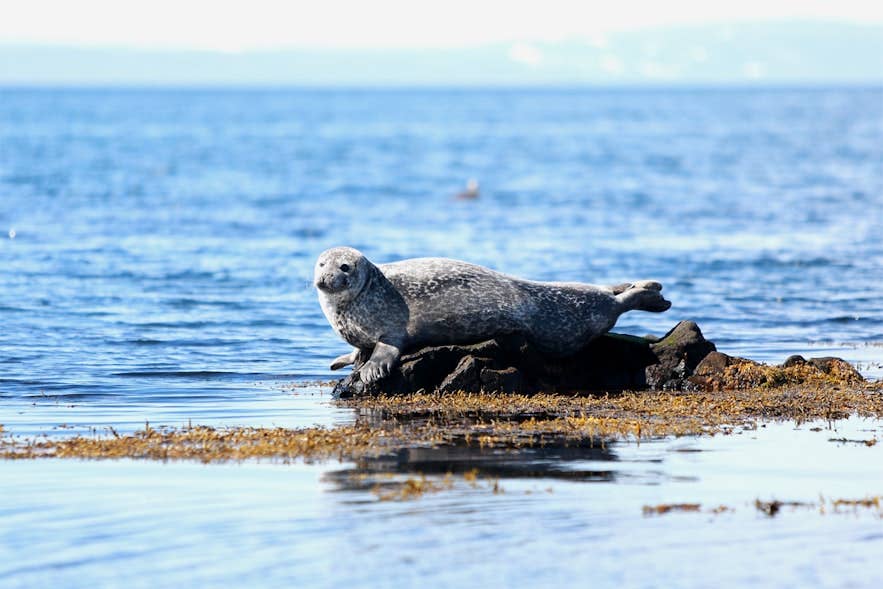 The Vatnsnes Peninsula is a quiet stretch of coast in Northwest Iceland, about 125 miles (200 km) from Reykjavik. Route 711 loops around it for about 43 miles (70 km), mostly on gravel.
A Vatnsnes trip usually starts at the Icelandic Seal Center in Hvammstangi, the village at the base of the peninsula. The center's exhibition covers Iceland's seal species and the research behind their protection.
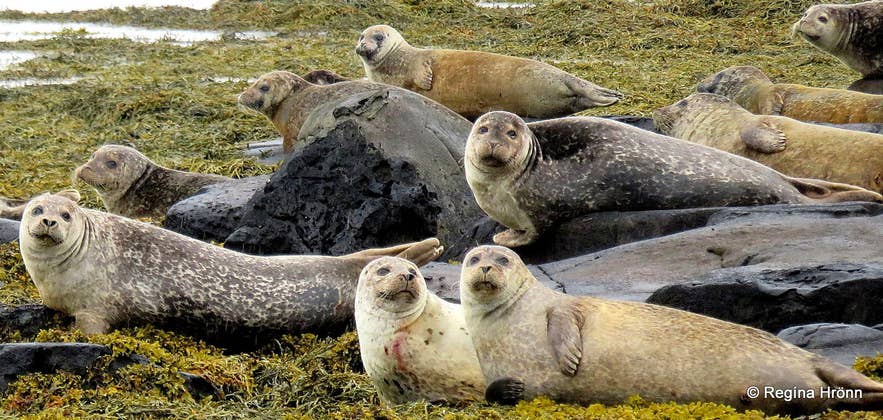
Illugastadir, a farm on the west side of the peninsula, has one of Vatnsnes's largest seal resting areas. A flat, wheelchair-accessible path of about half a mile (800 m) leads to a viewing shelter, where binoculars are provided.
The Illugastadir viewing area closes while eider ducks nest in early summer. Check with the Seal Center before visiting in late May or June.
Osar, a farm on the east side of the peninsula, had the biggest seal gatherings in a 2016 Seal Center study. Osar averaged about 250 seals per count in July, while Illugastadir averaged about 70 seals.
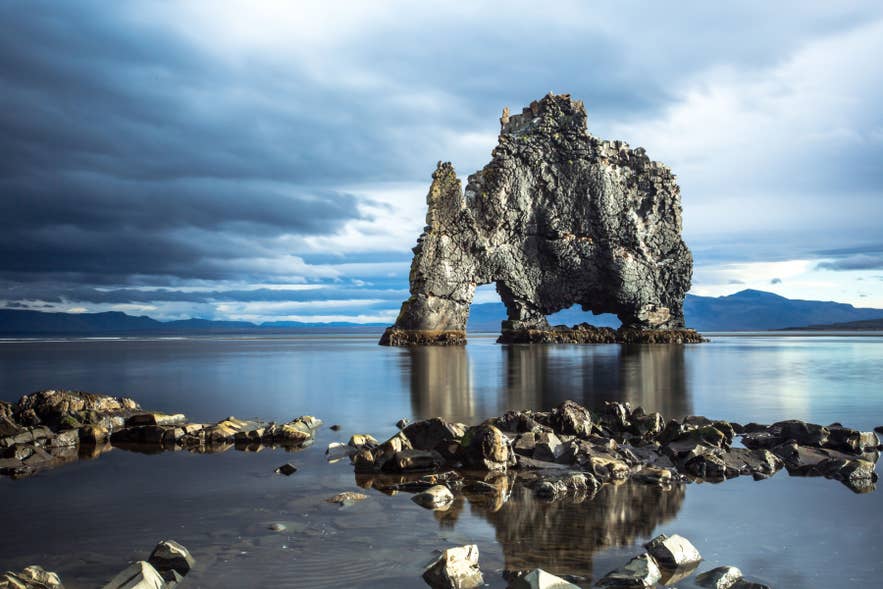 The seals at Osar rest on sandbanks across the river mouth, below the Hvitserkur sea stack. One path leads to a cliff-top viewing platform, and a second path leads down to the beach.
Best for: The most seals in one day, and newborn pups in late May and early June
Go in: July for the most seals, but September and October still bring large groups
Where to stay: Base yourself in Hvammstangi, at the start of Route 711
Ytri-Tunga: Harbor Seals Beside the Road on Snaefellsnes
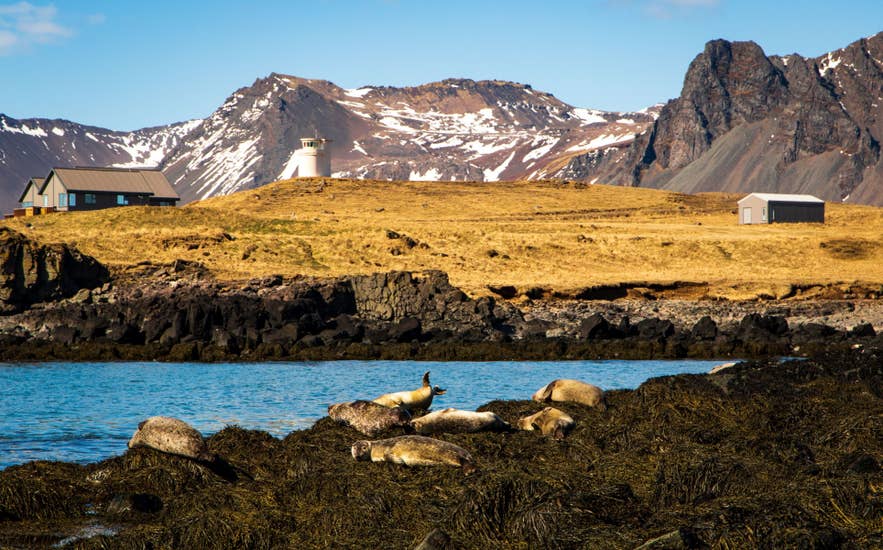 Ytri-Tunga is a farm on the south coast of the Snaefellsnes Peninsula, about 99 miles (159 km) from Reykjavik. The drive takes about 2 hours and 15 minutes on paved roads. A signed turn-off from Route 54 leads to a parking area beside the beach.
Ytri-Tunga Beach has rare golden sand, and harbor seals rest on the rocks just offshore. The seals are easiest to see there in summer. Gray seals turn up at times too.
Best for: A short seal stop on a Snaefellsnes road trip
Go in: June to August, at low tide
Where to stay: Choose from many Reykjavik hotels for a day trip, or consider accommodation in Snaefellsnes for a longer stay
Jokulsarlon: Seals Among the Icebergs in Southeast Iceland
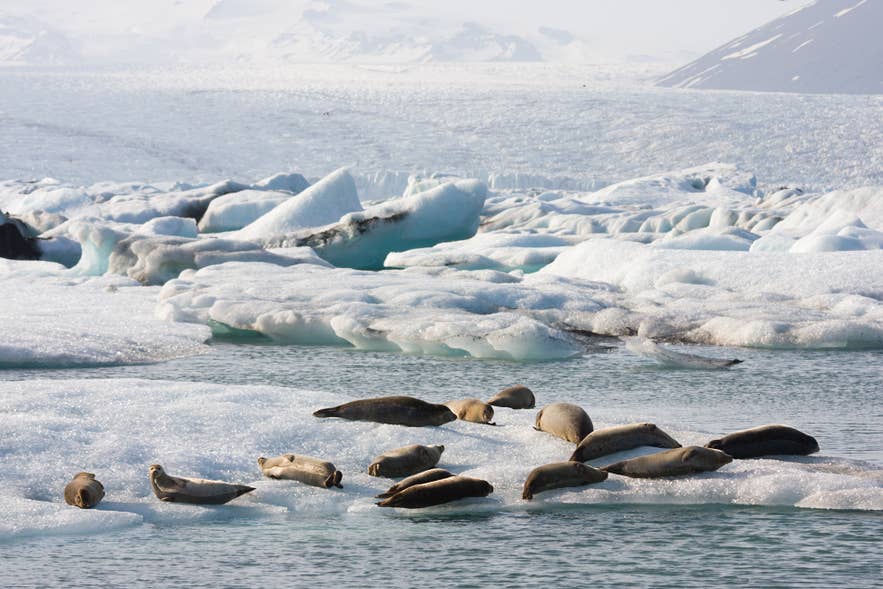
Jokulsarlon Glacier Lagoon sits beside the Ring Road in Southeast Iceland, where icebergs break off Breidamerkurjokull Glacier. Seals swim in the lagoon and rest on the floating ice all year.
More seals visit Jokulsarlon in winter to feed on the fish in the lagoon, according to Visit Vatnajokull, the regional tourism office. Vatnajokull National Park's guide to Jokulsarlon also notes large seal colonies where rivers meet the sea along this coast.
Seals often swim close to the boats on the Jokulsarlon Glacier Lagoon boat tour, which lasts 30 to 40 minutes and suits families.
Best for: Seals and icebergs in one stop, in any season
Go in: Any month, with more seals reported in winter
Where to stay: Hotels in Hofn, the nearest town, are about an hour's drive east
Strandir and Eyjafjordur: Quieter Seal Sightings in the North
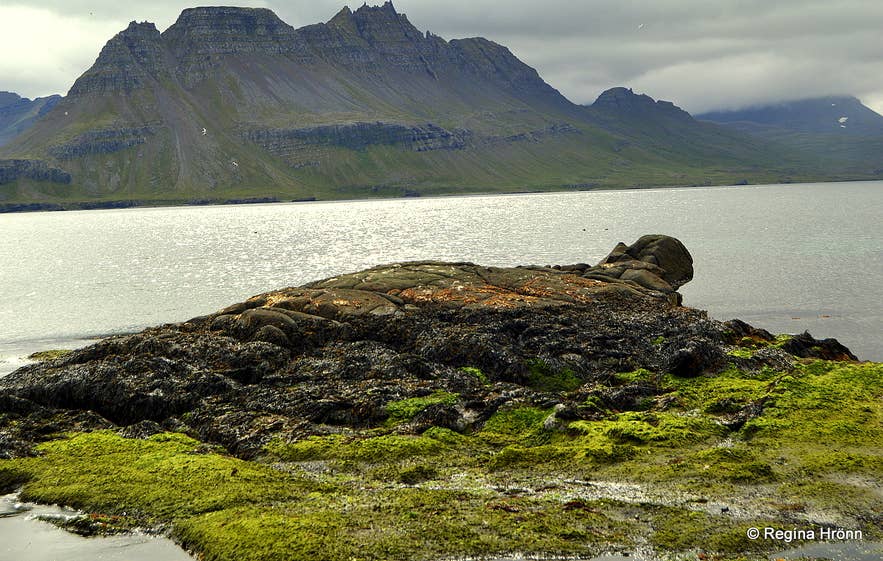 The Strandir coast is a remote stretch of the Westfjords facing Hunafloi Bay. The Natural Science Institute of Iceland names Strandir, with Vatnsnes, as a stronghold of harbor seals. Strandir is also one of Iceland's main gray seal breeding areas.
Rare seal visitors turn up on Strandir too. Hooded seals have been seen along this coast, and a walrus appeared at Ofeigsfjordur in 2008.
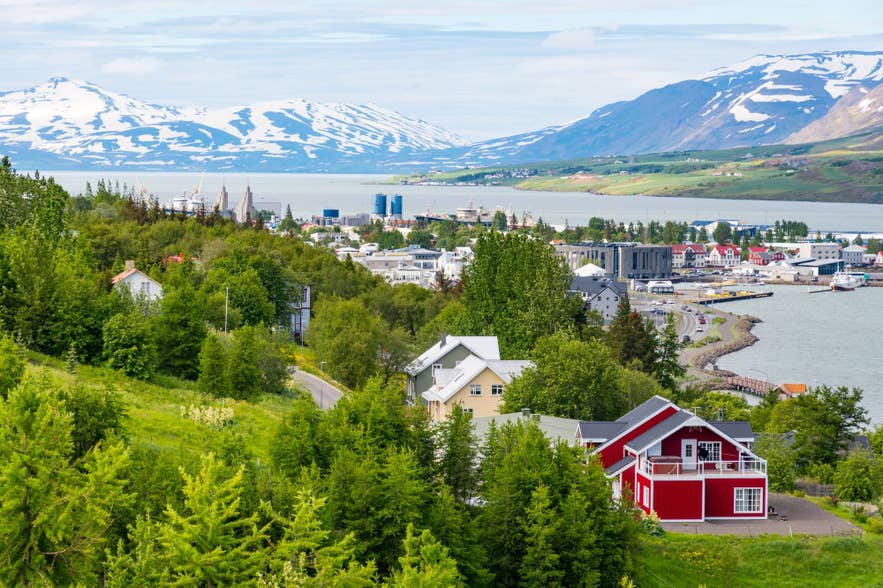 Eyjafjordur, the long fjord leading to Akureyri, gets regular visits from ringed seals in spring and early summer. That pattern comes from the Icelandic Seal Center's ringed seal profile. Ringed seals are rare in Iceland and usually travel alone or in small groups.
Best for: Travelers on Westfjords tours or exploring North Iceland
Go in: June to August for Strandir, after checking road conditions. Ringed seals appear near Akureyri from April to June
Where to stay: Compare Holmavik stays for Strandir or consider hotels in Akureyri for Eyjafjordur
Seals Are Visible in Iceland Every Month, With Pups in Early Summer
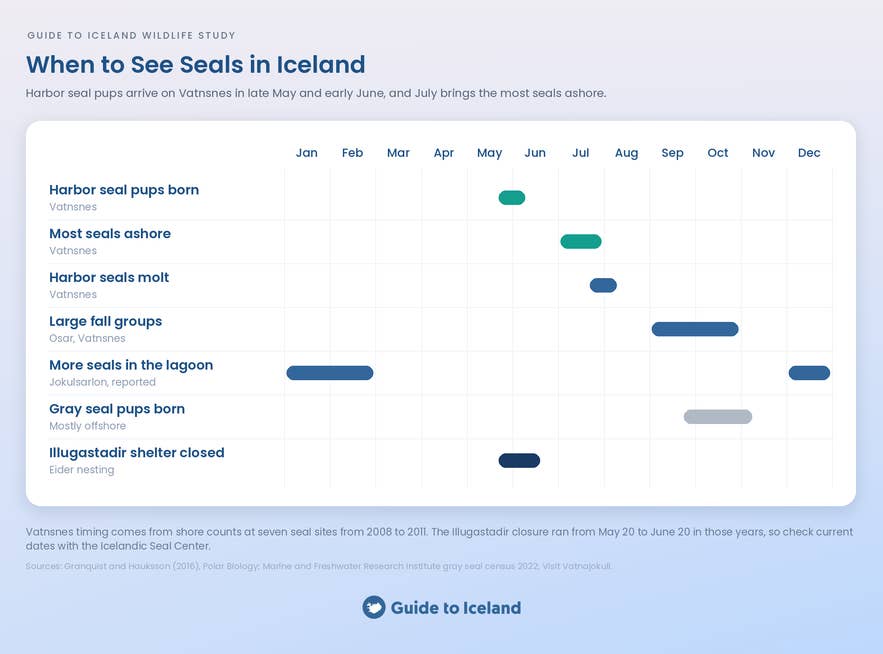
Seals stay along Iceland's coast all year, but the number resting on shore changes with the seasons. The calendar shows when harbor seals give birth, shed their fur, and gather in the largest groups.
Harbor seal pups are born on Vatnsnes in late May and early June, according to the 2016 Seal Center study. Mothers and pups spend more time on land while the pups nurse, which lasts three to four weeks.
July brought the highest seal counts at most Vatnsnes sites in the same study. Seals come ashore again in late July and early August to shed their fur. Resting on land warms the skin and can speed up the molt, according to the 2016 Seal Center study.
Fall in Iceland still brings large groups of seals to Vatnsnes. Counts at Osar in September and October stayed well above the winter counts.
Winter brings the fewest seals onto the Vatnsnes shore. Jokulsarlon Glacier Lagoon works the other way, since Visit Vatnajokull reports more seals feeding there in winter.
Gray seals give birth later in the year, from September to November. Gray seal births peak in October, mostly on offshore islands away from the main viewing sites.
How to Plan a Seal-Watching Trip in Iceland
A seal-watching trip in Iceland goes best when it is timed to the tide and the weather. The tips below come from the census reports, the 2016 Vatnsnes study, and the Icelandic Seal Center.
Check the Tide Table Before Driving to a Seal Site
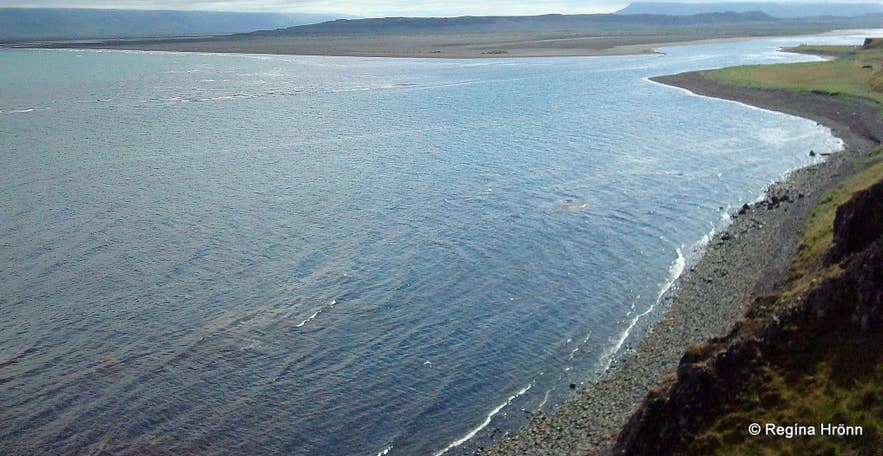 Low tide uncovers the rocks and sandbanks where seals rest. At Illugastadir, seal numbers peaked from two hours before to three hours after low tide.
The Icelandic Road and Coastal Administration publishes tide forecasts for Icelandic harbors in English. Check the harbor nearest your seal site on the day you plan to visit.
Calm, warm days bring more seals ashore than windy, cold ones. Rain and cloud made no difference to seal numbers in the 2016 study, so a gray day is still worth the trip.
Add Vatnsnes and Ytri-Tunga to a West and North Iceland Route
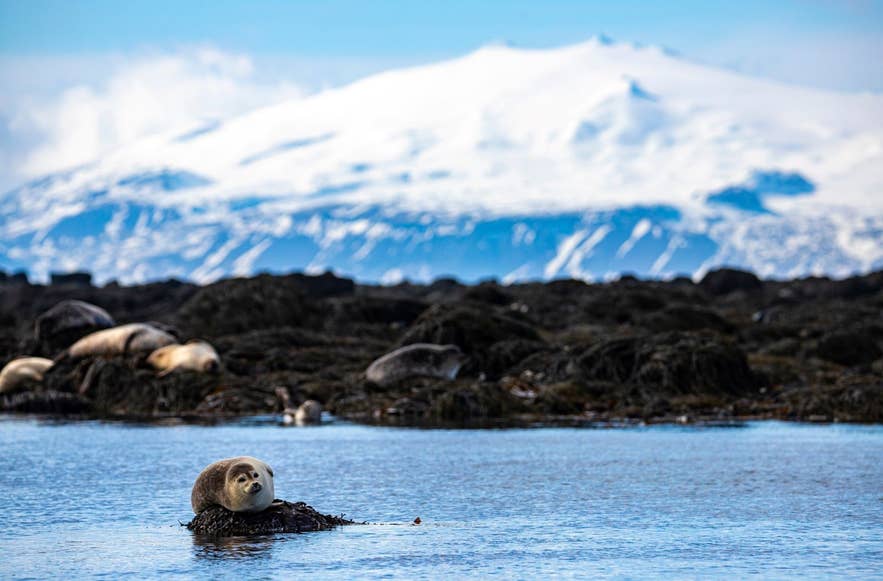 The Vatnsnes Peninsula sits just off the Ring Road between Reykjavik and Akureyri. The loop around it takes two to three hours with stops.
Ytri-Tunga Beach sits on the Snaefellsnes Peninsula, northwest of the town of Borgarnes. A route that loops Snaefellsnes before heading north can take in both seal sites.
Several multi-day Ring Road tours also cover Snaefellsnes and stop at Jokulsarlon. Check each itinerary for Vatnsnes and Ytri-Tunga before booking.
Drive Route 711 in a Regular Car in Summer
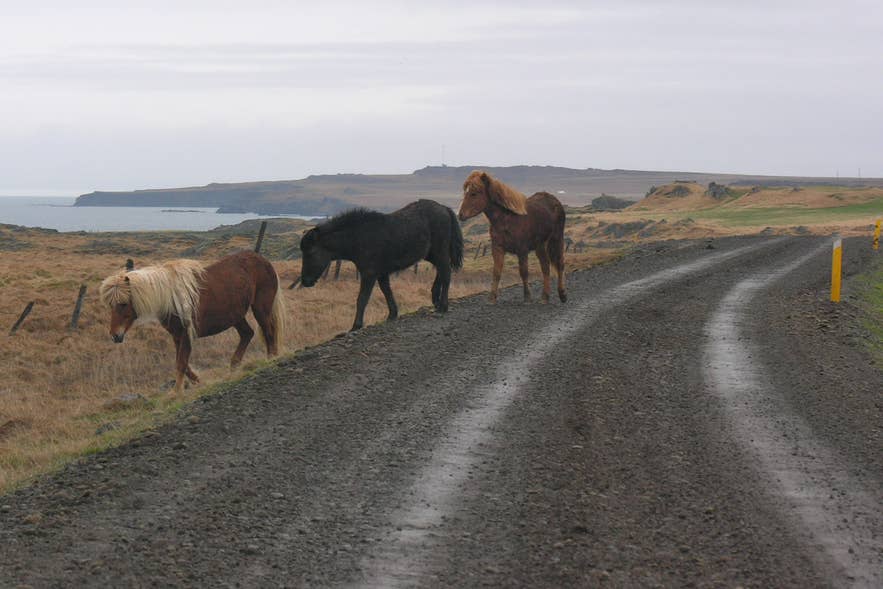
Photo from Wikimedia, Creative Commons, by Hansueli Krapf. No edits made.
Route 711 around Vatnsnes is mostly gravel, with paved stretches north of Hvammstangi. Regular two-wheel-drive rental cars handle the road in summer, so no 4x4 is needed for the main seal sites.
Driving is the simplest way to reach Vatnsnes and Strandir. A self-drive tour of the full Ring Road with the Westfjords and Snaefellsnes passes both coasts. A 12-day guided Ring Road tour with the Westfjords covers the same ground with a driver.
Gravel roads on Vatnsnes and Strandir call for slow driving. Check road conditions before setting out in spring or fall.
Take a Boat Tour at Jokulsarlon to See Seals From the Water
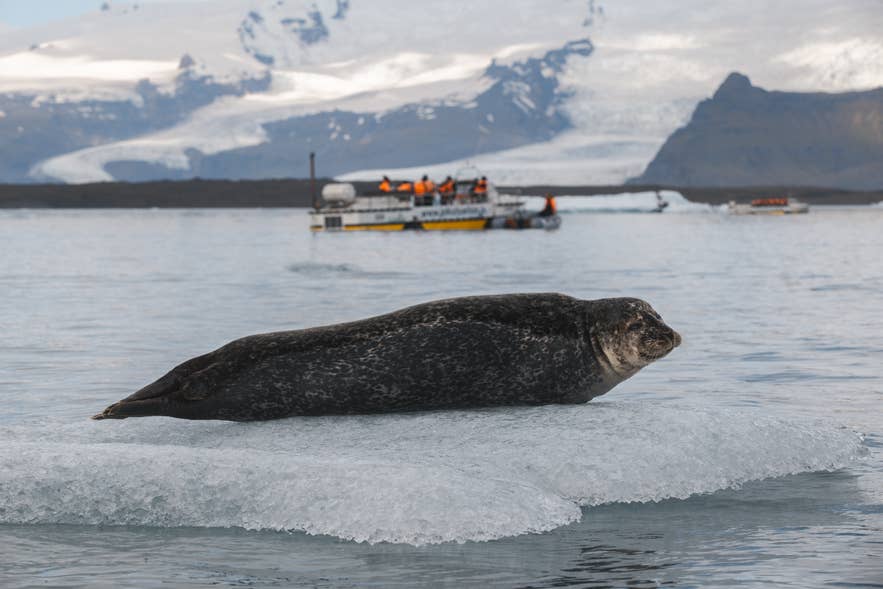 Seals at Jokulsarlon often swim close to the boats or rest on icebergs near them. A boat puts you at water level, where the seals are easier to spot than from the shore. The Jokulsarlon Glacier Lagoon boat tour runs seasonally, so check the dates before you plan your day.
Keep Your Distance and Leave the Drone in the Car
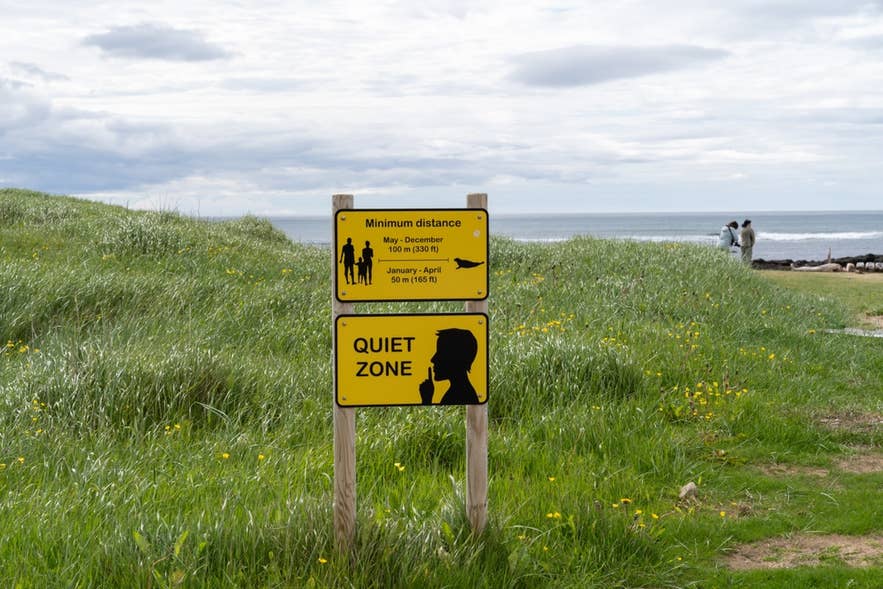 The Icelandic Seal Center asks visitors to stay 230 to 330 feet (70 to 100 m) from resting seals. Move gently, keep your voice down, and never touch a seal.
A pup alone on the shore usually has its mother close by in the water. The Seal Center asks visitors never to approach a lone pup.
Seals that lift their heads or slide into the water are telling you to move away. A 2014 Vatnsnes study found that seals grew more watchful as visitor numbers rose and moved to rocks farther from shore.
Drones frighten seals, and the Seal Center asks visitors not to fly them at seal sites. The full rules are in the Seal Center's code of conduct for seal watching.
Methodology and Limitations of This Study
This seal study combines published research with visitor information from the Icelandic Seal Center, Vatnajokull National Park, and Visit Vatnajokull. It involved no new fieldwork. The sources, methods, and limits are set out below.
How Iceland's Seal Censuses Work
 The 2020 harbor seal census counted seals from a small plane flying the whole coastline between July 27 and August 24. That window matches the yearly molt, when the most harbor seals rest on land.
Census flights for harbor seals took place only in clear, dry weather with wind under 22 mph (10 m/s). Each flight stayed within three hours of low tide, and observers counted 4,559 seals.
The harbor seal census team then adjusted the count for seals in the water or missed from the air. That correction gave the estimate of 10,319 seals.
The 2022 gray seal census counted pups instead of adults. Planes flew over the main pupping sites three to five times between September 22 and November 9. The Westfjords and Northeast Iceland, which have no large pupping sites, were flown once.
The gray seal census team estimated 1,551 pups and multiplied that figure by about four to estimate the whole population. That method gave the estimate of 6,697 gray seals.
How the Vatnsnes Studies Were Done
 The 2016 Vatnsnes study counted seals from the shore at seven resting sites from 2008 to 2011. Observers counted at low tide during each spring tide, the biggest tides that come twice a month, from January to November.
At Illugastadir, the 2016 study team also counted seals every 15 minutes during summer days. Those counts showed how seal numbers rise and fall with the tide.
A 2014 study at Illugastadir compared seal behavior on days with and without visitors from 2008 to 2010. The study recommended a visitor code of conduct built on its results.
Limitations
 The harbor seal estimate carries a wide margin. The census team's range runs from 6,733 to 13,906 seals, so the true number could sit well above or below 10,319.
The regional figures in this study are seals seen from the air, not population estimates for each area. A single flight can miss seals that are underwater or have been disturbed into the sea.
The 2016 study covered Vatnsnes only. Seal numbers varied a lot between sites, even on one peninsula, so its timing results may not hold elsewhere in Iceland.
The 2016 study's winter averages rest on few counts, and bad weather stopped all counts in December. The study could not separate the time of day from the tide.
Ytri-Tunga and Jokulsarlon have no published seal counts. The Jokulsarlon description comes from Vatnajokull National Park and Visit Vatnajokull, and the Ytri-Tunga description comes from visitor reports rather than published research.
Windy weather may have lowered the 2026 Vatnsnes volunteer count, according to the Seal Center. The 2020 figure is still the latest national harbor seal estimate. A new count with drones began in summer 2026, but it covers only Faxafloi, Strandir, and Northwest Iceland.
Sources
-
Marine and Freshwater Research Institute, The Icelandic harbour seal: population estimate in 2020 (Granquist, 2021)
-
Marine and Freshwater Research Institute, Population estimate of the Icelandic grey seal in 2022 (Granquist, 2024)
-
Marine and Freshwater Research Institute, announcement of the 2026 harbor seal count
-
Marine and Freshwater Research Institute, harbor seal stock assessment 2021 (in Icelandic and English)
-
Granquist and Hauksson (2016), Seasonal, meteorological, tidal and diurnal effects on haul-out patterns of harbour seals in Iceland, Polar Biology
-
Granquist and Sigurjonsdottir (2014), The effect of land-based seal watching tourism on the haul-out behaviour of harbour seals in Iceland, Applied Animal Behaviour Science
-
Icelandic Seal Center, seal species pages, seal-watching locations, and code of conduct
-
Icelandic Seal Center, 2017 gray seal population assessment
-
Natural Science Institute of Iceland, harbor seal species page and red list status
-
NAMMCO, Icelandic harbor seal population trends, 1980 to 2020
-
NAMMCO, harbor seal species page, for the bycatch estimate
-
Vatnajokull National Park, Jokulsarlon area page
-
Visit Vatnajokull, Jokulsarlon Glacier Lagoon page
-
UNESCO World Heritage Centre, Surtsey listing
-
Baejarins besta, report on the 2026 Vatnsnes seal count (in Icelandic)
Conclusion
 The Vatnsnes Peninsula holds the largest seal gatherings this study could document, with Osar below Hvitserkur leading in July. Pups arrive on Vatnsnes in late May and early June, and fall still brings large groups to the same shores.
Jokulsarlon Glacier Lagoon offers seals among icebergs in every season, with more seals reported in winter. Ytri-Tunga Beach adds an easy summer stop on the Snaefellsnes Peninsula.
Low tide and a calm day matter more at any seal site than the exact date. Seal watchers who keep 230 to 330 feet (70 to 100 m) back leave the seals resting for the next visitors too.
Iceland's harbor seals are endangered, and quiet visitors help keep these resting sites in use. Our guide to seal watching in Iceland covers more viewing tips, and our overview of wildlife and animals in Iceland covers the country's other animals.
Keep Reading: More Guide to Iceland Wildlife Studies
This seal study is part of a Guide to Iceland research series that maps where Iceland's animals live, region by region and month by month. The other wildlife studies cover the country's best-known animals.

Guide to Iceland Editorials is the shared byline for our content team. We use it on pieces several people worked on together, where no single writer owns the article, and on anything rewritten often enough that a personal byline would be misleading. We also publish our original data studies under this profile. Each study answers a question travelers ask about Iceland, using primary sources such as booking records, traveler reviews and public datasets, and every study is quality checked by human experts before it's published. Everything under this byline is researched and reviewed by people who live and work in Iceland. If you spot something out of date or want to suggest a correction, message us and it reaches the whole team.