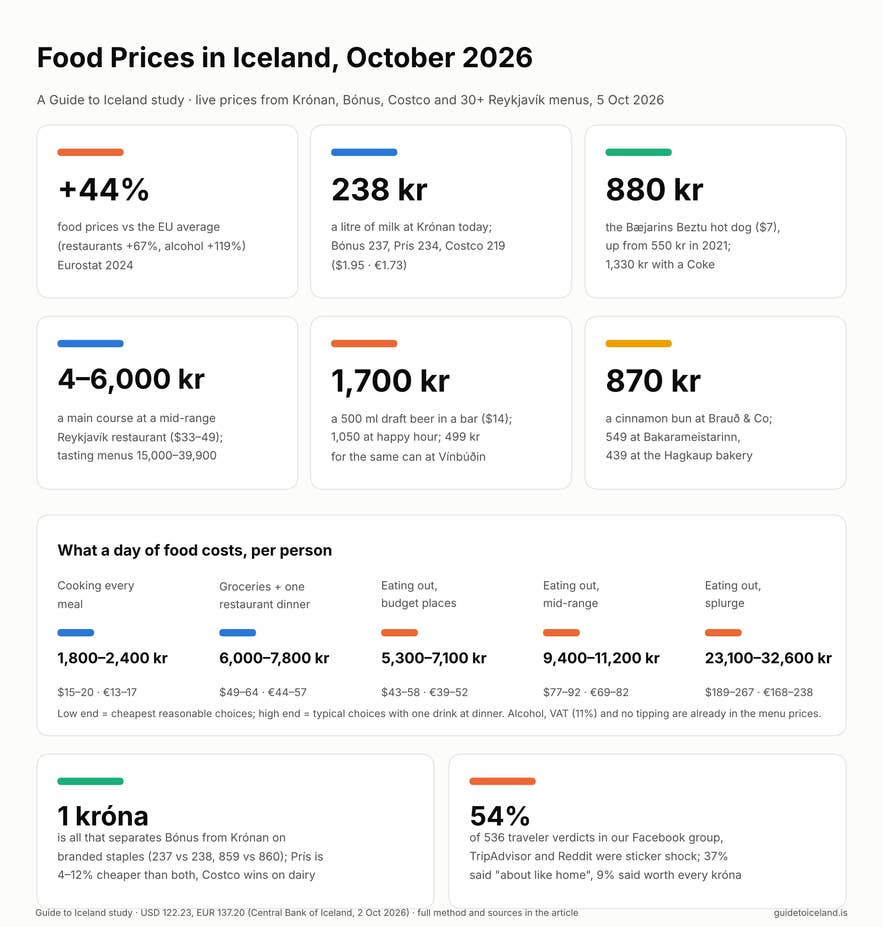
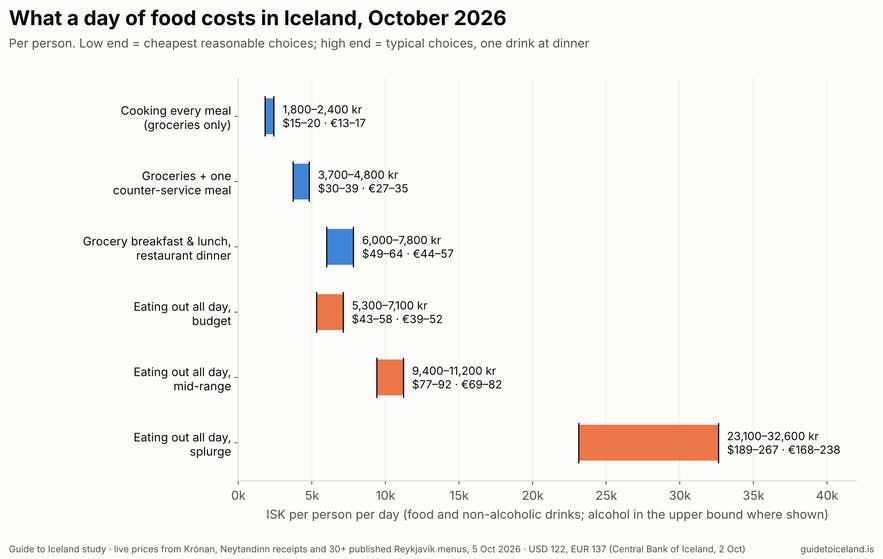
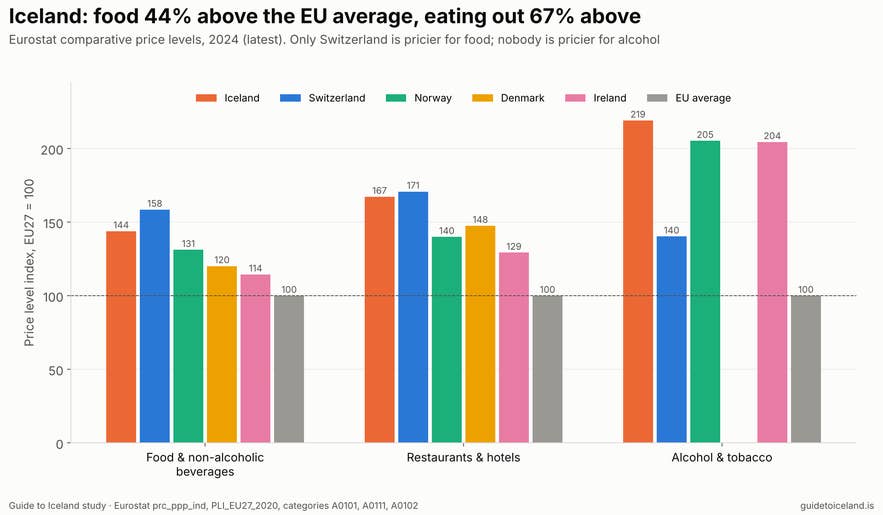
Food in Iceland costs about 44% more than the EU average, and eating out costs 67% more. That is the headline from Eurostat, and it is true. What it hides is how much of that bill is a choice. A traveler who cooks every meal spends 1,800 to 2,400 ISK a day (about $15 to $20). One who eats three restaurant meals at mid-range places spends 9,400 to 11,200 ISK ($77 to $92). Most people land somewhere in between, and this study shows exactly where each choice puts you.
We built it from live data rather than other people's estimates. On 5 October 2026 we pulled shelf prices straight from Krónan's online store, matched them against the most recent till receipts for Bónus, Prís and Costco submitted to the Icelandic price-tracking service Neytandinn, and read more than 30 published Reykjavík menus, from the hot dog stand by the harbor to Dill's tasting menu. Every number below is dated, and the full dataset is linked at the end.
If you are still deciding whether the trip itself fits your budget, start with our guide to how expensive Iceland is the study on the cheapest time to visit Iceland, and, if you are driving, our study of the cheapest month for a self-drive tour. This article is about one line in that budget: what you eat and drink.
Why Is Food So Expensive in Iceland?
Three things stack up. Iceland imports most of what is not dairy, lamb, fish or greenhouse vegetables, and everything arrives by ship or plane to a market of 400,000 people, so the volumes that keep European prices low never materialize. Wages are high: Statistics Iceland's September 2026 release puts restaurant prices up 4.4% in a year, and when the owner of Bæjarins Beztu raised the hot dog to 880 ISK in March he said labor was half his costs. And alcohol carries an excise duty of 156 ISK per centilitre of pure alcohol in beer, which is why Iceland tops Eurostat's alcohol price table for all of Europe, ahead of Norway.
The króna matters too: every price below is converted at 122 ISK to the dollar and 137 to the euro, and a 10% swing in the exchange rate moves your food bill by the same amount, which our guide to the Icelandic króna explains. For the bigger picture of why a small island economy prices the way it does, see our data study of the Icelandic economy.
Value-added tax is not the villain here. Food and restaurant meals are taxed at the reduced 11% rate, not the 24% standard rate, and that 11% is already included in every price on a menu or a shelf. There is no tipping culture to add on top either. The price you see is the price you pay.
The inflation picture in autumn 2026 is actually calmer than the headlines suggest. Food and non-alcoholic drinks rose 4.0% in the twelve months to September, while the overall consumer price index rose 5.9%, mostly on fuel. In late September Krónan froze prices on 647 products until the end of the year and Hagar, which owns Bónus and Hagkaup, cut prices on about 1,000 items by 2%. The grocery prices in this study already reflect those moves.
Cite This Study
The charts and data in this study are free to use under CC BY 4.0. Credit Guide to Iceland and link to this page. Every chart has an Embed button underneath it with ready-to-paste code.
How Much Do Groceries Cost in Iceland?
This is the chapter that saves you money. Iceland has three discount chains in the capital area, Bónus, Krónan and the newer Prís, and one Costco in Garðabær. Nettó and Hagkaup sit a step up, and the small convenience chains (10-11, Krambúð, the N1 petrol stations) are where visitors overpay without realizing it. Our guide to grocery stores in Iceland explains where each chain is and when it opens. Here we look only at what they charge.
The table shows a traveler's basket priced at Krónan on 5 October 2026 and the most recent Bónus receipt price on Neytandinn for the same product. Dollar and euro figures use the Central Bank of Iceland's reference rates from 2 October (122 ISK to the dollar, 137 to the euro).
| Item | Krónan (live) | Bónus (receipt, date) | USD | EUR |
|---|---|---|---|---|
| Whole milk, 1 L | 238 kr | 237 kr (3 Oct) | $1.95 | €1.73 |
| Skyr, plain, 500 g | 506 kr | 505 kr (22 Sep) | $4.14 | €3.69 |
| Icelandic butter, 500 g | 860 kr | 859 kr (4 Oct) | $7.04 | €6.27 |
| Eggs, large, 12 | 899 kr | 898 kr (Sep) | $7.35 | €6.55 |
| Cream, 500 ml | 806 kr | 805 kr (4 Oct) | $6.59 | €5.87 |
| Shredded cheese, 370 g | 1,090 kr | 1,089 kr (3 Oct) | $8.92 | €7.94 |
| Sandwich loaf, 770 g | 580 kr | 579 kr (3 Oct) | $4.75 | €4.23 |
| Hot dogs, pack of 10 | 1,139 kr | 1,138 kr (4 Oct) | $9.32 | €8.30 |
| Hot dog buns, 5 | 299 kr | 259 kr (2 Oct) | $2.45 | €2.18 |
| Chicken breasts, fresh, per kg | 2,769 kr | 2,768 kr (3 Oct) | $22.65 | €20.18 |
| Bananas, per kg | 338 kr | 337 kr (Sep) | $2.77 | €2.46 |
| Cucumber, 1 | 276 kr | 275 kr (3 Oct) | $2.26 | €2.01 |
| Carrots, 500 g | 599 kr | 529 kr (Sep) | $4.90 | €4.37 |
| Red bell pepper, per kg | 745 kr | 739 kr (Sep) | $6.10 | €5.43 |
| Potatoes, per kg | 598 kr | 349 kr (Sep) | $4.89 | €4.36 |
| Spaghetti, per kg | 460 kr | 284 kr (17 Sep) | $3.76 | €3.35 |
| Ham slices, 226 g | 919 kr | 959 kr (Jan) | $7.52 | €6.70 |
| Ground coffee, 500 g | 1,299 kr | — | $10.63 | €9.47 |
| Coca-Cola, 330 ml can | 126 kr | — | $1.03 | €0.92 |
| Lamb leg, per kg | 2,799 kr | — | $22.90 | €20.40 |
Read down the Bónus column and a pattern jumps out: 237 against 238, 859 against 860, 1,138 against 1,139. On nearly every branded staple Bónus sits exactly one króna under Krónan. Icelandic media noticed this years ago and it still holds in October 2026. For a visitor the two chains are interchangeable on price; pick whichever is closer. Where Bónus pulls clearly ahead is its own-brand and Euroshopper lines, which is why its potatoes, pasta and hot dog buns come in 15 to 40% cheaper.
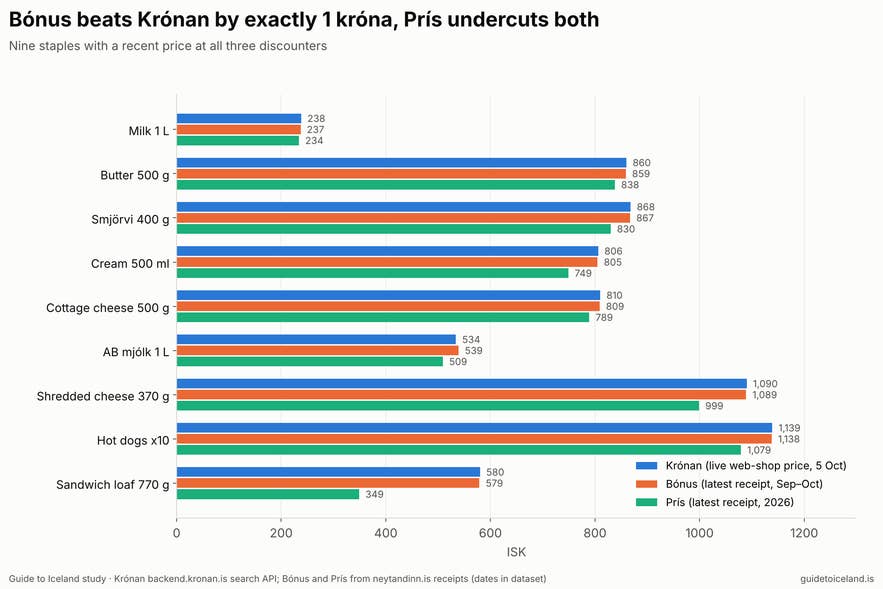
Prís is the one that changes the math. On the nine staples where all three discounters had a recent price, Prís was cheapest on every one, from 3 ISK less on milk to 231 ISK less on a sandwich loaf. The trade union federation ASÍ's August 2026 basket put Krónan at 19,522 ISK against 17,433 at Prís, a 12% gap. The catch is reach: Prís has a handful of stores around the capital, so it only matters if you are based in Reykjavík.
Costco is a different proposition. Receipts show it cheapest on dairy (milk 219 ISK, butter 848, cottage cheese 789), but you buy 24 eggs (1,699 ISK), a kilo of coffee beans (2,699) and two boxes of cereal at a time, and you need a membership that costs 4,800 ISK a year. For a two-week road trip with a kitchen it can pay off, especially combined with the cheapest fuel in the country. For a long weekend it won't.
Two local notes. Tap water in Iceland is some of the cleanest in the world, so the 130 ISK bottle of Icelandic Glacial on the Krónan shelf is a souvenir, not a necessity. And skyr, the thick Icelandic dairy product, is the best-value protein in the store at about 1,000 ISK per kilo; a 500 g tub makes three breakfasts.
Is the Quality Different Between Krónan, Bónus and Costco?
Price is a near tie, so the real difference between Iceland's two big discounters is what is on the shelf. An Icelander on our team puts it this way: fruit and vegetables are usually better at Krónan than at Bónus, with fresher stock and a wider range, while Costco carries the best seasonal fruit in the country when it has it.
Bread, meat, fish, dairy and packaged goods are much the same quality everywhere, because most of it comes from the same handful of Icelandic producers: MS and Arna for dairy, Myllan for bread, SS and Norðlenska for meat.
Travelers in our Facebook group, Iceland Travel Tips, say the same thing in their own words. "Bónus is not as cheap as it used to be. I recommend Krónan, similar price but much, much nicer product, fruit, vegetables, meat and a much larger range of dry foods," wrote one member in July 2026. Others found Krónan "has a better selection" and was the only one of the two to stock gluten-free bread, though one family who swore by Bónus reported "the produce there was so fresh, it was a treat." Costco's September receipts on Neytandinn show what its members go there for: 2 kg bags of easy-peel clementines at 999 ISK, Royal Gala apples at 1,399, a kilo of mixed tomatoes at 1,399 and fresh figs at 1,499, prices and quantities no supermarket matches.
The practical version: do the main shop at whichever discounter is nearest, but if you want good produce for a week of picnics, make it Krónan, and if you have a Costco card and a car, stop in Garðabær on the way from the airport for fruit, bread and fuel. For everything else the three are interchangeable, and a visitor who buys skyr, rye bread, butter and smoked lamb at any of them is getting the same product a local gets.
How Much Does It Cost to Eat Out in Iceland?
Reykjavík's food scene runs from an 880 ISK hot dog to a 39,900 ISK tasting menu, and the middle is where most travelers eat. We grouped the menus we read into four tiers.
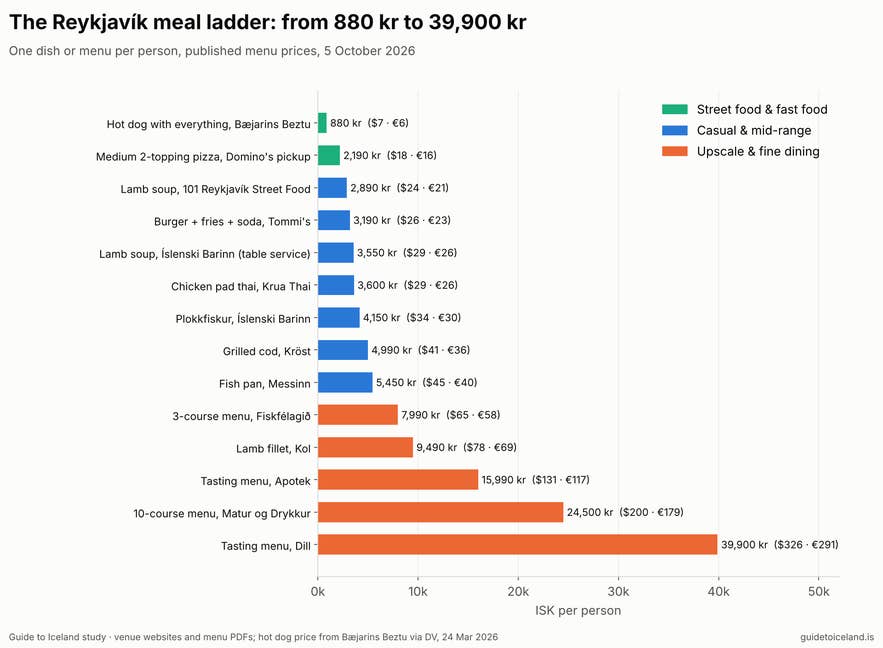
Street food and fast food, 880 to 2,200 ISK. The famous hot dog at Bæjarins Beztu Pylsur costs 880 ISK, or 1,330 with a Coke, after a March 2026 rise that made international news. A lamb shawarma at Mandi is 2,090 and a medium two-topping Domino's pizza on pickup 2,190. Krua Thai on Skólavörðustígur, a long-standing local favorite for a cheap hot sit-down meal, charges 3,400 for a noodle soup, 3,600 for a chicken pad thai and 3,650 for a green curry with rice, with kids' plates at 1,890. Tommi's Burger Joint sells the plain Tommaborgari for 1,290, but a burger with fries and a drink is 3,190.
"Aside from the hot dog, the best budget options to eat in Reykjavík are the lamb shawarma at Arabian Taste on Laugavegur and Krua Thai on Skólavörðustígur. Both are places locals actually eat at, and both fill you up for a fraction of a restaurant main."
Ingólfur Shahin, CEO of Guide to Iceland
Casual and counter-service, 2,900 to 4,200 ISK. This is the sweet spot for a hot sit-down lunch. Icelandic lamb soup (kjötsúpa) is 2,890 at 101 Reykjavík Street Food and 3,550 at the table-service Íslenski Barinn, which also does the national fish-and-potato mash plokkfiskur for 4,150. A burger with fries at Hamborgarafabrikkan is 3,399, a sandwich and juice combo at Lemon 2,590 to 2,990.
Mid-range restaurants, 4,000 to 6,000 ISK for a main. At Messinn, the fish-pan specialist on Lækjargata, the plokkfiskur pan is 5,450 and the arctic char or salmon pans 5,900. Kröst in the Hlemmur food hall grills cod for 4,990. Lamb shank at Íslenski Barinn is 5,850. Expect 1,700 to 1,900 for a draft beer with it and 1,800 to 2,300 for a glass of wine, which is why a mid-range dinner with one drink lands at 6,000 to 8,000 ISK a head.
Upscale and fine dining, 8,000 ISK and up. Fiskfélagið's three-course Fish Festival menu is 7,990, a grilled lamb fillet at Kol 9,490, the tasting menus at Apotek and Grillmarkaðurinn 15,990 and 16,990. The two restaurants at the top of the city's list are Matur og Drykkur (10 courses, 24,500) and Michelin-starred Dill (39,900, plus 21,300 for the wine pairing). The Lava restaurant at the Blue Lagoon charges 14,900 for its four-course menu; if that is in your plans, our Blue Lagoon timing study covers when to book.
| Meal | Venue | ISK | USD | EUR |
|---|---|---|---|---|
| Hot dog with everything | Bæjarins Beztu Pylsur | 880 | $7 | €6 |
| Medium 2-topping pizza, pickup | Domino's | 2,190 | $18 | €16 |
| Lamb soup | 101 Reykjavík Street Food | 2,890 | $24 | €21 |
| Burger, fries and soda | Tommi's Burger Joint | 3,190 | $26 | €23 |
| Chicken pad thai | Krua Thai | 3,600 | $29 | €26 |
| Tomato soup buffet | Friðheimar | 3,740 | $31 | €27 |
| Plokkfiskur | Íslenski Barinn | 4,150 | $34 | €30 |
| Fish pan | Messinn | 5,450 | $45 | €40 |
| Three-course menu | Fiskfélagið | 7,990 | $65 | €58 |
| Tasting menu | Apotek | 15,990 | $131 | €117 |
| Tasting menu | Dill | 39,900 | $326 | €291 |
Outside Reykjavík the tiers compress. Along the Ring Road the choice is usually a petrol-station grill (our guide to gas stations in Iceland covers which chains have proper kitchens), a guesthouse kitchen and one or two restaurants per town, and a main course of 4,000 to 6,000 ISK is normal even in modest places because there is no cheap tier underneath. The one destination lunch worth planning for is Friðheimar on the Golden Circle, where the tomato soup and bread buffet is 3,740 ISK and the greenhouse is the attraction.
What Do Coffee, Pastries and Ice Cream Cost?
Iceland drinks more coffee per head than almost anywhere, and the café bill reflects a high-wage country rather than an expensive bean. A cappuccino at Sandholt is 750 ISK, a latte 850, a filter coffee 650, and Messinn charges 650 for a cappuccino. Budget about 700 to 850 ISK ($6 to $7) for an espresso drink in central Reykjavík.
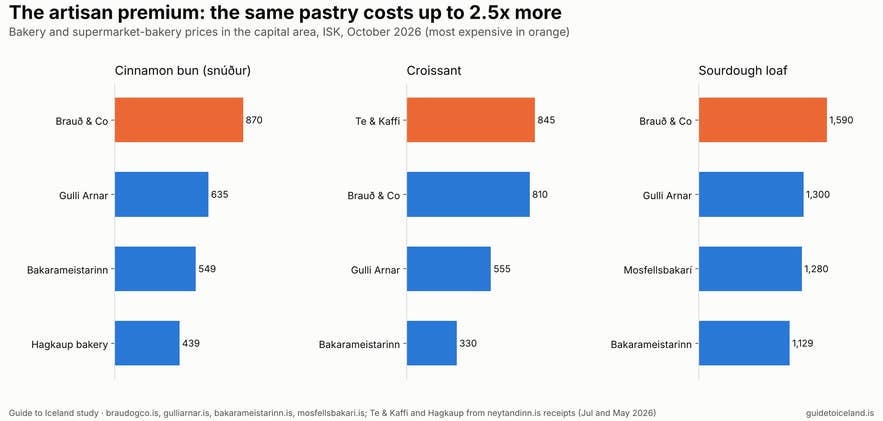
Pastries split sharply between artisan and everyday bakeries. A cinnamon bun (snúður) is 870 ISK at Brauð & Co, the sourdough bakery with the painted facade on Frakkastígur, 635 at Gulli Arnar, 549 at the Bakarameistarinn chain and 439 at the Hagkaup supermarket bakery. A croissant is 810 at Brauð & Co and 330 at Bakarameistarinn. A sourdough loaf is 1,590 at Brauð & Co, 1,280 at Mosfellsbakarí and 1,129 at Bakarameistarinn. The artisan places are worth it once; for a week of breakfasts, the chain bakeries and supermarket counters do the job at half the price.
Sit-down breakfast at a café costs real money. Sandholt's sourdough toast with jam and butter is 1,390, skyr with granola 1,490, shakshuka 3,290, and a coffee pushes any of those past 2,000 ISK. Buy the croissant and the coffee separately and you are at 1,560; buy skyr, a banana and bread at Bónus and the same breakfast is about 360.
Ice cream is the one treat Icelanders queue for in a snowstorm. At Valdís on the old harbor a single scoop is 950 ISK and two scoops 1,400; a kid's cone at Ísbúð Vesturbæjar showed up on a receipt at 540. Deig's bagels are 350 plain and 990 filled, which makes a filled bagel one of the cheapest proper lunches in the city.
How Much Is a Beer in Iceland?
A 500 ml draft of Gull or Víking in a Reykjavík bar costs 1,700 to 1,900 ISK ($14 to $16) at regular prices. The same 500 ml can is 499 ISK (Gull) or 363 ISK (Víking Lager) at Vínbúðin, the state liquor store, and supermarkets only sell beer under 2.25% alcohol. So the bar markup is roughly 3.5 times, and the single best money-saving habit in Iceland is happy hour: most bars run one from about 16:00 to 19:00, and Kaffibarinn's 15:00 to 20:00 window drops a Gull from 1,700 to 1,050.
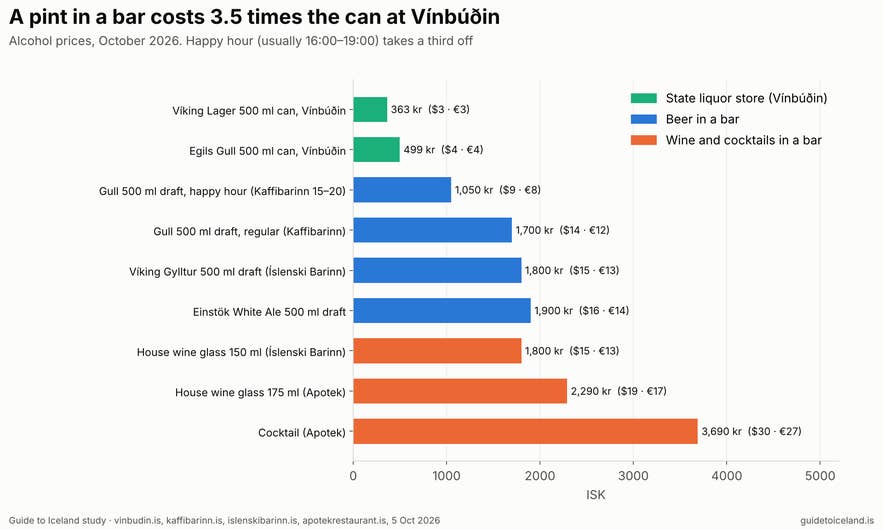
Wine and spirits follow the same logic. A 150 ml glass of house wine is 1,800 ISK at Íslenski Barinn and 2,290 for 175 ml at Apotek; the bottle those glasses come from is 7,200 to 8,990 in the restaurant and about 1,700 to 2,000 at Vínbúðin. A cocktail at Apotek is 3,690. A 700 ml bottle of Brennivín, the caraway schnapps, is 8,499 at Vínbúðin and Reyka vodka 8,999. If you want to drink more than one or two a night, the duty-free shop at Keflavík on arrival is the cheapest alcohol in the country; our guide to Icelandic liquor covers the allowances.
How Much Should You Budget for Food per Day in Iceland?
We priced six eating styles per person per day using the live prices above. Grocery figures price the portions you eat at Krónan (Bónus is a króna less); the restaurant figures use the venues in this study. The low end of each range is the cheapest reasonable version of that style, the high end the typical one with one alcoholic drink at dinner where it applies.
| Eating style | ISK per day | USD | EUR | What it buys |
|---|---|---|---|---|
| Cooking every meal | 1,800–2,400 | $15–20 | €13–17 | Skyr and bread breakfast, ham and cheese sandwich lunch, chicken pasta or hot dogs for dinner, a Coke and some chocolate |
| Groceries plus one counter-service meal | 3,700–4,800 | $30–39 | €27–35 | Grocery breakfast and lunch, shawarma, pizza or a Thai curry for dinner, happy-hour beer at the top end |
| Grocery breakfast and lunch, restaurant dinner | 6,000–7,800 | $49–64 | €44–57 | The most common pattern for self-drive travelers: picnic by day, a 5,000 ISK main at night, a draft beer at the top end |
| Eating out all day, budget | 5,300–7,100 | $43–58 | €39–52 | Bakery coffee and bun, hot dog and Coke or counter lunch, cheap-tier dinner |
| Eating out all day, mid-range | 9,400–11,200 | $77–92 | €69–82 | Café breakfast, 2,900 ISK soup lunch, mid-range main with one drink |
| Eating out all day, splurge | 23,100–32,600 | $189–267 | €168–238 | Café breakfast, Sandholt or three-course lunch, tasting menu with wine |
Food is one of the few trip costs that does not change with the season. Car rental and hotels do: a self-drive package costs about a third less per day in April than in August according to our self-drive pricing study, our booking-price study finds the same seasonal swing in car and hotel rates, and the cost of renting a car in Iceland is usually the second-largest line after flights. So a traveler who wants to spend more on food has the most room to do so in the shoulder months.
Two adjustments make these realistic. First, groceries come in packs. The 1,800 to 2,400 ISK figure is what the food you eat costs; on a short trip you buy a whole 500 g butter and a 10-pack of hot dogs whether or not you finish them, so a couple on a five-day self-catering trip should plan on 2,500 to 3,500 ISK per person per day and expect leftovers. Second, children eat for roughly half in restaurants (kids' menus run 1,500 to 2,200 ISK) and for a third on groceries.
For a week, the gap between the two most common styles is large. Seven days of grocery breakfast and lunch plus a restaurant dinner comes to 42,000 to 55,000 ISK per person ($345 to $450). Seven days of eating out at mid-range places comes to 66,000 to 78,000 ISK ($540 to $640). The difference, roughly 24,000 ISK, is a glacier hike or a whale watching tour.
What Do Other Travelers Say About Food Prices in Iceland?
Prices are one half of the picture; how they land on real visitors is the other. We read 1,193 posts and comments about Iceland food and grocery costs from three places: 182 posts in 46 TripAdvisor forum threads (2024 to October 2026), 93 comments in the two most-read r/VisitingIceland threads (December 2023 and August 2025), and 918 posts and comments in our own Facebook group, Iceland Travel Tips, between late June and early October 2026. Each was coded for its verdict on prices and for any money-saving advice it gave.
Of the 536 posts that voiced an opinion, 291 (54%) were sticker shock. "Dinners were considerably more expensive than New York City. That surprised me," wrote a New Yorker in June 2026. A Canadian on Reddit in August 2025: "Whatever you think it should cost, just know that it will probably be a bit over double." A British visitor in November 2025 caught the typical tone: "It's bloody expensive here. Meals, drinks, even little things like fridge magnets will set you back over a fiver. But it hasn't put me off at all."
The second camp is bigger than the stereotype suggests. 197 posts (37%) called prices expensive but manageable, and on Reddit this was the majority view: "Groceries were about the same as home. Some things more, some things less. An entree at a sit down restaurant was $40 CAD and up. A pint of beer was $15 CAD." A couple from New York City "kept laughing while we were there because if anything, Iceland was a bit less expensive than NYC." The most upvoted answer in the 2023 thread put the budget at "about 20 euros each for a quick bite and 40 euros each for a sit-down dinner, not including drinks," which is 8,200 ISK at today's rate and sits inside our mid-range estimate. A further 48 posts (9%) argued the food was worth the money, mostly from repeat visitors: "In 9 trips so far we have never had a bad meal."
The split played out in one thread on 5 October 2026. A member of our Facebook group posted a "tip of the day": please don't eat at your hotel's breakfast buffet and then make four sandwiches to take away, "food is not that expensive here." It drew 267 comments in a day. The most-liked reply, from an Icelander, read: "By the power vested in me by my little blue Icelandic passport, I hereby authorize everyone to make as many sandwiches as possible at the hotel breakfast buffet. You've paid for it and yes, food IS that expensive here." Another local split the difference: "Food is that expensive here but still don't do that." Hotels, for their part, often sell a packed lunch from the buffet for a small fee, which is the version nobody argues about.
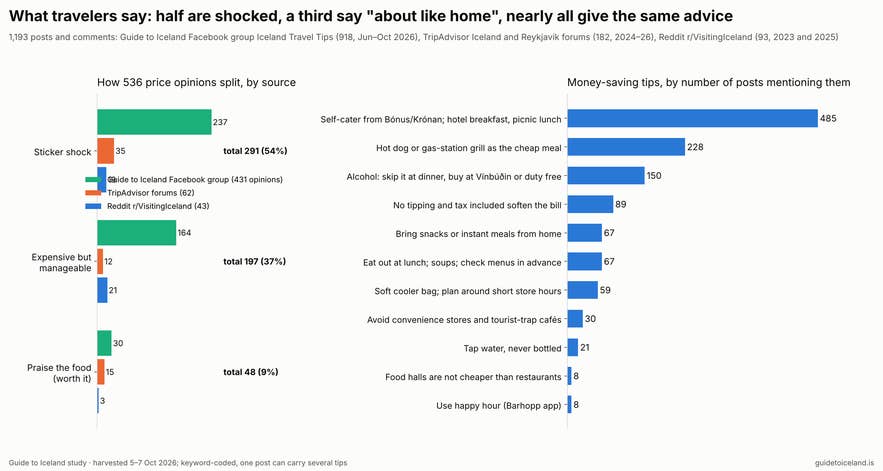
The three communities read the same prices differently. TripAdvisor's posters, older and more often first-time visitors, lean to shock. Reddit's, who compare with Toronto, New York or Los Angeles, more often shrug: "these prices are sadly pretty much the same in Los Angeles." The Facebook group sits in between and has worked out the conversion that makes the bill feel smaller: "3,900 ISK for a burger feels like a lot, but back out 20% tip and 7% tax that you would pay in the US and it's about $24." Another member's rule of thumb, with 392 likes: drop the last two digits of the króna price and subtract 20%, so 5,000 ISK is roughly $40. Because the 11% VAT is already in the menu price and nobody tips, a $110 restaurant bill in Iceland is "like a $70 to $75 meal" at home, as one Canadian put it.
The advice is remarkably consistent, and it matches the live prices. In the three communities together, 485 posts recommend self-catering from Bónus or Krónan, usually as a daily rhythm: a big included hotel breakfast, a picnic or supermarket lunch, and one proper dinner. A Texan traveler put the saving at "about 20% of what eating out did," close to our 1,800 to 2,400 ISK against 9,400 to 11,200 ISK. A Canadian family of four "stuffed my bag with instant noodles" for three dinners and reckoned it saved $500 CAD. The Facebook group's own numbers back that up. One traveler spent about $57 at Bónus and got "4 breakfasts, 3 lunches and 3 dinners" out of it, roughly 700 ISK a meal. A family of four with two teenagers fed themselves for a week on sandwich ham, Gouda, a sliced loaf, bulk pasta and a jar of sauce from Bónus, eating out only for the hot dogs and one tomato-soup lunch. At the other end, members who ate one restaurant meal a day reported about $100 per person per day, and a couple who did not count pennies put food and drink at $200 to $300 a day for two. Krua Thai came up unprompted as the budget sit-down pick in Reykjavík, for its take-away offers of about 6,000 ISK that feed two to four. Fifty-four posts discuss alcohol, and the consensus is to skip it at dinner and buy at Vínbúðin or at the departure airport's duty free; Icelanders in the 2026 threads were openly critical of the Keflavík arrivals duty free after a franchise change. Twenty-nine name the hot dog, a gas-station grill or a cheap Asian place as the hot meal that won't break the day ("You won't eat much cheaper than a pylsa from an N1 service station. Lamb soup is popular and good value too"), and twenty-one mention packing a thin soft-sided cooler bag and planning around supermarket hours, which outside Reykjavík are often 10:00 or 11:00 to 18:00.
A few warnings recur that first-time visitors rarely hear. Food halls are not a budget option: "Hlemmur Mathöll was absolutely no cheaper than the average restaurant here in Reykjavik." Convenience stores and tourist-street cafés are where the money disappears; a Reykjavík local's rule was "unless you own an oil-field then avoid the Kjorbudin and Krambudin," and a 2025 Reddit argument over a 9,800 ISK bill for two bagels and two drinks ended with locals pointing out that a lunch deal is 2,500 to 3,500 ISK and "3,000 to 3,500 is completely normal." Breakfast out barely exists outside the capital ("Icelanders eat their breakfast at home like other Europeans"), so travelers who need a café breakfast should plan for bakeries like Sandholt and Brauð & Co or buy skyr the night before. And lunch and dinner menus are often identical, so the "eat your big meal at lunch" trick only works at places with a separate lunch card, such as Messinn, Kol and Flatey.
The "should I bring snacks from home" question is asked every week in the Facebook group and divides it. The practical answer from Icelandic members is that packaged snacks are fine but meat and dairy are not (customs allows up to 10 kg of sealed, labelled food), and that "shopping at the grocery store is comparable in price to a lot of places, so you won't be saving money by bringing in granola bars and dried fruit." Where visitors do get caught is alcohol: $38 for a twelve-pack at Vínbúðin, and a reminder from several locals that the supermarket cans are 2.25% beer.
One last data point from the older Reddit thread shows how fast the floor has moved. In autumn 2021 visitors reported two burgers, fries and two sodas for $50 and a "gourmet 4 course meal at a nice restaurant" at 8,900 ISK, and Bæjarins Beztu had just raised its hot dog to 550 ISK. Five years later the hot dog is 880 ISK and comparable tasting menus run 14,900 to 16,990 ISK. Food inflation has slowed to 4% a year, but the 2021 to 2024 run-up is baked into every price in this article.
How to Eat Well in Iceland for Less
The live prices and the forum veterans agree on the playbook. Shop at Bónus, Krónan or Prís and skip the convenience stores; a 10-11 or petrol-station price is often double. Buy skyr, rye bread, smoked lamb and local dairy, which are the things Iceland produces and prices sensibly, and go easy on imported fresh produce in winter. Make lunch your restaurant meal: lunch menus at places like Kol (fish of the day 4,690 against 6,690 at dinner) and Flatey Pizza (weekday lunch pizza 2,790) cut 20 to 30% off the evening price. Drink tap water, hit happy hour, and buy alcohol at Keflavík duty free on the way in. And book accommodation with a kitchen, because the single biggest lever in this whole study is the 6,000 ISK difference between a cooked dinner and a restaurant one. Our itinerary for a week in Iceland on a budget puts all of this into a day-by-day plan.
How We Did This Study
Grocery prices for Krónan were pulled on 5 October 2026 from the search endpoint behind Krónan's online store, which returns the live shelf price, unit price and sale status for every product. Bónus, Prís, Costco and other chains do not publish grocery prices online, so we used Neytandinn, a crowdsourced Icelandic price database built from more than 280,000 scanned till receipts, taking the most recent receipt per chain for each product matched by barcode. Where Neytandinn also held a recent Krónan receipt it matched Krónan's live price to within one króna on every product checked, which is our validation that the Bónus receipt prices are reliable. Receipt dates are given in the dataset; most Bónus prices are from 2 to 4 October 2026 and Costco prices from late September.
Restaurant, café, bakery and bar prices come from the venues' own websites, online-ordering pages and menu PDFs, read on 5 October 2026. The Bæjarins Beztu hot dog price is from the stand's owner as reported by DV on 24 March 2026, since the stand publishes no prices online. Alcohol retail prices are from Vínbúðin. Where a venue had no public menu (KFC, Subway, Sægreifinn, several food-hall stalls) we left it out rather than estimate.
Context figures are from Statistics Iceland's September 2026 consumer price index, Eurostat's comparative price levels (prc_ppp_ind, 2024), the Central Bank of Iceland reference rates of 2 October 2026 (USD 122.23, EUR 137.20, GBP 161.35), Iceland Revenue and Customs for VAT and alcohol duty, and ASÍ's price monitoring as reported by Vísir. Per-day budgets price actual portions (for example 170 g of skyr from a 500 g tub) and round to the nearest 100 ISK.
Traveler sentiment comes from 1,193 posts and comments: 182 in 46 threads on the TripAdvisor Iceland and Reykjavík forums, found by scanning the April to September 2026 forum indexes and searching for 2024 and 2025 price threads, harvested on 5 October 2026, plus 918 posts and comments from our Facebook group Iceland Travel Tips between 25 June and 6 October 2026 (exported with Apify; only posts and comments mentioning both food and a price or cost were coded), plus 93 comments from the r/VisitingIceland threads Updated food prices (August 2025) and Iceland prices (December 2023), exported as JSON; a 2021 thread was read for the then-versus-now comparison only. Each post was keyword-coded for sentiment (sticker shock, expensive but manageable, praises the food) and for nine money-saving tip themes; a post can carry several tips. Quotes are verbatim; Reddit usernames are omitted.
Limits: Neytandinn depends on volunteers, so Costco and out-of-town prices are sparser and older than Bónus prices. Menu prices change several times a year and the figures here are a snapshot. Restaurant prices outside Reykjavík were not systematically sampled.
Frequently Asked Questions About Food Prices in Iceland
Is food expensive in Iceland?
Yes. Eurostat puts Icelandic food prices 44% above the EU average and restaurant prices 67% above. In October 2026 a litre of milk is 238 ISK ($1.95), a mid-range restaurant main 4,000 to 6,000 ISK ($33 to $49) and a pint of beer in a bar 1,700 to 1,900 ISK ($14 to $16).
How much is a meal in Iceland?
A hot dog is 880 ISK, a counter-service lunch 2,900 to 3,500 ISK, a main course at a mid-range restaurant 4,000 to 6,000 ISK, and a tasting menu 15,000 to 40,000 ISK. Add 1,700 to 2,300 ISK per alcoholic drink.
How much should I budget for food per day in Iceland?
About 2,500 to 3,500 ISK ($20 to $29) a day if you cook everything, 6,000 to 7,800 ISK ($49 to $64) if you self-cater by day and eat out at night, and 9,400 to 11,200 ISK ($77 to $92) for three mid-range restaurant meals.
Which supermarket is cheapest in Iceland?
Prís is cheapest on the staples we compared, 4 to 12% below Krónan according to ASÍ's 2026 surveys, but it has few stores. Bónus and Krónan are effectively tied, with Bónus one króna cheaper on most branded items. Costco is cheapest on dairy but sells in bulk and needs a 4,800 ISK membership.
How much is a beer in Iceland?
1,700 to 1,900 ISK ($14 to $16) for 500 ml of local draft in a Reykjavík bar, about 1,050 to 1,200 ISK during happy hour, and 363 to 499 ISK for a 500 ml can at the state liquor store Vínbúðin.
Is it worth eating out in Iceland?
Most travelers on the forums say yes once they adjust expectations: about half of the 536 opinions we coded were sticker shock, over a third said prices were close to home for people from big North American cities, and 9% praised the food outright; repeat visitors report never having had a bad meal. The common pattern is to self-cater by day and spend on one good dinner.
Do you tip in Iceland?
No. Service and 11% VAT are included in menu prices. Tipping is appreciated but never expected.
Can I drink tap water in Iceland?
Yes, everywhere. It is glacial groundwater and among the cleanest in the world. Bottled water costs 130 to 300 ISK and is unnecessary.
Keep Planning
Now that you know what a day of food costs, see how many days you need in Iceland to size the whole budget, find the cheapest time to visit and the cheapest month for a self-drive, compare airlines to Iceland by country and flight prices, check the best and worst months to visit, find the grocery stores near your route, and read our Krónan review for what to buy once you are inside. Then browse accommodation with a kitchen, because that is where the saving starts.

Guide to Iceland Editorials is the shared byline for our content team. We use it on pieces several people worked on together, where no single writer owns the article, and on anything rewritten often enough that a personal byline would be misleading. We also publish our original data studies under this profile. Each study answers a question travelers ask about Iceland, using primary sources such as booking records, traveler reviews and public datasets, and every study is quality checked by human experts before it's published. Everything under this byline is researched and reviewed by people who live and work in Iceland. If you spot something out of date or want to suggest a correction, message us and it reaches the whole team.