The Icelandic national costume, Þjóðbúningurinn, is the traditional Icelandic clothing still worn today at Independence Day, weddings, and cultural events. Learn about the traditional styles, what they symbolize, and where to spot them on your trip to Iceland.
Iceland’s traditional costume is a family of distinct styles known together as Þjóðbúningurinn, and is one of the country’s most iconic national symbols. It includes five main women’s versions and two men’s variants, each with its own silhouette, history, materials, and level of formality.
The national costume of Iceland offers travelers a way to experience Icelandic culture beyond the top places to visit. On trips to Iceland, you’ll see people in costumes on major public holidays such as the National Day, and they’re the highlights of museums and exhibitions around the country.
Why You Can Trust Our Content
Guide to Iceland is the most trusted travel platform in Iceland, helping millions of visitors each year. All our content is written and reviewed by local experts who are deeply familiar with Iceland. You can count on us for accurate, up-to-date, and trustworthy travel advice.
This traditional Icelandic clothing is closely tied to Iceland’s independence movement, one of the most important chapters in Iceland’s history, and is still handmade by skilled craftspeople using centuries-old techniques.
It’s common for Icelanders to sew their own costumes with guidance from experts, and they’re worn on special occasions like weddings, graduations, and festivals across Iceland.
This guide covers the different versions of the Icelandic national costume and how to tell them apart, the artists and craftspeople who keep the tradition alive, and exactly where and when visitors can see Þjóðbúningurinn worn in Iceland today.
Key Takeaways About the Icelandic National Costume
-
Þjóðbúningurinn is the collective name for Iceland’s traditional national costumes, which include several distinct women’s and men’s styles rather than one single outfit.
-
The five main women’s costumes are faldbúningur, peysuföt, upphlutur, skautbúningur, and kyrtill, each with its own history, design, and level of formality.
-
The most commonly worn costumes today are the upphlutur and peysuföt.
-
The national costume is closely tied to Iceland’s 19th-century independence movement, when it became an important symbol of Icelandic identity and heritage.
-
Traditional Icelandic costumes feature detailed embroidery, silver jewelry, wool fabrics, and handmade craftsmanship passed down through generations.
-
The Fjallkona, or Lady of the Mountain, traditionally wears skautbúningur or kyrtill during Iceland’s June 17 Independence Day celebrations.
-
Travelers can see Icelandic national costumes at museums, cultural festivals, and during Independence Day celebrations.
-
The Icelandic lopapeysa wool sweater is not part of the national costume, but it is sometimes referred to as an unofficial national costume.
-
Outside Iceland, descendants of Icelandic emigrants also wear the costumes to celebrate their heritage at special events, especially in Manitoba, Canada.
What Is the Icelandic National Costume?
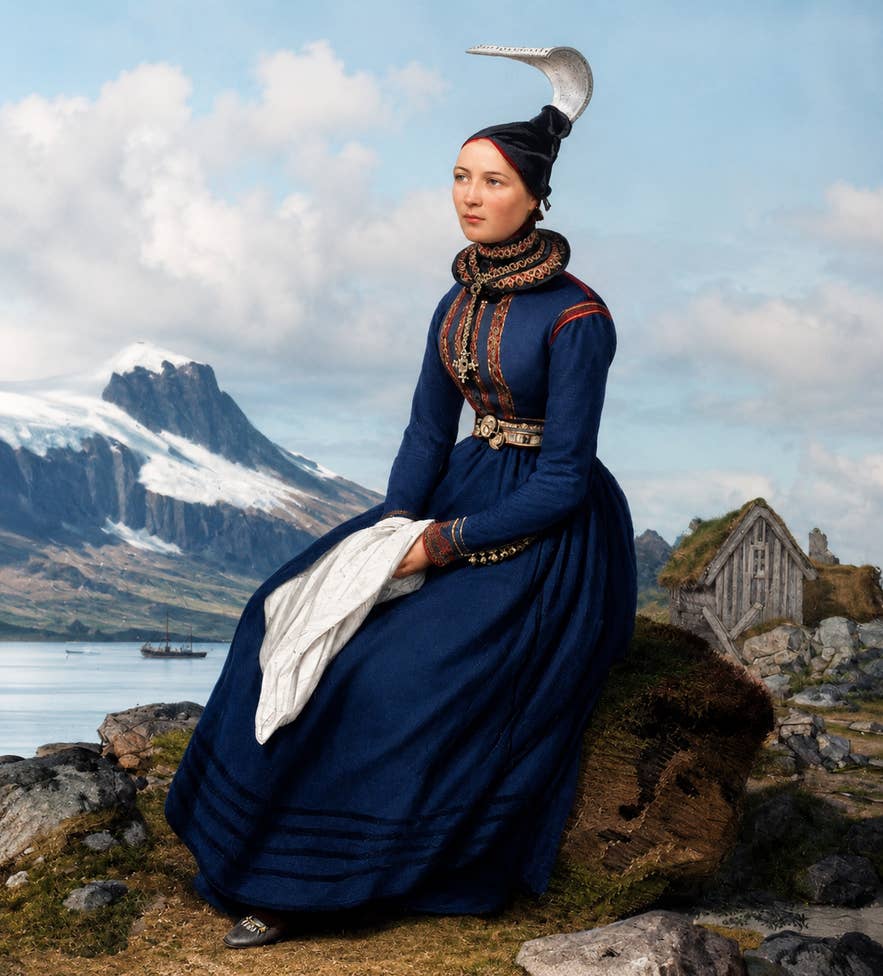
Colorized image, based on an 1836 drawing of Málfríður Sveinsdóttir wearing a faldbúningur.
The Icelandic national costume is called Þjóðbúningurinn, which roughly translates as “the national costume.” Rather than a single outfit, it’s an umbrella term covering a family of specially designed costumes inspired by traditional Icelandic clothing styles.
There are five recognized women’s national costumes, faldbúningur, peysuföt, upphlutur, skautbúningur, and kyrtill, and two main men’s variants. Some grew out of everyday rural dress from the 17th and 18th centuries, while others were designed in the 19th century as formal ceremonial wear tied to Iceland’s independence movement.
Today, Þjóðbúningurinn is still made and worn by Icelanders for weddings, confirmations, graduations, folk performances, and most visibly during Iceland’s Independence Day on June 17.
Traditional Icelandic Clothing That Inspired the National Costume
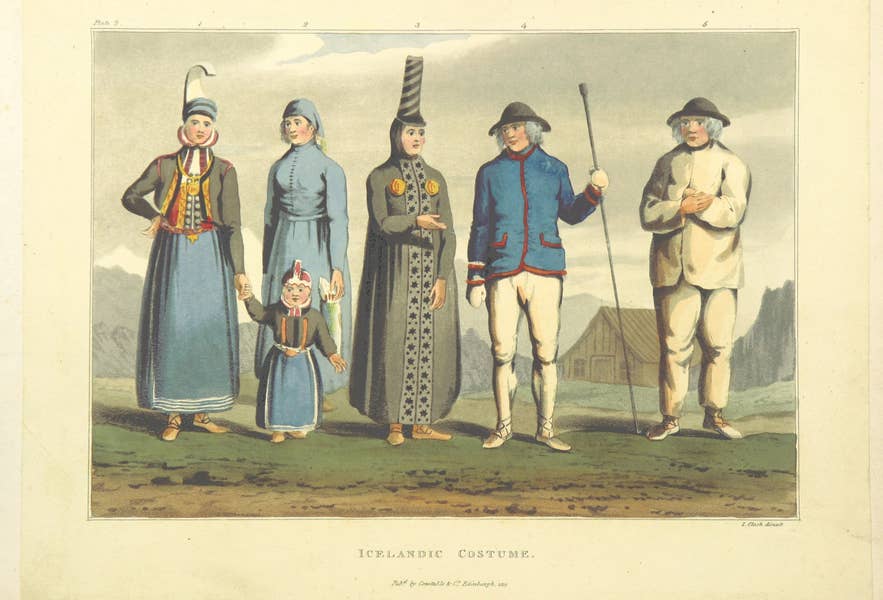
A drawing of Icelandic clothing in 1811 that appeared in “Travels in the Island of Iceland, during the summer of the year 1810,” digitized by the British Library.
Before a formal national costume existed, Icelanders wore clothing shaped by centuries of self-sufficiency, a wool-based economy, and near-complete isolation from European fashion trends.
Women spun and wove vaðmál, a dense, weather-resistant homespun wool cloth, and knitted clothing from wool. The fabrics were then dyed a variety of colors using the natural flora of Iceland.
The national costumes were inspired by 17th and 18th-century dress. For women, that was layered everyday outfits built around an underdress or shirt, a fitted vest, a skirt, and an apron.
Women covered their hair in a tall, white headdress, while girls wore a knitted hat with a single tassel. This style of hat would later become popular with adult women in the 19th century.
Men’s everyday dress from the 17th century onward centered on wool breeches, a vest, and a double-buttoned wool jacket called a treyja. These same core garments would later form the basis of the men’s traditional costume in Iceland.
These clothes were practical and passed down through families, rooted in the realities of Icelandic farm and coastal life. The silhouettes, fabrics, and layering of this rural dress later inspired the artists and cultural reformers who created Þjóðbúningurinn in the 19th century.
The Women’s National Costumes of Iceland
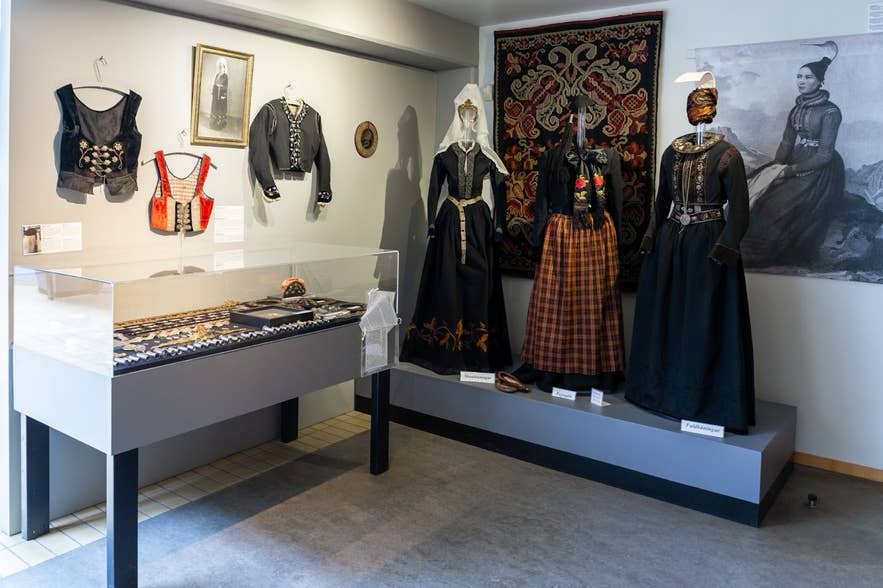
The women’s costumes are the best-known part of the Icelandic national costume tradition. They range from older everyday garments to highly formal ceremonial dress. The five recognized versions are faldbúningur, peysuföt, upphlutur, skautbúningur, and kyrtill.
For travelers, learning to recognize these costumes makes public celebrations and museum visits far more rewarding. A woman in a black jacket and skirt with a small tail-cap and a silk bow is wearing peysuföt, while a woman in a richly embroidered dark dress with a tall white headdress is wearing skautbúningur. A colorful bodice with silver clasps points to upphlutur, today the most popular version among young women.
Faldbúningur
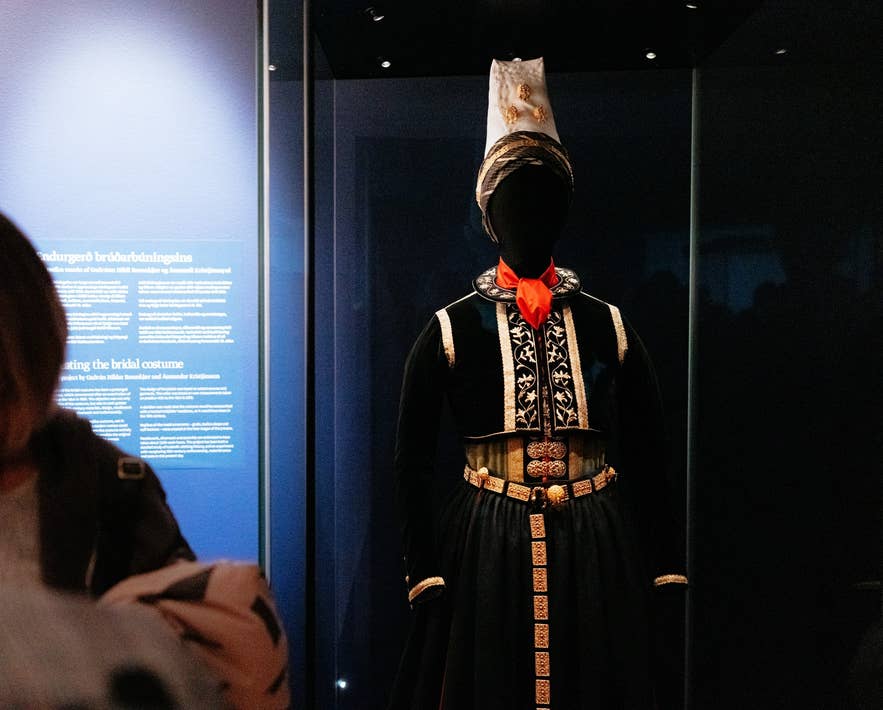
Photo from the National Museum of Iceland, a Faldbúningur at the temporary exhibition “A Voyage in History - The Bridal Costume” (May 9, 2026 - May 9, 2027)
The faldbúningur is the oldest of the main women’s national costumes. It was worn from at least the 17th century and remained in use into the 19th. Its name comes from the faldur, the distinctive headdress worn with the costume.
The headdress changed over time. Earlier versions paired a large gold-banded hat with a stiff ruff, which is why the faldbúningur has its characteristic wide collar. The collar was originally designed to support the ruff. By the 18th century, the curved krókfaldur appeared, and in the 19th century the flatter, spatula-shaped spaðafaldur took over. From around 1700, women also began wearing the smaller skotthúfa tail-cap with simplified versions of the outfit.
The faldbúningur usually includes a long wool skirt, a bodice, an apron, an embroidered shirt, and rich decoration. Dark colors such as black and deep blue are common, often with silk and metal-thread embroidery. Today, visitors are most likely to see faldbúningur in museum collections, historical drawings, or special ceremonial contexts rather than on the street.
Peysuföt
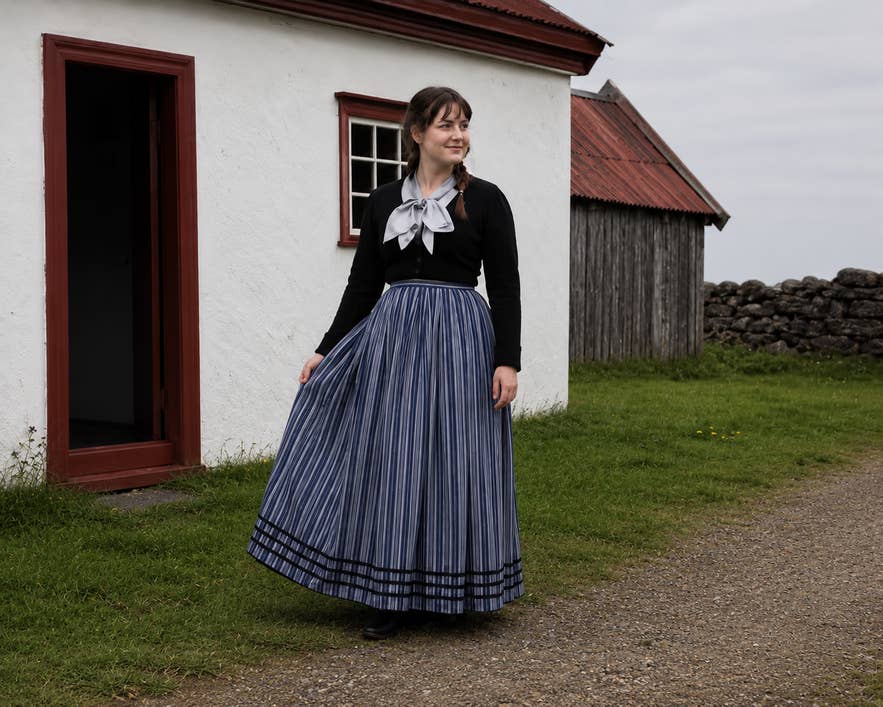
Peysuföt developed from older everyday clothing worn by Icelandic women in the 18th and 19th centuries. The name means “jumper outfit” or “sweater outfit,” referring to the fitted wool jacket, or peysa, at the center of the costume.
Historians believe peysuföt took shape when women wanted simpler working clothes than the faldbúningur and adopted male garments such as the tail-cap and the peysa, originally a single-row button jacket whose buttons were later removed. By the end of the 18th century, peysuföt had become an independent costume.
A traditional peysuföt outfit includes a long dark twill wool skirt, a fitted black knitted jacket, a large silk bow or silk scarf fastened with a silver brooch, and the black skotthúfa tail-cap with its long silk tassel attached by a silver cylinder. Peysuföt is less ornate than skautbúningur and more restrained than upphlutur, but its quiet elegance is part of its appeal. Travelers may see it at Independence Day celebrations, cultural events, and formal family occasions.
Upphlutur
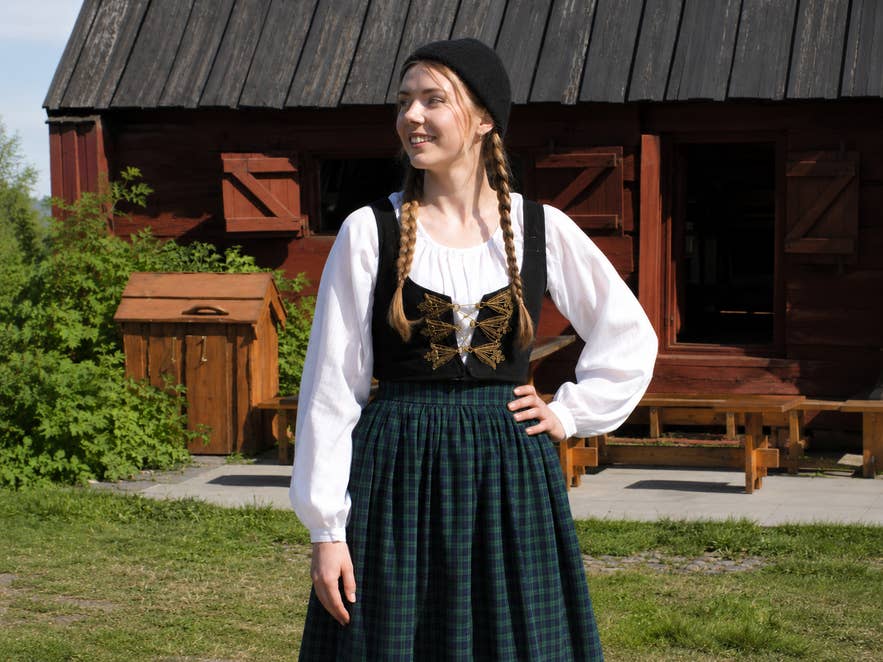
The upphlutur is the most popular and most widely recognized Icelandic women’s national costume today. It began life as the bodice worn under the faldbúningur, but over time, the bodice and skirt grew into a costume in their own right.
The outfit typically includes a long wool skirt, a white blouse, an apron, a fitted bodice, and the black skotthúfa tail-cap. The bodice may be black, red, blue, green, or another deep color, and it is often decorated with silver clasps, silver chains, metal-thread embroidery, and rows of silver buttons. Collectively, this silverwork is known as kvensilfur, “women’s silver,” and the amount a woman wore once reflected her family’s wealth and status.
Upphlutur is especially popular with young women and girls. It is festive, practical, and easier to move in than the grander ceremonial costumes, which is why it is the version travelers are most likely to see during June 17 celebrations, folk dance performances, concerts, and community festivals.
Skautbúningur
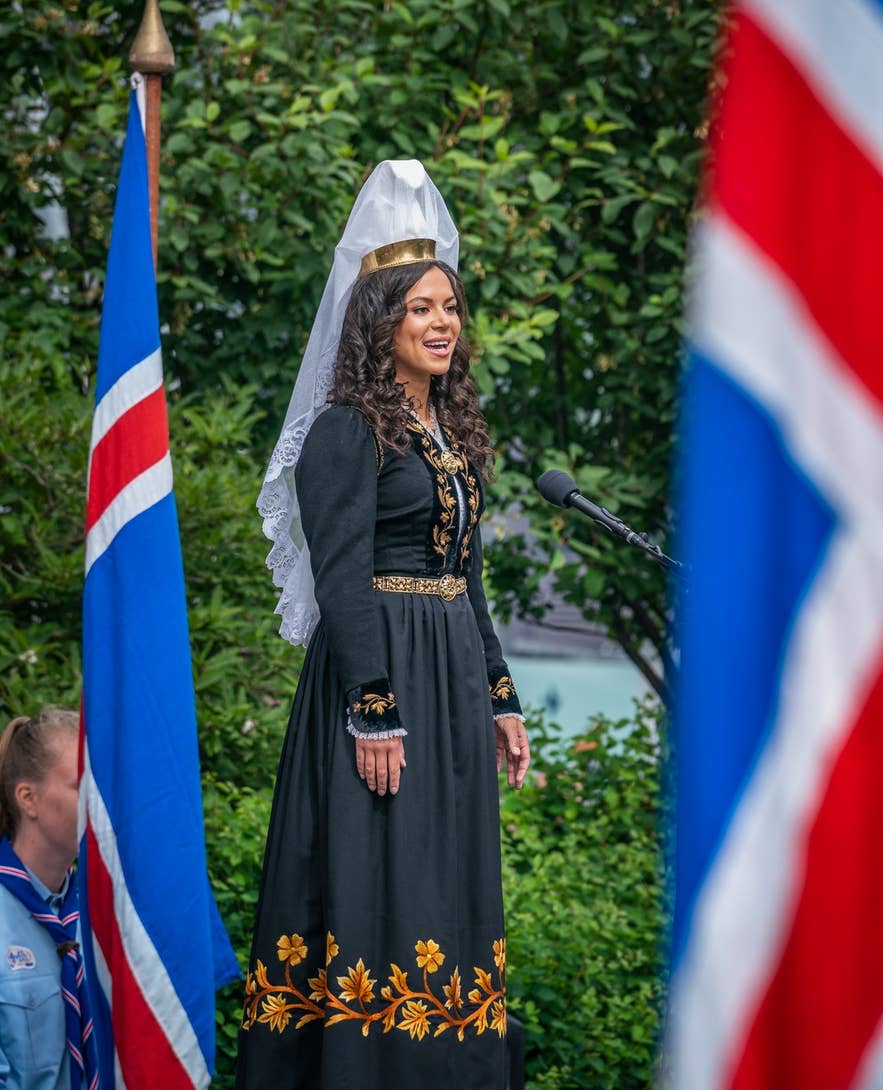
Aldís Amah Hamilton as the Lady of the Mountain in 2019, wearing a skautbúningur.
The skautbúningur is the grand ceremonial costume of Iceland. It is the version many people picture when they imagine Icelandic national dress: a dark formal gown, rich embroidery, fine silverwork, and a tall white headdress called a skautfaldur.
The modern skautbúningur was designed in the 19th century by artist Sigurður Guðmundsson, known as Sigurður málari, or Sigurður the Painter. He proposed the design in 1857 and developed it with women in his circle over the following years. Rather than being everyday clothing, it was a deliberate national romantic creation inspired by the older faldbúningur, giving Icelandic women a formal costume that felt distinctly Icelandic at a time when cultural identity was closely tied to the independence movement.
The skautbúningur is worn at the most formal occasions: state ceremonies and major national celebrations. On Independence Day, the Fjallkona, or Lady of the Mountain, traditionally appears in skautbúningur to recite a poem at official ceremonies, though the kyrtill is a popular alternative.
Kyrtill
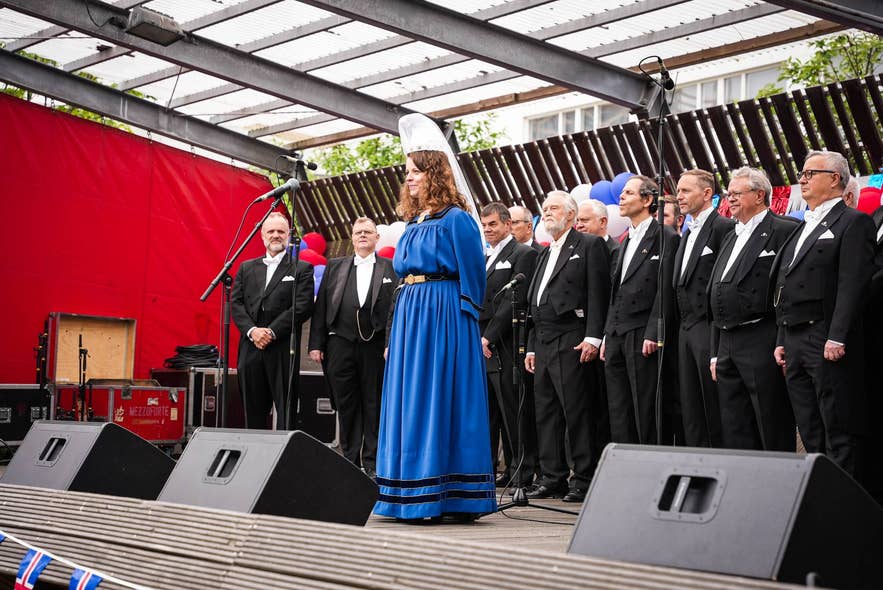
Björk Níelsdóttir as the Lady of the Mountain of Hafnarfjordur in 2024, wearing a blue kyrtill.
The kyrtill is the second 19th-century ceremonial costume designed by Sigurður Guðmundsson. It was conceived as a lighter, looser alternative to the skautbúningur, with inspiration drawn from Viking Age and saga-age dress.
The kyrtill typically has a long, flowing shape, a wide decorative belt, and a softer headpiece rather than the tall skautfaldur of the skautbúningur. It may be made from fine wool, silk, satin, velvet, or similar formal fabrics, depending on the version and occasion, and it’s most commonly in a striking blue color, but white and black variations also exist.
Today, the kyrtill is less common than upphlutur or peysuföt, but it is still an important part of Icelandic national dress. Travelers may see it at official ceremonies, weddings, Independence Day events, or on women chosen to represent the Fjallkona in towns around Iceland.
The Men’s Icelandic National Costume
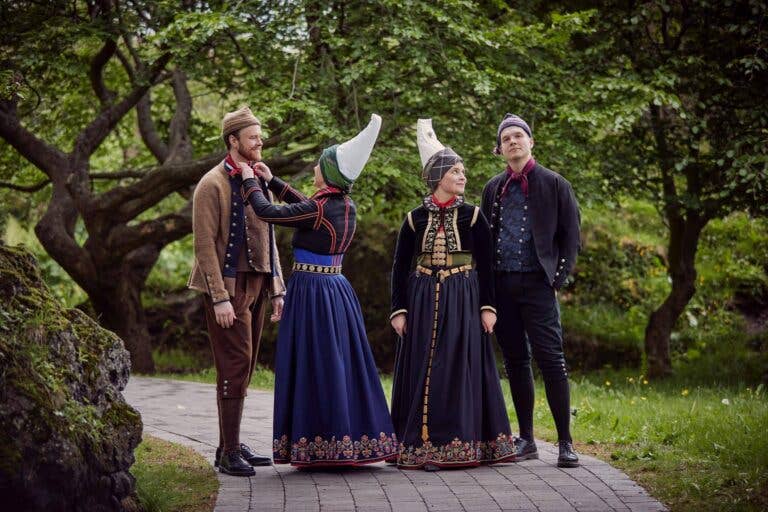
Photo from Hafnarfjordur, for a national costume gathering.
Men’s Icelandic national dress is less widely recognized by visitors than the women’s versions, but it is an important part of the tradition.
The main form is the only direct descendant of everyday historical men’s clothing, dating back to garments worn from the 17th to the 19th century. It typically consists of wool breeches, a vest, and a double-buttoned wool jacket called a treyja, in black, dark blue, or dark green, with pewter or silver buttons and a tail-cap.
A more recent alternative is the hátíðarbúningur, a festive costume created in 1994 to mark the 50th anniversary of the Republic, which has since become common at formal occasions in place of a tuxedo.
Icelandic National Costumes for Children
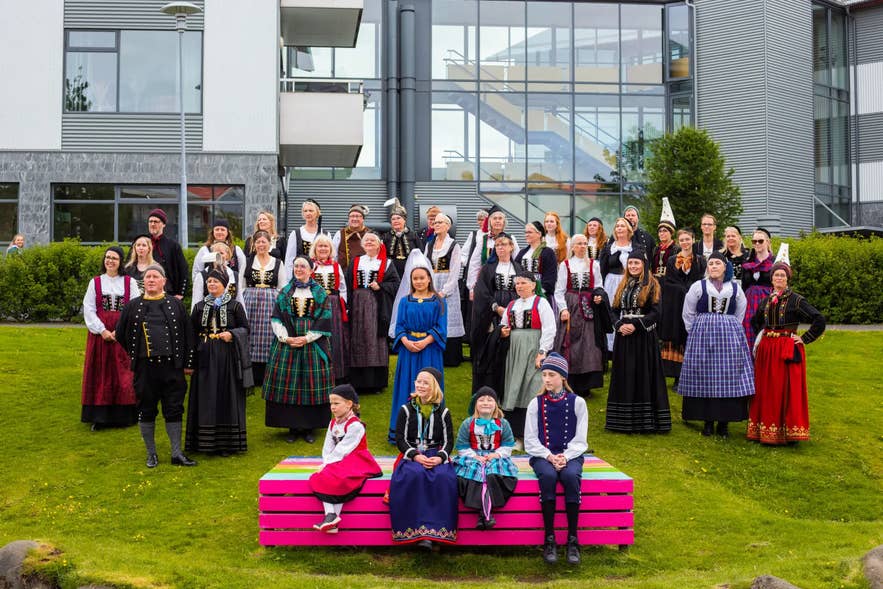
Photo from Hafnarfjordur of a national costume gathering in 2025.
Children’s national costumes were historically identical to adult versions, only smaller.
The boys’ costume is nearly identical to the main men’s one, and the girls’ one is a smaller version of the upphlutur costume. From the 20th century onward, girls’ skirts were shortened to make the costumes easier for children to wear.
Accessories of the Icelandic National Costume
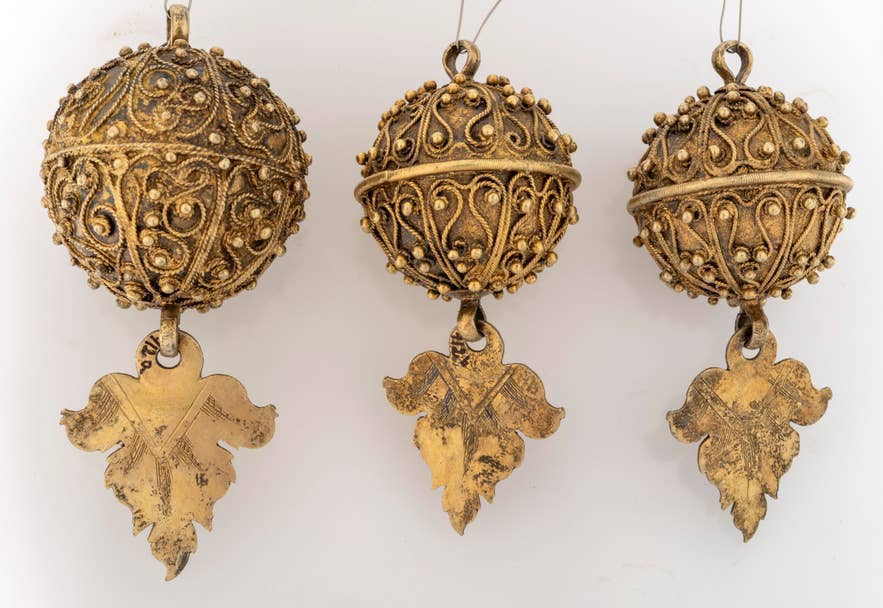
Close-up image of the metal work from a faldbuningur, from the National Museum of Iceland.
Silver metalwork is one of the most distinctive elements of Þjóðbúningurinn. Silver clasps, buttons, chains, belts, brooches, and decorative cylinders for the skotthúfa appear across the different costume versions.
In many Icelandic families, these silver pieces are heirlooms, passed down through generations and reused even when the fabric parts of the costume are remade.
Embroidery is another defining feature and can include elaborate floral, leaf, and scroll patterns stitched in silk, gold thread, or silver thread. It’s done by hand, and an ornate ceremonial costume can take hundreds of hours to complete.
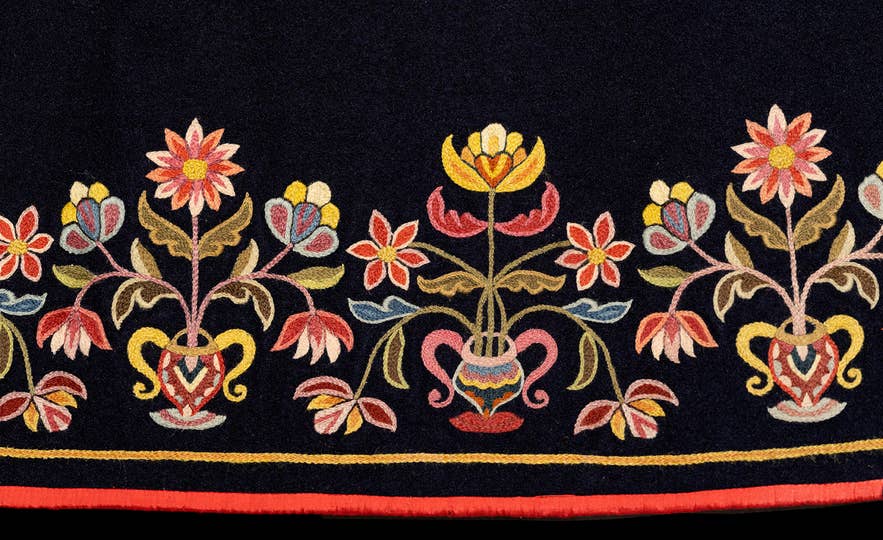
Close-up image of flower embroidery from a faldbuningur, from the National Museum of Iceland.
Footwear is one of the more overlooked details. Modern leather shoes are usually worn today, but historically, Icelanders wore either roðskór, shoes made from fish skin, or sauðskinnsskór, shoes made from Icelandic sheep skin.
The shoes were lined on the inside with colorful knitted wool insulation that was regularly replaced due to wear. This was an item young women would sometimes gift to men they were interested in as a sign of romantic intent. Men, in turn, might reciprocate with a hand-made item, usually featuring detailed wood carving, to signal their own feelings.
Some wearers still use 18th- or 19th-century-style leather shoes with metal buckles, similar to those found in Faroese and Norwegian costume traditions.
Two organizations are especially important for preserving this knowledge today. Heimilisiðnaðarfélag Íslands, the Icelandic Handicraft Association, runs courses and exhibitions on traditional textile work, while Annríki, run by historian and master dressmaker Hildur Rosenkjær in Hafnarfjordur, produces national costumes, embroidery, and silverwork by commission.
How the Icelandic National Costume Was Created
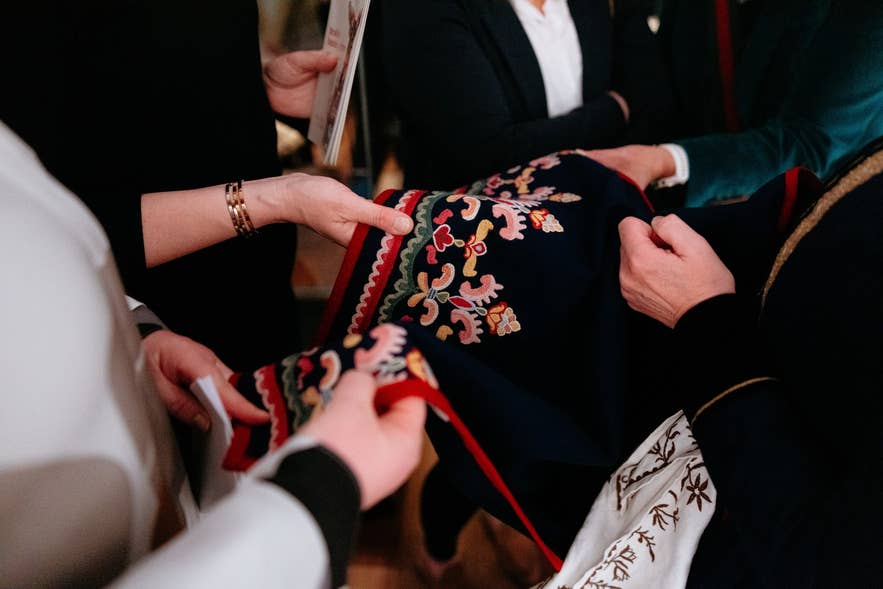
Photo from the National Museum of Iceland, showing Icelandic embroidery on the national costume.
The national costume is one of Iceland’s strongest visual symbols of national identity. The costumes connect modern Icelanders with older forms of clothing, rural life, textile work, and silversmithing, as well as the national romantic movement that helped shape Icelandic culture before independence from Denmark.
Some versions, like the faldbúningur, peysuföt, and upphlutur, grew directly out of the everyday clothing described above. Others, including the skautbúningur and kyrtill, were designed from scratch in the 19th century as formal ceremonial dress.
Together, they gave Iceland a visual identity it could call its own, distinct from Danish fashion and rooted in its own history, and they hold a very important place in Icelandic culture today.
Since 2001, the costumes have been overseen by Þjóðbúningaráð, the National Costume Board, which preserves construction techniques and keeps traditional sewing, embroidery, and silverwork alive across generations of makers.
Sigurður Guðmundsson and the Design of the National Costumes
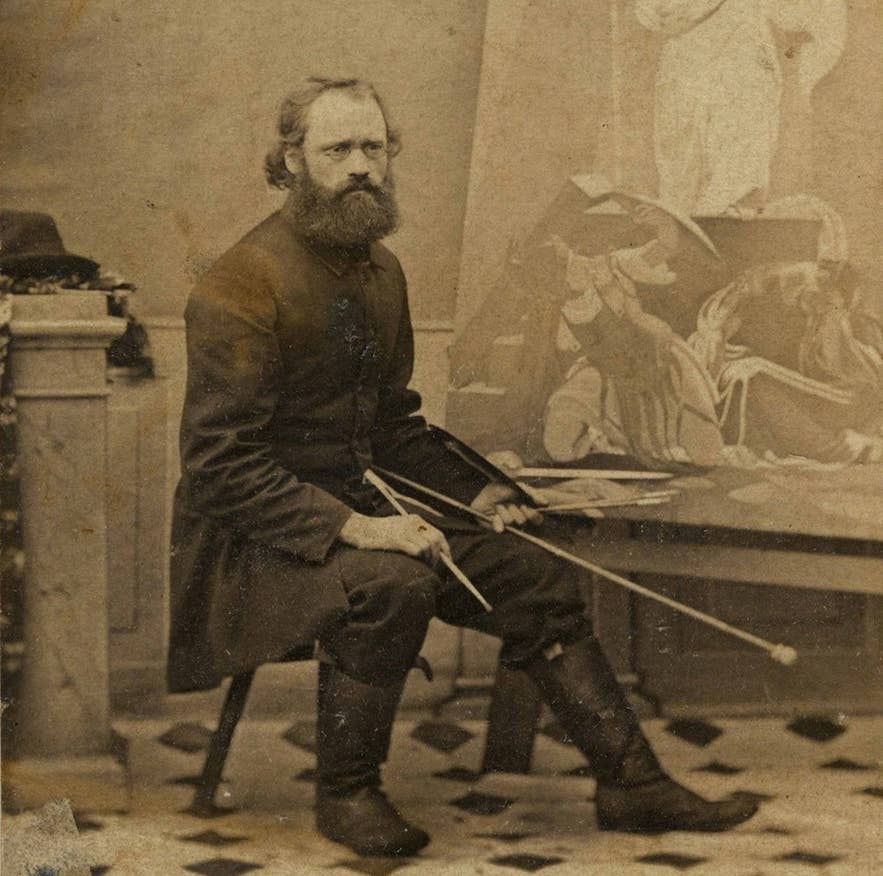
Sigurður Guðmundsson, better known as Sigurður málari. Photo from Wikimedia, Creative Commons, by Sigfús Eymundsson. Image has been cropped.
The most ceremonial of Iceland’s national costumes were largely the work of one man: Sigurður Guðmundsson (1833–1874), an artist and cultural reformer known as Sigurður málari, or Sigurður the Painter.
Sigurður was born in Skagafjordur in North Iceland and studied art in Copenhagen. When he returned, Icelandic intellectuals were actively working to define what made their culture distinct from their Danish rulers. Sigurður believed clothing could be central to that project.
In 1857, he published a proposal for a new national dress for Icelandic women. Women in his circle developed this into the skautbúningur, the grand ceremonial costume with rich embroidery, fine silverwork, and the tall white headdress called a skautfaldur.
He later designed the kyrtill as a lighter ceremonial alternative, drawing inspiration from the Viking Age in Iceland, and also proposed a Viking-inspired men’s costume, which is rarely used.
His designs combined historical research, artistic imagination, and the political energy of the independence movement.
Beyond clothing, Sigurður played a broad role in Icelandic cultural life. He helped establish what became the National Museum of Iceland in 1863, contributed to the collection and study of Icelandic material culture, and collaborated with folklorist Jón Árnason on the publication of Icelandic folktales. You can read more about this period in the broader history of Iceland.
The Fjallkona: Lady of the Mountain as a Symbol of Iceland
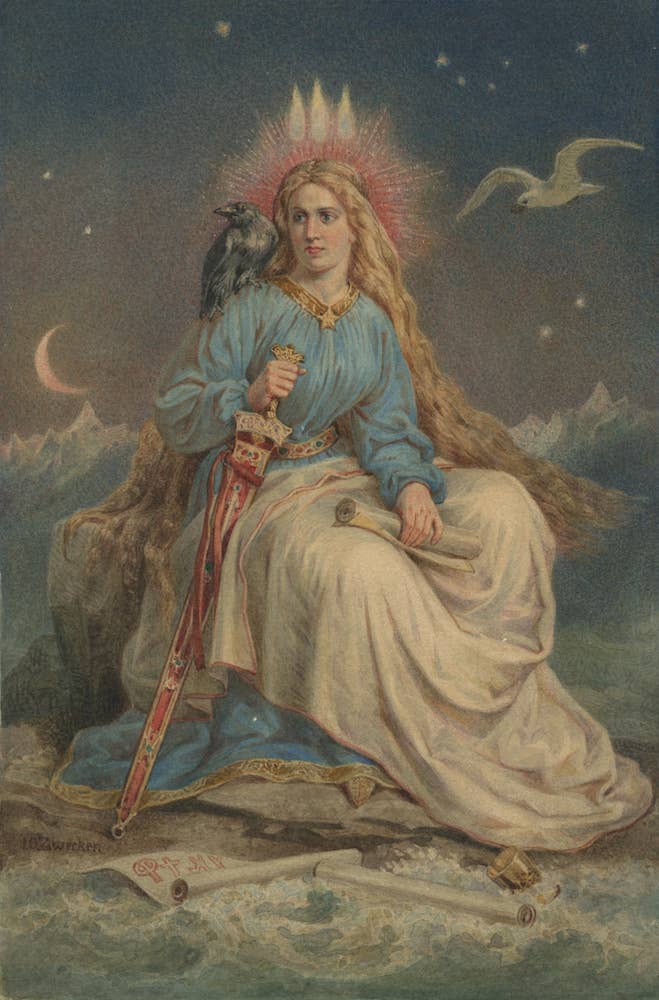
An iconic watercolor painting of the Icelandic Lady of the Mountain from the mid 1860's by Johann Baptist Zwecker.
Part of the reason Icelandic women’s national dress became so central to the tradition is that the Icelandic woman herself was turned into a symbol of the nation.
This is embodied in the figure of the Fjallkona, or Lady of the Mountain, the female personification of Iceland that grew out of 19th-century national romantic poetry.
The word first appeared in print in Bjarni Thorarensen’s poem “Eldgamla Ísafold” in the early 1800s and during Danish rule, the Lady of the Mountain served as a maternal counterweight to the image of the Danish king as “father” of Iceland.
After the founding of the Republic of Iceland in 1944, it became a national tradition for a woman to play the Fjallkona at the official June 17 ceremony, usually a well-known actress or respected public figure.
She wears the skautbúningur and recites a single poem, usually drawn from Icelandic literature. Smaller towns hold their own Fjallkona ceremonies, sometimes using the kyrtill rather than the skautbúningur.
The Fjallkona tradition reinforced the skautbúningur as the most formal and symbolic of all Iceland’s national costumes, and helped cement the idea that women’s dress, in particular, carried the weight of national identity.
Travelers who want to explore this side of Iceland’s story can join an Icelandic women’s walking tour in Reykjavik, which traces the lives and legacy of the women behind the country’s cultural identity.
The National Costume and June 17th
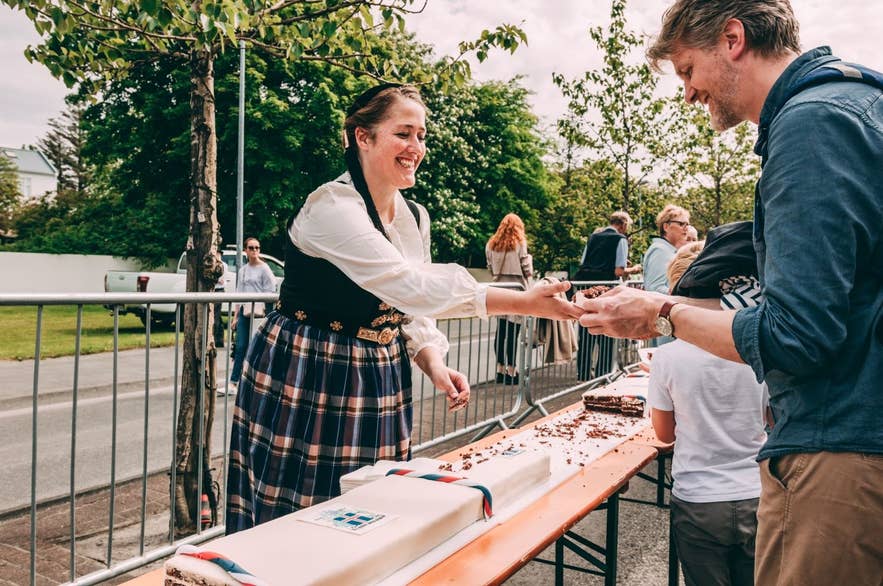
June 17, Iceland’s Independence Day, is the single best day for travelers to see the national costume being worn in public. Towns across the country hold parades, concerts, speeches, and outdoor celebrations; the city center fills with families, performers, scouts, officials, and visitors, especially in Reykjavik.
The national costumes are very much a central part of the occasion. Seeing the streets lined with people dressed in traditional costume is one of the more striking sights Iceland has to offer, and something you won’t see outside of June in Iceland.
There are also dedicated gatherings held specifically for people wearing a national costume, bringing together wearers of all ages in a shared celebration of the tradition. Travelers who want to dive deeper into Icelandic culture can join cultural activities in Reykjavik that often align with the city’s biggest celebrations and folk events.
Where to See Icelandic National Costumes in Iceland
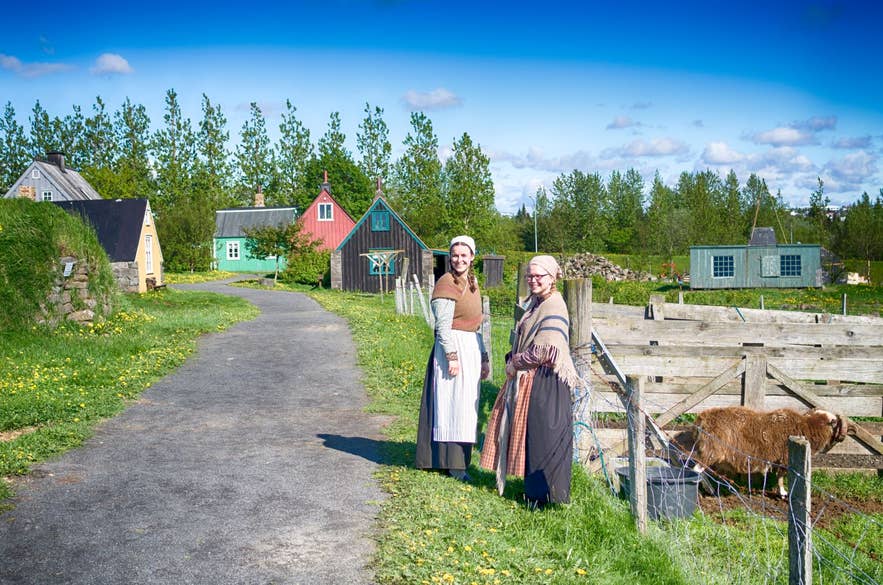
You do not have to visit Iceland on Independence Day to see the national costume. Several museums and cultural sites in Reykjavik and around Iceland display historic costumes, textiles, and related objects year-round.
The National Museum of Iceland in Reykjavik is the best starting point. Its collection places clothing in the wider story of Icelandic history, from settlement-era objects to modern national identity.
If you’re visiting Iceland between May 9, 2026, and May 9, 2027, you’re also in luck. The National Museum of Iceland is hosting a special exhibition centered on an extraordinary 18th-century Icelandic bridal costume that was bought by a British traveler in 1809 and has been preserved at the Victoria and Albert Museum until now.
The Arbaer Open Air Museum in Reykjavik is another useful stop, especially for travelers who want to understand how clothing related to daily life, turf houses, domestic work, and 19th-century Icelandic society. The staff wear traditional clothing to fit into the surroundings of the museum.
Outside the capital, you can see traditional costumes at the Skogar Museum, right next to the iconic Skogafoss Waterfall, which is a staple of all South Coast tours.
In West Iceland, the Textile Museum in Blonduos, known in Icelandic as Heimilisiðnaðarsafnið, is one of the country’s most important places for textile history. It holds a rich collection of women’s national costumes, embroidery samples, and silver pieces. It’s a great stop for travelers renting a car and exploring the Ring Road.
You can also find costumes in heritage museums around Iceland, such as in the Westfjords and the Eastfjords.
The National Costume and the Lopapeysa Sweater
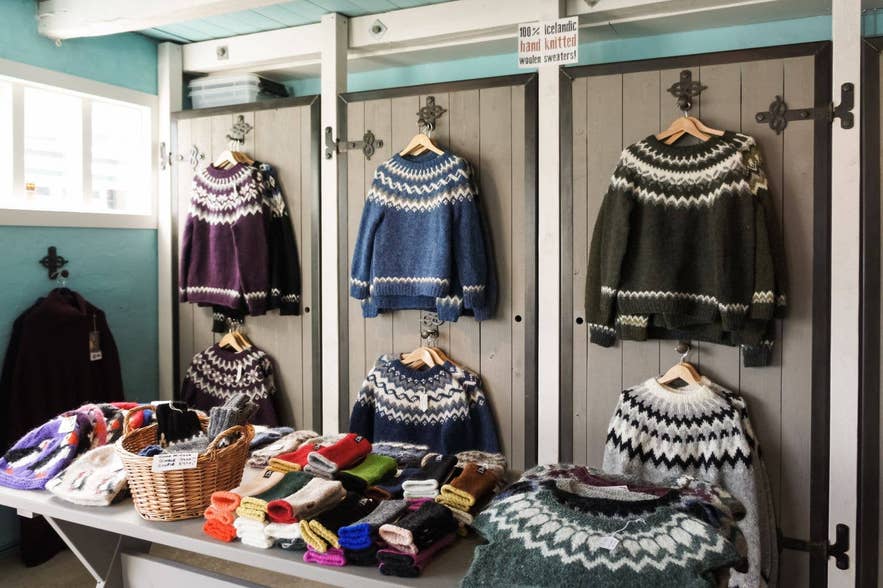
Travelers sometimes confuse the traditional Icelandic lopapeysa with the national costume of Iceland, but they are very different garments.
The national costumes of Iceland are formal ceremonial garments with specific designs, inherited techniques, and rules about materials and details. They are made by specialists or skilled makers, fitted to the wearer, and treated with great care. They are closer in role to a Scottish kilt outfit, Norwegian bunad, or Japanese kimono than to everyday clothing.
The Icelandic lopapeysa sweater is a knitted sweater with a circular yoke pattern, made from Icelandic lopi wool. It became popular in the 20th century and is worn as practical outdoor clothing. Many Icelanders own one, and it’s considered an unofficial symbol of the country. Because of this, they’re among the top souvenirs from Iceland for visitors.
For those wondering what to wear in Iceland, the lopapeysa is one of the most practical and beloved options. Most travelers will not buy an Icelandic national costume during a visit, so the lopapeysa is the closest thing to traditional Icelandic clothing most travelers will actually take home.
Iceland’s National Costume Today
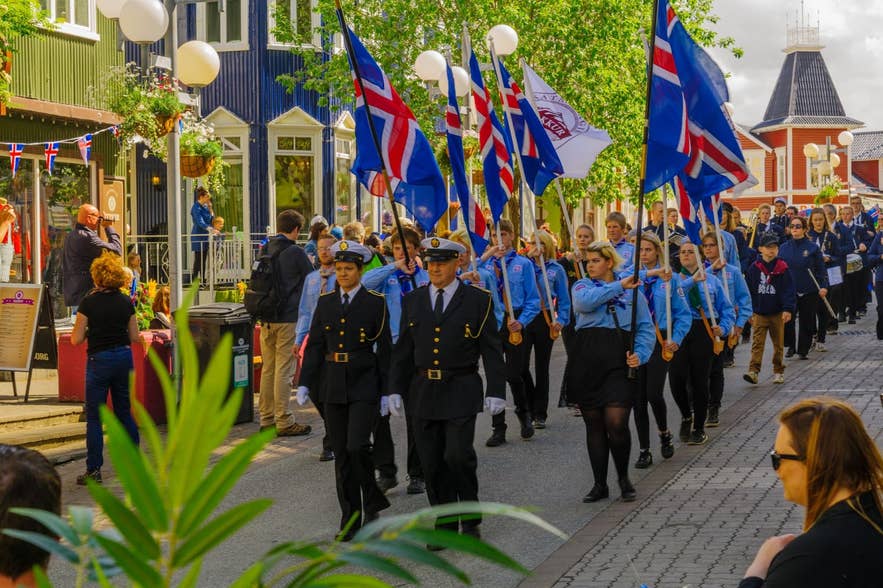
The Icelandic national costume is still worn across the country for weddings, confirmations, festivals, folk events, and Independence Day celebrations on June 17. While Reykjavik hosts the largest celebrations, smaller towns often offer a more local atmosphere and a chance to see different versions of Þjóðbúningurinn in use today.
Visitors can also learn more about this traditional Icelandic clothing at places like the National Museum of Iceland, the Arbaer Open Air Museum, and regional heritage museums around the country.
These costumes remain closely connected to Icelandic identity, family tradition, and craftsmanship, with many outfits passed down and reused across generations. For more on Icelandic culture and heritage, see our guides to Icelandic folklore, the Icelandic flag and national identity, and Icelandic clothing and fashion design.
What is the Icelandic national costume?
What is the traditional Icelandic dress called?
Where can I see Icelandic national costumes?
When is the best time to see Icelandic national costumes?
Are Icelandic national costumes still worn today?
Is the lopapeysa sweater part of the Icelandic national costume?
What is the difference between a lopapeysa and the national costume?
What is the Fjallkona in Iceland?
Can tourists wear an Icelandic national costume?
Are Icelandic national costumes expensive?
What is the most popular Icelandic national costume?
What is the skautbúningur?
What is the upphlutur?
What is peysuföt?
Have you seen the Icelandic national costume? Which type is your favorite? Share your thoughts in the comments below, and feel free to ask any questions about planning a trip around Iceland’s cultural traditions.

I was born on the west side of Reykjavík and grew up downtown, so Iceland has been my back yard for most of my life. I'm a father of two, I've traveled on five continents, and I still haven't found a country that holds my attention the way this one does.
That's why I co-founded Guide to Iceland. We connect travelers directly with Icelandic operators, guides and hosts, so the advice and the services both come from people who actually live here.
I write about the practical side of a trip: what eating out in Reykjavík really costs, whether to pick Sky Lagoon or Hvammsvík, where to stop for food along the Ring Road, and which regions give you the best odds of clear skies for the northern lights. If you're planning a trip and something doesn't add up, message me.