Find horses in Iceland in every region and in every month of the year. This Guide to Iceland study maps where the country's 78,000 horses actually live, names the one region where they outnumber people, and sets out the best months to see them. Read on before you plan the drive in Iceland.
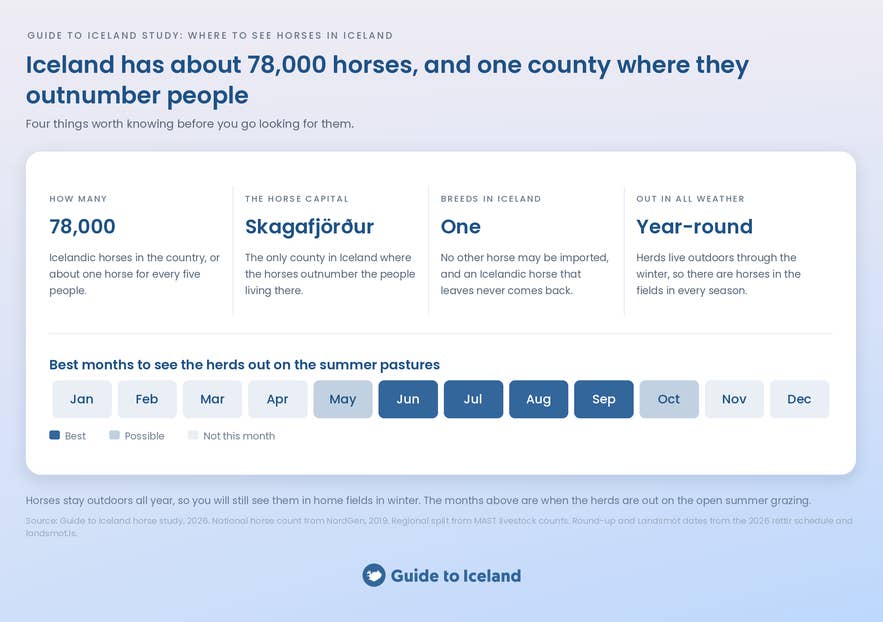
Iceland keeps around 78,000 horses, and every one of them belongs to a single breed. Set against a national population of 383,726 people, that works out at about one horse for every five residents.
Guide to Iceland analyzed the national livestock counts to find out where those horses actually are. The answer splits into two. South Iceland holds the largest share of the herd, at roughly a third of the national total. Northwest Iceland holds fewer horses in absolute terms, but it's the only region in Iceland where horses outnumber people.
Icelandic horses are the easiest large animals to find in the country year-round. Most of them live outdoors in paddocks along the main roads, so no boat, hide, or guided walk is needed to see one.
That makes horses a dependable addition to any wildlife tour in Iceland, and horse riding tours operate in every region covered below. Most of the viewing spots in this study sit beside public roads, so you can reach them through self-drive tours and rental cars.
Key Findings of the Guide to Iceland Horse Study
-
Iceland keeps around 78,000 horses against a national population of 383,726 people, which works out at about one horse for every five residents.
-
Every horse in Iceland belongs to one breed. The Icelandic parliament banned the import of other horse breeds in A.D. 982, and a horse that leaves Iceland can never legally return, so the national herd is a closed population.
-
South Iceland holds the largest share of Iceland's horses, at roughly a third of the national herd, concentrated in the lowland farming districts around Hella and Selfoss.
-
Northwest Iceland is the only Icelandic region where horses outnumber people. Its roughly 21,000 horses stand against 7,294 residents, which is almost three horses per person.
-
Skagafjordur in Northwest Iceland is the center of Icelandic horse culture. It hosts Laufskalarett, the best-known horse round-up in the country, and it hosted Landsmot, the national championship of the breed, at Holar in July 2026.
-
The Capital Region keeps around 6,000 horses, which means travelers staying in Reykjavik can reach a riding stable in about 20 minutes without leaving the city's edge.
-
Horses are visible in Iceland in all twelve months, because most Icelandic horses stay outdoors year-round in roadside paddocks rather than in stables.
-
Foals are born in Icelandic paddocks mainly in May and June, which makes early summer the best time to see them.
-
Icelandic herds graze mountain summer pasture between June and late September, and the round-ups bring them back down on the last weekend of September.
-
Horse riding tours in Iceland operate in all twelve months, in every region covered in this study.
Cite This Study
The charts and data in this study are free to use under CC BY 4.0. Credit Guide to Iceland and link to this page. Every chart has an Embed button underneath it with ready-to-paste code.
At a Glance: Icelandic Horses by Region
 The table below sets out the horse population of each Icelandic region, its share of the national herd, and how many horses it holds for every resident.
|
Region |
Horses (approx.) |
Share of national herd |
Horses per resident |
Best base |
What to time it for |
|---|---|---|---|---|---|
|
~26,000 |
~33% |
~0.8 |
Hella or Selfoss |
Foals in May and June, riding all year |
|
|
~21,000 |
~27% |
~2.9 |
Saudarkrokur |
Laufskalarett round-up, last weekend of September |
|
|
~11,000 |
~14% |
~0.3 |
Akureyri |
Valley herds, June to late September |
|
|
~9,000 |
~12% |
~0.5 |
Borgarnes |
Roadside paddocks all year |
|
|
~6,000 |
~8% |
~0.02 |
Reykjavik |
Riding tours all year, no car needed |
|
|
Westfjords and Eastfjords |
~5,000 |
~6% |
~0.3 |
Egilsstadir |
Roadside paddocks all year |
All horse figures are approximations rounded to the nearest thousand. Population figures come from Statistics Iceland and are dated 1 January 2024. The best base for each region is our own travel recommendation rather than a result of the data.
South Iceland Has the Most Horses, at Roughly a Third of the National Herd
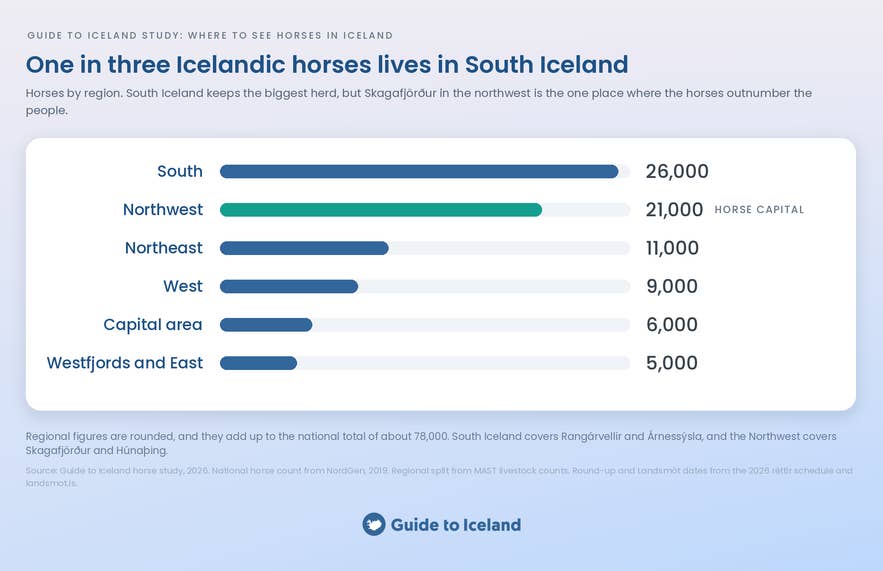
The national livestock counts put around 26,000 horses in South Iceland, which is roughly a third of every horse in the country. South Iceland is the most productive lowland farming region in Iceland, and the districts of Rangarvallasysla and Arnessysla hold many of the largest breeding and competition stables.
Northwest Iceland comes second, with around 21,000 horses, or about 27 percent of the national herd. Northeast Iceland follows with around 11,000 horses, West Iceland with around 9,000, and the Capital Region with around 6,000. The Westfjords and the Eastfjords hold around 5,000 horses between them.
All six regional figures are approximations rounded to the nearest thousand. A gap of a few thousand horses between two regions is therefore not a meaningful difference, and the methodology section below sets out how the regional split was derived.
Northwest Iceland Is the Only Region Where Horses Outnumber People
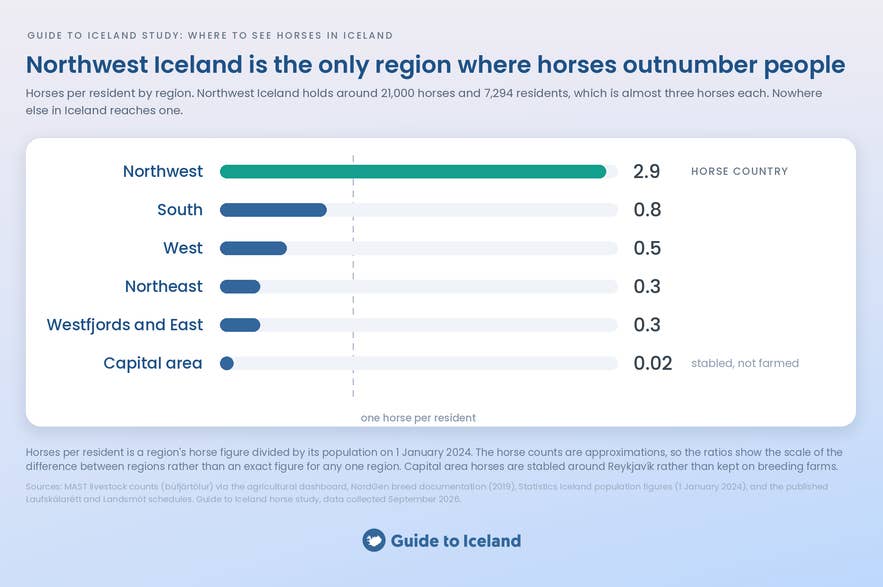
Northwest Iceland holds around 21,000 horses and 7,294 residents, which is almost three horses for every person living there. No other Icelandic region has more horses than people, and no other region comes close to that ratio.
South Iceland, the region with the most horses in absolute terms, has around 0.8 horses per resident. West Iceland has around 0.5 horses per resident. Northeast Iceland holds around 0.3, as does the Westfjords and Eastfjords grouping. The Capital Region holds around 0.02, which is roughly one horse for every 40 people who live there.
Because the horse counts are estimates, these ratios are best used to show the scale of regional differences rather than exact figures. Even with that limitation, the pattern is clear. Northwest Iceland has a far higher concentration of horses than any other part of the country.
Within Northwest Iceland, the district of Skagafjordur is the center of Icelandic horse culture. Laufskalarett, the best-known horse round-up in Iceland, is held in the Hjaltadalur valley in Skagafjordur. Landsmot, the national championship of the Icelandic horse, was held at Holar in that same valley in July 2026, and the next one is due in 2028.
Where to See Horses in Iceland, Region by Region
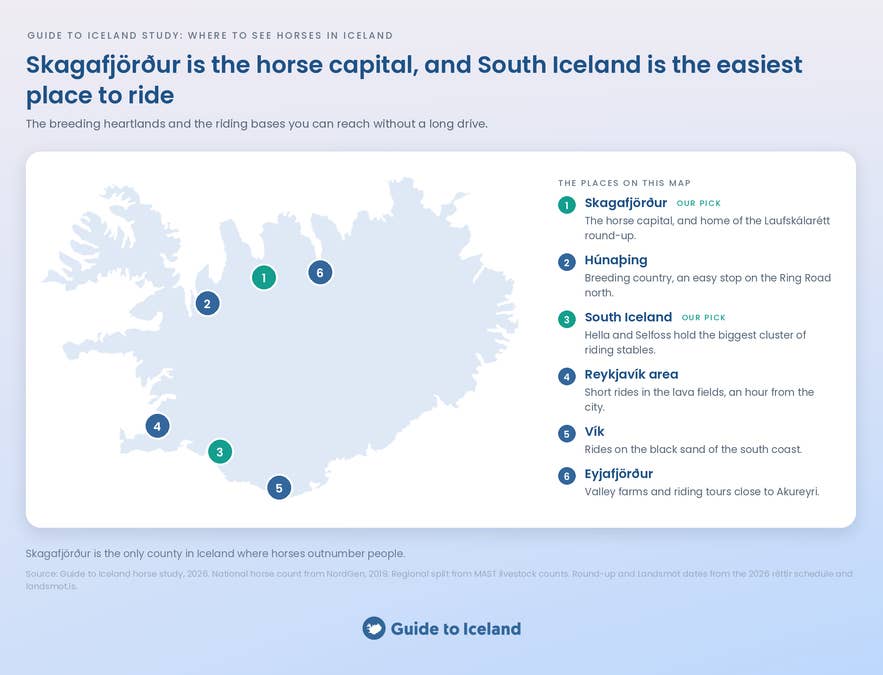
Icelandic horses are found across the country, but some areas hold much larger herds and a stronger connection to breeding and riding. This part of the study compares the main horse districts in Iceland using livestock data, riding-tour availability, and access for travelers.
The six places below stand out either for the size of their horse populations or for how easy they make it to see and ride Icelandic horses. Two of them, Skagafjordur and Hunathing, sit inside Northwest Iceland. Some are major breeding areas, and others are practical bases for travelers who want a riding tour.
Skagafjordur: Iceland's Horse Capital in Northwest Iceland
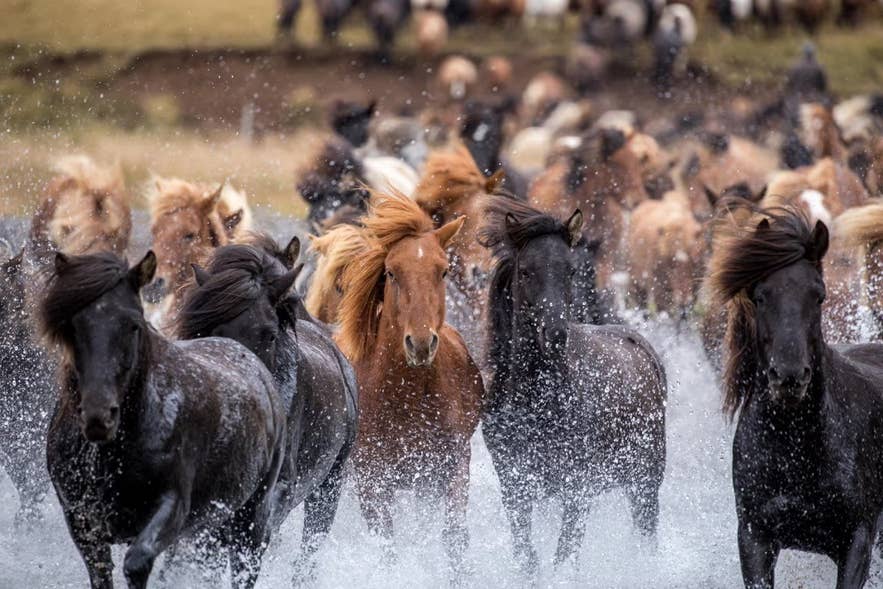 Drive the valley roads south of Saudarkrokur in Northwest Iceland, and horses graze in paddocks on both sides for most of the route. This is the easiest place in Iceland to see large numbers of horses without booking anything or leaving the car for long.
Skagafjordur earns its reputation because the horses are simply there. In a region where they outnumber people by almost three to one, you do not need a tour, a season, or a plan to find a herd. That is the practical difference between Skagafjordur and every other place in this study.
The district also holds the cultural weight of the breed. Skagafjordur hosts Laufskalarett in Hjaltadalur on the last weekend of September, when horses are driven down the mountain pastures and sorted in a single pen while spectators line the walls. The same valley holds Holar, where the national championship of the breed was staged in the summer of 2026.
-
Best for: seeing large herds without booking anything.
-
Go in: any month, or the last weekend of September for the round-up.
-
Base yourself in: Saudarkrokur.
Hunathing: Horse Breeding on the Ring Road West of Skagafjordur
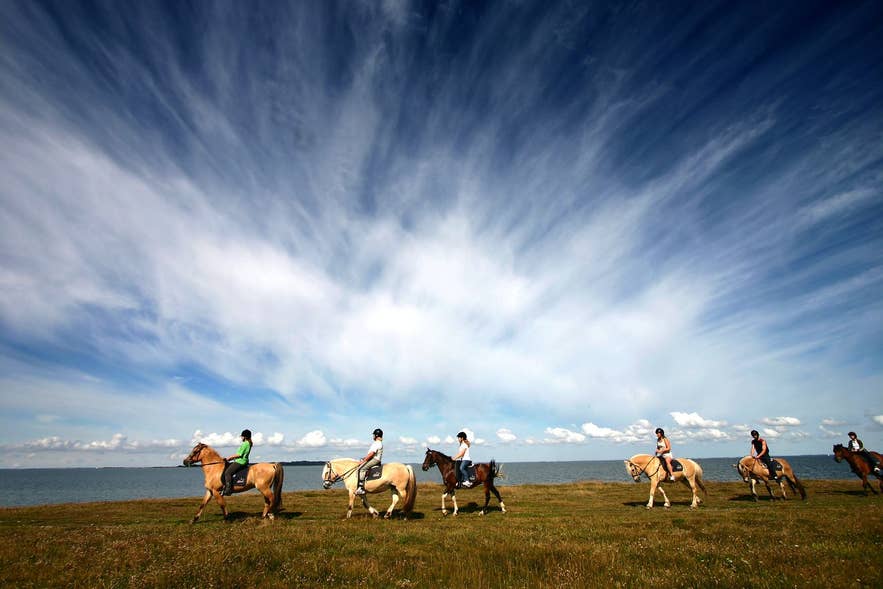 Hunathing sits on the Ring Road west of Skagafjordur and forms the other half of the Northwest Iceland horse belt. Breeding farms line the valleys inland of the road, and horses are visible in paddocks beside Route 1 for much of the drive between Blonduos and Varmahlid.
What Hunathing offers that the other places here do not is zero detour. The horses are on the road you are already driving, which makes this the district for travelers working to a schedule on a Ring Road itinerary.
Travelers driving the Ring Road clockwise pass through Hunathing before reaching Skagafjordur, so the two districts work as one stop rather than two on a longer North Iceland route.
-
Best for: seeing horses without leaving the Ring Road.
-
Go in: any month.
-
Base yourself in: Blonduos or Varmahlid.
Eyjafjordur: Valley Herds Within Reach of Akureyri
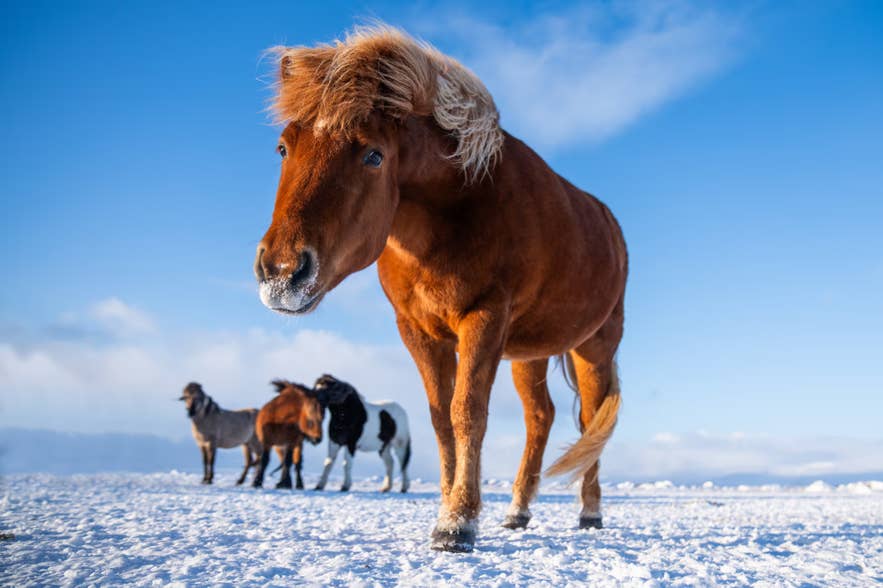 Northeast Iceland holds around 11,000 horses, and most of them are kept on the farmland around the Eyjafjordur Fjord. Travelers based in Akureyri can reach paddocks within a 20-minute drive south along the valley floor.
Eyjafjordur is the only large horse district in Iceland with a proper town beside it. That matters if you want restaurants, hotels, and a domestic flight at the end of the day rather than a farm stay. It also makes the north workable for families and for anyone who would rather not drive for hours.
Herds graze the Eyjafjordur valley between June and late September, which makes the summer months the best time to see numbers there rather than single animals.
-
Best for: horses on a town-based trip.
-
Go in: June to late September.
-
Base yourself in: Akureyri.
Hella and Selfoss: Stables along the South Iceland Lowlands
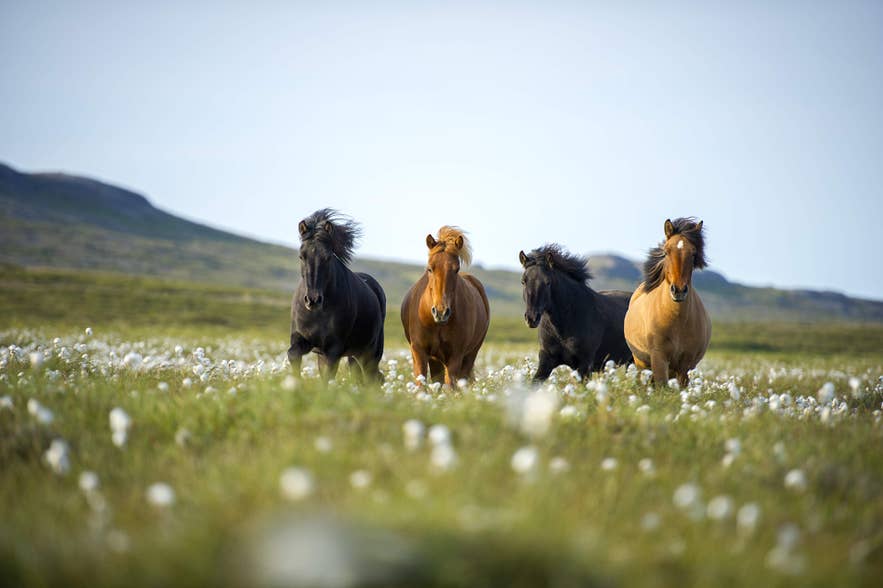 The flat farmland between Selfoss, Hella, and Hvolsvollur in South Iceland holds the highest concentration of breeding and competition stables in the country. Many of these farms take visitors, and the region sits directly on the main driving routes east of Reykjavik.
This is the part of Iceland where you ride rather than watch. South Iceland holds the largest share of the national herd and the widest choice of riding tours, and it is close enough to the capital that a ride fits into a day already spent driving.
The horse riding and Golden Circle combination puts travelers in the saddle between Gullfoss, Geysir, and Thingvellir. That makes South Iceland the natural region to add a ride to a day spent driving the Golden Circle.
-
Best for: riding rather than watching.
-
Go in: any month, or May and June for foals.
-
Base yourself in: Hella or Selfoss.
Reykjavik: Riding Without Leaving the Capital Region
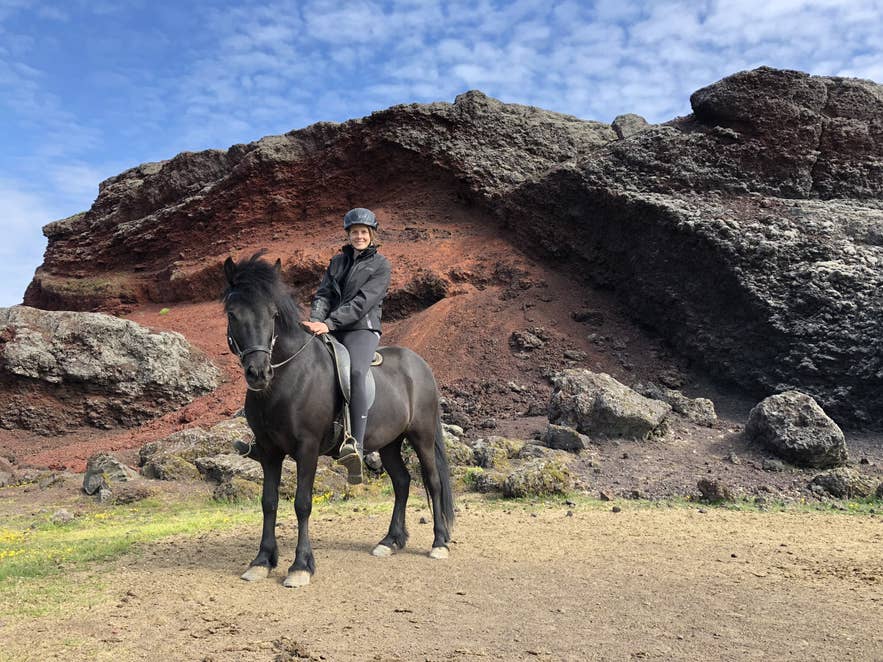 The Capital Region keeps around 6,000 horses in stables ringing Reykjavik, so travelers without a rental car can still ride. No herd is more than about 20 minutes from the city center.
This is the shortest route in Iceland to sitting on a horse. Stables collect riders from the city, tours run through the year, and the whole trip fits into a half day, which suits stopover passengers and anyone on a city break who is not driving.
The Reykjavik riding tour crosses the Raudholar lava field on the eastern edge of the city, which is the closest horse experience to central Reykjavik.
-
Best for: riding without a rental car.
-
Go in: any month.
-
Base yourself in: Reykjavik.
Vik: Black Sand Riding on the South Coast
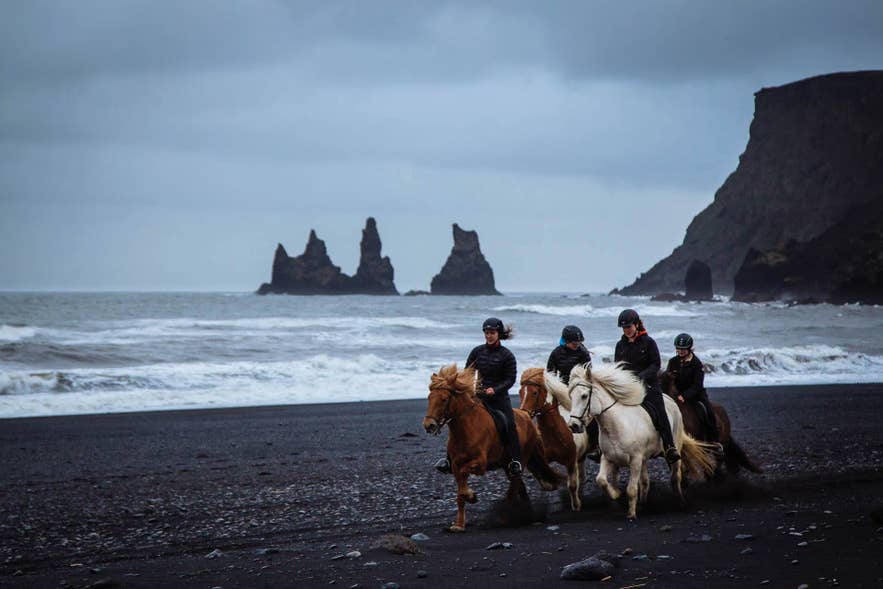 The black beach riding tour near Vik rides the sand itself, which puts the breed's signature tolt gait on black volcanic grit with the Atlantic surf alongside.
Vik is the setting rather than the herd. The horse numbers here are small next to the farming districts. No other ride in the country pairs the tolt with black sand and open ocean, which is why this is the one photographers plan around.
Vik sits about two and a half hours east of Reykjavik, which makes it the last horse stop on a South Coast drive.
-
Best for: a ride on black volcanic sand.
-
Go in: any month, or summer for longer light and calmer weather.
-
Base yourself in: Vik.
Horses Are Visible in Iceland Every Month of the Year
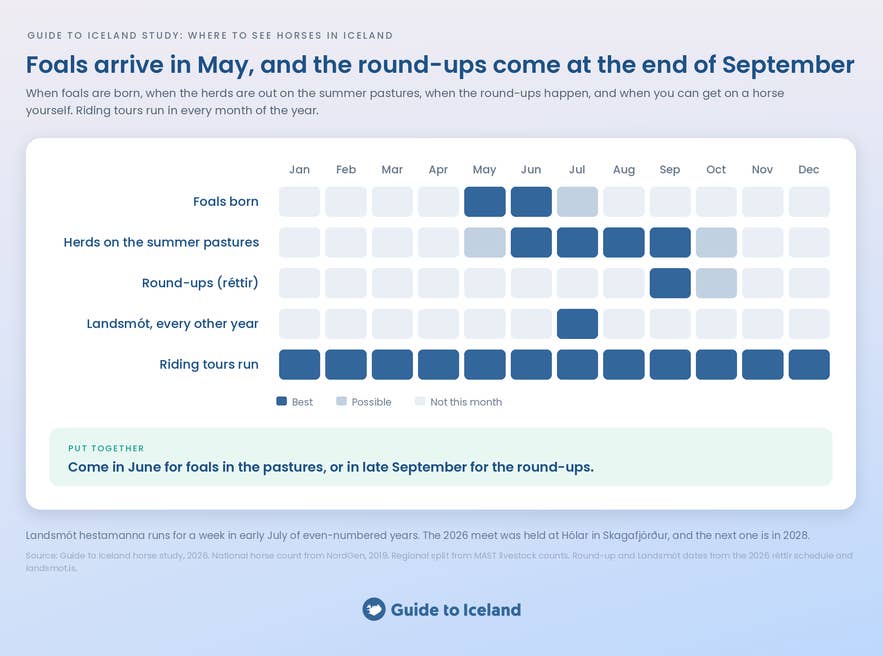
Icelandic horses can be seen in all twelve months, because most of them live outdoors all year. The breed grows a thick double coat in autumn that makes winter grazing possible, so herds stay out in roadside paddocks through the coldest months. Competition and riding horses are often stabled over winter.
What changes with the calendar is not the chance of seeing a horse in Iceland, but what there is to see and where.
|
What to see |
Best months |
Where |
What to expect |
|---|---|---|---|
|
Foals in the paddocks |
May and June, some into July |
South Iceland and Northwest Iceland |
Mares and foals graze in home paddocks near the farms, often within sight of the road. Our guide to driving in Iceland in June covers conditions in the peak foaling month. |
|
Herds on mountain summer pasture |
June to late September |
Northwest and Northeast Iceland |
Many herds move to highland and mountain grazing, so paddocks close to the farms hold fewer horses in high summer. |
|
Round-ups, known as rettir |
Last weekend of September |
Skagafjordur, Northwest Iceland |
Horses are driven off the mountains and sorted in a single pen, with Laufskalarett the best-known of them. Read our guide to Iceland in September before planning around it. |
|
Landsmot, the national championship |
Early July, even-numbered years |
Venue changes, held at Holar in 2026 |
A week of breeding and riding competitions that gathers the best of the breed in one place. The next edition is due in 2028. |
|
Winter coats |
November to April |
Every region |
Horses carry their full double coat and stay outdoors, which is when they photograph best against snow. |
|
Riding tours |
All twelve months |
Every region in this study |
Tours run year-round, with shorter daylight in winter and midnight-sun rides in June and July. |
How to Behave Around Horses at the Roadside in Iceland
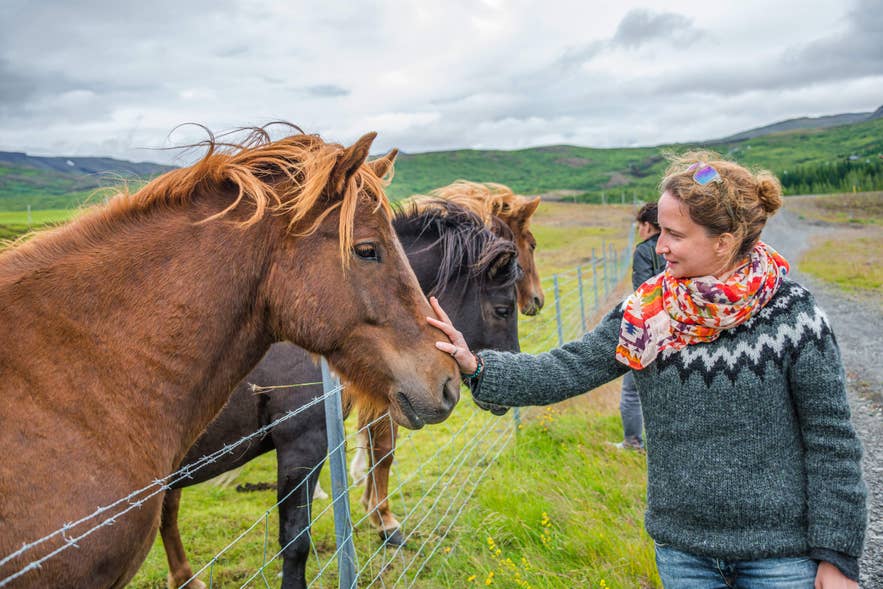 Icelandic horses are curious and they will often walk over to a fence on their own. That friendliness is exactly why roadside stops go wrong, because the horses are on working farms rather than in a petting zoo. The rules below keep the horses safe and keep you out of trouble with the farmer.
-
Do not feed them anything. Icelandic farm horses are kept on a controlled diet, and bread, fruit, or grass pulled from the verge can cause colic. Feeding also teaches a herd to crowd the fence line nearest the road, which puts the horses and passing drivers at risk.
-
Stay on your side of the fence. The paddocks along Iceland's roads are private farmland, and entering one without the farmer's permission is trespassing.
-
Let the horse move freely. Stand quietly at the fence and wait rather than calling, waving, or reaching through the wire. A horse that wants contact will come to you, and one that does not should be left alone.
-
Stroke the neck and shoulder. Most horses dislike hands coming at their eyes and muzzle, and the thick mane over the forehead means they may not see yours coming.
-
Give mares with foals extra room. Mares are protective in May and June, and a foal that walks toward you will usually bring its mother with it.
-
Keep drones away from herds. The noise spooks horses badly, and a bolting herd can injure itself on a fence line. Fly somewhere with no livestock in the frame.
-
Close every gate you open. An open gate on a working farm can put a herd onto the road.
-
Park fully off the pavement. Iceland's rural roads have narrow shoulders, and a car stopped on the pavement is a hazard to the traffic behind it. Never stop on a blind rise or in a passing place.
Current road and safety conditions across the country are published on safetravel.is, which is worth checking before any rural drive in Iceland.
Methodology and Limitations of the Guide to Iceland Horse Study
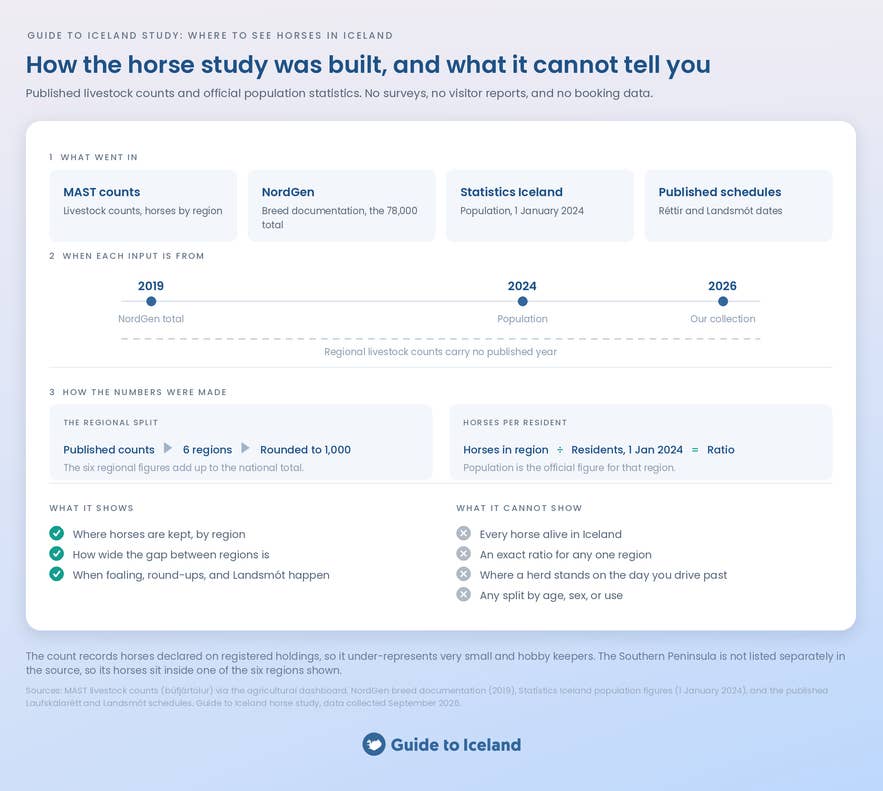
This study is built on published national livestock counts and official population statistics. It does not use survey answers, visitor reports, or booking data.
-
Horse numbers. Regional horse counts come from MAST's livestock counts (bufjartolur), published through the agricultural dashboard. The source we worked from does not state a reference year for the regional figures. Our data was collected in September 2026.
-
National total. The figure of around 78,000 horses is benchmarked against NordGen's documentation of the breed, published in 2019.
-
Population. National and regional population figures come from Statistics Iceland and are dated 1 January 2024.
-
What is counted. The livestock count records horses declared on registered holdings as of its reference date each year. It is not a census of every living horse in Iceland, and it under-represents very small and hobby keepers.
-
How the regions are defined. The six groupings map onto seven of Iceland's eight official regions, with the Westfjords and the Eastfjords shown as a single figure.
South Iceland covers Rangarvallasysla and Arnessysla. Northwest Iceland covers Skagafjordur and Hunathing. Northeast Iceland is centered on Eyjafjordur. West Iceland is centered on Borgarfjordur. The Capital Region covers Reykjavik and the municipalities around it.
The Southern Peninsula is not named as a separate grouping in the source breakdown.
-
How the regional split was derived. Regional figures are apportioned from the published counts and rounded to the nearest thousand, which is why the six figures sum to the national total of around 78,000.
-
How the ratios were calculated. Horses per resident is the regional horse figure divided by that region's population on 1 January 2024.
-
Event dates. Round-up and championship timings follow the published Laufskalarett and Landsmot schedules.
-
Studbook data. Every registered Icelandic horse is recorded individually in WorldFengur, the studbook of origin for the breed, run by the Farmers' Association of Iceland with FEIF. This study did not analyze WorldFengur records, and no findings above draw on them.
The limits of the analysis are as follows.
-
The count is declaration based. It records horses reported on registered holdings on one reference date, not every horse alive in Iceland on that date.
-
The regional split is approximated and rounded. Differences of a few thousand horses between two regions sit inside the margin of the method and should not be read as a ranking. The horses-per-resident figures inherit the same approximation, so they show the scale of the difference between regions rather than an exact ratio for any one region.
-
The data vintages are mixed. The national total is benchmarked to NordGen documentation published in 2019, and the population figures are dated 1 January 2024. The regional livestock counts carry no published reference year in the source we used, so the three inputs are not a single matched set.
That gap is too small to change which region comes out on top, because Northwest Iceland holds almost three horses per resident against less than one everywhere else.
-
The region groupings are ours. They follow the official regions closely, but the decision to show the Westfjords and the Eastfjords as one figure is a presentation choice made for readability.
-
The Southern Peninsula is not broken out. The source breakdown does not list it as its own grouping. Because the six regional figures account for the full national total, horses on the Southern Peninsula are counted within one of the six shown here, and the published data does not say which.
-
The Capital Region is not farming country. Its horses are kept in stables around Reykjavik rather than on breeding farms, so its position on absolute count is not comparable with the farming regions.
-
This study maps where horses are kept, not where they will be. Herds move with the season and with each farm's own practice, so no dataset can say where a given herd will be standing on the day you drive past.
-
Event dates move. Round-up and championship dates change year to year and can shift with the weather, so check the published schedule before booking around one.
-
There is no breakdown by age, sex, or use. The totals count foals, breeding stock, competition horses, and retired animals together.
Conclusion
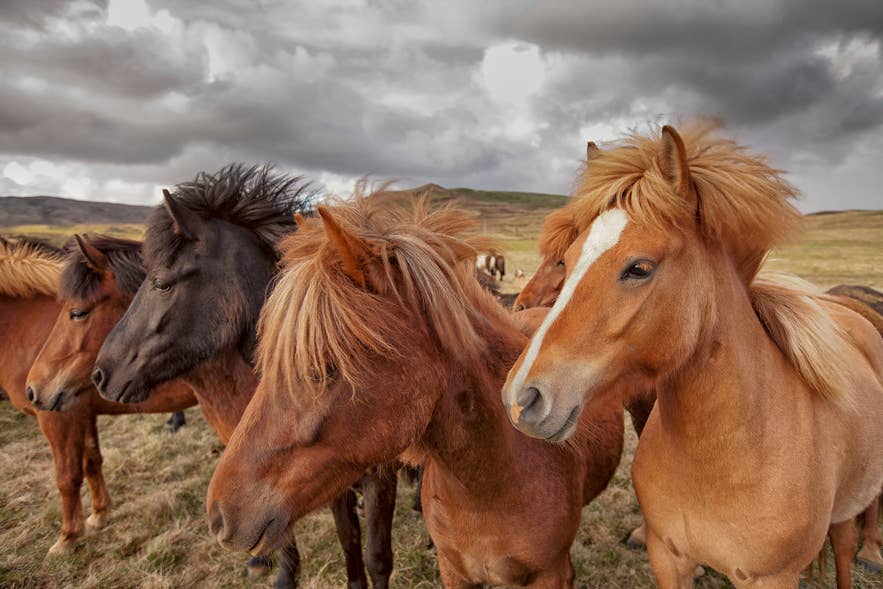 Travelers who want the best chance of seeing large herds without planning around them should drive to Northwest Iceland. Horses outnumber people there by almost three to one, and paddocks line the valley roads south of Saudarkrokur in every month of the year.
Travelers heading to Northwest Iceland for the horses are also close to the country's main seal coast. Our findings on where to see seals in Iceland show the biggest seal gatherings on the Vatnsnes Peninsula, just off the Ring Road.
Travelers who want to ride rather than watch have the widest choices in South Iceland. The lowlands between Selfoss and Hvolsvollur hold the densest concentration of breeding and competition stables in the country.
Travelers staying in Reykjavik without a rental car can ride inside the Capital Region. This horse-riding and hot springs tour pairs a short ride with a geothermal soak in a single afternoon.
Travelers who want the spectacle rather than the sighting should come for the last weekend of September, when the round-ups bring the herds down off the mountains. The wider picture for every animal in the country is in our guide to wildlife and animals in Iceland.
Guide to Iceland ran this as an objective and independent study. The horse figures come from published government livestock counts, and the population figures from Statistics Iceland. Our marketplace sells horse-riding tours in every region covered here. No partnership shaped which region came out on top.

Guide to Iceland Editorials is the shared byline for our content team. We use it on pieces several people worked on together, where no single writer owns the article, and on anything rewritten often enough that a personal byline would be misleading. We also publish our original data studies under this profile. Each study answers a question travelers ask about Iceland, using primary sources such as booking records, traveler reviews and public datasets, and every study is quality checked by human experts before it's published. Everything under this byline is researched and reviewed by people who live and work in Iceland. If you spot something out of date or want to suggest a correction, message us and it reaches the whole team.