A Guide to Iceland study reveals which waterfalls travelers recommend most, which receive the highest ratings, and which lesser-known falls stand out.
The findings are based on 8,488 Reddit comments, more than 27,000 TripAdvisor reviews, and traveler discussions in Iceland-focused Facebook groups, plus Google Maps ratings and review counts for the same waterfalls, added in September 2026.
The results show that the fame of Iceland's waterfalls does not always reflect how strongly travelers recommend them. Well-known attractions dominated the overall discussion, but smaller and less-reviewed waterfalls performed particularly well in the ratings and hidden-gem analysis.
Among the waterfalls analyzed, Skogafoss received the most Reddit mentions. Kvernufoss had the highest TripAdvisor rating and led the hidden-gem index. The study also explains what each waterfall is best for, when to visit, and how to reach them through self-drive trips and waterfall tours in Iceland.
Key Findings
-
Most recommended: Skogafoss ranked first with 344 Reddit mentions and 2,842 upvotes, nearly twice the mentions of second-place Seljalandsfoss.
-
Highest rated: Kvernufoss had the highest TripAdvisor rating at 4.9, the only waterfall in the study rated 4.9 on both TripAdvisor and Google Maps. Dynjandi, Bruarfoss, Haifoss, and Gljufrabui followed at 4.8.
-
Hidden gems: Kvernufoss led the hidden-gem index with 68 Reddit mentions per 100 TripAdvisor reviews, ahead of Aldeyjarfoss, Glymur, and Haifoss.
-
Best for different experiences: Travelers favored Glymur for hiking, Dynjandi for surrounding views, Dettifoss for power and scale, and Seljalandsfoss and Kvernufoss for walking behind the cascade.
-
Things to know before visiting: Check the walking distance and difficulty, as some waterfalls require a hike rather than a quick stop. Bring waterproof clothing for waterfalls where spray or wet paths are expected.
-
Best time to visit: Summer offers the easiest access and longest days, while winter and the shoulder months bring more closures. Check current road, trail, and weather conditions before setting out.
Cite This Study
The charts and data in this study are free to use under CC BY 4.0. Credit Guide to Iceland and link to this page. Every chart has an Embed button underneath it with ready-to-paste code.
How Did We Rank Iceland's Waterfalls?
 To rank Iceland's waterfalls, we collected every substantial discussion of Icelandic waterfalls in r/VisitingIceland and r/Iceland from 2023 through August 2026. We then extracted 8,488 comments from the 300 most relevant threads.
For each of 39 named waterfalls, we counted mentions, community upvotes, and positive and negative opinions. We also recorded what travelers praised about each waterfall, including its power, hiking opportunities, walk-behind experience, fewer crowds, and photography.
We compared the results with TripAdvisor, where Iceland’s waterfall category includes 81 listed waterfalls. The 16 waterfalls included in this part of the study had more than 27,000 reviews between them, based on review counts and ratings recorded in early September 2026.
We also reviewed traveler discussions in Iceland-focused Facebook groups. These provided a qualitative cross-check but were not used as a ranked source.
Since mention counts can reflect fame as well as visitor opinions, we also used measures that separated wider popularity from stronger traveler recommendations.
We also pulled Google Maps ratings and review counts for the 18 waterfalls and canyons in the study, roughly 54,000 ratings in total, as a third and much larger platform check on the pattern.
What Are the Most Recommended Waterfalls in Iceland?
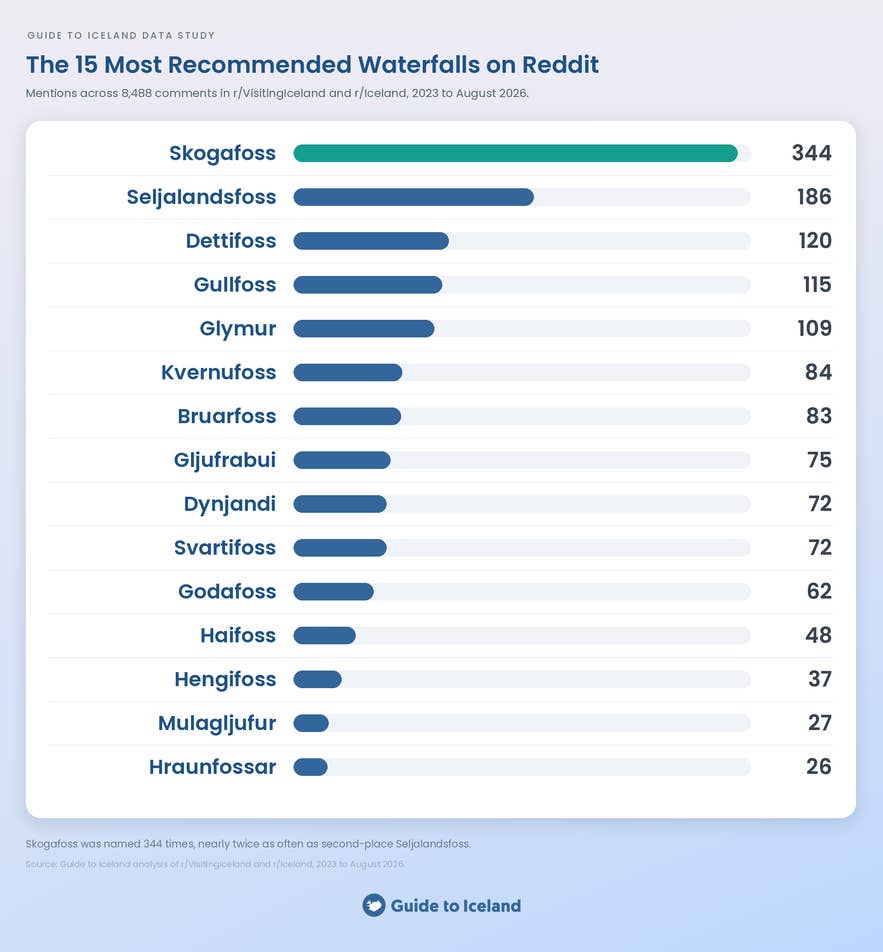
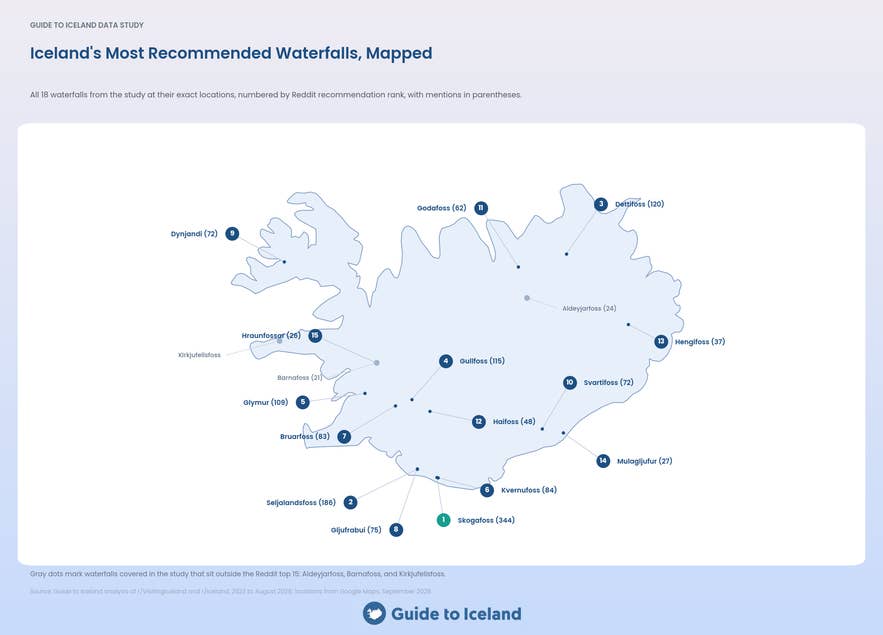
Skogafoss on the South Coast was the most recommended waterfall in Iceland, with 344 Reddit mentions and 2,842 upvotes. It received nearly twice as many mentions as the second-place waterfall. Travelers highlighted the close view of the 197-foot (60-meter) cascade, upper viewpoint, and nearby Fimmvorduhals Trail.
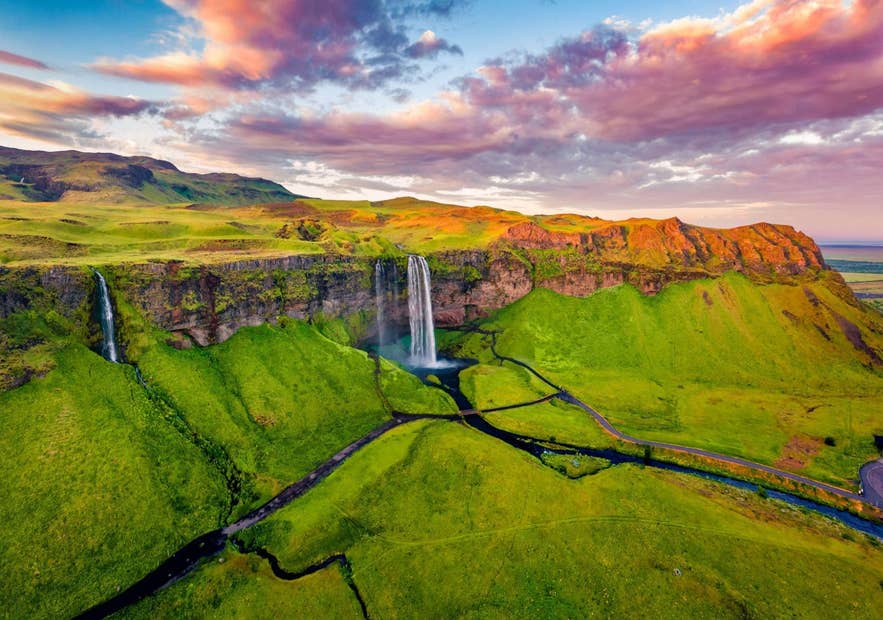
Seljalandsfoss, also on the South Coast, ranked second with 186 mentions, largely because of its path behind the waterfall. This experience appeared 20 times more often than in the average discussion. The path may close in winter because of ice, and travelers recommended wearing waterproof clothing to stay dry in the spray.
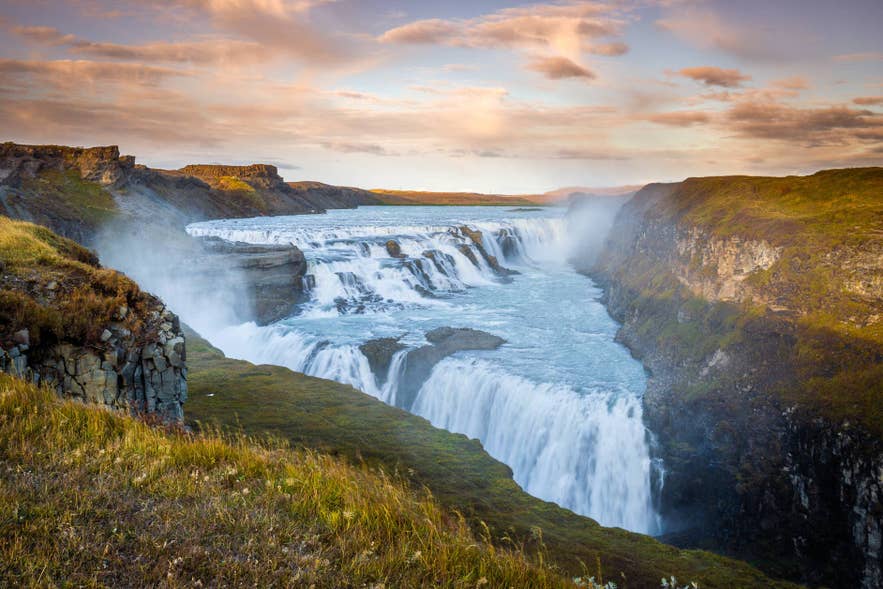
Dettifoss in North Iceland placed third with 120 mentions, with power and scale discussed six times more often than average. Gullfoss followed with 115 mentions. Its fourth-place ranking may reflect the fact that most travelers on the Golden Circle visit it without needing a recommendation.
Rounding out the top five was Glymur in West Iceland, with 109 mentions. It was the community’s favorite waterfall hike, offering a three-to-four-hour route through a river canyon with a log crossing. It had one of the highest positive-to-negative ratios in the study, with 55 positive comments and 10 negative ones.
Which Waterfall in Iceland Do Travelers Rate the Highest?
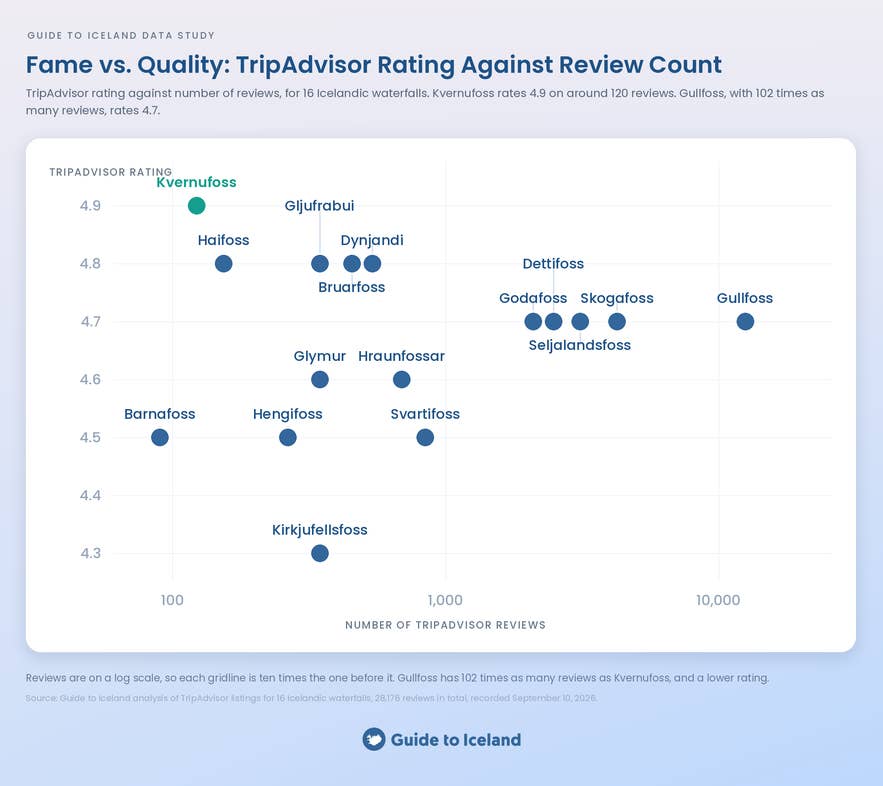
Kvernufoss was the highest-rated waterfall in Iceland, with a TripAdvisor rating of 4.9 based on 123 reviews, a score it repeats on Google Maps. Dynjandi, Bruarfoss, Haifoss, and Gljufrabui each had a rating of 4.8. Godafoss, Gullfoss, Skogafoss, Seljalandsfoss, and Dettifoss all had ratings of 4.7 but considerably more reviews.
Kvernufoss lies in a gorge about a 20-minute walk from the Skogar Museum parking area and less than 0.6 miles (1 kilometer) from Skogafoss. Visitors can walk behind the waterfall, and this feature appeared 21 times more often than average in its Reddit comments. Travelers also frequently described it as quieter than nearby Skogafoss.
The praise holds up under a harder test. Kvernufoss, Godafoss, and Gljufrabui are three of the four least overrated places among the famous attractions in Iceland that live up to the hype. Not one Google review calls Kvernufoss overrated.
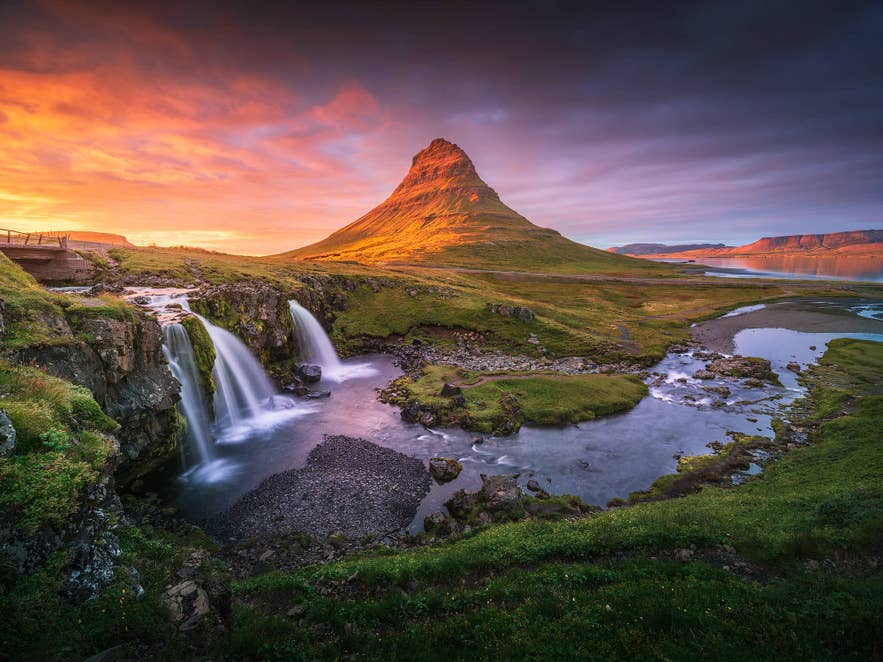
Kirkjufellsfoss on the Snaefellsnes Peninsula had the lowest rating among the well-known waterfalls included, at 4.3. Reviewers often described it as a small waterfall beside a highly photogenic Mount Kirkjufell.
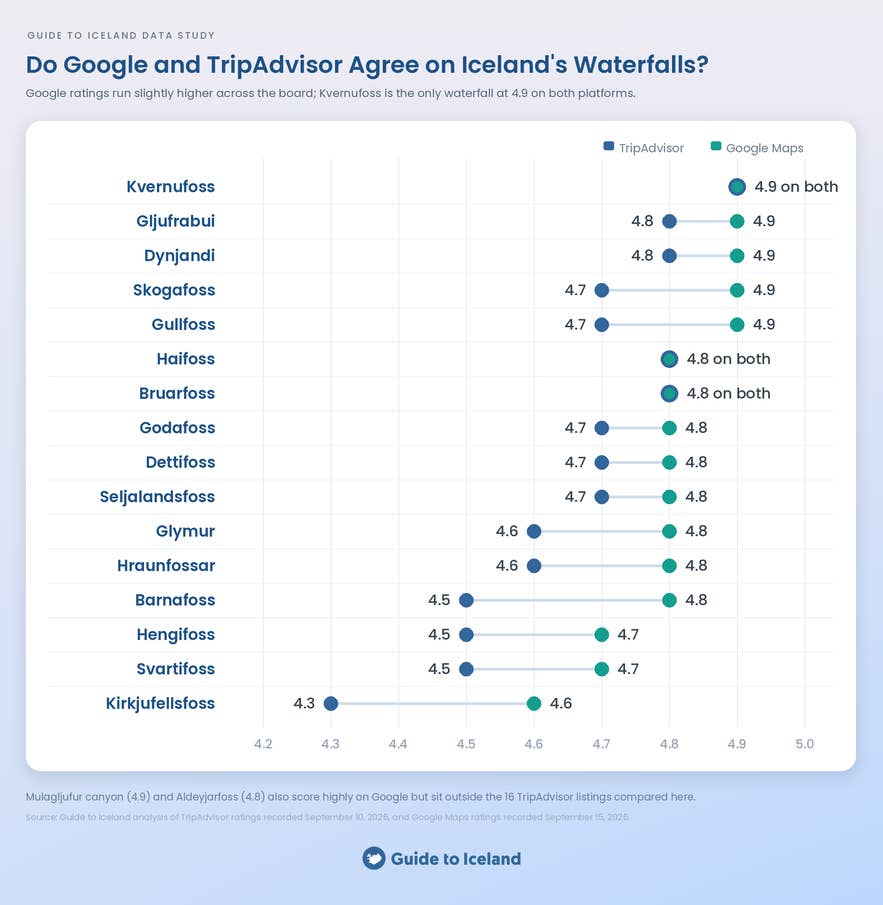
Google Maps, with roughly 54,000 ratings across these waterfalls, tells the same story with rounder numbers. Ratings there run slightly higher across the board, typically by a tenth of a point or two, yet the pattern holds: Kvernufoss is the only waterfall in the study rated 4.9 on both platforms, and Kirkjufellsfoss sits last on both. The quiet places join the 4.9 club on Google too, with Gljufrabui, Dynjandi, and Mulagljufur canyon alongside the big names. The one real disagreement is Barnafoss: Google reviewers, who reach it on the same easy path as Hraunfossar, rate it 4.8, while the smaller TripAdvisor crowd scores it 4.5, the same split our Reddit sentiment analysis found.
What Are Iceland's Hidden-Gem Waterfalls?
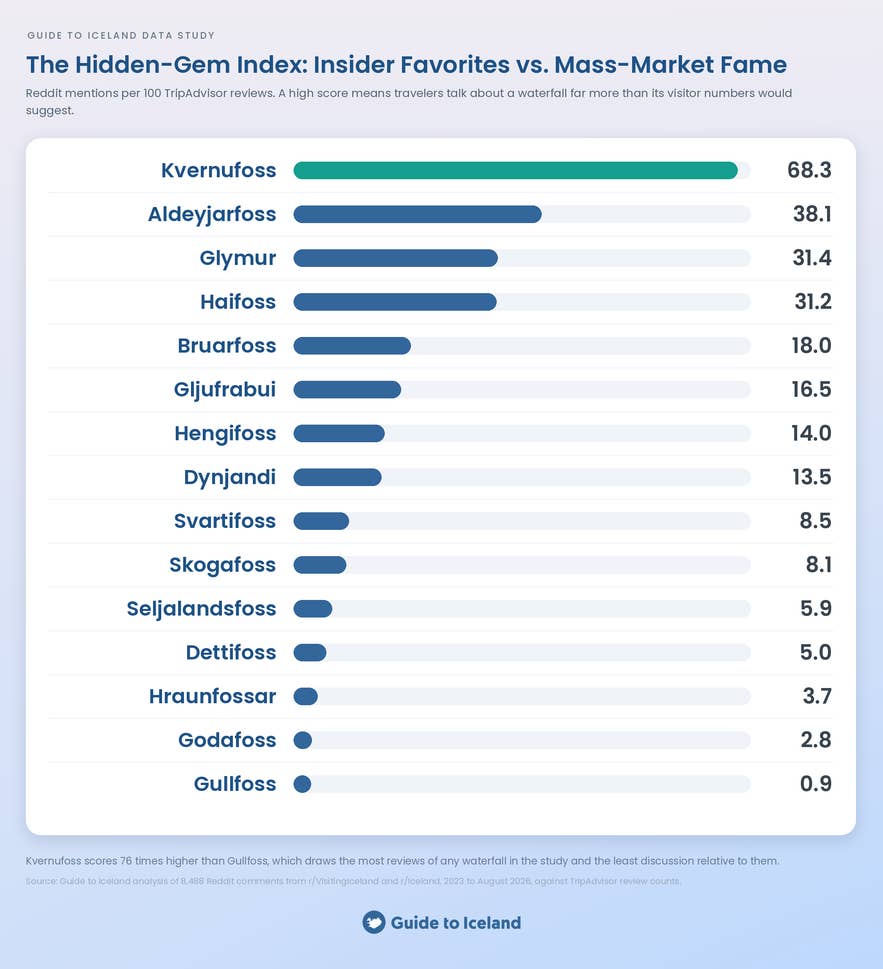
Iceland's hidden-gem waterfalls were identified by comparing Reddit mentions with TripAdvisor review totals. A high score means a waterfall received many Reddit mentions relative to its number of public reviews. Kvernufoss led with 68 mentions per 100 reviews, followed by Aldeyjarfoss with 38 and Glymur and Haifoss with 31 each.
Aldeyjarfoss lies near the northern end of the Sprengisandur Highland Route. Its glacial water drops between dark basalt columns, and road access is most reliable during summer. Tied with Glymur as one of the hidden gems in Iceland, Haifoss plunges 400 feet (122 meters) into a dramatic gorge near Hekla Volcano in South Iceland.
By comparison, Gullfoss scored 0.9 mentions per 100 reviews, Godafoss scored 2.8, and Hraunfossar scored 3.7. As established stops on the Golden Circle, Diamond Circle, and in West Iceland, they have accumulated far more TripAdvisor reviews, lowering their hidden-gem ratios.
What Is Each Waterfall In Iceland Best For?
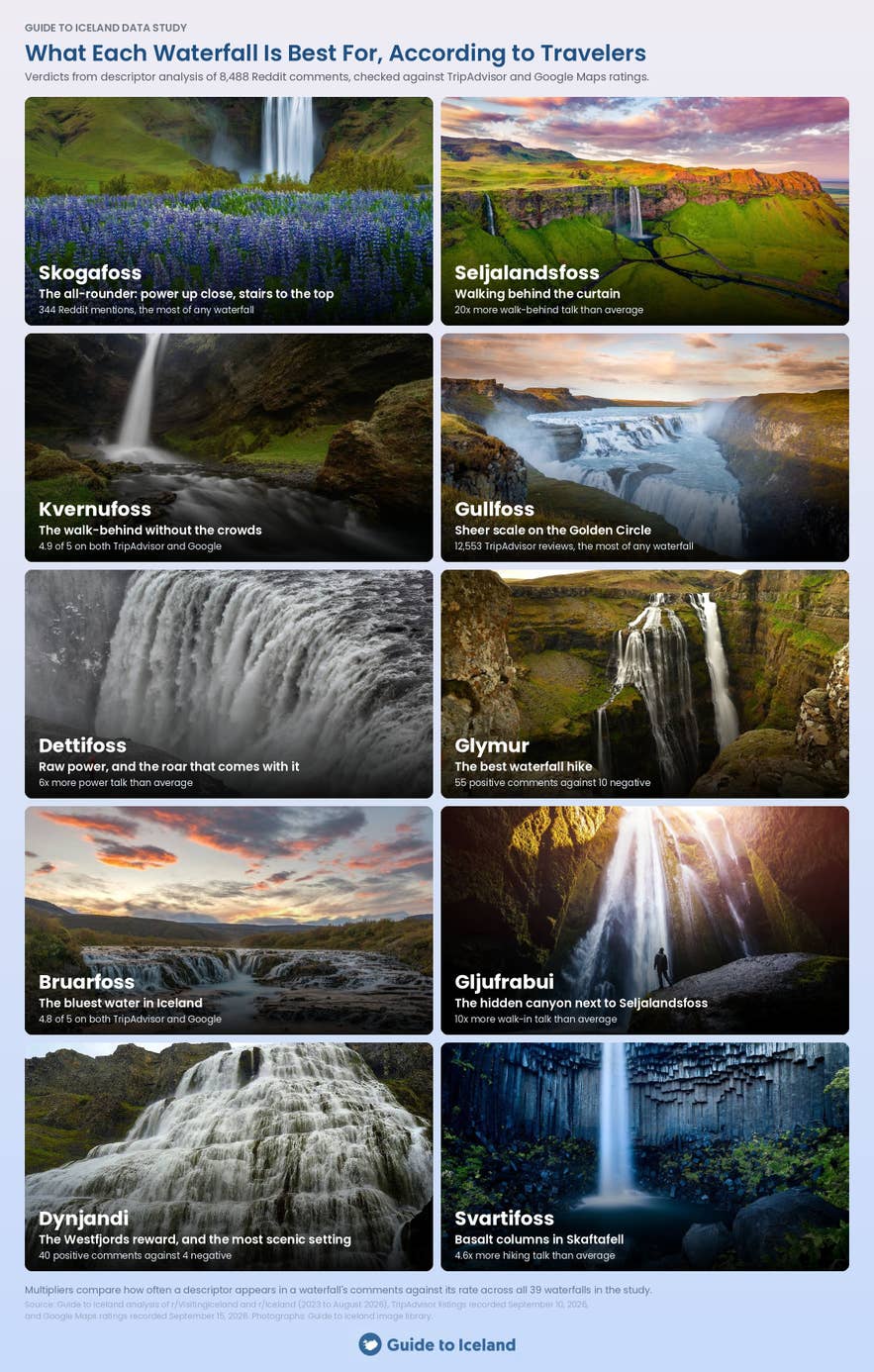
Each waterfall in Iceland is best for a different experience, from hiking and photography to dramatic power, fewer crowds, or walking behind the cascade. The analysis compared how often travelers associated these qualities with each waterfall across all 8,488 comments, revealing why they recommended different falls.
Seljalandsfoss and Kvernufoss were often associated with the experience of walking behind the cascade. The two falls are about 25 minutes apart and can be included in the same South Coast itinerary. Dettifoss was most strongly associated with power and scale, similar to Skogafoss.
Glymur was the leading choice for a waterfall hike. Svartifoss in Skaftafell Nature Reserve offers a shorter alternative with views of basalt columns. Bruarfoss near the Golden Circle stood out for its vivid blue water and maintained a 4.8 rating, even when reaching it required a muddy 4.3-mile (7-kilometer) round-trip hike.
Dynjandi had the strongest association with surrounding views. Its scenery score was 4.7 times above average, and it received 40 positive comments compared with four negative ones. Its remote location means it fits more naturally into a longer Westfjords itinerary than day trips from Reykjavik.
What Should You Know Before Visiting Waterfalls in Iceland?
Before visiting waterfalls in Iceland, check whether current access conditions could affect your plans or views. This was particularly relevant at Hengifoss in East Iceland. Its usual 1.6-mile (2.5-kilometer) climb passes red-striped cliffs, but visitors reported that restrictions in 2026 limited them to more distant views.
Travelers also advised checking how much walking each waterfall requires. Skogafoss, Seljalandsfoss, and Gullfoss are close to their main parking areas, while Hengifoss involves a 1.6-mile (2.5-kilometer) climb.
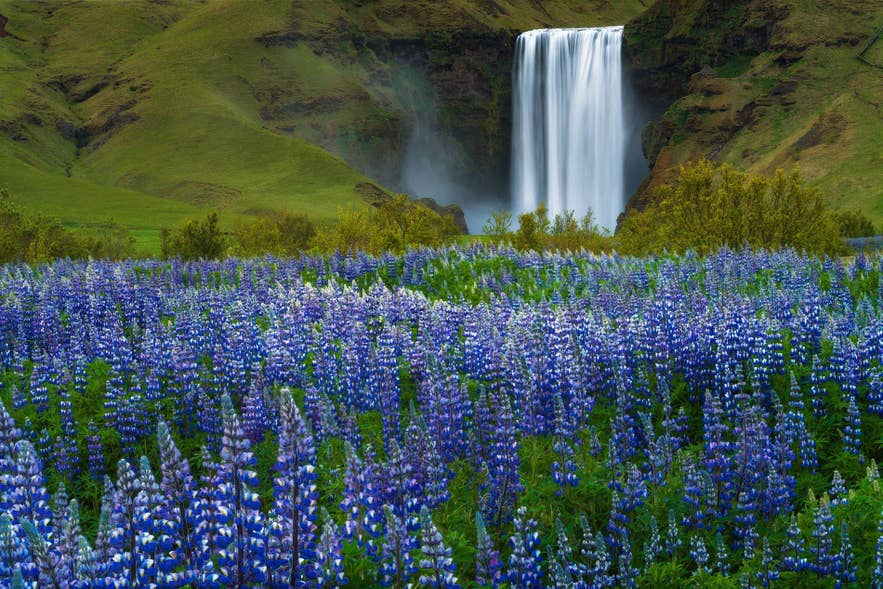
The staircase to the upper viewpoint at Skogafoss is optional, but the trail continues past several more waterfalls and can add an hour or more to the visit. Svartifoss and Glymur should also be planned as hikes rather than quick stops.
Barnafoss, often visited with Hraunfossar in West Iceland, received 10 positive and nine negative comments, making it the most divisive waterfall in the study. Some travelers felt it did not justify a separate detour, while others saw it as a quick addition to Hraunfossar. The shared advice was to visit if you are already there but not reroute your day for it.
Expect to get wet when visiting waterfalls with walk-behind paths. Travelers recommended waterproof clothing for Seljalandsfoss and Gljufrabui, including waterproof boots for the short walk into Gljufrabui Canyon, where the water underfoot may be deeper than expected.
When Should You Visit Iceland's Waterfalls?
The best time to visit Iceland’s waterfalls depends largely on access. Traveler discussions focused less on seasonal scenery and more on whether roads and trails were open.
Summer generally offers the easiest access, especially in the Highlands, while longer daylight during the midnight sun allows more stops in one day. To avoid crowds, travelers recommended visiting before the tour buses arrived or after they had left, but cautioned against planning very late visits every evening.
Winter brings more closures and shorter days. Travelers reported restricted access at Dettifoss, while slippery paths and falling ice can close the route behind Seljalandsfoss and make hikes such as Glymur unsafe.
The shoulder months are less predictable. Roads and hiking routes may still be closed in spring or begin closing again in autumn, particularly in the Westfjords and Highlands.
Because access can change quickly, check current road conditions and closures on Umferdin and review SafeTravel’s latest alerts before setting out. Check again on the day of your visit, especially during winter and the shoulder months.
How Can You See Iceland's Waterfalls?
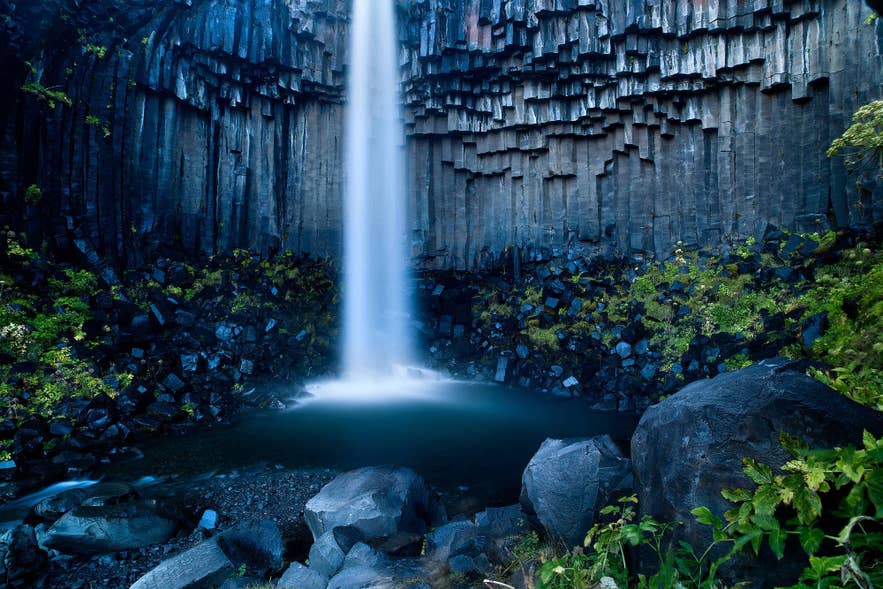
You can see the top waterfalls in Iceland through dedicated waterfall tours, self-drive itineraries, or guided excursions. Skogafoss, Seljalandsfoss, Kvernufoss, and Gljufrabui are close together on the South Coast, while Svartifoss lies farther east in Skaftafell. Many South Coast tours include several waterfall stops.
Gullfoss is a standard stop on Golden Circle itineraries, while Bruarfoss can be added to the same route. Farther inland, travelers can visit Haifoss on a summer Highland tour from Reykjavik.
In North Iceland, Dettifoss and Godafoss are two of the main waterfalls on Diamond Circle excursions. Aldeyjarfoss sits outside the circuit but can be reached on a Super Jeep waterfall tour from Akureyri.
Glymur, Hraunfossar, and Barnafoss can be included in West Iceland itineraries. Farther north, Dynjandi fits naturally into tours of the Westfjords. Hengifoss is in East Iceland, which is best reached with rental cars as part of a Ring Road itinerary.
About This Study
 Guide to Iceland analyzed 8,488 comments from 300 waterfall-related threads in r/VisitingIceland and r/Iceland, posted between January 2023 and August 2026. The study also covered more than 27,000 TripAdvisor reviews across 16 waterfall listings and traveler discussions in Iceland-focused Facebook groups. Google Maps ratings and review counts for 18 waterfalls and canyons in the study, about 54,000 ratings in total, were added as a third platform check in September 2026.
A computer program was used to calculate mention counts, sentiment tallies, and descriptor frequencies. TripAdvisor figures reflect early September 2026. The Facebook discussions were used as a qualitative cross-check rather than a ranked source.
Explore More Guide to Iceland Studies
This article is part of Guide to Iceland's original research series. For more data-driven trip-planning insights, read our studies on the best month to see the northern lights, the best places in Iceland to see the northern lights, and the best time to visit the Blue Lagoon.
You can also explore our analysis of Iceland’s most underrated places based on genuine traveler comments, our survey of the top experiences in Iceland according to tourism professionals, and our research on the best time to visit ice caves and the safest month to visit ice caves. For a camping trip between waterfalls, our study of 128 campsites in Iceland ranks where to stay.

Guide to Iceland Editorials is the shared byline for our content team. We use it on pieces several people worked on together, where no single writer owns the article, and on anything rewritten often enough that a personal byline would be misleading. We also publish our original data studies under this profile. Each study answers a question travelers ask about Iceland, using primary sources such as booking records, traveler reviews and public datasets, and every study is quality checked by human experts before it's published. Everything under this byline is researched and reviewed by people who live and work in Iceland. If you spot something out of date or want to suggest a correction, message us and it reaches the whole team.