We analyzed 50,087 cloud-cover observations from 144 weather stations to find the statistically best regions to see the northern lights in Iceland. The results were surprisingly different from the usually recommended northern lights spots.
A clear sky is one of the prerequisites for seeing the northern lights in Iceland. Comparing locations’ cloud coverage is one of the only ways travelers can actually plan in advance and increase their chances of seeing the northern lights.
Advice on finding the northern lights in Iceland has long pointed north, on the assumption that North Iceland has the clearest skies throughout the winter season. We tested that assumption against every cloud observation the Icelandic Meteorological Office has published.
Why You Can Trust Our Content
Guide to Iceland is the most trusted travel platform in Iceland, helping millions of visitors each year. All our content is written and reviewed by local experts who are deeply familiar with Iceland. You can count on us for accurate, up-to-date, and trustworthy travel advice.
The dataset covers 50,087 monthly cloud-cover readings from 261 station files, spanning 1937 to 2026. Based on the analysis of this data, we have been able to identify the parts of the country where you’re most likely to get the clear sky you need to see the northern lights.
Keep reading for the full breakdown of overcast data and the list of the most clear-skied places in Iceland. For advice on the season, the time of night, and the forecast tools, our guide to the best time to see the northern lights in Iceland has you covered.
Key Findings
-
Southeast Iceland has the clearest skies in the country. In an average aurora-season month, clouds cover about 70% of the sky in Southeast Iceland. A corridor from Kirkjubaejarklaustur through Jokulsarlon and Hofn to Djupivogur tops every measure.
-
Djupivogur is the place with the highest odds for a clear sky. In an average aurora-season month, clouds cover about 68% of the sky in Djupivogur. In 36% of the months, clouds cover 62.5% or less of the sky.
-
The Westfjords is the cloudiest region in the study. In an average aurora-season month, clouds cover about 81% of the sky in the Westfjords, rising to 86% at Hornbjargsviti on the region’s northern tip.
-
Akureyri, and North Iceland as a whole, is one of the cloudier parts of the country. The inland northeast is the exception. In an average aurora-season month, clouds cover about 71% of the sky at Lake Myvatn, putting it closer to the southeast than to the rest of the north.
-
Reykjavik is a better aurora base than its reputation may suggest. In an average aurora-season month, clouds cover about 72% of the sky in Reykjavik, which puts it in the clearer third of the ranking, ahead of Keflavik, Akureyri, and Snaefellsnes.
-
The clearest sky does not mean the least rain. The southeast is the wettest region in Iceland, but it often gets short, heavy bursts of rain and then clears. Kirkjubaejarklaustur in the southeast gets roughly four times the winter precipitation of Myvatn in the northeast.
-
A cloudy average does not rule anywhere out. The data cannot count clear nights, so the ranking shows which places are generally more or less overcast rather than how often the sky actually opens and you can see the northern lights.
Cite This Study
The charts and data in this study are free to use under CC BY 4.0. Credit Guide to Iceland and link to this page. Every chart has an Embed button underneath it with ready-to-paste code.
Overview: Study Method & Data Collection
 This study ranks Iceland’s main aurora destinations by how cloudy they are, using every monthly cloud-cover record the Met Office has published. The summary below covers how that data was collected, filtered, and analyzed, and how the rankings were checked. The full method chapter is at the end of the article.
-
Data collection: We downloaded every monthly cloud-cover record the Met Office publishes, 261 station files in all, on August 17, 2026. That gave us 50,087 monthly readings from 144 weather stations, going back to 1937.
-
Data inclusion and estimation: We kept only the aurora season, September to April, and only stations with at least 100 valid months of data. That left 92 stations. Icelandic stations open and close at different times, so we adjusted for the decades each one was actually observing. Otherwise, a station can look clear just because it recorded during clearer years.
-
Analysis: We used a two-way fixed-effects model, which splits every reading into a station part and a date part. The ranking is built on the station part, so a place is judged on its own climate rather than on the decades it happened to be observing.
-
Reporting: We grouped the 92 stations into 22 places travelers actually use as bases and 12 regions. Cloud is reported in oktas, and we also counted how often each place gets a month averaging five oktas or less.
-
Results of Analysis: Two ranked tables, one for the 22 travel bases and one for the 12 regions. Both sit in the Method chapter at the end, and the charts in the article are drawn from them.
-
Validation: We ran three cross-checks. Two recalculate the ranking over fixed 30-year windows, 1961 to 1990 and 1991 to 2020. The third compares it against measured sunshine hours, which an instrument records rather than a person. All three agree.
Top Northern Lights Destinations in Iceland: Ranked from Least to Most Cloudy
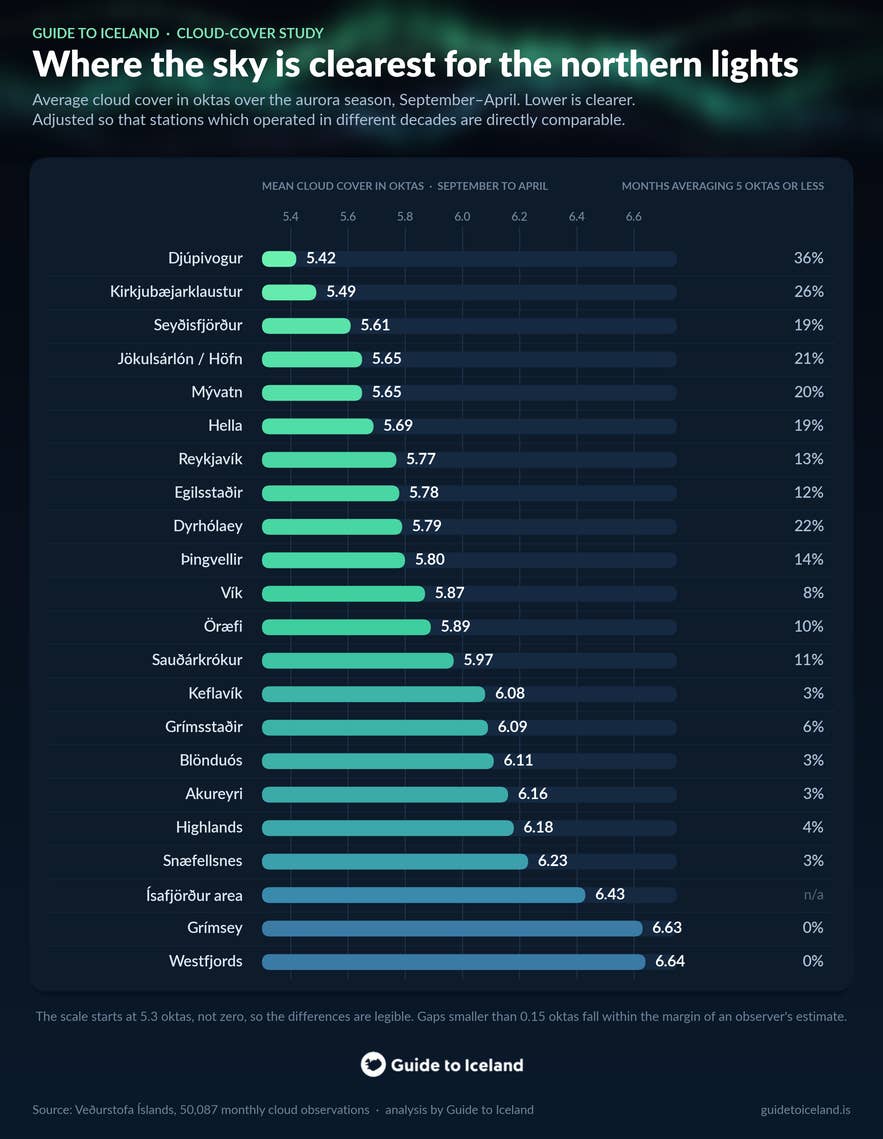
The results chart above ranks the 22 places travelers most often use as aurora bases from the clearest sky to the cloudiest.
The bars show average cloud cover across the aurora season, measured in oktas, meaning a shorter bar means a clearer sky. The percentage beside each bar is how often that place records a whole month averaging 5.0 oktas or less, which is the closest this data comes to counting clear spells.
Djupivogur comes first at 5.42 oktas and Kirkjubaejarklaustur second at 5.49. Seydisfjordur, the Jokulsarlon and Hofn area, and Lake Myvatn follow, all within a quarter of an okta of the top. Four of the five clearest places sit on the coastal stretch from Southeast Iceland to the Eastfjords.
The gap between the top two is smaller than the data can resolve. Differences below about 0.15 oktas fall inside the margin of an observer’s estimate, so Djupivogur and Kirkjubaejarklaustur are best read as joint first.
Reykjavik is the surprise in the upper half, seventh at 5.77 oktas and clearer than Keflavik at 6.08, Akureyri at 6.16, and Snaefellsnes Peninsula at 6.23. What holds the capital back as an aurora base is light pollution, not clouds.
The cloudiest places are the ones photographs sell hardest. Grimsey records 6.63 oktas and the Westfjords 6.64, and neither managed a single month averaging 5.0 oktas or less across the reference period.
The two columns do not always agree, and where they part offers a useful signal. A place that ranks higher on the percentage than on the average has a sky that swings between clear and overcast, which may give you more usable nights than one sitting at a steady middling average.
Dyrholaey is the clearest example. It ranks ninth on average cloud at 5.79 oktas but third on clear months at 22%, ahead of six places that look better on the average alone. For the other places on the list, the two measures broadly agree.
Every place in the study is cloudy on average, and even Iceland’s clearest sky is about two-thirds covered. The ranking shows where the odds are best, not where the sky is reliably clear.
The Clear-Sky Corridor in Southeast Iceland
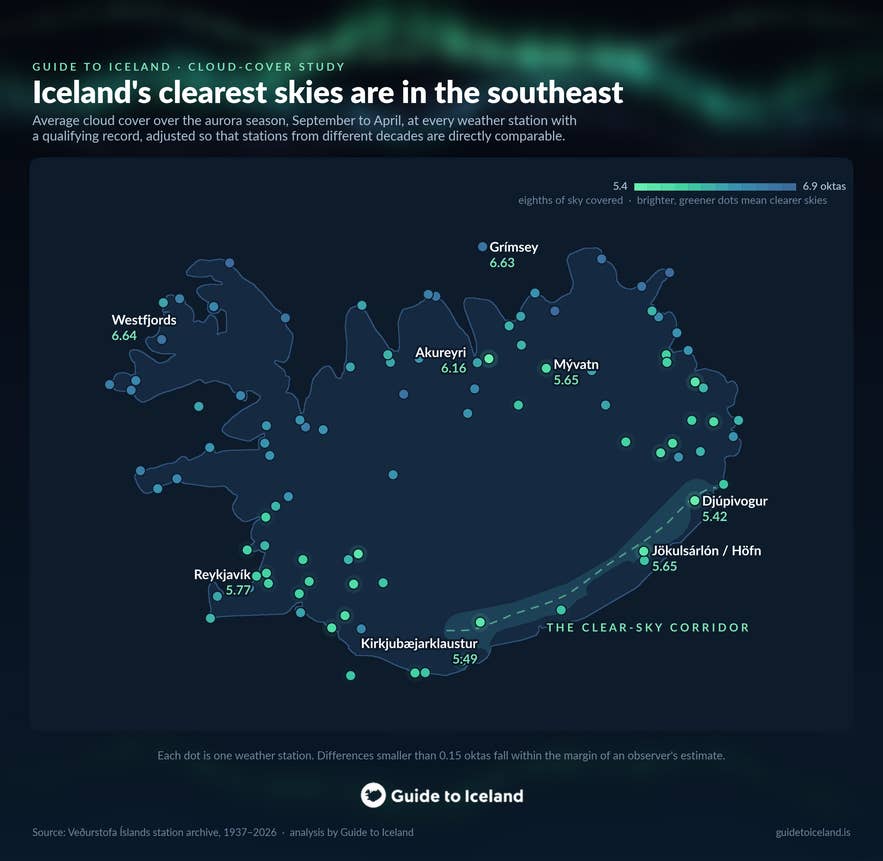
The clearest skies in Iceland are not spread evenly around the country. Average cloud cover is lowest in a continuous band along the southeast coast, a stretch which we have decided to call the clear-sky corridor. That band of low cloud cover runs from Kirkjubaejarklaustur through Skaftafell, Jokulsarlon Glacier Lagoon, and Hofn to Djupivogur. The clear-sky corridor spans about 176 miles (283 km) in total driving distance.
The 92 weather stations in this study were also grouped into 12 regions and ranked by average cloud cover from November to March. The two southeast regions came first and second of the 12, with Hornafjordur at 5.57 oktas and the Oraefi and Skaftafell area at 5.67 oktas. The Westfjords came last at 6.49 oktas, which is 0.92 oktas cloudier than Hornafjordur.
The same pattern appears when the weather stations are compared one by one rather than by region. Teigarhorn, just outside Djupivogur, has the lowest average cloud cover of any station in the study at 5.35 oktas. Flatey is the clearest station in the Westfjords at 6.15 oktas, and that is still cloudier than the clearest station in any of the other 11 regions.
The low cloud cover in the southeast runs against the region’s reputation for wet weather. Southeast Iceland records some of the highest rainfall in the country and still has the lowest average cloud cover of the 12 regions. However, rainfall totals measure how much water falls, not how many hours the sky stays covered. Rain in Southeast Iceland tends to arrive in short, heavy bursts, with clear spells in between.
North Iceland Does Not Have the Clearest Skies
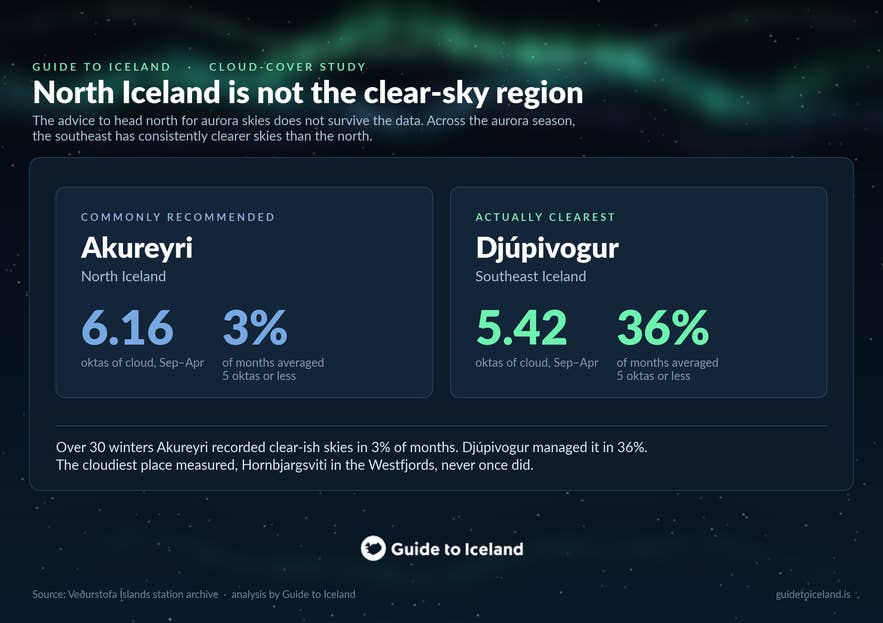
North Iceland is often recommended as the best part of the country for the northern lights, but the cloud data does not support that. Akureyri ranks seventeenth of the 22 places at 6.16 oktas, ten places below Reykjavik and 0.74 oktas behind Djupivogur.
The difference is larger when counted in months rather than oktas. Between 1961 and 1990, Akureyri had a month averaging five oktas or less 3% of the time, while Djupivogur reached that level in 36% of months.
The north does have one genuine advantage, which is how far north it sits. Akureyri lies about one degree further north than Djupivogur, giving it roughly 45 minutes more darkness at midwinter. Darkness matters as much as a clear sky for seeing the aurora.
Lake Myvatn is the exception in the north. At 5.65 oktas it is the clearest place in northern Iceland, level with the Jokulsarlon and Hofn area. Its winters are drier too, at about a quarter of the precipitation Kirkjubaejarklaustur receives.
Akureyri is still the largest town outside the capital region and the base for day tours from Akureyri, which can drive toward whichever part of the sky is clear that night, including in the direction of Myvatn. What the north does not have is the clear-sky advantage it is usually recommended for.
Cloud Cover by Month in Iceland
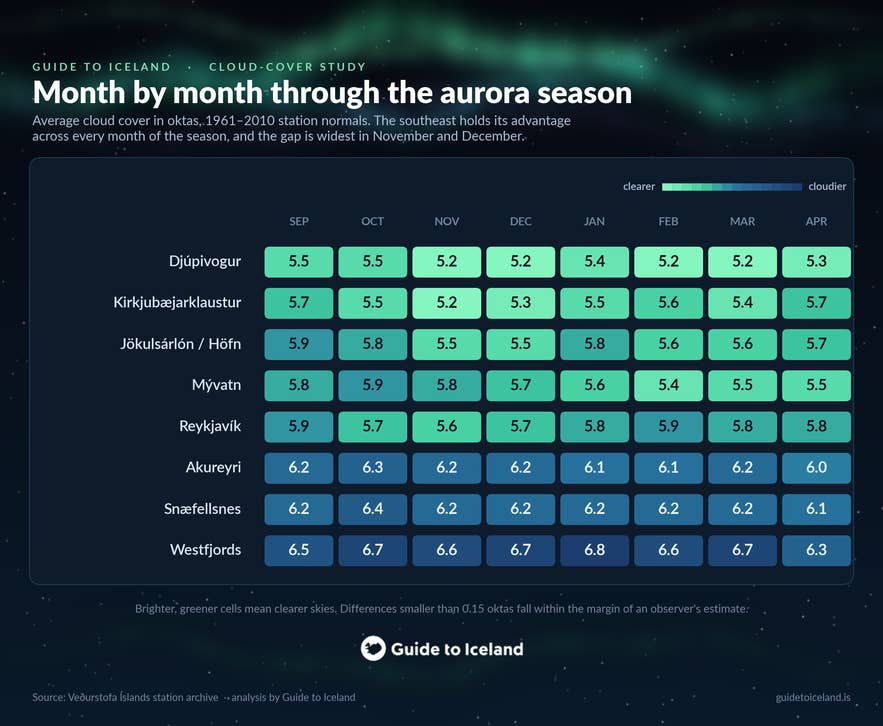
The month-by-month figures show that where a traveler goes matters more than when they go. At each of the eight places, the difference between its clearest month and its cloudiest month is no more than 0.5 oktas. In any single month of the season, the gap between the clearest place and the cloudiest place is at least 1.0 oktas.
The order of the eight places barely changes across the season. Djupivogur has the lowest average cloud cover in all eight months, and Akureyri, Snaefellsnes Peninsula, and the Westfjords hold the bottom three positions in all eight months. Only the four places in the middle of the table trade positions from month to month.
The cloudiest months in Djupivogur are September and October, both averaging 5.5 oktas, which is still clearer than the clearest month in Akureyri, April, 6.0 oktas. Djupivogur is at its clearest in November, December, February, and March, averaging 5.2 oktas in each of the four.
December and January are the darkest months of the Icelandic year. December is also among the clearest, while January sits in the middle of the pack.
September and October are the cloudiest months of the aurora season across all eight places. Early autumn is often chosen for milder weather and easier driving, but it carries the highest cloud cover of the season.
Cloud is only one of the factors that vary by month, though, and our study of the best month to see the northern lights in Iceland found that March combines high aurora activity with clear skies and long enough nights, while December has the least magnetic activity of the season.
 Lake Myvatn is the only place in northern Iceland that competes with the southeast, and its advantage arrives late in the season. From January onward, Lake Myvatn has less cloud cover than Reykjavik in every month, and February is its clearest month at 5.4 oktas.
These monthly figures are 1961 to 2010 station normals, meaning raw averages over a fixed 50-year period. The season averages used in the ranking are adjusted so that stations recording in different decades can be compared, so the two sets of numbers differ slightly. Djupivogur averages 5.3 oktas across these eight monthly normals and 5.42 oktas in the adjusted ranking.
No month at any of the eight places averages below 5.2 oktas, which is roughly two-thirds of the sky covered. The monthly figures show which combinations of place and month give the best odds, not which ones offer a reliably open sky.
What the Cloud Data Does Not Tell You
This study measures cloud cover and the results should therefore be interpreted with a few limitations in mind:
-
Cloud cover is an observer’s judgment, not an instrument reading. Differences smaller than about 0.15 oktas between two individual stations should not be treated as real. The regional gradient of 0.9 oktas and the 1.6-okta station spread are well outside that margin.
-
A monthly mean is not the same as the frequency of clear nights. The share of months at five oktas or less is the closest proxy monthly data allows, and it produces the same ranking.
-
Teigarhorn stopped reporting cloud in 2009 and Kirkjubaejarklaustur in 2013. In the 1991 to 2020 subset on its own, Kirkjubaejarklaustur still ranks first.
-
Weather stations sit in inhabited lowlands, so this study says nothing about the Highlands of Iceland beyond Hveravellir, which records 6.18 oktas. Most highland roads are closed through the aurora season anyway, so the gap matters more for the science than for trip planning.
-
Sunshine hours are not a guide to clear aurora nights. Our 26-year sunshine study found the midwinter sun sits too low to register on a sunshine recorder, even under a clear sky, so sunshine records cannot rank the winter months by cloud. Cloud observations, as used here, are the measure that can.
-
Cloud is one of three variables that decide whether you see the aurora. Solar activity and light pollution are not addressed here.
How to Plan an Aurora Trip Around Iceland’s Clearest Skies
 There are three sensible ways to use the cloud coverage rankings as input when planning northern lights vacations in Iceland, and the right one depends on how much night driving in Icelandic winter you want to do.
Drive the Clear-Sky Corridor on Route 1
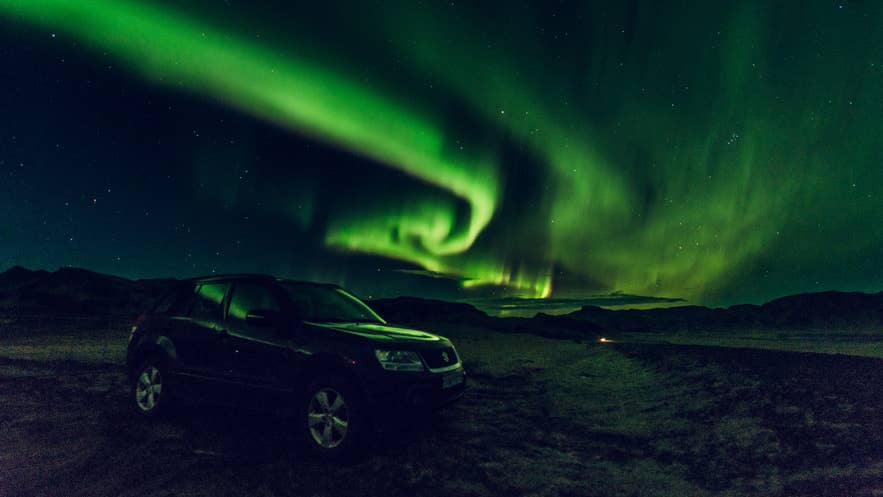 If you’re comfortable driving in Iceland in winter, booking a rental car and heading out for a road trip is the most flexible option to find northern lights.
To skip past the planning stage, you can also choose from a big selection of winter self-drive tours that come with an itinerary designed by local experts. Most winter self-drive tours follow the South Coast and clear-sky corridor as a base, with longer trips adding more regions.
Additionally, the packages come with a rental car and accommodations in strategic locations, which you can also customize to your liking.
For independent planners, Dyrholaey at 5.79 oktas and Vik at 5.87 are reasonable stops on the way east toward the clear-sky corridor connecting Kirkjubaejarklaustur, Skaftafell, Jokulsarlon, Hofn, and the Eastfjords.
Top-Rated Northern Lights Self-Drive Tours in Iceland
-
6-Day Northern Lights Self-Drive Tour of the South Coast with Ice Caving
-
7-Day Northern Lights Self-Drive Tour of the Golden Circle, South Coast, and Snaefellsnes Peninsula
-
One-Week Northern Lights Self-Drive Tour of South and West Iceland with Ice Caving
-
Full 10-Day Northern Lights Self-Drive Tour of the Complete Ring Road of Iceland
Base Yourself Near an Aurora Hub
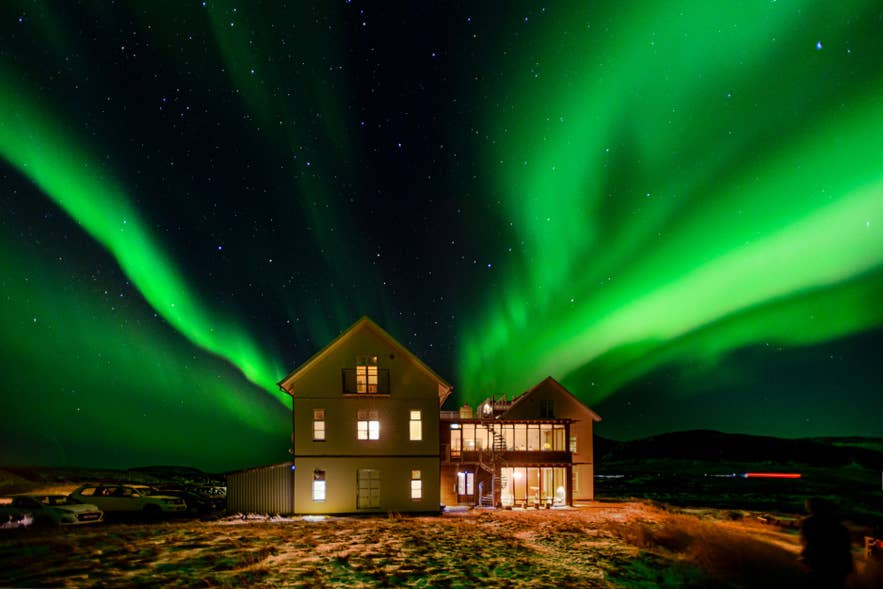
If you don’t mind driving, but would rather stay off the road after dark, pick one of the many great northern lights hotels around Iceland for the best chances.
Your best aurora base is in the southeast. Choose a place to stay between Kirkjubaejarklaustur and Djupivogur, with Hofn and Jokulsarlon as the obvious hubs on Route 1.
Best Northern Lights Hubs in Iceland
-
Accommodation in Kirkjubaejarklaustur: The western gateway to the corridor, about two and a half hours from Reykjavik. The village is small enough that you can walk out of the lights.
-
Accommodation near Jokulsarlon: Hotels between Skaftafell and the lagoon put the icebergs within reach after dark, which makes a foreground worth the trip on its own.
-
Accommodation in Hofn: The largest town on the clear-sky corridor, with the widest choice of rooms and restaurants.
-
Accommodation in Djupivogur: The eastern end of the corridor and the quietest of the hubs, a few minutes from Teigarhorn, the clearest station in the study at 5.35 oktas.
Accommodations around Lake Myvatn are the strongest option in the north. Accommodations in Reykjavik are perfectly reasonable if you are prepared to drive out of the city. Inside the city, light pollution rather than cloud is the limiting factor, which is a different problem with different solutions.
The Snaefellsnes Peninsula and the Westfjords are the least reliable choices if a clear sky is the priority and you are booking several months in advance.
Join a Guided Aurora Tour
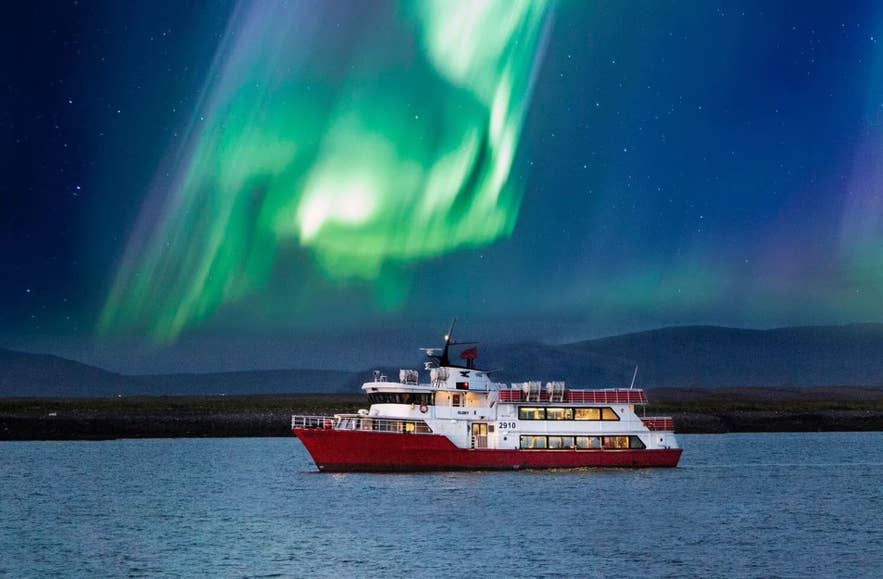
The third option removes the need to drive Icelandic roads in winter darkness. Guided northern lights tours range from evening tours to multi-day excursions that take you to a few selected regions or even the entire Ring Road.
On evening tours, the guide follows the cloud forecast through the day and picks the destination a few hours before departure. That flexibility counts for most in the cloudier parts of the country, where a fixed viewpoint is a gamble and the clear sky may be an hour away.
Guided multi-day packages take the same approach and add accommodation, transport, and a local guide for the whole trip. The ones below have the strongest ratings, and each of them spends at least one night inside or beside the clear-sky corridor.
Best Guided Northern Lights Tours and Vacations in Iceland
-
5-Day Northern Lights Winter Vacation Package with Ice Caving and the Blue Lagoon
-
5-Day Reykjavik Northern Lights Package with the Blue Lagoon, Golden Circle, and South Coast
-
One-Week Northern Lights Winter Package with Ice Caving and National Parks
-
8-Day Guided Northern Lights Tour Around the Complete Ring Road and Snaefellsnes Peninsula
Method
This chapter covers how the results were obtained, including the data used, its source, the analysis, and how we cross-checked and validated the rankings.
Data Collection
All figures derive from 261 monthly-value station files downloaded from the public station archive of Veðurstofa Íslands on August 17, 2026. From each file, we parsed the mean cloud cover column, which allowed us to obtain 50,087 monthly observations across 144 stations, covering 1937 to 2026.
Cloud cover is reported in oktas, or eighths of the sky, from zero for a clear sky to eight for full overcast, and is an observer’s estimate made according to the Met Office’s manual. This is also why several stations have a cloud record that ends when their manned observations ceased, since no instrument can make the judgment.
Inclusion and Estimation
We restricted the data to the aurora season, using September to April for the primary ranking and repeating the full analysis on November to March to confirm the results did not depend on where the seasonal boundary was drawn. We also required at least 100 valid season-months per station, which left 92 stations.
Because Icelandic stations have opened and closed continuously since the 1930s, they do not cover a common period, and unadjusted averages might confuse a site’s climate with the decades it happened to be observing. We corrected for this using the temporal overlap already present in the archive, estimating station effects with a two-way fixed-effects model of the form cloud cover = station effect + year-month effect, fitted by sparse least squares over 32,022 station-months and 388 distinct year-months for September to April, and 20,330 station-months for November to March.
The year-month coefficients account for conditions common to the network at a given time, leaving the station coefficients as estimates of site climate. Residual error is 0.53 oktas against a raw standard deviation of 0.74.
Reporting
The ranking table groups the 92 stations into the 22 places travelers commonly use as bases and the regional table into 12 regions. Some rows represent a single station, while others, including most of the regions in the second table, aggregate several.
The table’s final column, the share of months in which the average sky was five oktas or less, is counted from raw readings rather than modeled, over a fixed 1961 to 1990 window applied identically to every station, which is why stations not reporting throughout that period carry no value.
Results of Analysis
| Rank | Location | Oktas (Sep to Apr) | Oktas (Nov to Mar) | Months at 5 oktas or less |
|---|---|---|---|---|
| 1 | Djupivogur | 5.42 | 5.35 | 36% |
| 2 | Kirkjubaejarklaustur | 5.49 | 5.42 | 26% |
| 3 | Seydisfjordur | 5.61 | 5.46 | 19% |
| 4 | Jokulsarlon & Hofn | 5.65 | 5.58 | 21% |
| 5 | Myvatn | 5.65 | 5.60 | 20% |
| 6 | Hella | 5.69 | 5.66 | 19% |
| 7 | Reykjavik | 5.77 | 5.74 | 13% |
| 8 | Egilsstadir | 5.78 | 5.70 | 12% |
| 9 | Dyrholaey | 5.79 | 5.79 | 22% |
| 10 | Thingvellir | 5.80 | 5.74 | 14% |
| 11 | Vik | 5.87 | 5.86 | 8% |
| 12 | Oraefi and Skaftafell | 5.89 | 5.83 | 10% |
| 13 | Saudarkrokur | 5.97 | 5.97 | 11% |
| 14 | Keflavik | 6.08 | 6.06 | 3% |
| 15 | Grimsstadir | 6.09 | 6.07 | 6% |
| 16 | Blonduos | 6.11 | 6.04 | 3% |
| 17 | Akureyri | 6.16 | 6.16 | 3% |
| 18 | Highlands | 6.18 | 6.12 | 4% |
| 19 | Snaefellsnes | 6.23 | 6.21 | 3% |
| 20 | Isafjordur area | 6.43 | 6.47 | Not available |
| 21 | Grimsey | 6.63 | 6.66 | 0% |
| 22 | Westfjords | 6.64 | 6.71 | 0% |
Table 1. The top 22 aurora destinations in Iceland ranked from least to most cloudy. Lower is clearer. The first okta column covers the full September to April aurora season, and the second covers the darkest months, November to March. The final column is the share of months in which the sky averaged five oktas or less, measured over the common 1961 to 1990 period.
| Region | Stations | Oktas (Nov to Mar) | Clearest station in region |
|---|---|---|---|
| Southeast (Hornafjordur) | 3 | 5.57 | Teigarhorn (5.35) |
| Southeast (Oraefi and Skaftafell area) | 4 | 5.67 | Kirkjubaejarklaustur (5.42) |
| East Iceland | 13 | 5.79 | Seydisfjordur (5.46) |
| South lowland | 10 | 5.82 | Jadar (5.47) |
| Southwest (capital area and Reykjanes) | 9 | 5.84 | Holmur (5.66) |
| Northeast inland (Myvatn area) | 7 | 5.98 | Reykjahlid (5.60) |
| Interior highlands | 1 | 6.12 | Hveravellir (6.12) |
| North central | 10 | 6.23 | Saudarkrokur (5.97) |
| West (Borgarfjordur and Snaefellsnes) | 8 | 6.27 | Hvanneyri (5.72) |
| Strandir and the northwest coast | 4 | 6.32 | Blonduos (6.04) |
| North and northeast coast | 11 | 6.34 | Midfjardarnes (5.94) |
| Westfjords | 12 | 6.49 | Flatey (6.15) |
Table 2. The top travel regions in Iceland ranked from least to most cloudy, based on monthly cloud coverage data over winter months.
Validation
Three cross-checks were run, with differing evidential weight. The first two are recomputations on the same archive and therefore test the estimation procedure rather than adding independent evidence. The first calculates unadjusted 30-year normals for 1961 to 1990 across the 65 stations reporting continuously through it, where identical coverage removes any need for adjustment. The second repeats the exercise on 1991 to 2020 across the 34 stations extending that far, which tests whether the pattern persists in recent decades or is confined to the mid-century record.
The third check is independent, comparing measured sunshine hours at the ten stations that record them, so that a systematic bias in observer estimates, which the first two would reproduce rather than detect, would not carry through. All three are consistent with the modeled ranking.
Precision
Because cloud cover is an observer’s judgment, differences below roughly 0.15 oktas, about two percent of sky, should not be treated as meaningful. The findings reported here fall well outside that margin: 0.9 oktas separate the clearest and cloudiest regions, and 1.6 oktas, a fifth of the sky, separate the clearest and cloudiest individual stations.
Conclusion
The clearest aurora skies in Iceland are on the southeast coast, along the clear-sky corridor between Kirkjubaejarklaustur and Djupivogur. Clouds cover about 70% of the sky in Southeast Iceland in an average aurora-season month, against about 81% in the Westfjords.
No cloud average predicts a single night. Aurora activity, wind, and passing weather systems decide whether any one evening is worth going out. The value of a cloud ranking lies in improving the odds across several nights, not in picking the right one.
Our companion study on how many you need in Iceland puts those longer stays into context. Our model estimates a 58% to 83% chance of seeing the northern lights over three nights, rising to 76% to 95% over five nights.
A trip that spends several nights on the southeast coast between Kirkjubaejarklaustur and Djupivogur starts from better odds than the same nights spent in the northwest. The 176 miles (283 km) of road between those two towns also mean that an overcast sky at one end leaves somewhere to drive to.
Cloud cover is one half of the planning problem, and darkness is the other. Pair this ranking with more information on the best month to see the northern lights in Iceland to line up long nights with the best odds of a clear sky. Lastly, don’t forget to keep an eye on the northern lights forecast to check aurora activity and cloud cover for the next three nights before you decide where to drive.
We would like to hear where you have had the best luck with the aurora in Iceland, and whether the sky matched what the data predicts. Share your experience in the comments below, and ask us anything about the study or about choosing a base for your own trip.

Guide to Iceland Editorials is the shared byline for our content team. We use it on pieces several people worked on together, where no single writer owns the article, and on anything rewritten often enough that a personal byline would be misleading. We also publish our original data studies under this profile. Each study answers a question travelers ask about Iceland, using primary sources such as booking records, traveler reviews and public datasets, and every study is quality checked by human experts before it's published. Everything under this byline is researched and reviewed by people who live and work in Iceland. If you spot something out of date or want to suggest a correction, message us and it reaches the whole team.