Discover the best frozen waterfalls in Iceland to see in winter, including icy giants on the Golden Circle and remote falls that glow beneath the northern lights. Find out where each one is, how to reach it safely in the snow, and what to expect when you arrive. Read on to plan your winter waterfall adventure.
Winter is one of the best times to see frozen waterfalls in Iceland. The flowing water turns into sculptures of snow and ice that may even appear beneath the aurora.
You can discover them through a wide selection of waterfall tours or rent a car and explore at your own pace. They also pair well with ice cave tours, snowmobile rides, and a night of hunting the aurora borealis.
Why You Can Trust Our Content
Guide to Iceland is the most trusted travel platform in Iceland, helping millions of visitors each year. All our content is written and reviewed by local experts who are deeply familiar with Iceland. You can count on us for accurate, up-to-date, and trustworthy travel advice.
Seeing Iceland’s waterfalls in their winter coat, bursting with snow, glittering mist, and hanging icicles, is a completely different experience from a summer visit.
Fewer people brave the cold, so the falls feel quieter and more personal, and on a clear night you might even catch them under the northern lights. The 11 below are ranked by how easy they are to reach in winter, how striking their surroundings are, and their sheer natural beauty.
Key Takeaways: Frozen Waterfalls in Iceland
-
Iceland’s waterfalls do not fully freeze in winter. Falls like Gullfoss and Godafoss keep flowing while ice builds up on the rocks, cliffs, and edges, forming blue and white ice sculptures.
-
The most accessible frozen waterfalls in winter are Gullfoss, Godafoss, Skogafoss, Seljalandsfoss, Oxararfoss, and Kirkjufellsfoss, all close to main roads.
-
Remote falls such as Aldeyjarfoss and Selfoss in the north need a 4x4, crampons, and caution in winter, and are best reached with a guide.
-
Winter days are short, roughly 4 to 6 hours of daylight in December and January, so plan a tight route and start early.
-
Several of these waterfalls double as northern lights viewpoints on clear, dark nights, and 2026 is expected to be one of the strongest aurora seasons in years.
-
Always check road and weather conditions before setting out, and wear crampons or microspikes on icy paths.
At a Glance: Iceland’s Best Frozen Waterfalls in Winter
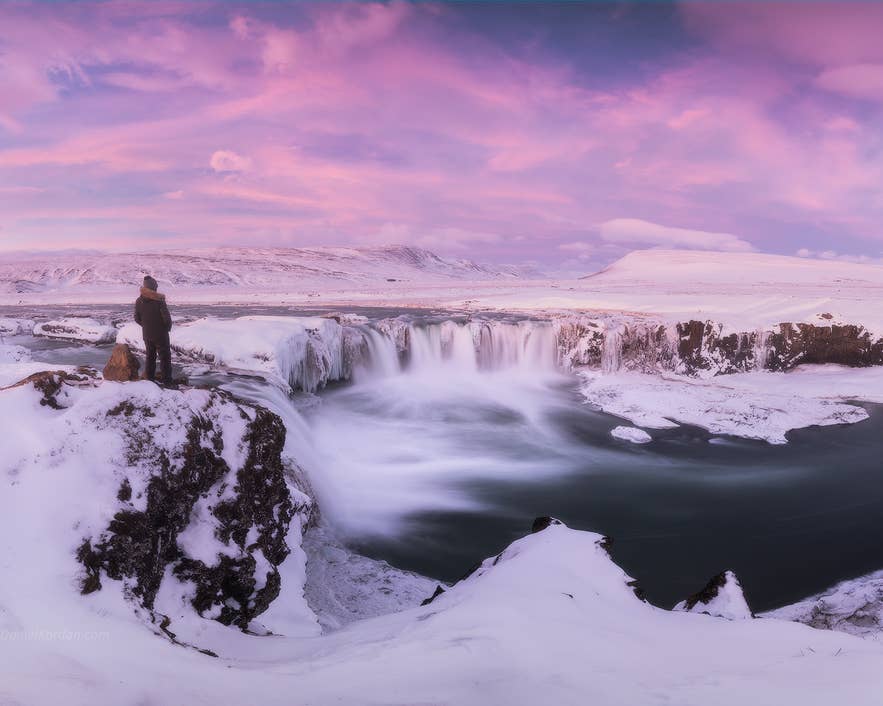 Use this quick comparison to see where each frozen waterfall is and how hard it is to reach in winter.
| Waterfall | Region | Winter access | Car needed |
|---|---|---|---|
| Gullfoss | Golden Circle, South | Easy, paved road, upper path open | Rental car or tour |
| Godafoss | North Iceland | Easy, short walk off the Ring Road | Rental car or tour |
| Skogafoss | South Coast | Easy, roadside off Route 1 | Rental car or tour |
| Kirkjufellsfoss | Snaefellsnes, West | Easy, short path | Rental car or tour |
| Seljalandsfoss | South Coast | Easy roadside, behind-falls path often closed | Rental car or tour |
| Oxararfoss | Thingvellir, Golden Circle | Easy boardwalk, icy in places | Rental car or tour |
| Bruarfoss | South, Golden Circle area | Moderate, about 2.2 miles (3.5 kilometers) walk | Rental car |
| Svartifoss | Skaftafell, Southeast | Moderate, about a mile (1.5 kilometers) uphill | Rental car or tour |
| Aldeyjarfoss | North Highlands edge | Hard, 4x4 only, often impassable | 4x4 or guide |
| Kermoafoss | Reykjavik, Ellidaardalur | Easy, short walk from the parking area or bus stop | Bus or car |
| Selfoss | North, Diamond Circle | Hard, hike plus crampons | 4x4 or guide |
See these falls in daylight, when the blue and white ice actually shows. If the aurora is the goal and you still want waterfalls in the mix, book a guided trip instead of driving yourself. A guide knows which sites are safe after dark and will change the route when conditions turn.
11 Best Frozen Waterfalls in Iceland to See in Winter
Start your waterfall journey early, as daylight is short in winter and icy roads slow the driving. The countdown begins at number 11 and builds to the most spectacular frozen waterfall of all.
These eleven waterfalls are among the best to visit in Iceland during winter, chosen for their frozen beauty, their surroundings, and how rewarding they are to reach in the cold season.
11. Selfoss Waterfall: A Wide Wall of Ice on the Diamond Circle
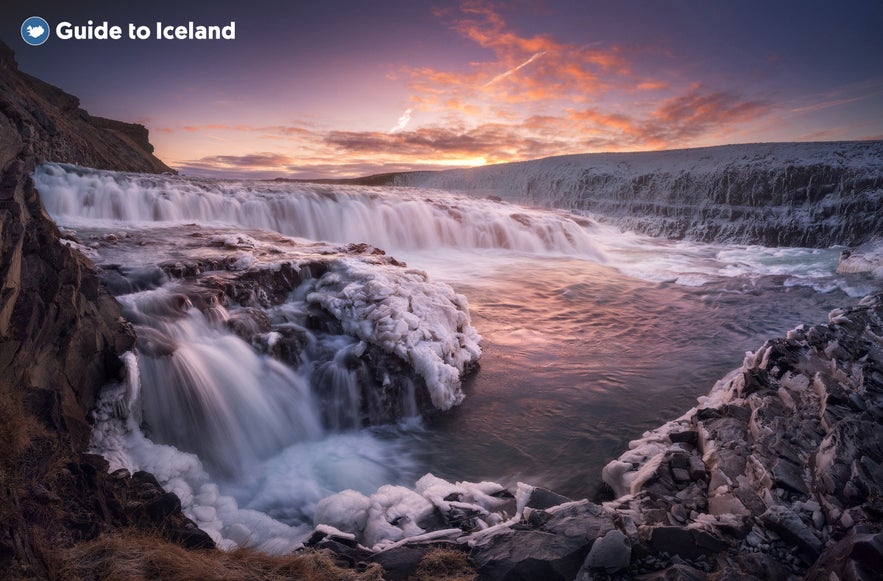 Selfoss Waterfall is far broader than it is tall, stretching about 330 feet (100 meters) across while rising only 36 feet (11 meters). In winter, that wide curtain freezes at the edges into a low wall of ice and snow, and you often have the viewpoint to yourself.
The falls sit on the Diamond Circle route in North Iceland, alongside Lake Myvatn and Dettifoss Waterfall. Reaching the spot in winter is not simple, so the easiest way to see it is on a guided trip such as this 9-Hour Diamond Circle Tour from Akureyri.
It ranks lower on this list because the site is remote and the final stretch means hiking on ground that ices over, so crampons and caution are essential. Watch the name too, as it is easy to confuse with Selfoss, a town in South Iceland, when setting your navigation.
10. Kermoafoss Waterfall: A Frozen Cascade Inside Reykjavik
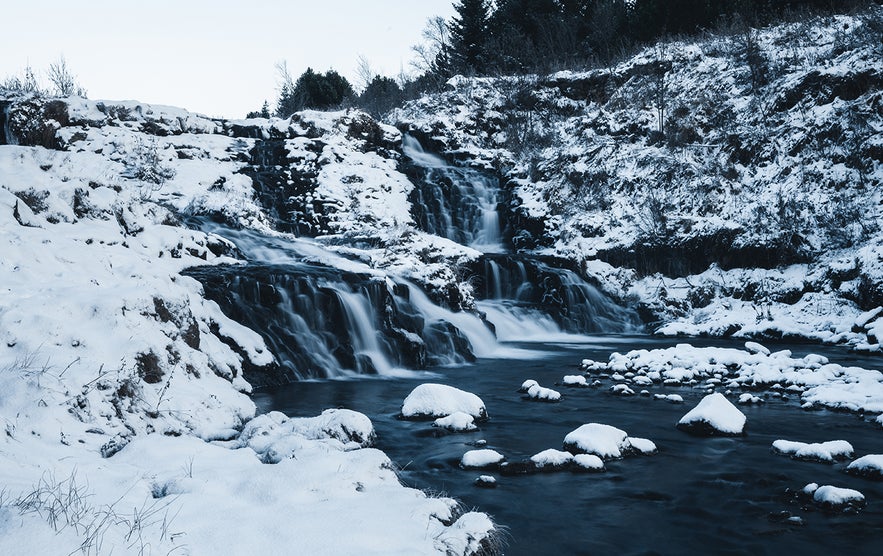 You do not have to leave the city limits to find a frozen waterfall in Reykjavik. Kermoafoss sits in Ellidaardalur Valley, a quiet public park built around a small river on the eastern edge of the capital, a short drive or bus ride from downtown.
In winter, the pine trees and lava-field paths turn white with snow, and benches along the route give you space to take it in. You might even spot rabbits near the water. Because the valley is still inside the city, the Reykjavik city bus system can drop you within a short walk of the falls, so you do not need a car.
9. Svartifoss Waterfall: Black Basalt Columns Framed in Ice
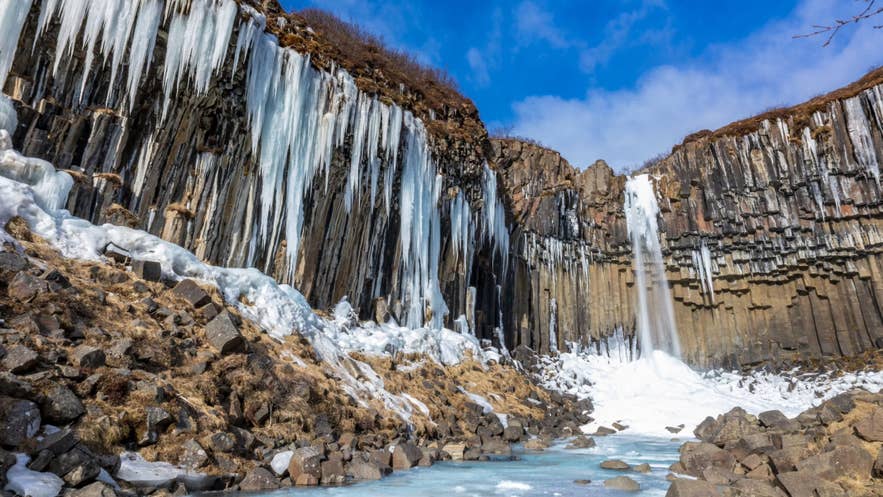 Svartifoss drops 65 feet (20 meters) over dark, hexagonal basalt columns, and the colder it gets, the longer the icicles grow along the cliff. Against the black rock, the white ice and snow make the falls look like a sculpture carved from the mountain.
It lies within Skaftafell Nature Reserve in Southeast Iceland, about a mile (1.5 kilometers) uphill from the visitor center. A bridge over the river doubles as a viewing platform, so you can admire the frozen falls without crossing slippery rocks, passing three smaller waterfalls on the way up.
8. Bruarfoss Waterfall: Iceland’s Bluest Winter Waterfall
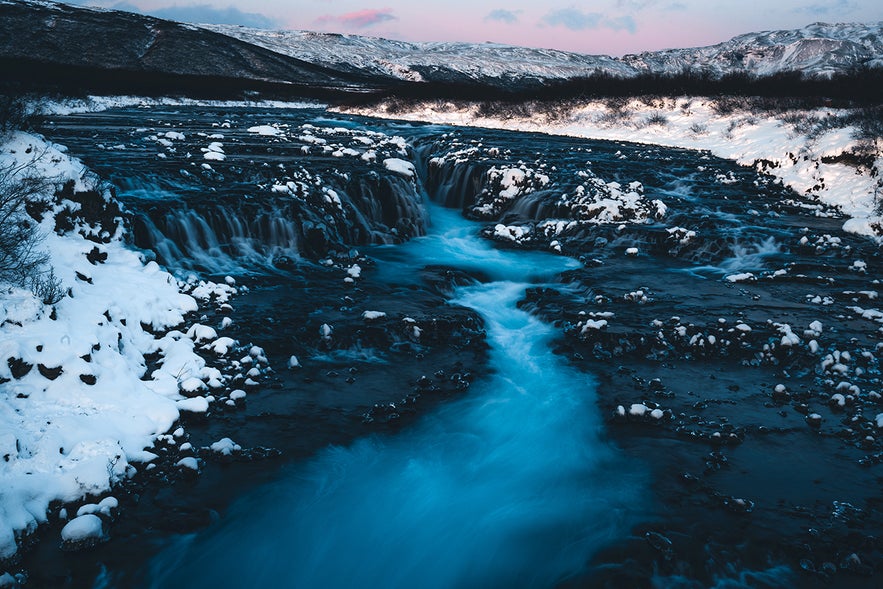 Bruarfoss is known above all for its startling azure water, which glows even brighter against winter snow. The falls are low and almost V-shaped, funneling the bright blue Bruara river through a narrow gap in the rock.
Reaching it in winter takes effort, roughly an hour each way along a gravel path. The walk rewards you with two more blue cascades, Hlauptungufoss and Midfoss, so getting there is part of the experience.
7. Seljalandsfoss Waterfall: The Falls You Can Walk Behind
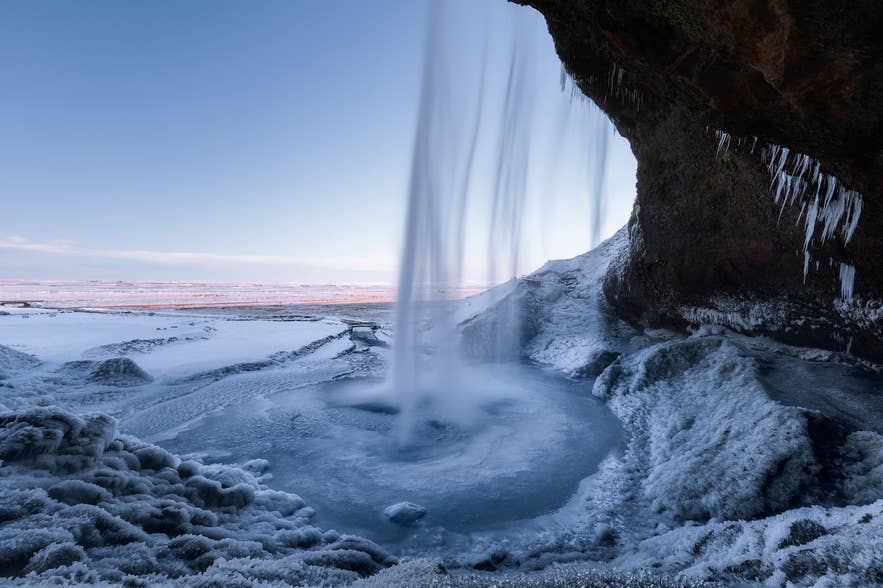 Seljalandsfoss falls 197 feet (60 meters) down a mossy cliff in a slim, elegant ribbon that photographs beautifully from almost any angle. In winter, the spray freezes into long icicles and delicate frost across the surrounding rock.
Its signature feature is the path that loops behind the water, though this closes once the ground turns icy and unsafe. The falls are an easy roadside stop on the South Coast and a fixture of most South Coast tours in Iceland.
6. Oxararfoss Waterfall: An Icy Cascade in Thingvellir
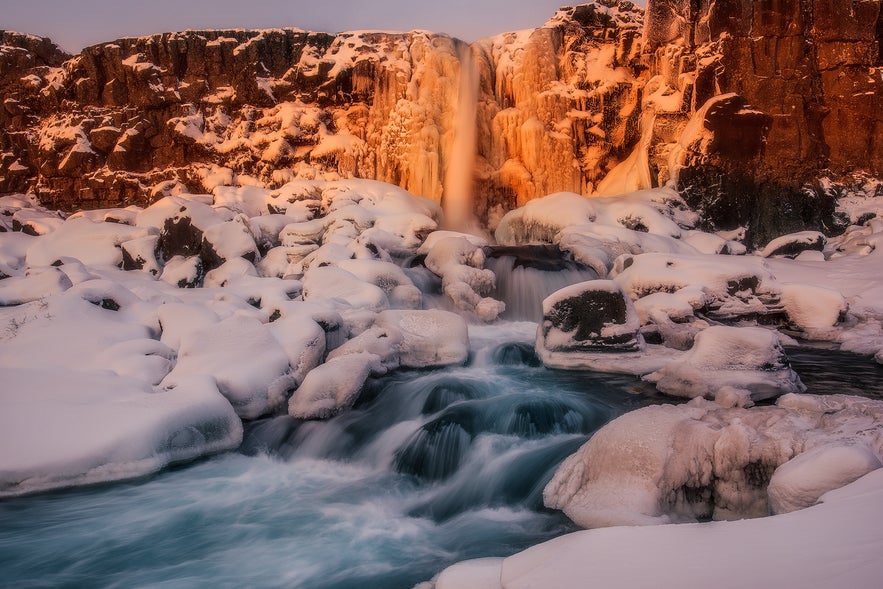 For a frozen waterfall you can reach easily and see up close, Oxararfoss is one of the best options near the capital. It stands about 40 feet (12 meters) high and spills over dark boulders that ice over into a striking winter scene.
The falls sit inside Thingvellir National Park, the founding site of the Althingi in the year 930 and the world’s oldest parliament. As a stop on the Golden Circle sightseeing route, it is simple to reach, with a wooden boardwalk leading right to a safe viewpoint.
5. Aldeyjarfoss Waterfall: Basalt Columns in the North Highlands
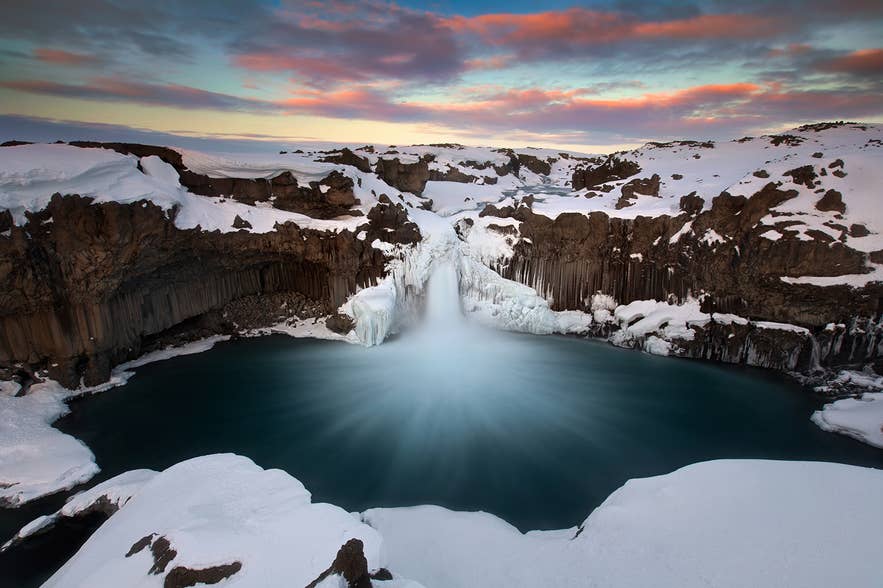 In its winter coat, Aldeyjarfoss Waterfall looks almost otherworldly. Half-frozen water pours over tall, dark basalt columns into an icy blue pool ringed by snow, a contrast of black rock and white ice that few other falls can match.
It lies on the edge of the Highlands of Iceland, so winter access is the real challenge. Roads can be closed or impassable, and reaching it safely means you rent a 4x4 vehicle and travel with care. Nearby Hrafnabjargafoss makes a worthwhile second stop for confident drivers.
4. Kirkjufellsfoss Waterfall: The Iconic Falls Below Mount Kirkjufell
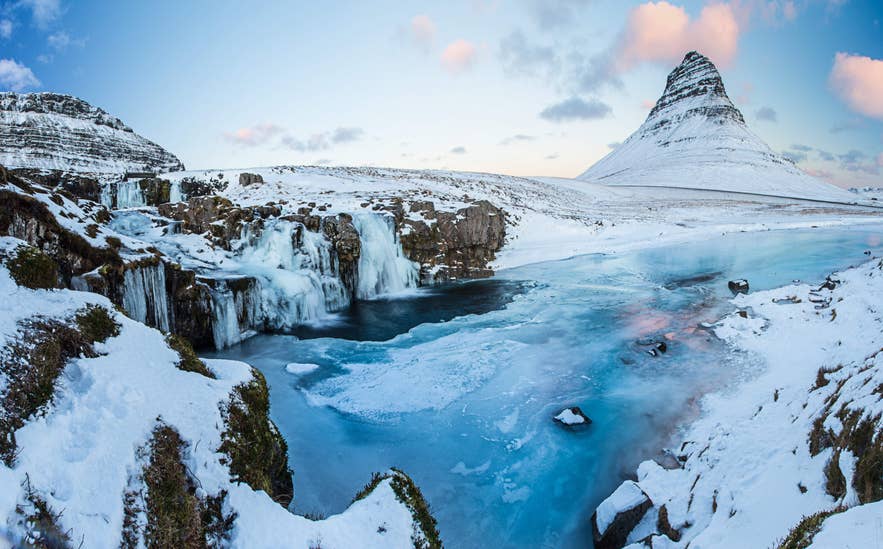 Kirkjufellsfoss is small, but its setting is unforgettable. The falls sit directly below Mount Kirkjufell, the arrowhead-shaped peak near Grundarfjordur on the Snaefellsnes Peninsula, and in deep winter the cascade freezes into tiers of ice.
With the mountain rising behind it, this is one of the most photographed scenes in Iceland, and a dusting of snow only makes it better. If you would rather not drive the peninsula in winter, it features on a wide selection of Snaefellsnes tours.
3. Skogafoss Waterfall: A Thundering South Coast Giant
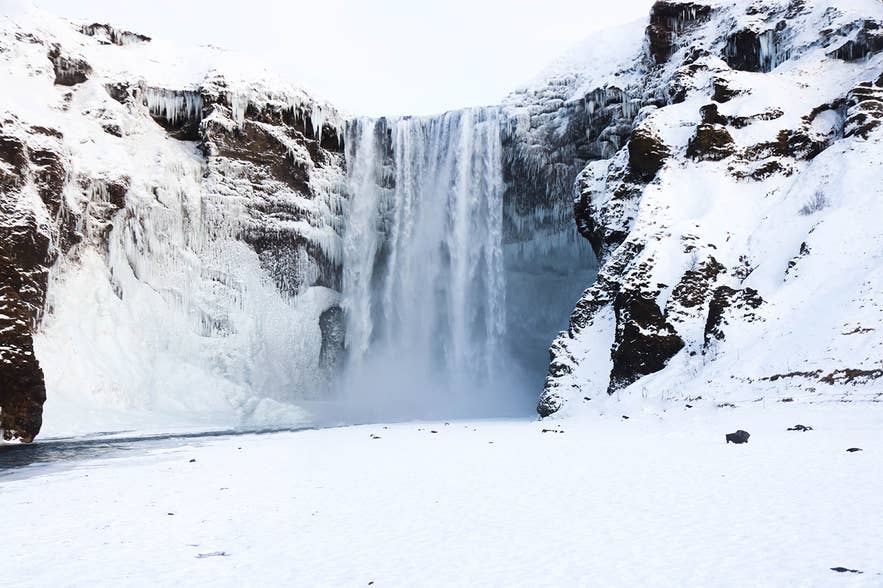 Skogafoss Waterfall is one of Iceland’s most powerful falls, dropping 197 feet (60 meters) over a cliff 82 feet (25 meters) wide. In winter the flow can look almost slow, and the spray freezes into thick ice and snow along the rock face on either side.
It stands right beside the Ring Road on the South Coast, so it is one of the easiest big waterfalls to reach in winter. The nearby Skogar museum is worth a stop to warm up and learn about Icelandic turf houses and history.
2. Godafoss Waterfall: The Waterfall of the Gods in Winter
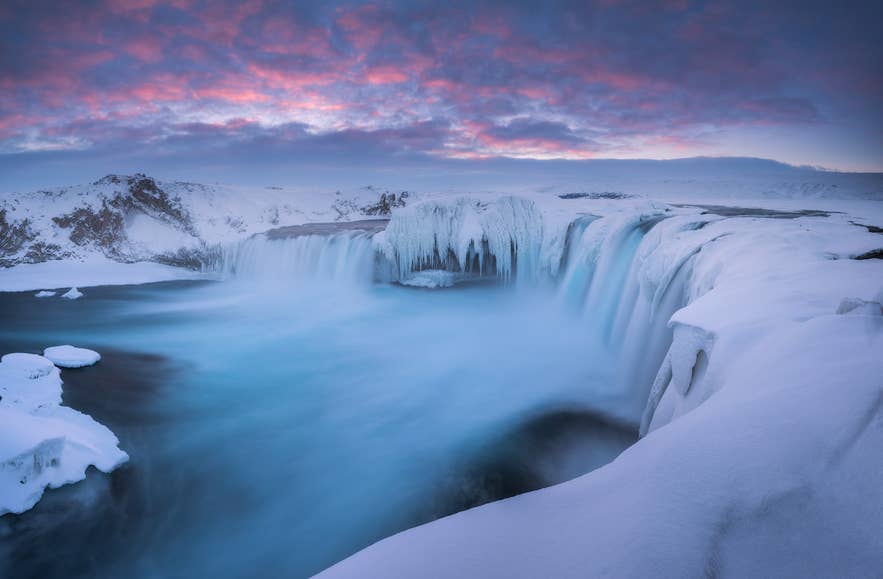 Godafoss Waterfall curves in a wide horseshoe in North Iceland, about 21 miles (35 kilometers) from Akureyri. It is more than twice as wide as it is tall, at 39 feet (12 meters) high and 98 feet (30 meters) across, and in winter snow piles along its crest until the whole arc looks frozen.
Its name means the waterfall of the gods, from the tale of a lawspeaker who cast his old Norse idols into the falls when Iceland turned to Christianity around the year 1000. A viewing platform across the water gives a safe, open vantage that also works well for the northern lights after dark.
The site gets bitterly cold, so dress in warm layers. If you would rather not drive the icy roads, a guided North Iceland tour from Akureyri brings you here as part of a wider day out.
1. Gullfoss Waterfall: The Golden Circle’s Frozen Powerhouse
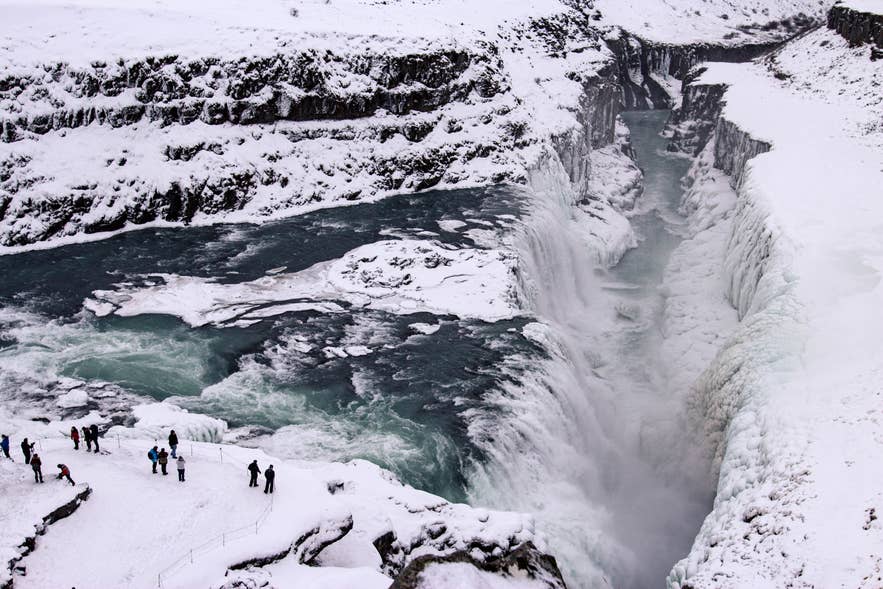 Gullfoss Waterfall is the most famous waterfall in Iceland, and in winter it truly earns its name. Golden Falls turns almost silver as frost coats the cliffs and snow fills the spray, a genuine highlight of any Golden Circle trip.
The falls drop 105 feet (32 meters) in two dramatic tiers into a narrow gorge on the Hvita River. A path leads to a viewing platform near the top, and even when winter weather closes part of it, the falls stay in full view from the cliff above.
Gullfoss might not exist today without Sigridur Tomasdottir, who fought off plans to dam it for a power plant in the early 20th century. A plaque near the falls honors her, a reminder of how close the country came to losing this piece of its nature of Iceland.
Best Waterfalls in Iceland to See Under the Northern Lights
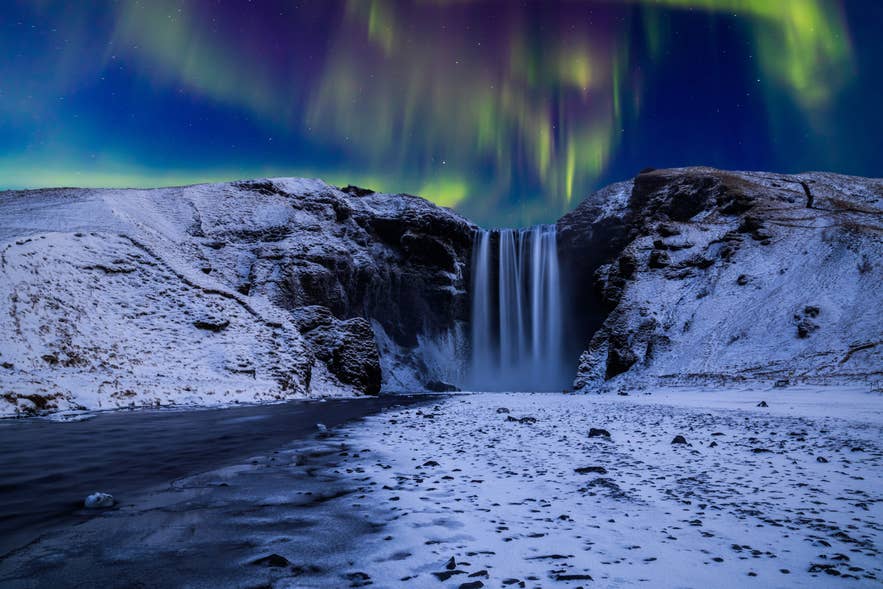 Once you have seen Iceland’s frozen waterfalls by day, the winter sky has one more gift to offer. On clear, dark nights, the aurora borealis can appear right above the falls, and watching the northern lights dance over rushing water is one of the most magical experiences in the country.
Winter 2026 is shaping up to be an exceptional aurora season. Iceland Review has reported strong northern lights across the country already this year, driven by heightened solar activity, and forecasters expect the seasons through the late 2020s to be some of the best in decades.
To catch the show, you need two things: a clear sky and a dark spot away from town lights. Check the aurora forecast from the Icelandic Met Office before heading out, give your eyes time to adjust, and consider joining one of the guided northern lights tours if you would rather leave the driving and hunting to a local.
If you cannot get out of town at all, Ellidaardalur Valley on the eastern edge of Reykjavik is dark enough to catch a strong display, with Kermoafoss Waterfall as a scenic foreground. The five waterfalls below are among the best places in the country to watch the aurora.
5. Oxararfoss: Aurora Over Thingvellir National Park
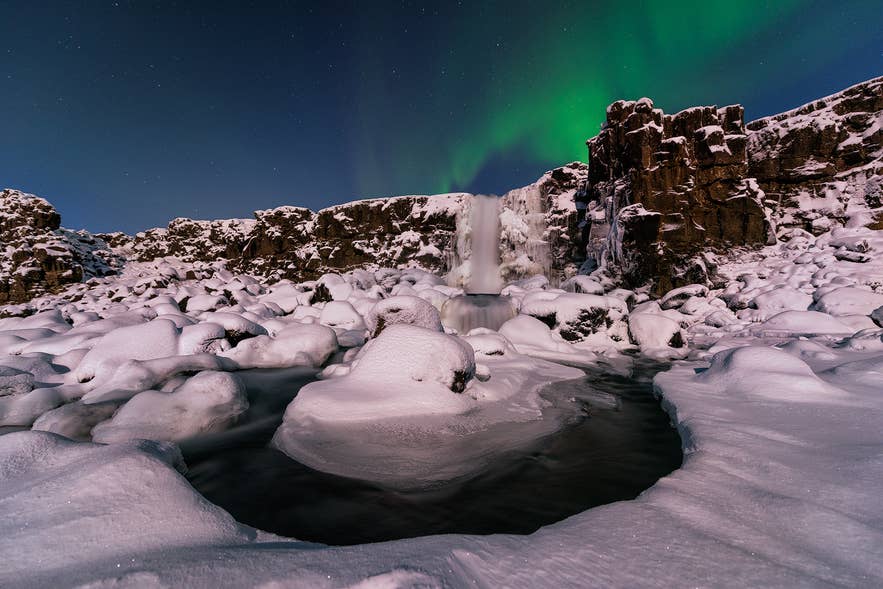 Set inside Thingvellir National Park, Oxararfoss is one of the easiest aurora waterfalls to reach on a Golden Circle trip. A short wooden boardwalk leads to the falls, where water spills over blocks of dark lava into an icy pool.
On a clear winter night, you can park by the trail, walk in a few minutes, and wait as the sky above the rift valley fills with green. Because Thingvellir sits far from city lights, the aurora reflects in the frozen river, and the silence makes the whole scene feel otherworldly. Bring crampons, as the boardwalk and rocks ice over fast.
4. Skogafoss: Northern Lights on the South Coast
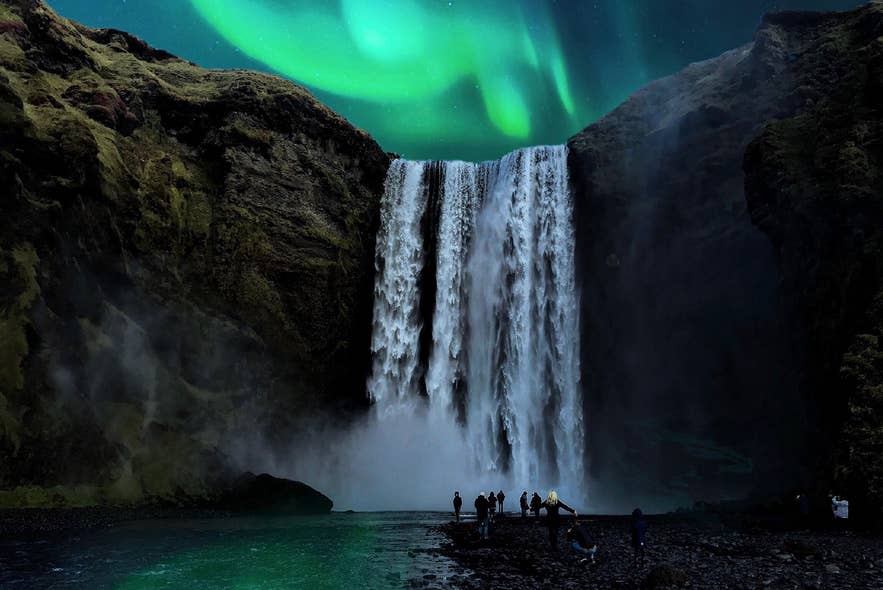 Skogafoss is one of Iceland’s biggest and most dramatic waterfalls, and its wide, roadside setting makes it a favorite for winter aurora hunting. You can park almost at its base, so even on a freezing night you are only steps from the falls.
Stand back on the open field as the 197-foot (60-meter) curtain of water thunders down, then watch the northern lights ripple above the cliff top. The spray freezes into ice along the edges, and with the aurora overhead, the roar of the water and the glowing sky together are unforgettable.
3. Kirkjufellsfoss: Iceland’s Most Iconic Aurora Scene
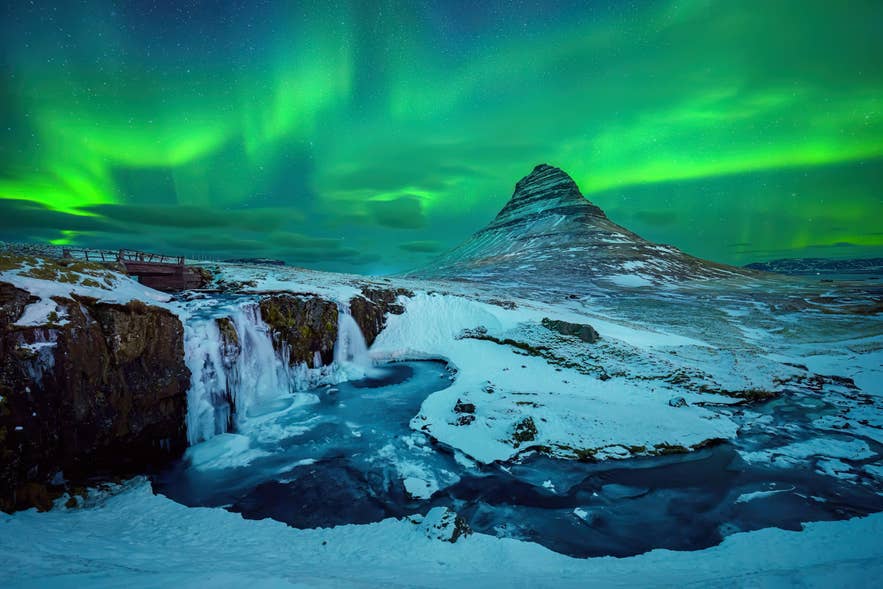 On the Snaefellsnes Peninsula, Kirkjufellsfoss sits right below Mount Kirkjufell, the arrowhead-shaped peak you have probably seen in countless photos. This is arguably the most recognizable northern lights composition in the whole country.
Follow the short path to the viewpoint where the small falls, the mountain, and the sky all line up in one frame. On a clear night the aurora arcs straight over the peak, and with little light pollution nearby, even a modest display looks spectacular reflected in the water below.
2. Gullfoss: A Frozen Canyon Stage for the Aurora
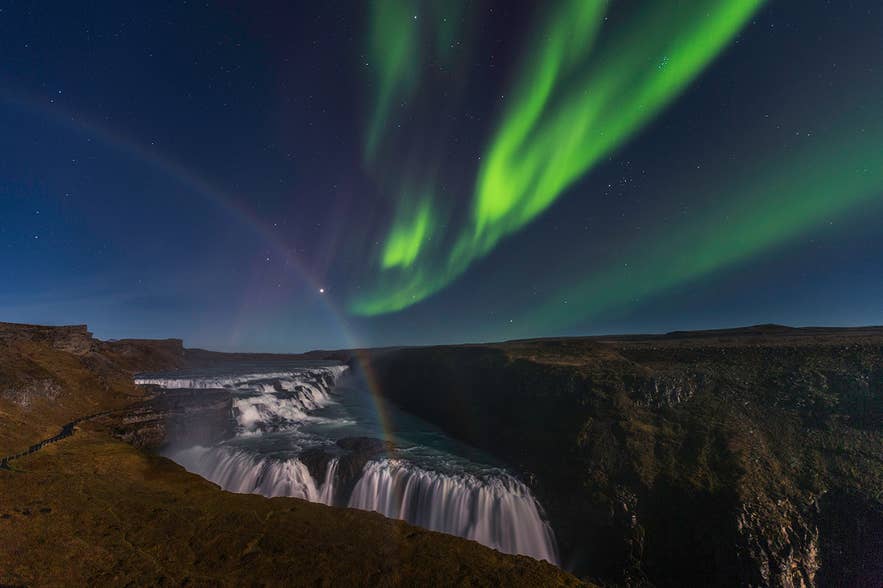 Gullfoss is the powerhouse of the Golden Circle, and in winter its two tiers and canyon walls glaze over with ice while the river keeps roaring. By day it is a must for the ice formations, and on a clear night it becomes a grand stage for the northern lights.
The upper viewing platform stays open in winter and looks straight down the gorge. Standing there in the cold, hearing the water crash below while green light sweeps overhead, is a genuinely humbling Iceland moment. Dress warmly, as the wind above the canyon is biting.
1. Godafoss: Aurora Over a North Iceland Horseshoe
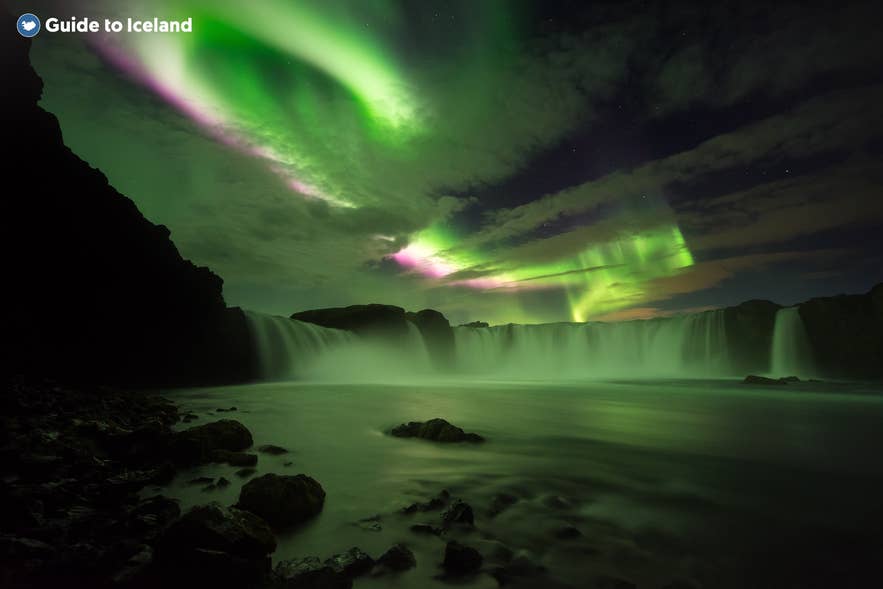 In North Iceland, Godafoss curves in a graceful horseshoe just off the Ring Road, and the short, flat walk from the parking area is easy even after heavy snow. You can reach the viewpoints without any real hike, which is a blessing on a cold night.
Winter wraps the surrounding rocks in ice while the falls keep flowing in a broad blue arc. Away from the glow of Akureyri, the sky here goes deep black, and when the aurora appears, it stretches across the whole curve of the falls. It is a quieter, less crowded place to watch the lights than the south.
How to Stay Safe at Iceland’s Frozen Waterfalls in Winter
Frozen waterfalls are beautiful because the conditions around them are extreme. The same spray that builds the ice sculptures turns every path, step, and viewing platform into sheet ice, and winter weather in Iceland can change within an hour. A little preparation is the difference between a spectacular stop and a ruined trip.
-
Check road.is for road conditions and closures, safetravel.is for travel alerts, and vedur.is for weather and wind before every drive, not just on the morning you leave.
-
Wear crampons or microspikes over proper hiking boots. Ordinary winter shoes are not enough on the frozen ground near a waterfall, and most winter injuries at these sites are slips.
-
Stay on marked paths and behind every rope and barrier. Snow hides the edge of gorges and undercut riverbanks, so ground that looks solid may be a drop.
-
Never climb on ice formations or walk onto frozen ledges at the base of a waterfall. The ice is hollow in places and the water underneath keeps flowing all winter.
-
Plan your route around the daylight, which is roughly 4 to 6 hours in December and January. Carry a headlamp, and reach any waterfall that needs a walk well before dark.
-
Hold onto your car door in the wind. Gusts rip doors off their hinges every winter, and this is one of the most common rental car damage claims in Iceland.
-
Park only in designated parking areas. Stopping on the shoulder of the Ring Road for a photo causes serious accidents, especially in low light and blowing snow.
-
Dress in warm, waterproof layers with a hat and gloves. Waterfall spray soaks through cotton and freezes, and windchill at an exposed viewpoint is far colder than the forecast.
-
Treat the remote falls differently. Aldeyjarfoss and Selfoss need a 4x4 vehicle and are safest with a guide, and phone signal is unreliable once you leave the main roads.
Download the 112 Iceland app before you set out and leave a travel plan on safetravel.is if you are heading anywhere remote. If the forecast turns while you are on the road, turn back or swap to a roadside waterfall.
Choosing the Right Frozen Waterfall for Your Winter Trip
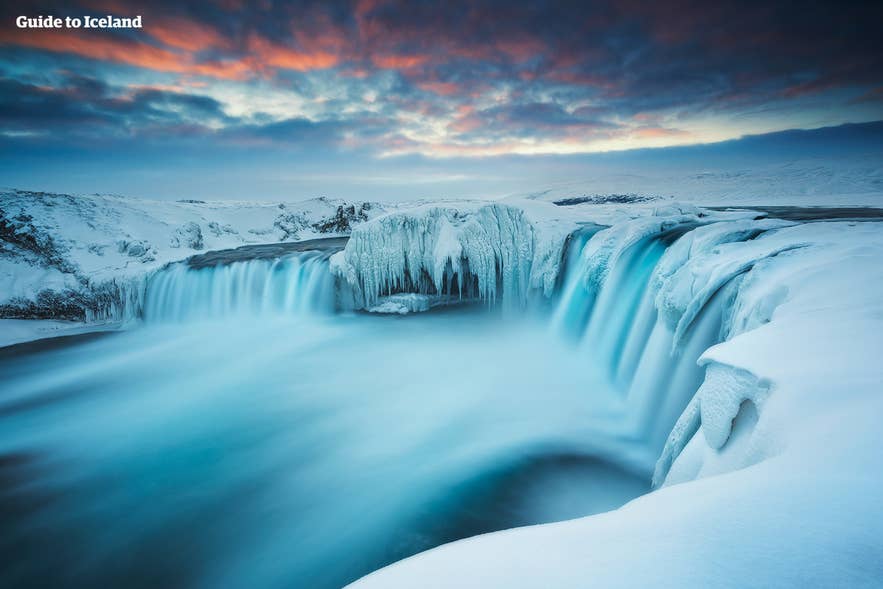 For a day near the capital, the Golden Circle falls of Gullfoss and Oxararfoss are the easiest wins, both icy by day and aurora-friendly by night. Travelers on the South Coast should not miss Skogafoss and Seljalandsfoss, while a trip west rewards you with the postcard scene at Kirkjufellsfoss.
In the north, Godafoss is the standout for anyone driving the Ring Road, and confident winter drivers with a 4x4 can chase the remote beauty of Aldeyjarfoss and Selfoss. If you would rather not drive on icy roads, plenty of guided day tours from Reykjavik reach these waterfalls and hunt for the aurora on the way back.
Do waterfalls in Iceland freeze completely in winter?
What is the best frozen waterfall to visit in Iceland in winter?
Can you see the northern lights over waterfalls in Iceland?
Are Iceland's waterfalls safe to visit in winter?
Do you need a 4x4 to visit frozen waterfalls in Iceland?
When is the best time to see frozen waterfalls in Iceland?
Which frozen waterfalls are easiest to reach without a guide?
Is Gullfoss worth visiting in winter?
What is your favorite among these frozen waterfalls in Iceland? Have you visited any of them yourself? Were they frozen over, and could you see the northern lights above them? Which of these are you planning to see? Share your thoughts in the comments below!

I’m Andri Gunnar Hauksson, a marketing specialist, travel writer, and copywriter from Keflavík who specializes in Icelandic travel, local culture, and destination storytelling. I’m an expert in the Reykjanes Peninsula and passionate about sharing the region’s volcanic landscapes, coastal scenery, hidden spots, and cultural history through engaging and informative content. Now based in downtown Reykjavík, I write about travel, music, culture, and local experiences while helping businesses communicate through clear, effective copywriting and marketing.