Learn how often tours in Iceland are canceled in this Guide to Iceland study of tour cancellation rates. We compare activities, seasons, and cancellation reasons to help you plan your trip and prepare for changes.
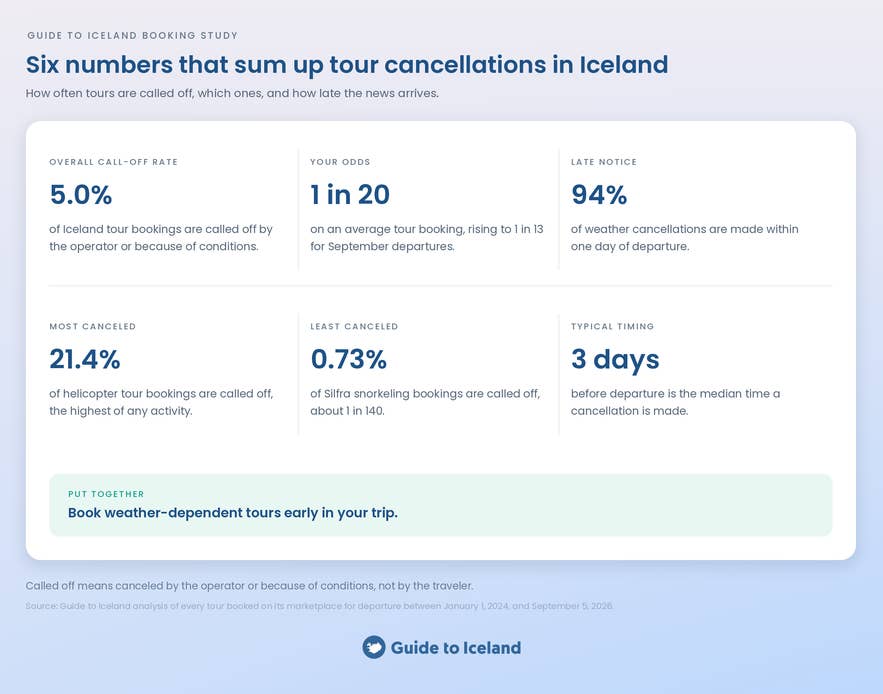
The study examines tour bookings with departure dates between January 1, 2024, and September 5, 2026. Operators or conditions caused 5.0% of bookings to be called off, about one in twenty, with weather-related cancellations putting traveler safety first.
That overall rate varies by activity and month. Helicopter tours were called off on 21.4% of bookings, compared with 0.73% for snorkeling tours. September’s overall rate was more than twice July’s.
To help you plan around these differences, we explain which tours in Iceland are canceled most often and how close to departure those decisions happen. We also cover refunds, booking changes, and ways to leave time in your itinerary for another departure.
Cite This Study
The charts and data in this study are free to use under CC BY 4.0. Credit Guide to Iceland and link to this page. Every chart has an Embed button underneath it with ready-to-paste code.
Key Findings
-
Operators or conditions caused 5.0% of tour bookings to be called off. The rate is 4.8% when the September 2024 natural ice cave suspension is excluded. Weather-related call-offs put traveler safety first.
-
Travelers initiated 58.6% of all cancellations. Weather accounted for 21.3%, while operator-side problems accounted for 9.9%. These are shares of cancellations, not bookings.
-
September had the highest call-off rate at 7.5%. July (3.5%) and May (3.6%) had the lowest overall rates, although patterns varied by activity.
-
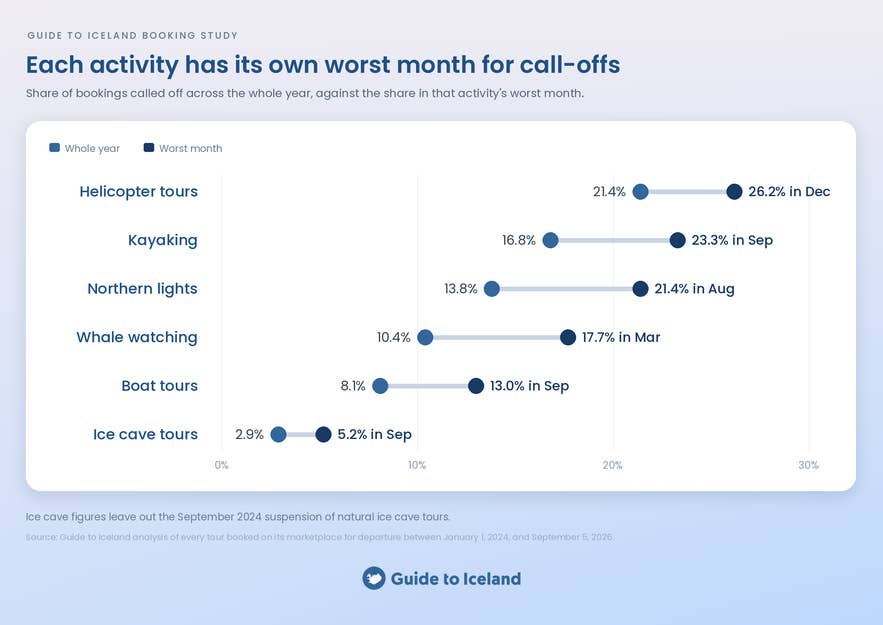
Helicopter tours were called off most often, at 21.4% of bookings. Kayaking followed at 16.8%, northern lights at 13.8%, snowmobiling at 11.2%, and whale watching at 10.4%.
-
Departure location made a difference. Whale watching from Olafsvik was called off about twice as often as from Reykjavik or Husavik.
-
Weather cancellations usually happened close to departure. Of these cancellations, 94% were recorded within one day of departure. Scheduling weather-dependent activities early in your stay leaves more time to find another available departure.
-
Booking early did not mean more operator call-offs. Rates were 4.0% for bookings made six months or more ahead, compared with 5.8% for bookings made within three days of departure.
-
Ask about changing dates before canceling and booking again. A modification may avoid another refund and payment transaction, but availability, price differences, and payment handling need confirmation.
How Often Are Tours in Iceland Canceled?
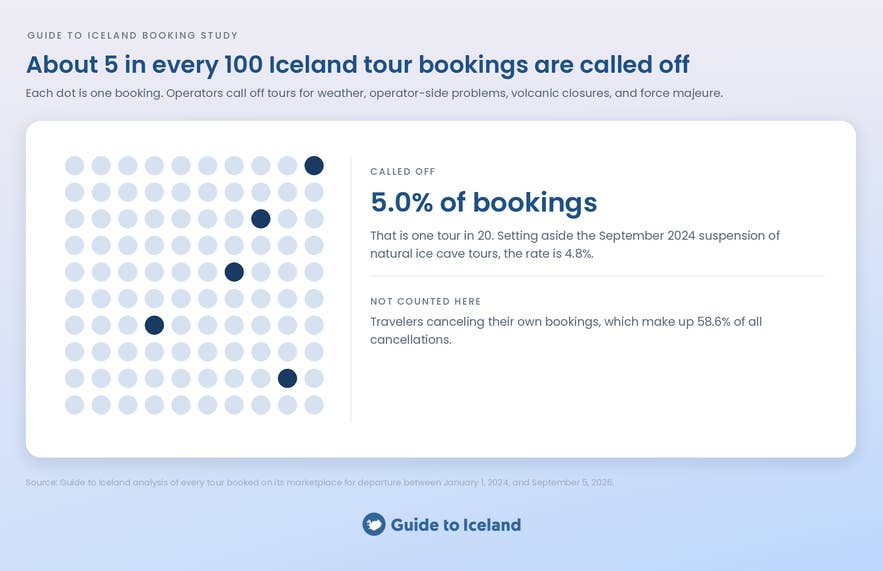
Across the period we studied, 5.0% of bookings in Iceland were canceled by the operator or because of conditions. Weather and unsafe conditions are the largest slice of that, followed by operator-side problems such as availability, vehicle issues, or a departure not reaching its minimum group size, followed by volcanic closures.
The 5.0% rate includes cancellations caused by weather and conditions, operator-side problems, volcanic closures, and force majeure. It excludes travelers canceling their own bookings, which account for the majority of all cancellations.
Who Cancels Iceland Tours: Travelers or Operators?
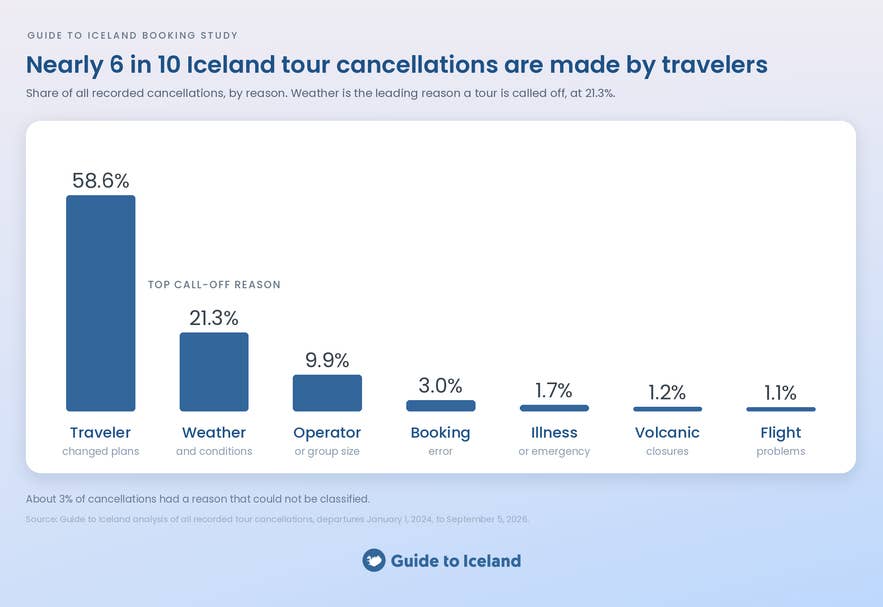
Travelers account for most Iceland tour cancellations, by a wide margin. Nearly six in ten cancellations (58.6%) are the customer’s own decision, made under Guide to Iceland’s free-cancellation policy.
Weather is a distant second at 21.3%, operator-side problems account for 9.9%, and other reasons make up the remainder. These include booking errors, illness, volcanic closures, and flight disruption.
For every tour canceled because of weather or unsafe conditions, nearly three bookings are canceled because travelers changed plans or requested cancellation. Weather-related call-offs reflect operators’ decisions to put safety first.
Booking behavior also matters. Travelers who book six months ahead cancel their own bookings roughly five times as often as those booking within three days of departure.
Booking further ahead gives travelers more time to change their plans, although the comparison alone does not establish why they cancel. The recorded reason for a traveler cancellation is usually just that the traveler asked.
Around two-thirds say nothing more than that, so we can count these cancellations accurately but cannot say much about the motives behind them. This limits what we can conclude about why travelers cancel.
Traveler cancellations also follow a different pattern from operator cancellations. They tend to happen earlier and are more common among bookings made well in advance. They occur at similar rates across activities, while operator cancellations are more common for tours affected by weather.
Why Do Operators Cancel Tours in Iceland?
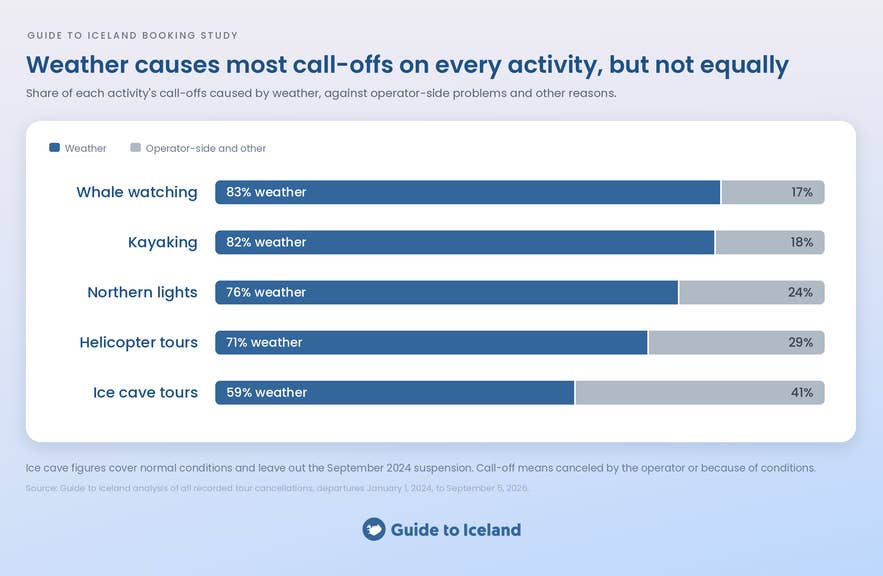
Weather is the leading reason operators cancel tours in Iceland. It accounts for 21.3% of all cancellations, more than twice the operator-side total, and Iceland’s operators cancel for it because they must.
Safety standards on Iceland's glaciers, at sea, and in the air are strict, and winter storms can force tours to be canceled when roads become inaccessible. Guide to Iceland works only with partners who hold to the highest safety standards, so canceling a tour when conditions are unsafe reflects that commitment to safety.
Operator-side problems come next at 9.9% of cancellations. Some are mechanical or availability issues, but a meaningful share are departures that never reached their minimum group size, which is why shoulder-season departures on niche tours are more fragile than peak-season ones on popular routes.
Both weather-related and operator-side cancellations usually happen close to departure. Of weather cancellations, 94% happen within one day of departure, because operators wait for the latest forecast before deciding to cancel, and 86% of operator-side cancellations land in the same window.
Across all cancellations, the median comes just three days before departure, and a third arrive on the day itself or later. If your tour is going to be called off, you will almost always find out the evening before or the morning of, not a week ahead.
When Are Iceland Tours Most Likely to Be Canceled?
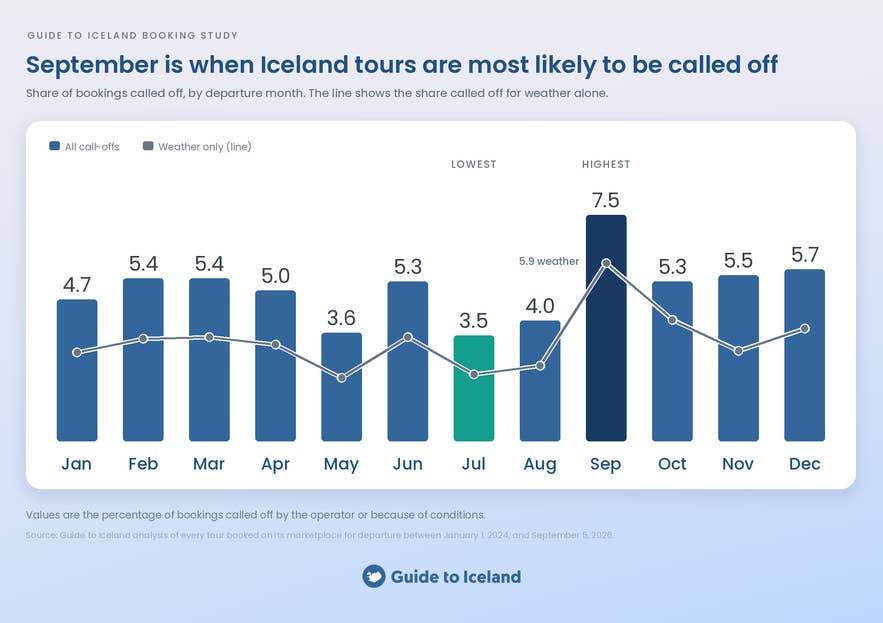
Iceland tours are most likely to be canceled in September, with 7.5% of bookings called off and a weather-cancellation rate of 5.9%, the highest of any month.
Autumn storms arrive while the tourist season is still running, and kayaking, boat, and whale watching all have some of their highest call-off rates in September. December (5.7%), November (5.5%), February (5.4%), and March (5.4%) follow.
Rainfall patterns also vary by region. Our rainiest months study identifies September as the wettest month in South and West Iceland, while rainfall peaks in October in East and North Iceland.
May (3.6%) and July (3.5%) have the lowest called-off rates, with August close behind at 4.0%. September’s called-off rate is more than twice July’s.
Which Iceland Tours Get Canceled the Most?
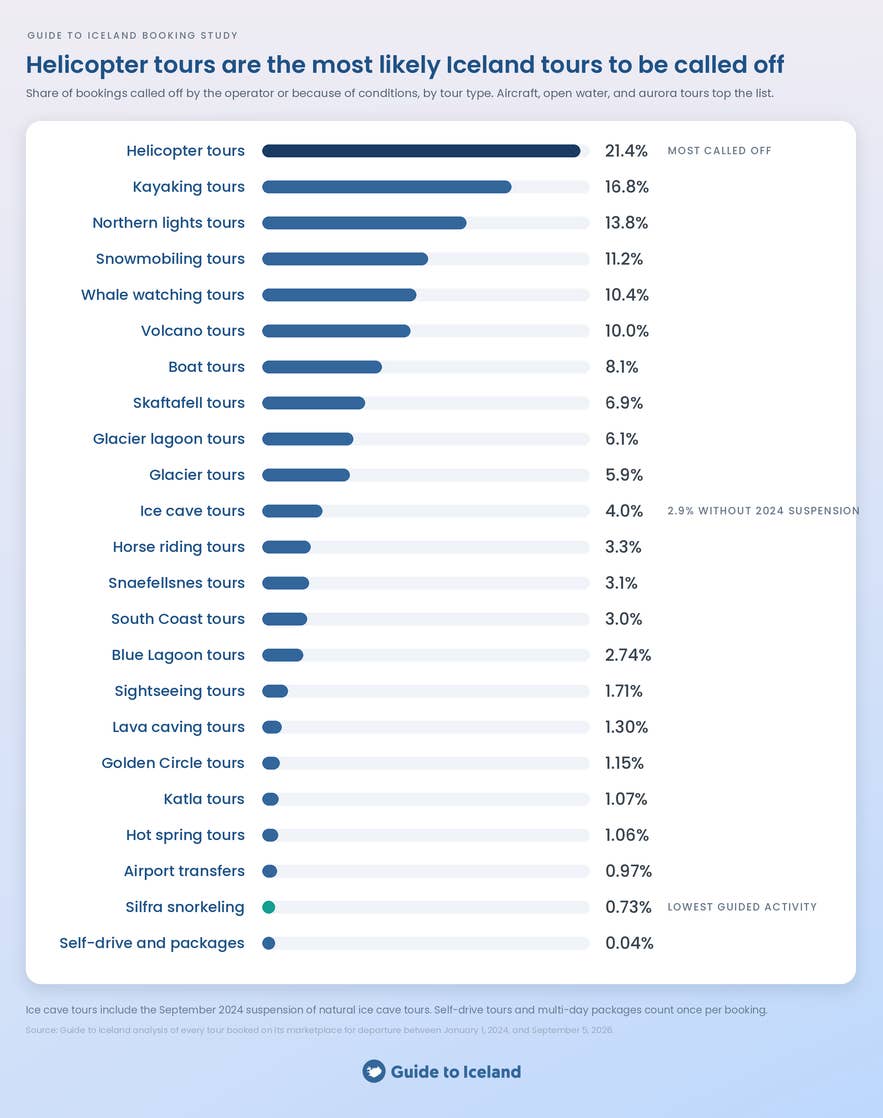
Helicopter tours in Iceland get canceled the most among the categories studied, at 21.4% of bookings, followed by kayaking tours at 16.8%, northern lights tours at 13.8%, snowmobiling tours at 11.2%, and whale watching tours at 10.4%. Tours involving aircraft, open water, or clear skies have some of the highest call-off rates.
At the other end, several popular activities have low call-off rates. Snorkeling tours sit at 0.73%. Airport transfers (0.97%), hot spring tours (1.06%), Golden Circle tours (1.15%), and lava caving tours (1.30%) also have low rates, while self-drive tours and multi-day packages have the lowest rate at 0.04%.
Call-off rates also vary between tour companies. For example, our study of the best glacier hiking tour operators in Iceland compares those rates alongside traveler ratings, prices, and tour formats.
Individual products follow the same pattern. Among the most-canceled tours on the marketplace are a whale watching tour from Olafsvik (22.9%), a volcano helicopter tour from Reykjavik (22.7%), and a northern lights super jeep tour (22.5%).
Why Do Helicopter Tours in Iceland Get Canceled?
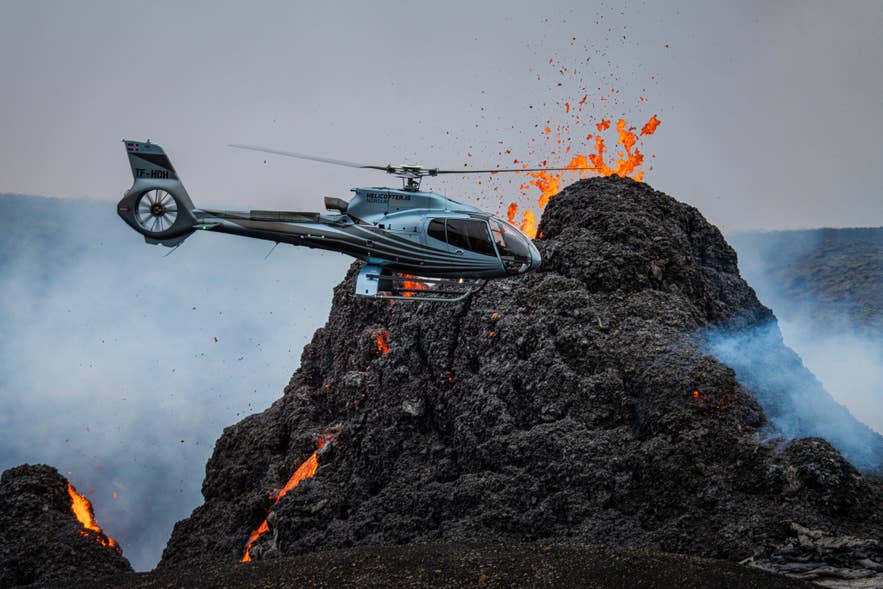
Helicopter tours in Iceland are canceled mainly because weather conditions prevent safe flights. They are the most-canceled activity on the marketplace, at 21.4% of bookings. Helicopters need suitable visibility, cloud conditions, and winds to fly and land safely.
Weather causes 71% of helicopter call-offs. The remaining 29% are operator-side, mostly aircraft availability and maintenance.
December has the highest call-off rate at 26.2%, but July is close behind at 25.2%. Our windiest months study found that July is Iceland’s calmest month, while winter brings the strongest winds. However, summer flights can still be grounded by unpredictable weather conditions over the Highlands and volcano sites.
The volcano helicopter tour from Reykjavik is canceled on 22.7% of bookings. Book it early in your trip and allow time to reschedule if conditions prevent it from running.
Why Do Northern Lights Tours in Iceland Get Canceled?
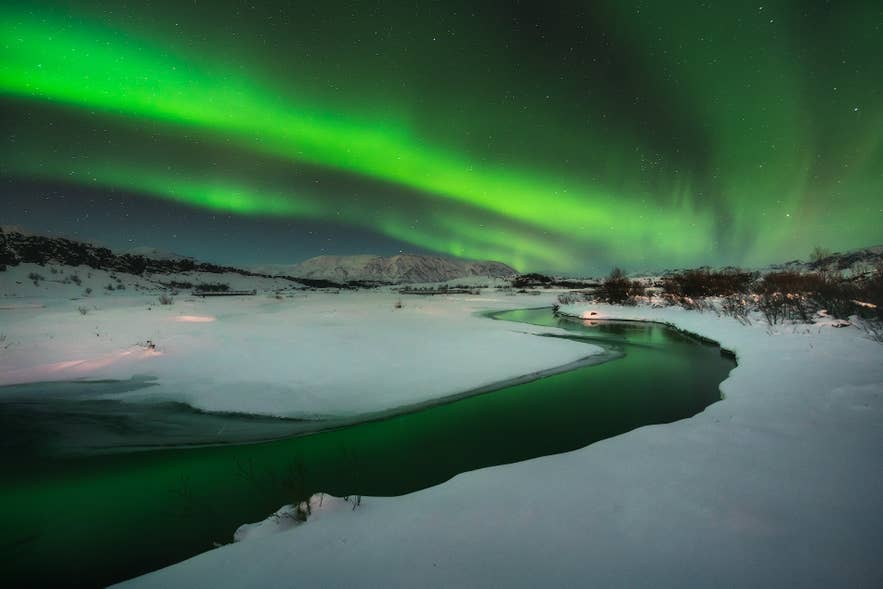
Northern lights tours in Iceland are canceled mainly because weather conditions limit the chance of seeing the aurora. They are called off on 13.8% of bookings, and 76% of those call-offs are weather-related.
Iceland’s northern lights viewing season generally runs from late August to mid-April. Sightings require darkness, clear or partly clear skies, and sufficient aurora activity. Our cloud-cover study found the lowest average cloud cover in Southeast Iceland, although clouds can prevent sightings anywhere.
Longer nights alone do not guarantee better viewing. Our study of the best month to see the northern lights in Iceland found that March offers the best balance of aurora activity, darkness, and cloud conditions, while December has the longest nights but the lowest average geomagnetic activity.
Operators may therefore cancel rather than run a tour with little chance of seeing the lights. Operator-side reasons make up the other 24% of call-offs, including departures that do not reach their minimum group size.
August has the highest call-off rate at 21.4%, followed by December at 16.3%. The lowest rates are in November and September, at around 11%. These figures measure cancellations, not your chances of seeing the lights.
Rates also vary by tour type. The northern lights super jeep tour from Reykjavik has a call-off rate of 22.5%, and the boat version is at 18.3%, both above the category average.
Why Do Whale Watching Tours in Iceland Get Canceled?
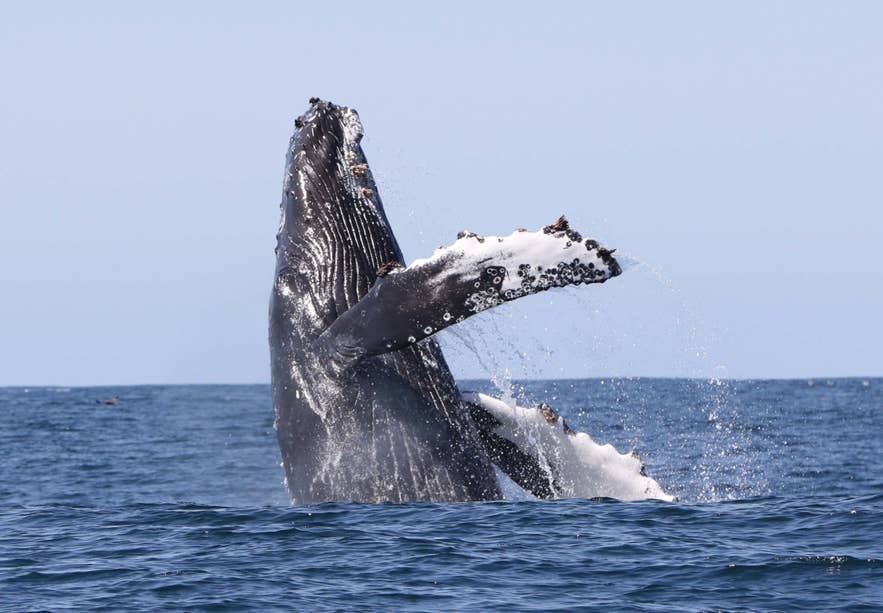
Whale watching tours in Iceland get canceled mainly because weather and sea conditions prevent safe or comfortable sailing. They are called off on 10.4% of bookings and are the most weather-driven activity we measured, with 83% of call-offs caused by weather. The remaining 17% are operator-side.
March has the highest call-off rate at 17.7%, followed by September at 15.6% and April at 14.8%. May has the lowest rate at 6.7%.
Location matters too. Whale watching from Olafsvik is called off about twice as often as from Reykjavik or Husavik. This individual whale watching tour from Olafsvik has a call-off rate of 22.9%.
Our study of the best whale watching companies in Iceland compares company-wide call-off rates, which may cover more than one harbor. Booking early in your trip leaves more time to reschedule if conditions prevent sailing.
Why Do Ice Cave Tours in Iceland Get Canceled?
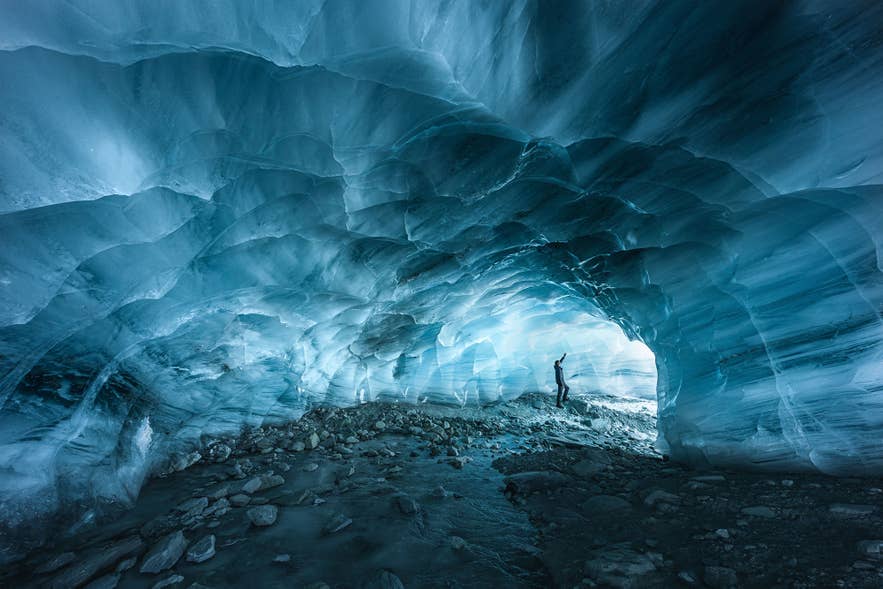
Ice cave tours in Iceland get canceled because of weather, access conditions, and operator-side problems. They are called off on 2.9% of bookings in normal conditions, below the marketplace average and roughly a seventh of the helicopter rate.
Weather accounts for 59% of these call-offs, and operator-side issues account for 41%. These include road conditions, wind on the approach, vehicle capacity, and guide availability.
Lower call-off rates do not mean the caves themselves are always stable. Our study of the safest month to visit ice caves in Iceland distinguishes ice conditions from cancellation rates. Its rates are higher because they also count travelers canceling their own bookings, while the 2.9% here counts only tours called off by operators or conditions.
Natural ice cave tours on Vatnajokull National Park generally run from October through April, depending on conditions. Katla tours operate year-round, although weather and glacier conditions can still prevent access.
Call-off rates are low in April (1.8%), January (2.0%), and March (2.4%). They rise to 5.2% in September and 4.2% in October. These historical figures cover the ice cave category as a whole, rather than only the current Vatnajokull season.
The Crystal Blue Ice Cave tour has a call-off rate of 4.4%. Rates are around 10% for the Langjokull snowmobiling and ice caving combo and for the Into the Glacier tour with Hraunfossar Waterfall, which visits a man-made ice tunnel.
One period is excluded from the normal-conditions figures. After a serious accident at a natural ice cave on Breidamerkurjokull in August 2024, operators suspended natural ice cave tours while conditions were reassessed, and almost every September 2024 departure was cancelled under force majeure.
Including that suspension, the headline ice cave rate rises from 2.9% to 4.0%, and September appears far riskier than it is. We have separated it out because it reflects a specific safety suspension rather than the ordinary seasonal pattern travelers can use to plan their trip. It also shows why some cancellations are necessary: tours may need to stop while safety conditions are reassessed.
How Often Are Kayak, Snowmobile, and Boat Tours in Iceland Canceled?
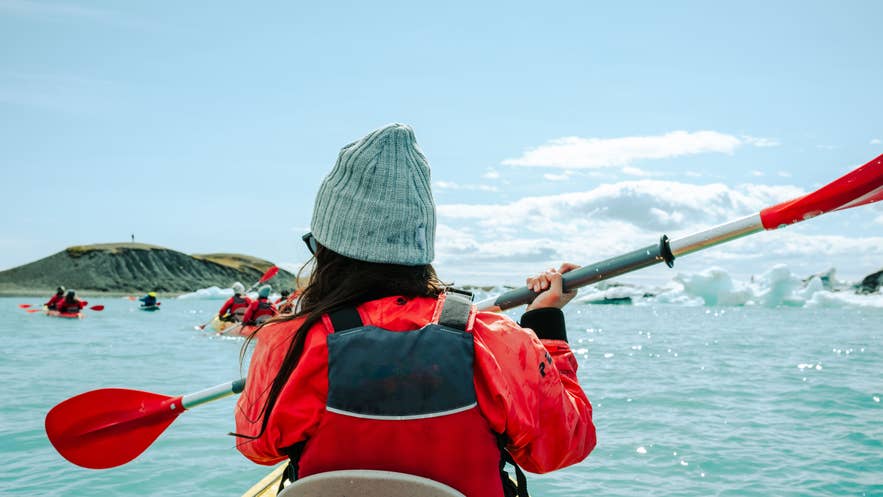
Kayaking tours in Iceland are called off on 16.8% of bookings, with weather accounting for 82% of those call-offs. September has the highest rate at 23.3%.
Snowmobiling tours have a lower overall call-off rate of 11.2%, but a sharp seasonal split. Rates are about 2% to 3% in May and July, compared with 16% to 19% from September through December.
Boat tours have the lowest overall rate of these three categories, at 8.1%. They also show seasonal variation, with rates of 2.5% in July and 13.0% in September.
These differences are worth considering when planning water and glacier activities. Allow time to reschedule if conditions prevent your tour from running, or have a backup activity if your itinerary is too short for another departure.
What Happens to Tours When a Volcano Erupts in Iceland?
Volcanic eruptions can disrupt nearby tours without stopping travel across Iceland. Volcanic closures accounted for 1.2% of all cancellations in our study, concentrated on Blue Lagoon, Reykjanes Peninsula, and volcano-viewing products.
Our 1,155-year volcano study traces the recent Reykjanes eruptions, beginning in 2021. Travel elsewhere generally continued during these events, although individual tours remained subject to weather and operating conditions.
If your tour visits an affected area, check your provider’s updates and official closure notices before setting out. A Blue Lagoon closure, for example, may mean choosing another hot spring rather than changing your whole itinerary.
Are Iceland Tours More Likely to Be Canceled if Booked Early?
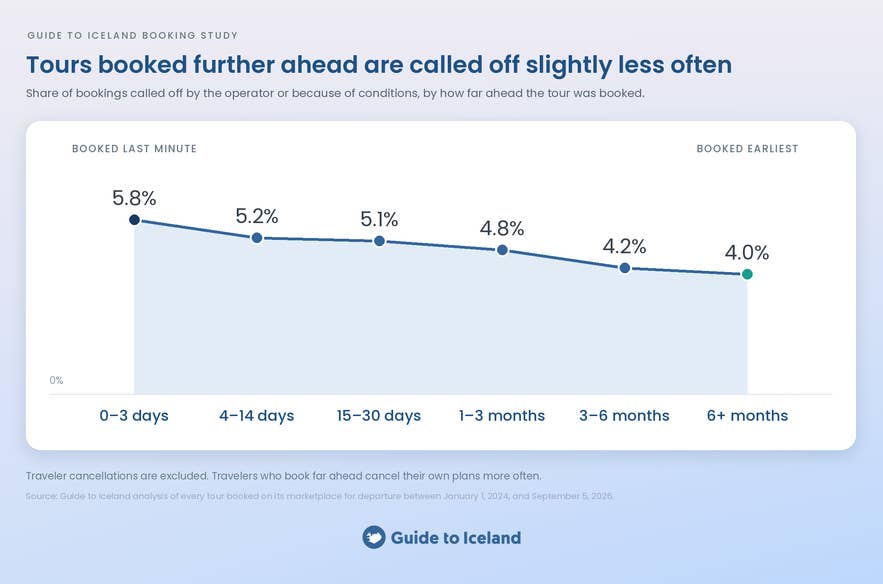
No, Iceland tours booked early had lower call-off rates in our data. Operators or conditions caused 4.0% of bookings made six months or more ahead to be called off, compared with 5.8% of bookings made within three days of departure.
This does not prove that booking early prevents cancellations. The higher traveler cancellation rate discussed earlier measures people canceling their own plans, rather than tours being called off.
Booking early is particularly useful when you need a specific date or departure time. For example, our study of the best time to visit ice caves in Iceland recommends reserving January and February tours early because Crystal Ice Cave departures can sell out weeks ahead.
The benefit is securing availability rather than expecting a lower price. Our study of the cheapest time to visit Iceland found that tour prices changed very little with how far ahead travelers booked.
Guide to Iceland offers full refunds for day tours canceled at least 24 hours before departure, or 48 hours for groups of 10 or more. Booking early can therefore secure your preferred departure while leaving flexibility to cancel within the applicable deadline.
How Late Are Iceland Tours Canceled, and What Happens Next?
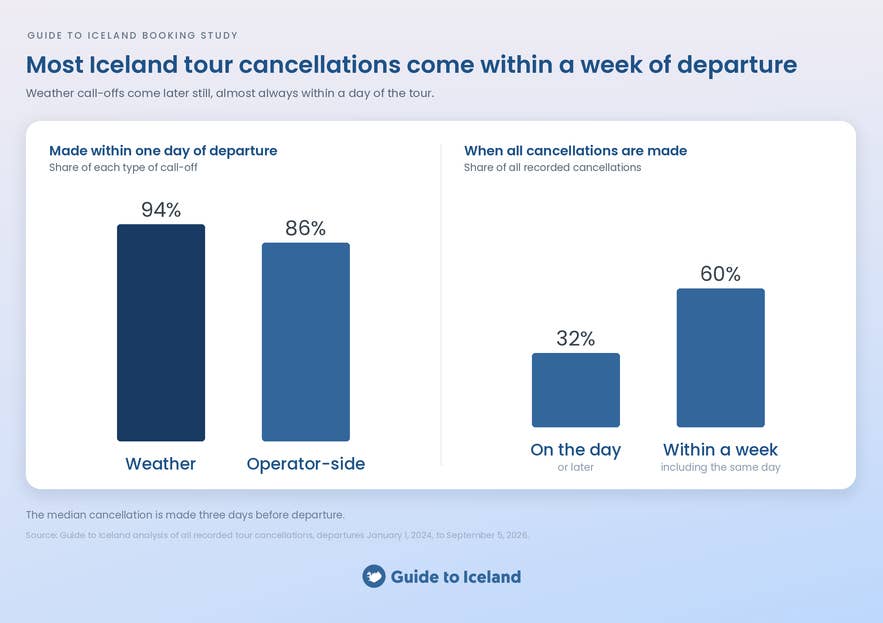
Iceland tour cancellations often happen close to departure. The median is three days before departure, 60% occur within a week, and 32% are recorded on departure day or later. For weather cancellations specifically, 94% are recorded within one day of departure.
If your tour is canceled near the end of your trip, you may not have time to take it another day. Scheduling it early in your stay leaves more time to rebook if another departure is available.
If your tour booked through Guide to Iceland is canceled because of weather or environmental conditions, you are eligible for a full refund. Your bank may take 10–14 business days to process the refund.
The planning section below explains how to arrange your itinerary around that flexibility.
Does Canceling a Tour in Iceland Cost You Anything?
Canceling a day tour booked through Guide to Iceland is free at least 24 hours before departure, or 48 hours for groups of 10 or more. Outside that window, a full refund is not guaranteed. If the operator cancels because of weather or environmental conditions, you are eligible for a full refund.
Guide to Iceland refunds the amount in the currency originally paid, without adding a refund fee. It charges no booking or transaction fees for Visa or Mastercard payments, although fees may apply to other payment methods such as Amex or PayPal. These are shown before checkout.
Your bank or payment provider can still affect how much reaches your account. Two things are worth understanding before you cancel a booking you might want back: exchange-rate differences and foreign transaction fees.
The first is the exchange rate. If your payment involved currency conversion, the refund may be converted at a different rate from the original purchase. The amount in your account’s currency can therefore be larger or smaller, even when Guide to Iceland refunds the full amount in the original payment currency.
The second is your bank’s foreign transaction fee. Some cards charge roughly 1% to 3% on international purchases, and that fee may remain even after the purchase is refunded. Policies differ between issuers, so ask your bank if it will return the fee. A card with no foreign transaction fee avoids that charge, but not possible exchange-rate differences.
Should You Change an Iceland Tour Booking or Cancel It?
If your dates move, ask about changing your Iceland tour booking before canceling and booking again. A change may avoid a refund and new payment, but confirm how it will be handled with our team.
Guide to Iceland charges no modification fee for day tours, multi-day tours, or car rentals when changes are requested at least 24 hours before departure. Price differences or additional costs may still apply.
Among travelers who cancel a tour themselves, 12% go on to book the same tour again. Of those who rebook, 59% do so on the day they canceled. These figures do not tell us why they rebooked, but travelers changing dates may be able to amend their booking instead.
How Can You Plan Around Tour Cancellations in Iceland?
Plan around tour cancellations in Iceland by leaving time to reschedule, comparing call-off rates, and understanding your booking terms. Five practical rules follow from the data.
-
Schedule weather-dependent tours early in your trip. Book whale watching or northern lights tours during your first few days. If conditions prevent the tour from running, you have more time to find another available departure.
-
Consider activities with lower call-off rates. Silfra snorkeling, lava caving, Golden Circle tours, and hot springs are called off less often. None is guaranteed to run, but they offer a lower likelihood of cancellation.
-
Check for updates close to departure. Most weather cancellations are recorded within one day of departure, so check messages from your provider before setting out. If you decide to cancel yourself, your booking’s cancellation deadline still applies.
-
Use the monthly rates when choosing travel dates. May, July, and August had the lowest overall call-off rates, while September had the highest. These are averages across tours, so also check the figures for your chosen activity. For example, northern lights tours do not run in May or July.
-
Know your refund and modification terms. Guide to Iceland day tours can be canceled for a full refund at least 24 hours before departure, or 48 hours for groups of 10 or more. Operator cancellations caused by weather or environmental conditions qualify for a full refund.
If only your dates have changed, ask about modifying the booking before canceling and booking again. Confirm availability, any price difference, and how the payment will be handled.
How We Did This Study
This study analyzes every tour booking made on the Guide to Iceland marketplace with a departure date between January 1, 2024, and September 5, 2026. Package sub-reservations are excluded, so a multi-day package counts once rather than once per component.
Every cancellation carries a written reason, which we classified into cause categories using text analysis. About 3% remained unclassifiable, and test bookings were identified and excluded from the reason breakdown.
Headline rates count cancellations attributed to weather and conditions, operator or availability problems, volcanic closures, and force majeure. Together, these account for 5.0% of bookings and represent cases where a booked tour did not run.
Force majeure accounts for a small share of that total and is almost entirely one event: the suspension of natural ice cave tours in September 2024. Excluding it, the headline rate is 4.8%. We report the ice cave figures both ways in the relevant section.
Cancellations made by travelers themselves are reported as a share of all cancellations rather than of bookings. Timing was measured against both the booking date and the scheduled departure.
Bookings departing after September 5, 2026, were excluded to keep a consistent departure-date cutoff. Weather context draws on the Icelandic Met Office.
What happens if my tour in Iceland is canceled because of the weather?
How far in advance will I know if my Iceland tour is canceled?
Which tours in Iceland are least likely to be canceled?
Do northern lights tours in Iceland get canceled if it's cloudy?
Sightings require darkness, clear or partly clear skies, and enough aurora activity. Operators may cancel when conditions offer little chance of seeing the lights.
Where is whale watching in Iceland least likely to be canceled?
What is the best month to avoid tour cancellations in Iceland?
Can I cancel a tour in Iceland for free?
After that deadline, a full refund is not guaranteed. If your dates have changed, you can request a booking modification more than 24 hours before departure without a modification fee. Changes depend on availability, and price differences may apply.
Why is my tour refund different from what I paid?
If your bank converts the refund into your account’s currency, exchange rate changes may affect the amount you receive. Contact your bank or payment provider to check any fees or conversion differences.
Keep Reading the Rest of Our Iceland Studies
Tour cancellation rates can help you plan your trip to Iceland, but weather, seasonal conditions, and traveler experiences also matter. Our best and worst months to visit Iceland study compares seasonal weather. The windiest months and rainiest months studies examine wind and rainfall in more detail.
If the northern lights are your reason for coming, our study of the best month to see the northern lights compares aurora activity, darkness, and cloud cover. Our study of Iceland’s clearest skies examines regional differences in cloud cover.
For ice caves, our safest month to visit ice caves study examines seasonal ice conditions. Our study of the best time to visit ice caves adds comparisons of crowds, daylight, and departure times.
Choosing an activity also means considering the experience itself. Our tour satisfaction study compares activities by traveler ratings. The whale watching company and glacier hiking operator studies compare providers within those activities.
For eruptions, our study of how often volcanoes erupt in Iceland provides historical context. For budgeting, our study of the cheapest time to visit Iceland examines travel costs and booking timing.

Guide to Iceland Editorials is the shared byline for our content team. We use it on pieces several people worked on together, where no single writer owns the article, and on anything rewritten often enough that a personal byline would be misleading. We also publish our original data studies under this profile. Each study answers a question travelers ask about Iceland, using primary sources such as booking records, traveler reviews and public datasets, and every study is quality checked by human experts before it's published. Everything under this byline is researched and reviewed by people who live and work in Iceland. If you spot something out of date or want to suggest a correction, message us and it reaches the whole team.