This study is part of a series Guide to Iceland runs on original data. The companion weather studies cover the sunniest month, the rainiest and driest months, and the warmest and coldest months in Iceland. A fifth study combines rain, wind, temperature, and daylight to rank the best and worst months to visit Iceland.
We analyzed 26 years of Icelandic Met Office wind records plus daily gust data for nine locations to find the windiest and least windy months in Iceland. The gap between the calmest month and the wildest is wider on the road than the averages suggest, and one northern town stays calm in every month of the year.
Ask a local about the weather in Iceland and you will hear about the wind before the rain or the cold. Wind is what shapes a trip to Iceland, and often, it's why roads close and tours are canceled.
July is our recommendation for calm, worry-free self-drive tours running to a fixed schedule with almost no wind delay. If your trip falls in winter, book guided multi-day tours instead, since a professional driver reads the forecast and reshapes the day for you.
Why You Can Trust Our Content
Guide to Iceland is the most trusted travel platform in Iceland, helping millions of visitors each year. All our content is written and reviewed by local experts who are deeply familiar with Iceland. You can count on us for accurate, up-to-date, and trustworthy travel advice.
Guide to Iceland set out to find the windiest and least windy months and places in the country. We analyzed monthly mean wind speeds from 2000 to 2025 at seven Icelandic Met Office stations spread around the country.
These seven stations are Reykjavik and Keflavik in the southwest, Stykkisholmur in the west, Akureyri in the north, Grimsstadir in the northeast highlands, Dalatangi in the east, and Vatnsskardsholar on the South Coast near Vik.
For this study, we also added Storhofdi in the Westman Islands for 2000 to 2013, the years its published record covers. We then counted storm days and calm days for those same nine places with a weather model called ERA5. It rebuilds past weather day by day from satellite and station data.
The findings below compare the wind across Iceland's months and places. Use them to pick a month based on how much wind you're willing to plan around. They also show when a buffer day or a guided tour is worth the extra cost.
Key Findings
-
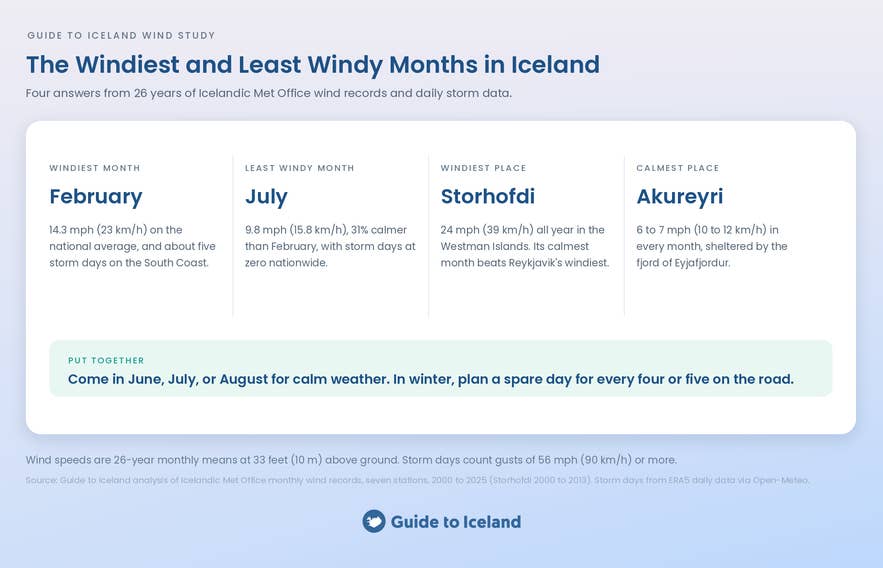
February is the windiest month in Iceland. Averaged across seven Met Office stations from 2000 to 2025, February winds run at 14.3 mph (23 km/h), just ahead of January at 13.9 mph (22 km/h). Every month from November to March stays above 13 mph (21 km/h).
-
July is the least windy month in Iceland. The national average falls to 9.8 mph (15.8 km/h), 31% below February, with August close behind at 10 mph (16.1 km/h).
-
Storm days almost disappear in an Icelandic summer. In February, Vik and the Westman Islands each average about five days with gusts of 56 mph (90 km/h) or more, and Reykjavik and Keflavik two to three. In July, every location in the study rounds to zero.
-
Storhofdi in the Westman Islands is the windiest place in Iceland. It averages 24 mph (39 km/h) across the year and 29 mph (47 km/h) in February. Even in July, its calmest month, it is windier at 17 mph (27 km/h) than Reykjavik is in February at 11 mph (18 km/h).
-
Akureyri is the calm exception in Iceland. Sheltered by the long fjord of Eyjafjordur, it averages 6 to 7 mph (10 to 12 km/h) in every month of the year, and its windiest month is May.
-
Calm days in Iceland are a summer feature. In July, the wind in Reykjavik stays below 18 mph (29 km/h) on 29 of 31 days. In February, that falls to 18 days in Reykjavik and 10 days at Keflavik.
Cite This Study
The charts and data in this study are free to use under CC BY 4.0. Credit Guide to Iceland and link to this page. Every chart has an Embed button underneath it with ready-to-paste code.
February Is the Windiest Month in Iceland
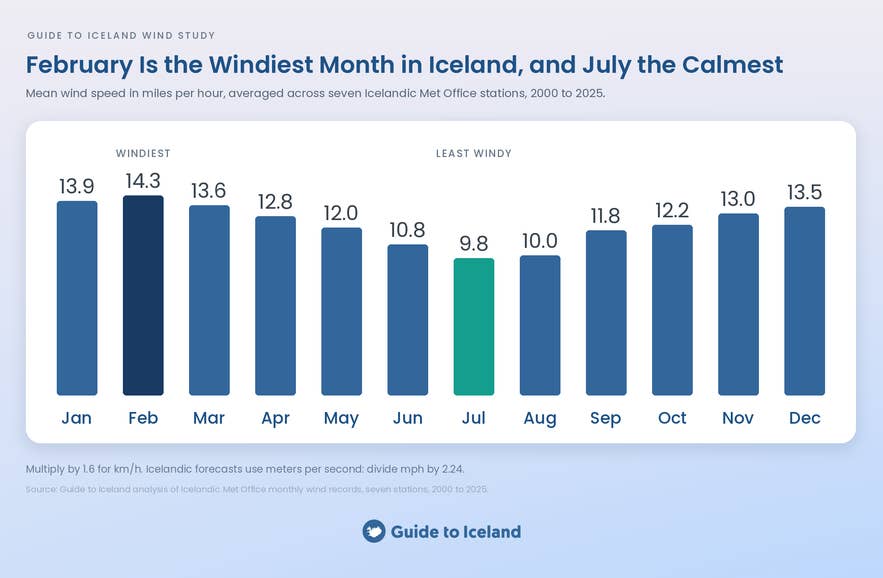
February is the windiest month in Iceland on the national average. Across the seven Met Office stations from 2000 to 2025, February winds ran at 14.3 mph (23 km/h), narrowly ahead of January at 13.9 mph (22 km/h).
March and December follow close behind at about 13.5 mph (22 km/h). Every month from November to March averages above 13 mph (21 km/h). That five-month stretch is Iceland's windy season.
Monthly averages undersell a windy February, because the average includes calm days, or days below 18 mph (29 km/h). The difference shows up in the storms.
On the South Coast, February brings around five days with gusts of 56 mph (90 km/h) or more, the level at which car doors bend and roads close. The same month in Reykjavik and Keflavik brings two to three such days.
Driving in Iceland in February is a daily judgment call rather than a fixed plan. Roads on the South Coast and around Keflavik can close at short notice, and rental companies charge for wind damage to doors. The forecast each morning decides the route.
February has also become the hardest month to visit Iceland since 2021, according to our study of the worst month to visit Iceland. Its windy days, with winds of 24 mph (39 km/h) or more, rose from 5.1 to 6.0 a month. Book a February trip around guided tours, and keep a spare day before your flight home.
July Is the Least Windy Month in Iceland
July is the least windy month in Iceland, at 9.8 mph (15.8 km/h) on the national average. August is right behind at 10 mph (16.1 km/h).
July is 31 percent calmer than February, and the storm statistics fall even further. Days with damaging gusts drop to essentially zero at every location in the study. That means Iceland tours in July, including self-drive trips, can keep to a fixed itinerary anywhere in the country.
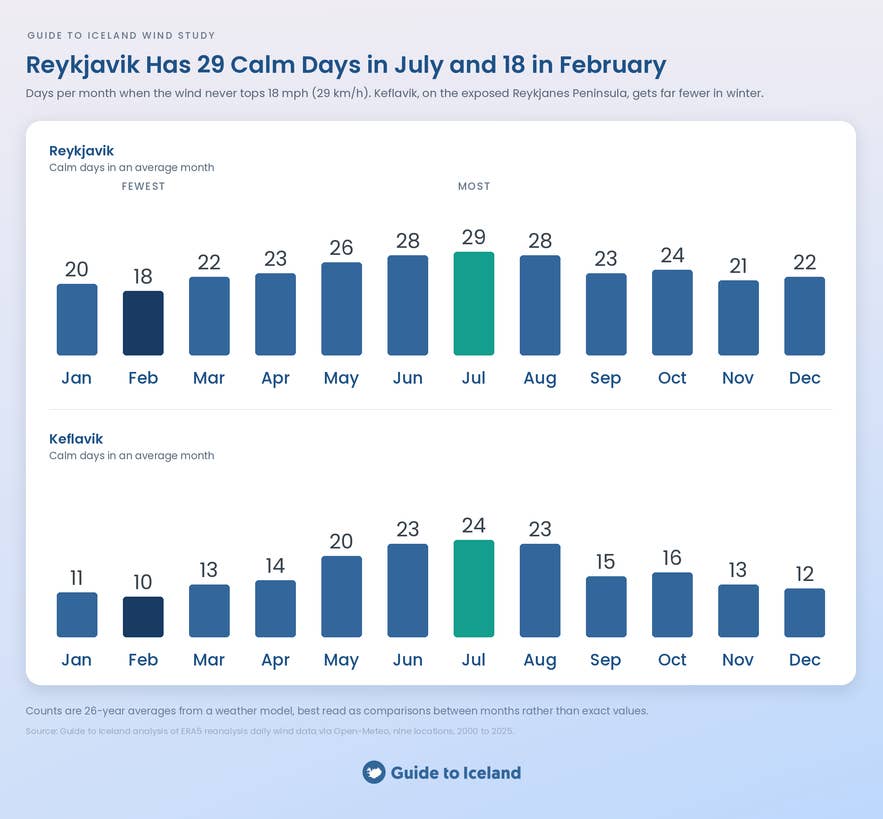
Calm days put the seasonal gap in plain numbers. In July, the wind in Reykjavik never tops 18 mph (29 km/h) on 29 out of 31 days. In February, that falls to 18 days. On the exposed Reykjanes Peninsula around Keflavik, the February count falls to 10.
The calm reaches every corner of Iceland in summer. Vik counts 26 calm days in July, against 10 in February. Keflavik counts 24 in July against 10 in February. Even Storhofdi in the Westman Islands manages 20 calm days in July against just 7 in February.
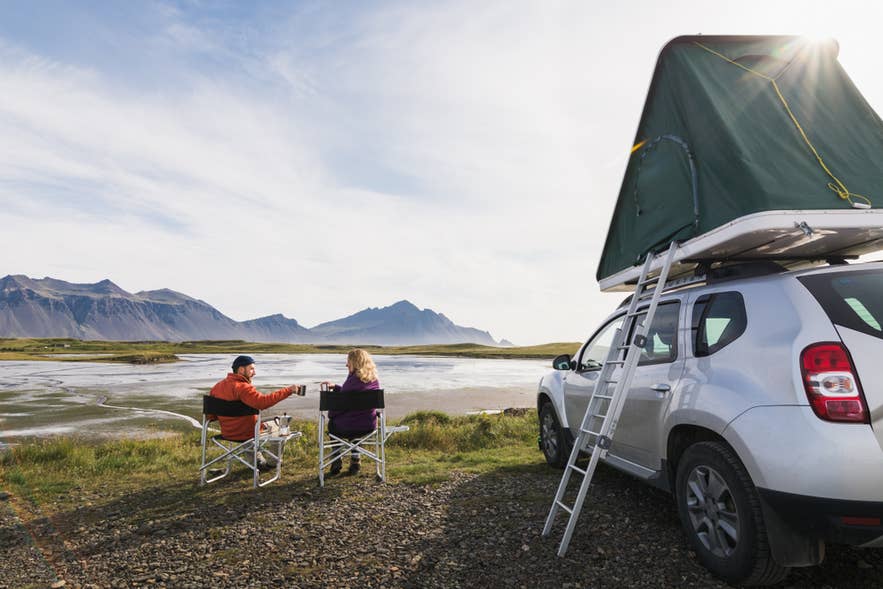
Those calm summer days are what make camping and a camper van rental in Iceland pleasant rather than an endurance test. Wind is also one of the main complaints at exposed sites such as Landmannalaugar in our study of 128 campsites in Iceland. July and August are also the calmest months for hiking, when exposed ridges and highland trails are least likely to be closed by wind.
 August matches July on calm days. Reykjavik records 28 days in August against 29 in July. Storm-gust days, or days with gusts of 56 mph (90 km/h) or more, stay close to zero everywhere.
The calm season runs from June to August and ends in September. The national average wind speed climbs to 11.8 mph (19 km/h), and the South Coast sees its first storm-gust day of the autumn. That means September tours in Iceland are the first ones of the year that might want at least one spare day.
Storhofdi in the Westman Islands Is the Windiest Place in Iceland
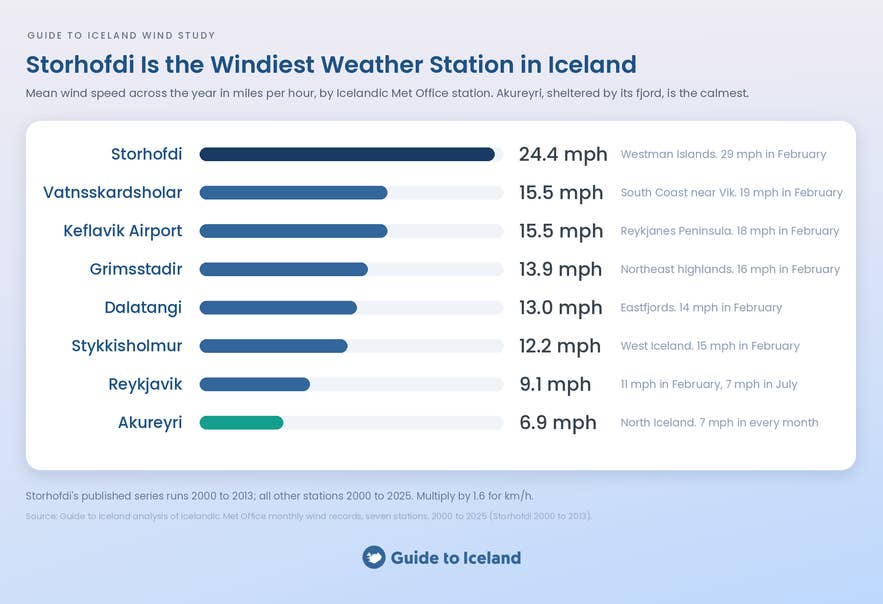
Storhofdi, the headland at the southern tip of Heimaey in the Westman Islands, is the windiest weather station in Iceland. The Icelandic Met Office has taken observations in Storhofdi since 1921 and notes that storms there are frequent and severe.
Storhofdi's record from 2000 to 2013 averages 24 mph (39 km/h) across the year and peaks at 29 mph (47 km/h) in February. In July, its calmest month, it still averages 17 mph (27 km/h). That is windier than Reykjavik in February.
The raw Atlantic exposure is why the ferry and small planes serving the islands run to the weather rather than the clock. That means a Westman Islands day trip should always have a backup date.
On the mainland, the South Coast is the windiest region in Iceland. Vatnsskardsholar, the station between Vik and Dyrholaey, averages 18.7 mph (30 km/h) in February. Keflavik Airport averages 18.1 mph (29 km/h).
The coast between Keflavik and Vik is where cars lose doors to gusts, so take wind warnings around Reynisfjara and Vik seriously.
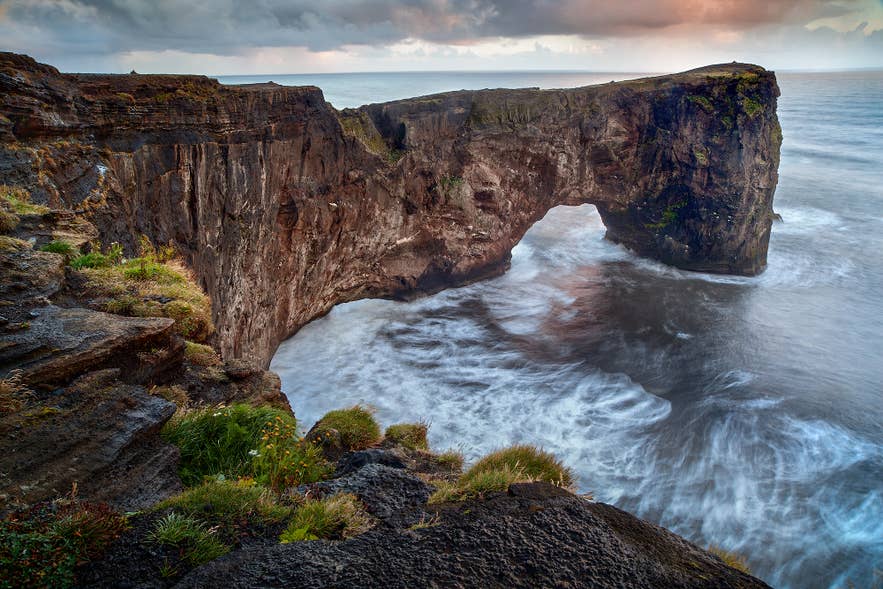 The east coast is windier than its reputation. Dalatangi, on the outermost point of the Eastfjords, averages 13.5 to 14.7 mph (22 to 24 km/h) from November to March.
Dalatangi also counts almost as many storm-gust days as the South Coast, or about four in an average December or February. The difference is that far fewer visitors are driving there in winter to notice.
Akureyri Is the Calmest Place in Iceland All Year
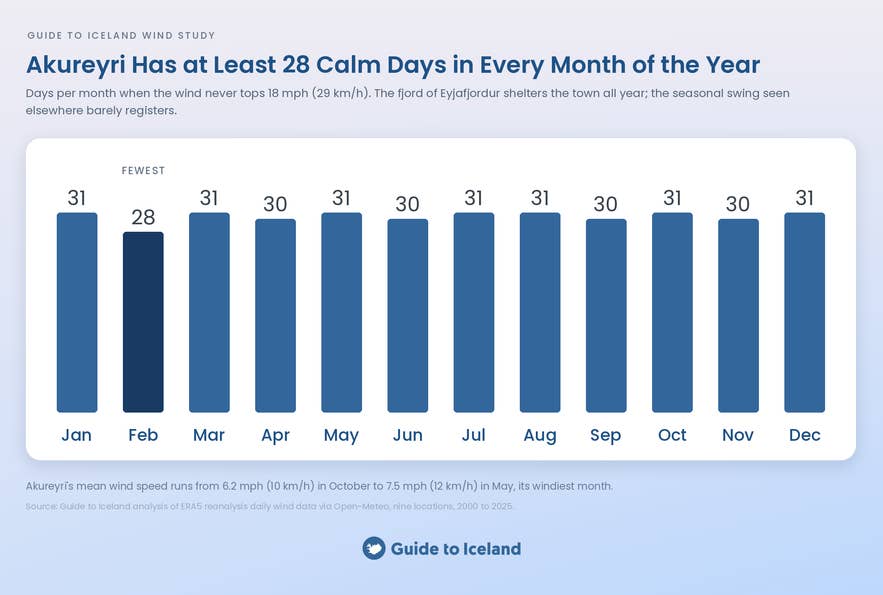
Akureyri is the calmest weather station in Iceland in every month of the year. Sheltered at the head of the long fjord of Eyjafjordur, it averages between 6 and 7 mph (10 and 12 km/h) all year round. Its windiest month is May, at 7.5 mph (12 km/h), and its calmest is October, at 6.2 mph (10 km/h).
The seasonal swing that defines the rest of Iceland barely registers in Akureyri. February in the town is calmer than July in Reykjavik, and an average February brings less than one storm-gust day. The daily data counts 28 to 31 calm days in every month.
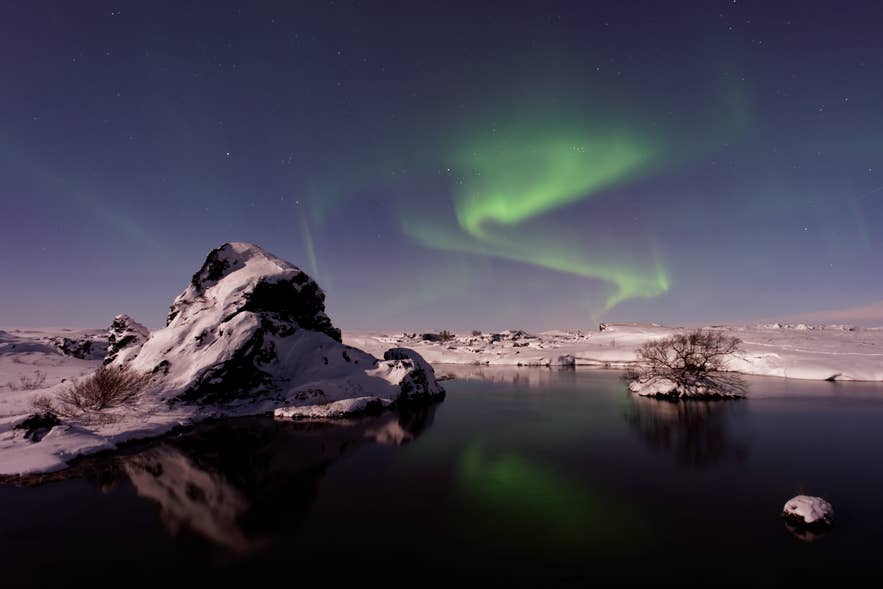
For a winter visitor, this calm makes Akureyri the most comfortable place in Iceland to stand outside at night. Waiting an hour for the northern lights in a 7 mph (11 km/h) breeze is a different experience from waiting in the 18 mph (29 km/h) that is normal on the South Coast in February.
Calm is not the same as clear skies, though. Our study of the best regions for northern lights in Iceland found Akureyri among the cloudier aurora bases, with the inland northeast around Myvatn clearer. A northern lights trip in the north is a trade between the shelter of the fjord and the skies beyond it.
 The shelter belongs to the fjord, not to North Iceland as a whole. Grimsstadir, on the highland plateau east of Myvatn, averages 15.8 mph (25 km/h) in February, more than double the town's figure.
The calm is real, but it ends where the fjord does. Once you drive out of Eyjafjordur toward Myvatn or the coast, you are back in the open country where the rest of the north's weather is made.
Iceland's South Coast Gets Five Storm Days in February and None in July
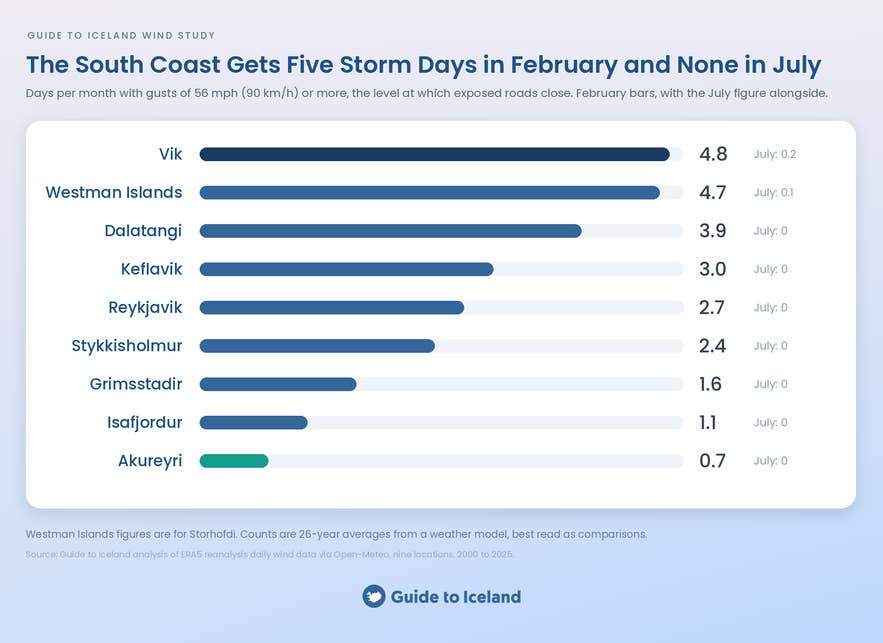
A storm-gust day in this study is a day with gusts of 56 mph (90 km/h) or more. It is the count that matters most for planning a road trip in Iceland.
Vik and the Westman Islands lead the country with about five storm-gust days in an average February. Dalatangi in the east counts four days. Keflavik counts three days. Reykjavik and Stykkisholmur count two to three days each.
Grimsstadir in the highlands gets between one and two days. Isafjordur gets about one day. Akureyri gets a little under one day.
In July, every location rounds to zero. Across the 26 years, Reykjavik and Akureyri never recorded a July storm-gust day. Vik saw a storm-gust day in four of those 26 years. The Westman Islands saw one in just one year. Keflavik also saw one in only one year.
The shoulder months sit in between. April brings roughly one storm-gust day on the South Coast, and October brings about two.
Over a full year, Vik counts around 27 storm-gust days. The Westman Islands and Dalatangi count around 22 each. Reykjavik and Keflavik count 13 to 14. Isafjordur counts about six. Akureyri counts fewer than four.
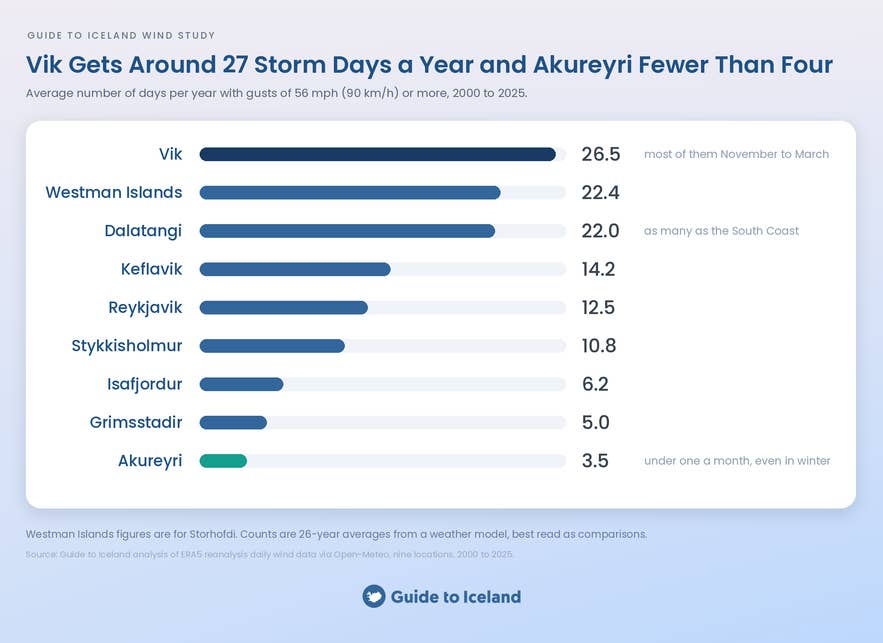
Iceland's wind gradient from coast to coast is why winter road trips in Iceland need buffer days. A winter self-drive tour along the South Coast with daily exposed coastal stops will, on average, lose one day in a February week to wind. Our study of how many days you need in Iceland recommends more days for winter road trips than summer ones for exactly this reason.
Driving in Iceland's Wind Is Safe With the Right Car and the Forecast
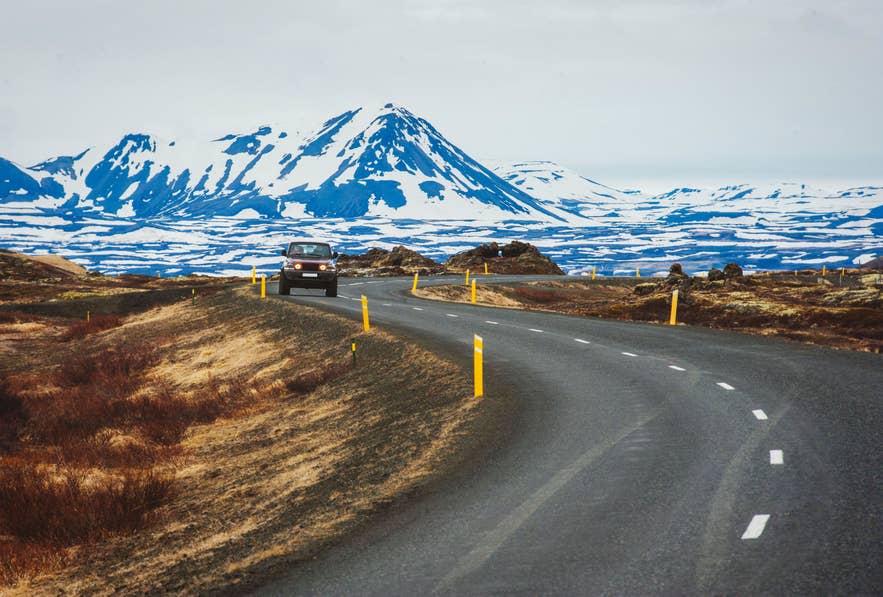 Driving in Iceland's wind is safe with planning, which is simpler than it sounds. The Icelandic Road Administration publishes live wind readings from roadside stations, the Icelandic Met Office issues color-coded wind warnings by region, and SafeTravel collects both in one place. Checking all three each morning is the whole routine.
Icelandic forecasts and roadside signs give wind in meters per second, not mph or km/h. A quick rule of thumb is to double the number for mph, or multiply it by 3.6 for km/h. So a forecast of 15 m/s is about 34 mph (54 km/h), and a gust warning of 25 m/s is about 56 mph (90 km/h).
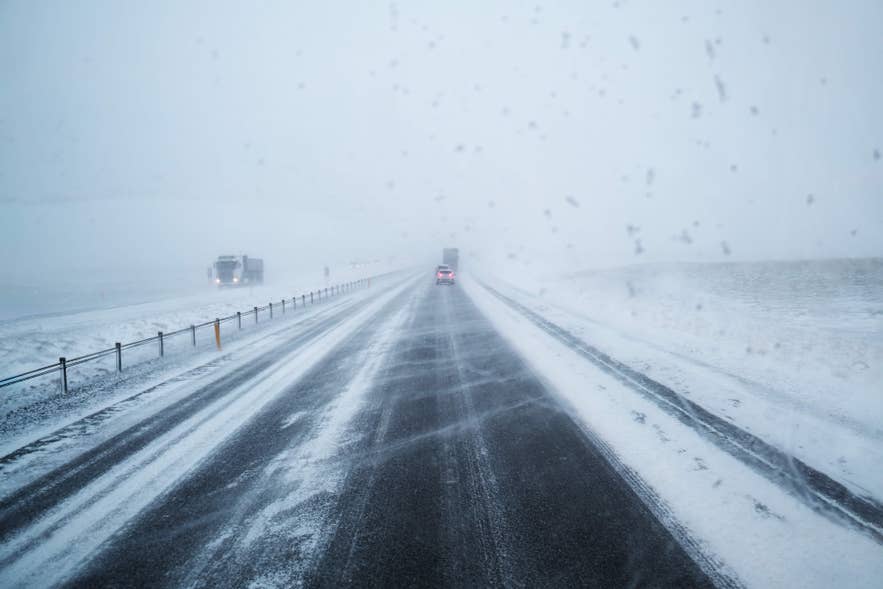
The working thresholds are simple. Sustained winds above 34 mph (15 m/s) are difficult for high-sided vehicles such as motorhomes and camper vans. Gusts of 45 to 56 mph (20 to 25 m/s) can move any car on the road, and at that level, exposed stretches of the South Coast and the Reykjanes Peninsula are often closed.
 The most common wind mishap in Iceland happens with the car parked. A gust catching an open door can bend it back against the hinge. Park facing into the wind where you can, open the door with both hands, and never let go of it until it is shut.
For winter driving, choose a 4x4 or SUV, which sits heavier on the road than a small car and copes better with side gusts and drifting snow. When driving in Iceland between November and March, treat the morning forecast as the thing that decides the day.
July Is the Month To Pick if You Hate Wind in Iceland
 July is the month to pick if wind is the part of Iceland's weather you most want to avoid. It has the lowest national average, the most calm days, and no storm-gust days worth counting.
August gives you the same calm, and June is a close third at 10.8 mph (17 km/h), with the midnight sun as its reward.
May is the compromise month. It is windier than July on paper, at 12 mph (19 km/h) against 9.8 mph (15.8 km/h). But our study of the sunniest month in Iceland found that May has the clearest skies of the year in Reykjavik. If you can accept a little more wind for a lot more sun, May is the better trade.
For winter visitors chasing the northern lights, wind is the price of the season, and there is no month between November and March that avoids it. The practical answer is to let someone else deal with it.
Northern lights tours in Iceland run on the night's forecast rather than a fixed plan. Most tours let you rebook for free if the night is called off for weather, which beats a self-drive hunt in a February gale.
If your dates are flexible, this wind study and our northern lights study can be read together. Our study of the best month to see the northern lights in Iceland ranks the months from September to April on solar activity. This wind study ranks the same months on wind.
On wind alone, the calmest months of the northern lights season are the two at either end. September averages 11.8 mph (19 km/h) and October 12.2 mph (20 km/h), before the winter storm season sets in. April averages 12.8 mph (21 km/h) as the season ends.
Planning Your Iceland Trip Around the Wind
The findings above come down to three choices: which month you come, how you get around, and how many spare days you build in. Here is how they apply to the main ways of booking a trip to Iceland.
Summer Trips Need Almost No Wind Planning
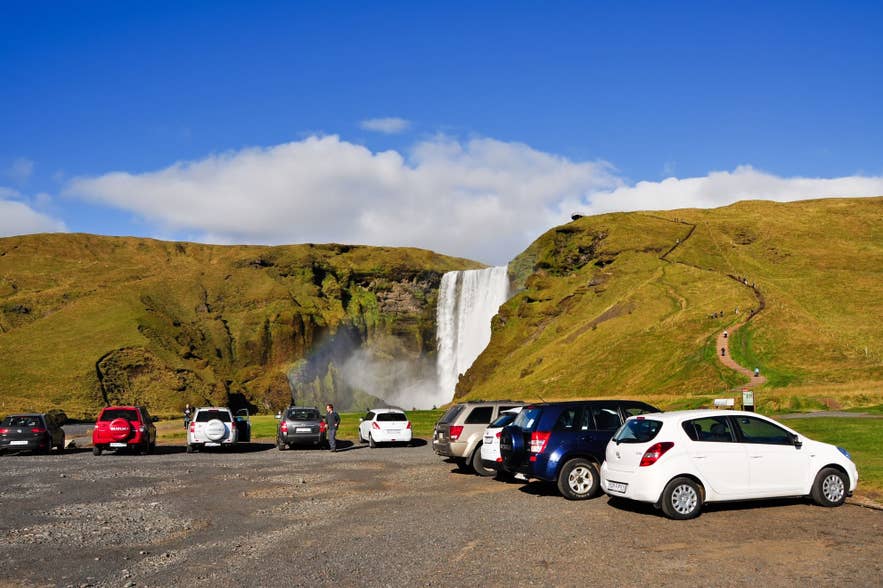 For a summer trip, the wind data barely constrains you. June, July, and August are calm enough everywhere in the study that summer packages in Iceland can keep to a fixed itinerary from the first day to the last. Travelers embarking on summer self-drive tours can plan a coastal day for every date without needing a spare one.
The two places that stay brisk even in July are the Reykjanes Peninsula and the South Coast. If you would rather not drive them yourself, Reykjanes tours and day trips along the South Coast cover both from Reykjavik with a driver who knows where the gusts come through.
Winter Trips Are Easier With a Guided Tour
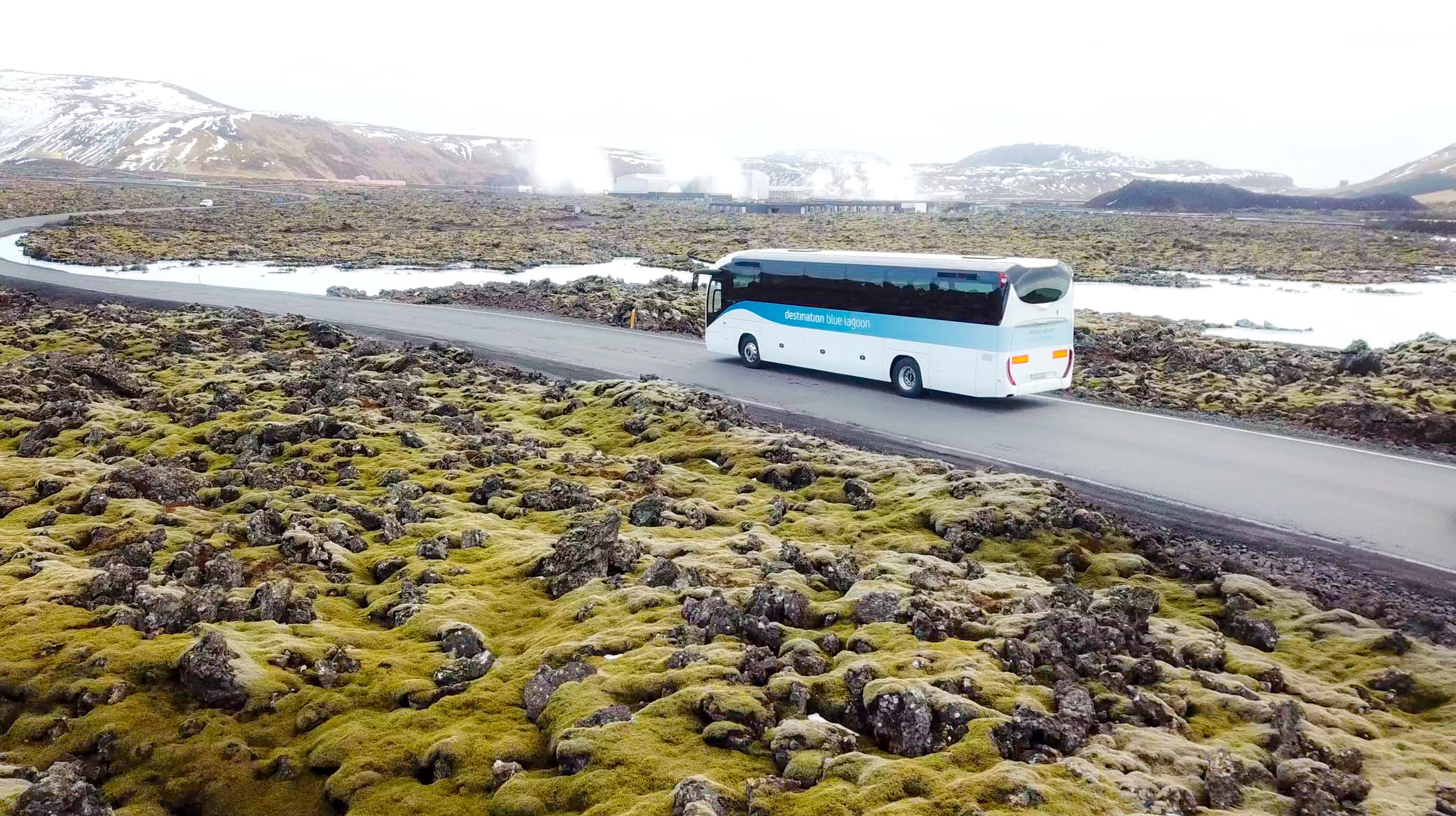 For a winter trip, the data makes a clear case for letting someone else drive. The case is strongest for first-time visitors to Iceland and for anyone who has not driven in winter conditions before.
Guided multi-day tours in Iceland run to the same weather rules you would face yourself, but with a driver who reads Icelandic forecasts for a living and an operator who reshapes the day when a road closes. Many of the winter departures are built around the northern lights, so the hunt is part of the itinerary rather than something you add after a long day of driving.
Self-Drivers Should Plan a Buffer Day in Winter
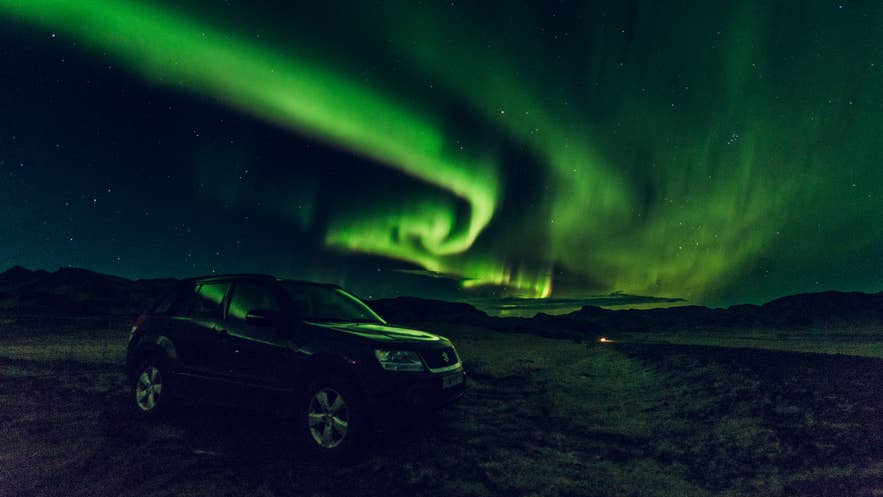 Travelers who prefer to explore on their own can still book winter self-drive tours in Iceland. Choose a 4x4 or SUV and plan one buffer day for every four or five days on the road. Stay two or three nights in each base, so that a closed road costs you a drive rather than a hotel.
Either way, if the northern lights are the reason for the trip, northern lights hotels in Iceland solve the wind problem in a different way. They sit away from town lights, and most offer a wake-up call when the aurora appears. You can watch from the doorstep instead of driving out into a February night to find a dark sky.
What This Iceland Wind Study Does Not Tell You
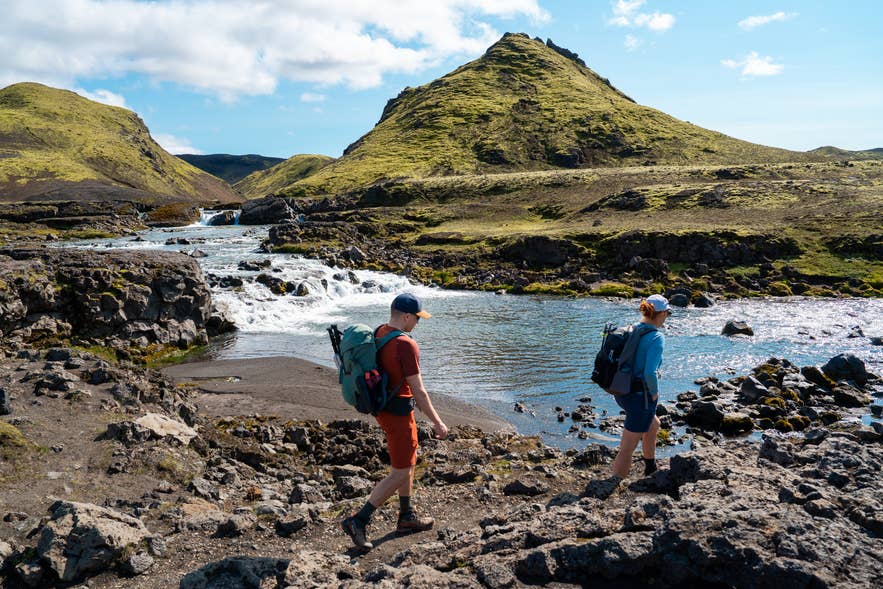 This study ranks the months and regions of Iceland by wind, using 26 years of station records and daily model data. Here is what it can and cannot support.
-
These are averages, not forecasts. A 26-year mean tells you what a typical February or July is like, not what yours will be. Calm Februaries happen, and so do July storms (Vik had at least one July storm-gust day in four of the 26 years). Use the study to choose a month and the forecast to plan a day.
-
The day counts come from a weather model, not from instruments. The monthly speeds are measured at Met Office stations, but the storm-day and calm-day counts come from a model that estimates conditions across grid cells several miles wide, which smooths out headlands and fjords. At Storhofdi, the model's February mean is 16 mph (26 km/h) against a measured 29 mph (47 km/h). The counts are sound for comparing months and regions, not as exact values for one spot.
-
Nine locations do not cover the whole country. The interior Highlands of Iceland, the tip of Snaefellsnes, the outer Westfjords, and the northeastern headlands have no long-running station in this study. The Met Office's wind resource mapping names several of those headlands as the windiest lowland areas in Iceland, so the true windiest place is probably not on our list.
-
A station reading is not the wind at the roadside. Stations measure wind 33 feet (10 meters) above open ground. A car on a bridge, a cliff-top parking lot, or a mountain pass can meet gusts well above what the nearest station reports. This is why the roadside sensors are the numbers to trust while driving.
-
The study does not tell you when a road will close. Closures are decided on the day from live readings and the forecast, and wind direction matters as much as speed. A monthly average of storm days tells you how many buffer days to plan, not which days they will be.
-
Wind is one part of the weather. This study says nothing about rain, temperature, snow, or daylight. It also does not measure wind chill, which is what a windy day feels like on your skin. The companion studies on the rainiest and driest months, the warmest and coldest months, and the sunniest month in Iceland cover those.
How We Built the Iceland Wind Study
The wind study has two parts. The monthly wind speeds come from Icelandic Met Office weather stations. The storm-day and calm-day counts come from a daily weather model, because the published station tables give monthly averages rather than day-by-day readings.
1. Monthly Wind Speeds From Seven Met Office Stations
We took the monthly mean wind speed from the Icelandic Met Office's published monthly tables for every month from January 2000 to December 2025. The seven stations are Reykjavik, Keflavik Airport, Stykkisholmur, Akureyri, Grimsstadir, Dalatangi, and Vatnsskardsholar. That is 312 months per station.
A handful of months are missing from the published record, six months at Akureyri and two months each at Grimsstadir and Vatnsskardsholar. Those months were left out rather than estimated.
Storhofdi in the Westman Islands is included separately because its published wind series ends in 2013. Its figures cover January 2000 to December 2013 and are not part of the national average.
The national average for each month is the plain average of the seven stations. It is a measure of what Iceland's populated coast experiences, not an area-weighted figure for the whole island.
The 31 percent gap between February and July is the difference between those two national averages, expressed as a share of the February figure.
2. What We Counted as a Storm Day and a Calm Day
A storm-gust day is any day on which the strongest gust reached 56 mph (90 km/h, or 25 m/s) or more. This is the level at which exposed roads in Iceland are commonly closed and car doors are damaged, and it matches the threshold used in our companion weather study.
A calm day is any day on which the wind never exceeded 18 mph (29 km/h, or 8 m/s). At that speed a flag flies out but walking, cycling, and photography are comfortable.
Both counts are averaged per calendar month across the 26 years, so "five storm-gust days in February" means an average February, not every February.
3. Where the Day Counts Come From
Daily maximum gust and daily maximum wind speed for 2000 to 2025 came from the Open-Meteo historical weather API. Open-Meteo serves the ERA5 family of reanalysis models, produced by the European Centre for Medium-Range Weather Forecasts.
A reanalysis is a weather model run backward over past decades and corrected against observations. That gives a complete daily record for any point on the map.
We pulled the daily series for the coordinates of the eight stations above plus Isafjordur, nine points in all. Reanalysis smooths local terrain, so fjord stations read calmer and headlands read less windy in the model than on the ground. For that reason, the day counts are used to compare months and regions with each other. The station records are used for the wind speeds themselves.
4. Units and Rounding
Wind speeds are given in miles per hour first, with kilometers per hour in brackets, because those are the units most readers know. Icelandic forecasts and road signs use meters per second (one meter per second is 2.24 mph or 3.6 km/h). Figures are rounded to one decimal where two months are close and to whole numbers elsewhere.
5. Sources
-
Icelandic Met Office, monthly climate tables by station (Mánaðargildi), accessed September 2026.
-
Copernicus Climate Change Service, ERA5 hourly data on single levels, accessed through the Open-Meteo historical weather API.
-
Icelandic Road Administration, road conditions and weather, for the live readings referenced in the driving section.
Conclusion
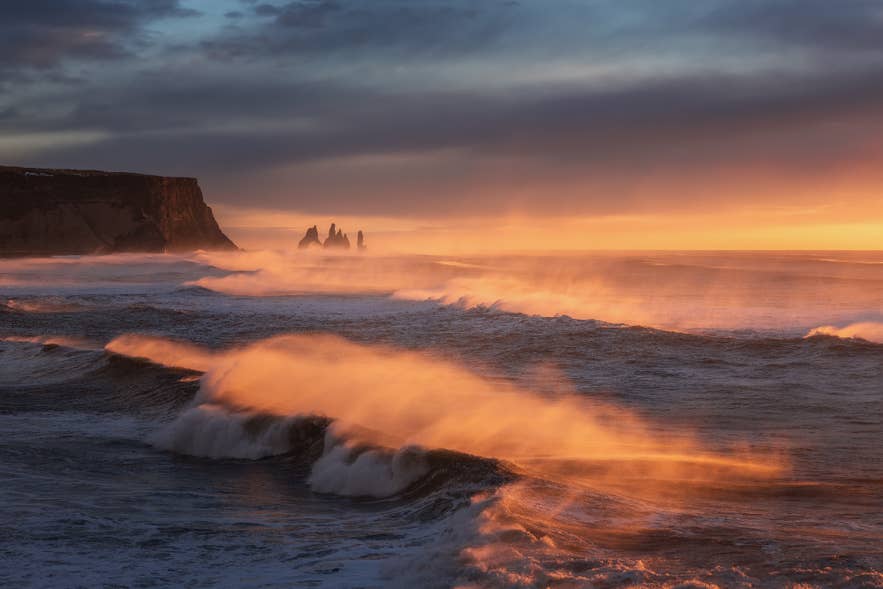 This study asked when and where Iceland is windiest, and the data gave clear answers.
February is the windiest month in Iceland, at 14.3 mph (23 km/h) on the national average, and July is the least windy, at 9.8 mph (15.8 km/h). The 31 percent gap between them understates the difference on the ground.
In February, the South Coast averages about five days with damaging gusts. In July, the whole country averages none.
Storhofdi in the Westman Islands is the windiest place in the study, windier in its calmest month than Reykjavik in its wildest. Akureyri is the calmest, sheltered in every month of the year by the fjord around it.
The South Coast and Keflavik are where the wind matters most to visitors. Those are the places where the roads, the rental cars, and the tours are.
Three points cover most trips.
-
Come in Iceland's summer, from June to August, for calm weather and a fixed itinerary. July averages 9.8 mph (15.8 km/h) across the country, and every location in the study rounds to zero storm days.
-
In Iceland in winter, plan a spare day for every four or five on the road, or book guided multi-day tours instead. Vik and the Westman Islands each average about five storm days in February, and Reykjavik and Keflavik average two to three.
-
Base yourself in Akureyri if wind bothers you more than cloud. The town averages 6 to 7 mph (10 to 12 km/h) in every month of the year, and its windiest month is May.
The wind on your own trip will be decided by the forecast, not by a 26-year average. Use this study to choose your month and shape your route. Treat the Road Administration's live readings as the way to choose your day.
Related reading from Guide to Iceland:

Guide to Iceland Editorials is the shared byline for our content team. We use it on pieces several people worked on together, where no single writer owns the article, and on anything rewritten often enough that a personal byline would be misleading. We also publish our original data studies under this profile. Each study answers a question travelers ask about Iceland, using primary sources such as booking records, traveler reviews and public datasets, and every study is quality checked by human experts before it's published. Everything under this byline is researched and reviewed by people who live and work in Iceland. If you spot something out of date or want to suggest a correction, message us and it reaches the whole team.