This study is part of a series Guide to Iceland runs on original data. The companion weather studies cover the windiest and least windy months, the rainiest and driest months, and the warmest and coldest months in Iceland. A fifth study combines rain, wind, temperature, and daylight to rank the best and worst months to visit Iceland.
We analyzed 26 years of Icelandic Met Office sunshine records and compared eleven locations around the country to find the sunniest month in Iceland. The answer is not the height of summer, and it changes depending on which part of the country you visit.
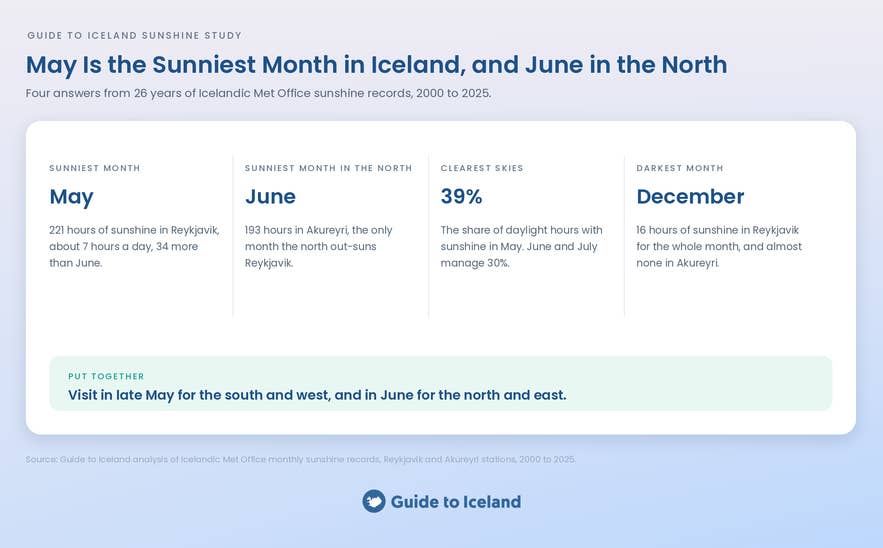
Here's a local tip for clear views of glaciers, waterfalls, and mountains: visit in May, the sunniest month in Iceland. Reykjavik averages 221 hours of sunshine across the month of May, about 7 hours a day. June and July manage about 6 hours a day each.
Late May is our recommendation for sunny road trips through the south and west, before peak-season prices for accommodation and rental cars set in. If you are heading north, June is the pick instead, since Akureyri records more sunshine than Reykjavik that month.
Why You Can Trust Our Content
Guide to Iceland is the most trusted travel platform in Iceland, helping millions of visitors each year. All our content is written and reviewed by local experts who are deeply familiar with Iceland. You can count on us for accurate, up-to-date, and trustworthy travel advice.
To find the best time to visit Iceland for sunny weather, we analyzed monthly sunshine hours from 2000 to 2025 at the only Icelandic Met Office stations where sunshine hours are directly measured. That is 312 months of measured sunshine at the two stations, Reykjavik and Akureyri.
To compare the rest of the country, we used a weather model called ERA5. It rebuilds past weather day by day from satellite and station data. We took its daily sunshine estimates for eleven locations over the same 26 years.
Those locations are Reykjavik, Keflavik, Stykkisholmur, Isafjordur, Akureyri, Grimsstadir, Egilsstadir, Dalatangi, Hofn, Vik, and the Westman Islands. The model tells us which places are sunnier than others, and the two stations tell us how many hours of sun that means.
The findings below compare sunshine across Iceland's months and regions. Use them to pick a month, and to pick which half of the country to spend it in. They also show that the longest days of the year are not the sunniest.
Key Findings
-
May is the sunniest month in Iceland. Reykjavik averaged 221 hours of sunshine in May from 2000 to 2025, about 7 hours a day. June came second at 187 hours and July ranked third at 183 hours.
-
May has the clearest skies of the year in Iceland. In May, the sun is out for 39 percent of the daylight hours in Reykjavik. In June and July, that share drops to 30 percent, a cloudier result than October.
-
June is the sunniest month in North Iceland. Akureyri averaged 193 hours of sunshine in June, its annual peak, and about 6 hours more than Reykjavik in the same month.
-
The southwest coast is the sunniest part of Iceland. Comparing the eleven locations in May, Keflavik, the Westman Islands, and Reykjavik are level at the top, within one percent of each other. Over the year, Vik on the South Coast comes fourth.
-
Iceland splits into a May zone and a June zone. The southwest and the South Coast, from Keflavik through Reykjavik to Hofn and the Westman Islands, have their sunniest month in May. The rest of the country, from Snaefellsnes and the Westfjords to Akureyri and the east, peaks in June. May and June are the top two months at all eleven locations.
-
December is the darkest month in Iceland. Reykjavik averages 16 hours of sunshine in December and Akureyri averages 0.3 hours. In 16 of the 26 Decembers, the Akureyri station recorded no sunshine at all.
-
May 2021 was the sunniest single month in the 26 years. Reykjavik recorded 335 hours of sunshine that month, nearly 11 hours a day.
Cite This Study
The charts and data in this study are free to use under CC BY 4.0. Credit Guide to Iceland and link to this page. Every chart has an Embed button underneath it with ready-to-paste code.
Sunshine Hours Are Not Daylight Hours in Iceland
 Every figure in this study counts sunshine, not daylight hours in Iceland. Daylight is the time the sun is above the horizon. Sunshine is the time it is bright enough to cast a shadow.
Daylight and sunshine are very different numbers in Iceland.
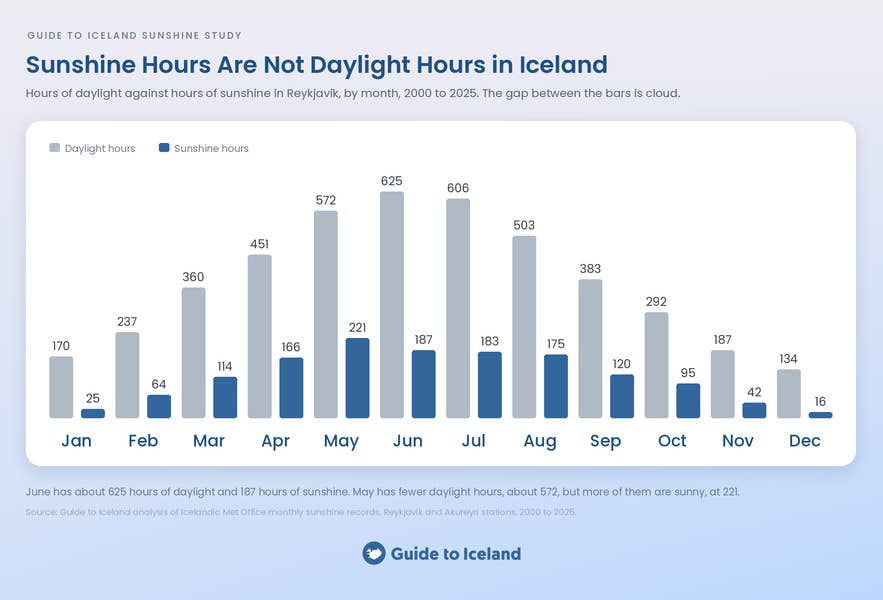
Reykjavik has about 625 hours of daylight in June, more than 20 hours a day around the midnight sun. The sun shone for 187 of those hours on average, less than a third of them. Cloud covered the rest.
The Met Office stations in Reykjavik and Akureyri record sunshine with an instrument that only registers direct sun. Thin cloud, haze, and the low sun skimming the horizon around midnight do not count. That is why a June day can feel bright from morning to night and still add only a few hours to the sunshine total.
May has fewer hours of daylight than June, about 572 hours against 625, but more of them are sunny. Reykjavik averaged 221 sunshine hours in May, so the sun was out for 39 percent of the available daylight. In June, that share fell to 30 percent.
The darkest month shows the same gap. Reykjavik has about 134 hours of daylight in December, a little over four hours a day, and only 16 of those hours brought sunshine.
May Is the Sunniest Month in Iceland
 May is the sunniest month in Iceland by a clear margin. The Reykjavik weather station averaged 221 hours of sunshine in May between 2000 and 2025, about 7 hours a day.
June came second at 187 hours and July ranked third at 183 hours, about 6 hours a day each. August followed at 175 hours. After that, the totals drop fast. December brings 16 hours of sunshine in Reykjavik, about half an hour a day.
The table below shows average sunshine hours in Reykjavik for every month of the year, based on the 26 years from 2000 to 2025.
| Month | Sunshine hours | Hours per day |
|---|---|---|
| January | 25 | 0.8 |
| February | 64 | 2.3 |
| March | 114 | 3.7 |
| April | 166 | 5.5 |
| May | 221 | 7.1 |
| June | 187 | 6.2 |
| July | 183 | 5.9 |
| August | 175 | 5.7 |
| September | 120 | 4.0 |
| October | 95 | 3.1 |
| November | 43 | 1.4 |
| December | 16 | 0.5 |
May wins in most individual years too, not only on the 26-year average. It was the sunniest month of the year in Reykjavik in 12 of the 26 years, more than any other month. It beat June in 17 of them.
The sunniest single month in the study was also a May. In May 2021, Reykjavik recorded 335 hours of sunshine, nearly 11 hours a day. Four of the five sunniest months since 2000 were Mays or Junes, and the fifth was July 2023.
A poor May does happen. May 2023 brought only 96 hours of sunshine to Reykjavik, less than half the average. The figures in this study are a guide to the odds, not a forecast.
May Has the Clearest Skies of the Year in Iceland
 May has the clearest skies of the year in Iceland, measured as the share of daylight hours that bring sunshine. In Reykjavik, the sun was out for 39 percent of the daylight hours in May. No other month comes close to that share.
June has more daylight than any other month, yet the sun shone for only 30 percent of it. July was the same at 30 percent. The extra daylight in midsummer arrives with extra cloud.
May beats June for one plain reason. May has about 50 fewer hours of daylight than June, but a far larger share of them are sunny. That gives May 34 more hours of sunshine.
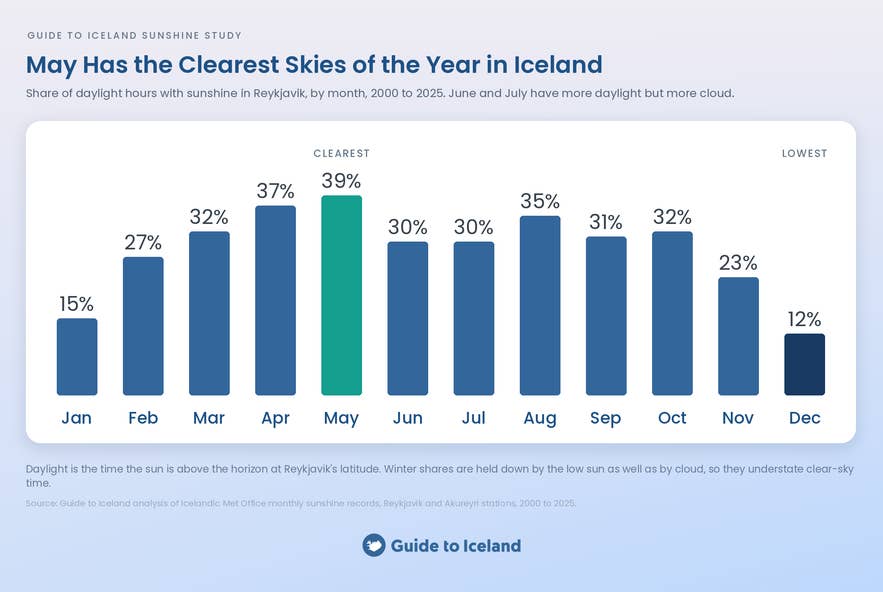
The clearest months after May are April at 37 percent and August at 35 percent. Even October, at 32 percent, has clearer skies than June or July.
For travelers tied to school holidays, August is the useful result. August has fewer daylight hours than June or July, but a sunnier share of them. It averaged 175 hours of sunshine in Reykjavik against 187 in June.
The winter shares are the lowest of the year. In December, the sun was out for only 12 percent of the daylight hours in Reykjavik. In January, the share was 15 percent.
Cloud explains only part of those low winter shares. The bigger cause is the height of the sun. The sun stays barely above the horizon in midwinter. A sun that low is often too weak to register on a sunshine recorder, even on a clear day.
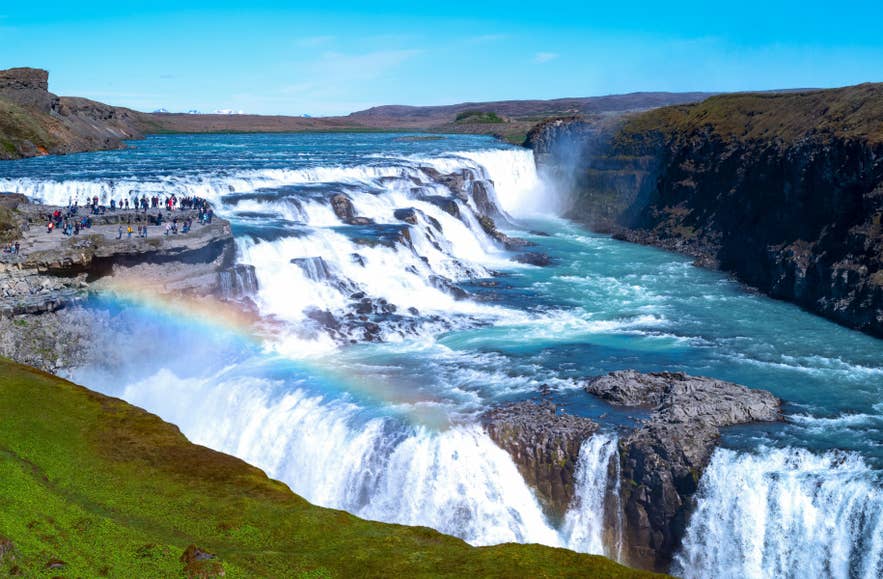 Clear skies in May are for landscapes, not the northern lights. The aurora season runs from September to mid-April, and the summer sky in between never gets dark enough for it.
The aurora months have a study of their own. Our study of Iceland's clearest skies maps cloud cover from 50,087 observations at 144 weather stations. It found the southeast coast clearest in winter and the Westfjords cloudiest. The summer data agrees on the Westfjords, where Isafjordur sits at the bottom of the eleven locations for yearly sunshine, level with Egilsstadir.
The winter and summer rankings differ in one telling way. The southeast around Hofn leads on clear winter skies but sits mid-table for May sunshine. Akureyri is among the cloudier places in winter, yet it out-suns Reykjavik in June. The sunniest place in summer is not the clearest place in winter.
June Is the Sunniest Month in North Iceland
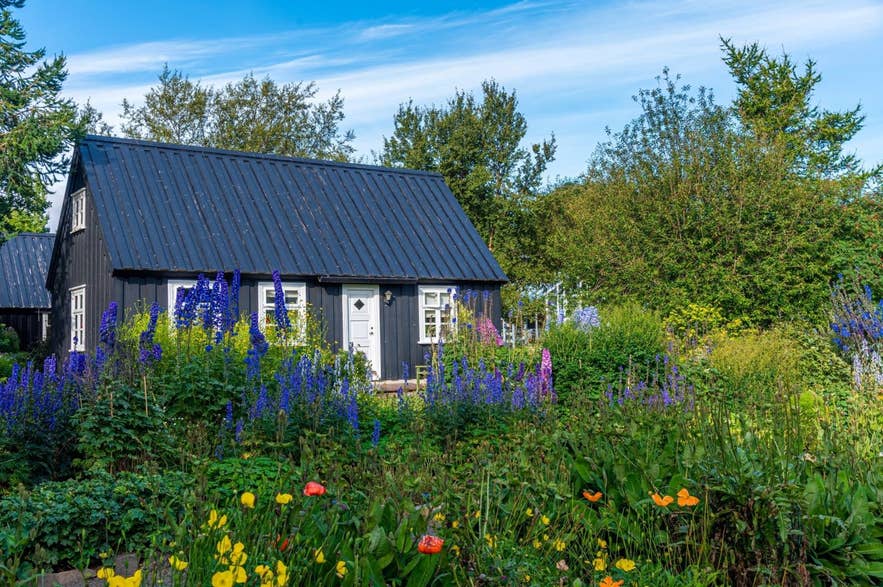 June is the sunniest month in North Iceland, one month later than the south and west. The Akureyri weather station averaged 193 hours of sunshine in June between 2000 and 2025, about 6.4 hours a day. May came second at 183 hours and July ranked third at 163 hours.
June is also the only month in which the north out-suns the capital. Akureyri recorded about 6 more hours of sunshine than Reykjavik in an average June. In every other month of the year, Reykjavik had more sun.
The June result holds up year by year. Akureyri had more June sunshine than Reykjavik in 14 of the 26 years. June was Akureyri's sunniest month in 11 of the 26 years, and May in 10. May and June run close together in the north, while Reykjavik's May lead is clear.
June has turned cloudier since 2021, according to our study of the best month to visit Iceland. Akureyri's June sunshine fell from 196 hours to 179 hours a month, and Reykjavik's fell from 190 hours to 171 hours. Book June for the north's sunshine odds, and bring a rain shell for the cloudier days.
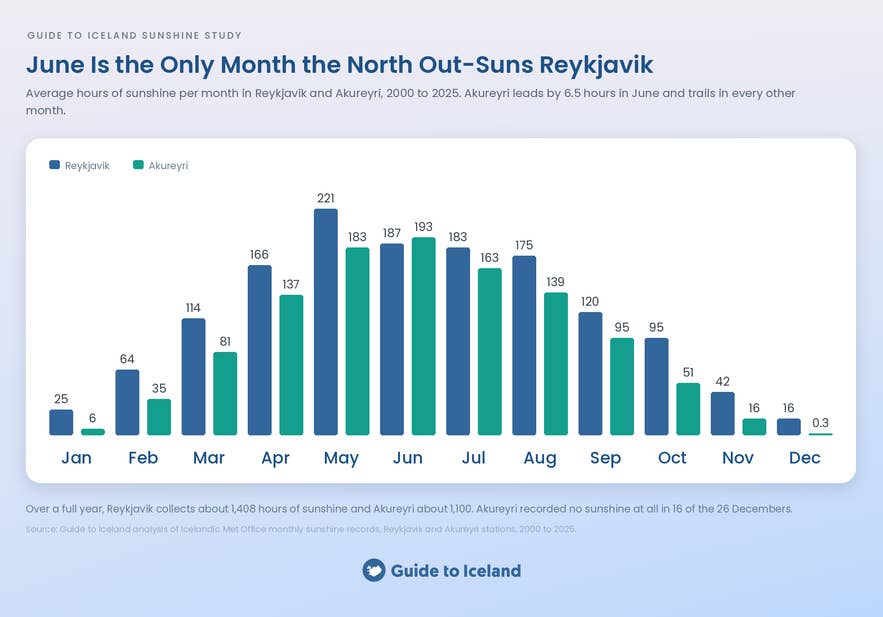
Outside June, Reykjavik has more sunshine than Akureyri in every month. Reykjavik collected about 1,400 hours of sunshine over a full year, and Akureyri collected about 1,100 hours.
The biggest gap came in October, when Akureyri trailed by 44 hours. May came next, and Akureyri finished 38 hours behind.
Akureyri's winter is the price of its sunny June. The station averaged 0.3 hours of sunshine in December, and in 16 of the 26 Decembers the station recorded none at all. Reykjavik averaged 16 hours in the same month.
Akureyri's dark December comes from the height of the sun, not only from cloud. The town sits at the head of Eyjafjordur, at nearly 66 degrees north. At noon in late December, the sun climbs less than one degree above the horizon there. The mountains around the fjord stand higher than that.
For a sunny trip to the north, June is the month to book. Day tours from Akureyri reach Lake Myvatn, Godafoss Waterfall, and the whale-watching harbors of Eyjafjordur. A June departure gives them the best sunshine odds of the year.
The Southwest Coast Is the Sunniest Part of Iceland
 The southwest coast is the sunniest part of Iceland in every month except June. The Westman Islands, Keflavik, and Reykjavik lead the eleven locations over the year, and Vik on the South Coast comes fourth.
The same three lead in May and in July. In May, they finish within one percent of each other, which is closer than the model can separate.
The sunniest and the least sunny places are not far apart. Over a full year, the Westman Islands get about 18 percent more sunshine than Egilsstadir and Isafjordur, the lowest two of the eleven. In May, the gap between the top and bottom locations is about 14 percent.
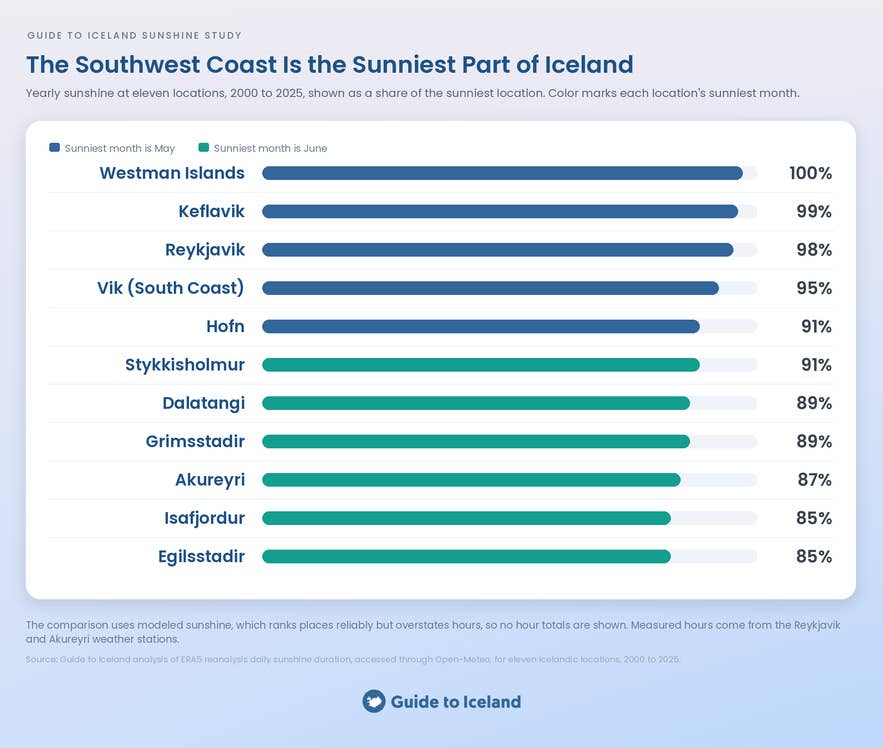
Iceland splits into two zones by sunniest month. The May zone runs along the southwest and the South Coast, from Keflavik through Reykjavik to Hofn, and out to the Westman Islands. The June zone covers the rest of the country, from Snaefellsnes Peninsula and the Westfjords to the north and the east.
June is the month when the whole country is sunny at once. The gap between the sunniest and least sunny locations narrows to about 8 percent that month. Isafjordur, Akureyri, and Grimsstadir match Keflavik and the Westman Islands.
In May and July, the north and east trail the southwest by up to 14 percent.
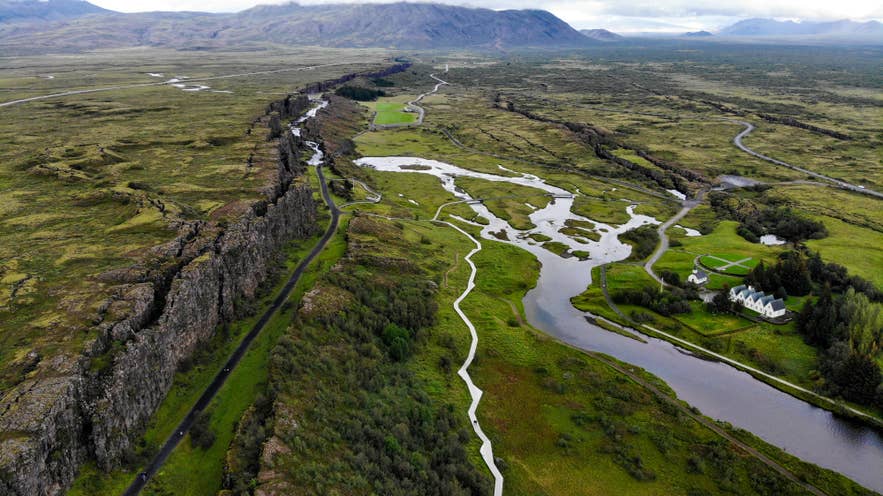 May and June are the two sunniest months at every one of the eleven locations. No location in the study peaks outside those two months.
For the south and west, May is the month to plan around. A late-May trip based in the capital can cover the Golden Circle, South Coast tours, and Snaefellsnes with the year's best sunshine odds.
For the north and east, June is the month. A self-drive tour of the complete Ring Road in June takes in both zones near their peaks. June is second only to May in the south.
December Is the Darkest Month in Iceland
 December is the darkest month in Iceland at both ends of the country. Reykjavik averaged 16 hours of sunshine for the whole of December between 2000 and 2025, about half an hour a day. Akureyri averaged 0.3 hours, close to none.
The darkest single month in the study was December 2004, when Reykjavik recorded 1.3 hours of sunshine. The brightest December, in 2022, still reached only 51 hours.
The dark season is longer than one month. November averaged 43 hours of sunshine in Reykjavik and January averaged 25 hours. November, December, and January brought 84 hours of sunshine between them, less than a single average May in Reykjavik.
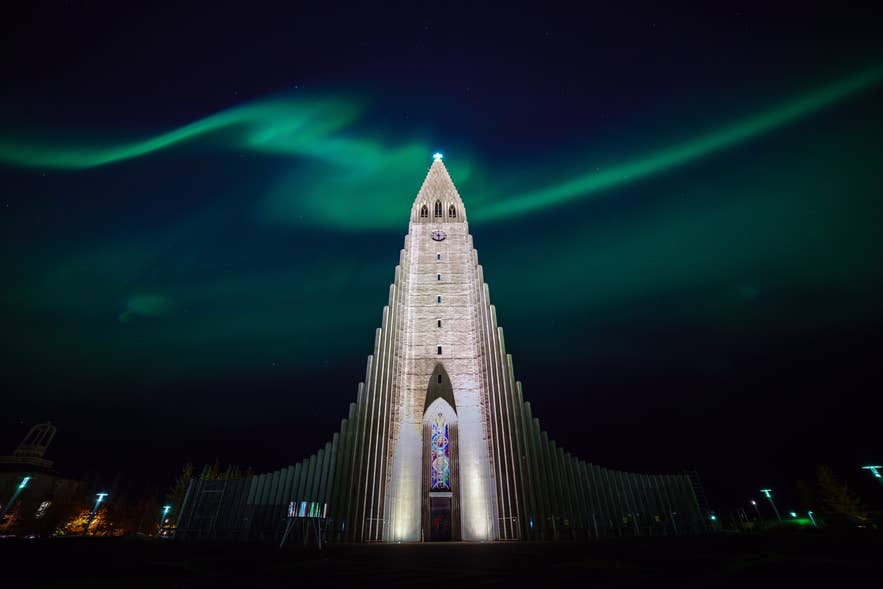 December buys its darkness back at night. The month gives aurora watchers more hours of darkness than any other.
The whole northern lights season runs from September to mid-April. Our study of the best month to see the northern lights in Iceland ranks those months by solar activity and darkness. It tells you when the sky is dark enough, and active enough, for the aurora.
For a December trip, northern lights tours drive or sail toward whichever part of the sky is clear that evening. Many northern lights hotels in Iceland offer an aurora wake-up call, so the short day costs you nothing at night.
Planning Your Trip Around Iceland's Sunniest Months
 The sunshine data points to a few plain rules for planning a trip. They are set out here by the questions travelers ask most often.
Late May Is the Best Time To Visit Iceland for Sunny Weather
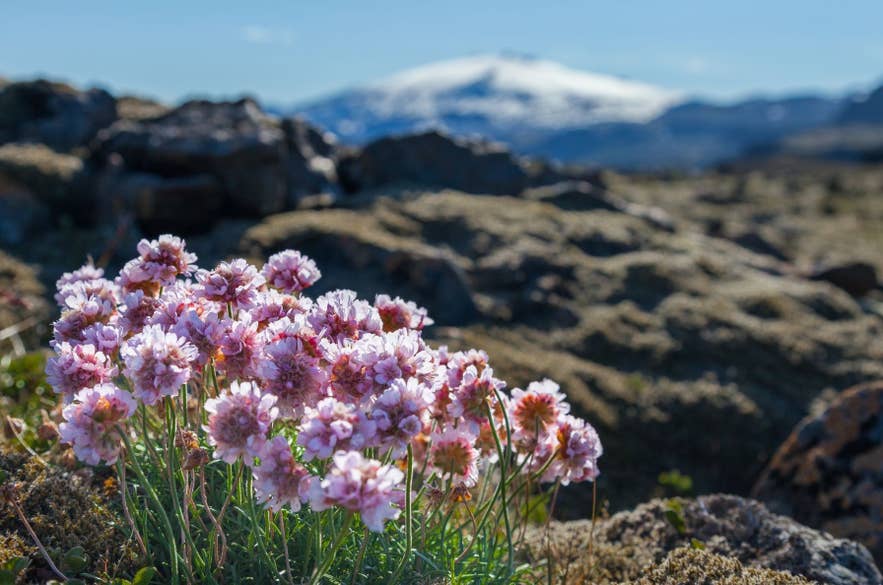 Late May is the best time to visit Iceland for sunny weather if your trip centers on Reykjavik, the Golden Circle, the South Coast, or the Westman Islands. May has the clearest skies of the year, with about 7 hours of sunshine a day in Reykjavik. Daylight reaches 20 hours by the end of the month, so that sunshine can land at any hour of a long day.
June is the best month if your trip centers on the north, the east, Snaefellsnes, or the Westfjords. Every one of those regions has its sunniest month in June, and it is the one month when the whole country is sunny at once.
If your dates are fixed to the school holidays, choose August over July where you can. August has a sunnier share of its daylight than July and nearly as many sunshine hours. It also sits at the end of peak season rather than the middle.
The Southwest and South Coast Get the Most Sun in Iceland
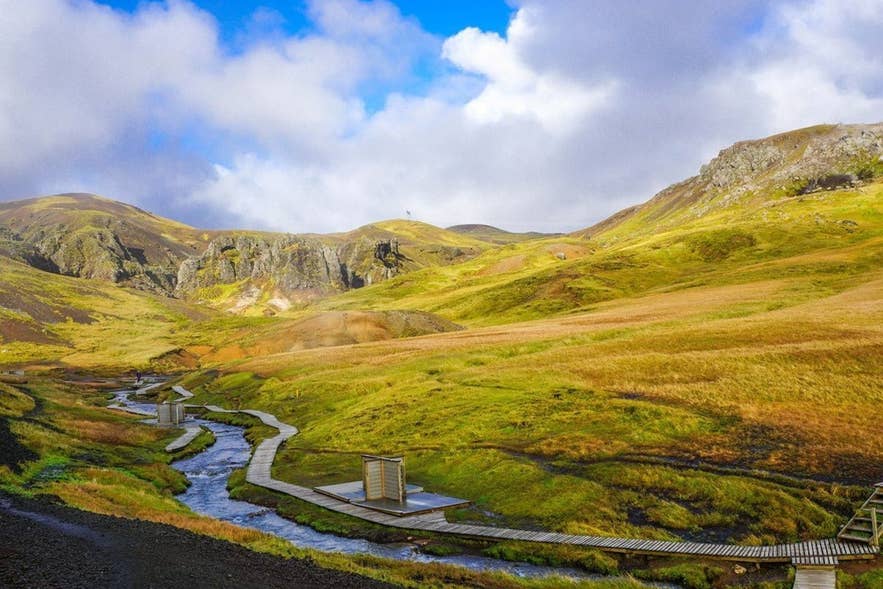 The southwest and the South Coast are the sunniest parts of Iceland in every month except June. A trip based in the capital gives the best sunshine odds in May, July, and August. Day trips along the South Coast and tours to the Westman Islands all run from there.
In June, go anywhere. The north, the east, and the Westfjords match the southwest that month. June is the month for Ring Road tours and visits to regions that are cloudier the rest of the year.
The Westfjords and the Inland East Get the Least Sun in Iceland
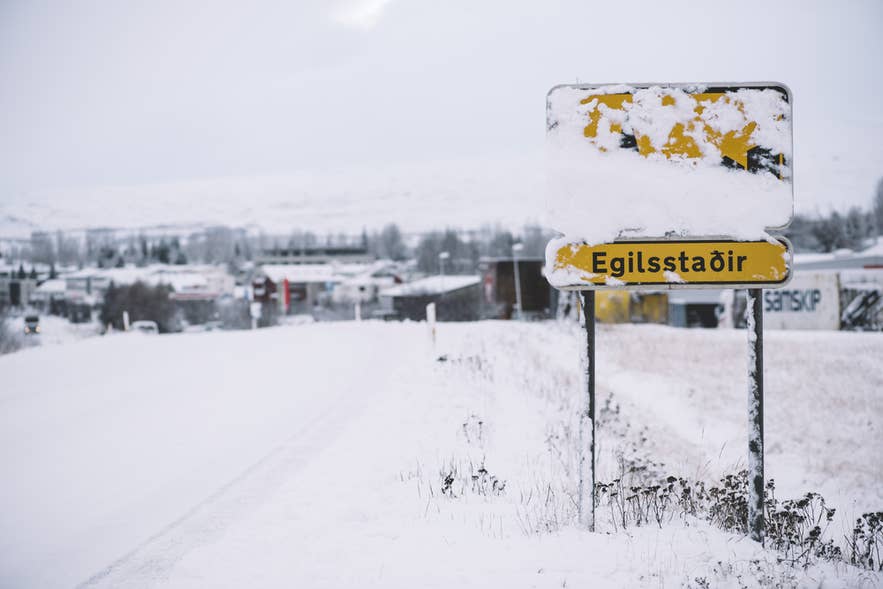 The Westfjords and the inland east around Egilsstadir had the least sunshine of the eleven locations over the year. Both sit about 15 percent below the Westman Islands.
Both regions run closest to the rest of the country in June, which is their sunniest month and the better time to go for sun.
Akureyri and the north have almost no sunshine in December, and the whole country has little. From November through January, plan around the aurora, the hot springs, and the low winter light rather than around the sun.
Iceland's Sunniest Month Still Calls for a Windproof Layer
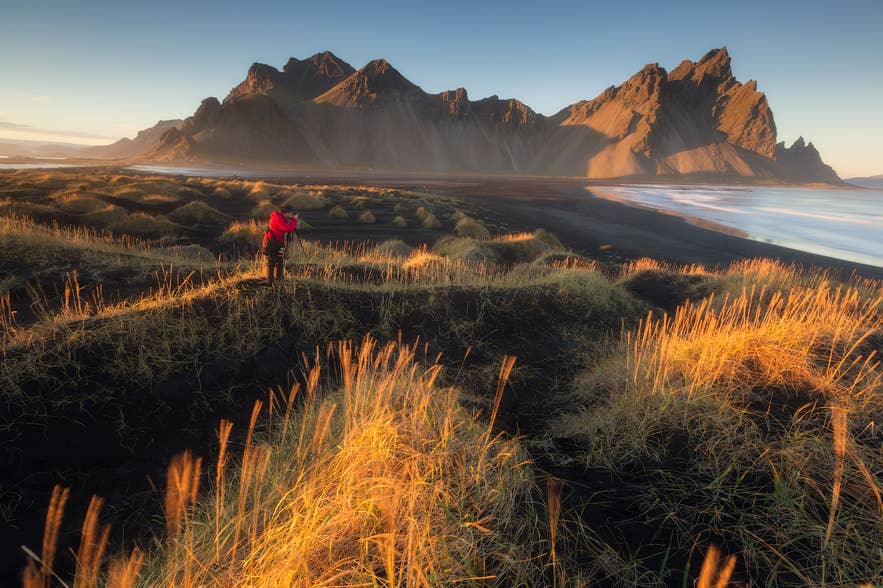 Pack for sun and wind together. May is the sunniest month and also about 30 percent windier than July in Reykjavik. The average temperature runs about 44°F (7°C). A windproof outer layer matters more than a thick fleece, and the rest of what to wear in Iceland changes with the season.
Sunny days in May and June are long ones for photographers. The sun sets after 11:00 PM in Reykjavik by late May and then skims the horizon. Golden hour lasts for hours rather than minutes, which is the light photography in Iceland is known for.
For the broader picture across all four seasons, the best time to visit Iceland weighs sunshine against crowds, prices, and the northern lights.
What This Sunshine Study Does Not Tell You
 This sunshine study answers one question well. It shows which month, and which part of Iceland, gets the most sun. However, it does not answer several questions travelers tend to ask next, and the limits below are worth knowing before you book.
-
A 26-year average is not a forecast for your trip. May is the sunniest month on average and in most years, but May 2023 brought Reykjavik 96 hours of sunshine against an average of 221. Use this study to choose a month and the forecast to plan a day.
-
Only two places in Iceland measure sunshine. The hours in this study are measured in Reykjavik and Akureyri. The other nine locations come from a weather model that estimates conditions across grid cells several miles wide. The model smooths out fjords and headlands. It also counts roughly 60 to 80 percent more sunshine than the two instruments do. The reason is that it registers thin cloud as sun. That is why the regional results are given as rankings, never as hours.
-
Sunshine is not warmth. May is the sunniest month in Reykjavik and one of the cooler months of the travel season. In our temperature study, May averaged 44°F (6.9°C) in Reykjavik and July averaged 53°F (11.7°C). A sunny May day often needs a jacket.
-
Sunshine is not calm weather either. Our wind study found July the least windy month in Iceland, and May runs about 30 percent windier than July in Reykjavik. The sunniest month and the least windy month are two different months.
-
The hours do not say when in the day the sun shone. A month with 200 sunshine hours could be one of sunny mornings and cloudy afternoons or the reverse. The monthly totals cannot tell the two apart, so they cannot tell you the best hour to be outside.
-
The winter figures measure the sun's height as much as the cloud. A sunshine recorder needs direct sun strong enough to cast a shadow. The midwinter sun in Iceland is often too low to manage that, even on a clear day. This study cannot rank the winter months by cloud cover. Our clearest-skies study, which uses cloud observations, does that job.
-
The study covers 2000 to 2025 and does not test for change over time. The averages describe those 26 years as a block. We did not look for a trend toward sunnier or cloudier years, and the study should not be read as a statement about climate change.
-
Sunshine is one part of the weather. Our studies of the windiest and least windy months, the rainiest and driest months, and the warmest and coldest months in Iceland cover the rest.
How We Built the Study on Iceland's Sunniest Month
This section sets out where every number in the study comes from, so a reader can check the work or repeat it.
1. Where the Sunshine Hours Come From
 Monthly sunshine hours were taken from the Icelandic Met Office's published monthly tables for Reykjavik (station 1) and Akureyri (station 422). The tables cover every month from January 2000 to December 2025. That is 312 months at each station, with no gaps in either record.
These are the only two Icelandic stations with a continuous long-run sunshine record. A sunshine hour is an hour in which direct sunlight was strong enough to register on the station's sunshine recorder. In practice, that means bright enough to cast a shadow. Thin cloud, haze, and a very low sun do not count.
The monthly averages in the tables and charts are plain 26-year means. Hours per day divide the monthly mean by the number of days in the month. Statements such as "May was the sunniest month in 12 of the 26 years" come from ranking the twelve months within each calendar year.
2. How the Share of Daylight Was Calculated
 Daylight hours for each month were calculated from the sun's position at Reykjavik's latitude, 64.1 degrees north. The calculation counts the time the sun's upper edge sits above the horizon, with standard refraction. Summing those daily values gives about 572 hours of daylight in May, 625 in June, and 134 in December.
The share of daylight for each month divides the measured sunshine hours by those daylight hours. May's 221 sunshine hours over 572 daylight hours gives 39 percent. June's 187 hours over 625 gives 30 percent.
A sunshine recorder ignores a very low sun, so the winter shares understate clear-sky time. The study does not use them to rank the winter months.
3. How the Eleven Locations Were Ranked
 Daily sunshine duration for 2000 to 2025 at eleven locations was taken from the Open-Meteo historical weather API, which serves the ERA5 family of reanalysis models from the European Centre for Medium-Range Weather Forecasts.
A reanalysis is a weather model run back over past decades and corrected against observations. That gives a complete daily record for any point on the map.
The eleven points are the Met Office station coordinates for Reykjavik, Keflavik Airport, Stykkisholmur, Akureyri, Grimsstadir, Dalatangi, Vatnsskardsholar (Vik), and Storhofdi (Westman Islands), plus Isafjordur, Egilsstadir, and Hofn. All of them except Egilsstadir and Hofn are the nine points used in our 26-year wind study.
The model counts about 60 percent more sunshine in Reykjavik and about 80 percent more in Akureyri than the stations measure, mainly because it registers thin cloud as sun. For that reason, the regional results are used only to rank places and months against each other. Every hour figure in the study comes from the two stations.
The ranked chart shows each location's yearly modeled sunshine as a percentage of the sunniest location.
4. Units and Rounding
 Sunshine and daylight are given in hours. Monthly totals are rounded to the nearest hour and hours per day to one decimal. Where two months are close, a decimal is kept to separate them.
Temperatures are given in Celsius with Fahrenheit in brackets. Place names use the anglicized spellings found elsewhere on Guide to Iceland.
5. Sources
-
Icelandic Met Office, monthly climate tables by station (Manadargildi), stations 1 and 422, accessed September 2026.
-
Copernicus Climate Change Service, ERA5 hourly data on single levels, accessed through the Open-Meteo historical weather API, September 2026.
-
Guide to Iceland, The Windiest and Least Windy Months in Iceland: A 26-Year Wind Study, 2026.
-
Guide to Iceland, Iceland's Clearest Skies: The Best Regions for Northern Lights, 2026.
Conclusion
 Iceland gets its most reliable sun in late spring, and the best region for it shifts with the month.
May is the sunniest month in Iceland, with 221 hours of sunshine in Reykjavik, about 7 hours a day. June has more daylight but more cloud, and ends up with 34 fewer hours of sun.
The north runs a month behind. Akureyri has its sunniest month in June, and it is the only month in which the north out-suns the capital.
The southwest coast, from Keflavik through Reykjavik to the Westman Islands, is the sunniest part of the country in every month except June. In June, the whole country is sunny at once.
December is the darkest month, with 16 hours of sunshine in Reykjavik and almost none in Akureyri. It is also the heart of the northern lights season.
Three points cover most trips.
-
Book May tours for the south and west, and aim for the second half of the month. Reykjavik averages 221 hours of sunshine in May, about 7 hours a day, and the sun is out for 39 percent of the daylight.
-
Head north in June, when day tours from Akureyri run in the sunniest part of the country. Akureyri averages 193 hours of sunshine in June, about 6 hours more than Reykjavik in the same month.
-
Choose August tours over July if summer is your only option. August averages 175 hours of sunshine in Reykjavik against 183 in July, with a sunnier share of its shorter days, at 35 percent against 30.
The sun on your own trip will be decided by the forecast, not by a 26-year average. Use this study to choose your month and your region. Check the Met Office forecast to choose your day.
Related reading from Guide to Iceland:

Guide to Iceland Editorials is the shared byline for our content team. We use it on pieces several people worked on together, where no single writer owns the article, and on anything rewritten often enough that a personal byline would be misleading. We also publish our original data studies under this profile. Each study answers a question travelers ask about Iceland, using primary sources such as booking records, traveler reviews and public datasets, and every study is quality checked by human experts before it's published. Everything under this byline is researched and reviewed by people who live and work in Iceland. If you spot something out of date or want to suggest a correction, message us and it reaches the whole team.